| Citation: | Wang Y,Cao S L,Liu M G,et al. Detection algorithm of ship key parts based on YOLOv11[J]. Journal of Beijing University of Aeronautics and Astronautics,2026,52(11):3969-3981 (in Chinese)

|
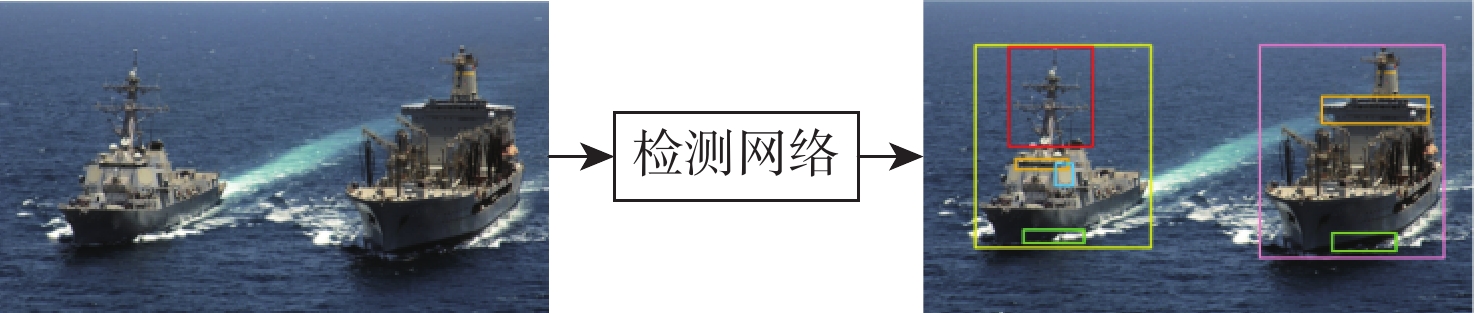
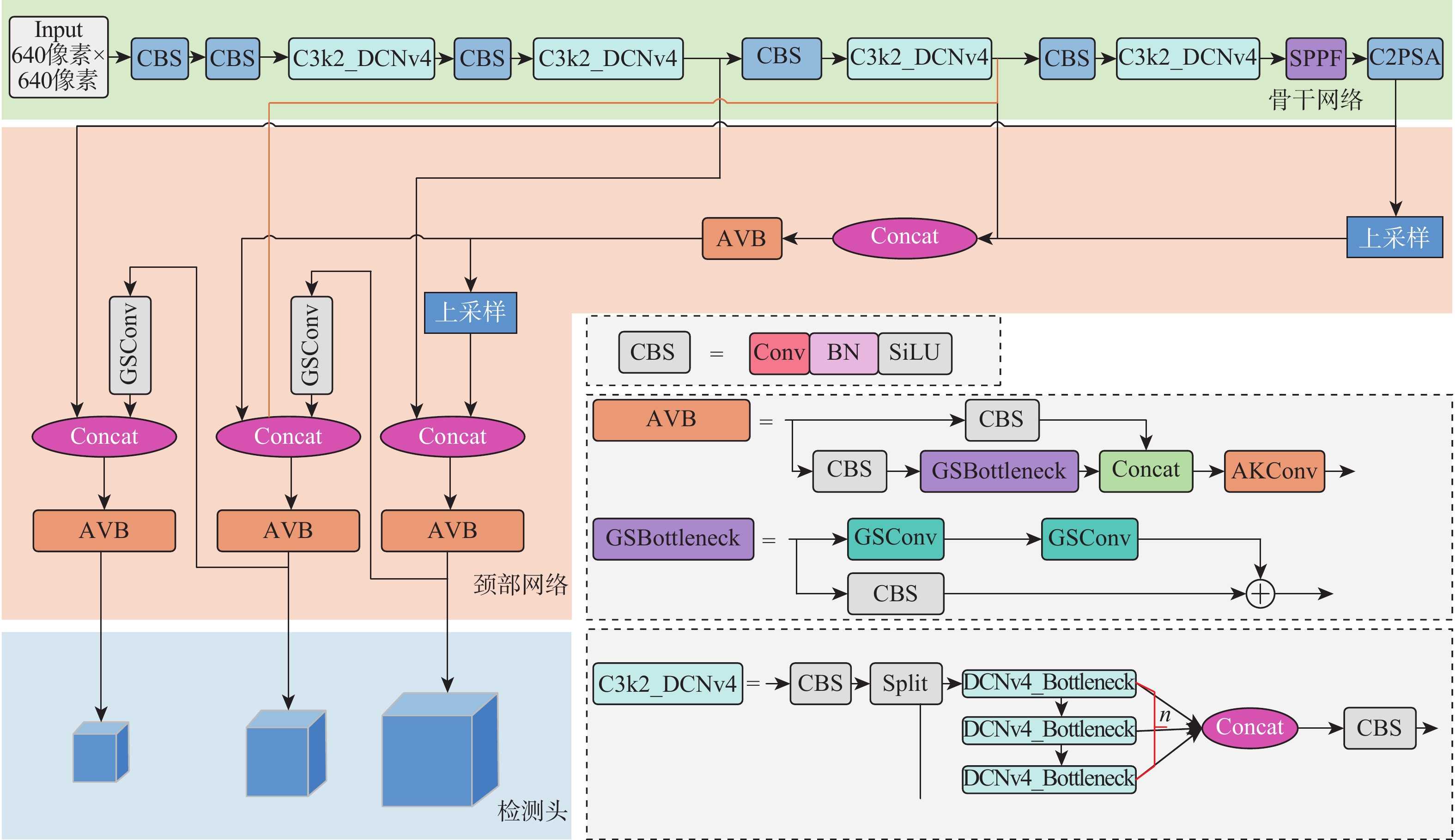
In contemporary and forthcoming maritime rights safeguarding and oceanic surveillance endeavors, it is critically important to investigate methods for swiftly and precisely acquiring data on essential components of vessels and adeptly analyzing real-time marine conditions. Despite the capability of deep learning-based object identification algorithms to identify various types of target information, there is a deficiency in research focused on algorithms for recognizing critical components of ships, and the examination of the relationship between multi-channel feature maps is inadequate. The feature utilization rate of key parts of ships with different scales is low, which may lead to the loss of important feature information and a decrease in detection accuracy. To address this issue, a ship key part detection method based on YOLOv11 is proposed to improve the accuracy and efficiency of key part detection. This manuscript initially performs a thorough examination of the critical and challenging issues in the present detection of essential ship components and engages in a comparative analysis with existing methods. Then, an improved YOLOv11 object detection network for ship key part detection is proposed based on actual problems. Ultimately, a dataset of key components for visible light ships has been established, and through the implementation of comparative and ablation experiments, it is thoroughly evidenced that the proposed algorithm developed in this study exhibits high precision and promptness in identifying ship key components, thereby offering viable technical assistance and a theoretical foundation for the meticulous differentiation of essential and critical parts across various ship types in intricate marine settings and the efficient surveillance of maritime vessel information.

| [1] |
Gao F, He Y S, Wang J, et al. Anchor-free convolutional network with dense attention feature aggregation for ship detection in SAR images[J]. Remote Sensing, 2020, 12(16): 2619.
|
| [2] |
白玉, 迟文恺, 谢宝蓉, 等. 结合目标提取和深度学习的红外舰船检测[J]. 电讯技术, 2023, 63(2): 193-198.
Bai Y, Chi W K, Xie B R, et al. Infrared ship detection by combining target extraction and deep learning[J]. Telecommunication Engineering, 2023, 63(2): 193-198(in Chinese).
|
| [3] |
Tang G, Liu S B, Fujino I, et al. H-YOLO: a single-shot ship detection approach based on region of interest preselected network[J]. Remote Sensing, 2020, 12(24): 4192.
|
| [4] |
刘忻伟, 朴永杰, 郑亮亮, 等. 面向航天光学遥感复杂场景图像的舰船检测[J]. 光学精密工程, 2023, 31(6): 892-904.
Liu X W, Piao Y J, Zheng L L, et al. Ship detection for complex scene images of space optical remote sensing[J]. Optics and Precision Engineering, 2023, 31(6): 892-904(in Chinese).
|
| [5] |
林鑫伟, 徐志京, 黄海. 复杂背景下的SAR图像多尺度舰船检测[J]. 中国航海, 2023, 46(2): 17-24.
Lin X W, Xu Z J, Huang H. Multi-scale detection of ship target against complex background out of SAR image[J]. Navigation of China, 2023, 46(2): 17-24(in Chinese).
|
| [6] |
王玺坤, 姜宏旭, 林珂玉. 基于改进型YOLO算法的遥感图像舰船检测[J]. 北京航空航天大学学报, 2020, 46(6): 1184-1191.
Wang X K, Jiang H X, Lin K Y. Remote sensing image ship detection based on modified YOLO algorithm[J]. Journal of Beijing University of Aeronautics and Astronautics, 2020, 46(6): 1184-1191(in Chinese).
|
| [7] |
李双伟. 基于红外偏振成像的近岸舰船目标识别和抗干扰技术研究[D]. 烟台: 烟台大学, 2016: 12-15.
Li S W. Research on inshore ship target recognition and antijamming technology based on infrared polarization imaging[D]. Yantai: Yantai University, 2016: 12-15(in Chinese) .
|
| [8] |
乔延军. 面向户外增强现实的地理实体目标识别与检测[D]. 武汉: 武汉大学, 2017: 10-30.
Qiao Y J. Object recognition and detection of geographical entity based on outdoor augmented reality[D]. Wuhan: Wuhan University, 2017: 10-30(in Chinese) .
|
| [9] |
Hinton G E, Salakhutdinov R P. Reducing the dimensionality of data with neural networks[J]. Science, 2006, 313(5786): 504-507.
|
| [10] |
苏娟, 杨龙, 黄华, 等. 用于SAR图像小目标舰船检测的改进SSD算法[J]. 系统工程与电子技术, 2020, 42(5): 1026-1034.
Su J, Yang L, Huang H, et al. Improved SSD algorithm for small-sized SAR ship detection[J]. Systems Engineering and Electronics, 2020, 42(5): 1026-1034(in Chinese).
|
| [11] |
Ahn S, Chang J W, Kang S J. An efficient accelerator design methodology for deformable convolutional networks[C]//Proceedings of the IEEE International Conference on Image Processing. Piscataway: IEEE Press, 2020: 3075-3079.
|
| [12] |
He K M, Zhang X Y, Ren S Q, et al. Deep residual learning for image recognition[EB/OL]. (2015-12-10)[2024-11-20]. https://doi.org/10.48550/arXiv.1512.03385.
|
| [13] |
Xiong Y W, Li Z Q, Chen Y T, et al. Efficient deformable ConvNets: rethinking dynamic and sparse operator for vision applications[C]//Proceedings of the IEEE/CVF Conference on Computer Vision and Pattern Recognition. Piscataway: IEEE Press, 2024: 5652-5661.
|
| [14] |
Tan M X, Pang R M, Le Q V. EfficientDet: scalable and efficient object detection[C]//Proceedings of the IEEE/CVF Conference on Computer Vision and Pattern Recognition. Piscataway: IEEE Press, 2020: 10778-10787.
|
| [15] |
Zhang X, Song Y Z, Song T T, et al. AKConv: convolutional kernel with arbitrary sampled shapes and arbitrary number of parameters[EB/OL]. (2023-11-20)[2024-11-22]. https://arxiv.org/abs/2311.11587v1.
|
| [16] |
Li Y K, Shen H B, Fu Y P, et al. A method of dense point cloud SLAM based on improved YOLOV8 and fused with ORB-SLAM3 to cope with dynamic environments[J]. Expert Systems with Applications, 2024, 255: 124918.
|
| [17] |
Li H L, Li J, Wei H B, et al. Slim-neck by GSConv: a lightweight-design for real-time detector architectures[EB/OL]. (2024-07-02)[2024-11-22]. https://doi.org/10.48550/arXiv.2206.02424.
|
| [18] |
Liu W, Anguelov D, Erhan D, et al. SSD: single shot multibox detector[C]//Proceedings of the Computer Vision-ECCV 2016. Berlin: Springer, 2016: 21-37.
|
| [19] |
Newell A, Yang K, Deng J. Stacked hourglass networks for human pose estimation[C]//Proceedings of the European Conference on Computer Vision. Berlin: Springer, 2016: 486-499.
|
| [20] |
Yaseen M. What is YOLOv8: an in-depth exploration of the internal features of the next-generation object detector[EB/OL]. (2024-08-28)[2024-11-20]. https://arxiv.org/abs/2408.15857.
|
| [21] |
Wang A, Chen H, Liu L H, et al. YOLOv10: real-time end-to-end object detection[C]//Proceedings of the Advances in Neural Information Processing Systems 37. Vancouver: NeurIPS, 2024: 107984-108011.
|
| [22] |
Khanam R, Hussain M. YOLOv11: an overview of the key architectural enhancements[EB/OL]. (2024-11-23)[2024-11-25]. https://arxiv.org/abs/2408.15857.
|
Figures(17) / Tables(7)
Copyright © Journal of Beijing University of Aeronautics and Astronautics
Address: Editorial Department of Journal of Beijing University of Aeronautics and Astronautics, 37 Xueyuan Road, Haidian District, Beijing Post Code: 100191 Email: jbuaa@buaa.edu.cn
Supported by:
Beijing Renhe Information Technology Co., Ltd.







 DownLoad: