| Citation: | Li Q L,Shi P,Chen Y. Phased orbit design for manned lunar landing mission with on-orbit refueling[J]. Journal of Beijing University of Aeronautics and Astronautics,2026,52(10):3635-3646 (in Chinese)

|
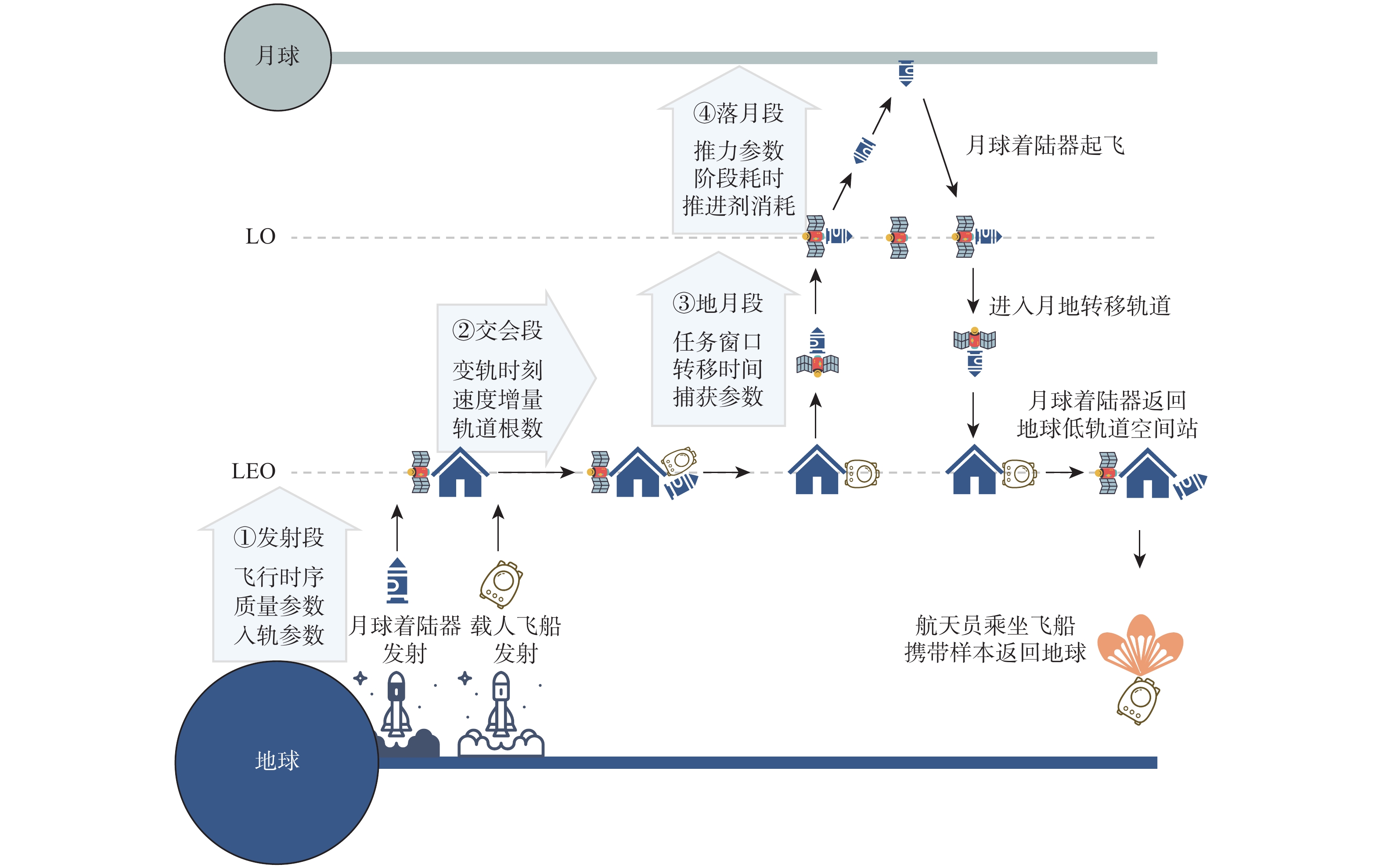
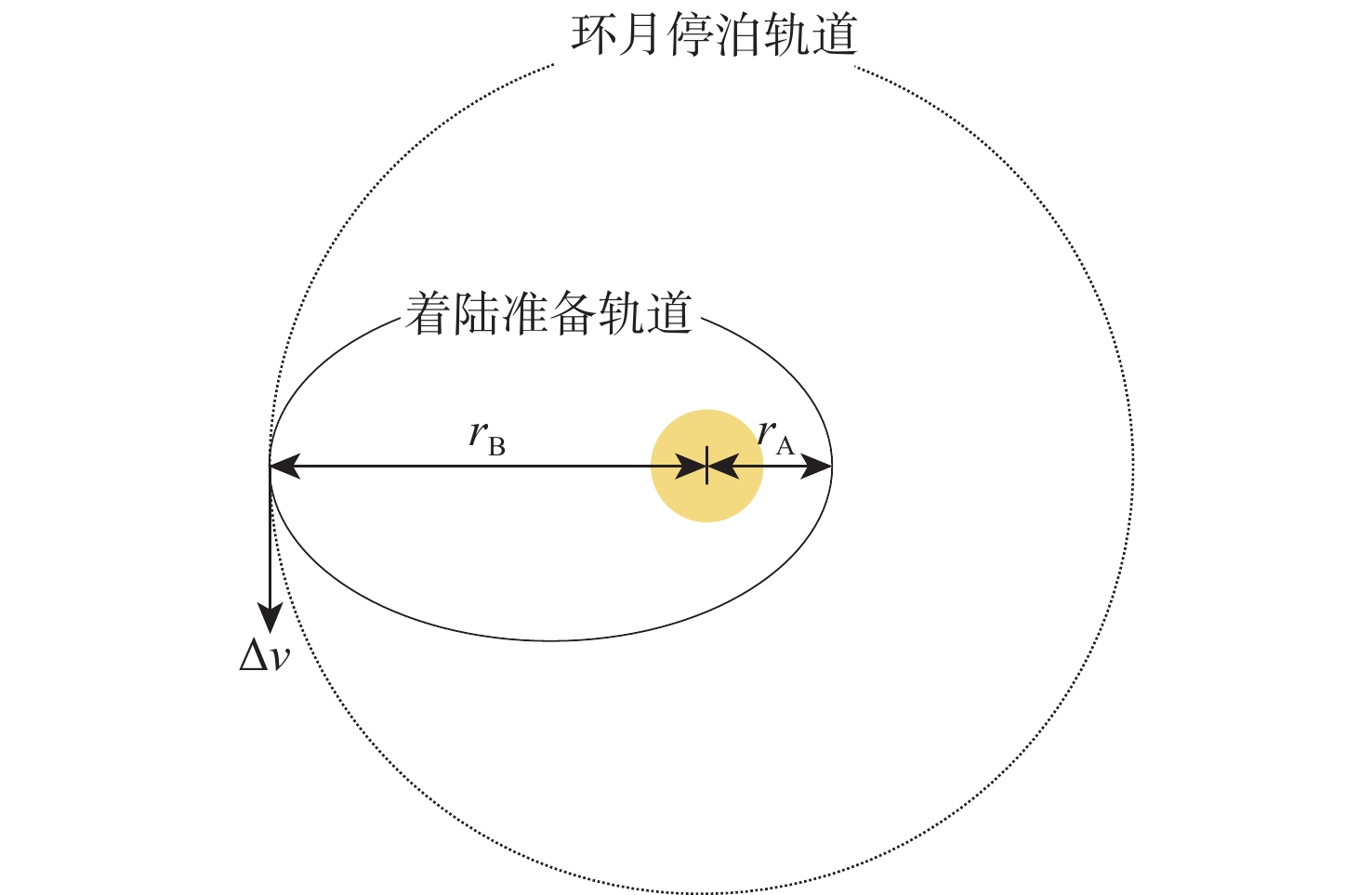
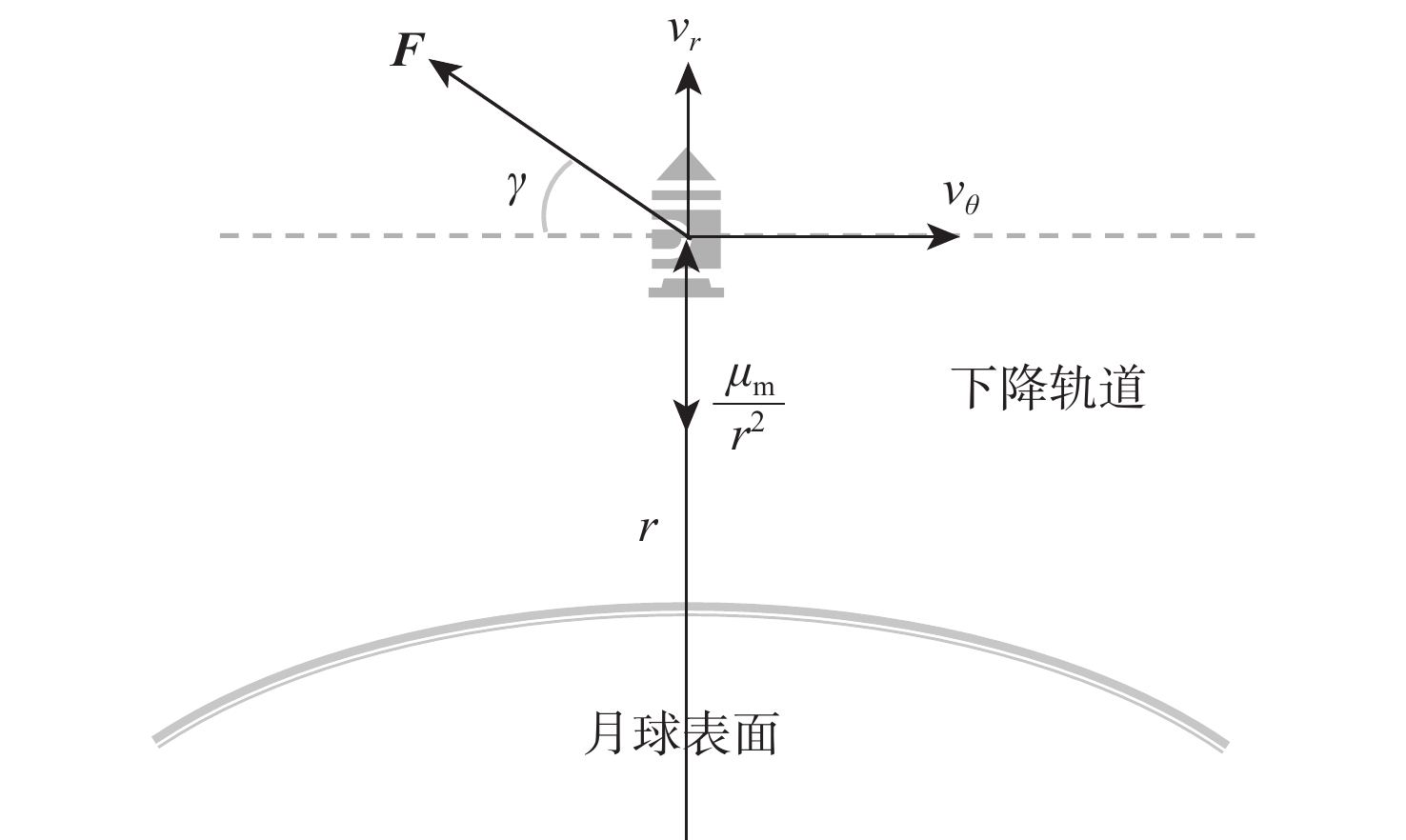
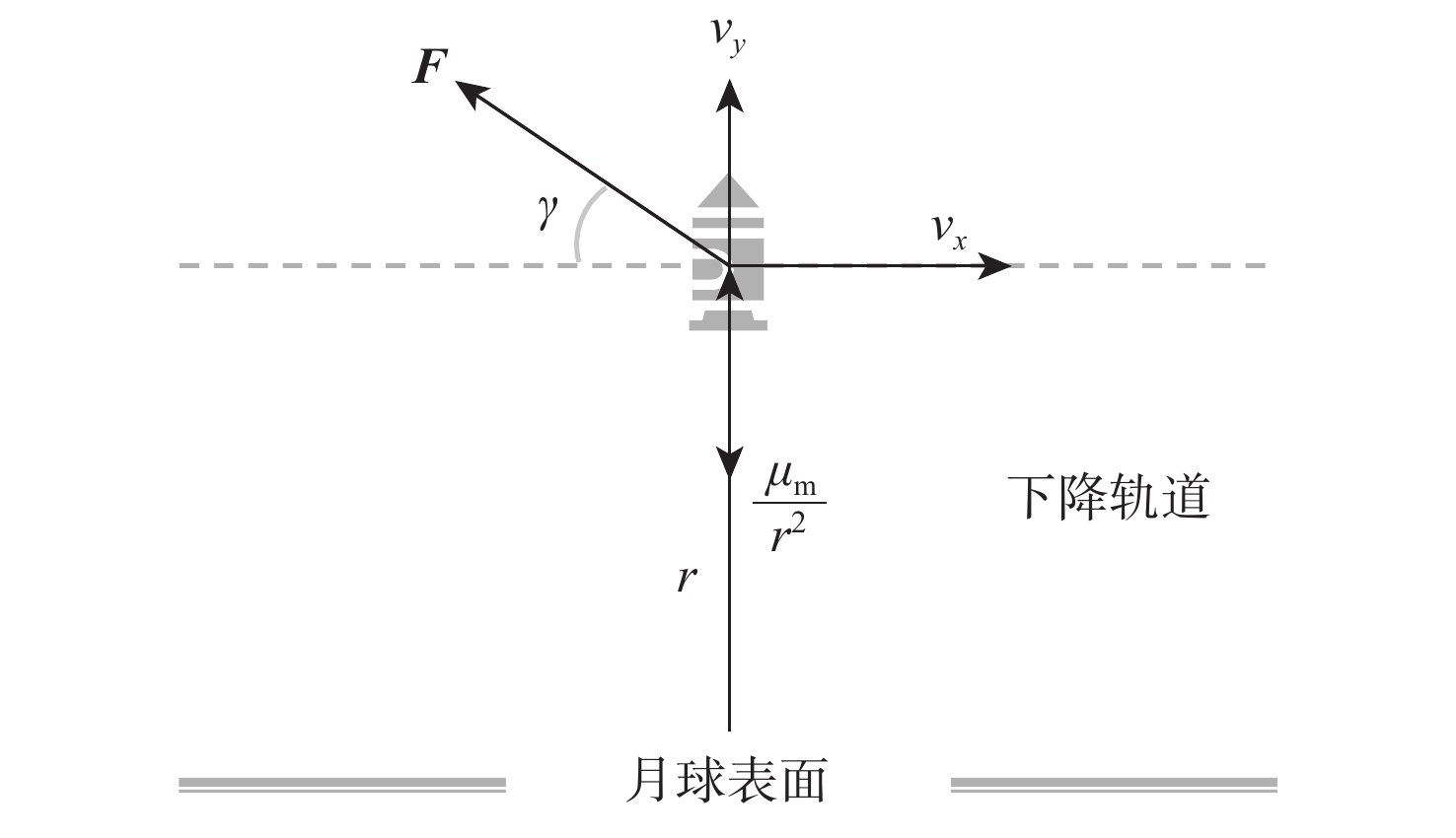
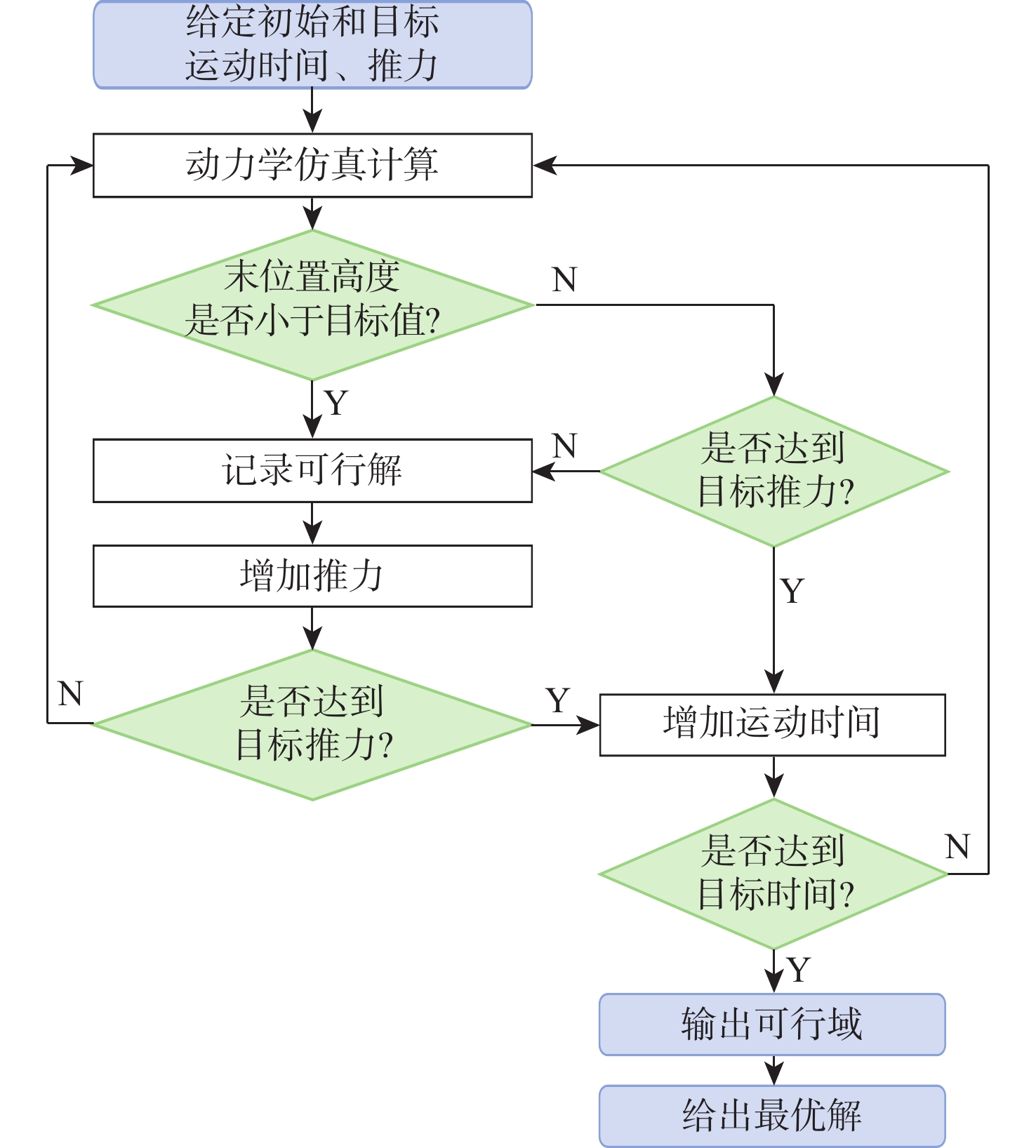
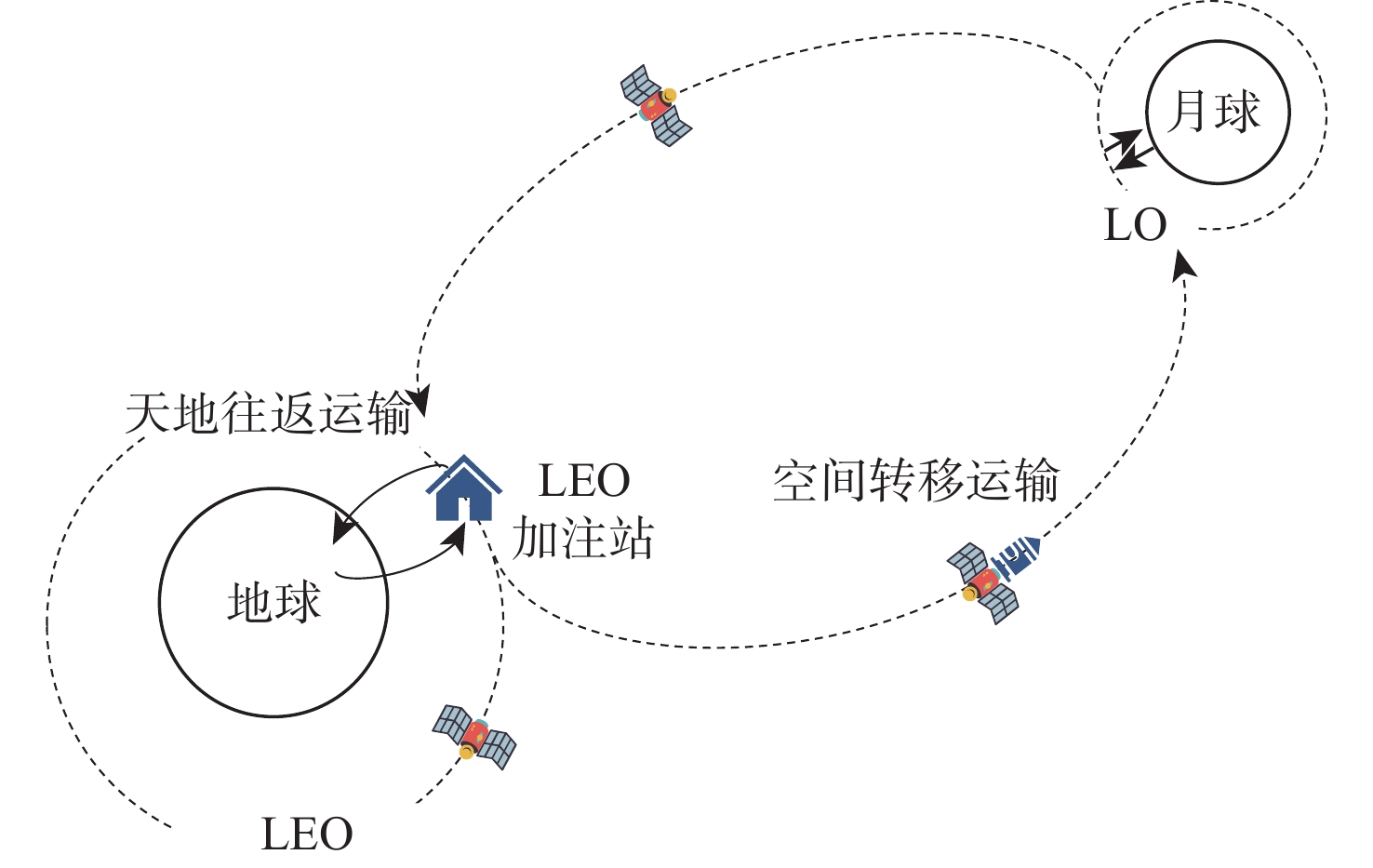
To address the conflict between the limited payload capacity of a single launch vehicle and the substantial deployment demands of large-scale target payloads, this paper employs a two-phase manned lunar landing mission architecture, where on-orbit refueling connects Earth ascent and space transfer. Mission scale analysis and calculations were performed for manned lunar landing utilizing on-orbit refueling. Dynamic models for the four main phases—launch, rendezvous, Earth-Moon transfer, and lunar landing—were established, and overall mission design simulation analysis was completed. A mass estimation method was employed to compare the total mission mass and the scale of each stage between the traditional mode and the on-orbit refueling mode. In order to define phase-specific limitations and develop a mass model that takes into account in-orbit evaporation losses of cryogenic propellant, a mission model covering the four phases of launch, rendezvous and docking, Earth-Moon transfer, and lunar landing was built. Subsequently, mission windows were calculated, and full-process orbital simulations were conducted to analyze trajectory parameters and propellant consumption for each phase. Genetic algorithms were used to optimize parameters for the lunar landing phase. Mass estimation results show that, compared to the thousands of tonnes launch mass required by the traditional mode, the total launch mass for the on-orbit refueling scheme is below 500 tonnes, and the space transfer stage mass is on the order of tens of tonnes. The full-process simulation findings provide crucial references for engineering design, further elucidating the propellant consumption for each stage of the on-orbit refueling strategy.

| [1] |
Smith D A. Space launch system (SLS) mission planner’s guide[R]. Washington, D. C.: National Aeronautics and Space Administration, 2018.
|
| [2] |
Gillespie R W. Impulse propulsion gains resulting from" free" starship[J]. Scientific Reports, 2024, 14(1): 11804.
|
| [3] |
Kutter B, O'Neil G, Pitchford B, et al. A practical, affordable cryogenic propellant depot based on ULA’s flight experience[C]//AIAA Space 2008 Conference & Exposition. Reston: AIAA, 2008: 7644.
|
| [4] |
Hartwig J W. Liquid acquisition devices for advanced in-space cryogenic propulsion systems[M]. Cleveland: Case Western Reserve University, 2014.
|
| [5] |
Fikes M J, Howell M J T, Henley M M. In-space cryogenic propellant depot (ISCPD) architecture definitions and systems studies[C]//57th International Astronautical Congress. Reston: AIAA, 2006.
|
| [6] |
陈小前, 袁建平, 姚雯. 航天器在轨服务技术 [M]. 北京: 中国宇航出版社, 2009.
Chen X Q, Yuan J P, Yao W. Spacecraft on-orbit servicing technology[M]. Beijing: China Astronautic Publishing House, 2009(in Chinese).
|
| [7] |
Jones C A, Merrill R G, Mcvay E. Cis-lunar reusable in-space transportation architecture for the evolvable Mars campaign[C]//AIAA SPACE 2016. Reston: AIAA, 2016: 5493.
|
| [8] |
National Academies of Sciences, Engineering, and Medicine. Space nuclear propulsion for human Mars exploration[M]. Washington, D. C.: The National Academies Press, 2021.
|
| [9] |
高永飞. 以地月空间站为空间港的载人月球探测轨道问题研究[D]. 长沙: 国防科技大学, 2019.
Gao Y F. Study on transfer trajectories of manned lunar exploration with LEO space station and lunar orbital station as spaceport[D]. Changsha: National University of Defense Technology, 2019(in Chinese).
|
| [10] |
王昊, 王浩苏, 陈士强, 等. 低温推进剂在轨加注关键技术研究进展与展望[J]. 导弹与航天运载技术(中英文), 2024(5): 21-27.
Wang H, Wang H S, Chen S Q, et al. Review and development on key techniques of cryogenic propellants on-orbit refueling progress[J]. Missiles and Space Vehicles, 2024(5): 21-27(in Chinese).
|
| [11] |
鲁宇, 汪小卫, Saccoccia G, 等. 在轨加注站概念研究[J]. 导弹与航天运载技术, 2015(1): 1-7.
Lu Y, Wang X W, Saccoccia G, et al. Space transportation concept supported by on-orbit propellant depots[J]. Missiles and Space Vehicles, 2015(1): 1-7(in Chinese).
|
| [12] |
汪小卫, 鲁宇, 唐琼, 等. 基于在轨加注站的空间运输系统规模分析[J]. 载人航天, 2017, 23(3): 342-347.
Wang X W, Lu Y, Tang Q, et al. Scale analysis of space transportation system supported by space propellant depots[J]. Manned Spaceflight, 2017, 23(3): 342-347(in Chinese).
|
| [13] |
陈蓉, 汪小卫, 邓思超, 等. 大规模低成本地月空间航天运输体系研究[J]. 深空探测学报(中英文), 2023, 10(5): 525-531.
Chen R, Wang X W, Deng S C, et al. Research on large-scale and low-cost cislunar aerospace transportation system[J]. Journal of Deep Space Exploration, 2023, 10(5): 525-531(in Chinese).
|
| [14] |
王晓慧, 毛李恒, 赵建文, 等. 一种载人登月质量规模估算的方法与系统: CN201510362335.2[P]. 2018-01-23.
Wang X H, Mao L H, Zhao J W, et al. Method and system for estimating mass scale of manned lunar landing: CN105005643B[P]. 2018-01-23(in Chinese).
|
| [15] |
龙乐豪. 总体设计[M]. 北京: 宇航出版社, 1991: 42-99.
Long L H. System design[M]. Beijing: Astronautic Publishing House, 1991: 42-99(in Chinese).
|
| [16] |
阮开利. 小型月球探测器轨道设计[D]. 西安: 西北工业大学, 2001.
Ruan K L. Orbit design for small lunar probe[D]. Xi’an: Northwestern Polytechnical University, 2001(in Chinese).
|
| [17] |
杨孟飞, 张高, 张伍, 等. 月面无人自动采样返回任务技术设计与实现[J]. 中国科学: 技术科学, 2021, 51(7): 738-752.
Yang M F, Zhang G, Zhang W, et al. Technical design and implementation of Chang’e-5 robotic sample return mission on lunar surface[J]. Scientia Sinica Technologica, 2021, 51(7): 738-752(in Chinese).
|
| [18] |
王劼, 李俊峰, 崔乃刚, 等. 登月飞行器软着陆轨道的遗传算法优化[J]. 清华大学学报(自然科学版), 2003, 43(8): 1056-1059.
Wang L, Li J F, Cui N G, et al. Genetic algorithm optimization of lunar probe soft-landing trajectories[J]. Journal of Tsinghua University (Science and Technology), 2003, 43(8): 1056-1059(in Chinese).
|
| [19] |
刘炎东, 黄震, 侯振东. 载人月面着陆器中途分离模式下降着陆策略优化研究[J]. 载人航天, 2024, 30(4): 501-509.
Liu Y D, Huang Z, Hou Z D. A strategy optimization study of descent and landing process for manned lunar lander in mid-course separation mode[J]. Manned Spaceflight, 2024, 30(4): 501-509(in Chinese).
|
Figures(16) / Tables(10)
Copyright © Journal of Beijing University of Aeronautics and Astronautics
Address: Editorial Department of Journal of Beijing University of Aeronautics and Astronautics, 37 Xueyuan Road, Haidian District, Beijing Post Code: 100191 Email: jbuaa@buaa.edu.cn
Supported by:
Beijing Renhe Information Technology Co., Ltd.






 DownLoad: