





Modeling and parameter design methodology for component-level performance model of ducted ram air generation turbine
-
摘要:
随着机载附件系统电力需求的日益增长,涵道式冲压发电涡轮因其高效、低阻的特性,被视为理想的机载发电方案。针对涵道式冲压发电涡轮布局结构导致的部件耦合性强、系统建模与性能分析难度大等挑战,提出涵道式冲压涡轮部件级模型建模和参数设计方法。采用部件法进行建模,并通过粒子群优化算法实现模型参数设计,自动实现设计点性能精确匹配;同时采用Newton Raphson方法进行模型求解,为系统分析提供可靠依据。针对某型带有旁路和增压级的涵道式冲压涡轮系统,进行模型建立和参数设计,验证了所提方法的有效性,并初步揭示了该系统的潜在优势。非设计点仿真结果显示:此系统旁路开启时26 kW下工作包线面积拓展为关闭状态的332.48%,显著增大了有效工作范围,动态阶跃干扰后响应达到95%的时间增大至307.59%,系统的稳定性显著提升。
Abstract:With the growing power demand of airborne systems, the ducted ram air turbine is considered an ideal onboard power-generation solution due to its high efficiency and low aerodynamic drag. However, its ducted configuration leads to strong component coupling, complicating system modeling and performance analysis. To address these challenges, this paper proposes a component-level modeling approach and a parameter design methodology for the ducted ram air turbine. In this method, the model is modeled by a component method, and the model parameters are designed by a particle swarm optimization algorithm to automatically match the performance parameters of design points accurately, and Newton-Raphson method was used to solve the model, which provided a reliable basis for system analysis. The effectiveness of this method is validated by the modeling and parameter design of a type of ducted ram turbine system with bypass and compressor, which also reveals the potential advantages of this system. The simulation results at non-design points demonstrate that, when the bypass is opened, the working envelope area of this ram air generation turbine expands to 332.48% of the closed state at 26 kW. This substantial increase significantly enhances the effective working range. A notable improvement in system stability is also indicated by the time it takes for the response to reach 95% following dynamic step interference, which rises to 307.59%.
-
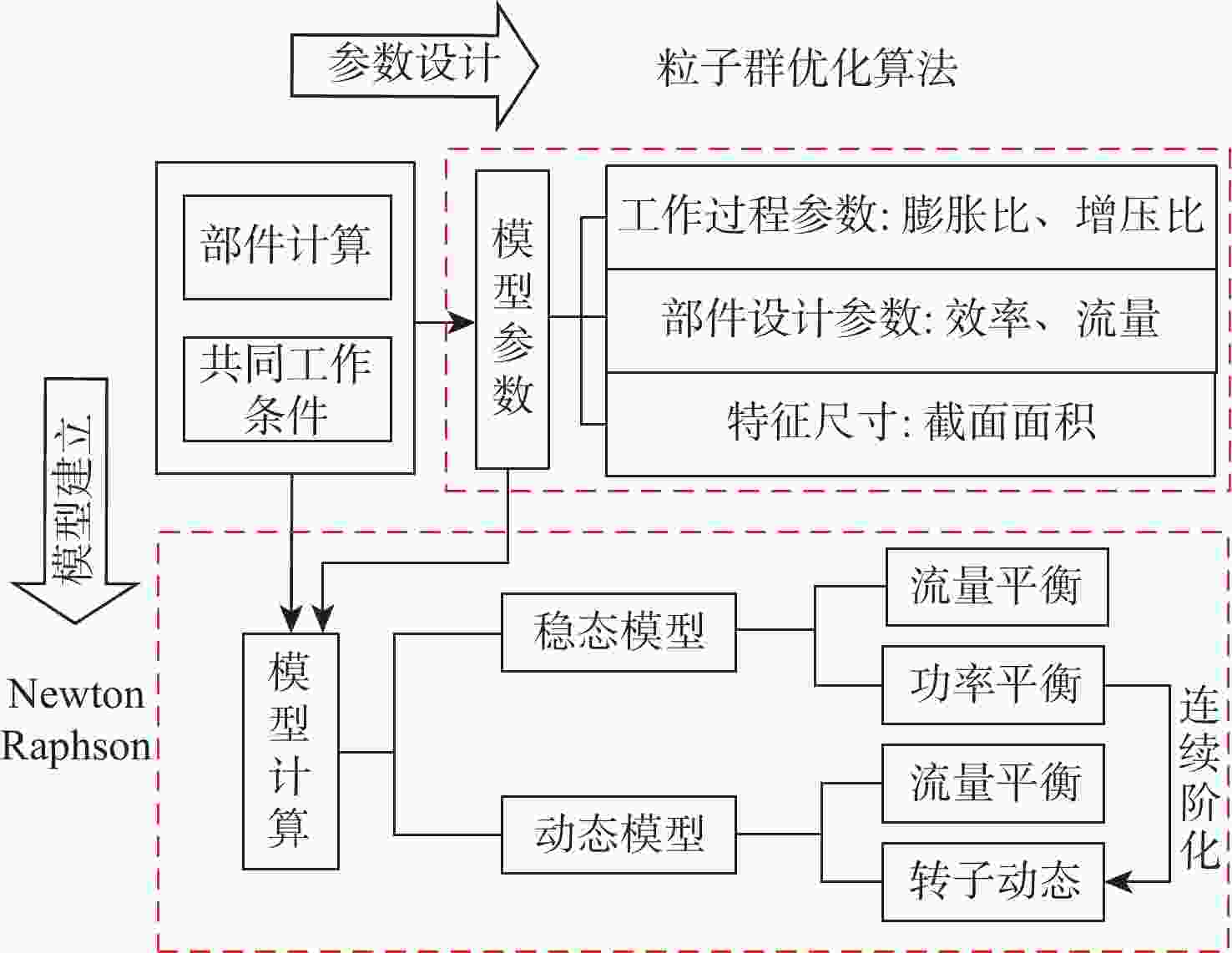
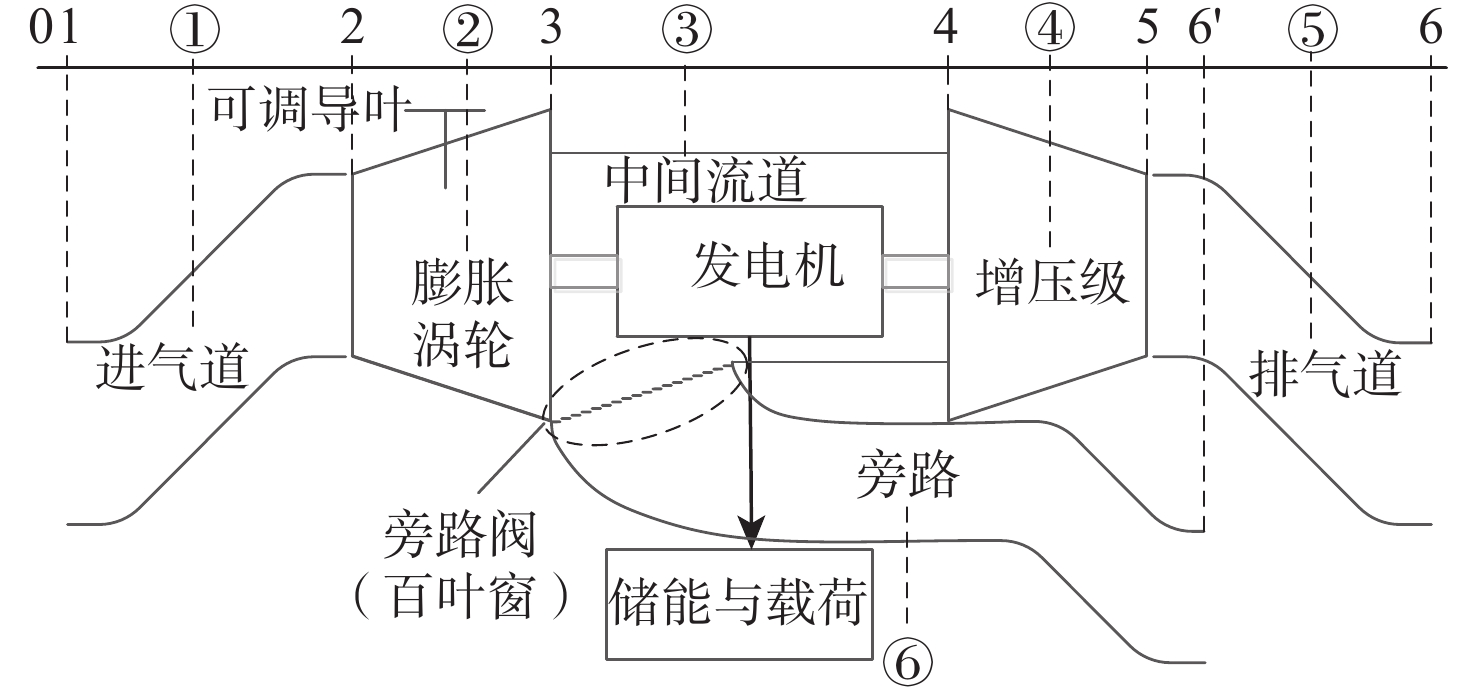
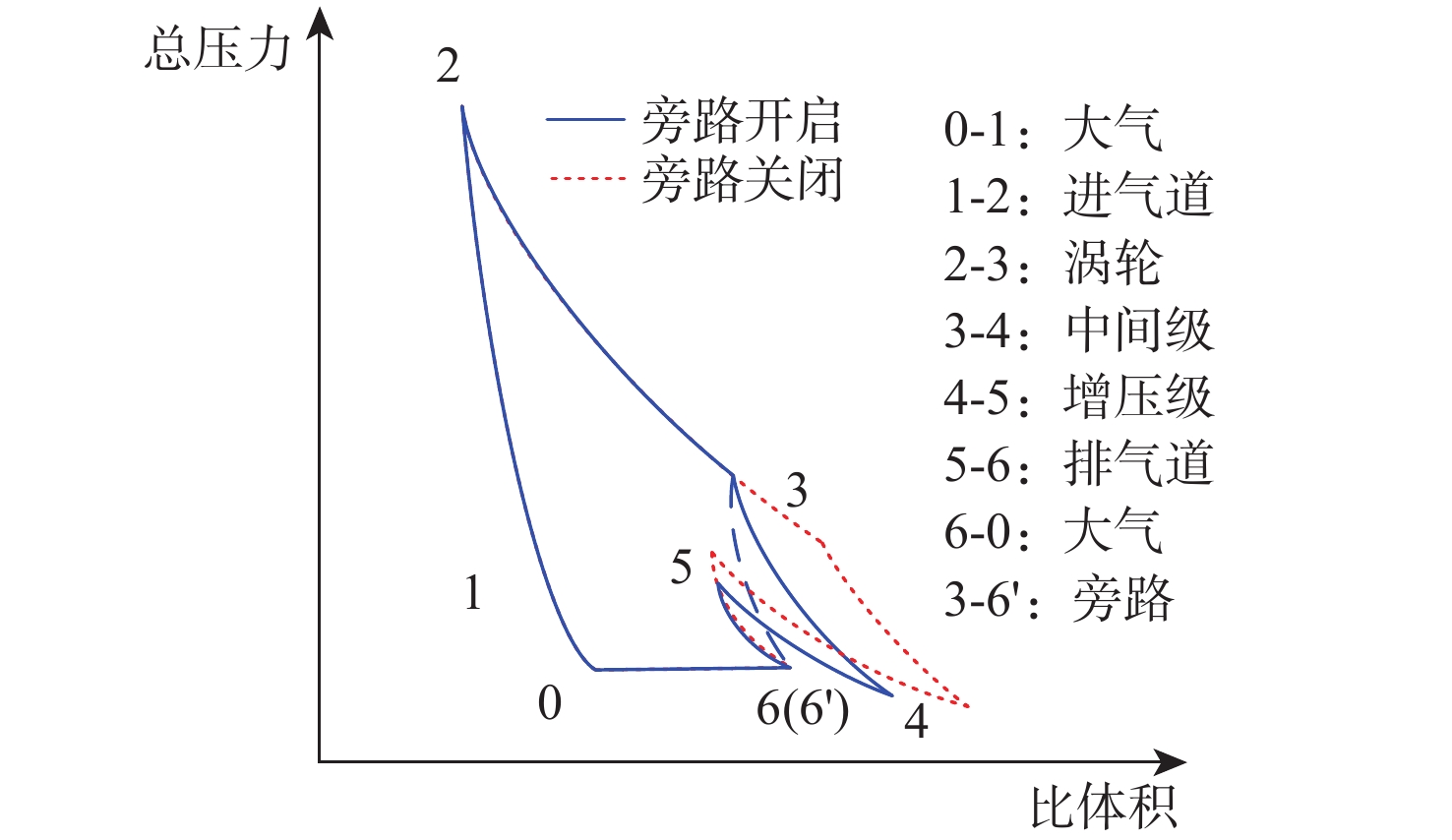
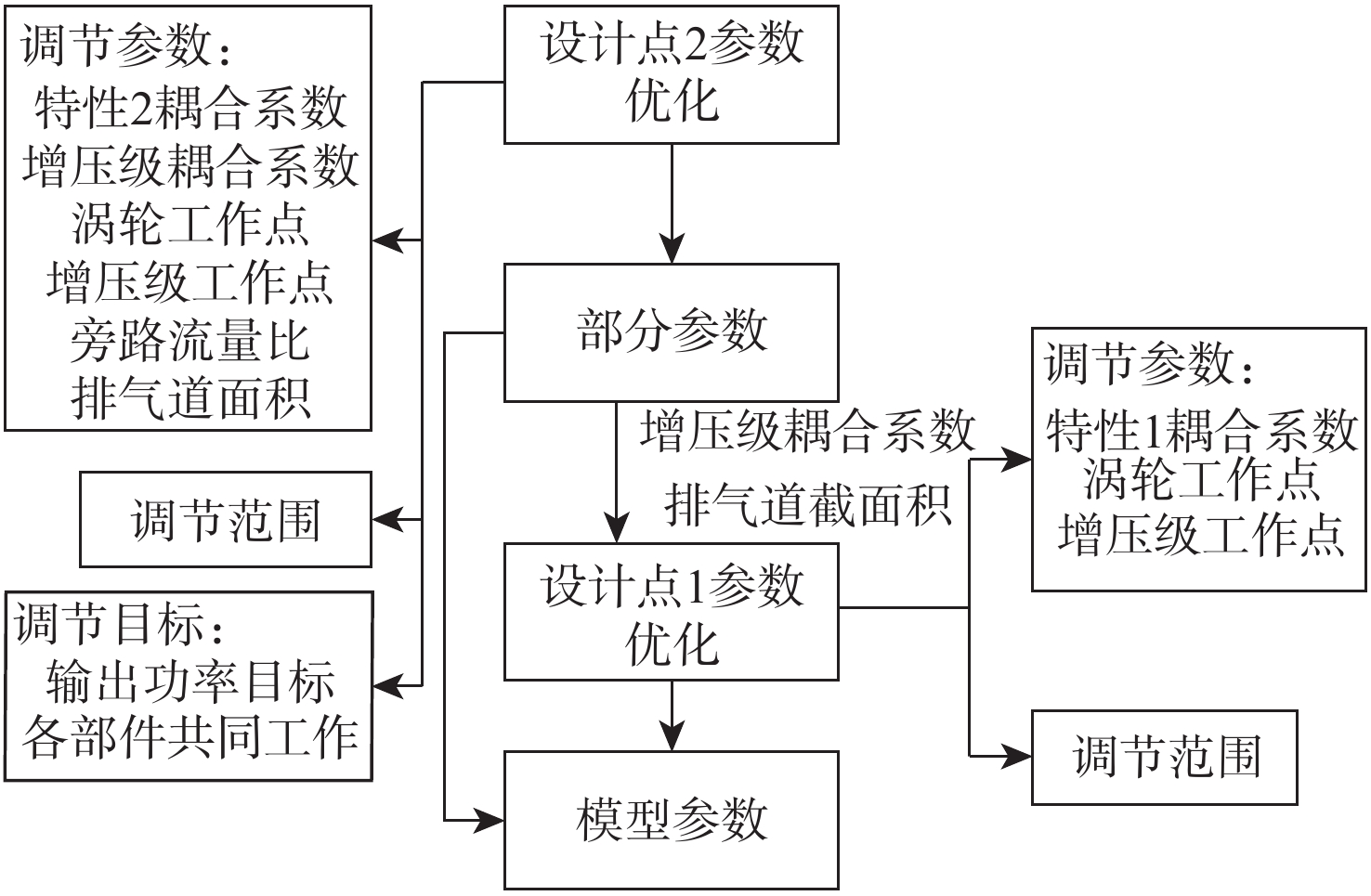
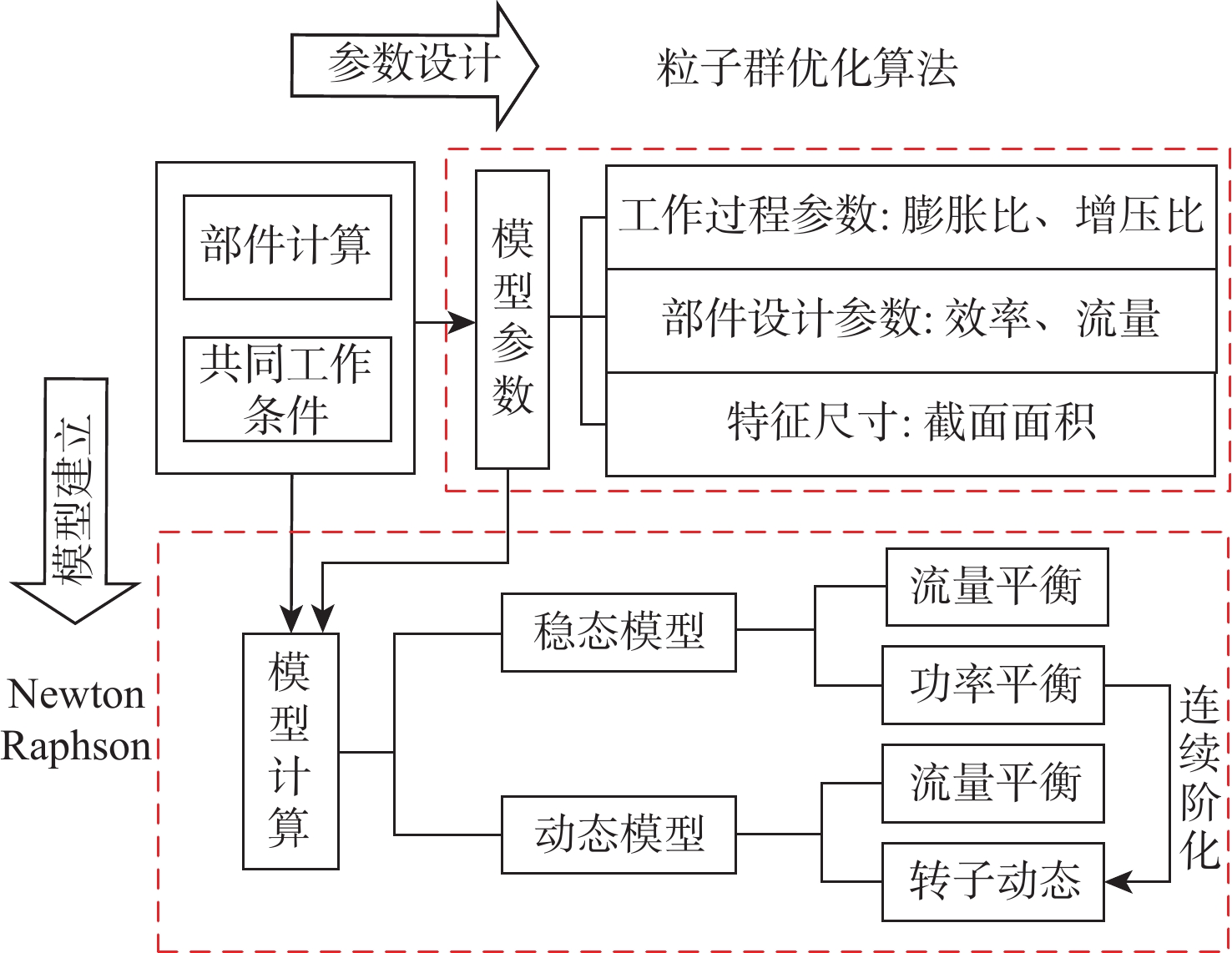
图 1 涵道式冲压涡轮部件级性能模型建立通用方法流程
Figure 1. General method flow for building component level performance model of ducted ram air turbines
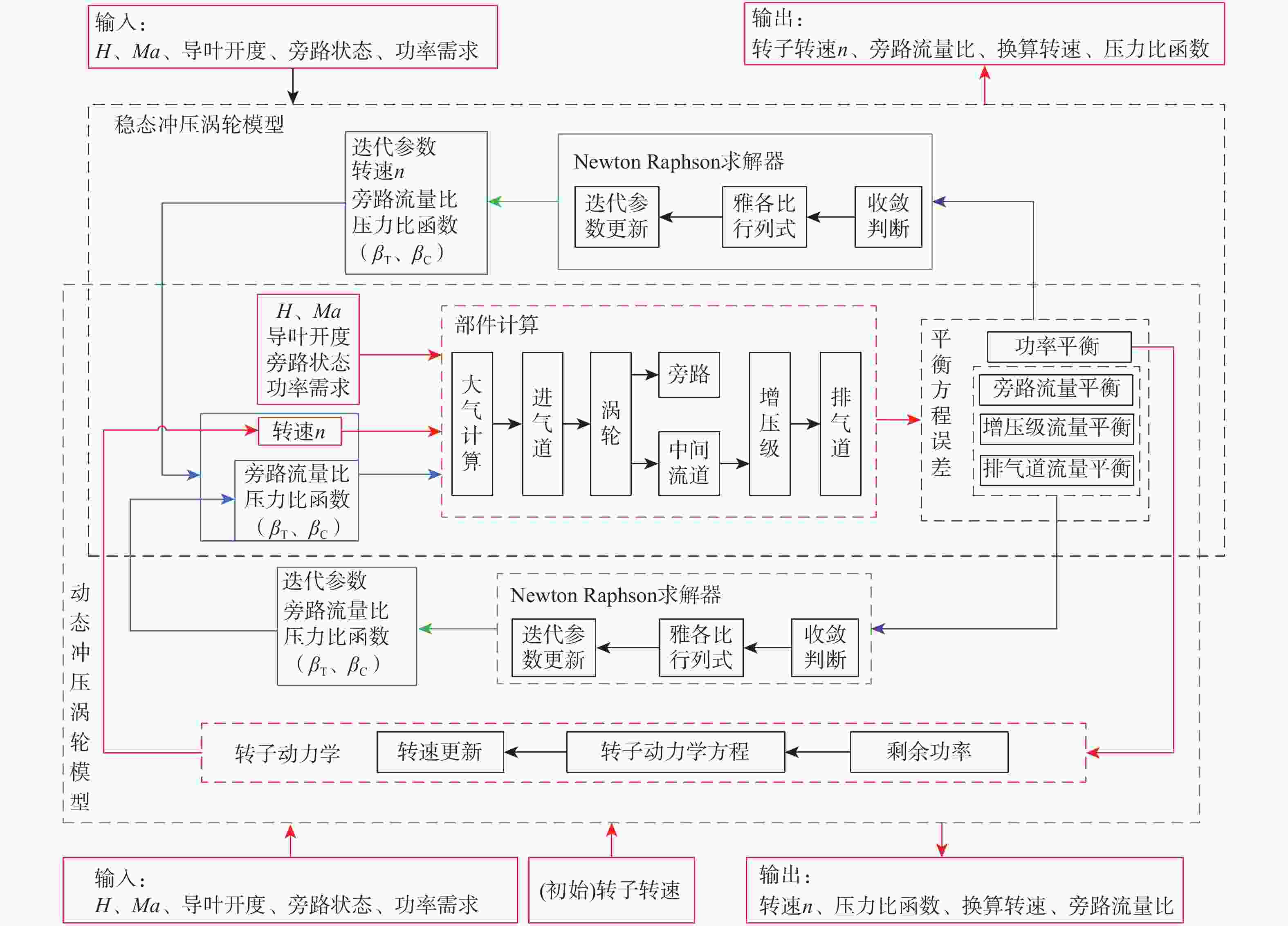
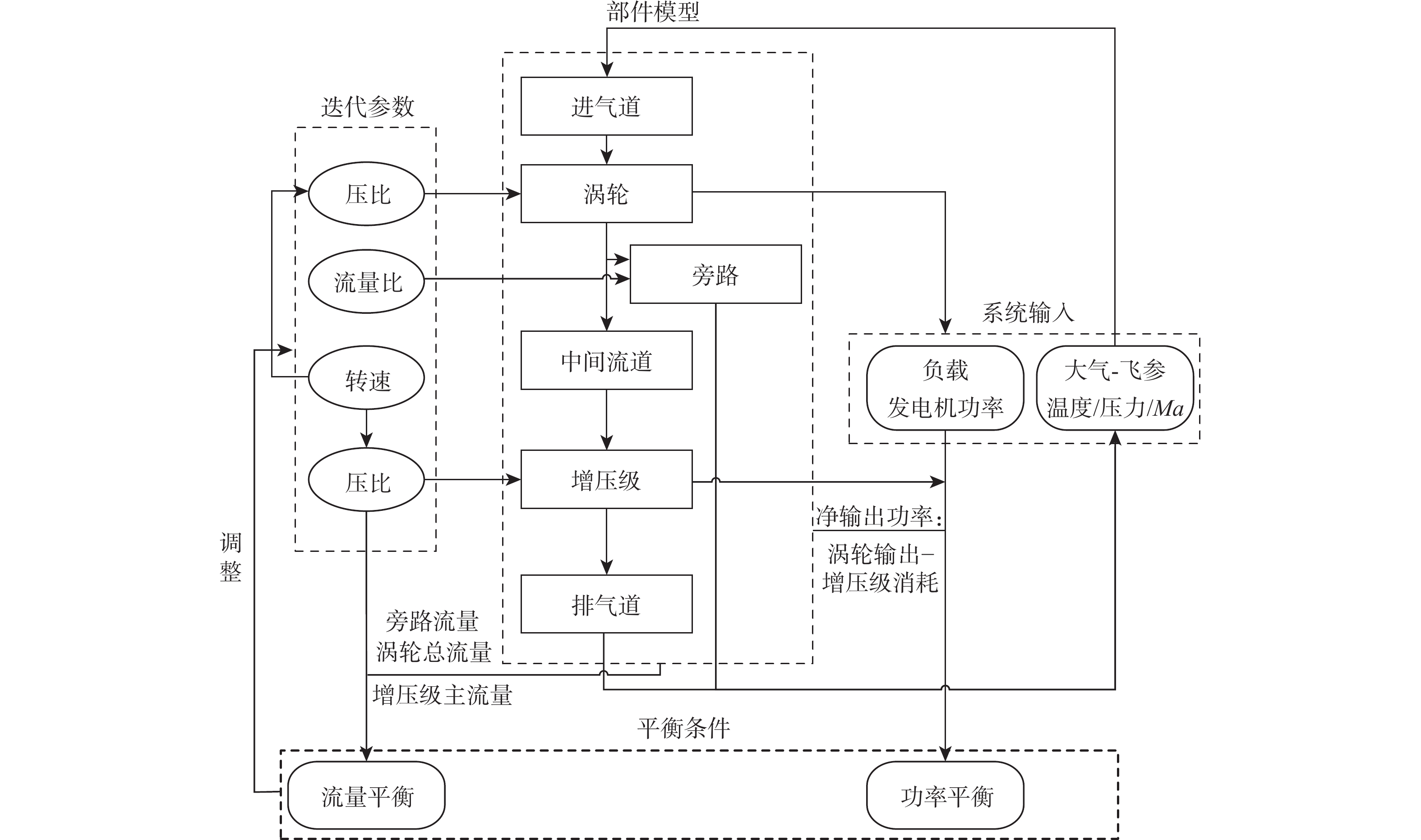
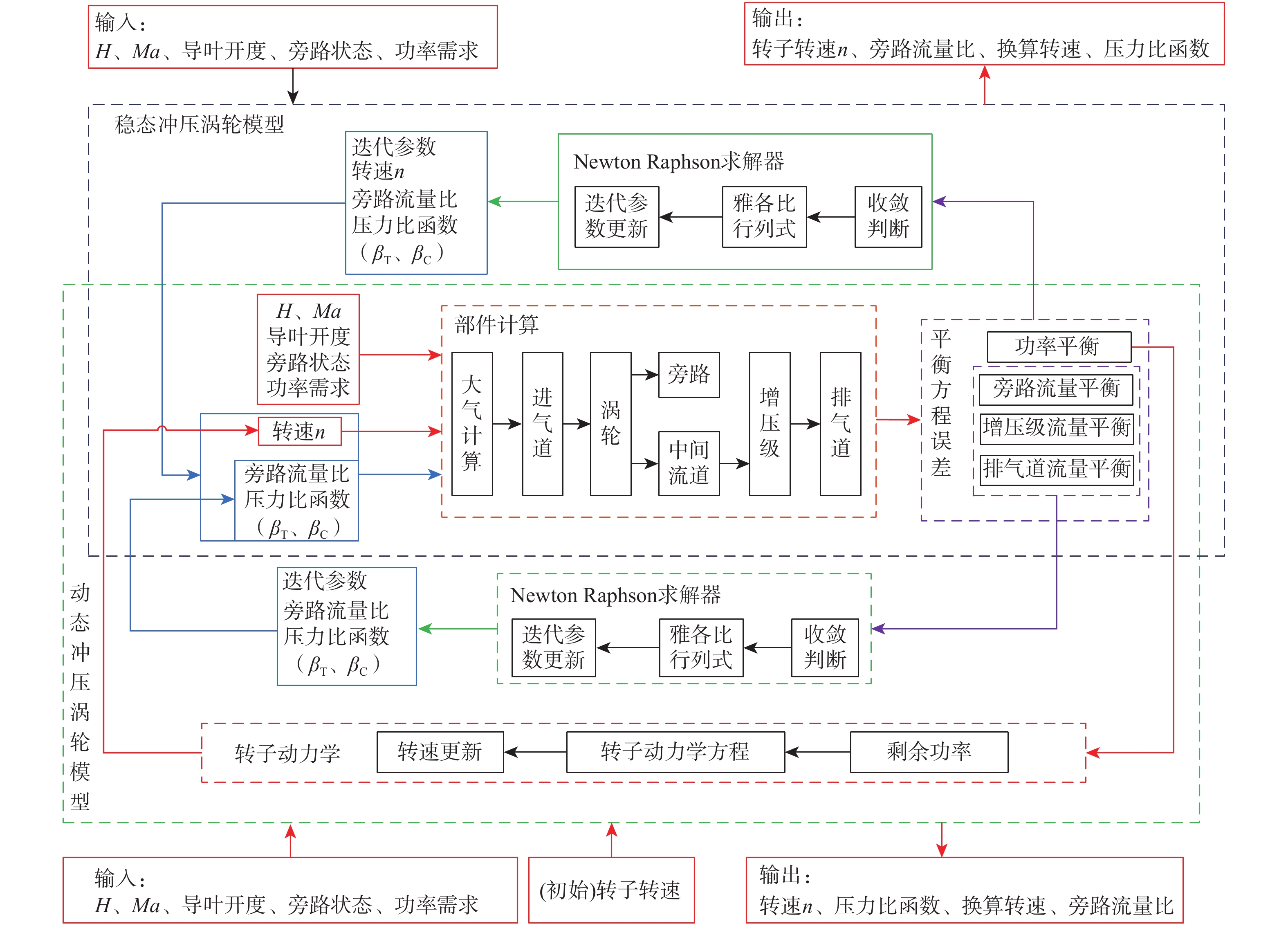
图 6 涵道式冲压涡轮数学模型框架
Figure 6. Mathematical model framework for ducted ram air generation turbines
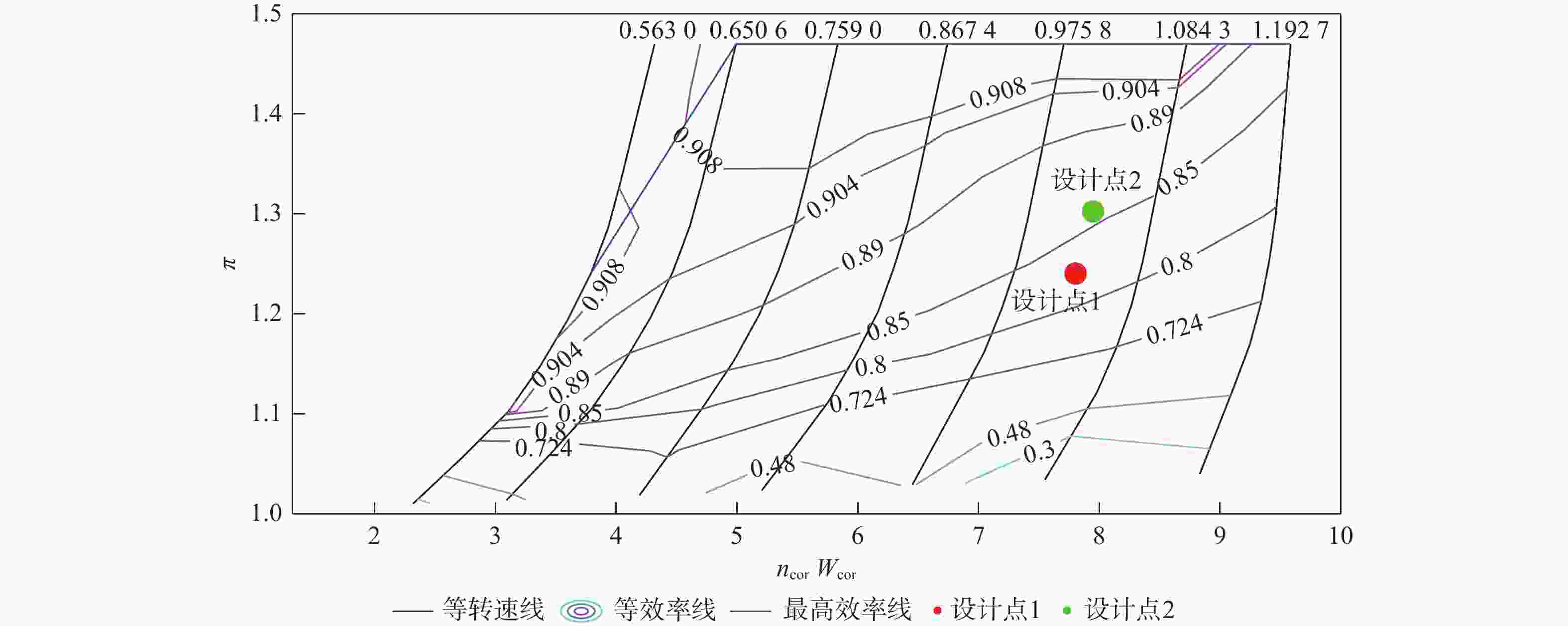
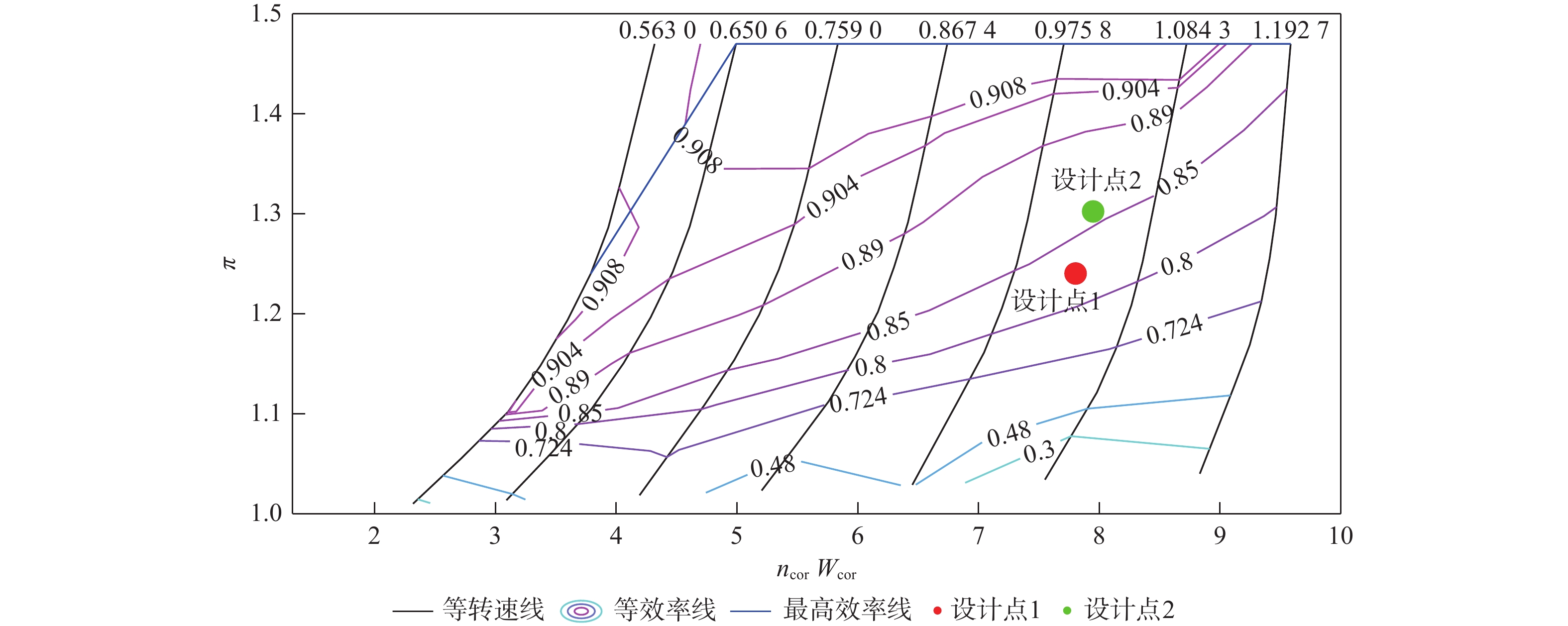
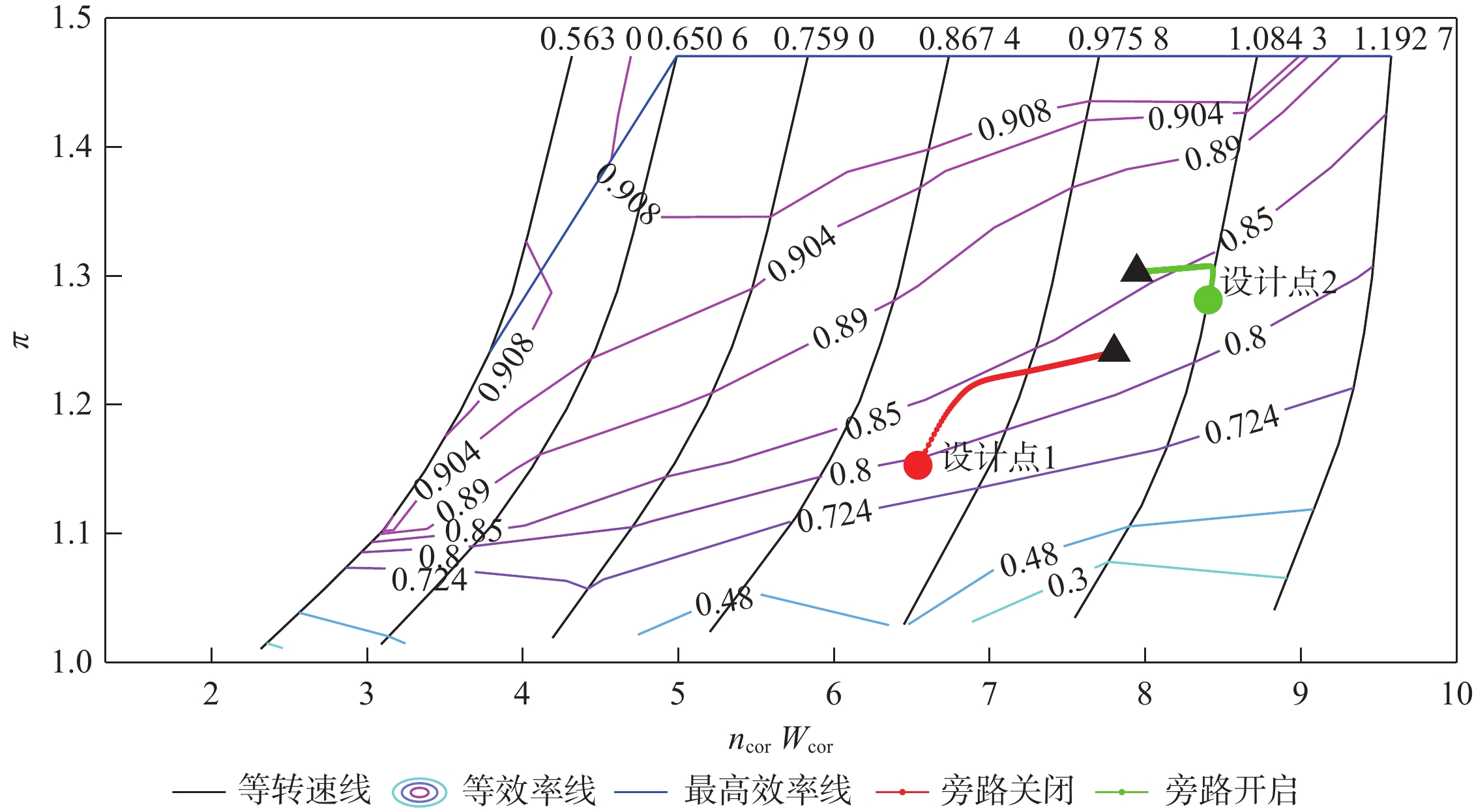
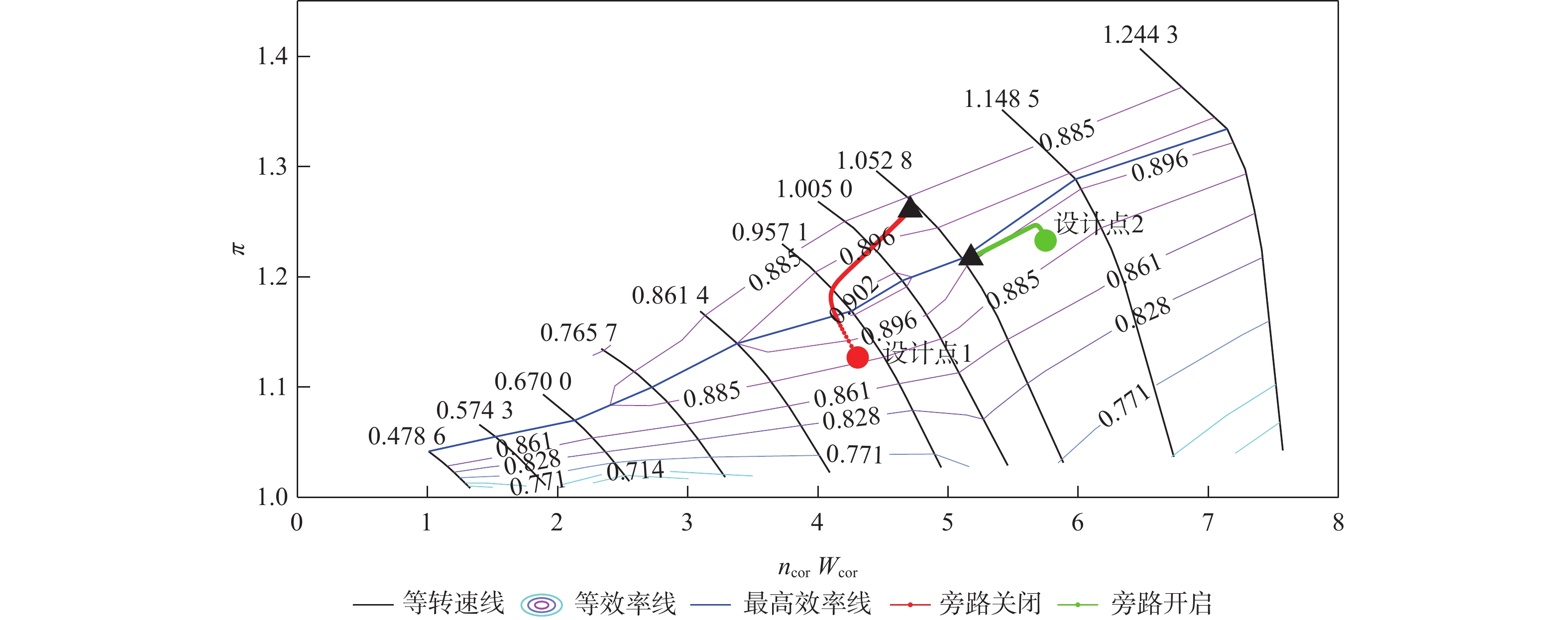
图 7 涡轮设计点2特性中设计点位置
Figure 7. Position of design point in turbine design point 2 characteristics
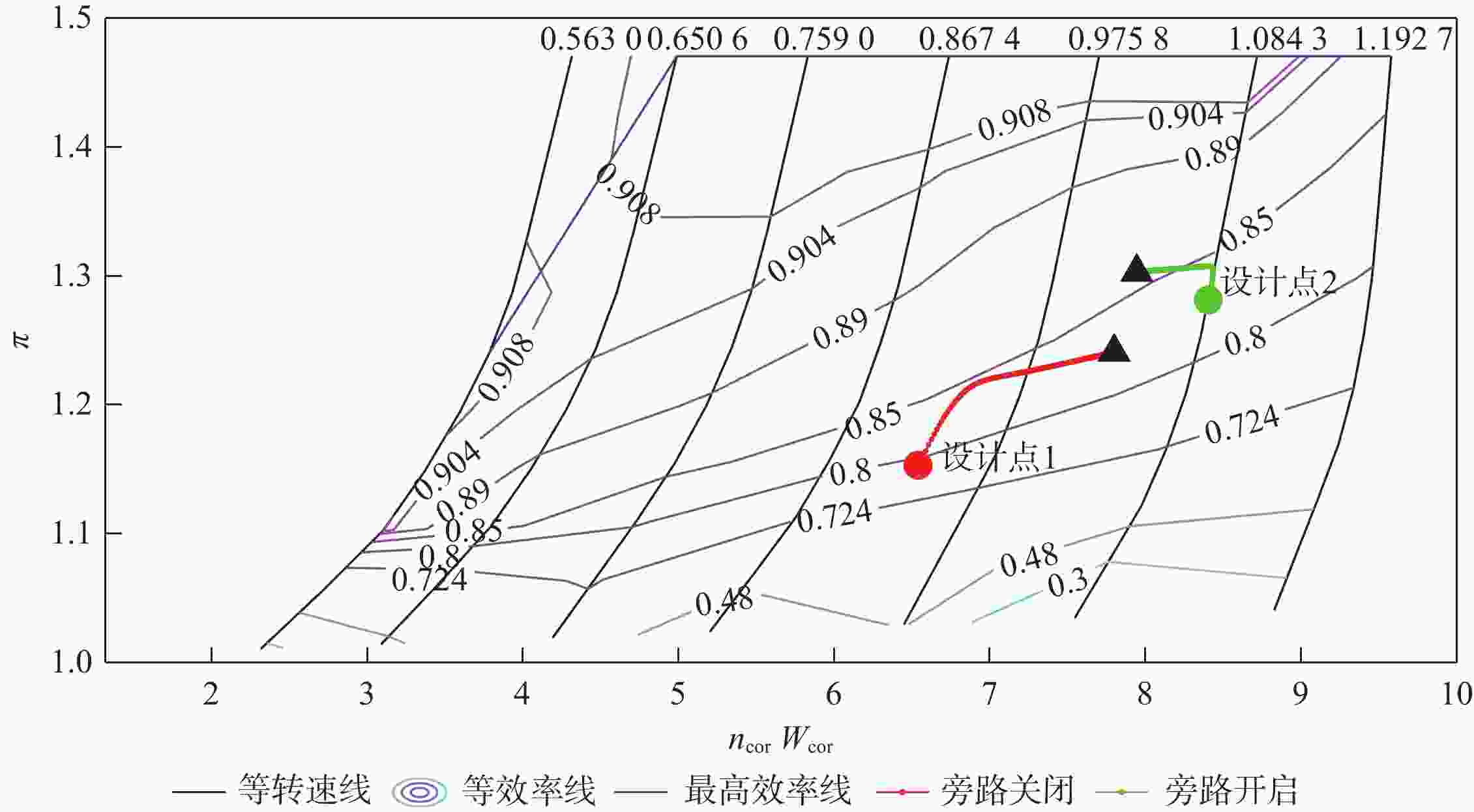
图 12 导叶开度阶跃共同工作点在涡轮特性2上的移动
Figure 12. Movement of common operating point on turbine characteristic 2 when guide vane opening step
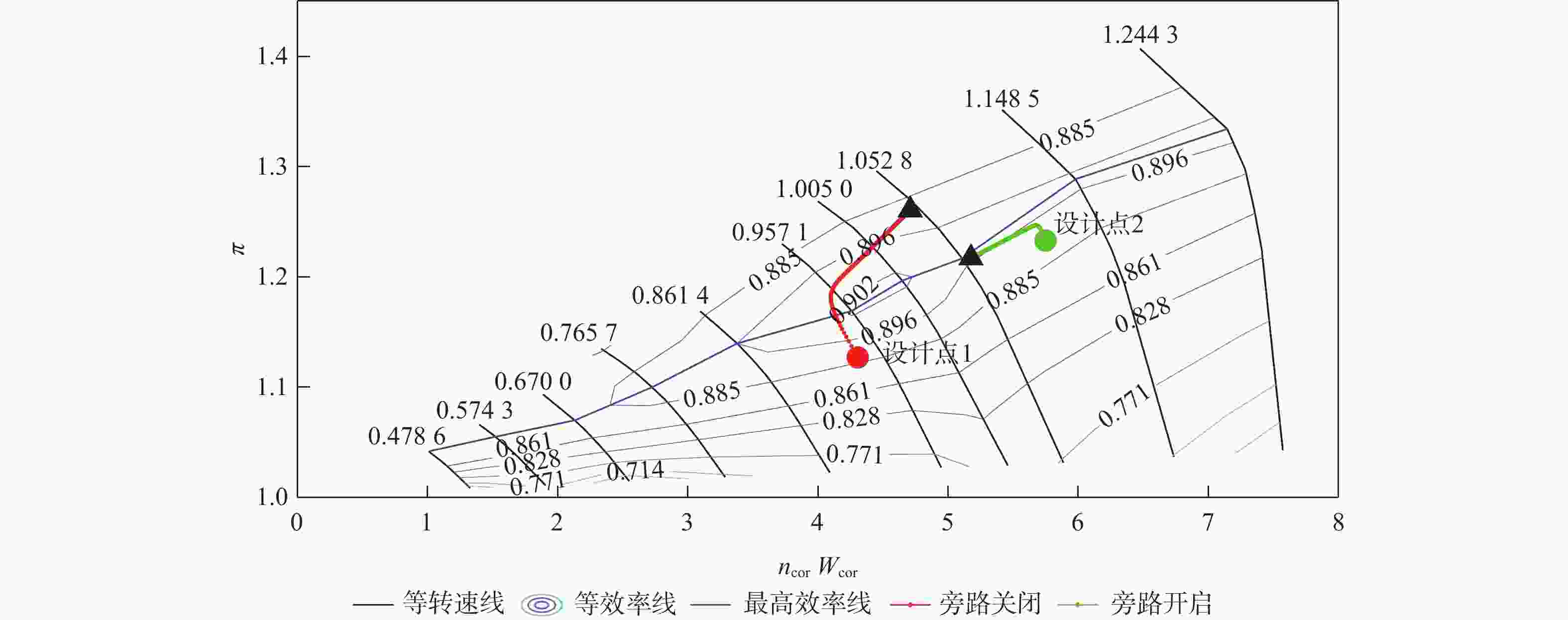
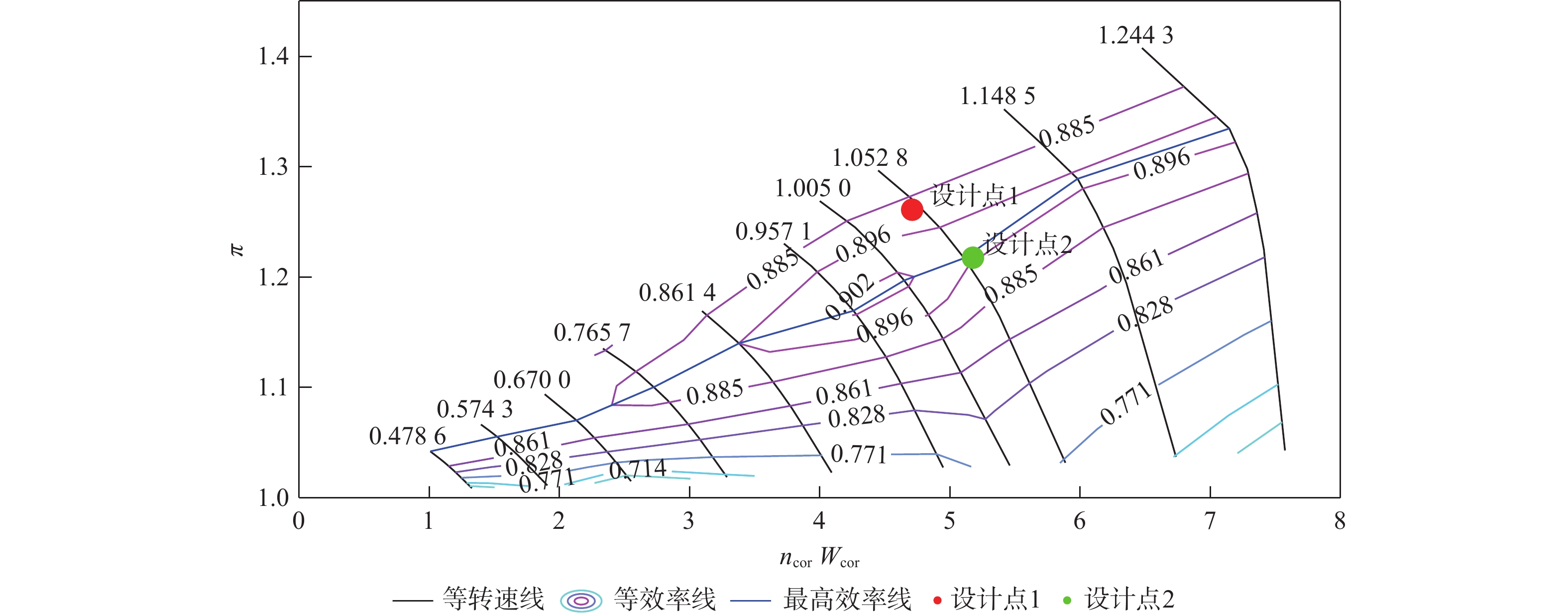
图 13 导叶开度阶跃共同工作点在增压级特性上的移动
Figure 13. Movement of common working point on compressor characteristic when guide vane opening step
表 1 设计点参数
Table 1. Design point parameters
设计点 旁路
状态导叶
开度α/%转速n/
(r·min−1)高度
H/km马赫数
Ma标准温差
dT/K功率
Pe/kW设计点1 关闭 56.67 18000 0.5 0.65 23.00 26 设计点2 开启 100.00 18000 10.0 0.70 −0.15 26  下载: 导出CSV
表 2 设计点参数计算结果
Table 2. Design point parameter calculation results
设计点 旁路
比$ \tau $涡轮功
PT/ kW增压级
功PC/ kW输出
功率Pe/ kW转速n/
(r·min−1)设计点1 0 47.21 21.21 26 18000 设计点2 0.3556 33.70 7.70 26 18000
下载: 导出CSV
-
[1] 杨康, 刘禹, 郝汀, 等. 机载干扰吊舱总体设计技术的探讨[J]. 现代信息科技, 2020, 4(15): 37-41.YANG K, LIU Y, HAO T, et al. Discussion on the overall design technology of airborne jamming pod[J]. Modern Information Technology, 2020, 4(15): 37-41(in Chinese). [2] HAID D, JUSTAK J. Innovative ram air turbine for airborne power generation[C]//Proceedings of the ASME Turbo Expo 2015: Turbine Technical Conference and Exposition. New York: ASME, 2015. [3] 杨汉华. 飞机自主发电系统的试验研究[D]. 南京: 南京航空航天大学, 2006.YANG H H. Experimental study on aircraft autonomous power generation system[D]. Nanjing: Nanjing University of Aeronautics and Astronautics, 2006(in Chinese). [4] 叶国祥, 陆启航, 张大林. 吊舱发电用涵道式冲压涡轮优化设计[J]. 航空兵器, 2016, 23(5): 61-65.YE G X, LU Q H, ZHANG D L. Optimization design for ducted ram air turbine of pod power[J]. Aero Weaponry, 2016, 23(5): 61-65(in Chinese). [5] MAJUMDAR S. Growler, the 'electronic' hornet[J]. Vayu Aerospace and Defence Review, 2021(1): 126-127. [6] ARUMUGAM A, THOMAS S, MADHUSUDAN M, et al. Utilisation of ram air turbine on a fighter platform for energy extraction failure mode study[J]. Defence Science Journal, 2020, 70(6): 583-589. [7] 汪涛, 楚武利, 卢家玲, 等. 亚音速涵道式冲压空气涡轮性能数值仿真[J]. 计算机仿真, 2009, 26(10): 34-38.WANG T, CHU W L, LU J L, et al. Numerical simulation of performance of subsonic ducted ram air turbine[J]. Computer Simulation, 2009, 26(10): 34-38(in Chinese). [8] 傅达旺. 某型冲压涡轮性能计算及分析[D]. 南京: 南京航空航天大学, 2007.FU D W. Performance calculation and analysis of a ramjet turbine[D]. Nanjing: Nanjing University of Aeronautics and Astronautics, 2007(in Chinese). [9] SAAD M M M, MOHD S B, ZULKAFLI M F. A survey on the use of ram air turbine in aircraft[J]. AIP Conference Proceedings, 2017, 1831(1): 020048. [10] 王建平, 朱春玲. 冲压涡轮发电系统数值分析及试验研究[C]//第二届中国航空学会青年科技论坛会议论文集. 北京: 中国航空学会, 2006.WANG J P, ZHU C L. The numerical analysis and experiment study of ram air turbine generator system[C]//Proceedings of the 2nd Chinese Society of Aeronautics and Astronautics Youth Science and Technology Forum. Beijing: Chinese society of aeronautics and astronautics, 2006(in Chinese). [11] 郭涛. 冲压空气涡轮性能研究[D]. 南京: 南京航空航天大学, 2007.GUO T. Study on performance of ram air turbine[D]. Nanjing: Nanjing University of Aeronautics and Astronautics, 2007(in Chinese). [12] 叶国祥. 吊舱发电用涵道式冲压涡轮优化设计[D]. 南京: 南京航空航天大学, 2016.YE G X. Optimal design of ducted ramjet turbine for pod power generation[D]. Nanjing: Nanjing University of Aeronautics and Astronautics, 2016(in Chinese). [13] LIU S L, MA G Y, XU S X, et al. A review of reverse Brayton air cycle refrigerators[J]. International Journal of Refrigeration, 2023, 150: 200-214. [14] 王超, 包胜, 王璐璐. TTC双涡轮并行制冷吊舱环控系统性能研究[J]. 电子机械工程, 2017, 33(1): 48-51.WANG C, BAO S, WANG L L. Capability analysis of double-turbo parallel refrigeration of turbo-turbo-compressor environment control system of pods[J]. Electro-Mechanical Engineering, 2017, 33(1): 48-51(in Chinese). [15] 绳春晨, 杨榆, 谢洪涛, 等. 逆升压式吊舱涡轮冷却器变工况特性研究[J]. 真空与低温, 2020, 26(6): 466-470.SHENG C C, YANG Y, XIE H T, et al. Performance study on variable working condition of reverse-boost pod turbine cooler[J]. Vacuum and Cryogenics, 2020, 26(6): 466-470(in Chinese). [16] 绳春晨, 杨榆, 谢洪涛, 等. 机载吊舱环控空气制冷系统分析及试验研究[J]. 低温与超导, 2020, 48(1): 80-85.SHENG C C, YANG Y, XIE H T, et al. Performance analysis and experimental study on air cooling system for airborne pod ECS[J]. Cryogenics & Superconductivity, 2020, 48(1): 80-85(in Chinese). [17] YANG Y, CHEN S T, SHENG C C, et al. Study on coupling performance of turbo-cooler in aircraft environmental control system[J]. Energy, 2021, 224: 120029. [18] LUO K, LV B. Study on performance of autonomous power generation and refrigeration system of the jamming pod[C]//Proceedings of the CSAA/IET International Conference on Aircraft Utility Systems. London: IET, 2022: 719-724. [19] KENNEDY J, EBERHART R. Particle swarm optimization[C]//Proceedings of the ICNN'95 - International Conference on Neural Networks. Piscataway: IEEE Press, 1995: 1942-1948. [20] GALÁNTAI A. The theory of Newton's method[J]. Journal of Computational and Applied Mathematics, 2000, 124(1): 25-44. [21] BEN-ISRAEL A. A Newton-Raphson method for the solution of systems of equations[J]. Journal of Mathematical Analysis and Applications, 1966, 15(2): 243-252. -

 下载:
下载:

 点击查看大图
计量
- 文章访问数: 258
- HTML全文浏览量: 108
- PDF下载量: 113
- 被引次数: 0
