





-
摘要:
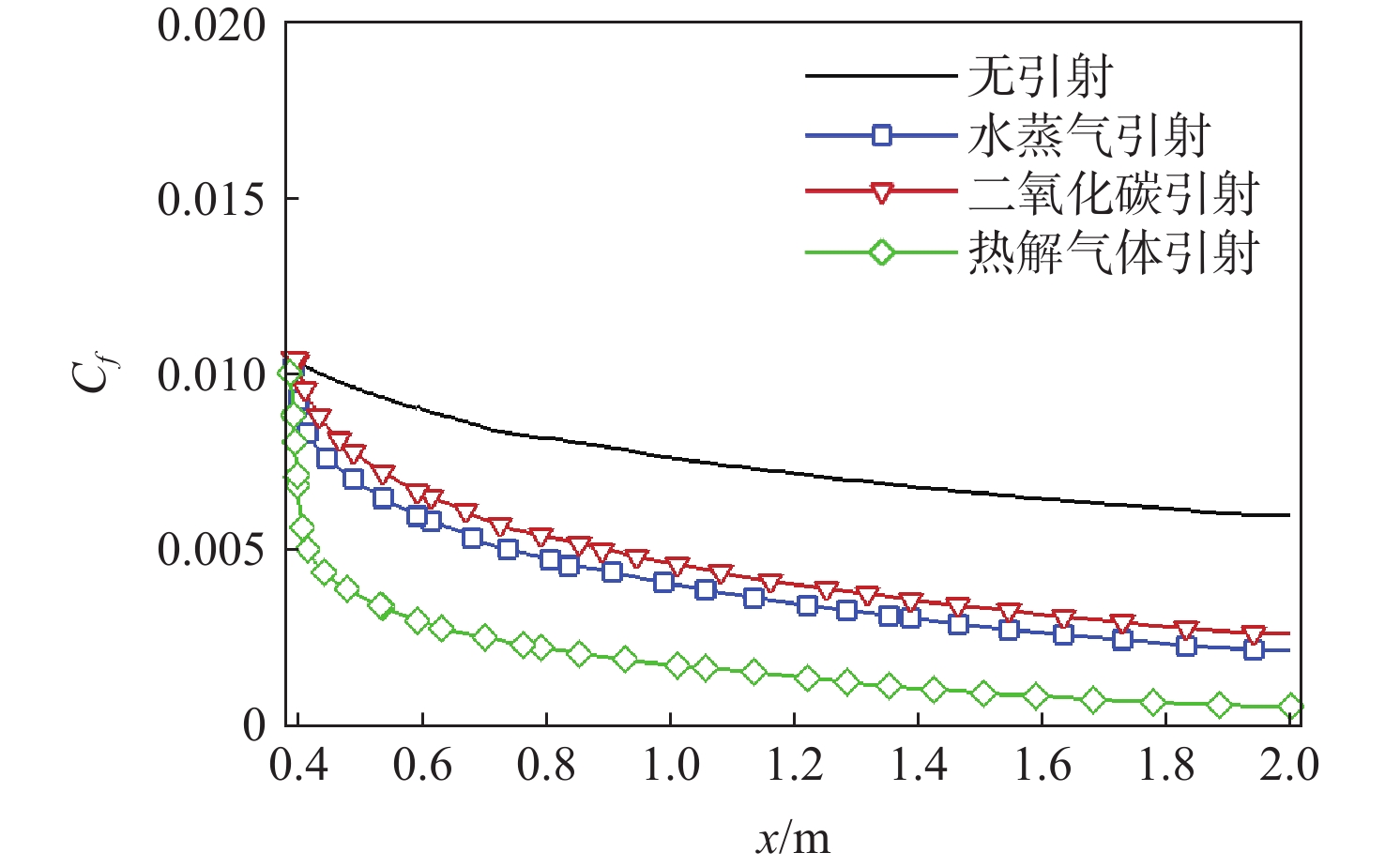
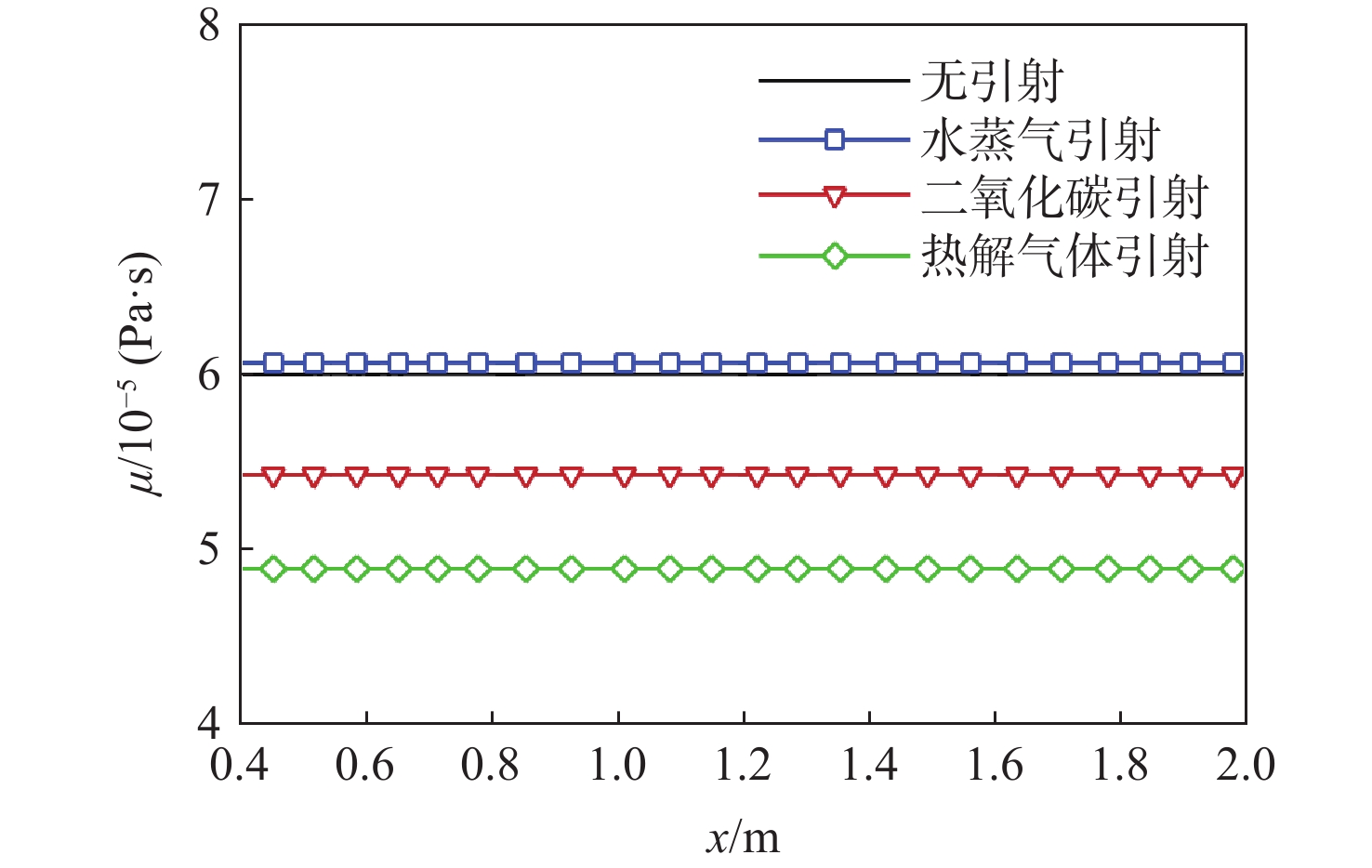
壁面质量引射可有效降低壁面热流和摩擦阻力,是解决高超声速飞行器热防护问题的备选方案之一。选取二维钝楔为计算模型,展开质量引射对降热减阻的数值模拟研究,对比分析了3种不同工质引射气体(热解气体、水蒸气和二氧化碳)对气动力热特性的影响。将热流分解为对流热流和扩散热流可知,热解气体引射降低了对流热流和扩散热流;而水蒸气和二氧化碳引射虽然降低了对流热流,但增大了扩散热流,且水蒸气增大扩散热流的效果更明显,使得总热流增加。此外,3种不同工质引射气体均通过降低壁面附近的速度梯度来降低壁面的摩擦阻力,其中,热解气体引射降低的速度梯度最大,减阻效果最好。
Abstract:One way to address the thermal protection issue of hypersonic vehicles is through wall mass injection, which can successfully lower skin friction and wall heat flow. The effects of three distinct gases (pyrolysis gas, water vapor, and carbon dioxide) on aerodynamic force and thermal characteristics are compared and analyzed, and the numerical simulation of mass injection on the heat flux and skin friction of the wall is investigated using a two-dimensional blunt wedge as the calculation model. It is possible to determine that the pyrolysis gas injection lowers the convective and diffusion heat flux by splitting the heat flux into these two categories. Both carbon dioxide injection and water vapor enhance the diffusion heat flux while decreasing the convective heat flow. The effect of water vapor raising the diffusion heat flux is more noticeable, leading to an increase in the overall heat flux. Additionally, by lowering the velocity gradient close to the wall, all three gases can lessen the skin-friction of the wall, with pyrolysis gas injection having a greater impact.
-
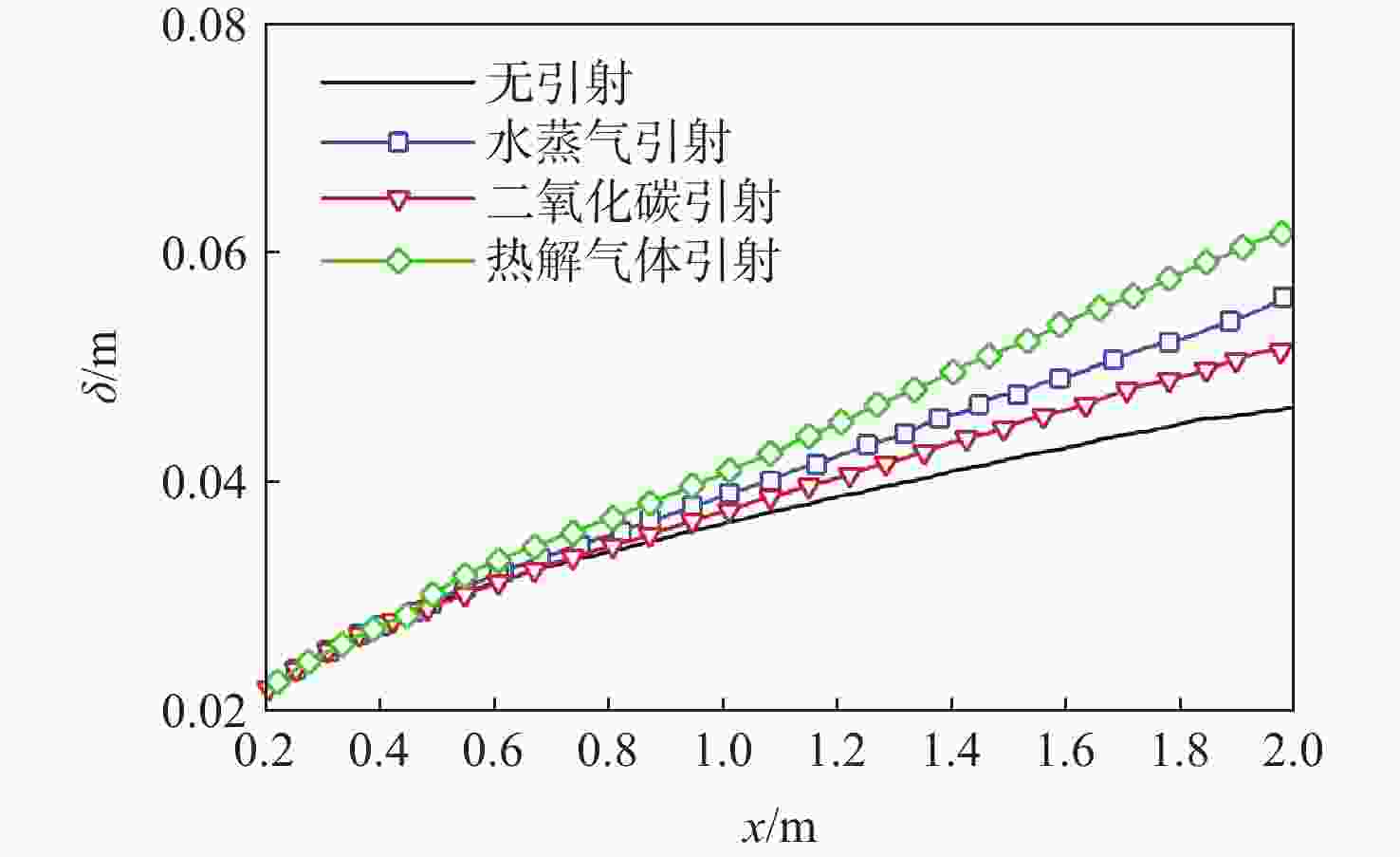
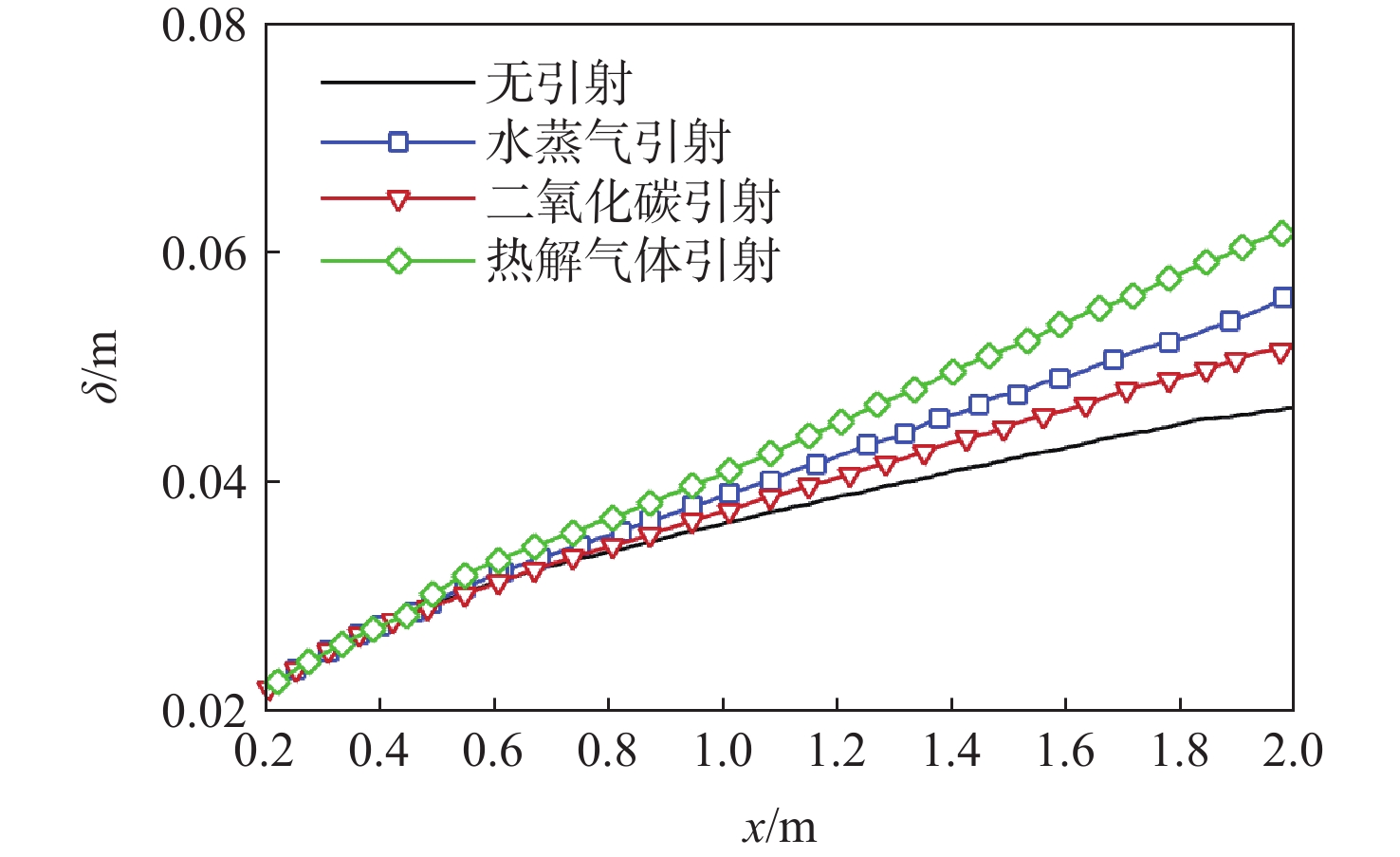
图 6 钝楔迎风面边界层厚度分布
Figure 6. Boundary layer thickness distributions along the windward of the blunt wedge
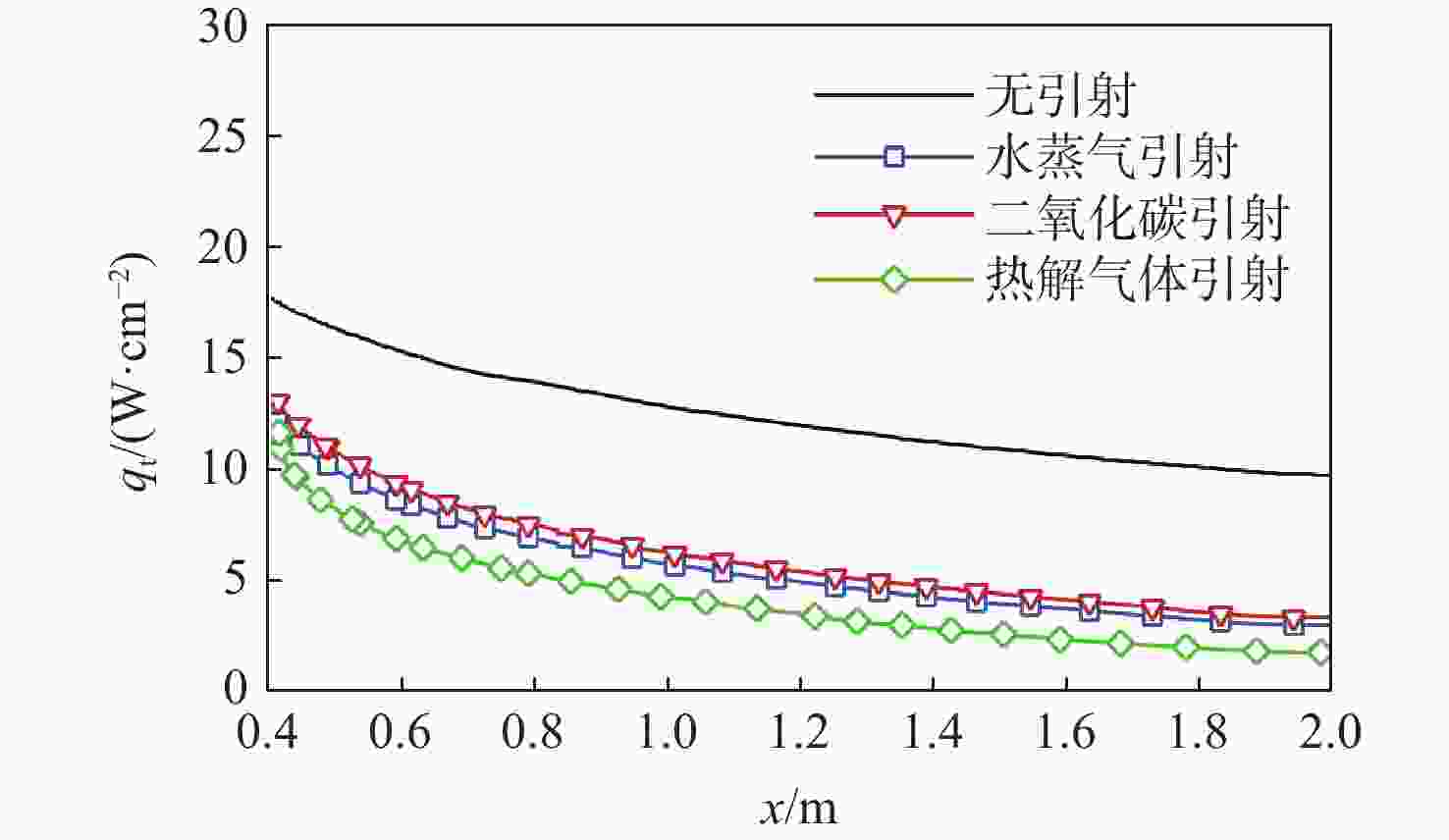
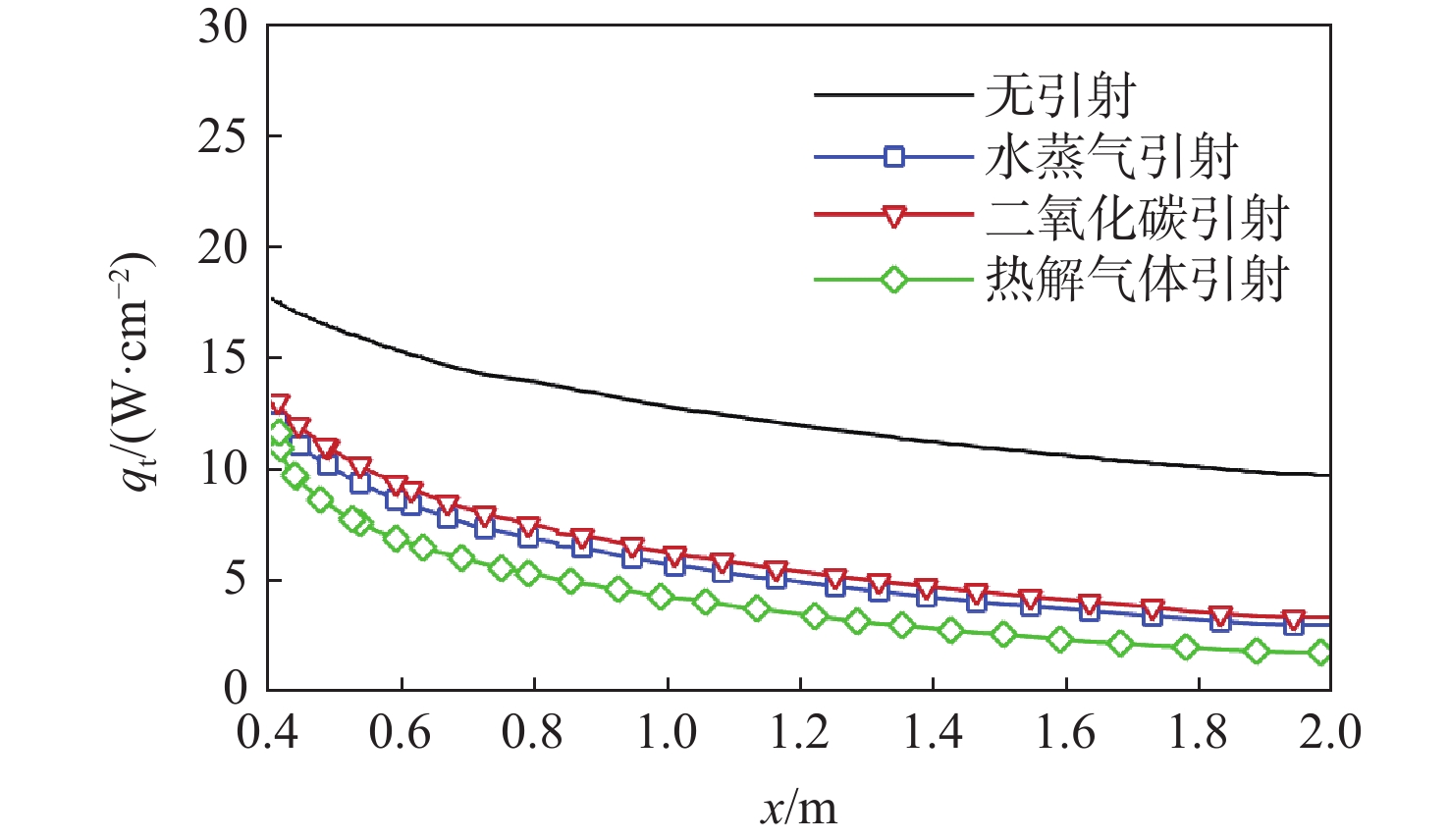
图 8 钝楔迎风面对流热流分布
Figure 8. Convection heat flux distributions on windward of the blunt wedge
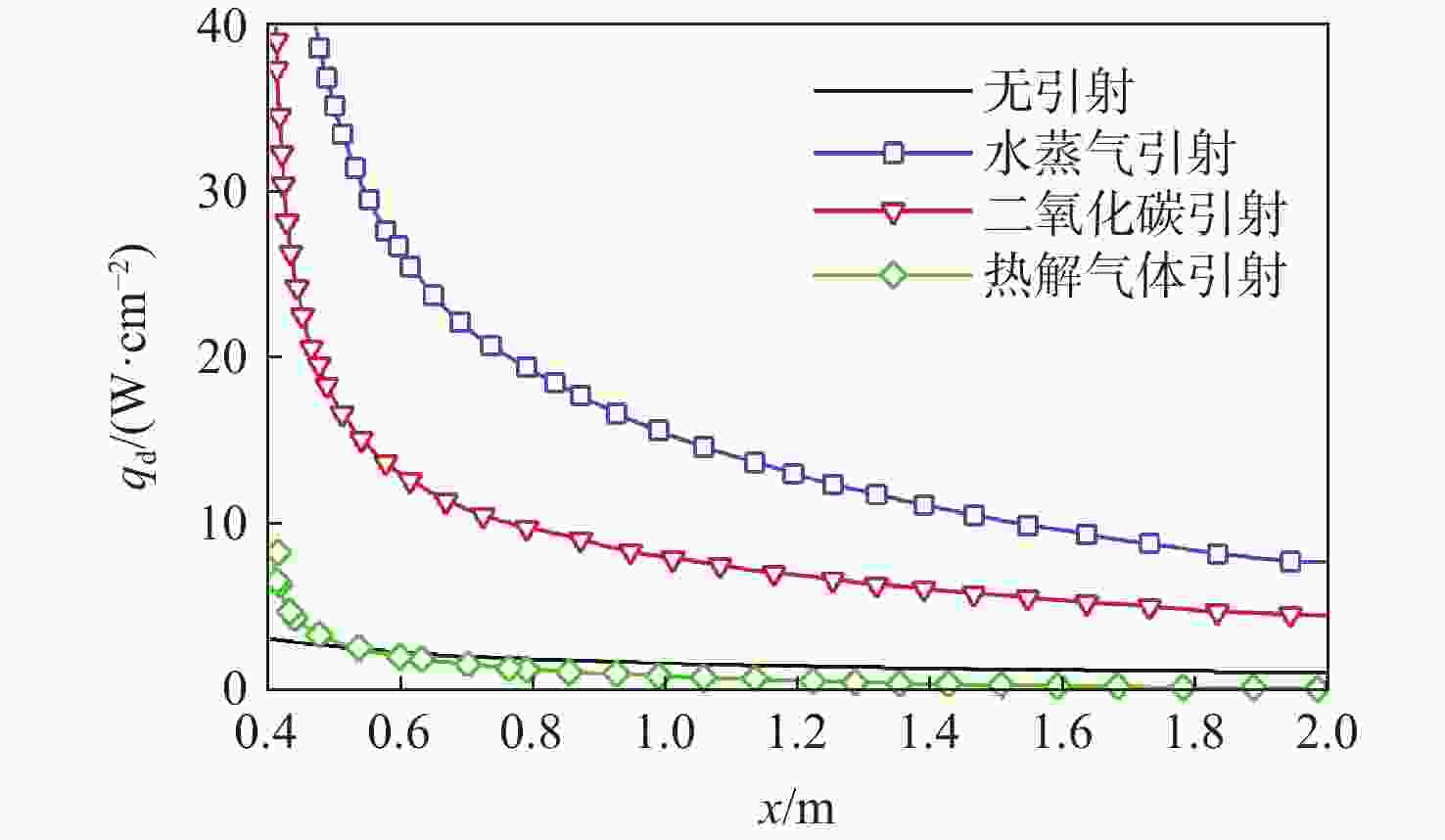
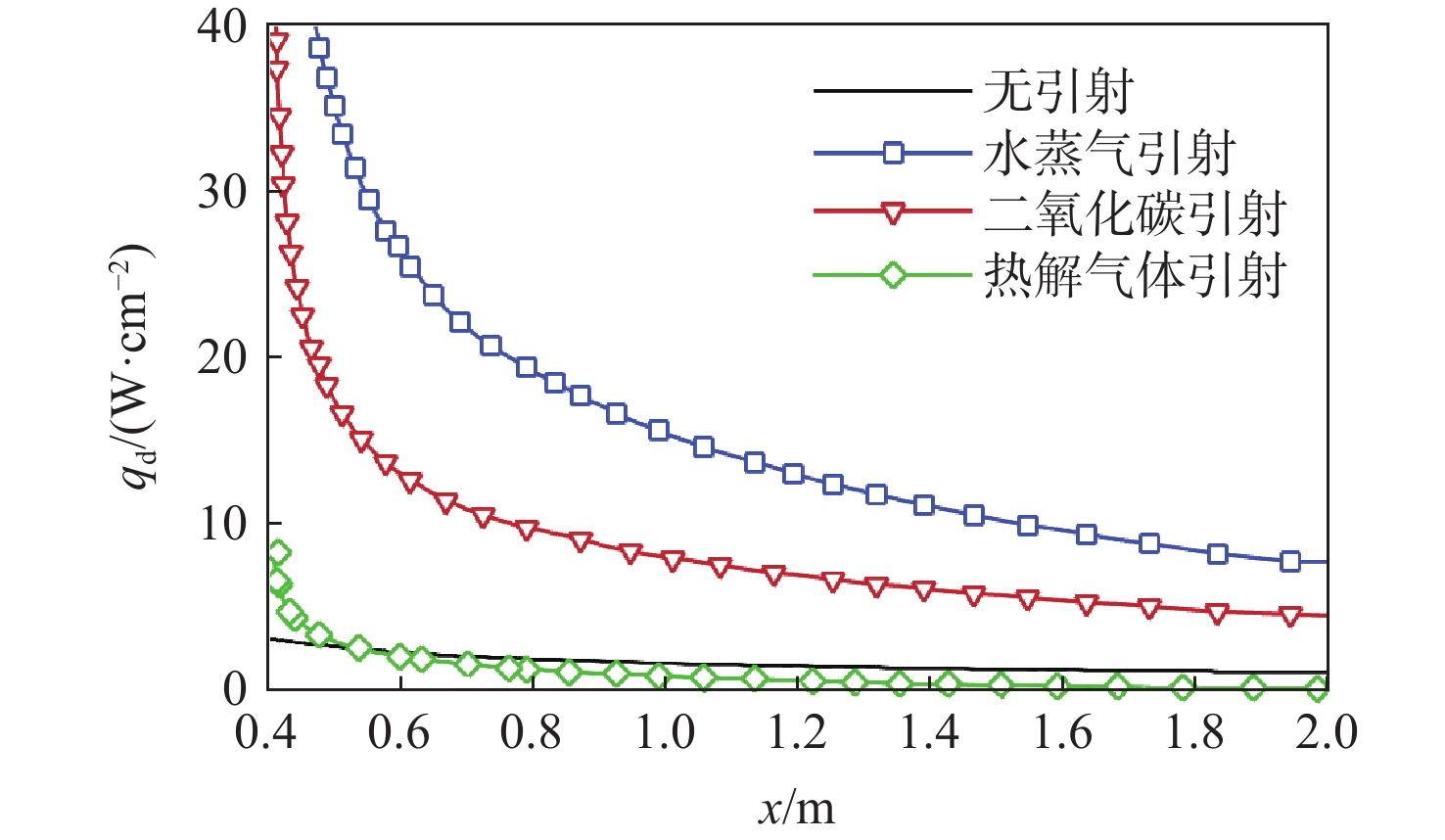
图 9 钝楔迎风面扩散热流分布
Figure 9. Diffusion heat flux distributions on windward of the blunt wedge
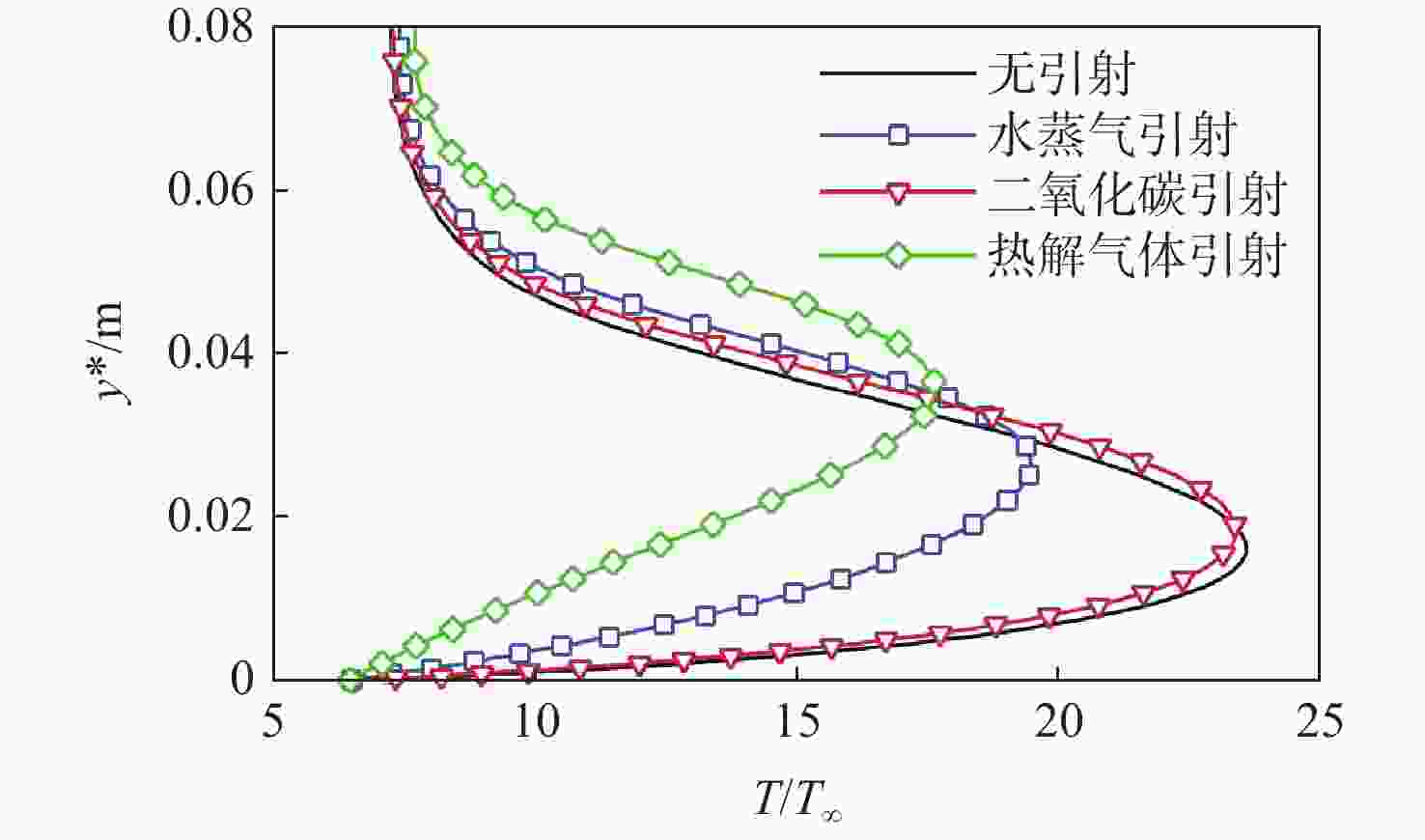
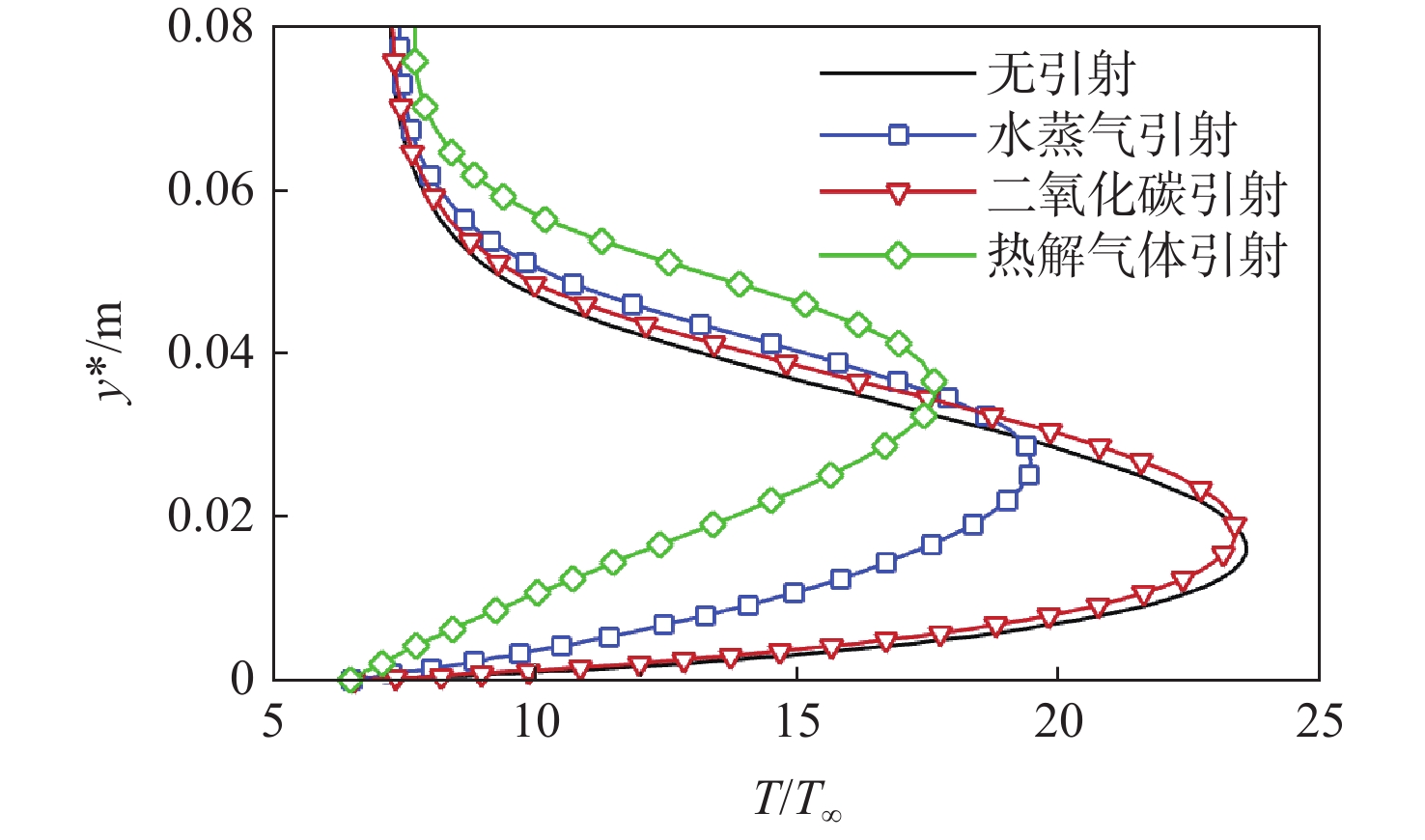
图 10 钝楔迎风面 x=1.2 m处T/T∞沿壁面法向分布
Figure 10. Distributions of T/T∞ on windward of the blunt wedge along the wall-normal direction at x=1.2 m
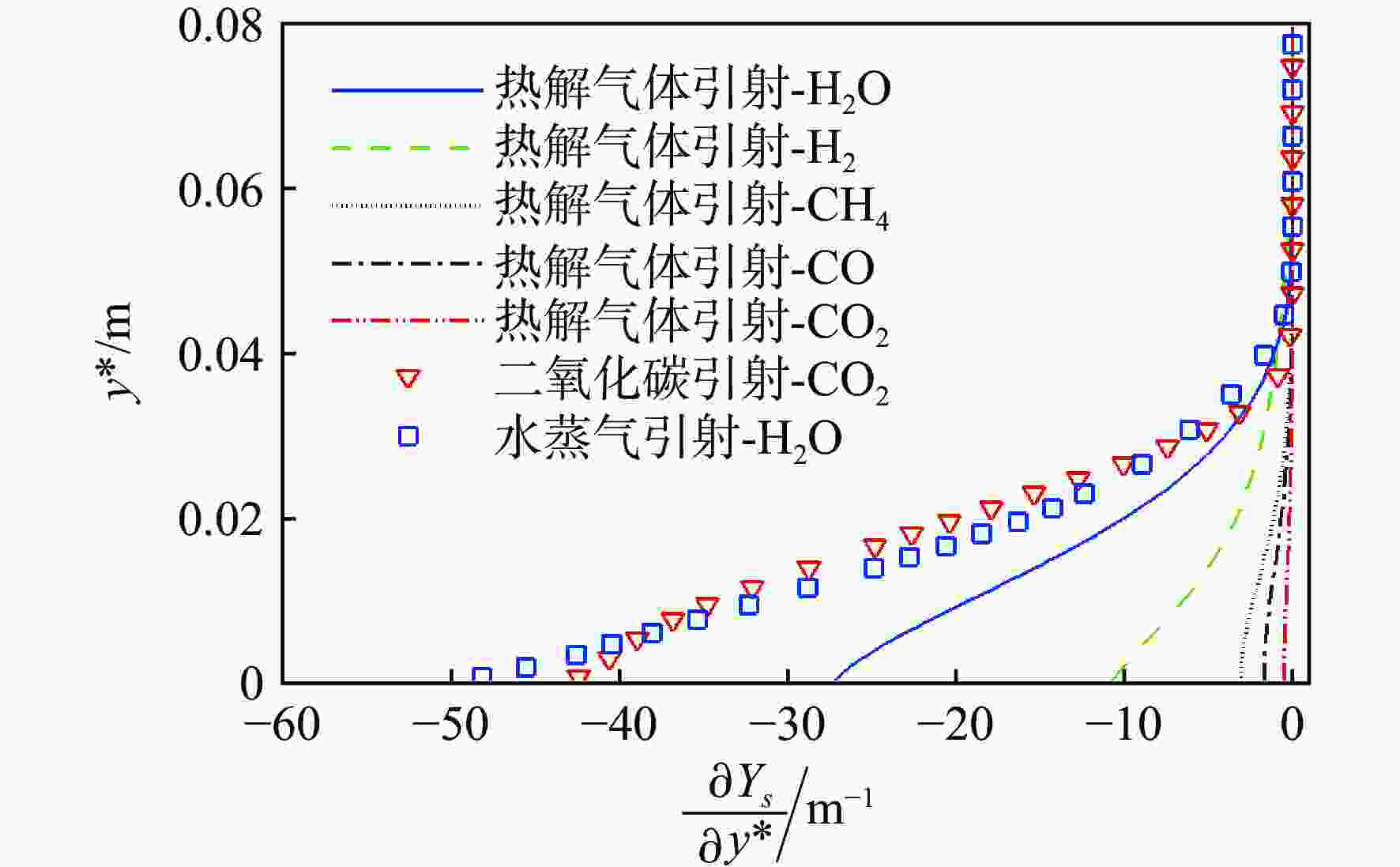
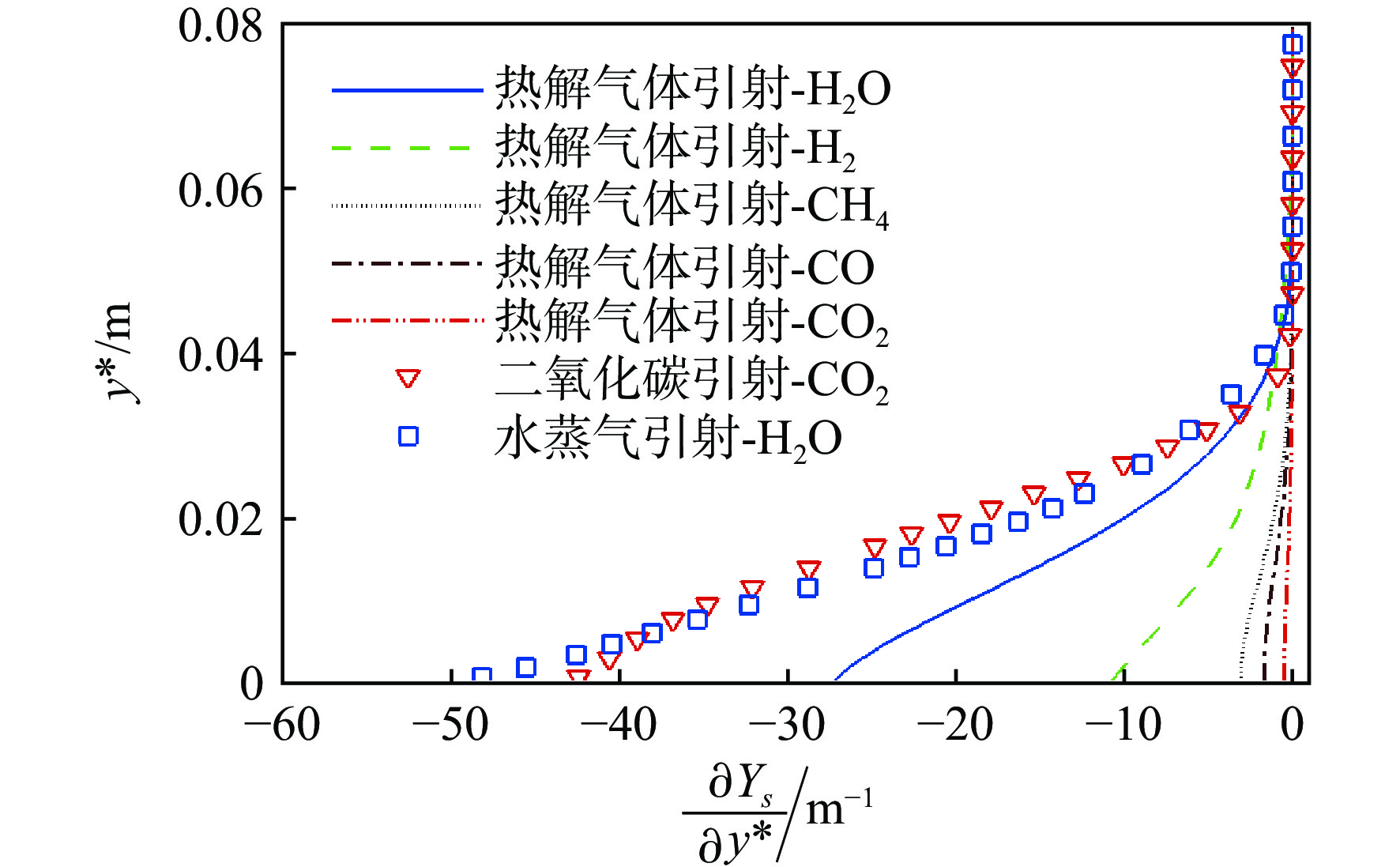
图 12 钝楔迎风面x=1.2 m处组分质量分数梯度分布
Figure 12. Distributions of component mass fraction gradient on windward of the blunt wedge at x=1.2 m
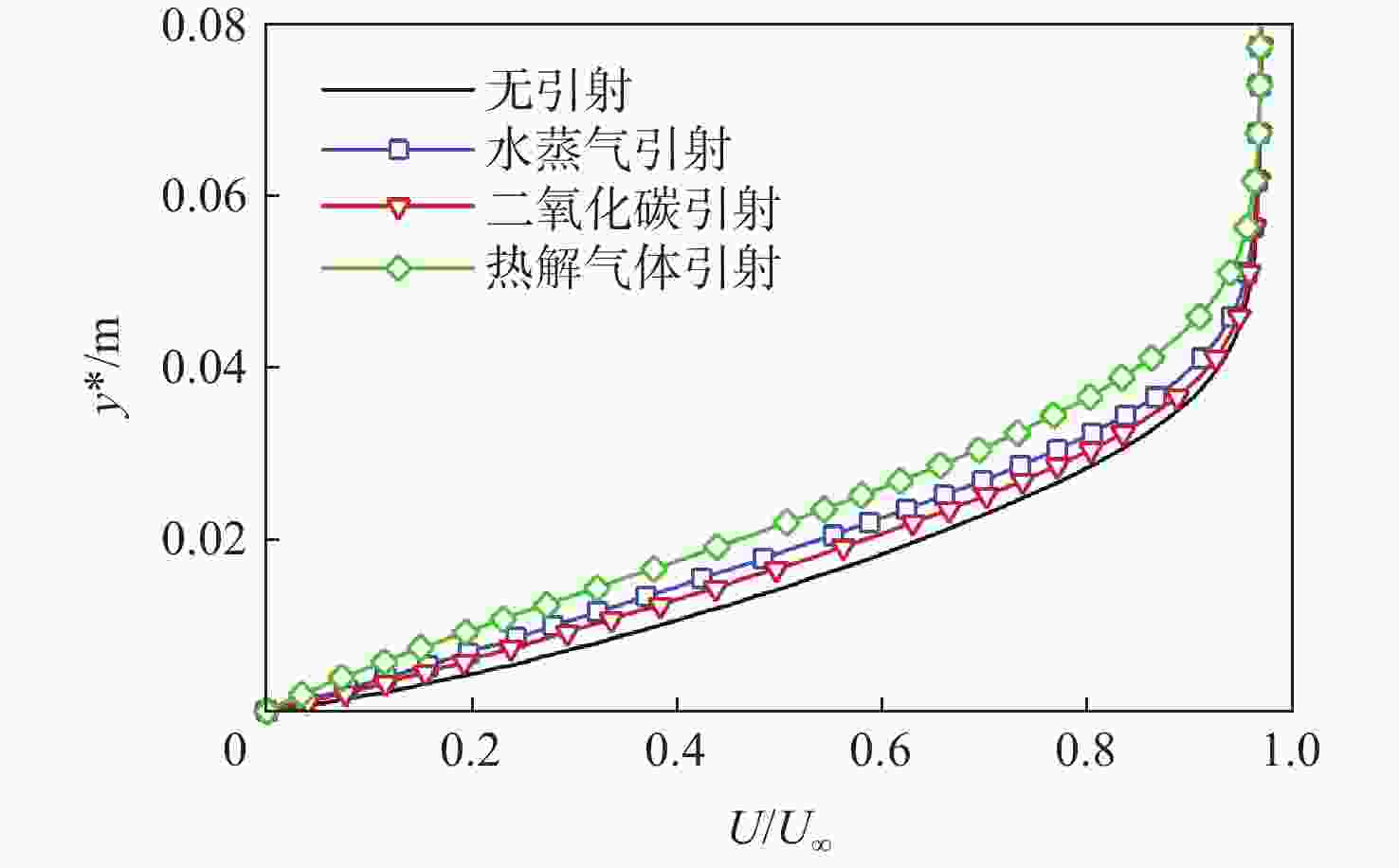
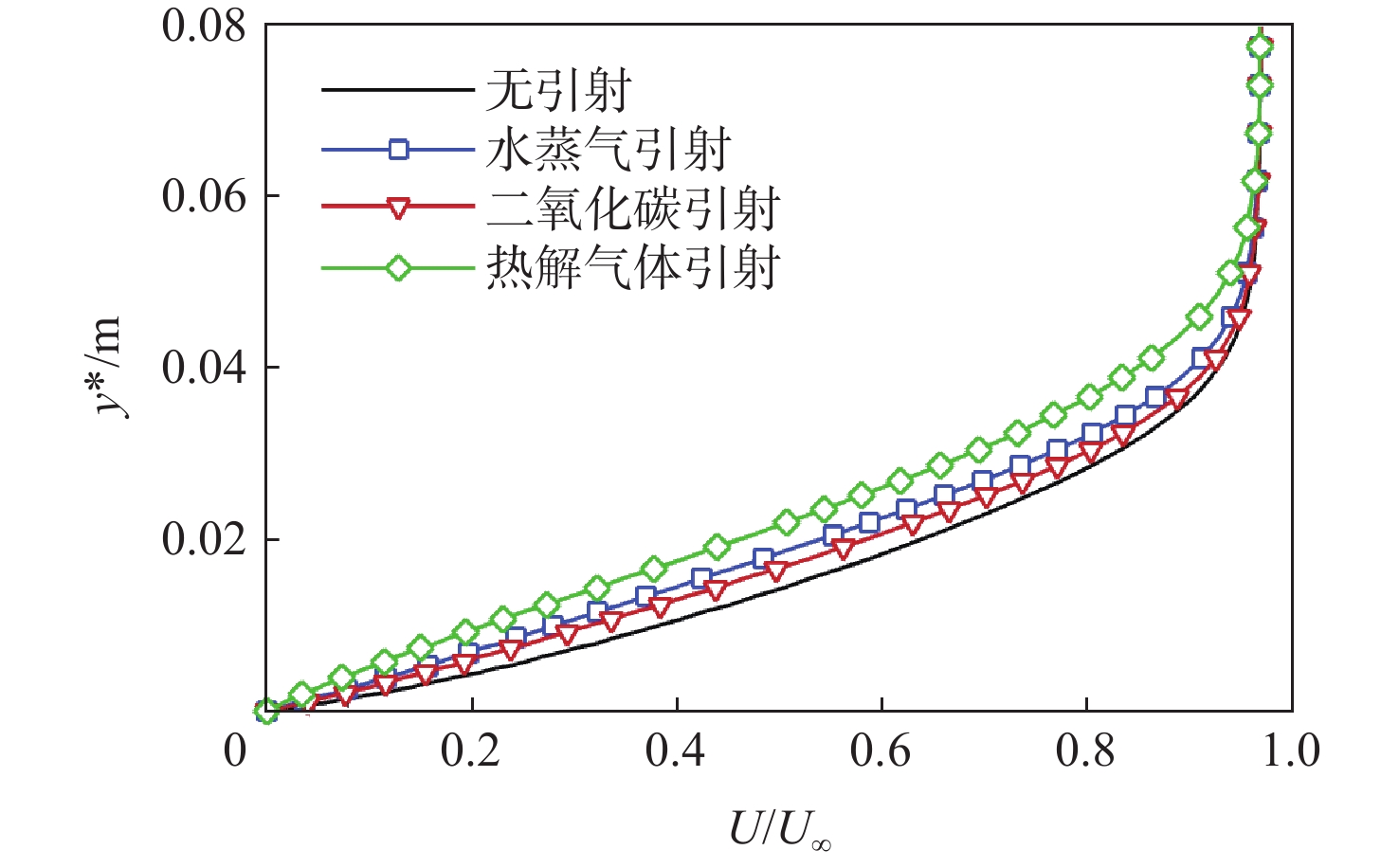
图 15 钝楔迎风面 x=1.2 m处U/U∞沿壁面法向分布
Figure 15. Distributions of U/U∞ on windward of the blunt wedge along the wall-normal direction at x=1.2 m
表 1 引射工质质量分数
Table 1. Mass injection conditions
引射工质 质量分数/% H2O 3.08 CO2 1.22 N2 67.80 H2 0.72 O2 2.44 CO 12.50 OH 3.71 NO 2.08 N 0.0078 O 6.46  下载: 导出CSV
表 2 来流工况
Table 2. Flow condition
速度/(m·s−1) 来流密度/(kg·m−3) 温度/K 迎角/(°) 7349 1.6×10⁻⁴ 233 9.5
下载: 导出CSV
表 3 质量引射工质
Table 3. Mass injection conditions
引射工质 各组分占比 H2O H2 CH4 CO CO2 水蒸气 1 0 0 0 0 二氧化碳 0 0 0 0 1 热解气体 0.66 0.23 0.06 0.01 0.01
下载: 导出CSV
表 5 引射气体各组分扩散系数和焓值
Table 5. Diffusion coefficient and enthalpy of each component of injection gas
引射工质 组分 扩散系数Ds/
(m2·s−1)焓值$h_{s}^{a} $/
(MJ·kg−1)$ \displaystyle\sum\limits_{s=1}^{ns}{D}_{s}h_{s}^{a}\dfrac{\partial {Y}_{s}}{\partial n}\Big/ $
((m2·MJ)·(s·kg)−1)热解气体 H2O 0.25 −10.75 21.17 H2 0.28 18.02 CH4 0.14 0.35 CO 0.16 −2.56 CO2 0.13 −7.54 水蒸气 H2O 0.25 −10.75 133.54 二氧化碳 CO2 0.13 −7.54 42.38
下载: 导出CSV
-
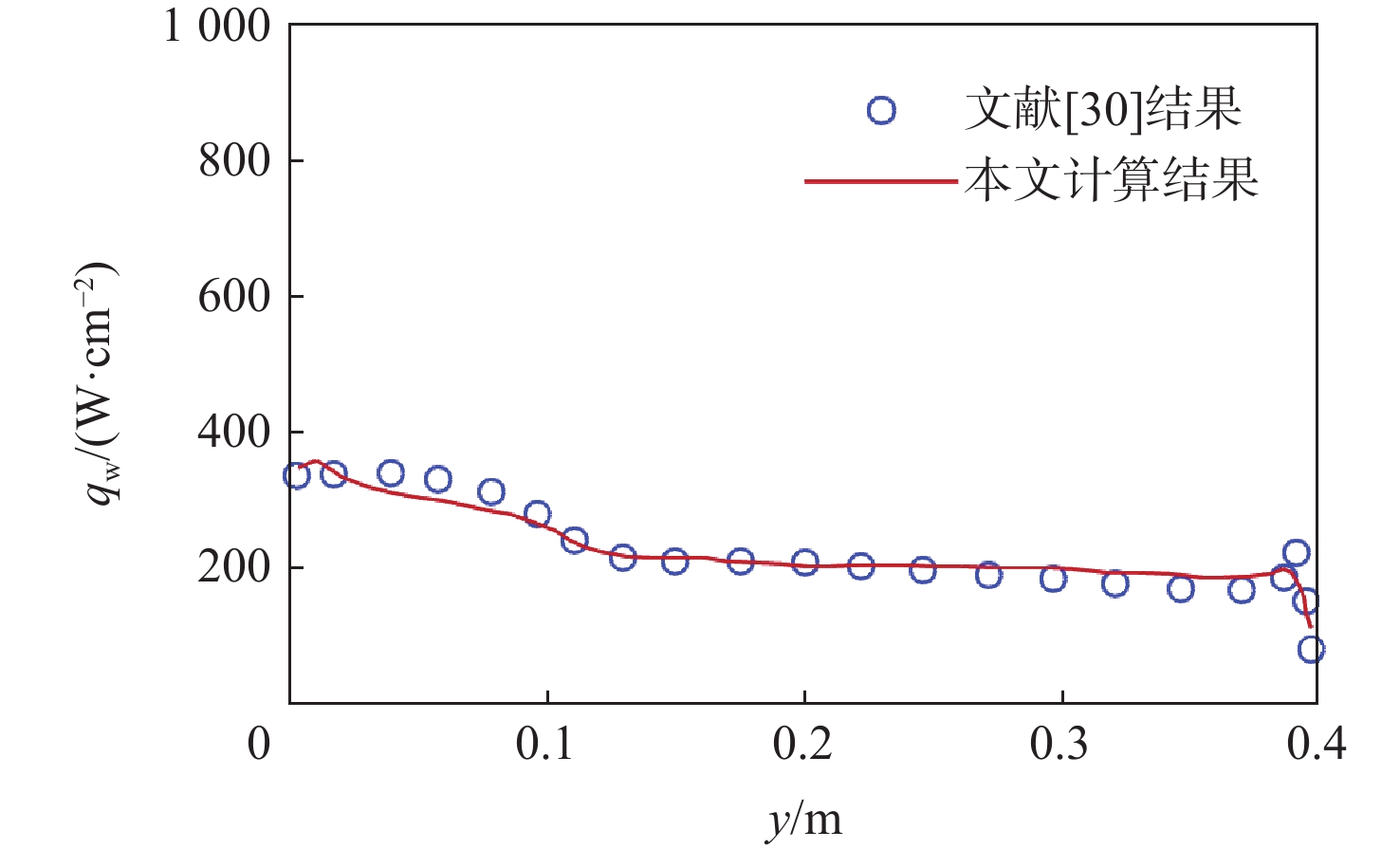
[1] 李海燕, 唐志共, 杨彦广, 等. 高超声速飞行器高温流场数值模拟面临的问题[J]. 航空学报, 2015, 36(1): 176-191.LI H Y, TANG Z G, YANG Y G, et al. Problems of numerical simulation of high-temperature gas flow fields for hypersonic vehicles[J]. Acta Aeronautica et Astronautica Sinica, 2015, 36(1): 176-191(in Chinese). [2] 杜晨慧. 高超声速飞行器综合热管理及关键技术研究进展[J]. 装备环境工程, 2023, 20(1): 43-51.DU C H. Research progress on integrated thermal management and key technology of hypersonic vehicles[J]. Equipment Environmental Engineering, 2023, 20(1): 43-51(in Chinese). [3] 林友达. 高超声速空气动力学研究进展与趋势[J]. 科学通报, 2015, 60(12): 1095-1103.LIN Y D. Advances and prospects in hypersonic aerodynamics[J]. Chinese Science Bulletin, 2015, 60(12): 1095-1103(in Chinese). [4] 周立鸣, 周宇衡. 非烧蚀防热材料在高超声速飞行器中的发展[J]. 飞航导弹, 2018(1): 14-24.ZHOU L M, ZHOU Y H. Development of non-ablative thermal protection materials for hypersonic vehicles[J]. Aerodynamic Missile Journal, 2018(1): 14-24(in Chinese). [5] 尹凯军. 防热瓦式热防护系统结构技术研究[D]. 南京: 南京航空航天大学, 2010: 9-13.YIN K J. A research on structure of ceramic tile thermal protection system[D]. Nanjing: Nanjing University of Aeronautics and Astronautics, 2010: 9-13(in Chinese). [6] 吴晓宏, 陆小龙, 李涛, 等. 轻质烧蚀材料研究综述[J]. 航天器环境工程, 2011, 28(4): 313-317.WU X H, LU X L, LI T, et al. Review of light ablative materials[J]. Spacecraft Environment Engineering, 2011, 28(4): 313-317(in Chinese). [7] 薛华飞, 姚秀荣, 程海明, 等. 热防护用轻质烧蚀材料现状与发展[J]. 哈尔滨理工大学学报, 2017, 22(1): 123-128.XUE H F, YAO X R , CHENG H M, et al. Current situation development of lightweight ablation materials for thermal protection[J]. Journal of Harbin University of Science and Technology, 2017, 22(1): 123-128(in Chinese). [8] 伊翠云, 刘甲秋, 陈英函. 轻质烧蚀材料的研究现状与展望[J]. 纤维复合材料, 2023, 40(2): 82-85.YI C Y, LIU J Q, CHEN Y H. Research status and prospects of lightweight ablative materials[J]. Fiber Composites, 2023, 40(2): 82-85(in Chinese). [9] 董维中, 高铁锁, 丁明松, 等. 硅基材料烧蚀产物对再入体流场特性影响的数值计算[J]. 空气动力学学报, 2010, 28(6): 708-714.DONG W Z, GAO T S, DING M S, et al. Numerical analysis for the effect of silicon based material ablation on the flowfield around re-entry blunt body[J]. Acta Aerodynamica Sinica, 2010, 28(6): 708-714(in Chinese). [10] 李瑾, 苏伟, 黄章峰, 等. 质量引射对边界层稳定性的影响[J]. 航空动力学报, 2020, 35(2): 280-293.LI J, SU W, HUANG Z F, et al. Effect of mass ejection on boundary layers stability[J]. Journal of Aerospace Power, 2020, 35(2): 280-293(in Chinese). [11] DEMETRIADES A, LADERMAN A J, VON SEGGERN L, et al. Effect of mass addition on the boundary layer of a hemi-sphere at Mach 6[J]. Journal of Spacecraft and Rockets, 1976, 13(8): 508-509. [12] MARVIN J G, AKIN C M. Combined effects of mass addition an nose bluntness on boundary-layer transition[J]. American Institute of Aeronautics and Astronautics, 1970, 8(5): 857-863. [13] MIRO F M, PINNA F. Injection-gas-composition effects on hypersonic boundary-layer transition[J]. Journal of Fluid Mechanics, 2020, 890(R4): 4-14. [14] SCHNEIDER S P. Hypersonic boundary-layer transition with ablation and blowing[J]. Journal of Spacecraft and Rockets, 2010, 47(2): 225-237. [15] 朱广生, 段毅, 姚世勇, 等. 壁面质量引射对高速飞行器减阻降热影响的研究[J]. 空气动力学学报, 2023, 41(8): 59-70.ZHU G S, DUAN Y, YAO S Y, et al. Effects of wall mass injection on drag and heat reduction characteristics of high-speed flight vehicles[J]. Acta Aerodynamica Sinica, 2023, 41(8): 59-70(in Chinese). [16] 周伟江, 姜贵庆. 高超声速流中局部构件上质量引射的热防护特性研究[J]. 航空学报, 1999, 20(3): 193-196.ZHOU W J, JIANG G Q. Study of heating protection features bu mass injection over the local structure in a hypersonic flow[J]. Acta Aeronautica et Astronautica Sinica, 1999, 20(3): 193-196(in Chinese). [17] 聂春生, 袁野, 马伟, 等. 主动引射气体参数对平板空气舵气动热影响[J]. 航空学报, 2022, 43(S2): 170.NIE C S, YUAN Y, MA W, et al. Effect of active injection gas parameters on thermal environment of plate and air rudder[J]. Acta Aeronautica et Astronautica Sinica, 2022, 43(S2): 170(in Chinese). [18] 樊宇翔, 赵瑞, 左政玄, 等. 气体引射效应对壁面热流和摩擦阻力的影响规律研究[J]. 航空学报, 2023, 44(21): 528587.FAN Y X, ZHAO R, ZUO Z X, et al. Gas-injection effects on wall heat flux and skin-friction of vehicles[J]. Acta Aeronautica et Astronautica Sinica, 2023, 44(21): 528587(in Chinese). [19] 张威, 曾明, 肖凌飞, 等. 碳-酚醛材料烧蚀热解对再入流场特性影响的数值计算[J]. 国防科技大学学报, 2014, 36(4): 41-48.ZHANG W, ZENG M, XIAO L F, et al. Numerical study for the effects of ablation and pyrolysis on the hypersonic reentry flow[J]. Journal of National University of Defense Technology, 2014, 36(4): 41-48(in Chinese). [20] 周禹. 高超声速热化学非平衡流场数值模拟研究[D]. 北京: 北京航空航天大学, 2009: 45-55.ZHOU Y. Numerical simulation of hypersonic thermochemical non-equilibrium flow field[D]. Beijing: Beihang University, 2009: 45-55(in Chinese). [21] GNOFFO P A, GUPTA R N, SHINN J L. Conservation equations and physical models for hypersonic air flows in thermal and chemical nonequilibrium: NASA-TP-2867[R]. Washington, D.C: NASA, 1989: 1-3. [22] SARMA G S R. Physico-chemical modelling in hypersonic flow simulation[J]. Progress in Aerospace Sciences, 2000, 36(3): 281-349. [23] LEONARDO S, LAIN B. Numerical simulation of weakly ionized hypersonic flow for reentry configurations[C]//Proceedings of the 9th AIAA/ASME Joint Thermophysics and Heat Transfer Conference. Reston: AIAA, 2006. [24] GUPTA R N, YOS J M, THOMPSON R A, et al. A review of reaction rates and thermodynamic and transport properties for an 11-species air model for chemical and thermal nonequilibrium calculations to 30000 K: NASA-RP-1232[R]. Washington, D.C: NASA, 1990: 11-17. [25] PARK C. Review of chemical-kinetic problems of future NASA missions. I-Earth entries[J]. Journal of Thermo-physics and Heat Transfer, 1993, 7(3): 385-398. [26] PARK C, HOWE J T, JAFFE R L, et al. Review of chemical-kinetic problems of future NASA missions. II-Mars entries[J]. Journal of Thermophysics and Heat Transfer, 1994, 8(1): 9-23. [27] 李海燕. 高超声速高温气体流场的数值模拟[D]. 绵阳: 中国空气动力研究与发展中心, 2007: 19-24.LI H Y. Numerical simulation of hypersonic and high temperature gas flowfields[D]. Mianyang: China Aerodynamics Research and Development Center, 2007: 19-24(in Chinese). [28] 赵一朴. 含化学非平衡效应的钝体绕流的发汗型降热减阻数值研究[D]. 北京: 北京交通大学, 2022: 28-29.ZHAO Y P. Numerical study on heat and drag reduction of transpiration with chemical nonequilibrium flow past a blunt body[D]. Beijing: Beijing Jiaotong University, 2022: 28-29(in Chinese). [29] MICHAEL J W, GRAHAM C, DEEPAK B, et al. A data-parallel line relaxation method for the navier-stokes equations[C]//Proceedings of the 13th Computational Fluid Dynamics Conference. Reston: AIAA, 1997. [30] MARTIN A, BOYD I D. Modeling of heat transfer attenuation by ablative gases during the stardust reentry[J]. Journal of Thermophysics and Heat Transfer, 2015, 29(3): 450-466. -

 下载:
下载:

 点击查看大图
计量
- 文章访问数: 430
- HTML全文浏览量: 129
- PDF下载量: 15
- 被引次数: 0
