





-
摘要:
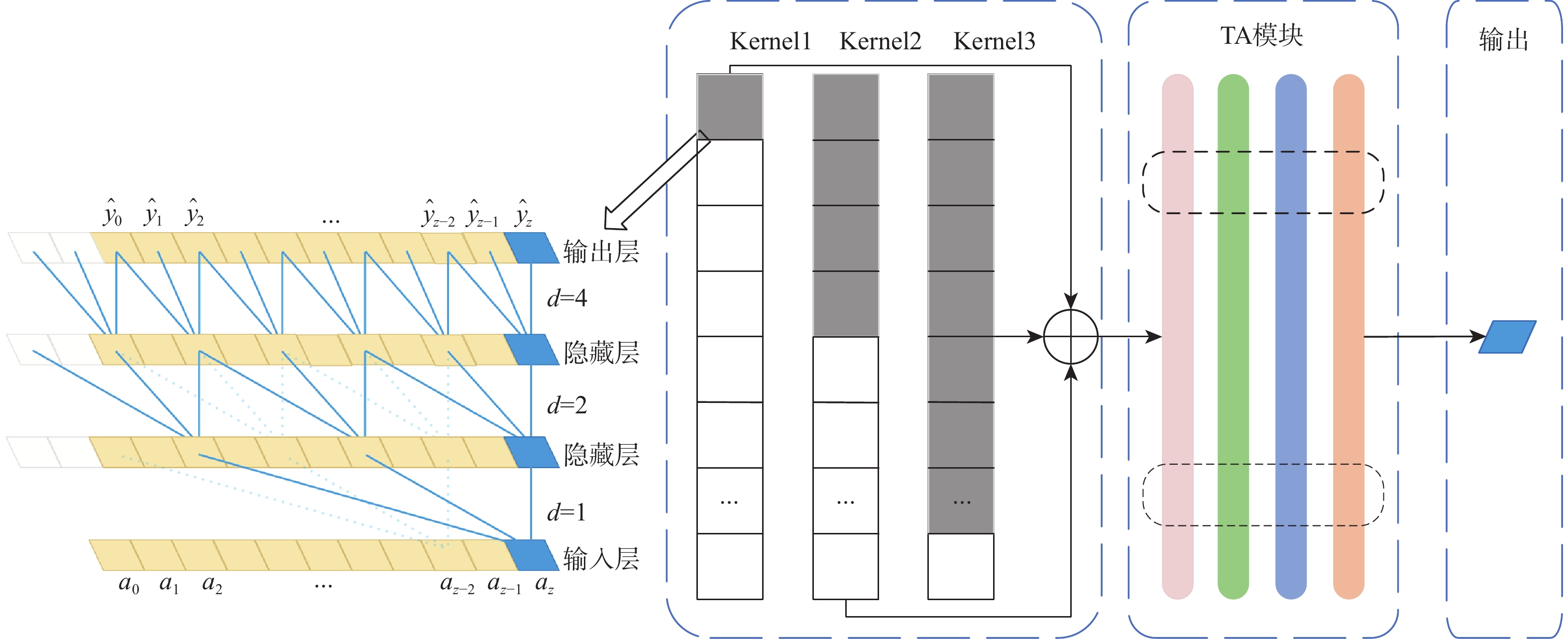
电力负荷预测对于电力系统的稳定运行有着重要意义。传统短期预测算法常使用线性回归模型进行负荷预测,无法捕捉到复杂的负荷波动,导致预测结果准确性受到限制,因此,提出一种基于迁移学习(TL)的时间卷积网络-双向门控循环单元(TCN-BiGRU)模型。采用迁移学习策略将相关性高的信息迁移到实验模型中,利用K-medoids聚类算法对数据进行聚类分析,通过并行卷积策略提取TCN不同尺度的特征,利用时间注意力(TA)捕获相关信息,结合BiGRU进一步提取TCN训练输出的非线性特征,使用动态多群粒子群优化(DMS-PSO)算法对网络训练的超参数寻找最佳的超参数组合。实验结果表明:相对于门控循环单元(GRU),所提TL-TCN-BiGRU算法的平均绝对误差(MAE)降低了38.6%,均方根误差(RMSE)降低了40.7%,平均绝对百分比误差(MAPE)降低了30.4%,
R 2提升了5.3%。-
关键词:
- 短期负荷预测 /
- 迁移学习 /
- 时间卷积网络 /
- K-medoids聚类 /
- 融合网络
Abstract:Electricity load forecasting is of great significance to the stable operation of power systems. For load forecasting, traditional short-term forecasting techniques frequently employ linear regression models, which have low forecasting accuracy due to the models’ inability to incorporate complicated load changes. A temporal convolutional network-bidirectional gated recurrent unit (TCN-BiGRU) model based on transfer learning (TL) is proposed. Highly relevant information is moved into the experimental model using a transfer learning strategy; the data is clustered and analyzed using a K-medoids clustering algorithm; features at various TCN scales are extracted using a parallel convolution strategy; pertinent information is captured using temporal attention (TA); and the TCN training is further extracted using a BiGRU. The non-linear features of the output are further extracted using the dynamic multigroup particle swarm optimization (DMS-PSO) algorithm to optimize and tune the hyperparameters of the network training in order to find the best combination of hyperparameters. The experimental results show that the proposed TL-TCN-BiGRU algorithm reduces mean absolute error (MAE) by 38.6%, root mean square error (RMSE) by 40.7%, mean absolute percentage error (MAPE) by 30.4%, and
R 2 by 5.3% relative to the gated recurrent unit (GRU). -
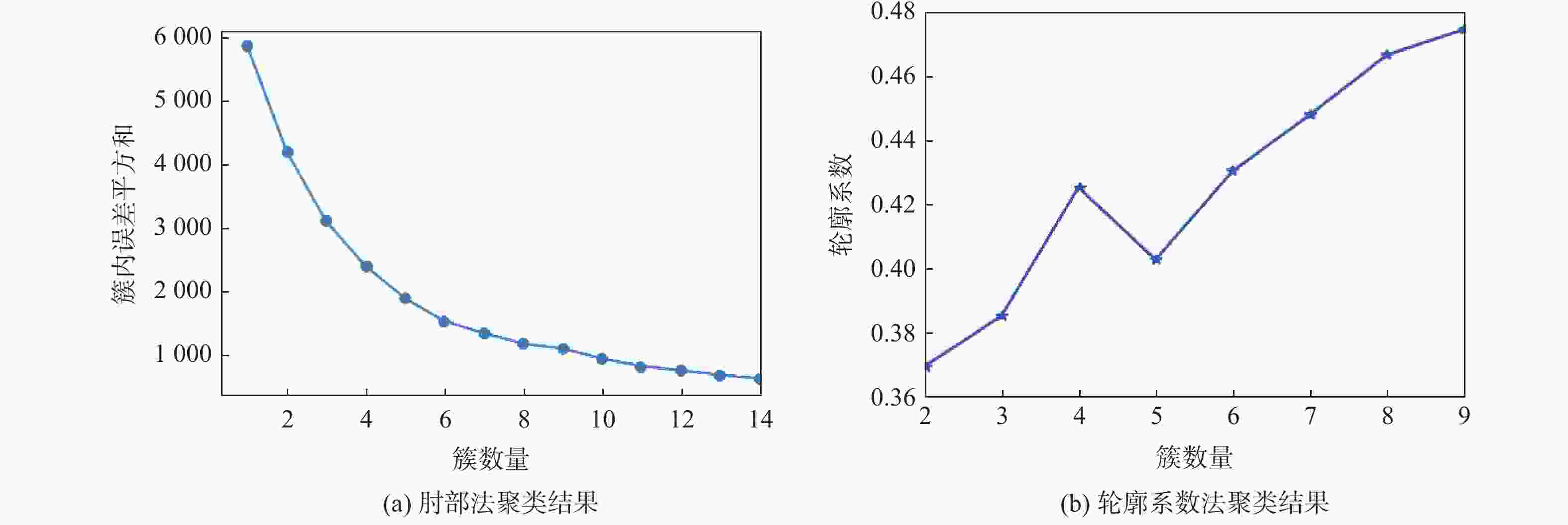
图 4 不同簇数量下SSE和轮廓系数的变化曲线
Figure 4. Curves of SSE and silhouette coefficient under different cluster numbers
表 1 DMS-PSO算法寻优结果
Table 1. DMS-PSO algorithm optimisation results
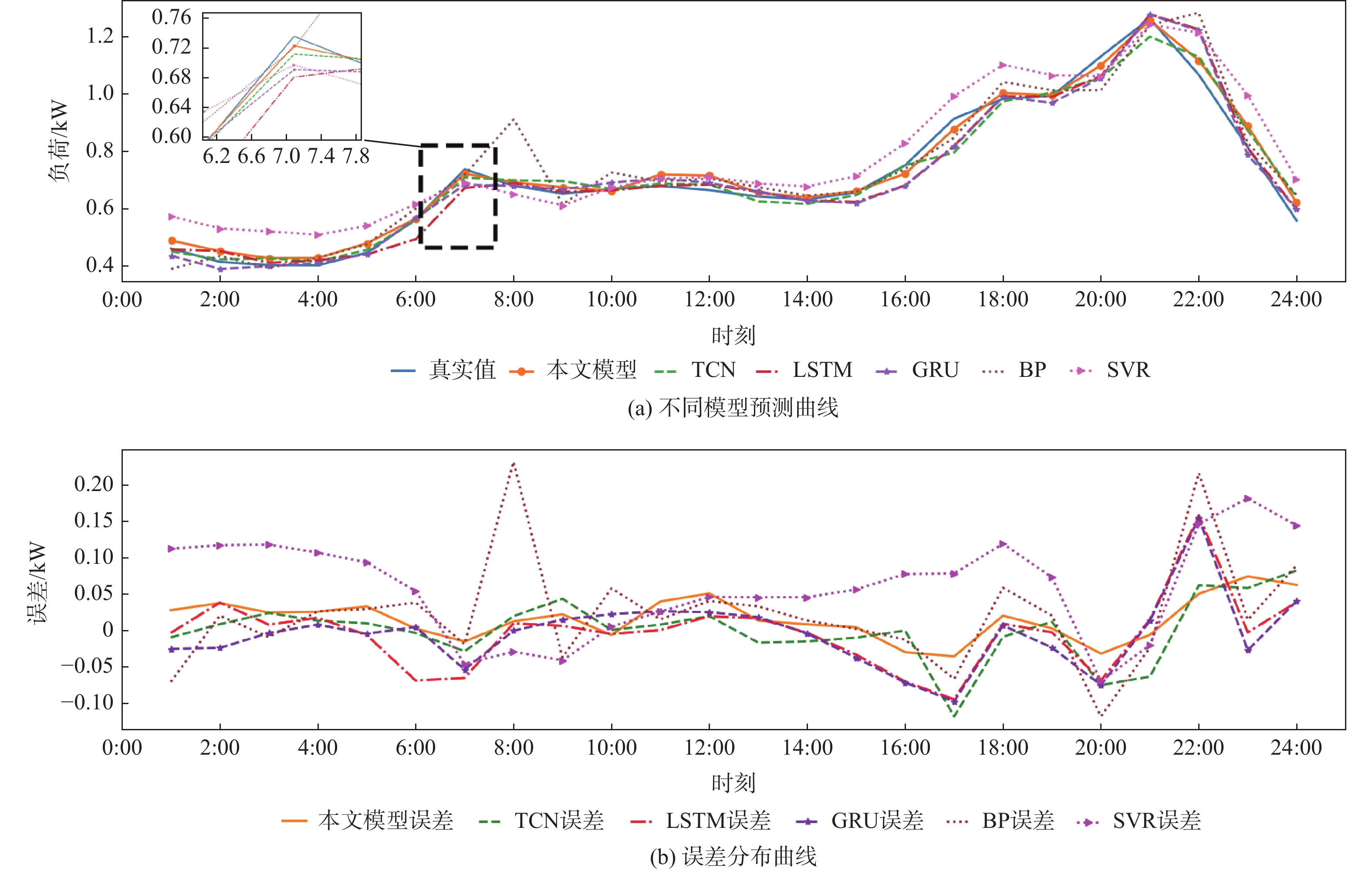
寻优参数 范围 寻优结果 BiGRU隐藏层神经元数量 [1,50] 31 卷积核大小 [3,5] 4 Dropout [0,0.5] 0.01 学习率 [ 0.0001 ,0.01]0.001 批处理大小 [16,32] 20 迭代次数 [100,200] 121  下载: 导出CSV
表 2 不同聚类算法指标对比
Table 2. Comparison of indicators of different clustering methods
聚类算法 DB指数 CH指数 DBSCAN 1.459 805.715 K-means 1.368 990.687 K-medoids 1.231 1083.451
下载: 导出CSV
表 3 不同优化算法效果对比
Table 3. Comparison of effect of different optimization algorithms
聚类算法 MAE/kW MAPE/‰ GA 0.092 0.7023 PSO 0.075 0.5236 DMS-PSO 0.035 0.4183
下载: 导出CSV
表 4 消融实验结果
Table 4. Ablation experiment results
TCN TA结构 BiGRU DMS-PSO K-medoids聚类 TL模块 MAE/kW RMSE/kW MAPE/‰ $ {R}^{2} $ √ 0.065 0.099 0.7435 0.908 √ 0.062 0.091 0.7174 0.922 √ √ 0.059 0.088 0.6709 0.928 √ √ √ 0.052 0.080 0.5795 0.940 √ √ √ √ 0.046 0.072 0.5061 0.964 √ √ √ √ √ √ 0.035 0.054 0.4183 0.972
下载: 导出CSV
表 5 不同模型评价结果
Table 5. Evaluation results of different models
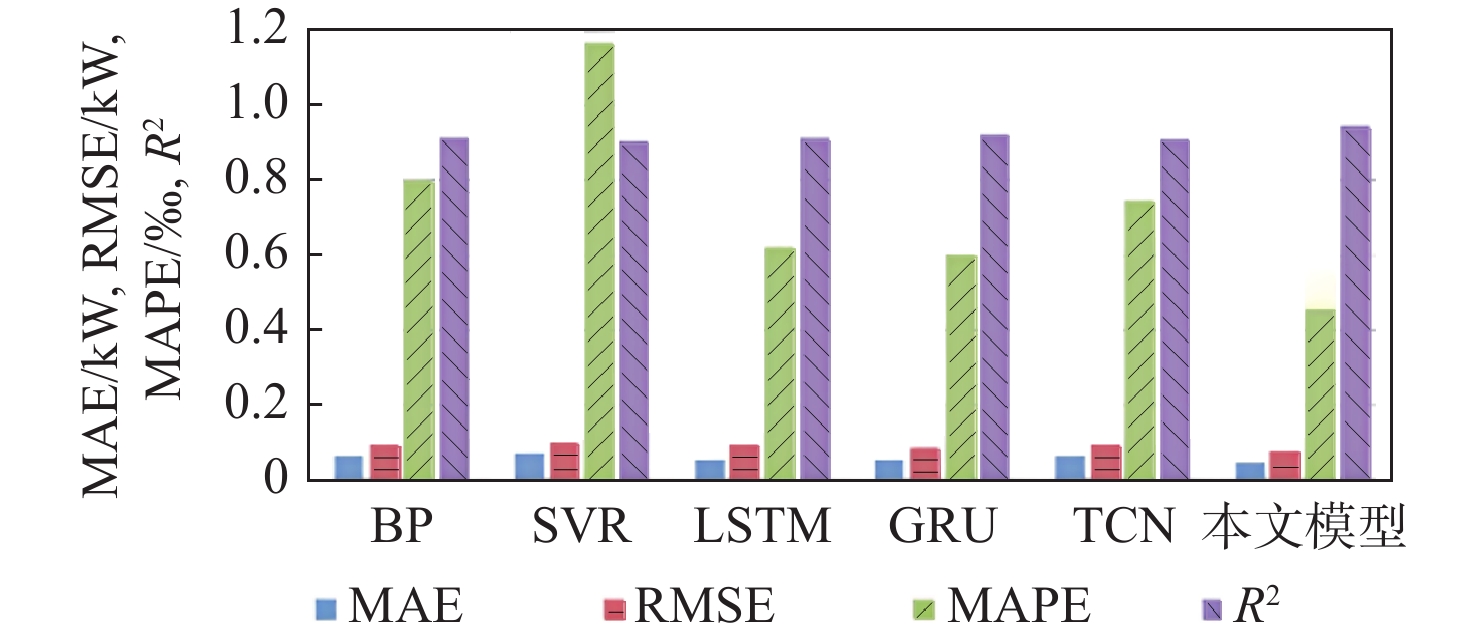
模型 MAE/kW RMSE/kW MAPE/‰ $ {R}^{2} $ BP 0.066 0.096 0.7995 0.914 SVR 0.076 0.101 1.1669 0.905 LSTM 0.058 0.097 0.6244 0.912 GRU 0.057 0.091 0.6009 0.923 TCN 0.065 0.099 0.7435 0.908 本文模型 0.035 0.054 0.4183 0.972
下载: 导出CSV
-
[1] 刘倩倩, 刘钰山, 温烨婷, 等. 基于PCC-LSTM模型的短期负荷预测方法[J]. 北京航空航天大学学报, 2022, 48(12): 2529-2536.LIU Q Q, LIU Y S, WEN Y T, et al. Short-term load forecasting method based on PCC-LSTM model[J]. Journal of Beijing University of Aeronautics and Astronautics, 2022, 48(12): 2529-2536(in Chinese). [2] LI X M, GUO X C, LIU L N, et al. A novel seasonal grey model for forecasting the quarterly natural gas production in China[J]. Energy Reports, 2022, 8: 9142-9157. [3] 王艳松, 申晓阳, 李强, 等. 基于PCA-GRD-LWR模型的海上油田中长期最大电力负荷预测[J]. 中国石油大学学报(自然科学版), 2023, 47(2): 129-135.WANG Y S, SHEN X Y, LI Q, et al. Forecasting of medium and long-term maximum power load for offshore oilfields based on PCA-GRD-LWR model[J]. Journal of China University of Petroleum (Edition of Natural Science), 2023, 47(2): 129-135(in Chinese). [4] 李丹, 孙光帆, 缪书唯, 等. 基于多维时序信息融合的短期电力负荷预测方法[J]. 中国电机工程学报, 2023, 43(S1): 94-106.LI D, SUN G F, MIAO S W, et al. A short-term power load forecasting method based on multidimensional temporal information fusion[J]. Proceedings of the CSEE, 2023, 43(S1): 94-106(in Chinese). [5] ZHANG R X, ZHU Z Y, YUAN M, et al. Regional residential short-term load-interval forecasting based on SSA-LSTM and load consumption consistency analysis[J]. Energies, 2023, 16(24): 8062. [6] BACANIN N, STOEAN C, ZIVKOVIC M, et al. On the benefits of using metaheuristics in the hyperparameter tuning of deep learning models for energy load forecasting[J]. Energies, 2023, 16(3): 1434. [7] AL-JAMIMI H A, BINMAKHASHEN G M, WORKU M Y, et al. Advancements in household load forecasting: deep learning model with hyperparameter optimization[J]. Electronics, 2023, 12(24): 4909. [8] WANG J Z, WANG K, LI Z W, et al. A multitask integrated deep-learning probabilistic prediction for load forecasting[J]. IEEE Transactions on Power Systems, 2024, 39(1): 1240-1250. [9] TRAN T N. Grid search of convolutional neural network model in the case of load forecasting[J]. Archives of Electrical Engineering, 2021, 70(1): 25-36. [10] ESKANDARI H, IMANI M, MOGHADDAM M P. Convolutional and recurrent neural network based model for short-term load forecasting[J]. Electric Power Systems Research, 2021, 195: 107173. [11] CAICEDO-VIVAS J S, ALFONSO-MORALES W. Short-term load forecasting using an LSTM neural network for a grid operator[J]. Energies, 2023, 16(23): 7878. [12] 李艳波, 尹镨, 陈俊硕, 等. 结合改进残差网络和Bi-LSTM的短期电力负荷预测[J]. 哈尔滨工业大学学报, 2023, 55(8): 79-86.LI Y B, YIN P, CHEN J S, et al. Short-term power load forecasting based on combination of residual network and Bi-LSTM[J]. Journal of Harbin Institute of Technology, 2023, 55(8): 79-86(in Chinese). [13] BAI S J, KOLTER J Z, KOLTUN V. An empirical evaluation of generic convolutional and recurrent networks for sequence modeling[EB/OL]. (2018-04-19)[2024-01-10]. https://arxiv.org/abs/1803.01271. [14] CHUNG J, ÇAGLAR G, CHO K, et al. Empirical evaluation of gated recurrent neural networks on sequence modeling[EB/OL]. (2014-12-11)[2024-01-10]. https://arxiv.org/abs/1412.3555. [15] XU H S, FAN G L, KUANG G F, et al. Construction and application of short-term and mid-term power system load forecasting model based on hybrid deep learning[J]. IEEE Access, 2023, 11: 37494-37507. [16] 吴晨, 姚菁, 薛贵元, 等. 基于MMoE多任务学习和长短时记忆网络的综合能源系统负荷预测[J]. 电力自动化设备, 2022, 42(7): 33-39.WU C, YAO J, XUE G Y, et al. Load forecasting of integrated energy system based on MMoE multi-task learning and LSTM[J]. Electric Power Automation Equipment, 2022, 42(7): 33-39(in Chinese). [17] 杨国华, 郑豪丰, 张鸿皓, 等. 基于Holt-Winters指数平滑和时间卷积网络的短期负荷预测[J]. 电力系统自动化, 2022, 46(6): 73-82.YANG G H, ZHENG H F, ZHANG H H, et al. Short-term load forecasting based on Holt-Winters exponential smoothing and temporal convolutional network[J]. Automation of Electric Power Systems, 2022, 46(6): 73-82(in Chinese). [18] 叶林, 李奕霖, 裴铭, 等. 寒潮天气小样本条件下的短期风电功率组合预测[J]. 中国电机工程学报, 2023, 43(2): 543-555.YE L, LI Y L, PEI M, et al. Combined approach for short-term wind power forecasting under cold weather with small sample[J]. Proceedings of the CSEE, 2023, 43(2): 543-555(in Chinese). [19] 邹智, 吴铁洲, 张晓星, 等. 基于贝叶斯优化CNN-BiGRU混合神经网络的短期负荷预测[J]. 高电压技术, 2022, 48(10): 3935-3945.ZOU Z, WU T Z, ZHANG X X, et al. Short-term load forecasting based on Bayesian optimized CNN-BiGRU hybrid neural network[J]. High Voltage Technology, 2022, 48(10): 3935-3945(in Chinese). [20] HUO F C, CHEN Y, REN W J, et al. Prediction of reservoir key parameters in ‘sweet spot’ on the basis of particle swarm optimization to TCN-LSTM network[J]. Journal of Petroleum Science and Engineering, 2022, 214: 110544. [21] 苏伟, 肖小龙, 史明明, 等. 周期规律增强的多视角短期电力负荷预测[J]. 北京航空航天大学学报, 2024, 50(2): 477-486.SU W, XIAO X L, SHI M M, et al. Periodic pattern-enhanced multi-view short-term load prediction[J]. Journal of Beijing University of Aeronautics and Astronautics, 2024, 50(2): 477-486(in Chinese). [22] LI F, WANG C F. Develop a multi-linear-trend fuzzy information granule based short-term time series forecasting model with K-medoids clustering[J]. Information Sciences, 2023, 629: 358-375. [23] 欧阳福莲, 王俊, 周杭霞. 基于改进迁移学习和多尺度CNN-BiLSTM-Attention的短期电力负荷预测方法[J]. 电力系统保护与控制, 2023, 51(2): 132-140.OUYANG F L, WANG J, ZHOU H X. Short-term power load forecasting method based on improved hierarchical transfer learning and multi-scale CNN-BiLSTM-Attention[J]. Power System Protection and Control, 2023, 51(2): 132-140(in Chinese). [24] HU Q H, ZHANG R J, ZHOU Y C. Transfer learning for short-term wind speed prediction with deep neural networks[J]. Renewable Energy, 2016, 85: 83-95. [25] JIN Y W, ACQUAH M A, SEO M, et al. Short-term electric load prediction using transfer learning with interval estimate adjustment[J]. Energy and Buildings, 2022, 258: 111846. -

 下载:
下载:



 点击查看大图
计量
- 文章访问数: 403
- HTML全文浏览量: 121
- PDF下载量: 34
- 被引次数: 0
