





-
摘要:
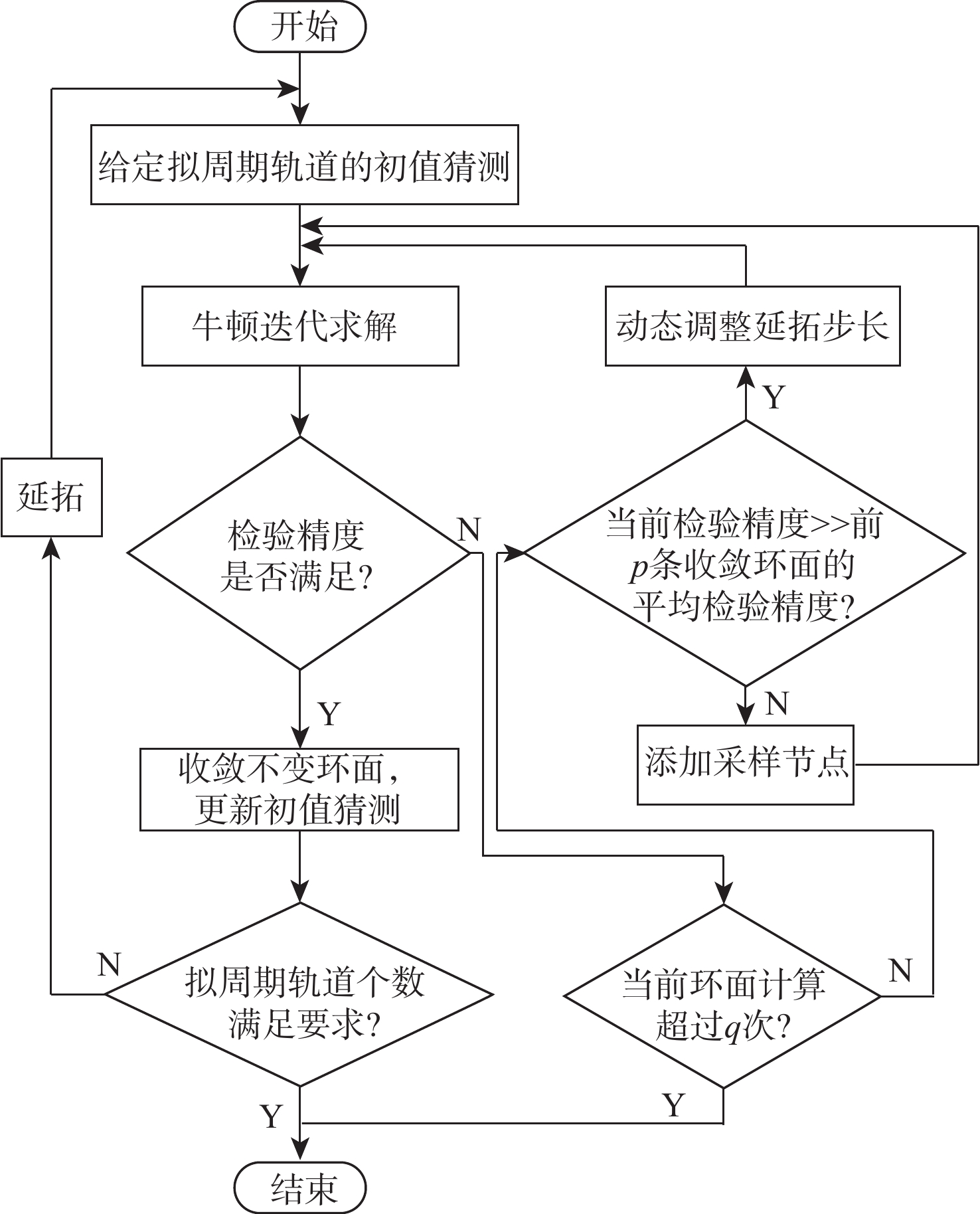
地月空间2∶1共振远距离逆行轨道(DRO)因其长期稳定和全域可达的良好特性,在当前地月空间任务探索中具有重要的战略意义。为进一步理解2∶1 DRO附近的相空间结构,同时提供更多的可供选择的停泊轨道,在双圆限制性四体模型(BCR4BP)下对2种不同构型的2∶1 DRO附近的拟周期轨道进行了计算。针对目前数值延拓计算拟周期轨道过程较为繁复的缺点,提出一种自适应延拓算法,该算法可自动调节延拓步长及添加表征环面所需的离散节点数量,从而在保证环面精度的情况下越过共振区,同时平衡了计算时间。在此基础上,针对BCR4BP中2种不同构型的2∶1 DRO,分别计算了其附近存在的2D拟DRO 族,进一步分析了其稳定特性。仿真结果表明:所提算法能有效差异化处理采样阶次不足与共振奇异,从而得到较为完整的轨道族。
Abstract:The 2∶1 resonant distant retrograde orbit (DRO), owing to its long-term stability and extensive global accessibility in the Earth-Moon space, holds strategic significance in contemporary space exploration missions. Investigations of quasi-periodic orbits near two distinct configurations of the 2∶1 DRO were carried out in the bicircular restricted four-body problem (BCR4BP) in order to better understand the phase space structure near the 2∶1 DRO and offer more parking orbit alternatives. Firstly, addressing the complexity in the numerical continuation of quasi-periodic orbits, an adaptive continuation scheme was proposed. This approach ensures the overstep of the resonance region while maintaining torus accuracy by automatically adjusting the continuation step size and the number of discrete nodes representing the torus. Based on this scheme, we computed quasi-periodic families near the 2∶1 DRO for both configurations in the BCR4BP and conducted a comprehensive analysis of their stability characteristics. The simulation results demonstrate the efficacy of the proposed method in differentiating and handling issues related to insufficient sampling orders and resonance singularities, yielding a more complete set of orbit families.
-
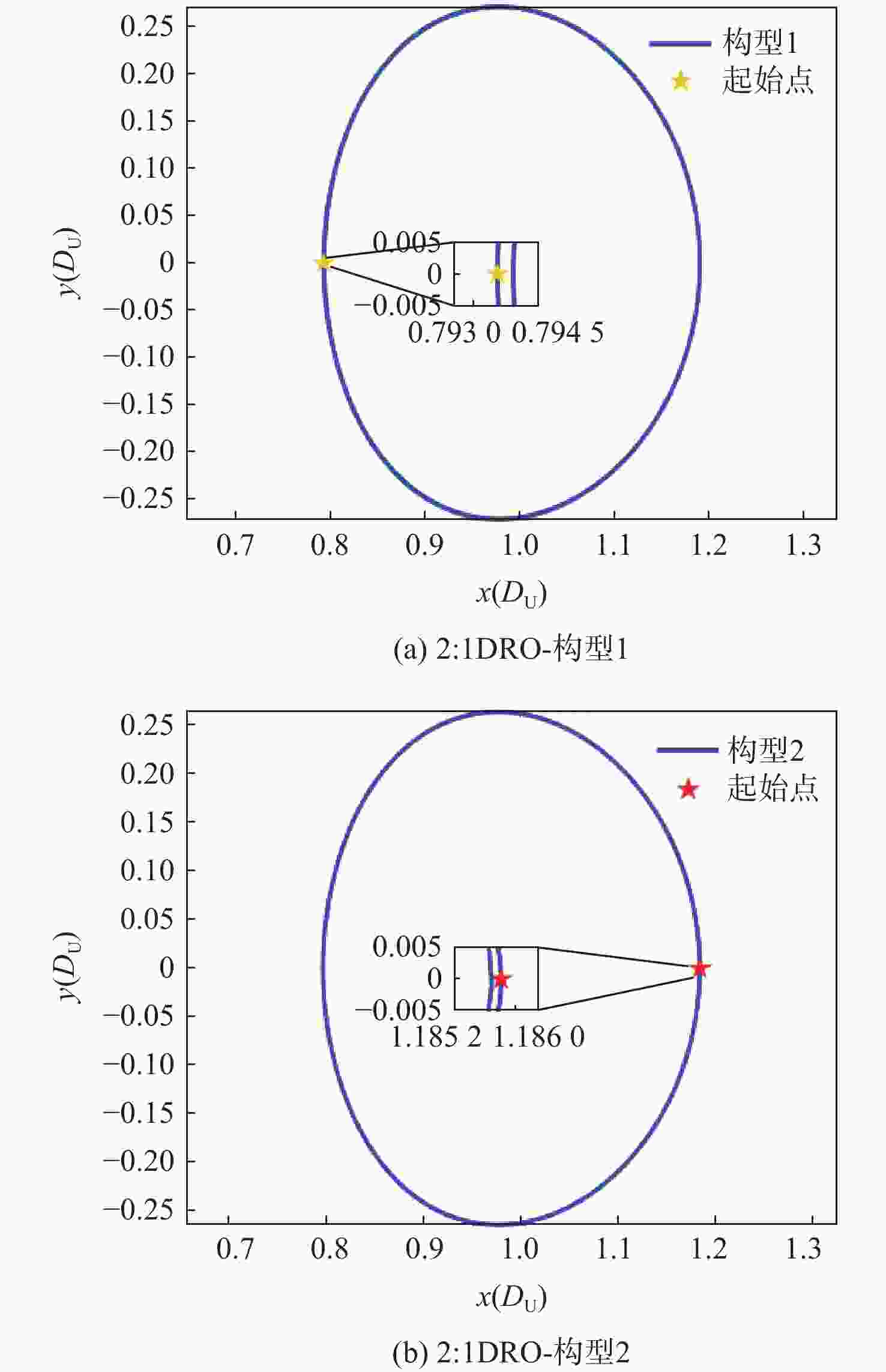
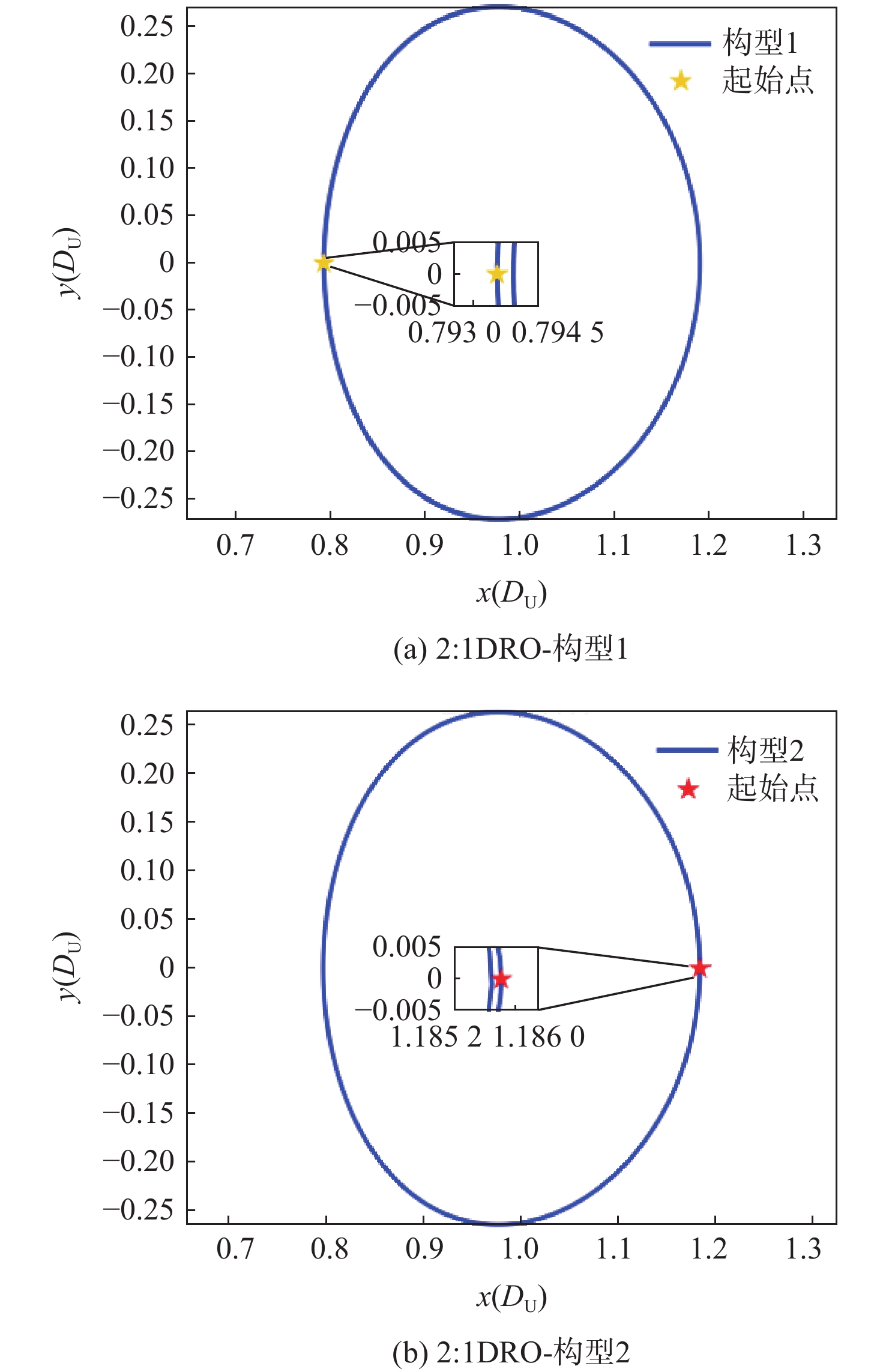
图 2 双圆限制性四体模型中的2种2∶1 DRO构型
Figure 2. Two different configurations of 2∶1 DRO in BCR4BP
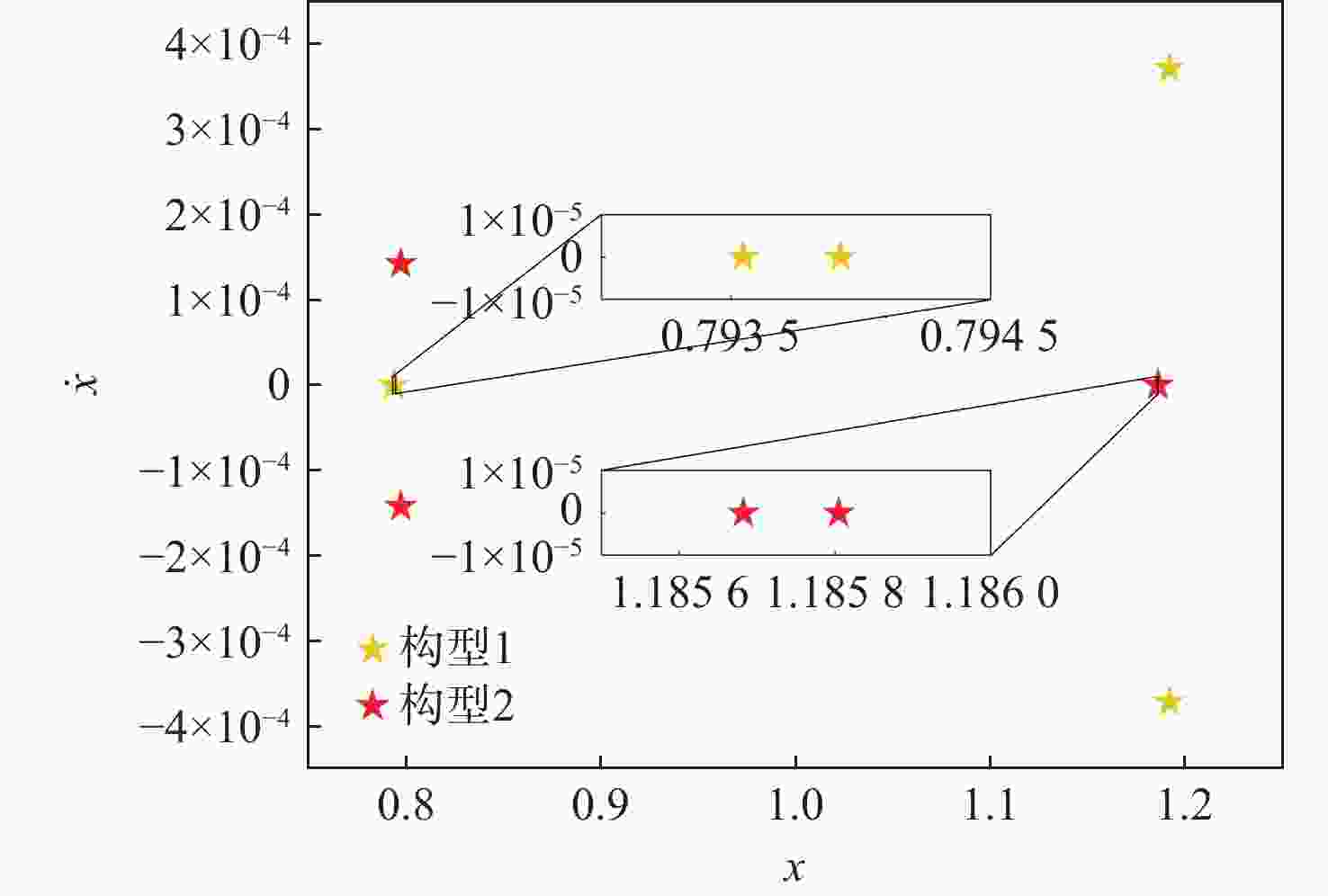
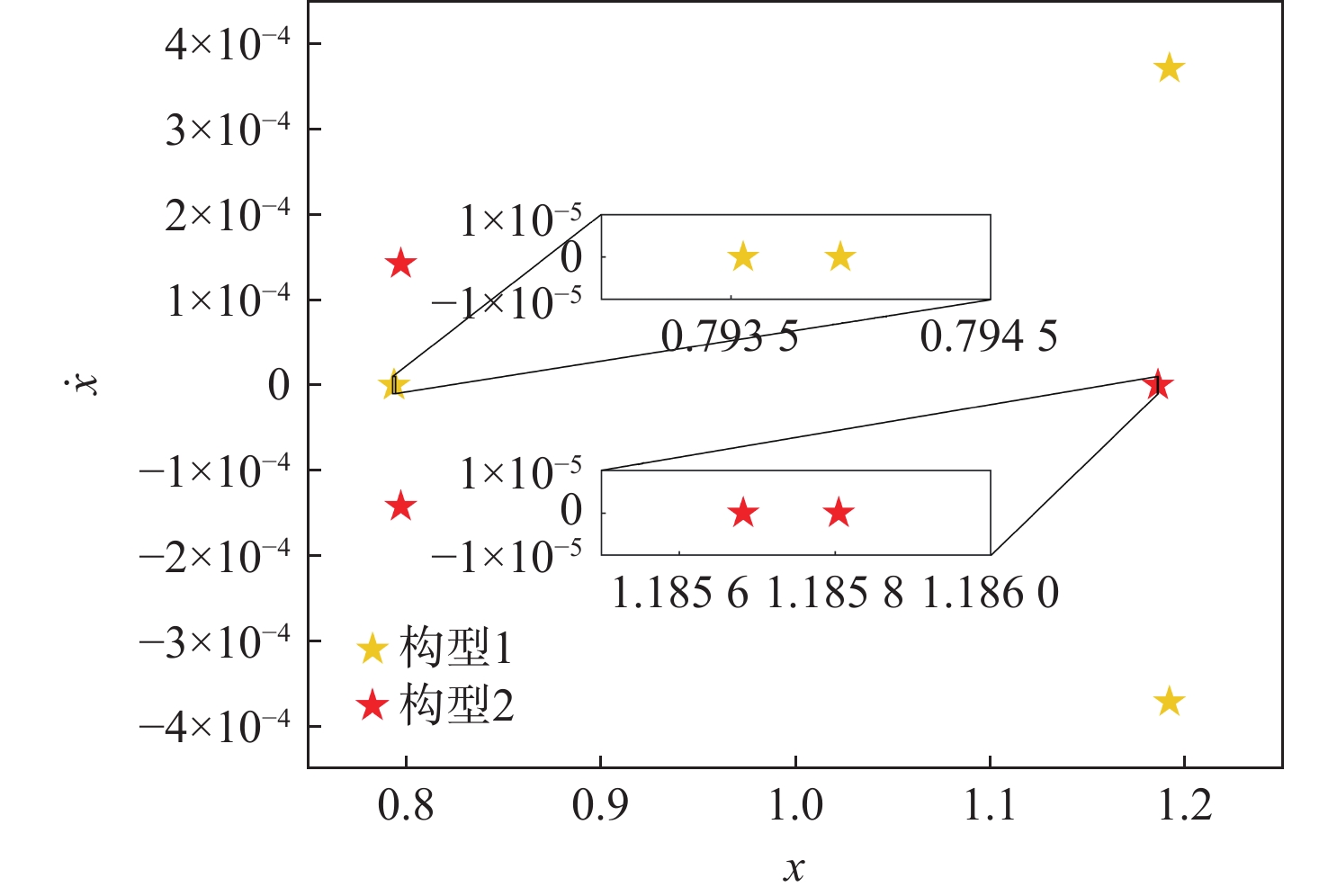
图 3 2种DRO构型在庞加莱截面上的投影
Figure 3. Two different configurations of 2∶1 DRO projected on the Poincaré section
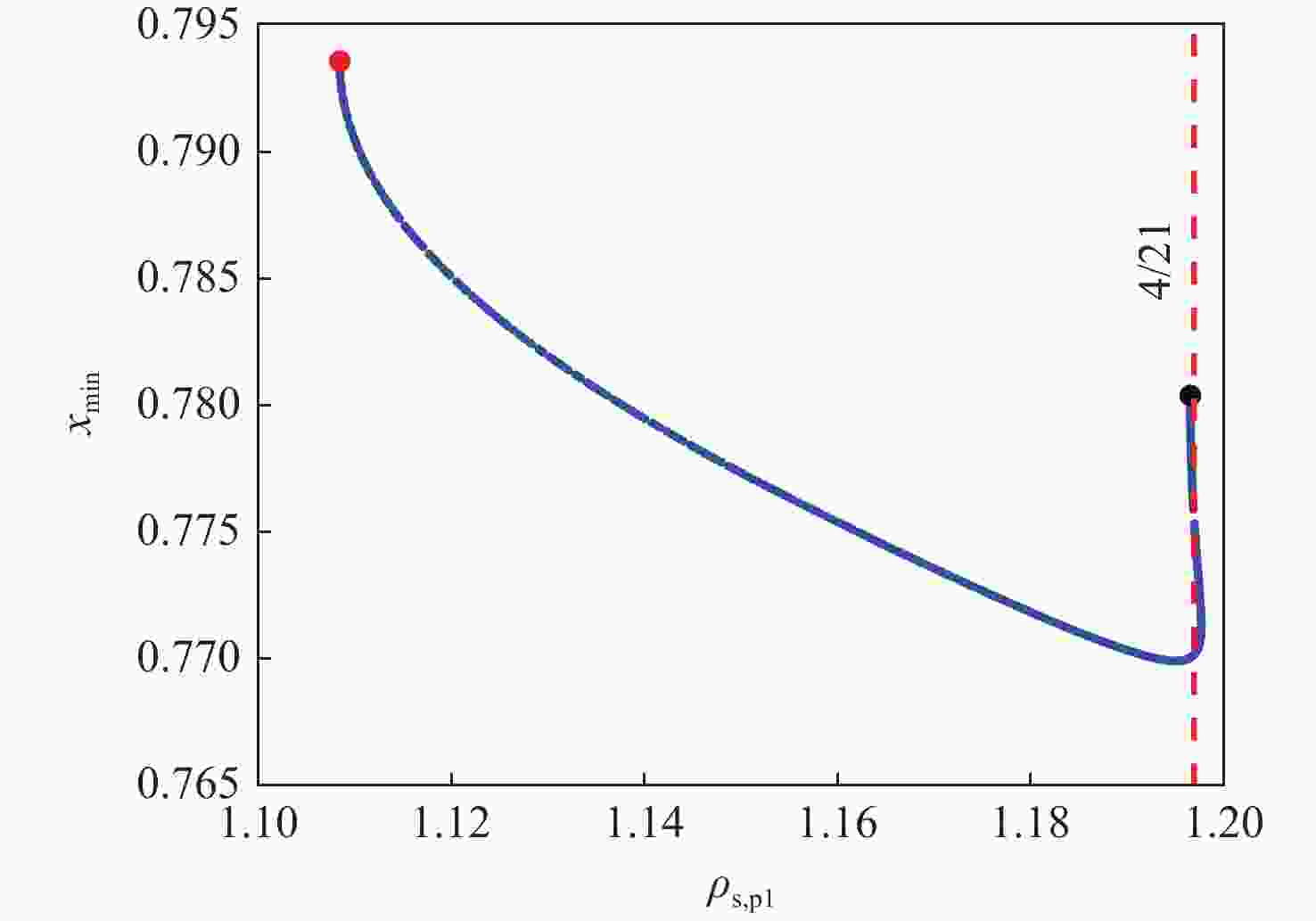
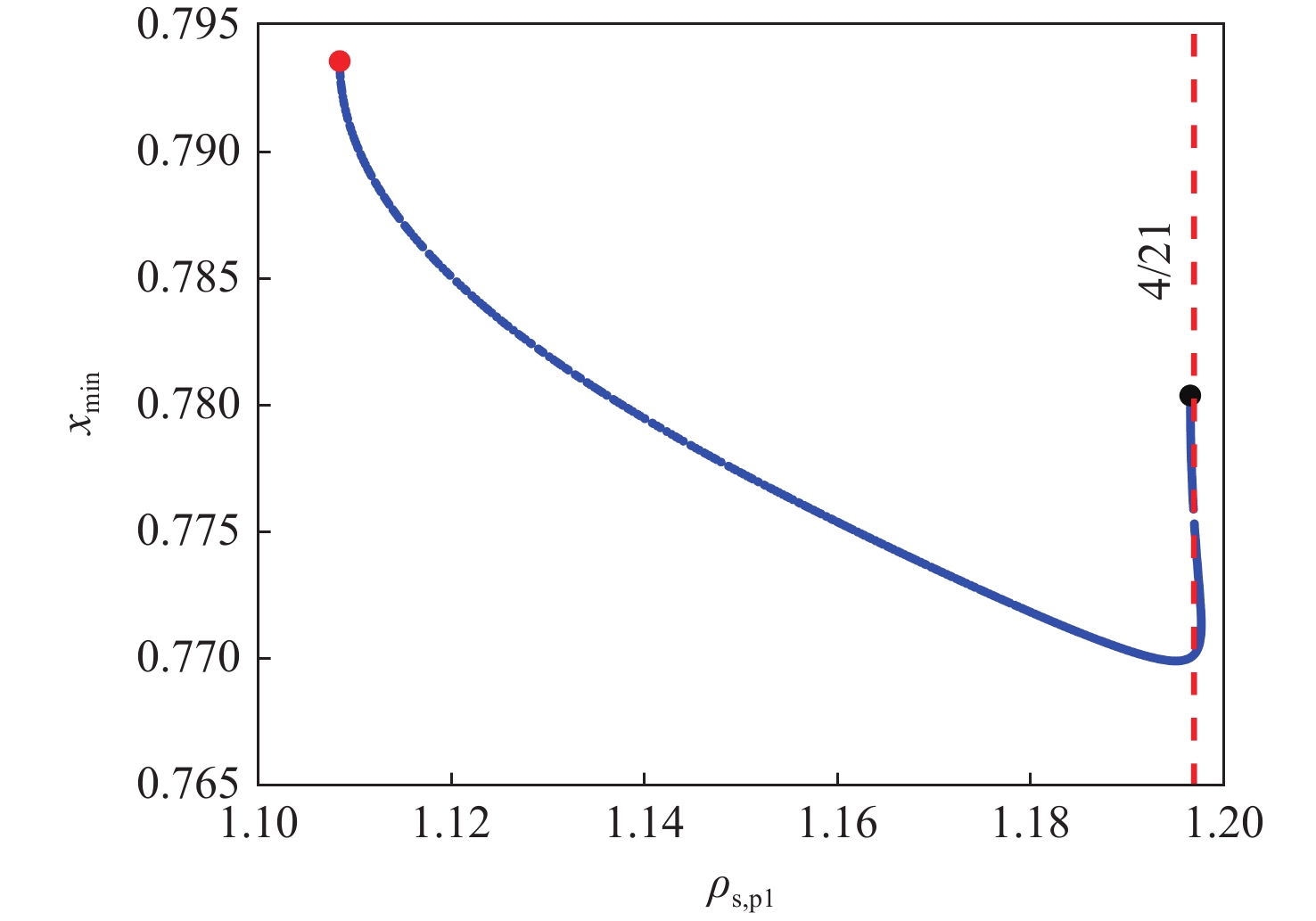
图 6 $ {\rho }_{\text{s,p1}} $所对应的平面拟DRO轨道族在x方向的最小值随$ {\rho }_{\text{s,p1}} $的变化关系图
Figure 6. Relationship between the minimum value of plane quasi-DRO corresponding to $ {\rho }_{\text{s,p1}} $ in x direction and rotation angle $ {\rho }_{\text{s,p1}} $
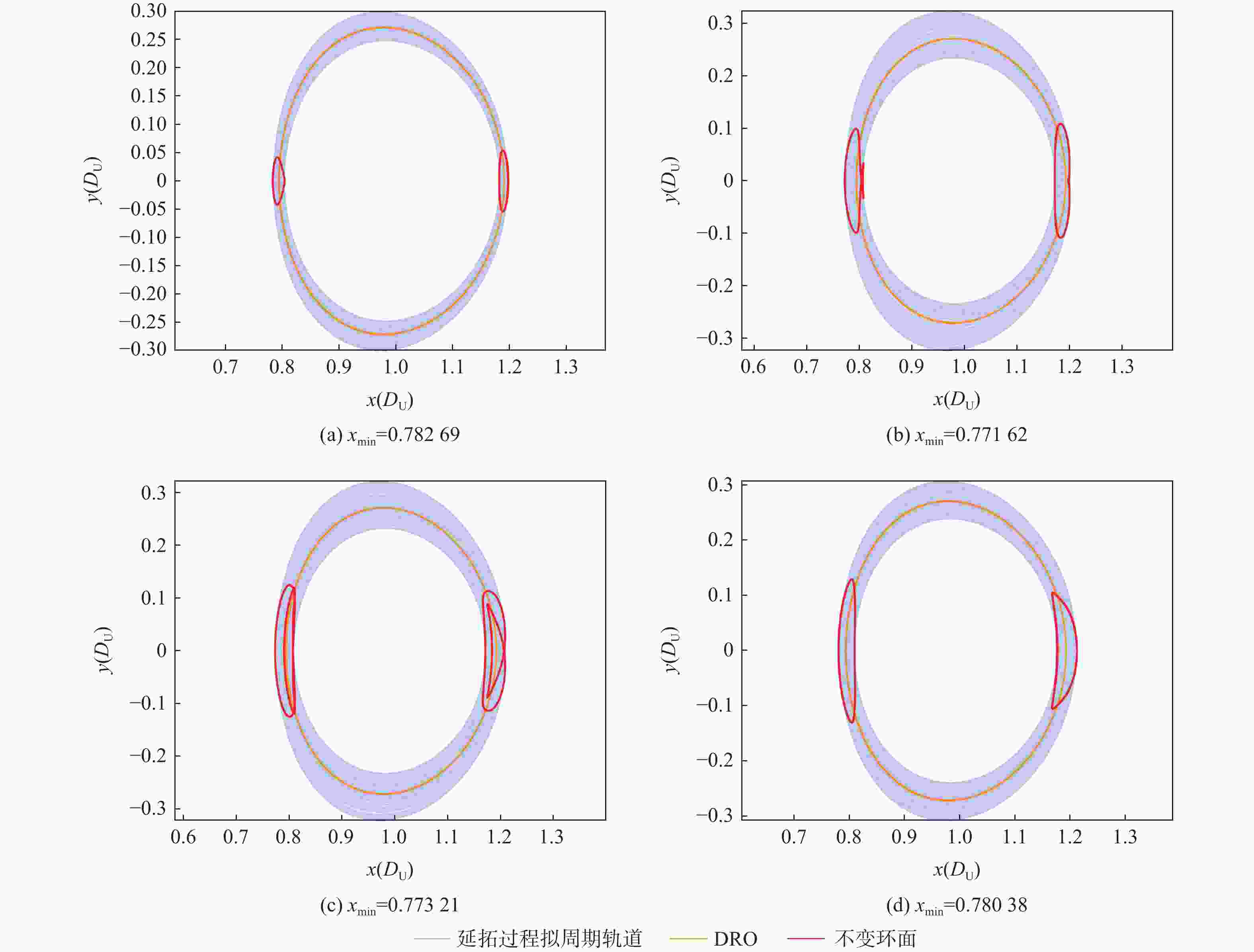
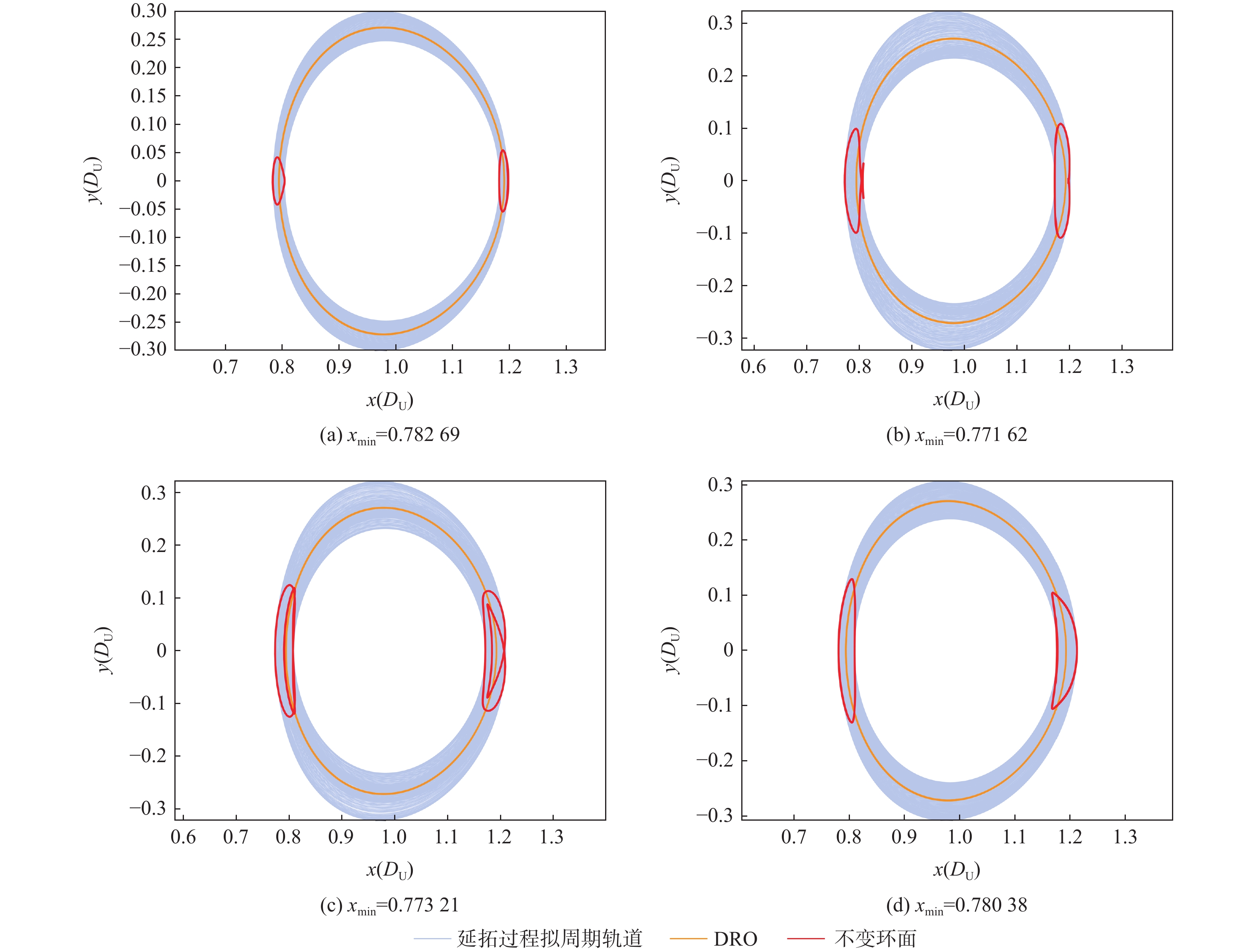
图 7 与$ {\rho }_{\text{s,p1}} $相对应的平面2D拟DRO族中的4条轨道
Figure 7. Four members of 2D plane quasi-DRO family corresponding to $ {\rho }_{\text{s,p1}} $
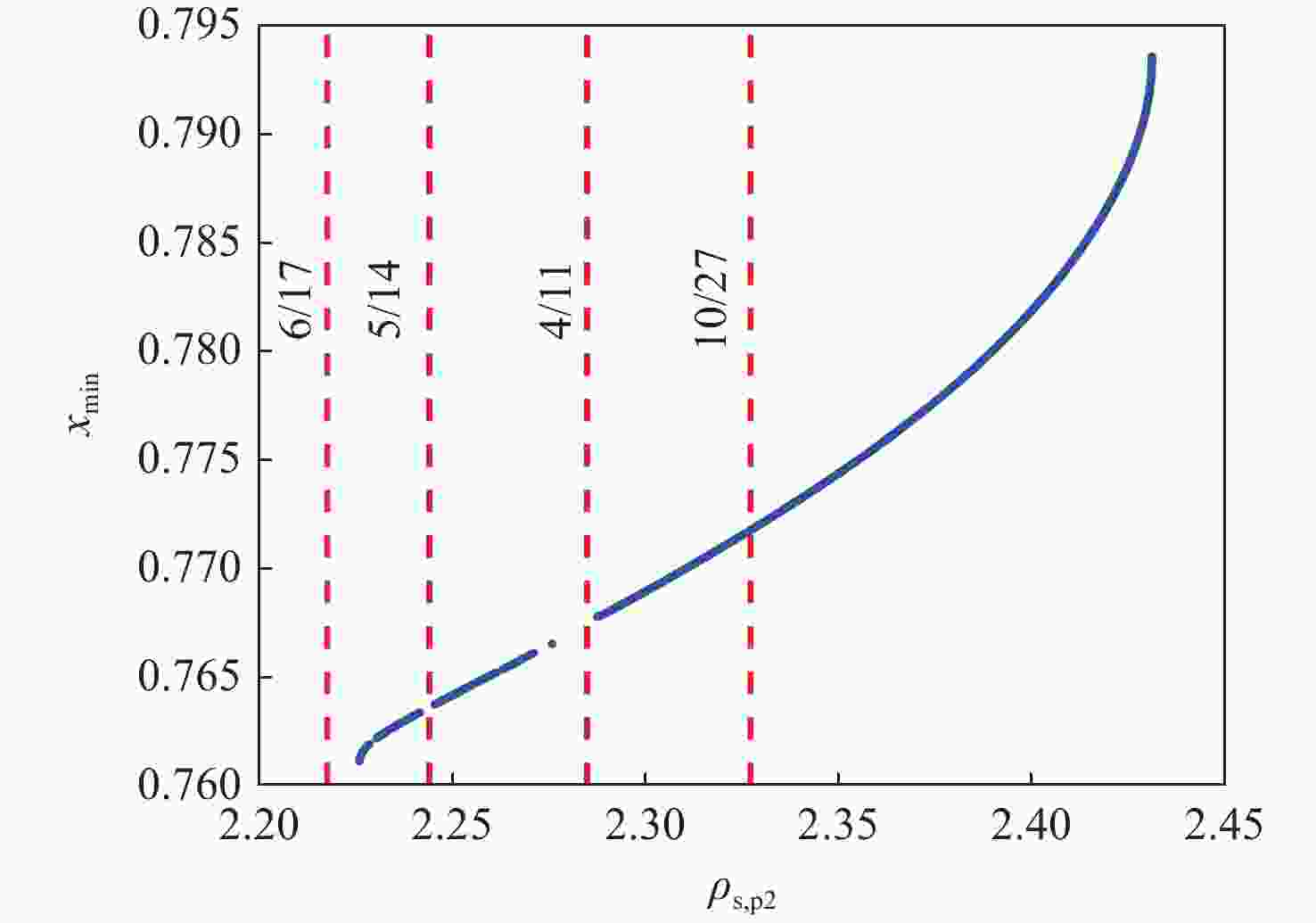
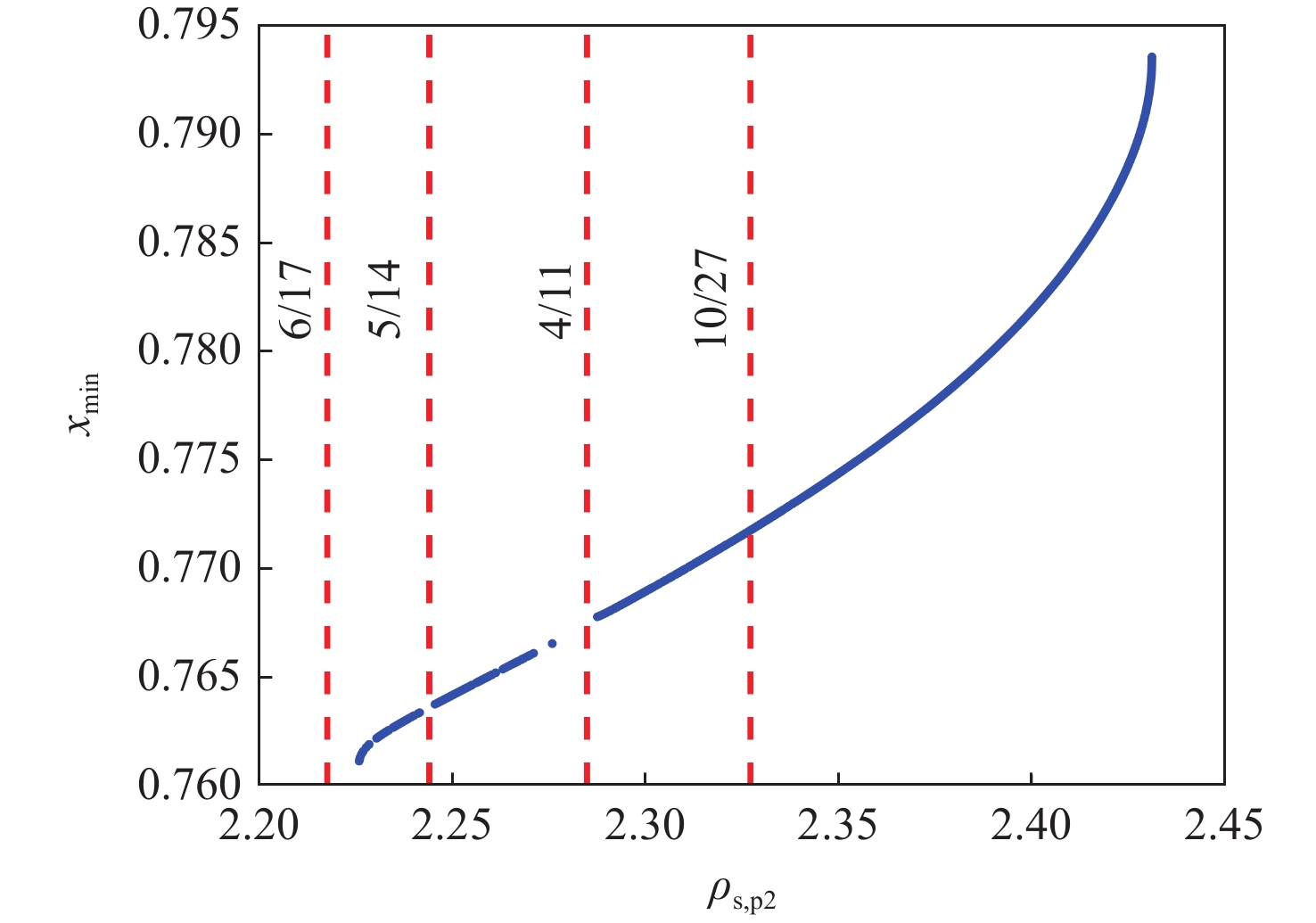
图 8 $ {\rho }_{\text{s,p2}} $所对应的平面拟DRO轨道族在x方向的最小值随$ {\rho }_{\text{s,p2}} $的变化关系
Figure 8. Relationship between the minimum value of plane quasi-DROs corresponding to $ {\rho }_{\text{s,p2}} $ in x direction and rotation angle $ {\rho }_{\text{s,p2}} $
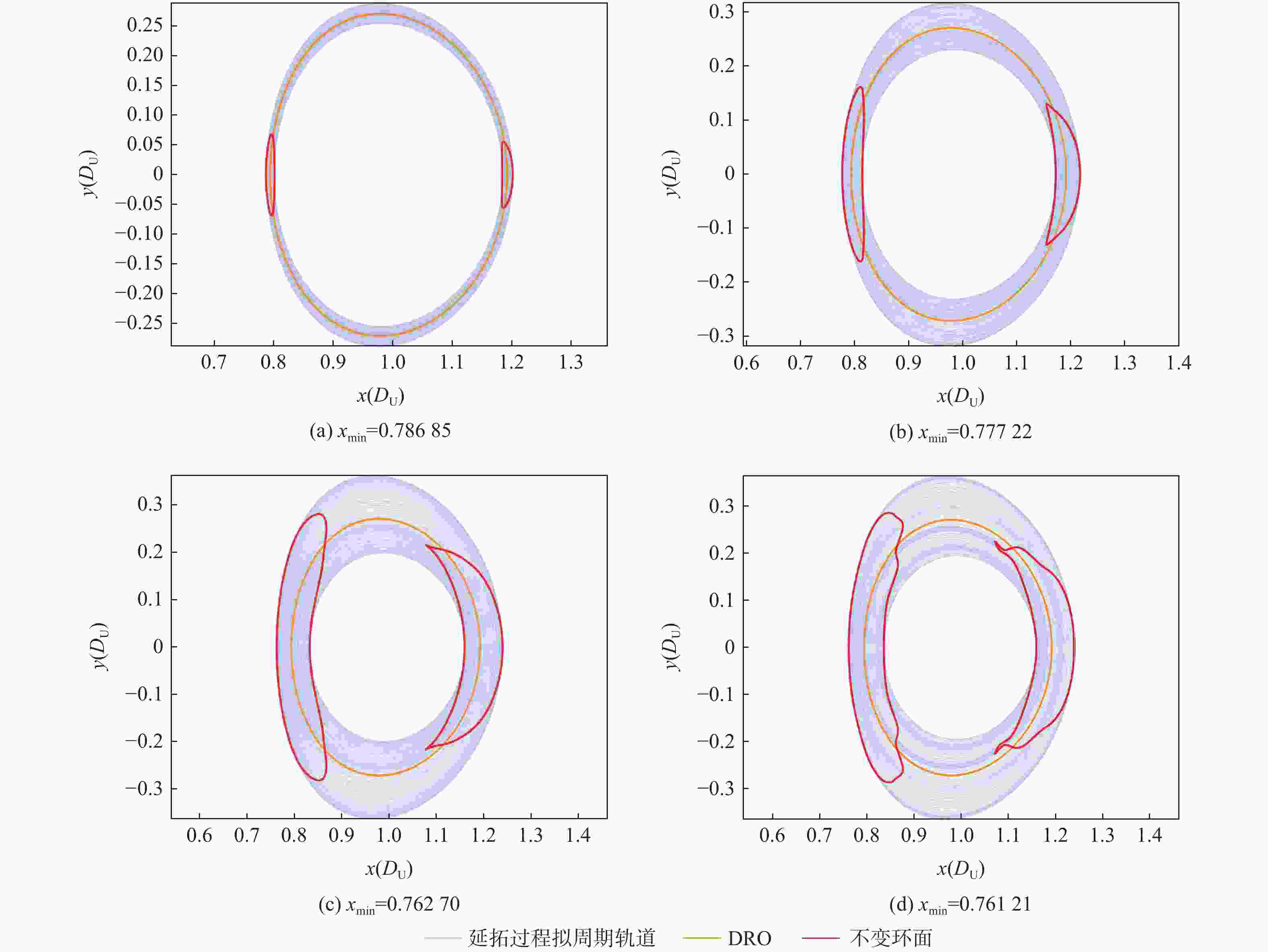
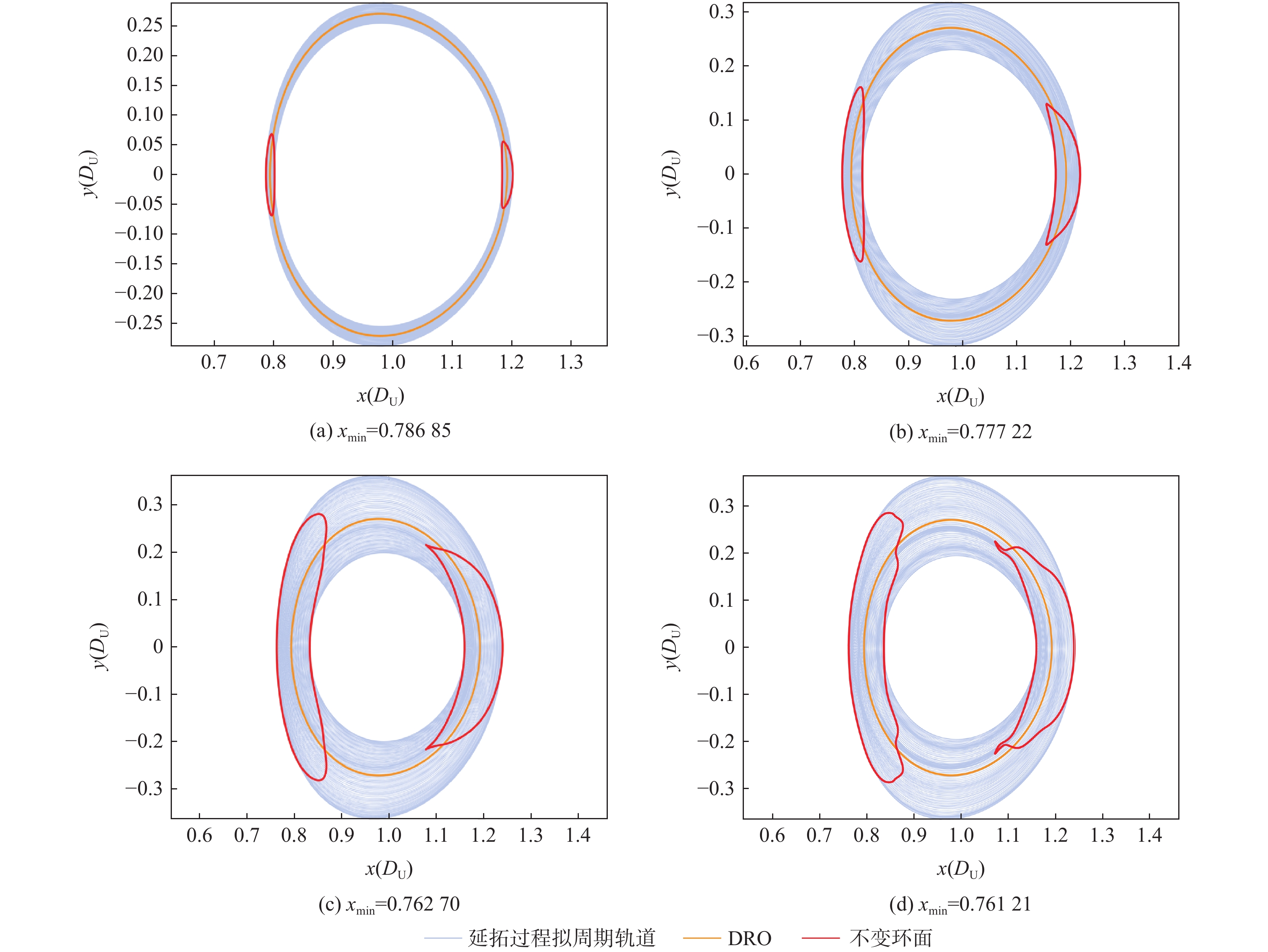
图 9 与$ {\rho }_{\text{s,p2}} $相对应的平面2D拟DRO轨道族中的4条轨道
Figure 9. Four members of 2D plane quasi-DRO family corresponding to $ {\rho }_{\text{s,p2}} $
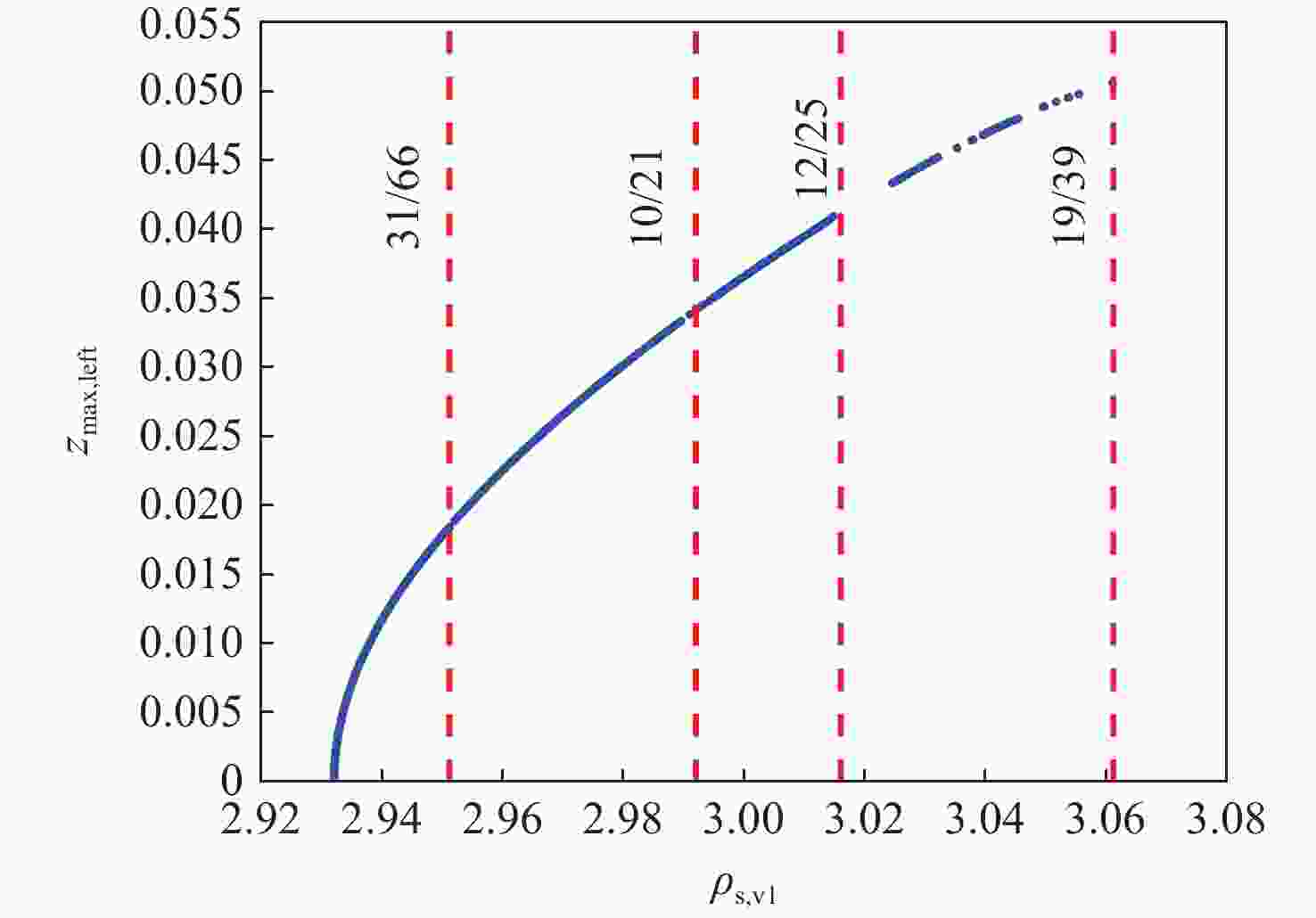
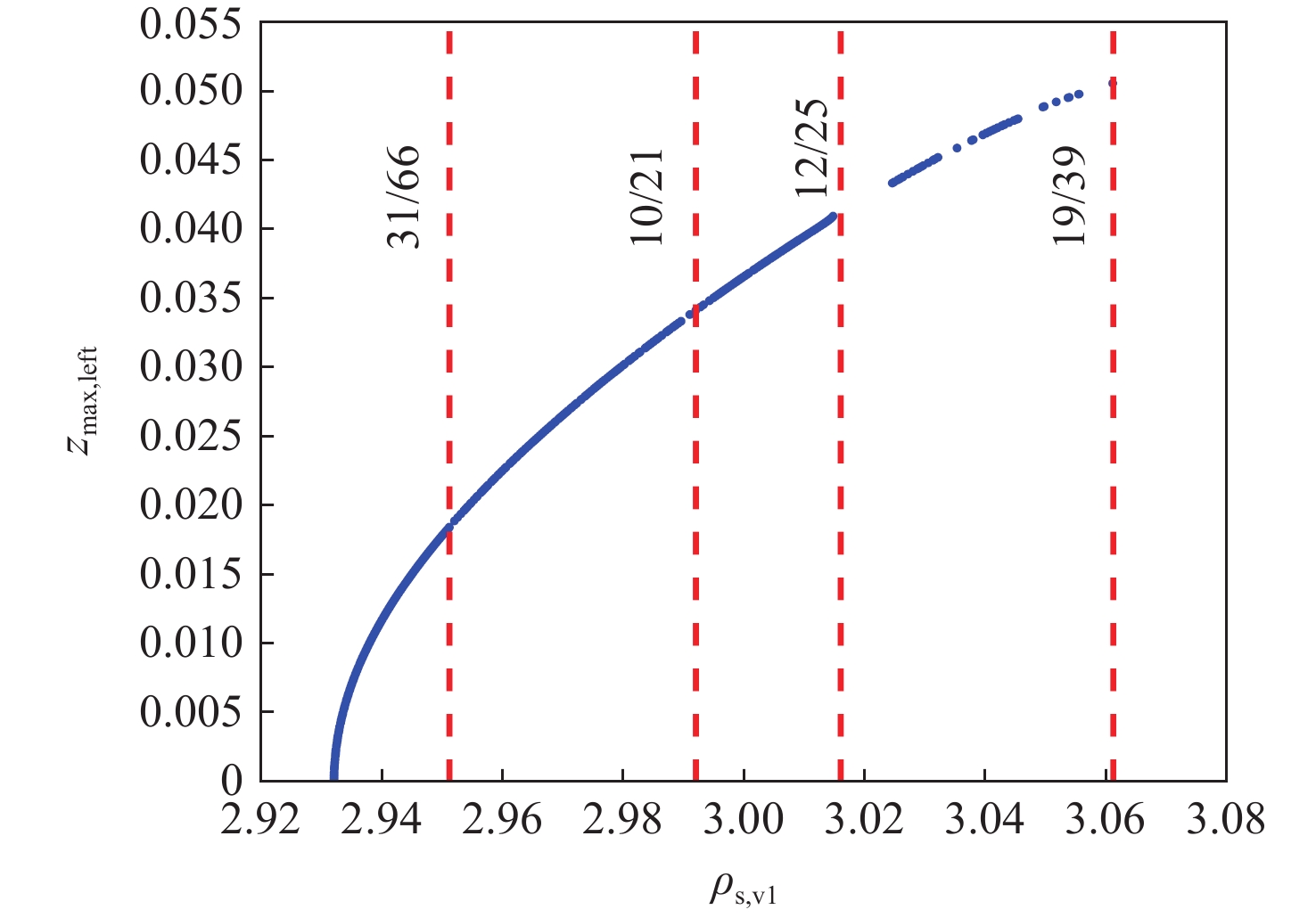
图 10 $ {\rho }_{\text{s,v1}} $所对应的法向拟DRO在月球左侧z方向的最大值随$ {\rho }_{\text{s,v1}} $的变化关系图
Figure 10. Relationship between the maximum value of vertical quasi-DROs on left of the Moon in z direction and rotation angle$ {\rho }_{\text{s,v1}} $
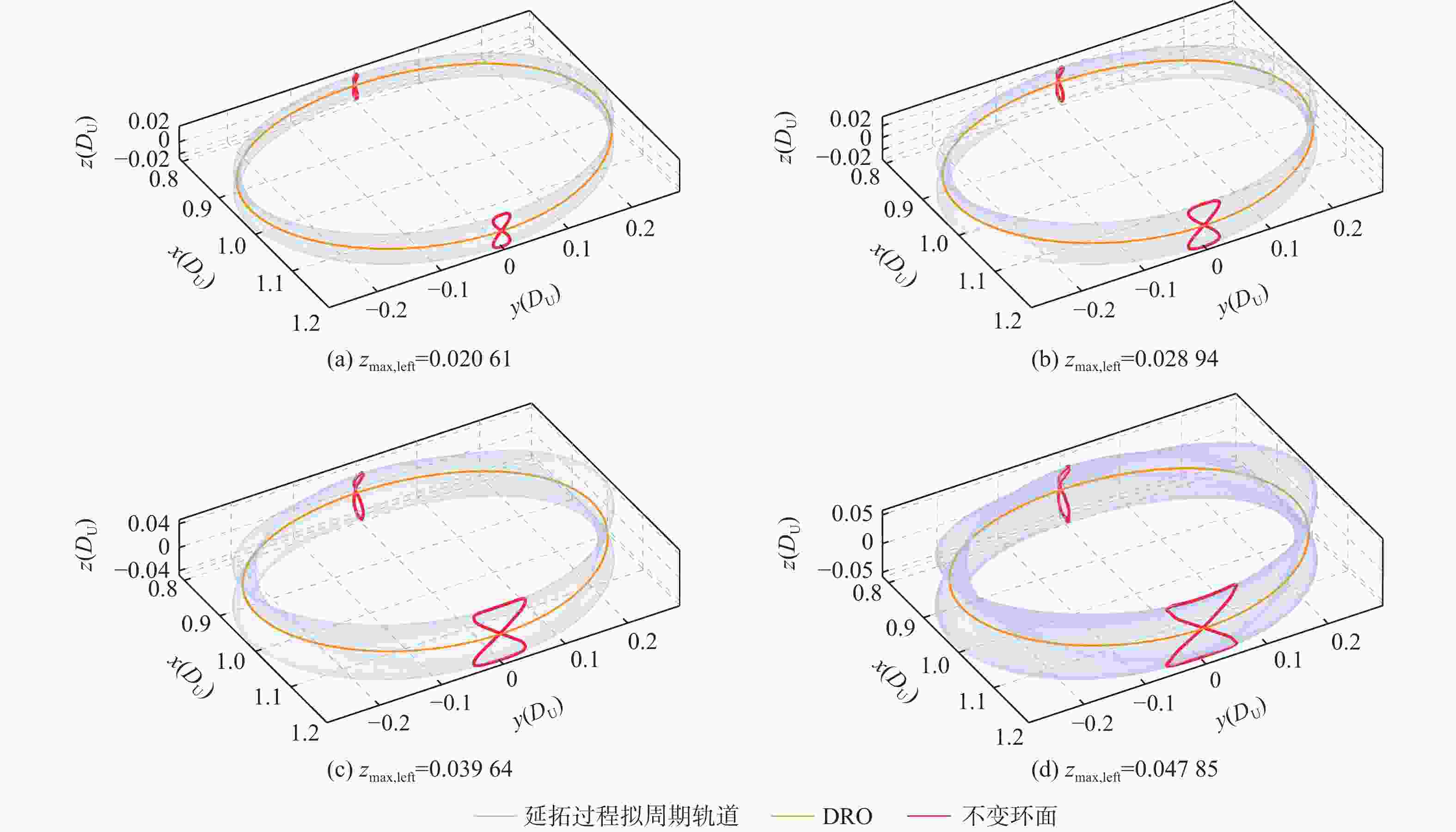
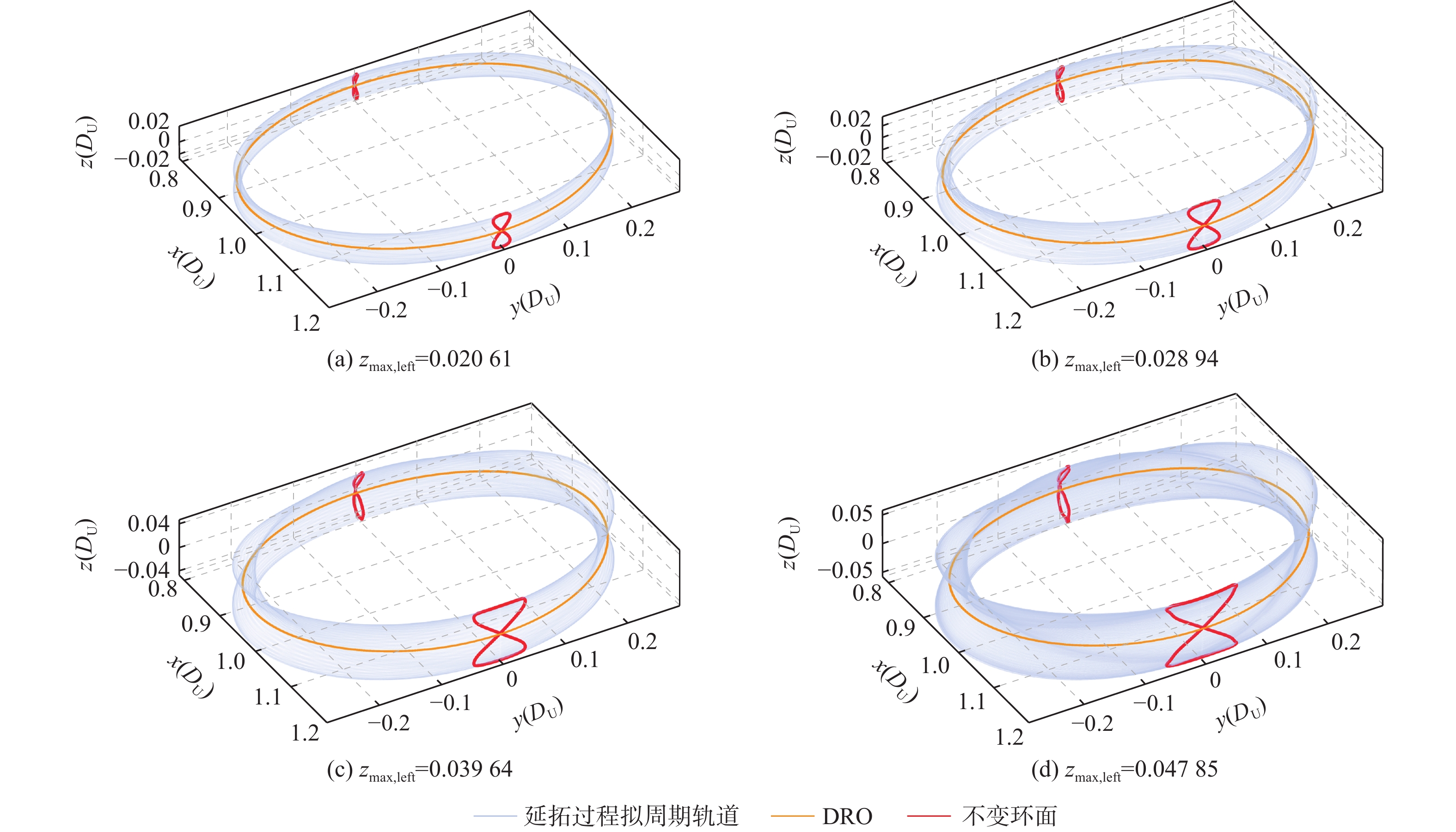
图 11 与$ {\rho }_{\text{s,v1}} $相对应的法向2D拟DRO轨道族中的4条轨道
Figure 11. Four members of the 2D vertical quasi-DRO family corresponding to $ {\rho }_{\text{s,v1}} $
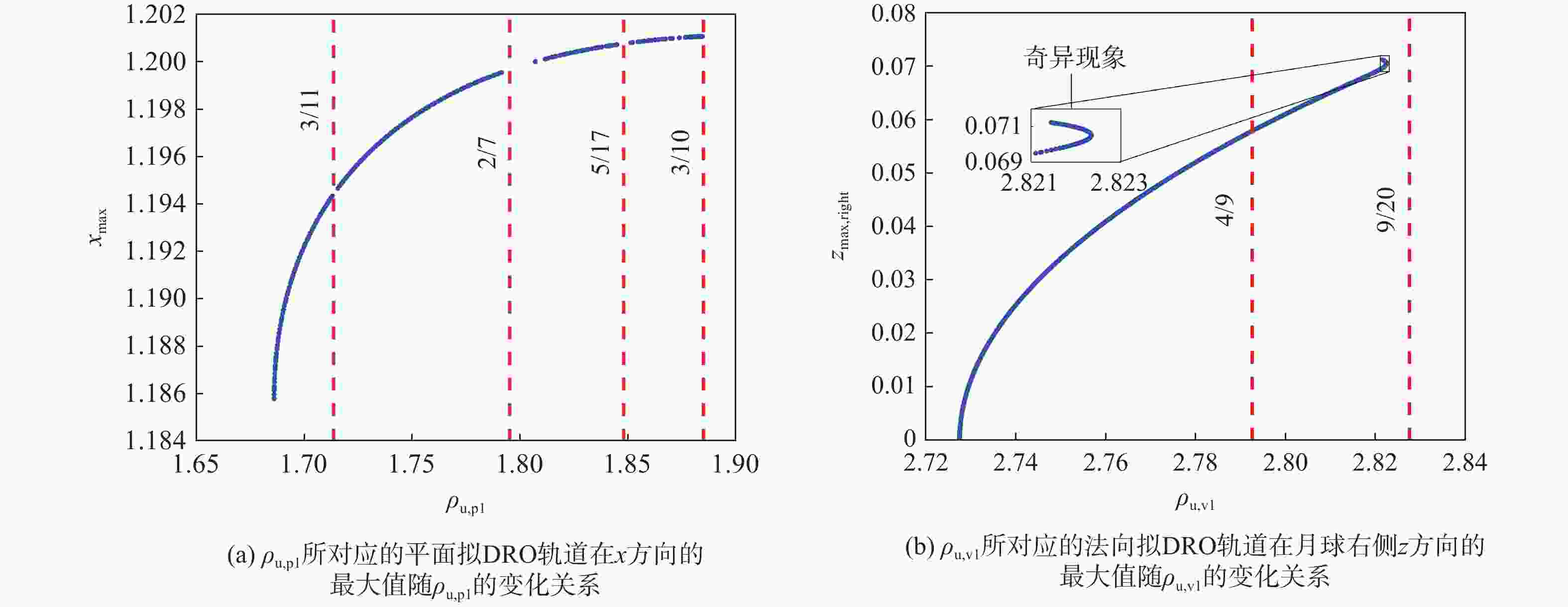
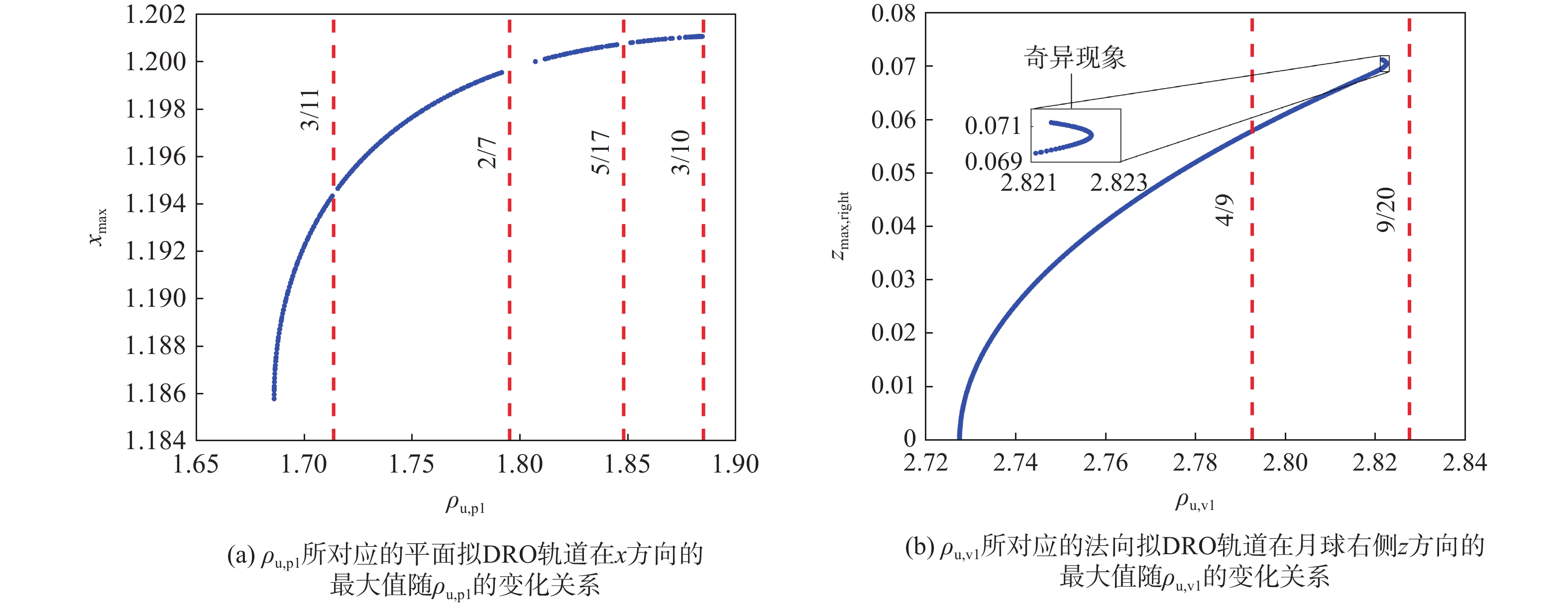
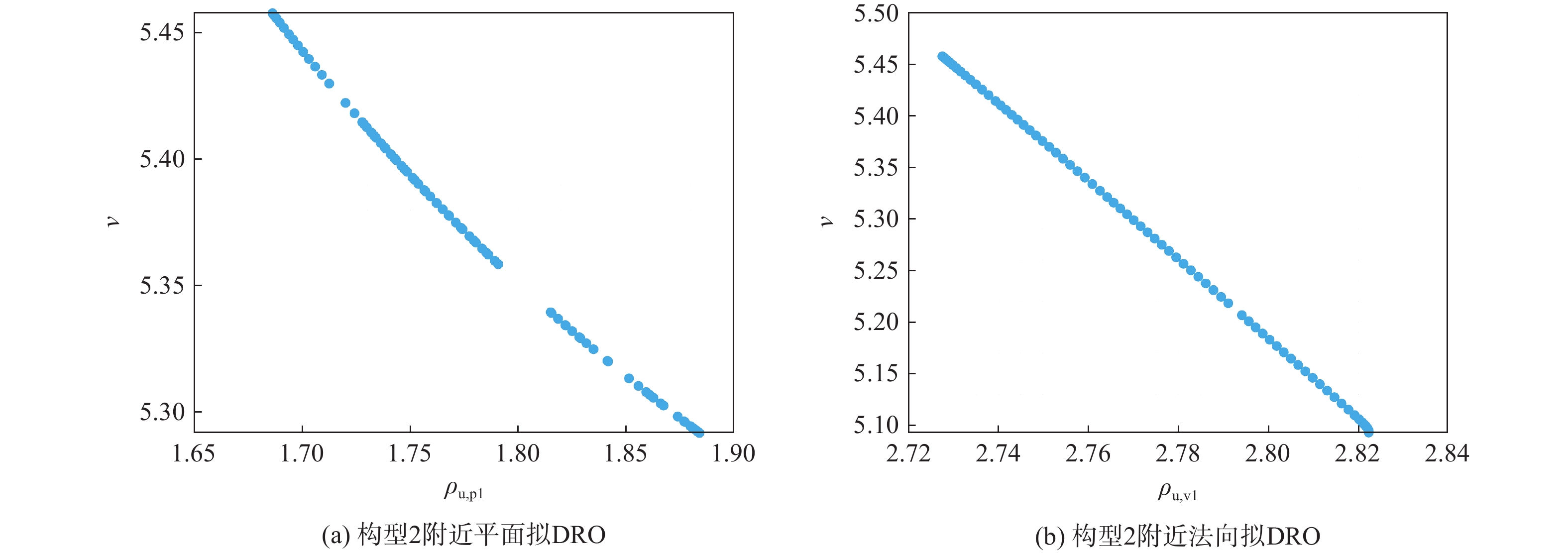
图 12 不稳定构型附近的拟DRO的几何参数随旋转相角的变化关系
Figure 12. Relationship between the geometric parameters of quasi-DRO families near the unstable 2∶1 DRO and rotation phase angles
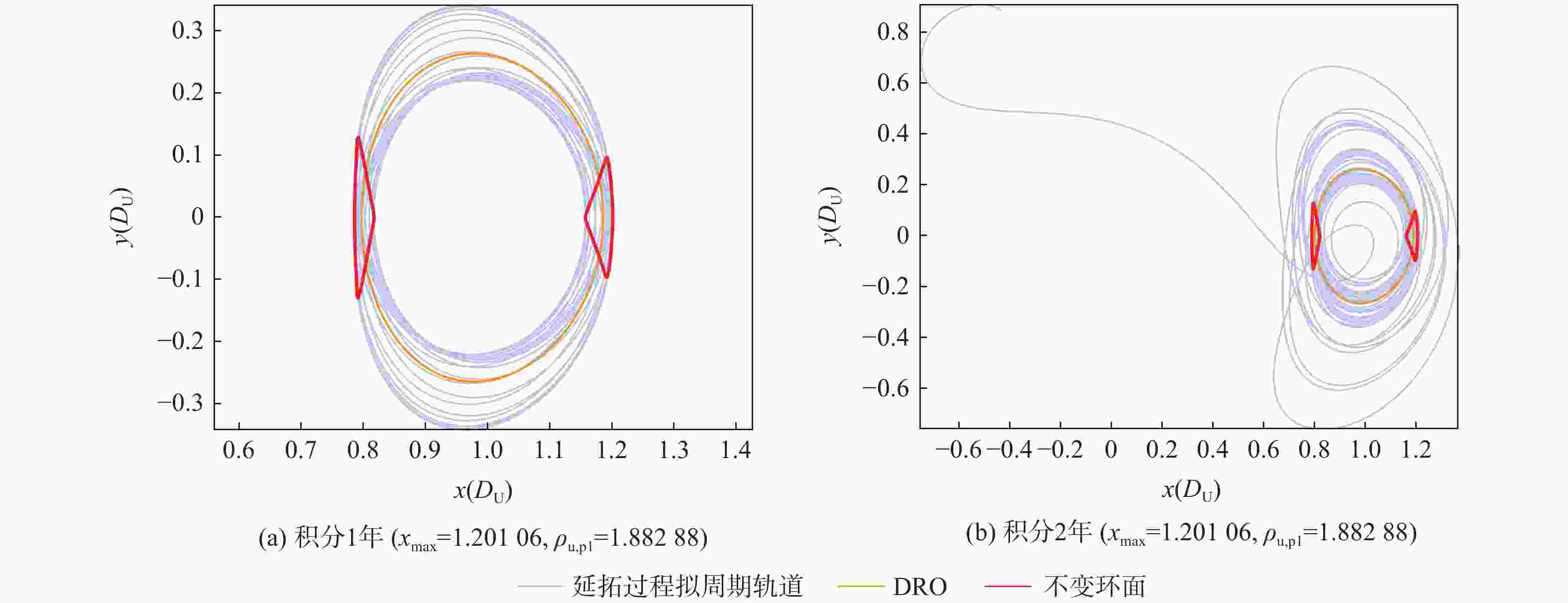
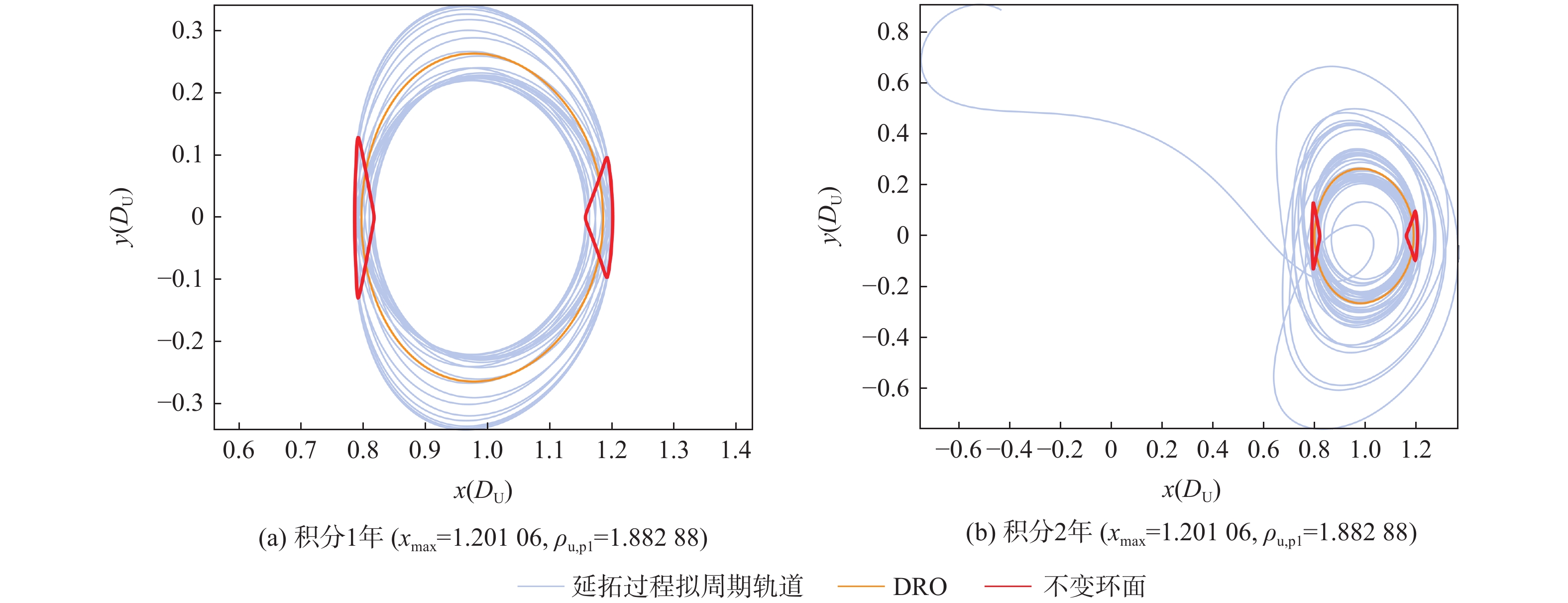
图 13 $ {\rho }_{\text{u,p1}} $所对应的平面拟周期轨道族中的拟DRO示例
Figure 13. Example of plane quasi-DRO corresponding to $ {\rho }_{\text{u,p1}} $
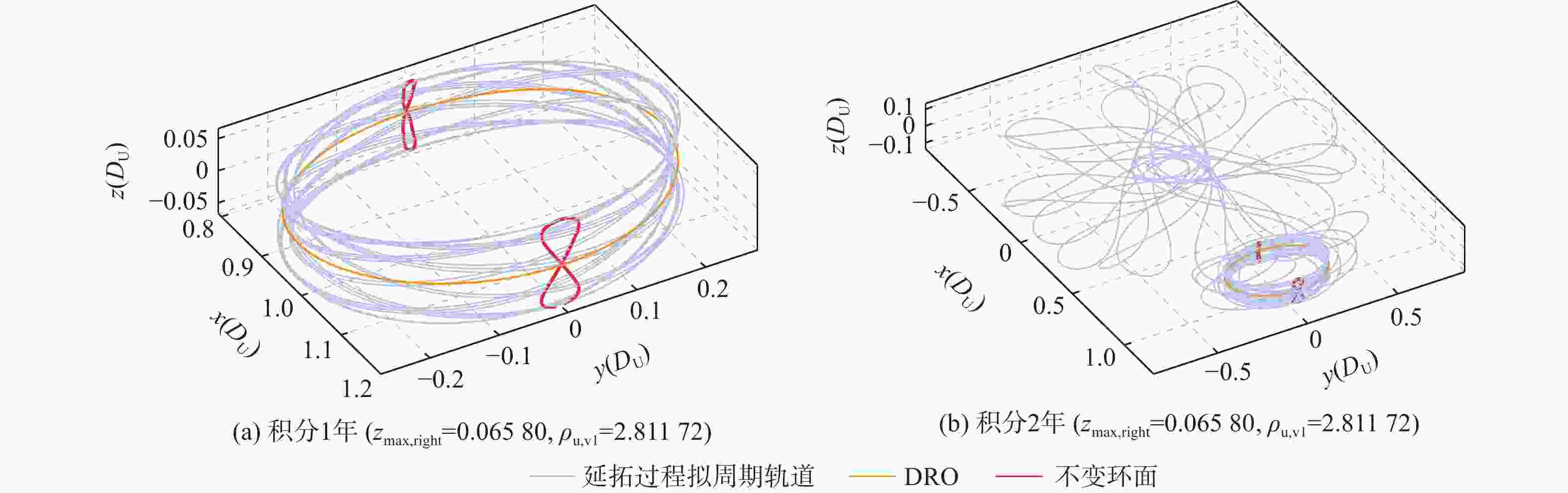
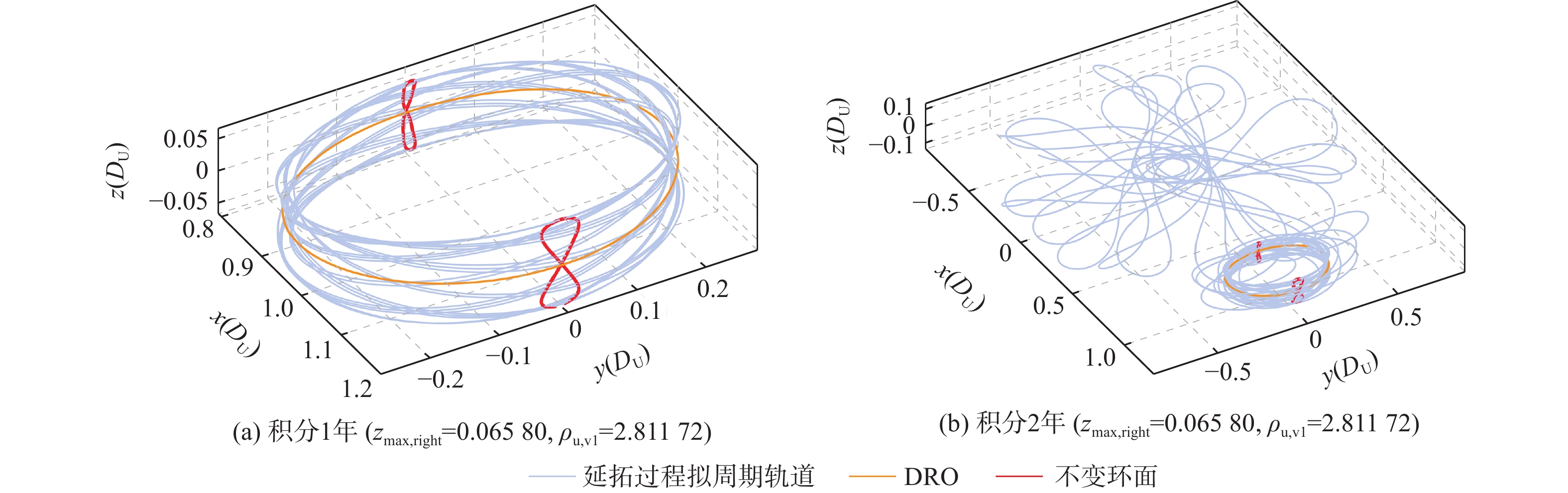
图 14 $ {\rho }_{\text{u,v1}} $所对应的法向拟周期轨道族中的拟DRO示例
Figure 14. Example of vertical quasi-DRO corresponding to $ {\rho }_{\text{u,v1}} $
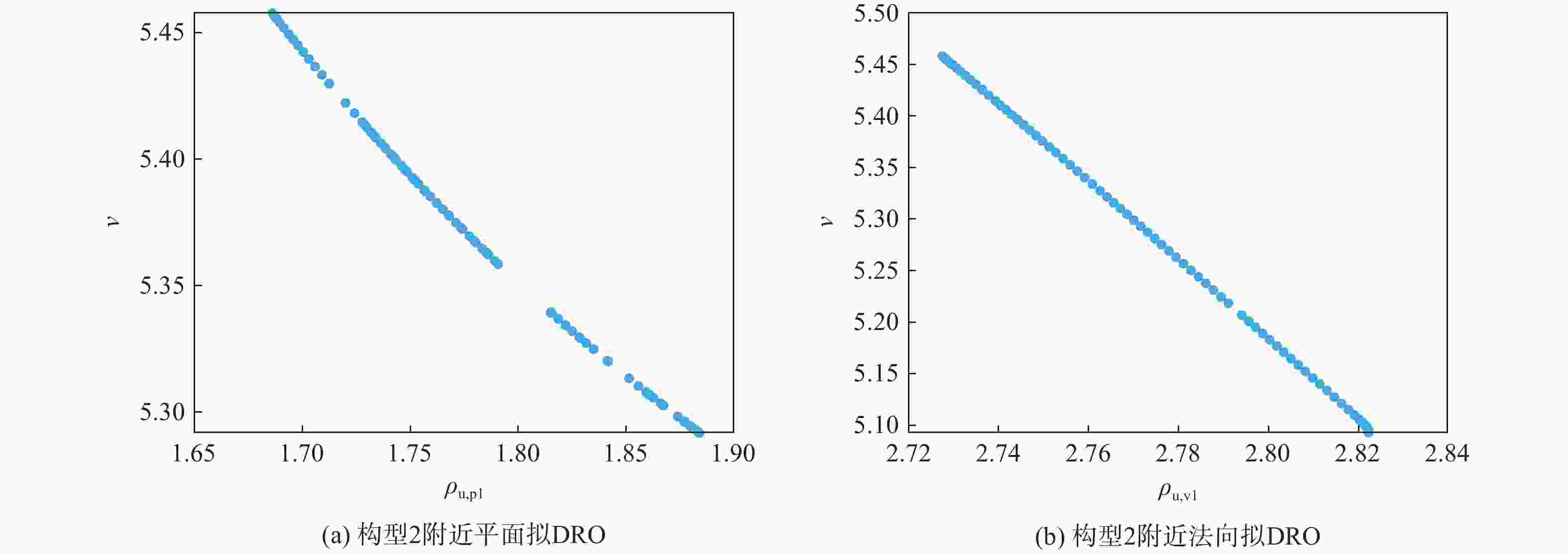
图 15 构型2附近2类2D拟周期轨道的稳定性指数关于旋转相角的变化关系
Figure 15. Relationship between stability index of two types of 2D quasi-DROs with respect to rotation phase angle near unstable 2∶1 DRO
表 1 地月系统相关物理常数
Table 1. Physical constants in the Earth-Moon system
物理常数 数值 地月质量参数$ \mu $ 0.0125 无量纲太阳质量$ {m}_{\text{S}} $ 328900.541 无量纲太阳角速度$ {\omega }_{\text{S}} $ − 0.92520 无量纲太阳-地月质心距离$ {r}_{\text{S}} $ 388.81114 地月距离$ {D}_{\text{U}} $/km 384405 归一化时间$ {T}_{\text{U}} $/s 375197.58323 归一化速度$ {V}_{\text{U}} $/(km·s−1) 1.02454  下载: 导出CSV
表 2 BCR4BP中2种2∶1 DRO的单值矩阵特征值及中心流形相角
Table 2. Eigenvalues and types of center manifolds associated with two types of 2∶1 DRO in BCR4BP
DRO构型 单值矩阵的特征值 中心流形
相角/rad中心流形
方向
构型1$ {\lambda }_{1,2}=0.460\;64\pm 0.895\;00\;{\mathrm{i}} $ 1.10843 平面 $ {\lambda }_{3,4}=-0.758\;00\pm 0.652\;25\;{\mathrm{i}} $ 2.43104 平面 $ {\lambda }_{5,6}=-0.978\;14\pm 0.207\;95\;{\mathrm{i}} $ 2.93211 法向
构型2$ {\lambda }_{1,2}=0.460\;64\pm 0.895\;00\;{\mathrm{i}} $ 1.68608 平面 $ {\lambda }_{3,4}=-0.915\;50\pm 0.402\;31\;{\mathrm{i}} $ 2.72755 法向 $ {\lambda }_{5}=10.823\;37,{\lambda }_{6}=0.092\;39 $
下载: 导出CSV
-
[1] BEZROUK C J, PARKER J. Long duration stability of distant retrograde orbits[C]//Proceedings of the AIAA/AAS Astrodynamics Specialist Conference. Reston: AIAA, 2014. [2] DAWN T F, GUTKOWSKI J, BATCHA A, et al. Trajectory design considerations for exploration mission 1[C]//Proceedings of the Space Flight Mechanics Meeting. Reston: AIAA, 2018. [3] 张晨. 基于数值延拓的日月综合借力DRO入轨策略[J]. 北京航空航天大学学报, 2024, 50(4): 1176-1186.ZHANG C. Low-energy transfer from Earth into DRO with hybrid gravity assist and numerical continuation[J]. Journal of Beijing University of Aeronautics and Astronautics, 2024, 50(4): 1176-1186(in Chinese). [4] 陈冠华, 杨驰航, 张晨, 等. 地月空间的远距离逆行轨道族及其分岔研究[J]. 北京航空航天大学学报, 2022, 48(12): 2576-2588.CHEN G H, YANG C H, ZHANG C, et al. Distant retrograde orbits and its bifurcations in Earth-Moon system[J]. Journal of Beijing University of Aeronautics and Astronautics, 2022, 48(12): 2576-2588(in Chinese). [5] MCCARTHY B P, HOWELL K C. Leveraging quasi-periodic orbits for trajectory design in cislunar space[J]. Astrodynamics, 2021, 5(2): 139-165. [6] MCCARTHY B P, HOWELL K C. Trajectory design using quasi-periodic orbits in the multi-body problem[C]//Proceedings of the 29th AAS/AIAA space flight mechanics meeting. Reston: AIAA, 2019. [7] WANG M, YANG C H, SUN Y, et al. Family of 2: 1 resonant quasi-periodic distant retrograde orbits in cislunar space[J]. Advances in Space Research, 2024, 73(12): 6166-6181. [8] FARQUHAR R W, KAMEL A A. Quasi-periodic orbits about the translunar libration point[J]. Celestial Mechanics, 1973, 7(4): 458-473. [9] RICHARDSON D L, CARY N D. A uniformly valid solution for motion about the interior libration point of the perturbed elliptic-restricted problem[C]//Proceedings of the AIAA Conference on the Exploration of the Outer Planets. Reston: AIAA, 1975. [10] GÓMEZ G, MASDEMONT J, SIMÓ C. Quasihalo orbits associated with libration points[J]. The Journal of the Astronautical Sciences, 1998, 46(2): 135-176. [11] JORBA À, MASDEMONT J. Dynamics in the center manifold of the collinear points of the restricted three body problem[J]. Physica D: Nonlinear Phenomena, 1999, 132(1-2): 189-213. [12] GÓMEZ G, NOGUERA M. Some manifolds of periodic orbits in the restricted three-body problem[J]. Celestial Mechanics, 1985, 35(3): 235-255. [13] HOWELL K C, PERNICKA H J. Numerical determination of Lissajous trajectories in the restricted three-body problem[J]. Celestial Mechanics, 1987, 41(1): 107-124. [14] KOLEMEN E, KASDIN N J, GURFIL P. Quasi-periodic orbits of the restricted three-body problem made easy[J]. AIP Conference Proceedings, 2007, 886(1): 68-77. [15] KOLEMEN E, KASDIN N J, GURFIL P. Multiple Poincaré sections method for finding the quasiperiodic orbits of the restricted three body problem[J]. Celestial Mechanics and Dynamical Astronomy, 2012, 112(1): 47-74. [16] GÓMEZ G, MONDELO J M. The dynamics around the collinear equilibrium points of the RTBP[J]. Physica D: Nonlinear Phenomena, 2001, 157(4): 283-321. [17] OLIKARA Z P, SCHEERES D J. Numerical method for computing quasi-periodic orbits and their stability in the restricted three-body problem[J]. Advances in the Astronautical Sciences, 2012, 145: 911-930. [18] BARESI N, OLIKARA Z P, SCHEERES D J. Fully numerical methods for continuing families of quasi-periodic invariant tori in astrodynamics[J]. The Journal of the Astronautical Sciences, 2018, 65(2): 157-182. [19] OLIKARA Z P, HOWELL K C. Computation of quasi-periodic invariant tori in the restricted three-body problem[C]//Proceedings of the AIAA Space Flight Mechanics Meeting. Reston: AIAA, 2010. [20] JORBA À, JORBA-CUSCÓ M, ROSALES J J. The vicinity of the Earth-Moon L1 point in the bicircular problem[J]. Celestial Mechanics and Dynamical Astronomy, 2020, 132(2): 11. [21] LUJAN D, SCHEERES D J. Earth-Moon L2 quasi-halo orbit family: characteristics and manifold applications[J]. Journal of Guidance, Control, and Dynamics, 2022, 45(11): 2029-2045. [22] ROSALES J J, JORBA À, JORBA-CUSCÓ M. Families of halo-like invariant tori around L2 in the Earth-Moon bicircular problem[J]. Celestial Mechanics and Dynamical Astronomy, 2021, 133(4): 16. [23] MCCARTHY B P, HOWELL K C. Quasi-periodic orbits in the Sun-Earth-Moon bicircular restricted four-body problem[C]//Proceedings of the 31st AAS/AIAA Space Flight Mechanics Meeting. Reston: AIAA, 2021. [24] JORBA À, NICOLÁS B. Transport and invariant manifolds near L3 in the Earth-Moon bicircular model[J]. Communications in Nonlinear Science and Numerical Simulation, 2020, 89: 105327. [25] 李瑞龙, 朱战霞. 一种适用于大幅值Quasi周期轨道的数值构造方法[J]. 宇航学报, 2023, 44(1): 52-61.LI R L, ZHU Z X. A numerical construction method for large-amplitude Quasi periodic orbits[J]. Journal of Astronautics, 2023, 44(1): 52-61(in Chinese). [26] CIRCI C, TEOFILATTO P. On the dynamics of weak stability boundary lunar transfers[J]. Celestial Mechanics and Dynamical Astronomy, 2001, 79(1): 41-72. [27] SÁNCHEZ J, NET M. A parallel algorithm for the computation of invariant tori in large-scale dissipative systems[J]. Physica D: Nonlinear Phenomena, 2013, 252: 22-33. [28] VILLEGAS-PINTO D, BARESI N, HESTROFFER D, et al. On the numerical computation of quasi-periodic families and applications to the Martian Moons exploration mission[C]//Proceedings of the International Conference on Astrodynamics Tools and Techniques. Paris : European Space Agency , 2021. -

 下载:
下载:

 点击查看大图
计量
- 文章访问数: 348
- HTML全文浏览量: 125
- PDF下载量: 40
- 被引次数: 0
