





-
摘要:
为准确测量飞机油箱内的燃油体积,提出基于流体单位质量力的飞机燃油测量算法(AFUMF)。在机体坐标系下基于三轴加速度计信号等效流体单位质量力直接确定油面单位法向量,将燃油箱内油量测量传感器测量的油面高度转换为燃油面上的点坐标,得到油面距离机体原点的有向距离用于确定油面高度,建立燃油测量数据库并实现燃油测量传感器高度至燃油体积解算。基于CATIA二次开发,采用蒙特卡罗方法对最小二乘(LMS)拟合和AFUMF开展误差评估,结果表明:在传感器存在误差的条件下,AFUMF对测量传感器误差有减小作用且仅需1根传感器有效即可实现油量解算,LMS对测量传感器误差有放大作用且需至少3根传感器有效以实现油量解算。通过动态燃油箱台架试验对AFUMF进行验证,试验结果表明:在测量范围内姿态稳定条件下,燃油测量最大误差为±0.5%油箱容积。
Abstract:In order to accurately measure the remaining fuel in the aircraft fuel tank, the aircraft fuel quantity measurement algorithm based on fluid unit mass force (AFUMF) is proposed. The unit normal vector of the fuel surface in the aircraft-body coordinate frame can be directly determined using the three-axis accelerometer’s output signals as the equivalent of fluid unit mass force. The fuel quantity database can then be created and utilized for the fuel volume calculation by combing the point coordinates obtained from the fuel probes' height signal to determine the directed distance from origin as the fuel surface height. A CATIA secondary development program is developed to evaluate the error distribution of least mean square (LMS) and AFUMF by using the Monte-Carlo analysis method. The result shows AFUMF will alleviate the fuel probes’ error and only 1 valid probe is needed, on the contrary, LMS will amplify the fuel probes’ error and at least 3 valid probes are required. Using a six-degree-of-freedom platform, a fuel tank test item was constructed to validate AFUMF. The test findings indicate that, under steady conditions, the maximum error is ±0.5% full fuel tank quantity.
-
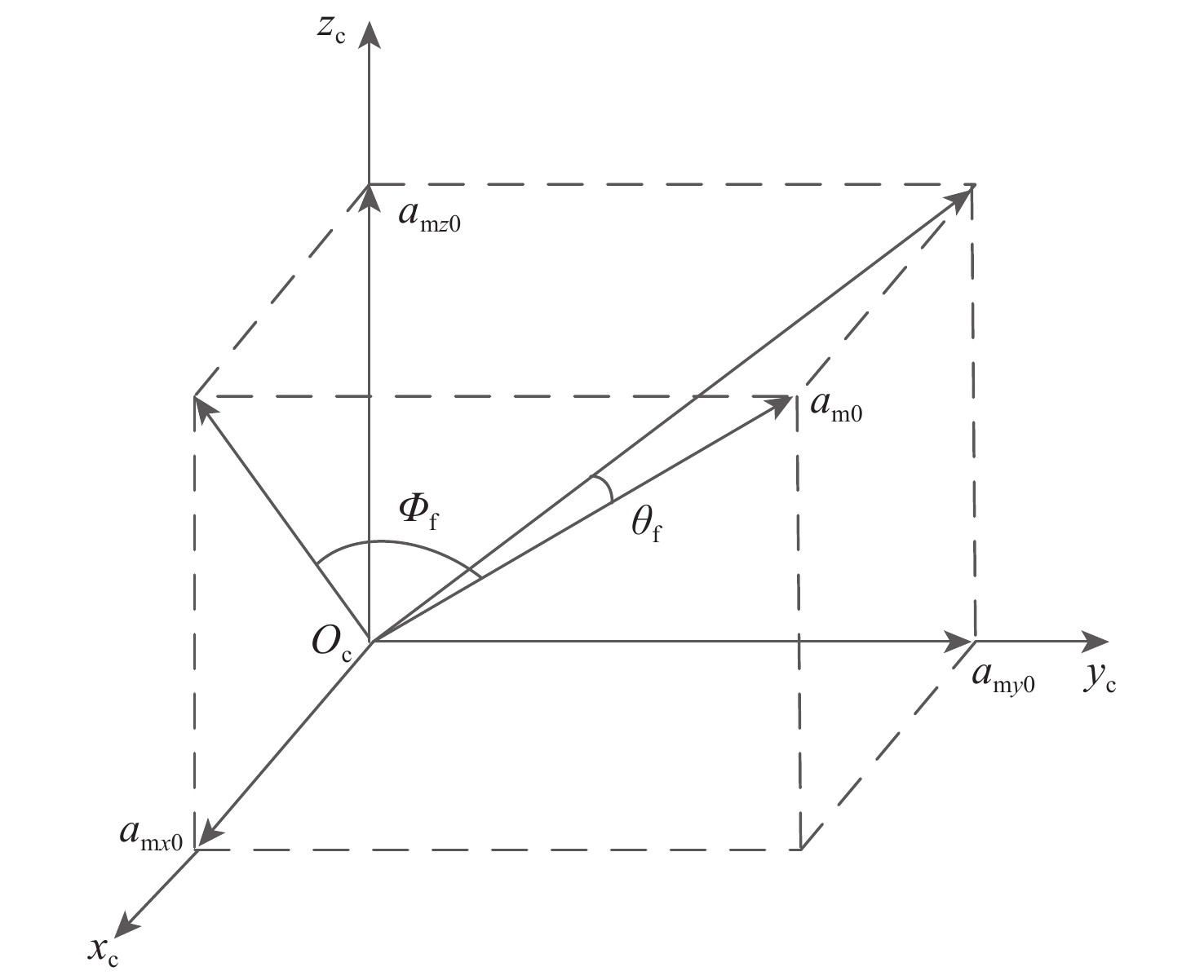
图 1 油面单位法向量与姿态角关系
Figure 1. Relationship between unit normal vector and attitude angles of fuel surface
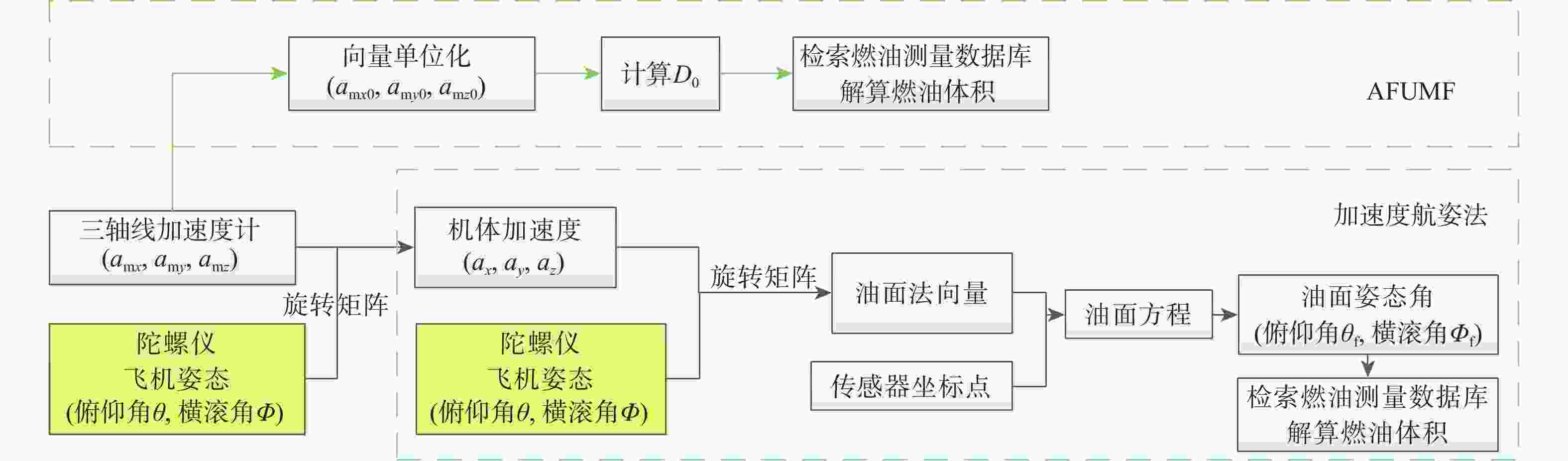
图 4 AFUMF与加速度航姿法解算环节对比
Figure 4. Comparison between AFUMF and algorithm of attitude combined acceleration
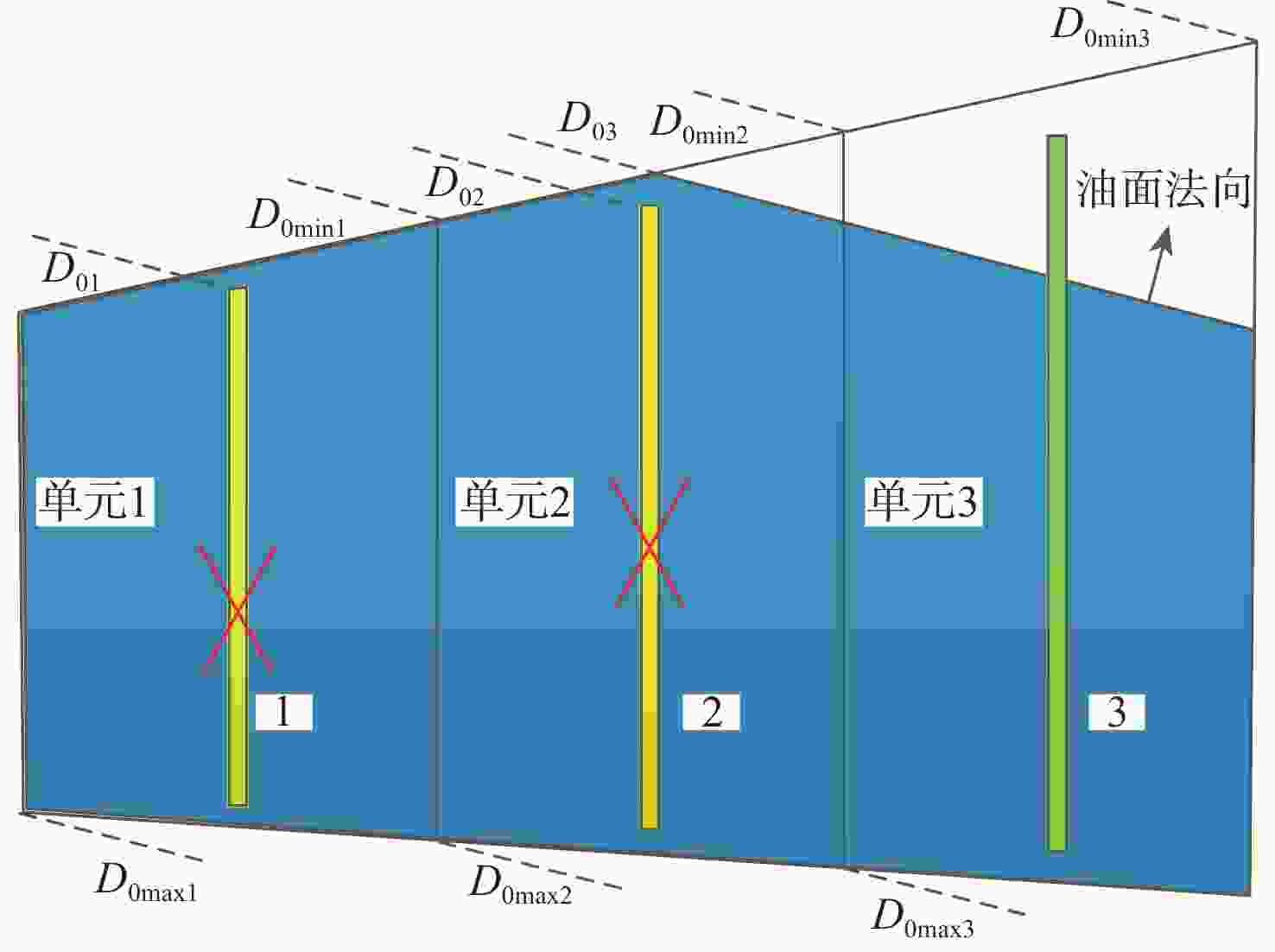
图 5 典型油面姿态测量解算示意图
Figure 5. Schematic diagram of fuel quantity solution for typical fuel surface attitude
表 1 燃油测量试验误差
Table 1. Error of fuel quantity measurement test
amx0 amy0 基准值/% 指示值/% 误差/% 0 0 4.59 4.58 −0.01 −0.12 0 4.59 4.24 −0.35 −0.26 0.09 4.59 4.17 −0.42 0 0.26 4.59 4.47 −0.12 0 0 45.51 45.46 −0.05 −0.12 0 45.51 45.87 0.36 −0.26 −0.09 45.51 45.91 0.40 0.17 −0.09 45.51 45.03 −0.47 0 0 90.96 91.05 0.10 −0.12 0 90.96 90.73 −0.23 −0.17 0.09 90.96 91.09 0.14 0.17 0.09 90.96 91.28 0.32 0 −0.26 90.96 91.47 0.51 0 0.26 90.96 90.62 −0.34 0 0 100.00 100.03 0.03 −0.26 0.09 100.00 99.78 −0.22 0.17 0.09 100.00 100.09 0.09 0 −0.26 100.00 100.39 0.39 0 0.26 100.00 99.89 −0.11  下载: 导出CSV
-
[1] SAE International. Guidance for the design and installation of fuel quantity indicating systems: AIR5691[R]. Warrendale: SAE International, 2017: 11-33. [2] Airlines Electronic Engineering Committee. Guidance for the design and installation of fuel quantity systems: ARINC REPORT 611-1[R]. Annapolis: Aeronautical radio, Inc., 1999: 1-8. [3] LANGTON R, CLARK C, HEWITT M. 飞机燃油系统[M]. 颜万亿, 译. 上海: 上海交通大学出版社, 2010: 137-176.LANGTON R, CLARK C, HEWITT M. Aircraft fuel systems [M]. YAN W Y, translated. Shanghai: Shanghai Jiaotong University Press, 2010: 24-27(in Chinese). [4] 袁梅, 林柯, 崔德刚. 飞机燃油油量测量及姿态误差修正方法[J]. 航空计测技术, 2001, 21(1): 24-26.YUAN M, LIN K, CUI D G. Attitude error correction method of measurement of aircraft fuel[J]. Aviation Metrology & Measurement Technology, 2001, 21(1): 24-26(in Chinese). [5] 金宇林, 庄达民, 杨钦. 民航客机油箱建模与油量传感器姿态误差修正[J]. 北京航空航天大学学报, 2005, 31(2): 218-222.JIN Y L, ZHUANG D M, YANG Q. Modeling of airliner gasoline tank and modification of attitude error of sensor[J]. Journal of Beijing University of Aeronautics and Astronautics, 2005, 31(2): 218-222(in Chinese). [6] 王向杨, 庄达民, 刘建民. 飞机燃油测量方法研究[J]. 飞机设计, 2004(1): 47-51.WANG X Y, ZHUANG D M, LIU J M. A study of aircraft fuel quantity gauging method[J]. Aircraft Design, 2004(1): 47-51(in Chinese). [7] 单宝峰, 张广涛, 李景春, 等. 航空油量测量技术研究及其发展现状[J]. 自动化仪表, 2013, 34(4): 32-33.SHAN B F, ZHANG G T, LI J C, et al. Research on the measurement technology for aviation fuel volume and its current developing status[J]. Process Automation Instrumentation, 2013, 34(4): 32-33(in Chinese). [8] GAO N, QU Z H. Modified particle swarm optimization based algorithm for BP neural network for measuring aircraft remaining fuel volume[C]//Proceedings of the 31st Chinese Control Conference. Piscataway: IEEE Press, 2012: 3398-3401. [9] 段福宽, 揭裕文, 许应虎, 等. 飞机燃油系统油量计算与误差分析[J]. 南京航空航天大学学报, 2005, 37(6): 811-815.DUAN F K, JIE Y W, XU Y H, et al. Aircraft fuel calculation and attitude error analysis[J]. Journal of Nanjing University of Aeronautics & Astronautics, 2005, 37(6): 811-815(in Chinese). [10] 欧阳平超, 刘红梅, 焦宗夏. 基于等效传感器和插值法的燃油量测量算法[J]. 北京航空航天大学学报, 2006, 32(8): 950-953.OUYANG P C, LIU H M, JIAO Z X. Measurement arithmetic based on linear interpolation and equivalent transducer in aircraft fuel quantity gaging[J]. Journal of Beijing University of Aeronautics and Astronautics, 2006, 32(8): 950-953(in Chinese). [11] 常伟, 苏三买, 王卉, 等. 基于虚拟传感器理论的飞机油量测量方法[J]. 计算机仿真, 2011, 28(12): 53-57.CHANG W, SU S M, WANG H, et al. Measurement method of aircraft fuel quantity based on dummy sensor theory[J]. Computer Simulation, 2011, 28(12): 53-57(in Chinese). [12] 袁梅, 何一强, 牛奔, 等. 变速变姿态下飞机燃油体积解算技术[J]. 北京航空航天大学学报, 2016, 42(9): 1827-1835.YUAN M, HE Y Q, NIU B, et al. Aircraft fuel volume calculation technique in state of variable velocity and attitude[J]. Journal of Beijing University of Aeronautics and Astronautics, 2016, 42(9): 1827-1835(in Chinese). [13] 国家质量监督检验检疫总局, 中国国家标准化管理委员会. 飞行力学 概念、量和符号 第1部分: 坐标轴系和运动状态变量: GB/T 14410.1—2008[S]. 北京: 中国标准出版社, 2008: 299-300.General Administration of Quality Supervision, Inspection and Quarantine of the People’s Republic of China, Standardization Administration of the People’s Republic of China. Flight mechanics-concepts quantities and symbols Part 1: axis systems and motion state variables: GB/T 14410.1—2008[S]. Beijing: Standards Press of China, 2008: 299-300(in Chinese) . [14] 中华人民共和国国防科学技术工业委员会. 基于CATIA建模要求 第2部分: 坐标系: HB7756.2-2014[S]. 北京: 中国航空综合技术研究所, 2014: 1-2.Commission of Science, Technology and Industry for National Defense of China. CATIA modeling requirements Part 2: coordinate axis system: HB7756.2-2014[S]. Beijing: AVIC China Aero-Polytechnology Establishment, 2014: 1-2(in Chinese ). [15] HUGHES W F, BRIGHTON J A. 流体动力学[M]. 徐燕侯, 过明道, 徐立功, 等, 译. 北京: 科学出版社, 2002: 12-14.HUGHES W F, BRIGHTON J A. Schaum’s outline of theory and problems of fluid dynamics[M]. XU Y H, GUO M D, XU L G, et al, translated. Beijing: China Science Publishing & Media Ltd, 2002: 12-14(in Chinese). [16] 蒋新生. 工程流体力学[M]. 重庆: 重庆大学出版社, 2017: 23-27.JIANG X S. Engineering fluid mechanics[M]. Chongqing: Chongqing University Press, 2017: 23-27(in Chinese). [17] 吴森堂, 费玉华. 飞行控制系统[M]. 北京: 北京航空航天大学出版社, 2005: 122-125.WU S T, FEI Y H. Flight control[M]. Beijing: Beijing University of Aeronautics & Astronautics Press, 2005: 122-125(in Chinese). [18] RUDOLF B. 飞行控制[M]. 金长江, 肖业伦, 译. 北京: 国防工业出版社, 1999: 35-227.RUDOLF B. Flight control[M]. JIN C J, XIAO Y L, translated. Beijing: National Defense Industry Press, 1999: 35-227(in Chinese). [19] 苏三买, 常伟, 王卉. 飞机油箱燃油量体积特性计算与油量测量仿真[J]. 计算机测量与控制, 2011, 19(9): 2091-2094.SU S M, CHANG W, WANG H. Aircraft fuel tank volume characteristic database establishing and fuel quantity measurement simulation[J]. Computer Measurement & Control, 2011, 19(9): 2091-2094(in Chinese). [20] 宋伟, 钟若瑛. 飞机燃油质量特性计算的截面自适应分割法[J]. 北京航空航天大学学报, 2020, 46(3): 505-514.SONG W, ZHONG R Y. Adaptive cross-section segmentation method for aircraft fuel mass properties calculation[J]. Journal of Beijing University of Aeronautics and Astronautics, 2020, 46(3): 505-514(in Chinese). [21] 苏三买, 陈金平, 常伟. 采用CATIA的飞机燃油质量特性计算方法[J]. 计算机仿真, 2015, 32(10): 22-26.SU S M, CHEN J P, CHANG W. Calculate algorithm of aircraft fuel mass property based on CATIA[J]. Computer Simulation, 2015, 32(10): 22-26(in Chinese). -

 下载:
下载:


 点击查看大图

计量
- 文章访问数: 357
- HTML全文浏览量: 177
- PDF下载量: 59
- 被引次数: 0
