





-
摘要:
飞机地面结霜影响飞行安全,造成航班延误,精准的结霜预测是机场除冰雪参数生成的重要依据。飞机地面结霜受气象、机体表面结构和航班时刻等诸多因素影响,且机场对飞机结霜预报指标特殊。为此,将飞机地面结霜分为液核形成阶段和霜层增长阶段进行研究。在液核形成阶段,基于经典成核理论建立了结霜温度模型,将冻结液核覆盖率达到阈值时的温度定义为结霜温度,研究了飞机表面特性及外部环境对结霜温度的影响情况;在霜层增长阶段,基于欧拉多相流建立了霜层增长模型,从霜层的生成原理入手,加入了霜层生长的识别判据,研究了不同工况环境对飞机表面霜层特性的影响。多种工况仿真和现场实验结果表明:结霜温度模型的平均误差为0.65 ℃;霜层增长模型的平均误差为5.99%。研究结果表明所提的分阶段建模方法可为预测飞机地面结霜问题提供理论支持。
Abstract:Aircraft ground frost has an impact on flight safety and causes flight delays. An accurate frost forecast is an essential basis for the generation of airport snow removal parameters. Frost formation on aircraft ground is influenced by many factors such as weather, body surface structure and flight time, and airports have special forecast indexes for aircraft frost formation. Therefore, frost formation on aircraft ground is divided into the nucleation stage and the frost layer growth stage. A frost formation temperature model based on classical nucleation theory is established during the nucleation stage, and the frost formation temperature is defined as the temperature at which the coverage rate of frozen liquid nuclei approaches the threshold. The surface characteristics of aircraft and the influence of the external environment on the frosting temperature were studied. During the growth stage, the Euler multiphase flow-based frost layer growth model is developed, the frost layer growth identification criterion is added from the frost layer formation principle, and the impact of various working conditions on the frost layer properties of the aircraft surface is investigated. The results of simulation and field experiments show that the average error of the frost formation temperature model is 0.65 ℃. The average error of the frost growth model is 5.99%. The results demonstrate that the proposed phased modeling method can provide theoretical support for predicting ground aircraft frosting.
-
Key words:
- nucleation /
- frost temperature /
- frost layer growth /
- numerical simulation /
- predict
-
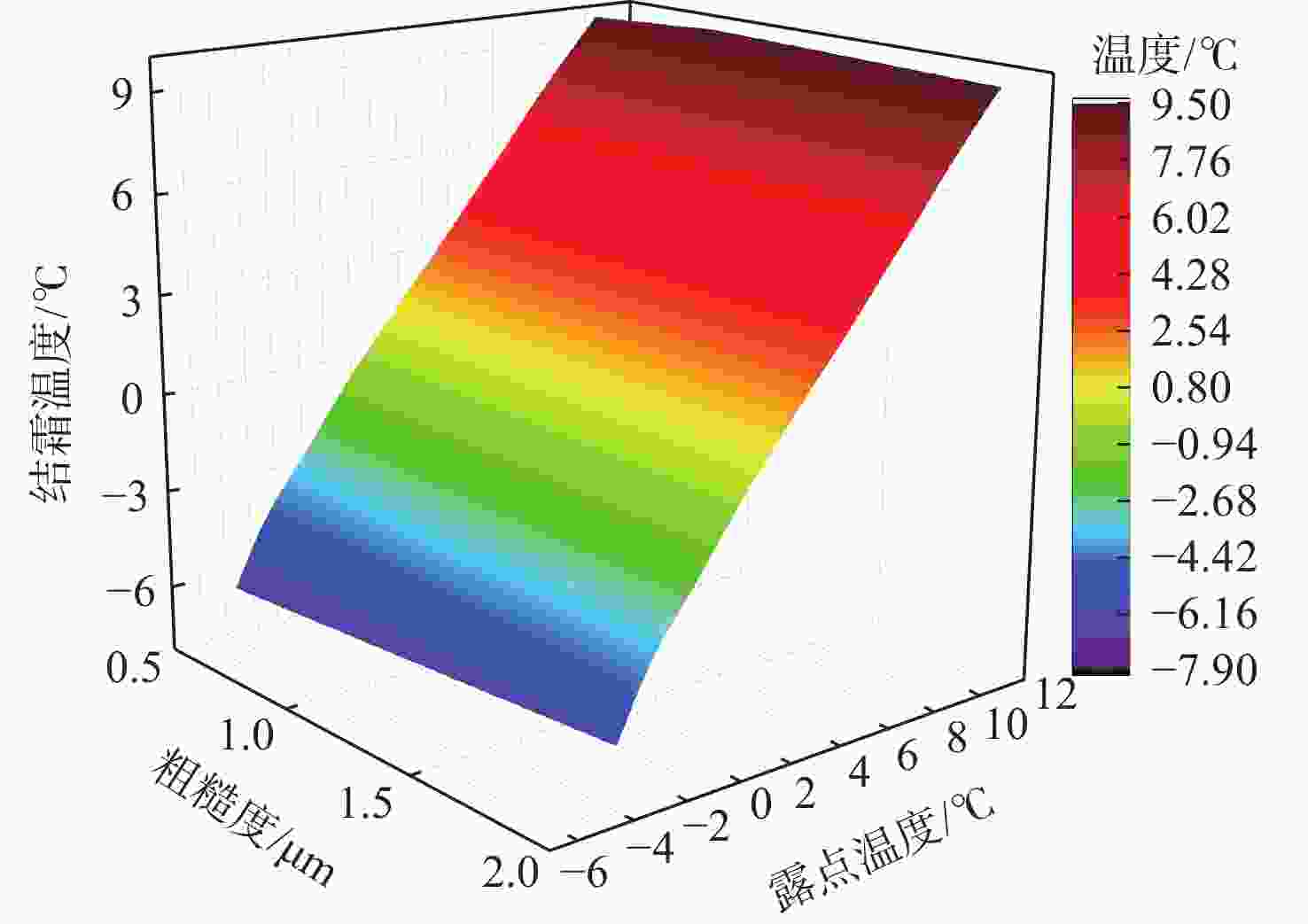
图 8 露点温度对结霜温度的影响
Figure 8. Effect of dew point temperature on frost formation temperature
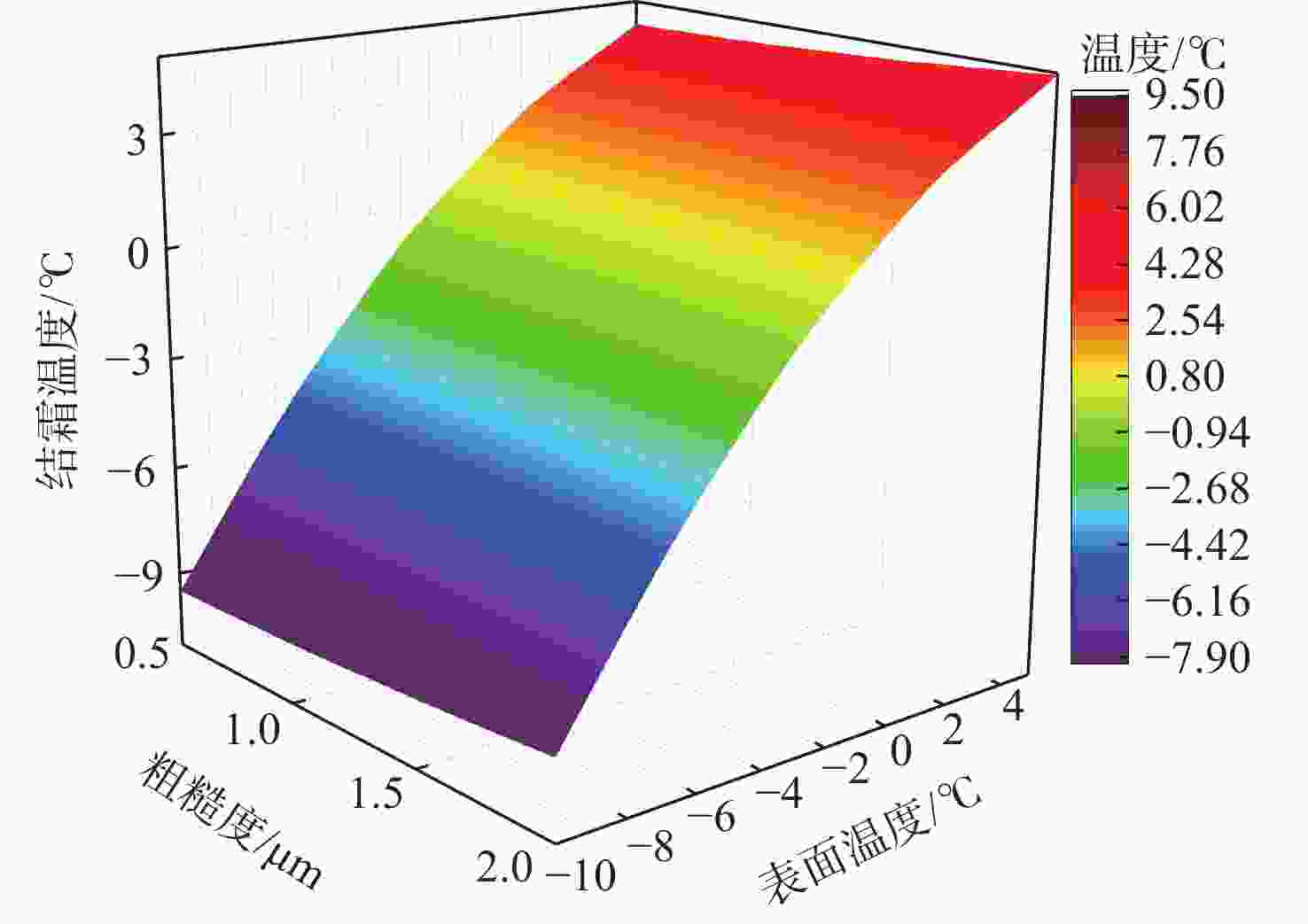
图 9 表面温度对结霜温度的影响
Figure 9. Effect of surface temperature on frosting formation temperature
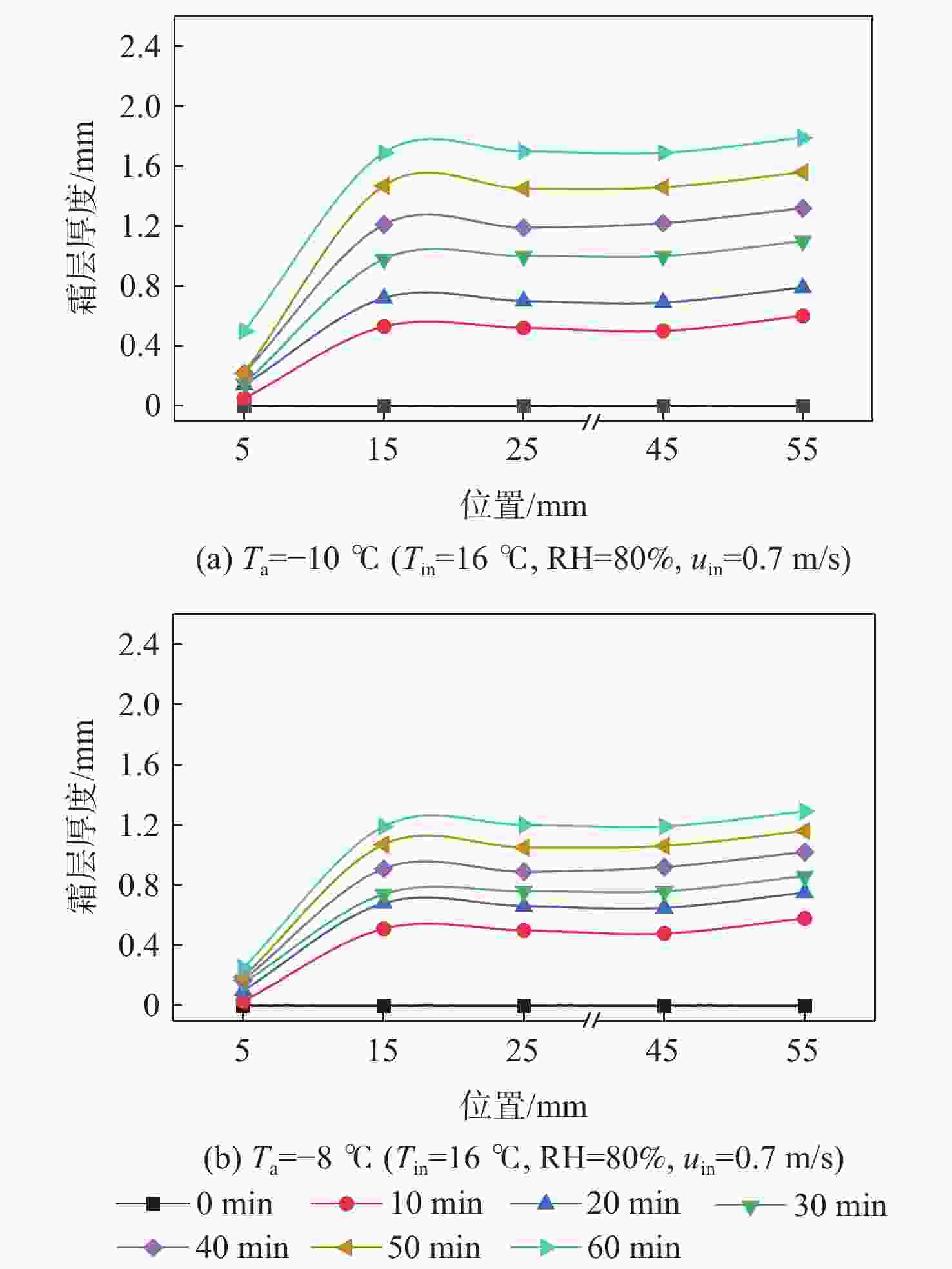
图 11 不同位置霜层厚度随时间变化
Figure 11. Thickness of frost layer varies with time at different locations
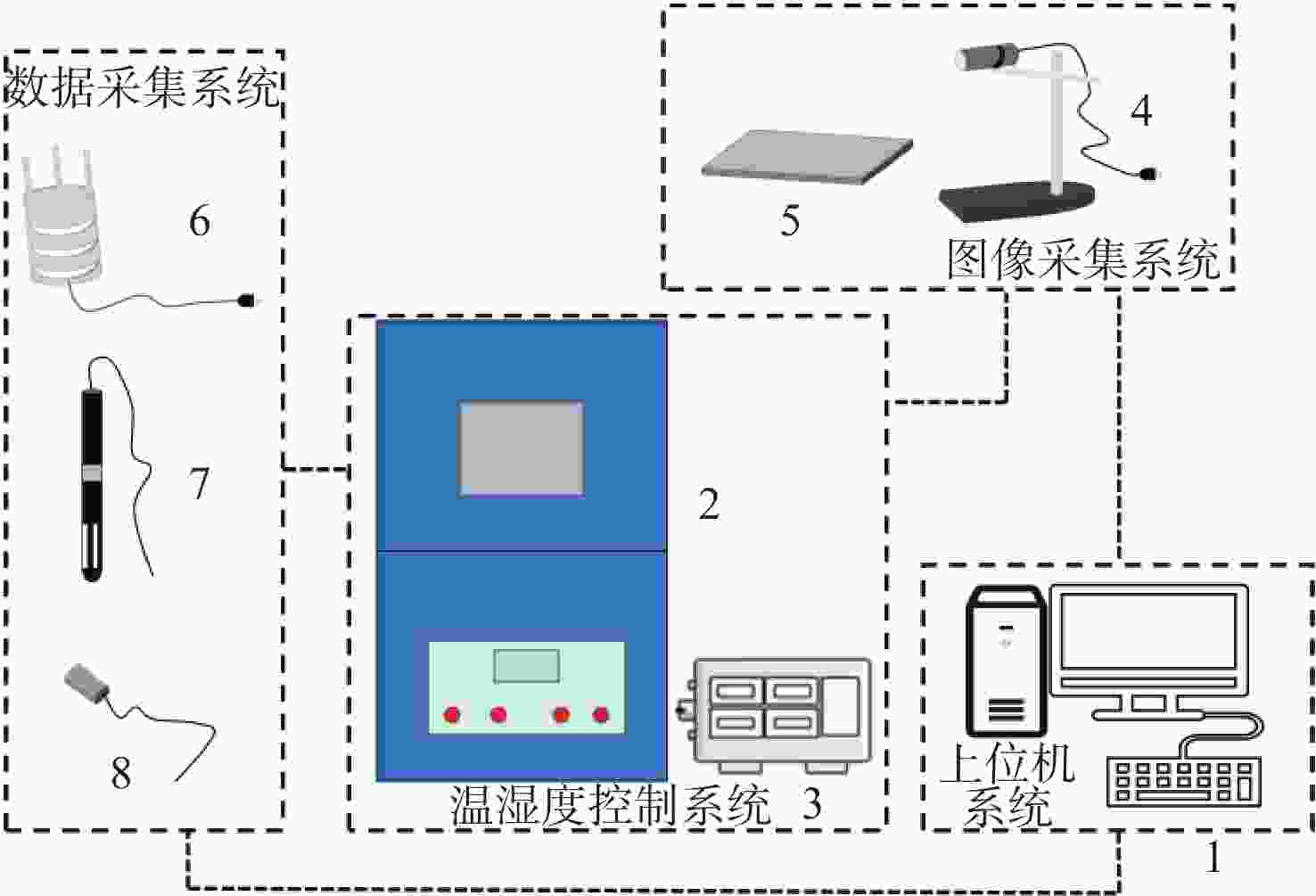
图 13 结霜温度实验系统
1. 上位机;2. 低温试验箱;3. 温湿度控制器;4. 相机;5. 铝板;6. 气象传感器;7. 温湿度传感器;8. PT100贴片式表面温度传感器。
Figure 13. Frost temperature test system
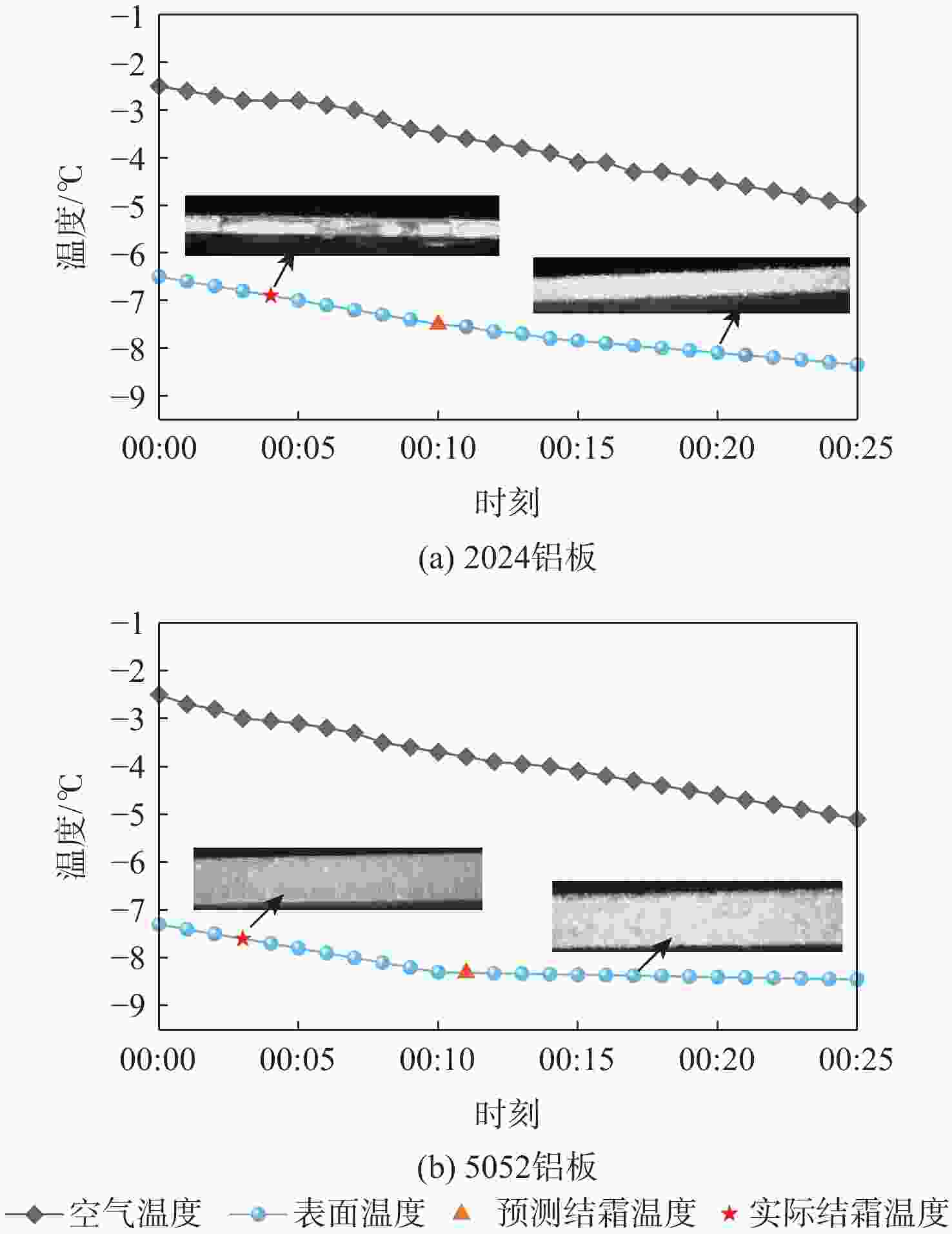
图 14 结霜温度实验与模型结果对比
Figure 14. Comparison of experimental and model results for frost temperature
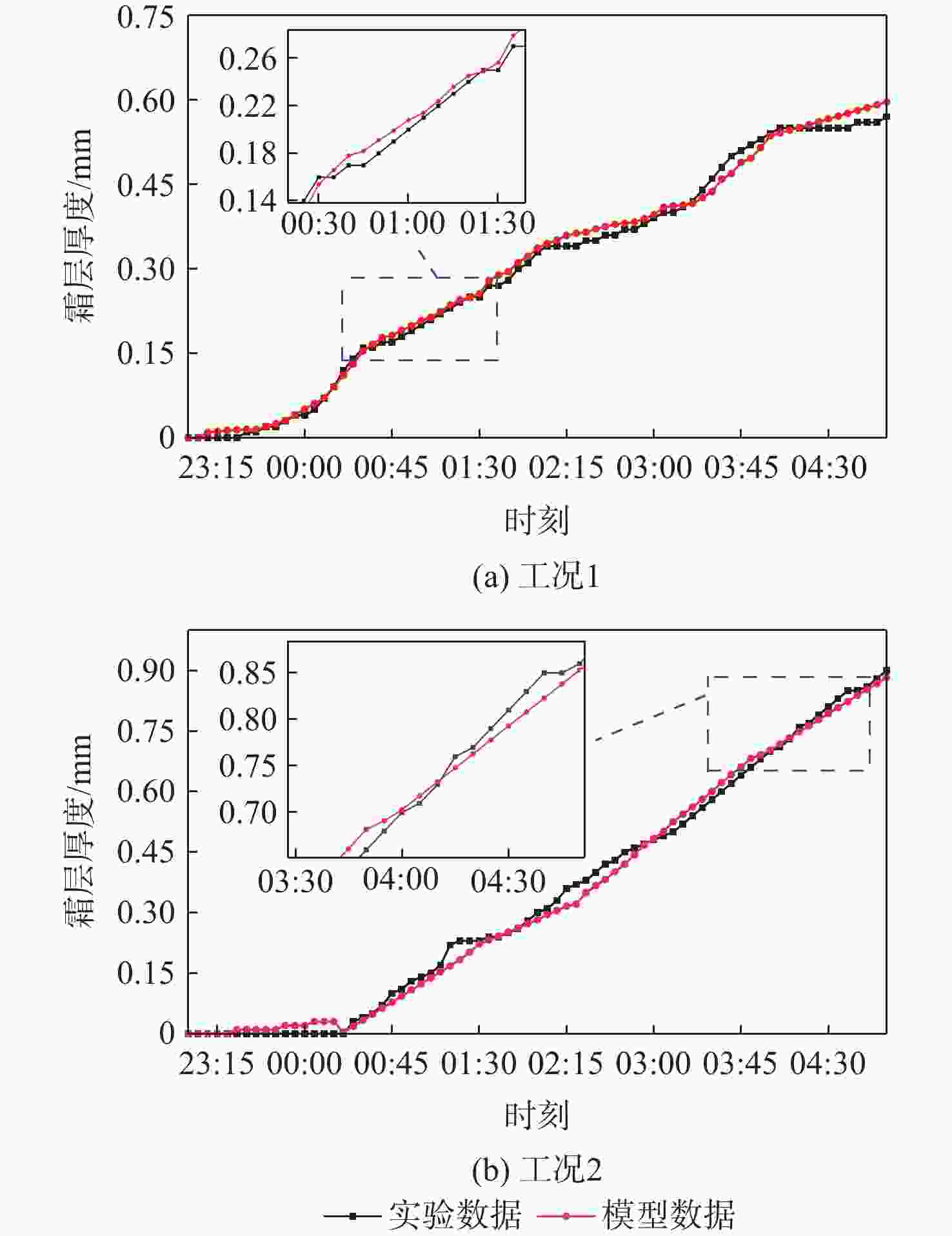
图 17 霜层厚度实验与模型结果对比
Figure 17. Comparison of experimental and model results for frost thickness
表 1 特性参数选取
Table 1. Characteristic parameter selection
参数 数值 液核分子数密度/cm−2 1.0383 ×10¹⁵玻耳兹曼常数/(J·K−1) 1.380622 ×10⁻²³普朗克常数/(J·s−1) 6.626176 ×10⁻³⁴阿伏伽德罗常数 6.022045 ×10²³液核密度/(g·cm−3) 1.000 凝固潜热/(J·kg−1) 334388.9 液核扩散激活能/(J·mol−1) 13000  下载: 导出CSV
表 2 物性参数选取
Table 2. Physical property parameter selection
物质 密度/(kg·m−3) 热导率/(W·(m·K)−1) 黏性系数/(J·(g·K)−1) 空气 1.225 1.79×10⁻⁵ 水蒸气 0.554 1.34×10⁻⁵ 霜 917 2.5 铝 2719 202.4
下载: 导出CSV
-
[1] HAYASHI Y, AOKI A, ADACHI S, et al. Study of frost properties correlating with frost formation types[J]. Journal of Heat Transfer, 1977, 99(2): 239-245. [2] WU X M, DAI W T, SHAN X F, et al. Visual and theoretical analyses of the early stage of frost formation on cold surfaces[J]. Journal of Enhanced Heat Transfer, 2007, 14(3): 257-268. [3] CHENG C H, WU K H. Observations of early-stage frost formation on a cold plate in atmospheric air flow[J]. Journal of Heat Transfer, 2003, 125(1): 95-102. [4] CHAUDHARY G, LI R. Freezing of water droplets on solid surfaces: an experimental and numerical study[J]. Experimental Thermal and Fluid Science, 2014, 57: 86-93. [5] MATSUMOTO M, SAITO S, OHMINE I. Molecular dynamics simulation of the ice nucleation and growth process leading to water freezing[J]. Nature, 2002, 416(6879): 409-413. [6] HUANG L Y, LIU Z L, LIU Y M, et al. Effect of contact angle on water droplet freezing process on a cold flat surface[J]. Experimental Thermal and Fluid Science, 2012, 40: 74-80. [7] BUCHER F, KNOTHE K, THEILER A. Normal and tangential contact problem of surfaces with measured roughness[J]. Wear, 2002, 253(1-2): 204-218. [8] 陆晨律, 王利平, 孟航飞, 等. 过冷水-壁面接触面积对冰成核行为影响实验研究[J]. 上海交通大学学报, 2025, 59(8): 1145-1155.LU C L, WANG L P, MENG H F, et al. Ice nucleation behavior in supercooled water with varying wall contact area[J]. Journal of Shanghai Jiao Tong University, 2025, 59(8): 1145-1155(in Chinese). [9] NA B, WEBB R L. A fundamental understanding of factors affecting frost nucleation[J]. International Journal of Heat and Mass Transfer, 2003, 46(20): 3797-3808. [10] PIUCCO R O, HERMES C J L, MELO C, et al. A study of frost nucleation on flat surfaces[J]. Experimental Thermal and Fluid Science, 2008, 32(8): 1710-1715. [11] LEE K S, KIM W S, LEE T H. A one-dimensional model for frost formation on a cold flat surface[J]. International Journal of Heat and Mass Transfer, 1997, 40(18): 4359-4365. [12] XU D D, WANG L W. Frost formation mechanism analysis and frost growth prediction on ground aircraft[J]. Heat and Mass Transfer, 2013, 49(10): 1385-1393. [13] HERMES C J L, PIUCCO R, BARBOSA J, et al. A study of frost growth and densification on flat surfaces[J]. Experimental Thermal and Fluid Science, 2009, 33(2): 371-379. [14] HERMES C J L. An analytical solution to the problem of frost growth and densification on flat surfaces[J]. International Journal of Heat and Mass Transfer, 2012, 55(23-24): 7346-7351. [15] LENIC K, TRP A, FRANKOVIC B. Transient two-dimensional model of frost formation on a fin-and-tube heat exchanger[J]. International Journal of Heat and Mass Transfer, 2009, 52(1-2): 22-32. [16] LENIC K, TRP A, FRANKOVIC B. Prediction of an effective cooling output of the fin-and-tube heat exchanger under frosting conditions[J]. Applied Thermal Engineering, 2009, 29(11-12): 2534-2543. [17] KIM D, KIM C, LEE K S. Frosting model for predicting macroscopic and local frost behaviors on a cold plate[J]. International Journal of Heat and Mass Transfer, 2015, 82: 135-142. [18] 赵泽扬, 夏鹏. 倾斜表面结霜过程实验及数值模拟研究[J]. 制冷技术, 2022, 42(5): 33-39.ZHAO Z Y, XIA P. Experimental and numerical research on frosting process of inclined surfaces[J]. Chinese Journal of Refrigeration Technology, 2022, 42(5): 33-39(in Chinese). [19] 中国民用航空局. 民航冬季安全运行指导意见: 局发明电〔2007〕4027号[Z]. 北京: 中国民用航空局, 2007.Civil Aviation Administration of China. Guidance on winter safety operation of civil aviation: CAAC Dispatch [2007] No. 4027[Z]. Beijing: Civil Aviation Administration of China, 2007(in Chinese). [20] 洪天顺, 梁彩华, 吕宁. 结霜工况下水蒸气在冷表面上冷凝成核的理论与实验研究[J]. 中南大学学报(自然科学版), 2021, 52(6): 1865-1875.HONG T S, LIANG C H, LV N. Theory and experimental study of water vapour nucleation process on a cold surface in frosting condition[J]. Journal of Central South University (Science and Technology), 2021, 52(6): 1865-1875(in Chinese). [21] THOMAS Y. The Bakerian lecture. experiments and calculations relative to physical optics[J]. Philosophical Transactions of the Royal Society of London, 1804, 94: 1-16. [22] 中国民用航空局. 地面结冰条件下的运行: AC-121-50R1[S]. 北京: 中国民用航空局, 2014.Civil Aviation Administration of China. Operation under icy ground conditions: AC-121-50R1[S]. Beijing: Civil Aviation Administration of China, 2014(in Chinese). -

 下载:
下载:


 点击查看大图

计量
- 文章访问数: 300
- HTML全文浏览量: 102
- PDF下载量: 97
- 被引次数: 0
