





Quantitative assessment of extravehicular maintenance operation time for astronauts
-
摘要:
航天员舱外维修操作是维持空间站在太空环境中安全运行的必要措施,量化评估维修操作时间是确保舱外活动任务成功和航天员安全的基础。基于此,提出一种航天员舱外维修操作时间量化评估方法,用于设计和分析航天员舱外活动操作时间,以满足航天员出舱时间的要求。该方法考虑微重力环境的影响,运用模特(MOD)法对已有数据中的关节基准动作时间进行修正,采用最小二乘法对已有数据进行拟合得到关节基准动作时间的不确定性范围。针对不同航天员、不同舱外任务的工况,与公开的舱外活动视频进行对比分析,验证了所提方法的准确性,为航天员舱外维修操作所需时间提供一种可行的依据。
Abstract:For space stations to operate safely in the space environment, astronauts' extravehicular maintenance tasks are essential. Therefore, it is essential to quantitatively assess the time required for these operations to ensure the success of extravehicular activities and the safety of astronauts. In this study, we present a quantitative technique for evaluating astronaut operational time during extravehicular maintenance activities, with the goal of designing and analyzing the duration of astronaut extravehicular operations to fulfill extravehicular time requirements. The proposed method takes into consideration the influence of the microgravity environment and the reference motion time of the joint in the literature data, which was modified by the modular arrangement of predetermined time standard (MOD) method, and the uncertainty range of the reference motion time of the joint was obtained by fitting the literature data with the least square method. For the working conditions of different astronauts and different extravehicular tasks, a comparative analysis with publicly available videos of extravehicular activities was conducted to verify the accuracy of the assessment method and provide a feasible basis for the time required for astronauts' extravehicular maintenance operations.
-
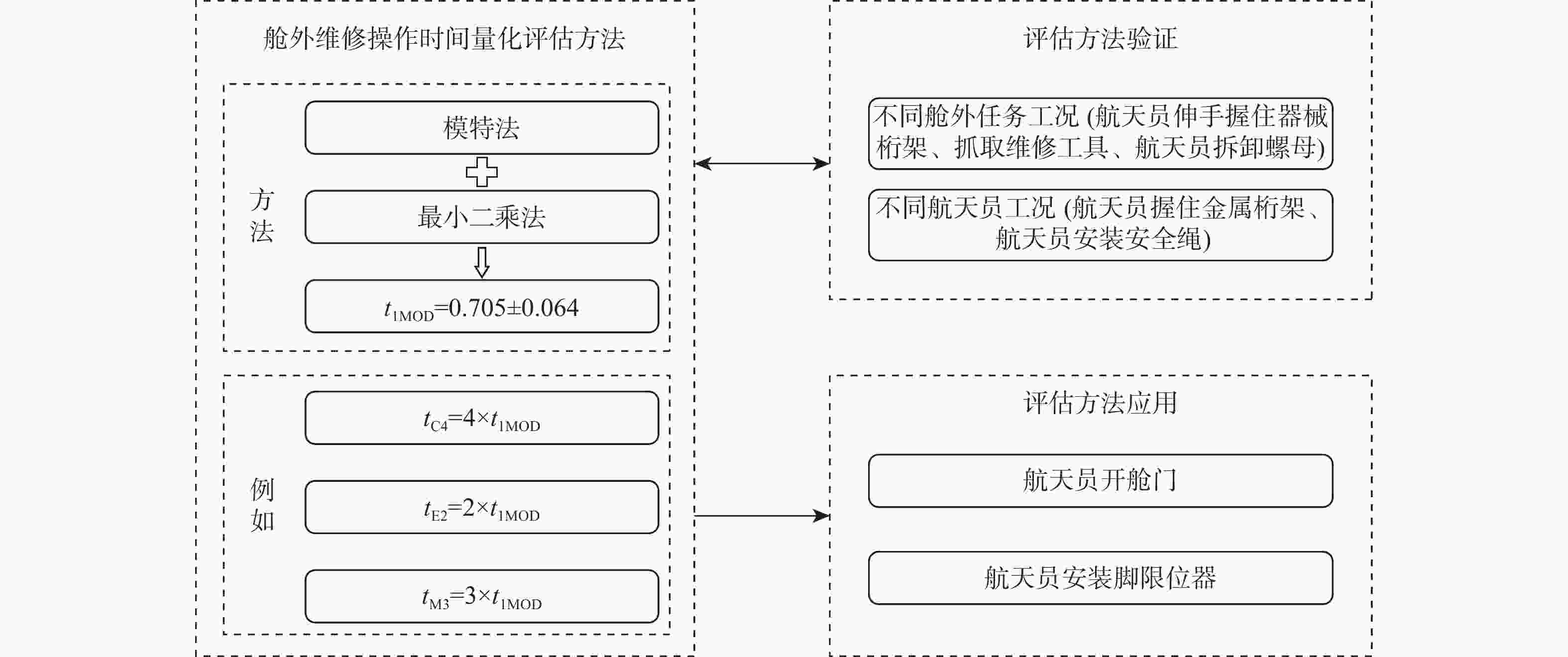
图 3 航天员舱外维修操作时间的量化评估流程图
Figure 3. Framework for quantitative assessment of extravehicular maintenance operation time for astronauts
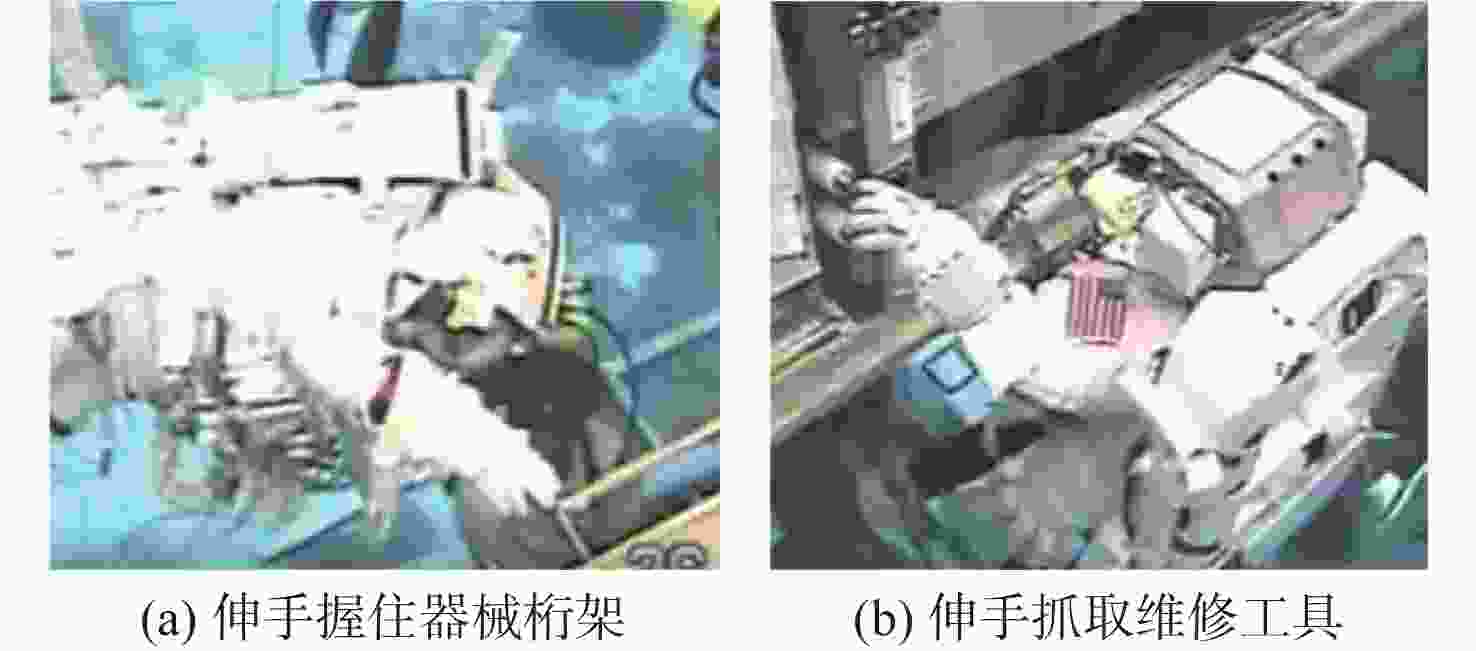
图 4 案例1公开舱外视频片段截图
Figure 4. Public extravehicular video segments screenshots of case 1
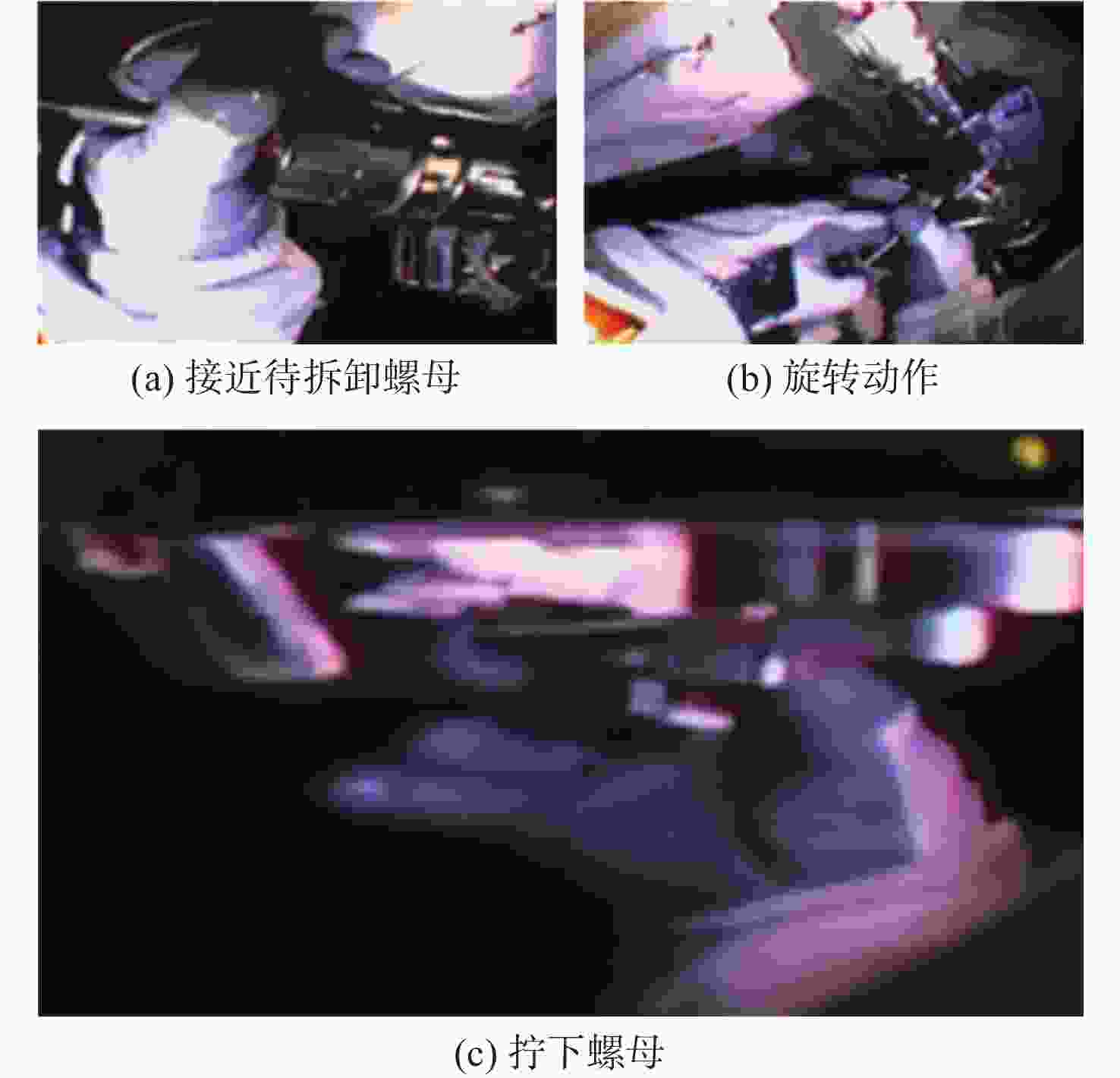
图 5 案例2公开舱外视频片段截图
Figure 5. Public extravehicular video segments screenshots of case 2
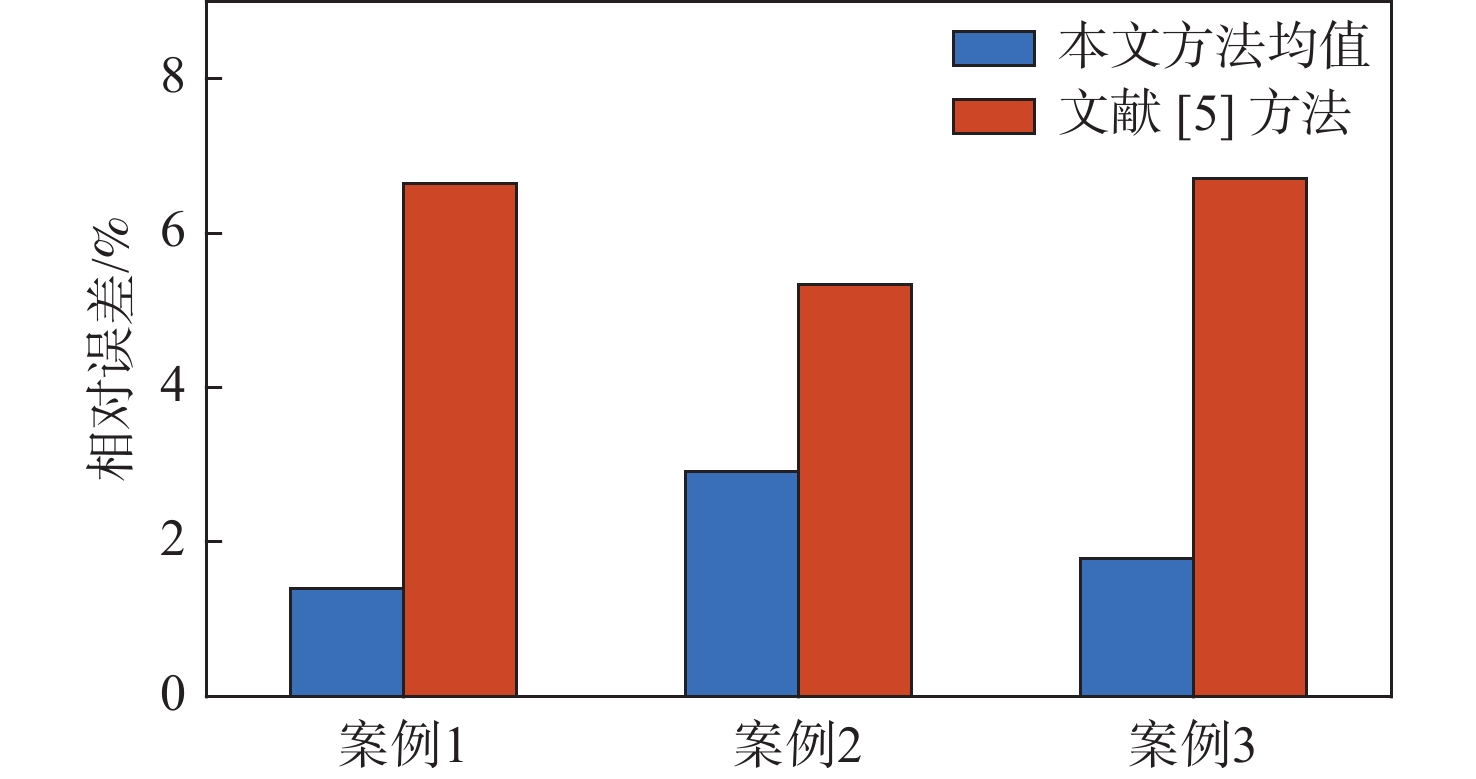
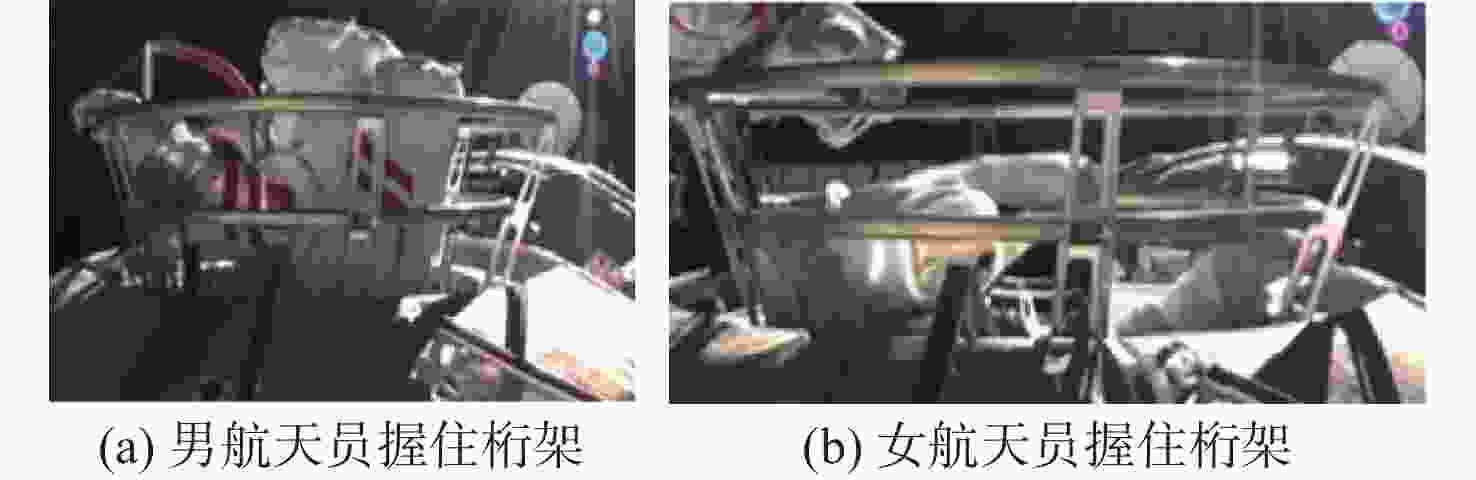
图 8 案例3公开舱外视频片段截图
Figure 8. Public extravehicular video segments screenshots of case 3
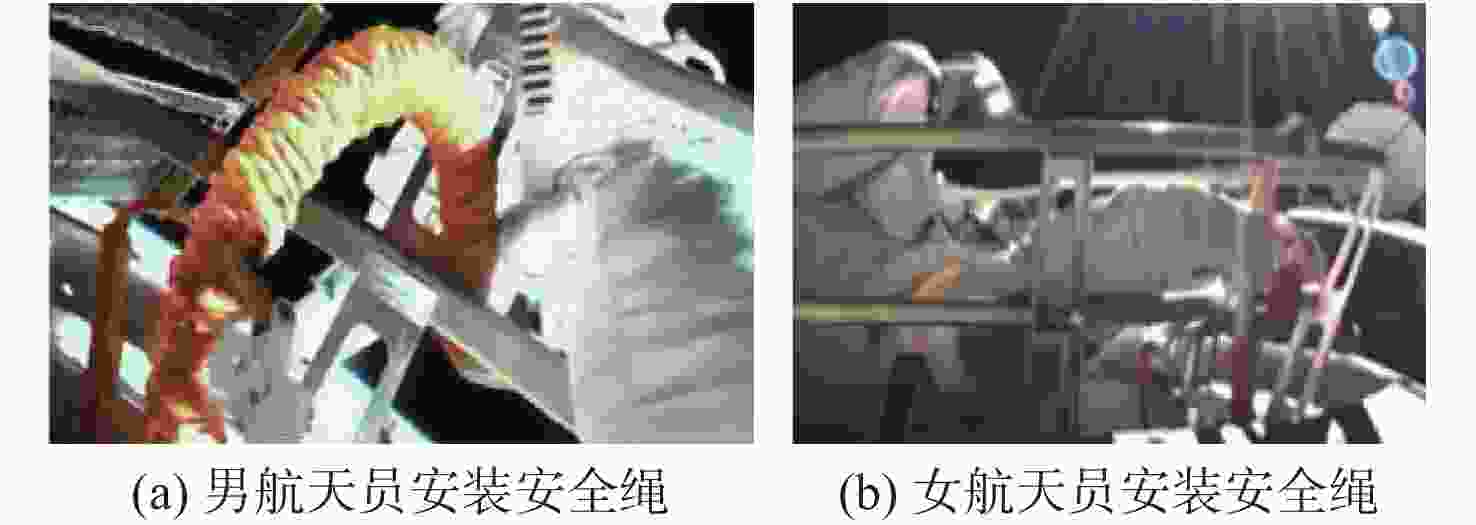
图 10 案例4公开舱外视频片段截图
Figure 10. Public extravehicular video segments screenshots of case 4
基本动作 动作描述 MOD值 移动动作 手指动作M1 1 腕关节动作M2 2 肘关节动作M3 3 肩关节动作M4 4 伸直手臂动作M5 5 终结动作 触摸动作G0 0 简单抓取动作G1 1 复杂抓取动作G3 3 简单放置动作P0 0 较复杂放置动作P2 2 复杂放置动作P5 5 其他动作 走步动作W5 5 起身坐下动作S30 30 目视动作E2 2 校正动作R2 2 判断动作D3 3 加压动作A4 4 旋转动作C4 4  下载: 导出CSV
部位 活动角度 活动角度范围/(°) 指关节 屈曲θKQ1 0~ 90 伸展θKQ2 0~15 腕关节 掌曲θWQ1 0~80 背伸θWQ2 0~30 桡偏θWP1 0~20 尺偏θWP2 0~30 肘关节 屈曲θEQ1 0~150 伸展θEQ2 0~10 旋前θEX1 0~80 旋后θEX2 0~80 肩关节 屈曲θSQ1 0~180 伸展θSQ2 0~120 外展θSZ1 0~90 内收θSZ2 0~30 旋内θSX1 0~70 旋外θSX2 0~90
下载: 导出CSV
动作 基准动作
时间平均值/s基准动作
时间方差/s2基准动作
时间中位数/s基准动作
时间最大值/s基准动作
时间最小值/s基准动作
时间极差/s指关节动作M1 0.72 0.03 0.71 0.96 0.52 0.44 腕关节动作M2 1.39 0.09 1.30 2.16 0.98 1.18 肘关节动作M3 1.95 0.19 2.01 2.82 1.19 1.63 肩关节动作M4 3.02 0.26 2.95 3.81 2.06 1.75
下载: 导出CSV
表 4 案例1结果分析
Table 4. Case 1 result analysis
动作描述 动作
分解t1MOD值 本文方法
时间/s文献[5]方法
时间/s实际
时间/s伸手握住器械桁架 M3-G1 4 [5.13,6.15] 5.34 5.72 伸手抓取维修工具 M3-G1 4
下载: 导出CSV
表 5 案例2结果分析
Table 5. Case 2 result analysis
动作描述 动作
分解t1MOD值 本文方法
时间/s文献[5]方法
时间/s实际
时间/s接近待拆卸螺母 M4 4 [25.00,29.99] 26.12 28.00 旋转动作 M3 30 拧下螺母 M1 5
下载: 导出CSV
表 6 案例3结果分析
Table 6. Case 3 result analysis
动作描述 动作
分解t1MOD值 本文方法
时间/s男航天员平均
实际时间/s女航天员平均
实际时间/s握住金
属桁架M3-G1 4 [2.56,3.08] 2.83 2.89
下载: 导出CSV
表 7 案例4结果分析
Table 7. Case 4 result analysis
动作描述 动作分解 t1MOD值 本文方法
时间/s男航天员平均
实际时间/s女航天员平均
实际时间/s安装
安全绳M4-P2-C4 10 [6.41,7.69] 7.01 7.18
下载: 导出CSV
表 8 航天员开舱门的时间评估
Table 8. Estimated time for astronauts to open the door of the spacecraft
动作描述 动作分解 次数 t1MOD值 评估时间/s 伸手取工具 M4-G3 1 7 [4.49,5.38] 旋转工具 M2-C4 18 108 [69.23,83.05] 放回工具 M4-P5 1 9 [5.77,6.92] 伸手拉住舱门 M4-G3 3 21 [13.46,16.15]
下载: 导出CSV
表 9 航天员安装脚限位器的时间评估
Table 9. Estimated time for astronauts to install the foot restraint device
动作描述 动作分解 次数 t1MOD值 评估时间/s 拿取脚限位器 M4-G3 1 7 [4.49,5.38] 将脚限位器末端插入基座 M3-P5-E2 4 40 [25.64,30.76] 锁定末端的锁紧把手 M3-C4 2 14 [8.97,10.77]
下载: 导出CSV
-
[1] 李兴乾, 魏传锋, 张伟, 等. 载人航天器在轨维修性设计体系[J]. 系统工程与电子技术, 2016, 38(1): 84-89.LI X Q, WEI C F, ZHANG W, et al. On-orbit maintainability design system for manned spacecraft[J]. Systems Engineering and Electronics, 2016, 38(1): 84-89(in Chinese). [2] 张杰, 朱欣, 尹玉梅, 等. 国外载人航天器维修性标准综述[J]. 载人航天, 2023, 29(6): 824-831.ZHANG J, ZHU X, YIN Y M, et al. Review of foreign standards for manned spacecraft maintainability[J]. Manned Spaceflight, 2023, 29(6): 824-831(in Chinese). [3] 张伟, 侯永青, 夏侨丽, 等. 空间站维修设计与实践[J]. 中国科学: 技术科学, 2022, 52(9): 1332-1344.ZHANG W, HOU Y Q, XIA Q L, et al. Maintenance design and practice for the China space station[J]. Scientia Sinica (Technologica), 2022, 52(9): 1332-1344(in Chinese). [4] GE X Y, ZHOU Q X, LIU Z Q. Assessment of space station on-orbit maintenance task complexity[J]. Reliability Engineering & System Safety, 2020, 193: 106661. [5] 薛龙. 面向在轨的维修时间度量方法研究[D]. 北京: 北京航空航天大学, 2018.XUE L. Research on on-orbit maintenance time measurement methods[D]. Beijing: Beihang University, 2018(in Chinese). [6] REMBALA R, OWER C. Robotic assembly and maintenance of future space stations based on the ISS mission operations experience[J]. Acta Astronautica, 2009, 65(7-8): 912-920. [7] FENG Z H, DING X R, ZHANG H, et al. An energy consumption estimation method for the tool setting process in CNC milling based on the modular arrangement of predetermined time standards[J]. Energies, 2023, 16(20): 7064. [8] 康乐. 基于虚拟现实的维修时间度量方法研究[D]. 北京: 北京航空航天大学, 2012.KANG L. Research of maintenance time measurement based on virtual reality[D]. Beijing: Beihang University, 2012(in Chinese). [9] 张力匀, 刘毅, 刘佳. 基于虚拟现实的维修时间预计方法[J]. 计算机辅助设计与图形学学报, 2016, 28(8): 1383-1392.ZHANG L Y, LIU Y, LIU J. Maintenance time prediction using virtual reality[J]. Journal of Computer-Aided Design & Computer Graphics, 2016, 28(8): 1383-1392(in Chinese). [10] CHEN J Y, ZHOU D, KANG L, et al. A maintenance time estimation method based on virtual simulation and improved modular arrangement of predetermined time standards[J]. International Journal of Industrial Ergonomics, 2020, 80: 103042. [11] DONG Z, LE K, CHUAN L. A virtual reality-based maintenance time measurement methodology for complex products[J]. Assembly Automation, 2013, 33(3): 221-230. [12] SU X B, GAO Q, MA W N, et al. Algorithm of maintenance time and maintenance amount based on maintenance degree[C]//Proceedings of the IEEE International Conference on Power, Intelligent Computing and Systems. Piscataway: IEEE Press, 2020: 230-234. [13] 吴振亚, 郝建平, 陈汉青, 等. 装备平均修复时间验证方法研究综述[J]. 系统工程与电子技术, 2020, 42(12): 2931-2943.WU Z Y, HAO J P, CHEN H Q, et al. Review on research of equipment mean time to repair demonstration methods[J]. Systems Engineering and Electronics, 2020, 42(12): 2931-2943(in Chinese). [14] 陈善广. 航天员出舱活动技术[M]. 北京: 中国宇航出版社, 2007.CHEN S G. Astronaut extravehicular activity technology[M]. Beijing: China Astronautic Publishing House, 2007(in Chinese). [15] 聂喜荣, 李鹏. 预定时间标准方法对比分析[J]. 价值工程, 2019, 38(19): 252-254.NIE X R, LI P. Comparative analysis of predetermined time standard methods[J]. Value Engineering, 2019, 38(19): 252-254(in Chinese). [16] 易树平, 郭伏. 基础工业工程[M]. 3版. 北京: 机械工业出版社, 2022.YI S P, GUO F. Fundament of industrial engineering[M]. 3rd ed. Beijing: China Machine Press, 2022(in Chinese). [17] 李涛, 魏传锋, 李伟, 等. 载人航天器在轨维修地面仿真验证技术[J]. 航天器环境工程, 2016, 33(5): 510-515.LI T, WEI C F, LI W, et al. Simulation and validation technology of manned spacecraft on-orbit maintenance[J]. Spacecraft Environment Engineering, 2016, 33(5): 510-515(in Chinese). -

 下载:
下载:


 点击查看大图

计量
- 文章访问数: 238
- HTML全文浏览量: 88
- PDF下载量: 58
- 被引次数: 0
