





Optimization of take-off rotation process considering tail striking dynamic limit angle
-
摘要:
为防止擦机尾的发生,同时优化起飞抬轮过程,将抬轮过程中擦机尾角的变化考虑在内,建立计算飞机俯仰角、机尾离地高度等性能参数的抬轮阶段动力学模型。以波音737-800为例,探究抬轮速率变化对抬轮段距离的影响,对比擦机尾动态限制角和擦机尾固定限制角这2种抬轮方式的差异,分析动态限制角的优势。结果表明:大多数情况下,该机型最优抬轮速率范围为2.5~3.0 (°)/s。总体而言,相比于固定限制角,使用动态限制角的抬轮段距离减小约10%,从抬轮到离地的时间缩短约10%。对有关后机身长度和起落架高度的飞机设计提出建议,即后机身长度的选取与起落架高度应是相匹配的,选取比值约为5.0,若采用擦机尾动态限制角抬轮方式,比值应略微增大。研究结果可为飞行员提供抬轮操作参考,改善飞机的起飞性能,在防止擦机尾的同时,提高飞机载重。
Abstract:In order to prevent the occurrence of tail striking and optimize the take-off rotation process, this paper established a dynamic model of rotation to calculate the performance parameters such as pitch angle of the aircraft and tail ground clearance, taking into account the change of the tail striking angle during the rotation process. Using the Boeing 737-800 as an example, this study examined how the rotation rate affected the rotation distance, contrasted the tail striking dynamic limit angle with the tail striking fixed limit angle, and examined the benefits of the latter. The results show that in most cases, the optimal rotation rate ranges from 2.5 to 3.0 (°)/s. In comparison to the tail striking fixed limit angle, the rotation distance and lift-to-lift-off time are reduced by approximately 10% and 10%, respectively, with the tail striking dynamic limit angle. Finally, it is suggested that the ratio of the length of the rear fuselage to the length of the landing gear should be about 5.0, and that the ratio should be increased slightly if the tail striking dynamic limit angle is used. This study can provide pilots with a reference, improve the take-off performance of the aircraft, and increase the load of the aircraft while preventing tail striking.
-
Key words:
- air transportation /
- take-off performance /
- tail striking /
- rotation rate /
- dynamic limit angle
-
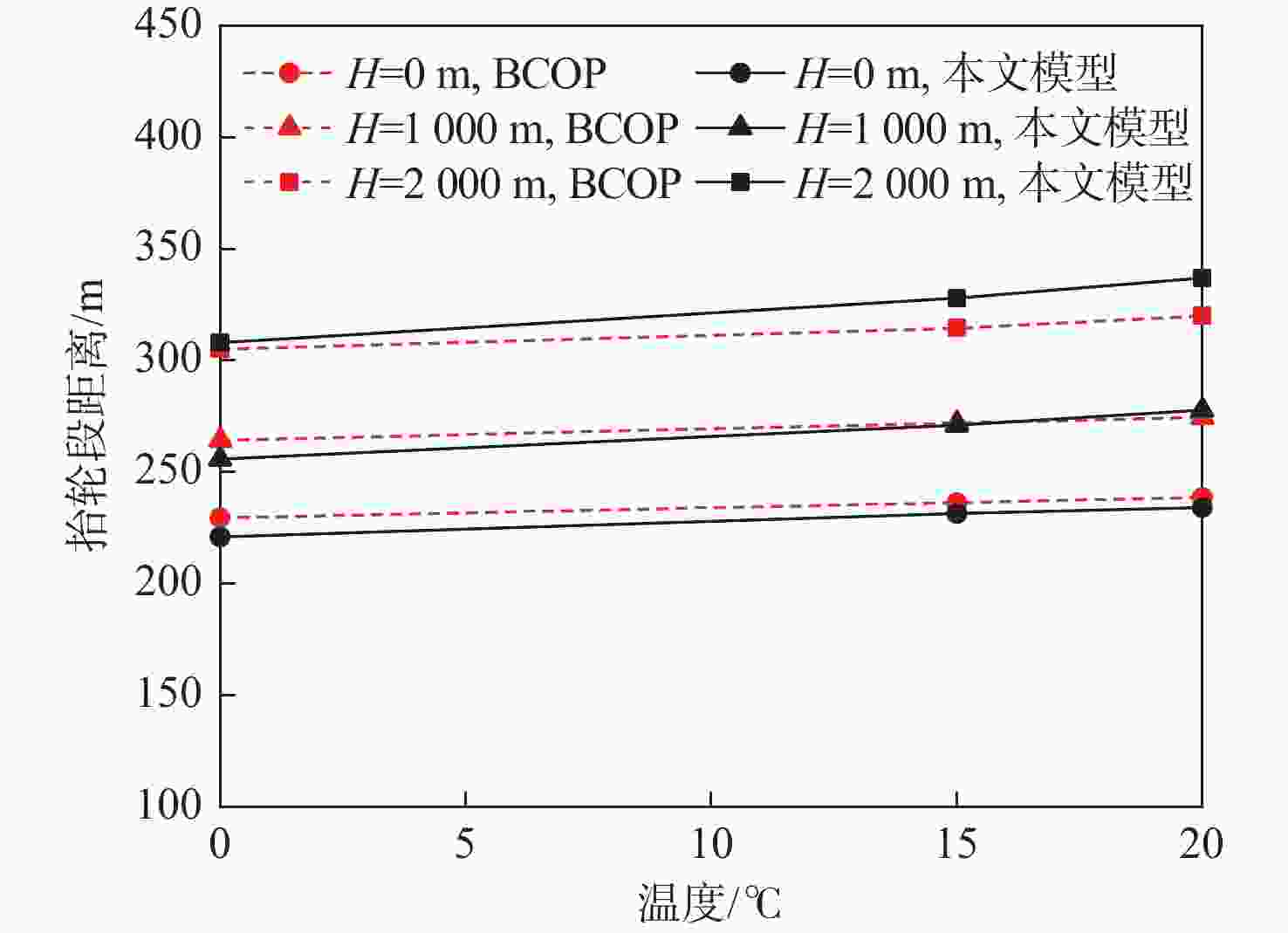
图 4 本文模型与BCOP计算结果对比
Figure 4. Comparison between results of the proposed model and BCOP
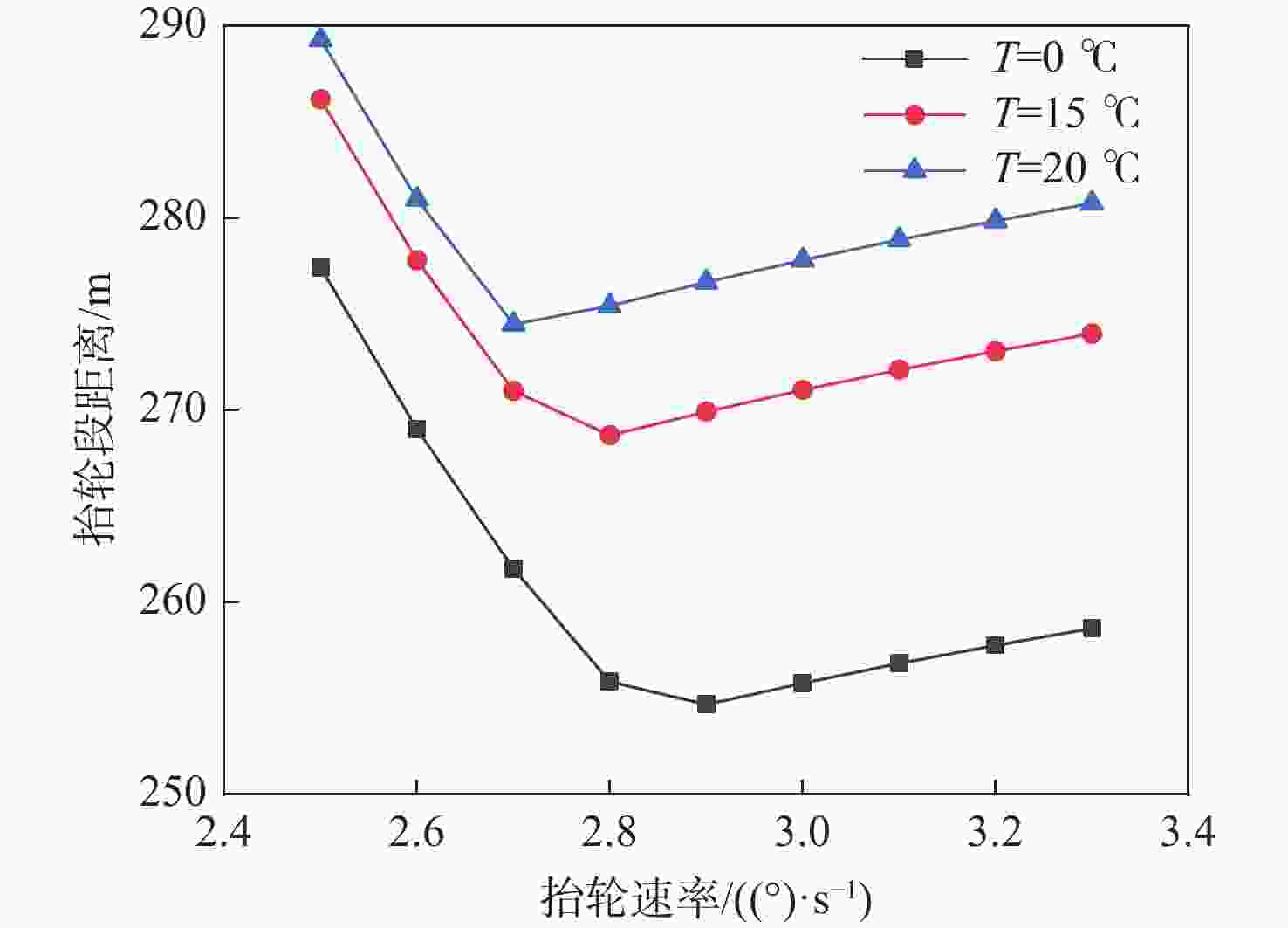
图 6 H=1 000 m,抬轮段距离随抬轮速率变化
Figure 6. H=1 000 m, rotation distance varies with rotation rate
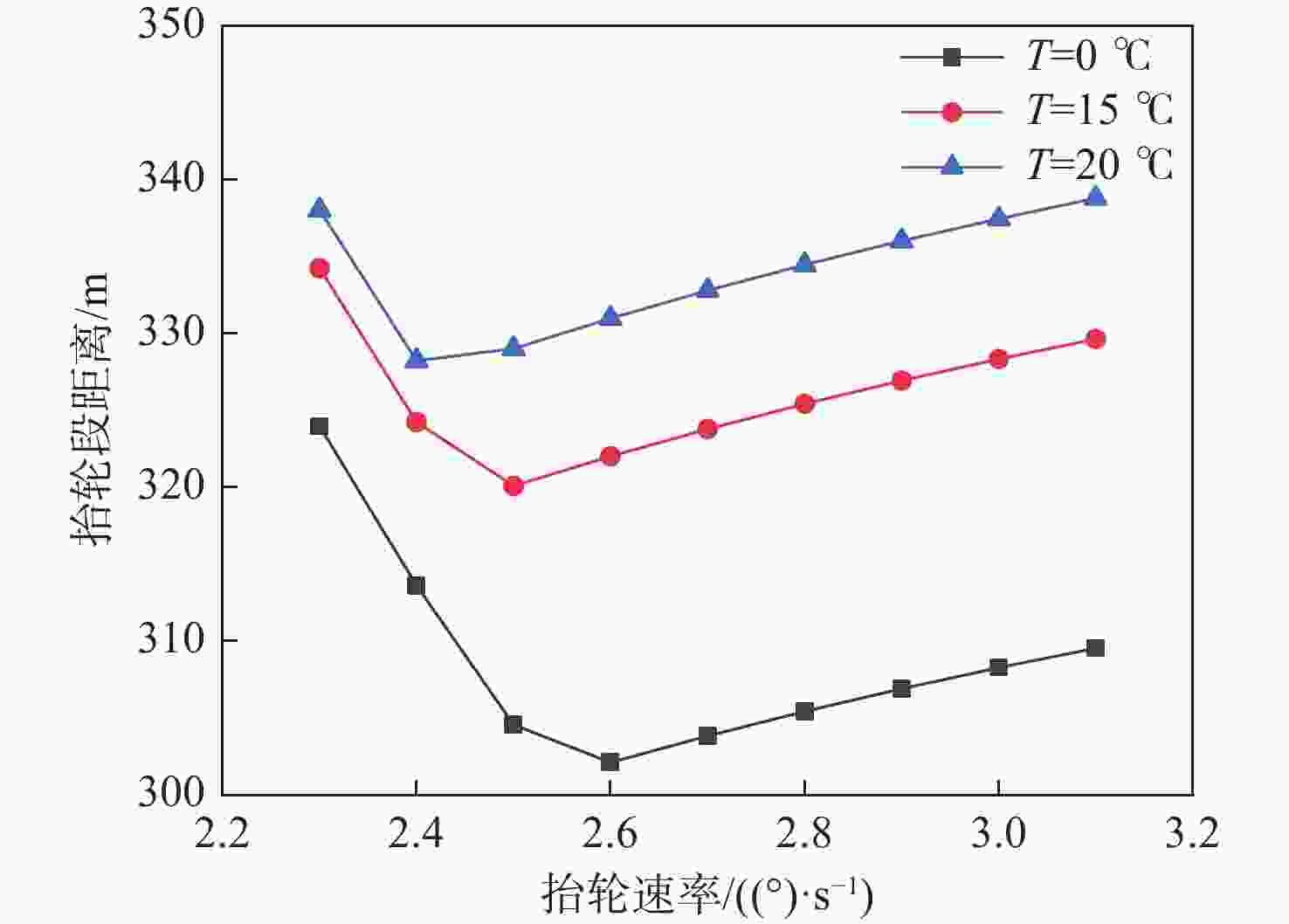
图 7 H=2 000 m,抬轮段距离随抬轮速率的变化
Figure 7. H=2 000 m, rotation distance varies with rotation rate
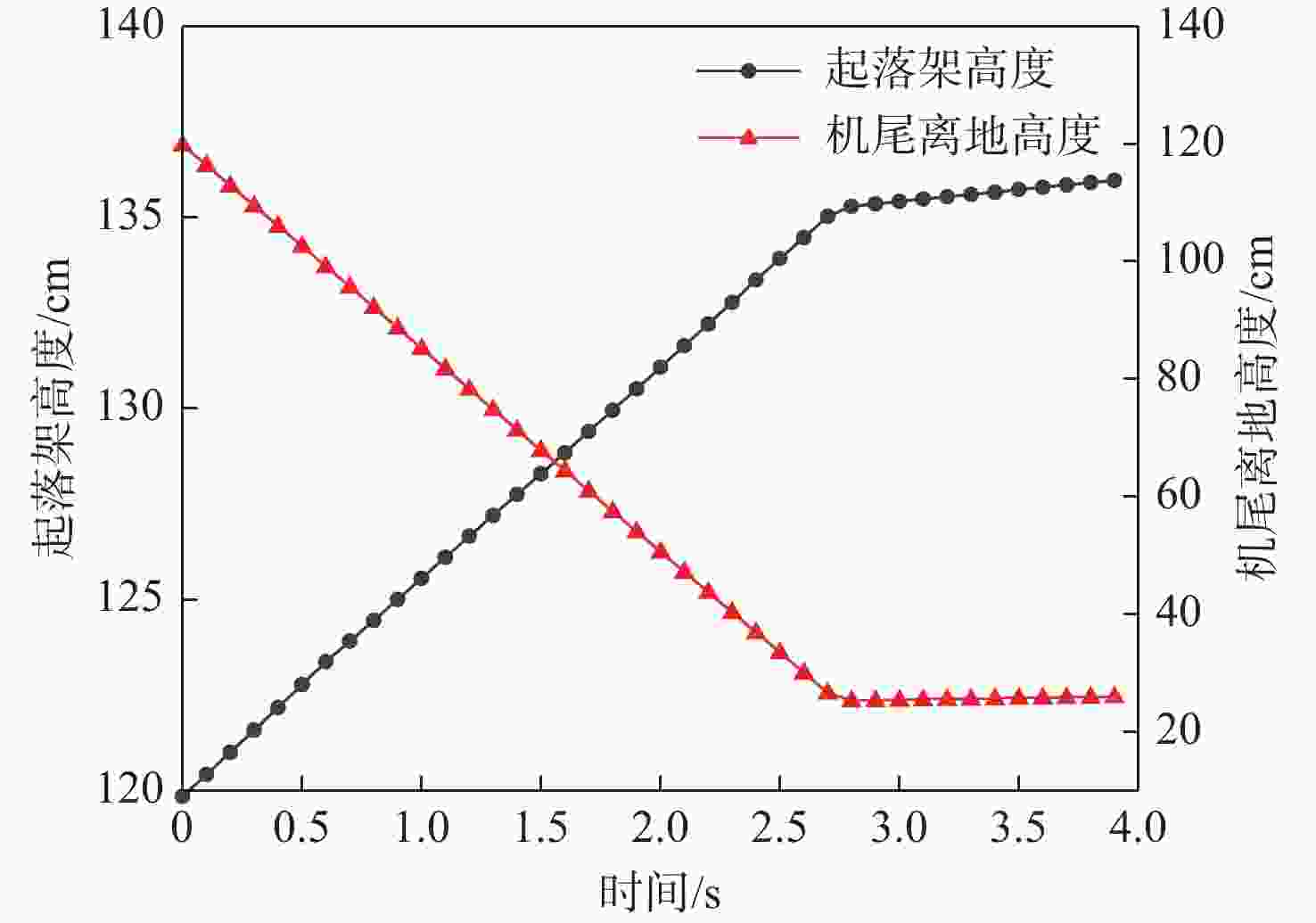
图 8 起落架高度和机尾离地高度随时间变化
Figure 8. Landing gear height and tail height above ground change over time
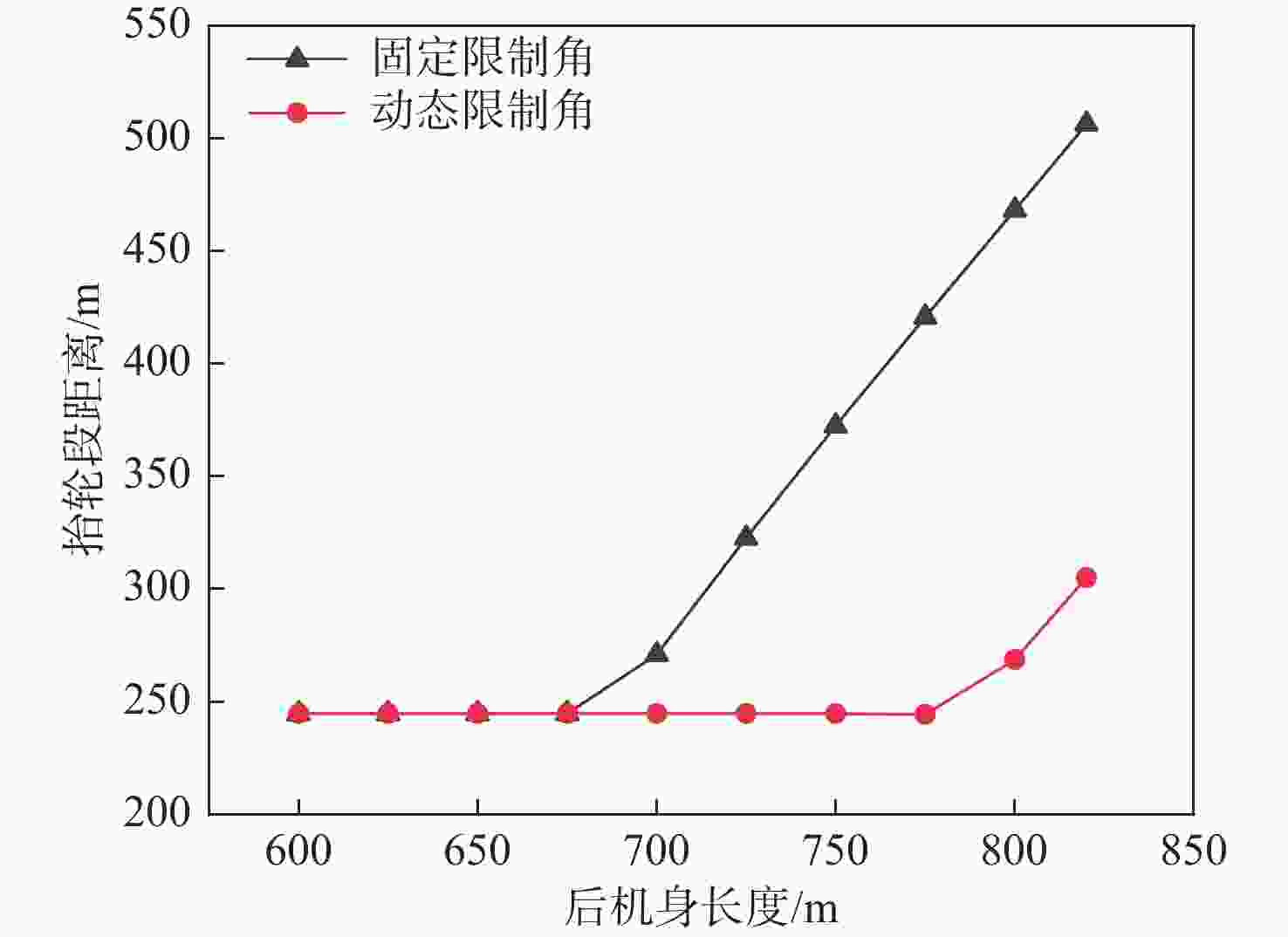
图 11 后机身长度的变化对抬轮段距离的影响
Figure 11. Effect of change in length of rear fuselage on rotation distance
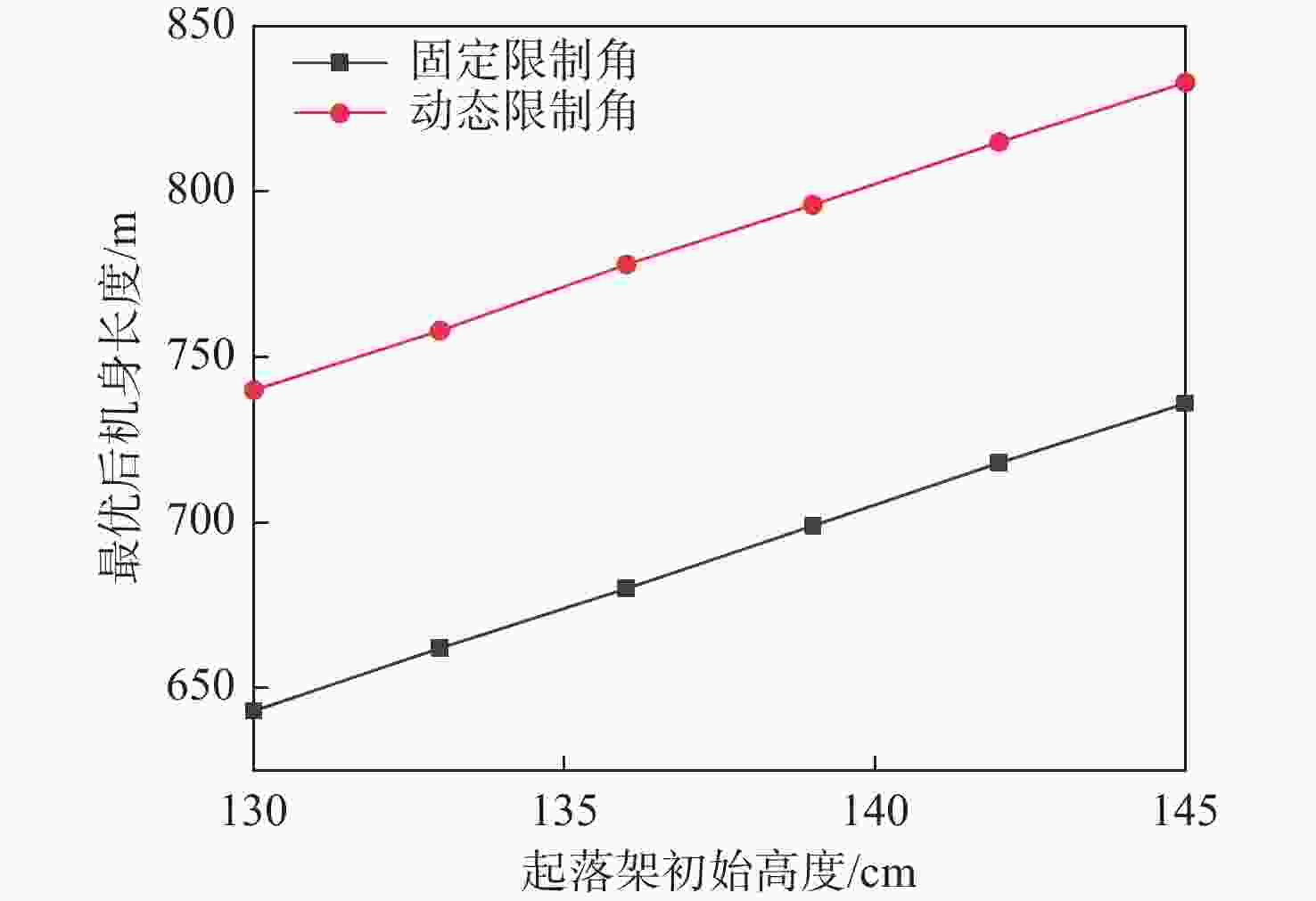
图 12 最优后机身长度与起落架初始高度的关系
Figure 12. Relationship between length of optimal rear fuselage and height of landing gear
表 1 机型参数
Table 1. Aircraft parameters
飞机质量/kg 机翼面积/m2 标准抬轮速率/((°)·s−1) 后机身长度/m 起落架初始高度/cm 完全压缩后起落架高度/cm 压缩率/10−5(cm·N−1) 67 000 124.5 3 700 136 112 3  下载: 导出CSV
表 2 H=0 m,T=0 ℃, 不同抬轮速率下起飞性能参数变化
Table 2. H=0 m,T=0 ℃, variation of relevant parameters at different rotation speeds
距离抬轮
开始的时间/s$ \theta $/(°) $ {C}_{L} $ $ D $/N $ {F}_{\text{V}} $/N VR=
2.7 (°)/sVR=
3.1 (°)/sVR=
3.4 (°)/sVR=
2.7 (°)/sVR=
3.1 (°)/sVR=
3.4 (°)/sVR=
2.7 (°)/sVR=
3.1 (°)/sVR=
3.4 (°)/sVR=
2.7 (°)/sVR=
3.1 (°)/sVR=
3.4 (°)/s0 0 0 0 0.350 0.350 0.350 28371 28371 28371 0 0 0 0.5 1.35 1.55 1.70 0.519 0.544 0.563 29958 30259 30485 4551 5225 5731 1 2.70 3.10 3.40 0.677 0.721 0.754 32923 33644 34328 9099 10446 11456 1.5 4.05 4.65 5.10 0.825 0.888 0.936 36964 38309 39620 13643 15660 17171 2 5.40 6.20 6.80 0.967 1.051 1.114 41837 44646 46980 18179 20862 22872 2.5 6.75 7.75 8.50 1.109 1.214 1.290 48174 52972 56743 22704 26049 28552 3 8.10 9.04 9.04 1.250 1.344 1.344 56379 61535 61448 27217 30351 30351
下载: 导出CSV
表 3 不同标高、不同温度的离地参数
Table 3. Ground clearance parameters at different elevations and temperature
抬轮速率/((°)·s−1) 从抬轮到离地时间/s 速率×时间 $ H $=0 m,$ T $=0 ℃ $ H $= 1000 m, $ T $=15 ℃$ H $= 2000 m, $ T $=20℃$ H $=0 m, $ T $=0 ℃ $ H $= 1000 m, $ T $=15 ℃$ H $= 2000 m, $ T $=20 ℃2.3 3.91 8.98 2.4 3.80 9.11 2.5 3.56 3.81 8.91 9.51 2.6 3.46 3.83 9.01 9.95 2.7 3.27 3.38 3.85 8.83 9.13 10.39 2.8 3.18 3.35 3.87 8.90 9.38 10.82 2.9 3.09 3.37 3.88 8.96 9.77 11.26 3 3.03 3.38 3.90 9.08 10.15 11.70 3.1 2.99 3.40 3.91 9.28 10.53 12.12 3.2 3.00 3.41 9.60 10.91 3.3 3.01 3.42 9.93 11.28 3.4 3.02 10.26
下载: 导出CSV
-
[1] Boeing. Statistical summary of commercial jet airplane accidents worldwide operations: 1959-2014[R]. Washton, D. C.: Boeing, 2017. [2] 中国民用航空局. 中国民航不安全事件统计分析报告[EB/OL]. (2018-07-18)[2024-03-10]. https://safety.caac.gov.cn.Civil Aviation Administration of China. Statistical analysis report of Chinese civil aviation unsafe incidents[EB/OL]. (2018-07-18)[2024-03-10]. https://safety.caac.gov.cn(in Chinese). [3] CHEN Y D, HAN Z, GU J. Analyzing the causes of tail strike event during takeoff with stepwise regression[C]//Proceedings of the IEEE 1st International Conference on Civil Aviation Safety and Information Technology. Piscataway: IEEE Press, 2019: 418-424. [4] LI C X, ZHONG M Z, ZHOU X T. An algorithm for aircraft tailstrike screening based on geometric constraint model[C]//Proceedings of the IEEE 4th International Conference on Civil Aviation Safety and Information Technology. Piscataway: IEEE Press, 2022: 346-351. [5] 孙瑞山, 杨绎煊. 飞机起飞擦机尾事件的风险预测研究[J]. 安全与环境工程, 2016, 23(2): 153-156.SUN R S, YANG Y X. Risk prediction of aircraft tail strike events during take-off phase[J]. Safety and Environmental Engineering, 2016, 23(2): 153-156(in Chinese). [6] 杨星月, 汪磊. 基于飞行员模型的民机擦机尾事件分析[J]. 飞行力学, 2022, 40(5): 89-94.YANG X Y, WANG L. Analysis of civil aircraft tail striking event based on pilot model[J]. Flight Dynamics, 2022, 40(5): 89-94(in Chinese). [7] 蔡良才, 王海服, 朱占卿, 等. 高原机场飞机起飞滑跑距离计算方法[J]. 交通运输工程学报, 2013, 13(2): 66-72.CAI L C, WANG H F, ZHU Z Q, et al. Calculation method of running distance for aircraft takeoff on plateau airport[J]. Journal of Traffic and Transportation Engineering, 2013, 13(2): 66-72(in Chinese). [8] 刘静, 成婷婷, 屈飞舟. 运输类飞机污染跑道起飞性能建模与分析[J]. 飞行力学, 2021, 39(2): 22-26.LIU J, CHENG T T, QU F Z. Modeling and analysis of takeoff performance on contaminated runway for transport aircraft[J]. Flight Dynamics, 2021, 39(2): 22-26(in Chinese). [9] 孟祥光, 王立新, 刘海良. 民机起飞爬升梯度适航符合性数学仿真评估[J]. 北京航空航天大学学报, 2016, 42(10): 2222-2230.MENG X G, WANG L X, LIU H L. Mathematical simulation and assessment of airworthiness compliance of climb gradient during takeoff of civil aircraft[J]. Journal of Beijing University of Aeronautics and Astronautics, 2016, 42(10): 2222-2230(in Chinese). [10] CHAN P W. A tail strike event of an aircraft due to terrain-induced wind shear at the Hong Kong International Airport[J]. Meteorological Applications, 2014, 21(3): 504-511. [11] CUERNO-REJADO C, SANCHEZ-CARMONA A. Preliminary sizing correlations for the rear-end of transport aircraft[J]. Aircraft Engineering and Aerospace Technology, 2016, 88(1): 24-32. [12] BALACHANDRAN S, OZAY N, ATKINS E M. Verification guided refinement of flight safety assessment and management system for takeoff[J]. Journal of Aerospace Information Systems, 2016, 13(9): 357-369. [13] JONATHAN A. Dynamic tail strike avoidance controller fortakeoff and landing[D]. Gothenburg: Chalmers University of Technology, 2023. [14] OUDIN S, FROT C. Optimizing take-off performances using a protected rotation law[C]//Proceedings of the AIAA SCITECH Forum. Reston: AIAA Press, 2022. [15] 刘海良, 王立新. 基于数字虚拟飞行的民用飞机纵向地面操稳特性评估[J]. 航空学报, 2015, 36(5): 1432-1441.LIU H L, WANG L X. Assessment of longitudinal ground stability and control for civil aircraft based on digital virtual flight testing method[J]. Acta Aeronautica et Astronautica Sinica, 2015, 36(5): 1432-1441(in Chinese). [16] CFM 国际公司. LEAP-1A 航空发动机性能手册: P/N 312-001-100-042)[M/OL]. (2022-09-15)[2025-03-10]. https://www.cfmaeroengines.com/manuals/leap-1a-performan-ce-v42.CFM International. LEAP-1A aircraft engine performance manual: P/N 312-001-100-042)[M/OL]. (2022-09-15)[2025-03-10]. https://www.cfmaeroengines.com/manuals/leap-1a-performan-ce-v42(in Chinese). -

 下载:
下载:


 点击查看大图

计量
- 文章访问数: 454
- HTML全文浏览量: 194
- PDF下载量: 50
- 被引次数: 0
