





Joint optimization of green low-carbon oriented flight launch strategy and towing operation plan
-
摘要:
为减少离港航空器在推出滑行过程中产生的碳排放,提出一类基于绿色低碳导向的航空器牵引推出作业调度优化模型。根据航空器场面滑行状态及延误情况,在考虑航空器机坪运行规则的基础上,建立航班推出时刻动态调整机制,定义柔性推出缓冲时间,量化动态牵引推出条件,建立考虑碳排放的航空器牵引调度混合整数规划模型,结合牵引推出机-车协同调度优化计划降低场面滑行碳排放水平。考虑到整数规划模型为复杂非线性结构,求解难度较大,提出基于线性迭代的两阶段算法求解。采用天津滨海国际机场数据开展案例分析,标定调度优化模型中关键参数并验证该模型的可行性。结果表明:与现情况相比,通过对牵引推出计划的优化,航空器场面运行排放降低7.98%。研究结果对机场飞行区低碳运行及机-车协同调度提供决策支持。
Abstract:To reduce carbon emissions during the departure taxiing process of outbound aircraft, this paper proposes a type of optimization model for aircraft towing operations based on a green and low-carbon approach. The flexible launch buffer time is defined, the dynamic traction launch conditions are quantified, the aircraft traction scheduling mixed integer programming model taking carbon emissions into account, and the dynamic adjustment mechanism of flight launch time is established based on the operation rules of the aircraft apron based on the taxiing state and delay of the aircraft surface. The carbon emission level of surface taxiing is reduced by combining the optimization of the traction roll-out motor-vehicle collaborative scheduling plan. The model integrates the optimization of aircraft-towing dispatch plans to reduce carbon emissions during apron taxiing. Considering the complexity and non-linearity of the model, a two-stage algorithm based on linear iteration is proposed for solving. Tianjin Binhai International Airport data is used for case studies, and the model's viability is confirmed and important model parameters are calibrated. The results of the case study indicate that, compared to the current situation, optimizing the towing departure plan reduces emissions during apron operations by 7.98%. The research findings provide decision support for achieving low-carbon operations in the airport apron area and optimizing aircraft-towing dispatch plans.
-
Key words:
- air transportation /
- airport /
- towing /
- linearization algorithm /
- green and low-carbon
-
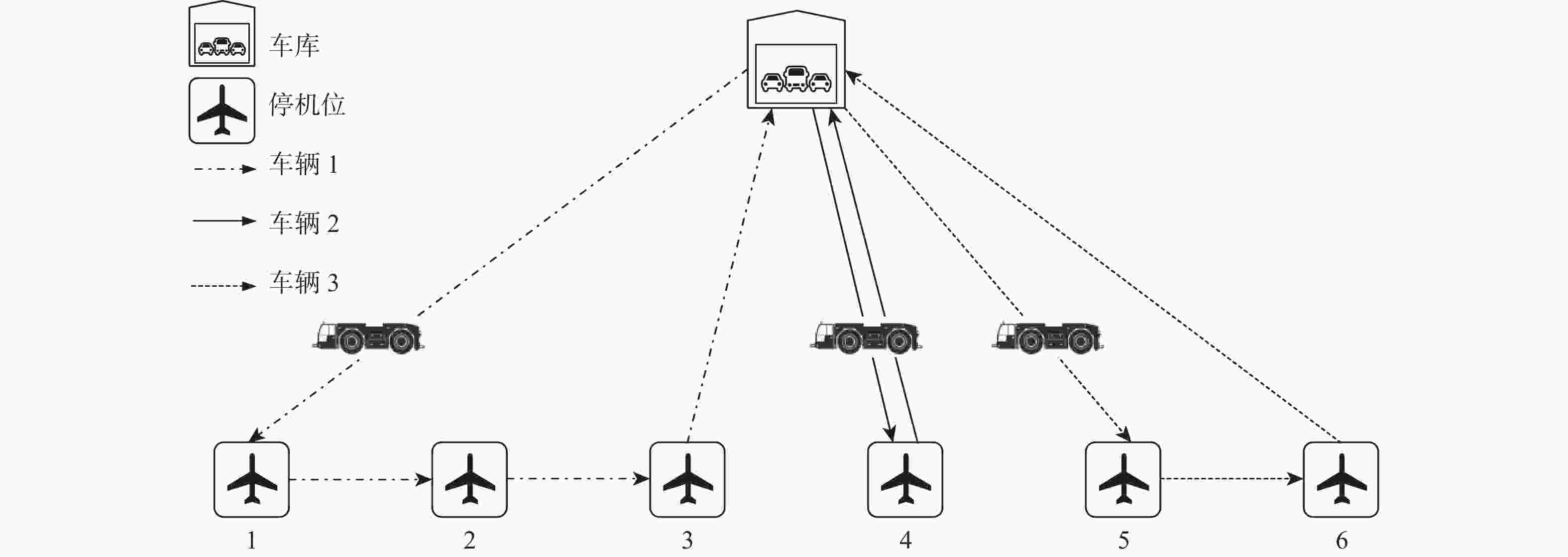
图 1 航空器牵引调度优化模型流程示意图
Figure 1. Schematic diagram of aircraft towing scheduling optimization model process
表 1 航班基础数据
Table 1. Basic flight data
航空器
序号停机位
序号最早开始
服务时刻计划推出
时刻柔性推出缓冲
时刻上限1 1 9:06 9:11 9:16 2 2 9:20 9:25 9:30 3 3 9:00 9:05 9:10 4 4 9:08 9:16 9:18 5 5 9:33 9:38 9:43 6 6 10:07 10:12 10:17 7 7 10:20 10:25 10:30 8 8 9:04 9:09 9:14 9 9 9:35 9:40 9:45 10 10 9:23 9:28 9:33 11 11 9:53 9:58 10:03 12 12 9:02 9:07 9:12 13 13 10:17 10:22 10:27 14 14 10:04 10:09 10:14 15 15 10:59 11:04 11:09 16 16 9:26 9:31 9:36 17 17 9:10 9:15 9:20 18 18 9:14 9:19 9:24 19 19 9:17 9:22 9:27 20 20 9:25 9:30 9:35 21 21 9:28 9:33 9:38 22 22 9:54 9:59 10:04 23 23 9:38 9:43 9:48 24 24 9:57 10:02 10:07 25 25 9:40 9:45 9:50 26 26 10:01 10:06 10:11 27 27 10:10 10:16 10:20 28 28 10:14 10:19 10:24 29 29 10:33 10:38 10:43 30 30 10:23 10:28 10:33 31 31 10:40 10:45 10:50 32 32 10:57 11:02 11:07 33 33 10:46 10:51 10:56 34 34 10:48 10:53 10:58 35 35 10:53 10:58 11:03  下载: 导出CSV
表 2 案例参数
Table 2. Case parameters
单车固定
启用成本/元车辆运行
成本/(元·min−1)燃油碳排放
系数/(kg·kg−1)碳排放量的
排放成本/(元·kg−1)最小安全起飞
间隔/min最晚推出
时刻/min航空器单位运行
成本/(元·min−1)航空燃油
价格/(元·kg−1)1000 1 3.115 0.28 3 20 133.76 4.5
下载: 导出CSV
表 3 优化后航空器牵引调度方案
Table 3. Aircraft traction scheduling scheme
牵引车辆编号 牵引航空器序号 1 18→24→14(0.18)→34 2 17→2→20(0.9)→31→7(0.9) 3 16→6→30→26(4.2) 4 8→25→22→13 5 12→10→11→3(5.82)→15(2.58) 6 4→29 7 19→9→21(0.84)→27→35 8 5→23→28→1(5.22)→32(0.96)→33(3.3)
下载: 导出CSV
表 4 优化结果
Table 4. Optimization results
牵引调度模型 牵引作业
总时间/min航空器滑行碳
排放量/ kg目标函数值/元 现状 392.61 27427.58 88568.16 本文调度优化模型 367.24 25238.70 81820.80 最大柔性推出时间方案 389.44 26415.20 83239.80
下载: 导出CSV
表 5 不同车辆数的优化结果
Table 5. Optimization results for different numbers of vehicles
车辆数目 航空器滑行碳排放量/kg 车辆运行成本/元 航空器运行成本/元 5 27770.22 5259.97 42827.50 6 25898.56 6263.62 41730.00 7 25840.19 7266.59 41535.00 8 25238.70 8268.32 37147.50 9 23529.20 9273.36 36660.00 10 25723.45 10274.32 37160.68 11 25752.63 11283.87 37202.84 12 25956.93 12291.36 37497.97
下载: 导出CSV
表 6 不同航空器数目的优化结果
Table 6. Optimization results for different numbers of aircrafts
航空器
数目优化前航空器滑行
碳排放量/kg优化后航空器滑行
碳排放量/kg碳排放量优化
百分比/%优化前目标
函数值/元优化后目标
函数值/元目标函数值优化
百分比/%20 15658.06 15050.64 3.88 49074.00 47319.00 3.58 25 19842.55 18627.70 6.12 62005.20 58495.20 5.66 30 24263.25 22339.74 7.93 74974.25 70426.20 6.07 35 27427.58 25238.70 7.98 88568.16 81820.80 7.62 40 33727.66 28665.79 15.01 111834.90 97989.90 12.38
下载: 导出CSV
表 7 高峰期航空器优化结果
Table 7. Peak time optimization results for aircraft
牵引调度
模型牵引作业
总时间/min航空器滑行
碳排放量/kg目标
函数值/元现状 539.81 43415.31 145257.45 本文调度优化模型 483.17 36749.21 124575.90
下载: 导出CSV
表 8 算法对比结果
Table 8. Comparison of algorithms
算法类型 求解时间/ min 目标函数值/元 遗传算法 6 82 347.20 线性迭代算法 3 81 820.80
下载: 导出CSV
-
[1] 李耀辉, 于敬磊, 谷娟, 等. 民航飞行CO2排放及其对气候变化影响研究综述[J]. 地球科学进展, 2023, 38(1): 9-16.LI Y H, YU J L, GU J, et al. Review of research on CO2 emissions from civil aviation flights and its impact on climate change[J]. Advances in Earth Science, 2023, 38(1): 9-16(in Chinese). [2] BAAREN E V, ROLING P C. Design of a zero emission aircraft towing system[C]//Proceedings of the AIAA Aviation Forum. Reston: AIAA, 2019. [3] 胡荣, 王德芸, 冯慧琳, 等. 碳达峰视角下的机场航空器碳排放预测[J]. 交通运输系统工程与信息, 2021, 21(6): 257-263.HU R, WANG D Y, FENG H L, et al. Prediction of aircraft CO2 emission from perspective of CO2 emission peak[J]. Journal of Transportation Systems Engineering and Information Technology, 2021, 21(6): 257-263(in Chinese). [4] 杨培颖, 唐加福, 于洋, 等. 面向最小碳排放量的接送机场服务的车辆路径与调度[J]. 自动化学报, 2013, 39(4): 424-432.YANG P Y, TANG J F, YU Y, et al. Minimizing carbon emissions for vehicle routing and scheduling in picking up and delivering customers to airport service[J]. Acta Automatica Sinica, 2013, 39(4): 424-432(in Chinese). [5] 王超, 任云鸿. 面向节油减排的平行多跑道混合运行机场停机位分配模型[J]. 交通信息与安全, 2021, 39(5): 144-152.WANG C, REN Y H. A model of gate allocation for parallel multi-runway hybrid operation from the perspective of fuel-saving and carbon emission reduction[J]. Journal of Transport Information and Safety, 2021, 39(5): 144-152(in Chinese). [6] 姜雨, 王雅莎, 薛清文, 等. 基于碳排放的航空器时空滑行优化研究[J]. 华南理工大学学报(自然科学版), 2023, 51(10): 152-159.JIANG Y, WANG Y S, XUE Q W, et al. Research on space-time taxiing optimization of aircraft based on carbon emission[J]. Journal of South China University of Technology (Natural Science Edition), 2023, 51(10): 152-159(in Chinese). [7] BAO D W, ZHOU J Y, ZHANG Z Q, et al. Mixed fleet scheduling method for airport ground service vehicles under the trend of electrification[J]. Journal of Air Transport Management, 2023, 108: 102379. [8] DU J Y, BRUNNER J O, KOLISCH R. Planning towing processes at airports more efficiently[J]. Transportation Research Part E: Logistics and Transportation Review, 2014, 70: 293-304. [9] LIU Y H, WU J J, TANG J, et al. Scheduling optimisation of multi-type special vehicles in an airport[J]. Transportmetrica B: Transport Dynamics, 2022, 10(1): 954-970. [10] VAN OOSTEROM S, MITICI M, HOEKSTRA J. Dispatching a fleet of electric towing vehicles for aircraft taxiing with conflict avoidance and efficient battery charging[J]. Transportation Research Part C: Emerging Technologies, 2023, 147: 103995. [11] 姜雨, 刘振宇, 胡志韬, 等. 大型机场进场航空器联合调度模型[J]. 交通运输工程学报, 2022, 22(1): 205-215.JIANG Y, LIU Z Y, HU Z T, et al. Coordinated scheduling model of arriving aircraft at large airport[J]. Journal of Traffic and Transportation Engineering, 2022, 22(1): 205-215(in Chinese). [12] 赵文涛, 万莉莉, 彭秋萍. 基于航班离场成本的离场航空器滑行策略优化[J]. 科学技术与工程, 2021, 21(16): 6930-6936.ZHAO W T, WAN L L, PENG Q P. Optimization of taxiing strategy of departing aircraft based on flight departure cost[J]. Science Technology and Engineering, 2021, 21(16): 6930-6936(in Chinese). [13] 王博, 王剑辉, 彭笑非, 等. 基于机场协同决策系统的机坪牵引车调度方法[J]. 科学技术与工程, 2021, 21(4): 1667-1673.WANG B, WANG J H, PENG X F, et al. The method for scheduling towing tractors based on A-CDM system[J]. Science Technology and Engineering, 2021, 21(4): 1667-1673(in Chinese). [14] 张文义, 唐雨拉尔, 王旭兰, 等. 考虑双时间窗特性的机场多车型摆渡车调度优化[J]. 北京航空航天大学学报, 2025, 51(10): 3345-3353.ZHANG W Y, TANG Y L E, WANG X L, et al. Optimization of multi-type airport ferry vehicles schedules with double service time windows characteristic[J]. Journal of Beijing University of Aeronautics and Astronautics, 2025, 51(10): 3345-3353(in Chinese). [15] 张颖, 黎晓英, 尹嘉男, 等. 基于概率滑行时间的航空器离场推出柔性控制[J]. 航空学报, 2023, 44(10): 207-220.ZHANG Y, LI X Y, YIN J N, et al. Flexible control of aircraft departure pushback time based on probabilistic taxiing time[J]. Acta Aeronautica et Astronautica Sinica, 2023, 44(10): 207-220(in Chinese). [16] 赵俊, 陈旭梅, 刘志硕, 等. 航权资源双边谈判的序贯互惠博弈建模与分析[J]. 哈尔滨工业大学学报, 2022, 54(3): 1-11.ZHAO J, CHEN X M, LIU Z S, et al. Modeling and analysis of sequential reciprocal game problem of bilateral negotiation for air traffic rights resources[J]. Journal of Harbin Institute of Technology, 2022, 54(3): 1-11(in Chinese). [17] 中国民航局. 民航航班正常统计办法[EB/OL]. (2013-10-21)[2024-03-30]. http://www.caac.gov.cn/XXGK/XXGK/ZFGW/202406/P020240611543423562244.pdf.Civil Aviation Administration of China. Statistical method for air transport flight normalcy[EB/OL]. (2013-10-21) [2024-03-30]. http://www.caac.gov.cn/XXGK/XXGK/ZFGW/202406/P020240611543423562244.pdf(in Chinese). [18] 中华人民共和国交通运输部. 民用航空空中交通管理规则: CCAR-93TM-R4[S]. 北京: 中华人民共和国交通运输部, 2015: 83-88.Ministry of Transport of the People's Republic of China. Civil aviation air traffic management regulations: CCAR-93TM-R4[S]. Beijing: Ministry of Transport of the People's Republic of China, 2015: 83-88(in Chinese). [19] 郑丽君, 胡荣, 张军峰, 等. 高峰时段下离港航空器绿色滑行策略设计与评价[J]. 北京航空航天大学学报, 2019, 45(11): 2320-2326.ZHENG L J, HU R, ZHANG J F, et al. Design and evaluation of green taxiing strategy for departure aircraft during peak hours[J]. Journal of Beijing University of Aeronautics and Astronautics, 2019, 45(11): 2320-2326(in Chinese). [20] 张亚平, 廉冠, 邢志伟, 等. 飞机推出控制停机位等待惩罚策略[J]. 哈尔滨工业大学学报, 2018, 50(3): 39-45.ZHANG Y P, LIAN G, XING Z W, et al. Aircraft departure pushback control strategy based on gate-hold penalty[J]. Journal of Harbin Institute of Technology, 2018, 50(3): 39-45(in Chinese). [21] 朱佳琳, 胡荣, 张军峰, 等. 中国航空器碳排放测算与演化特征研究[J]. 武汉理工大学学报(交通科学与工程版), 2020, 44(3): 558-563.ZHU J L, HU R, ZHANG J F, et al. Research on the measurement and evolution characteristics of aircraft carbon emissions in China[J]. Journal of Wuhan University of Technology(Transportation Science & Engineering), 2020, 44(3): 558-563(in Chinese). -

 下载:
下载:


 点击查看大图

计量
- 文章访问数: 504
- HTML全文浏览量: 196
- PDF下载量: 54
- 被引次数: 0
