





Prediction method for matching between in-orbit satellites and satellite network filings based on knowledge graph
-
摘要:
在轨卫星与国际电信联盟(ITU)卫星网络申报资料的精确匹配,对于卫星频率和轨道的设计、选取、申报、协调具有重要意义。针对传统人工匹配方法领域知识要求高、匹配效率低等问题,提出一种基于知识图谱的在轨卫星与卫星网络资料匹配关系无监督预测(UPMIS)方法。该方法在构建匹配关系预测指标体系、在轨卫星知识图谱、卫星网络资料知识图谱的基础上,基于业务知识融合与图划分的思想,设计由时间参数模块、数值型轨道参数模块和字符型社会参数模块组成的三级滤波结构框架,实现在轨卫星与卫星网络资料的快速精确匹配。实验结果表明:UPMIS在真实数据集上的排名前10命中率(
H 10)为0.8542 ,优于其他对比模型,且平均运行时间达到毫秒级。此外,实验给出过滤数量、聚合深度等参数选取的推荐值,对后续匹配关系预测具有参考价值。Abstract:Matching in-orbit satellites with International Telecommunication Union (ITU) satellite network declaration filings is crucial for the design, selection, declaration, and coordination of satellite frequencies and orbits. Due of their low matching efficiency and high domain knowledge requirements, traditional manual matching algorithms frequently encounter difficulties. To address these issues, we propose an unsupervised prediction of matching between in-orbit satellites and satellite network filings (UPMIS) method. This method establishes a prediction indicator system and knowledge graphs for both in-orbit satellites and satellite network filings. By integrating domain knowledge and graph partitioning, we design a three-tier filtering framework comprising a time parameter module, a numerical orbit parameter module, and a character-based societal parameter module. This framework enables fast and accurate matching between in-orbit satellites and satellite network filings. Experimental results demonstrate that UPMIS achieves a
H 10 score of0.8542 on real datasets, outperforming other comparative models. Additionally, the average runtime reaches millisecond-level efficiency. Additionally, the trials offer helpful references for future matching relationship predictions by recommending values for parameters like filtering quantity and aggregation depth. -
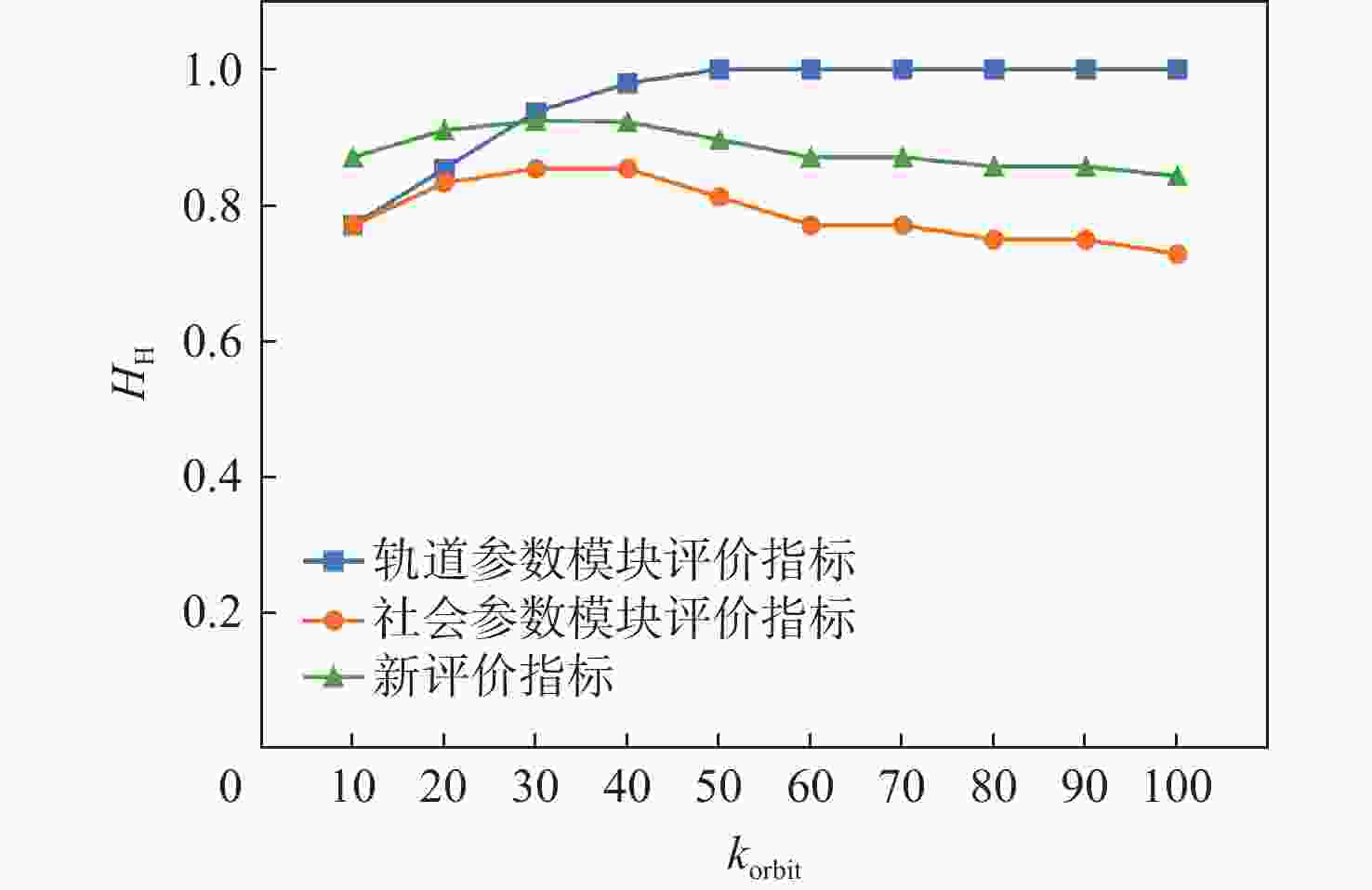
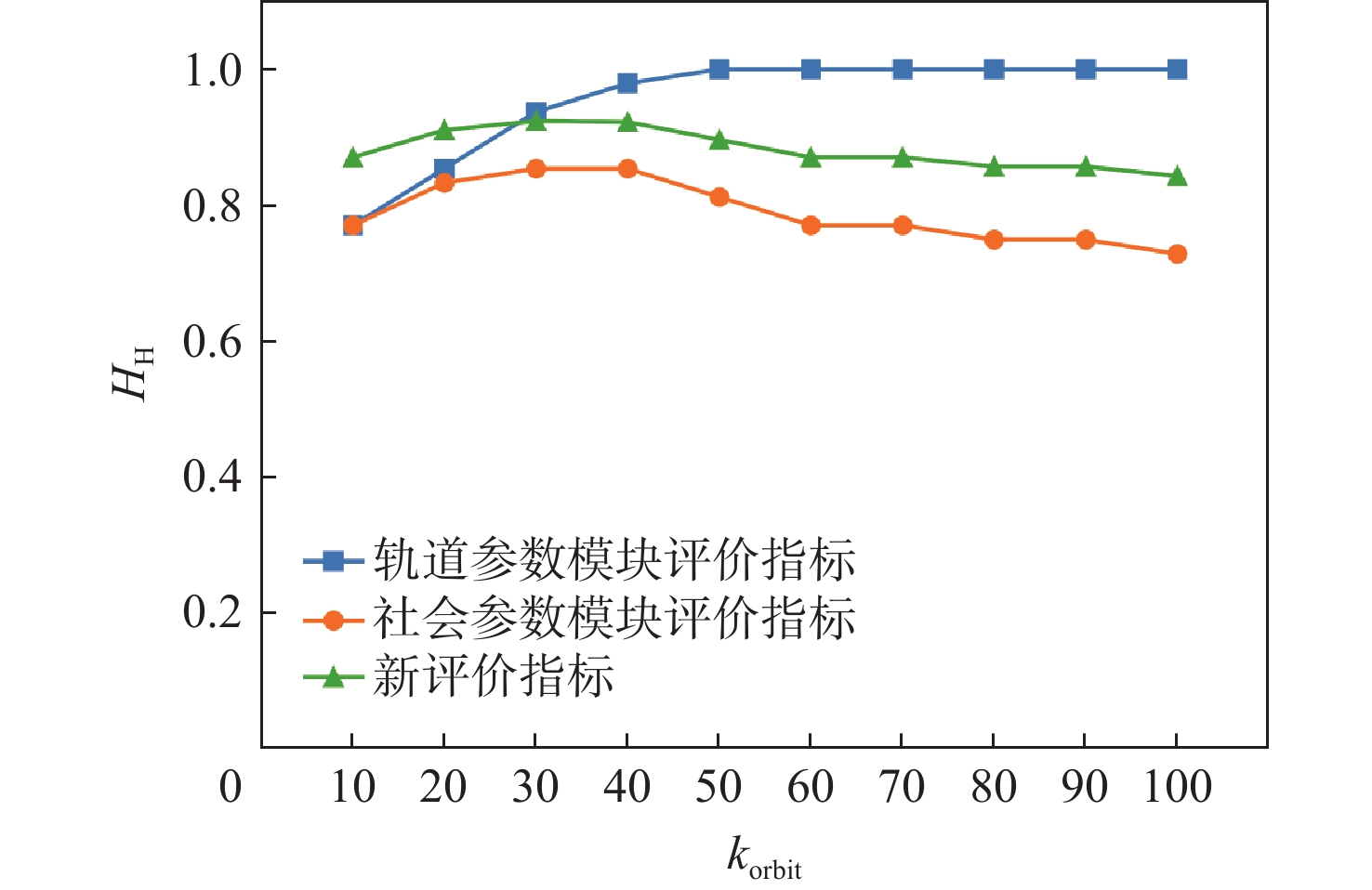
图 4 轨道参数模块卫星网络资料过滤数量$ {k}_{{\mathrm{orbit}}} $对UPMIS性能的影响
Figure 4. Impact of filtered satellite network data sets $ {k}_{{\mathrm{orbit}}} $ on UPMIS performance
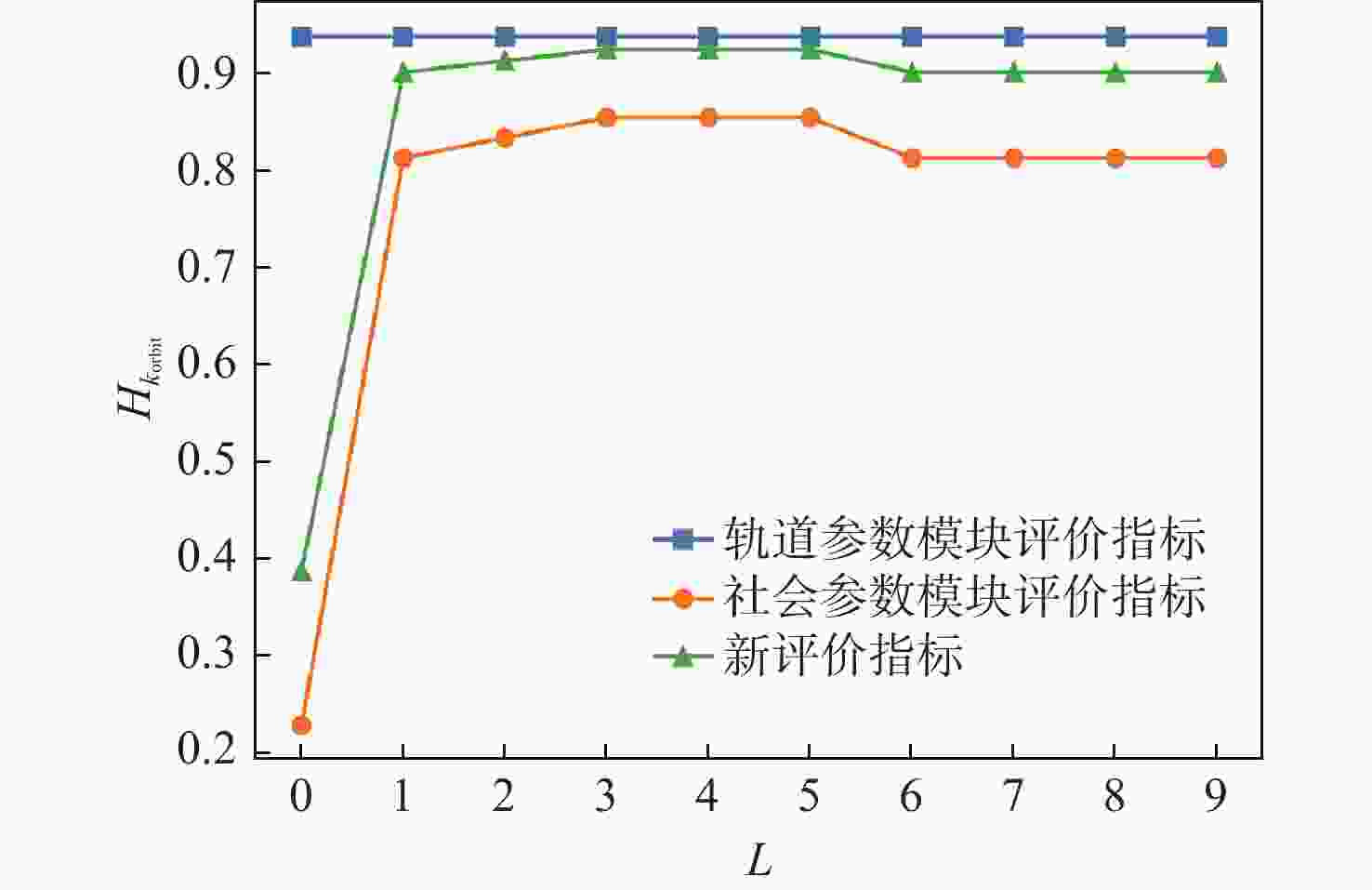
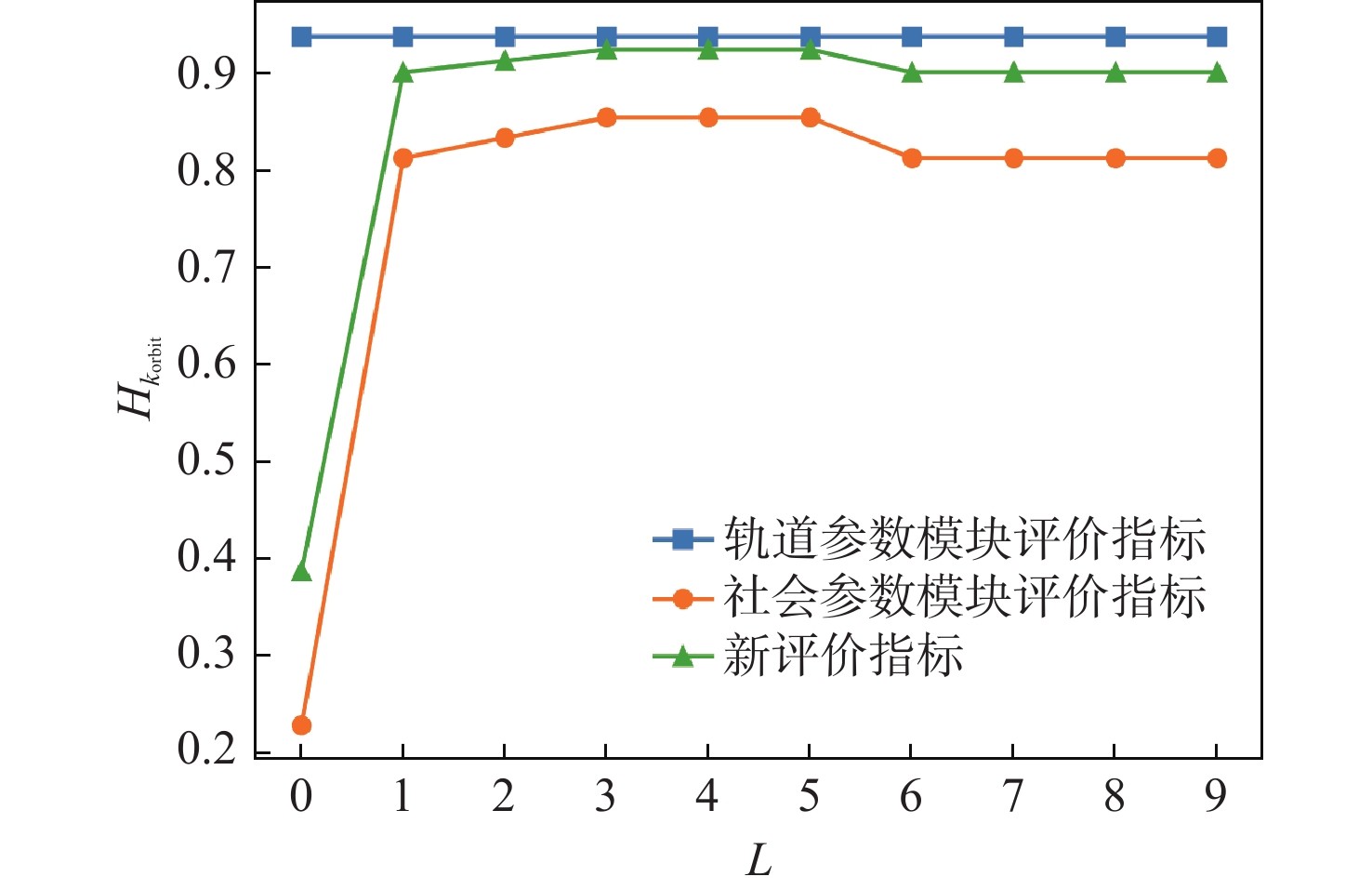
图 5 聚合深度$ L $对UPMIS性能的影响
Figure 5. Impact of aggregation depths $ L $ on UPMIS performance
表 1 在轨卫星与卫星网络资料关联指标
Table 1. Indicators for associating on-orbit satellites with satellite network filings
指标范围 在轨卫星指标 卫星网络资料指标 指标关联度 轨道类 近地点 近地点 完全一致 远地点 远地点 完全一致 倾角 轨道倾角 完全一致 周期 轨道周期 完全一致 组织类 国家/UN登记组织 主管部门代码 关联度高 操作者/拥有者 操作者/拥有者的国家 制造商 制造商的国家 标志类 卫星官方名称 卫星网络名称 关联度低 卫星别名 时间类 发射时间 接收时间 关联度高  下载: 导出CSV
表 2 $ {K}^{\text{sat}} $与$ {K}^{\text{net}} $统计数据
Table 2. Statistics of $ {K}^{{\mathrm{sat}}} $ and $ {K}^{{\mathrm{net}}} $
数据集 三元组
个数实体个数 关系个数 在轨卫星/卫星网络
资料个数$ {K}^{\text{sat}} $ 82979 20307 11 7548 $ {K}^{\text{net}} $ 6258 2007 6 628
下载: 导出CSV
表 3 消融实验结果
Table 3. Ablation experimental results
方法 模块 $ k={k}_{{\mathrm{orbit}}} $ $ k={k}_{{\mathrm{society}}} $ $ H_{{k}_{{\mathrm{orbit}}}} $ $ H_{{k}_{{\mathrm{society}}}} $ $ {H_{10}} $ 时间参数模块 轨道参数模块 社会参数模块 ① √ √ 0.5833 ② √ 0.4583 ③ √ 10 0.6875 0.6875 ④ √ 10 0.3125 0.3125 ⑤ √ √ 10 0.7917 0.7917 ⑥ √ √ 10 0.4167 0.4167 ⑦ √ √ 30 10 0.6875 0.6667 0.6667 ⑧(UPMIS) √ √ √ 30 10 0.9375 0.8542 0.8542
下载: 导出CSV
表 4 不同轨道距离函数的性能
Table 4. Performances with different orbit distance functions
距离函数 $ H_{{k}_{{\mathrm{orbit}}}} $ $ H_{{k}_{{\mathrm{society}}}} $ $ H_{\mathrm{H}} $ MSE 0.916667 0.8125 0.9013 $ \text { Dis } $ 0.937500 0.8542 0.9241
下载: 导出CSV
表 5 UPMIS在不同邻接矩阵下的性能
Table 5. Performances of UPMIS under different adjacency matrices
邻接矩阵 $ H_{{k}_{{\mathrm{society}}}} $ $ H_{\mathrm{H}} $ $ \boldsymbol{A} $ 0.3958 0.5822 $ {\boldsymbol{A}}_{\text{L}} $ 0.7500 0.8633 $ {\boldsymbol{A}}_{\text{rel}} $ 0.8542 0.9241
下载: 导出CSV
-
[1] 袁俊, 鲍晓月, 孙茜, 等. 巨型低轨星座频率轨道资源趋势分析及启示建议[J]. 空间碎片研究, 2021, 21(1): 48-57.YUAN J, BAO X Y, SUN Q, et al. Analysis and suggestions on orbit and spectrum resources trend for mega LEO constellations[J]. Space Debris Research, 2021, 21(1): 48-57(in Chinese). [2] 田伟, 陈珊珊, 林源. 空间频率轨道资源法规标准建设情况初探[J]. 中国航天, 2019(8): 54-62.TIAN W, CHEN S S, LIN Y. Preliminary analysis on the regulations and standards for space spectrum and orbit resources[J]. Aerospace China, 2019(8): 54-62(in Chinese). [3] International Telecommunication Union. Radio regulations[EB/OL]. (2023-03-16)[2024-01-25]. https://www.itu.int/pub/R-REG-RR. [4] 王羽, 李清, 李克军, 等. Starlink星座应用现状及分析[J]. 天地一体化信息网络, 2023, 4(2): 93-102.WANG Y, LI Q, LI K J, et al. Application status and analysis of starlink constellation[J]. Space-Integrated-Ground Information Networks, 2023, 4(2): 93-102(in Chinese). [5] MCDOWELL J C. The low earth orbit satellite population and impacts of the SpaceX starlink constellation[J]. The Astrophysical Journal Letters, 2020, 892(2): L36. [6] 崔潇潇, 王琦, 范青松. 从“一网”(OneWeb)卫星 探究卫星互联网面临的风险与挑战[J]. 国防科技工业, 2022(6): 56-58.CUI X X, WANG Q, FAN Q S. Exploring the risks and challenges faced by satellite Internet from the perspective of “OneWeb” satellites[J]. Defence Science & Technology Industry, 2022(6): 56-58(in Chinese). [7] 王学宇, 武坦然. OneWeb低轨道卫星系统及其军事应用分析[J]. 航天电子对抗, 2022, 38(4): 59-64.WANG X Y, WU T R. Analysis on OneWeb LEO satellite system and its military application[J]. Aerospace Electronic Warfare, 2022, 38(4): 59-64(in Chinese). [8] RADTKE J, KEBSCHULL C, STOLL E. Interactions of the space debris environment with mega constellations: using the example of the OneWeb constellation[J]. Acta Astronautica, 2017, 131: 55-68. [9] 吴树范, 王伟, 温济帆, 等. 低轨互联网星座发展研究[J]. 北京航空航天大学学报, 2024, 50(1): 1-11.WU S F, WANG W, WEN J F, et al. Review on development of LEO Internet constellation[J]. Journal of Beijing University of Aeronautics and Astronautics, 2024, 50(1): 1-11(in Chinese). [10] ZHANG J R, CAI Y F, XUE C B, et al. LEO mega constellations: review of development, impact, surveillance, and governance[J]. Space: Science & Technology, 2022: 9865174. [11] DAEHNICK C, KLINGHOFFER I, MARITZ B, et al. Large LEO satellite constellations: will it be different this time?[EB/OL]. (2020-05-04)[2024-01-25]. https://www.mckinsey.com.br/industries/aerospace-and-defense/our-insights/large-leo-satellite-constellations-will-it-be-different-this-time. [12] FALLE A, WRIGHT E, BOLEY A, et al. One million (paper) satellites[J]. Science, 2023, 382(6667): 150-152. [13] 王琦. “纸卫星”: 卫星产业面临的一道难题[J]. 卫星与网络, 2010(6): 62-64.WANG Q. “Paper satellite”: a difficult problem faced by satellite industry[J]. Satellite & Network, 2010(6): 62-64(in Chinese). [14] 田伟. 关注“纸卫星”[J]. 卫星与网络, 2014(4): 68-72.TIAN W. Pay attention to “paper satellite”[J]. Satellite & Network, 2014(4): 68-72(in Chinese). [15] ALLISON A L. The advent of paper satellites[C]//Proceedings of the ITU and Managing Satellite Orbital and Spectrum Resources in the 21st Century. Berlin: Springer, 2014: 25-29. [16] Space. com Staff. SpaceX’s starlink broadband service will begin in 2020: report [EB/OL]. (2019-10-24) [2024-01-24]. https://www.15minutenews.com/article/2019/10/24/172984982/spacexs-starlink-broadband-service-will-begin-in-2020-report/. [17] BUNGLAWALA W, SHAH J, PARMAR D. Recommender system using knowledge graph and ontology: a survey[C]//Proceedings of the Expert Clouds and Applications. Berlin: Springer, 2022: 237-251. [18] PEREIRA A, TRIFAN A, LOPES R P, et al. Systematic review of question answering over knowledge bases[J]. IET Software, 2022, 16(1): 1-13. [19] LUO S X, YU S. An accurate unsupervised method for joint entity alignment and dangling entity detection[C]//Proceedings of the Findings of the Association for Computational Linguistics. Kerrville: Association for Computational Linguistics, 2022: 2330-2339. [20] WU Y T, LIU X, FENG Y S, et al. Relation-aware entity alignment for heterogeneous knowledge graphs[C]//Proceedings of the 28th International Joint Conference on Artificial Intelligence. California: International Joint Conferences on Artificial Intelligence Organization. 2019: 5278-5284. [21] XU K, WANG L W, YU M, et al. Cross-lingual knowledge graph alignment via graph matching neural network[EB/OL]. ((2019-07-29)[2024-03-04]. https://arxiv.org/abs/1905.11605. [22] CAO Y X, LIU Z Y, LI C J, et al. Multi-channel graph neural network for entity alignment[C]//Proceedings of the 57th Annual Meeting of the Association for Computational Linguistics. Stroudsburg: Association for Computational Linguistics. 2019: 1452–1461. [23] WANG Z C, LV Q S, LAN X H, et al. Cross-lingual knowledge graph alignment via graph convolutional networks[C]//Proceedings of the Conference on Empirical Methods in Natural Language Processing. Stroudsburg: Association for Computational Linguistics. 2018: 349-357. [24] ZHAO X, ZENG W X, TANG J Y, et al. An experimental study of state-of-the-art entity alignment approaches[J]. IEEE Transactions on Knowledge and Data Engineering, 2022, 34(6): 2610-2625. [25] GAUR M, FALDU K, SHETH A. Semantics of the black-box: can knowledge graphs help make deep learning systems more interpretable and explainable?[J]. IEEE Internet Computing, 2021, 25(1): 51-59. [26] WU X D, WU J, FU X Y, et al. Automatic knowledge graph construction: a report on the 2019 ICDM/ICBK contest[C]//Proceedings of the IEEE International Conference on Data Mining. Piscataway: IEEE Press, 2020: 1540-1545. [27] STOKMAN F N, DE VRIES P H. Structuring knowledge in a graph[C]//Proceedings of the Human-Computer Interaction. Berlin: Springer, 1988: 186-206. [28] WANG Z C, YANG J J, YE X J. Knowledge graph alignment with entity-pair embedding[C]//Proceedings of the Conference on Empirical Methods in Natural Language Processing. Stroudsburg: Association for Computational Linguistics, 2020: 1672-1680. [29] ZHONG L F, WU J, LI Q, et al. A comprehensive survey on automatic knowledge graph construction[J]. ACM Computing Surveys, 2024, 56(4): 1-62. [30] Union of Concerned Scientists . Satellite database | union of concerned scientists[EB/OL]. (2024-01-02) [2024-01-24]. https://www.ucs.org/resources/satellite-database. [31] HENRI Y, MATAS A, DOS SANTOS J M S. Regulation of telecommunications by satellites: ITU and space services[M]. Abingdon: Routledge, 2016: 129-163. [32] ROTHBLATT M A. ITU regulation of satellite communication[J]. Stanford Journal of International Law, 1982, 18: 1. [33] DODEL I B H. The ITU filing of satellite systems[M]. Abingdon: Routledge, 2011. [34] ALLISON A L. Requirements for obtaining spectrum and of orbital approvals for small satellite constellations[C]//Proceedings of the Handbook of Small Satellites: Technology, Design, Manufacture, Applications, Economics and Regulation. Berlin: Springer, 2020: 1-23. [35] LOO C C, WANG X. Navigating the spectrum: an overview of ITU's regulatory process for small satellites[C]//Proceedings of the 38th Annual Small Satellite Conference. Logan: Utah State University, 2024: 134. [36] ANSELMO L. The use of space and satellites: problems and challenges[C]//Proceedings of the Technology and International Relations. Berlin: Springer, 2021: 109-131. [37] KIPF T N, WELLING M. Semi-supervised classification with graph convolutional networks[EB/OL]. (2017-02-22)[2024-03-04]. https://arxiv.org/abs/1609.02907. [38] MAO X, WANG W T, XU H M, et al. MRAEA: an efficient and robust entity alignment approach for cross-lingual knowledge graph[C]//Proceedings of the 13th International Conference on Web Search and Data Mining. New York: ACM, 2020: 420-428. [39] MAO X, WANG W T, WU Y B, et al. From alignment to assignment: frustratingly simple unsupervised entity alignment[C]//Proceedings of the Conference on Empirical Methods in Natural Language Processing. Stroudsburg: Association for Computational Linguistics, 2021: 2843-2853. [40] International Telecommunication Union. SRS[EB/OL]. (2023-03-16)[2024-03-04]. https://www.itu.int/en/ITU-R/software/Pages/srs.aspx. [41] GARCIA-BORDILS S, MAFLA A, BITEN A F, et al. Out-of-vocabulary challenge report[EB/OL]. (2022-09-14)[2024-03-04]. https://arxiv.org/abs/2209.06717. [42] LIU Z Y, CAO Y X, PAN L M, et al. Exploring and evaluating attributes, values, and structures for entity alignment[C]//Proceedings of the Conference on Empirical Methods in Natural Language Processing. Stroudsburg: Association for Computational Linguistics , 2020: 6355-6364. [43] LI X, WANG Y Y, ACERO A. Learning query intent from regularized click graphs[C]//Proceedings of the 31st Annual International ACM SIGIR Conference on Research and Development in Information Retrieval. New York: ACM, 2008: 339-346. [44] CHINCHOR N. MUC-3 evaluation metrics[C]//Proceedings of the 3rd Conference on Message Understanding. New York: ACM, 1991: 17-24. [45] FANG J Y, WANG X B, MENG Z Q, et al. MANNER: a variational memory-augmented model for cross domain few-shot named entity recognition[C]//Proceedings of the 61st Annual Meeting of the Association for Computational Linguistics (Volume 1: Long Papers). Stroudsburg: Association for Computational Linguistics, 2023: 4261-4276. [46] ZHENG C M, FENG J H, CAI Y, et al. Rethinking multimodal entity and relation extraction from a translation point of view[C]//Proceedings of the 61st Annual Meeting of the Association for Computational Linguistics (Volume 1: Long Papers). Stroudsburg: Association for Computational Linguistics , 2023: 6810-6824. -

 下载:
下载:

 点击查看大图
计量
- 文章访问数: 351
- HTML全文浏览量: 163
- PDF下载量: 22
- 被引次数: 0
