





-
摘要:
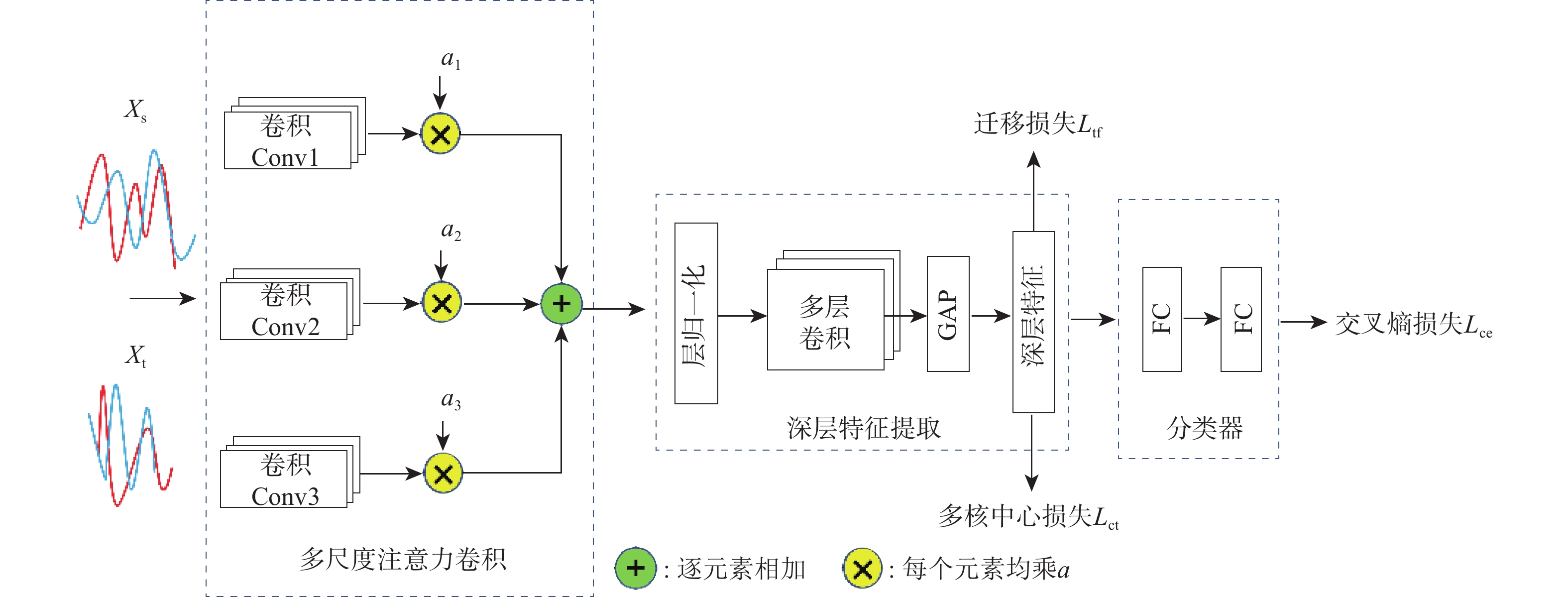
深度学习在调制分类上的应用取得了很大进展,但受到训练数据和测试数据分布一致性的限制。为解决源域和目标域采样率不同导致的数据分布不一致的调制分类问题,提出一种新颖的多尺度注意力迁移学习架构(MATLA)来解决跨域识别问题,该架构利用3个具有不同尺度的并行卷积核来提取不同粒度级别特征。此外,该过程还融入了多尺度注意力机制,这一机制通过强化重要特征的权重,增强了提取具有辨别力的特征的能力。为实现源域与目标域特征的有效对齐,使用多核最大均值差异(MK-MMD)来度量再生核希尔伯特空间(RKHS)中2个域的特征分布的差异程度。为有效减少源域特征内部的变化,增强特征的一致性和稳定性,提出多核中心损失(MKCL)。实验结果表明:MATLA在信噪比大于0 dB时,识别准确率达到83.42%,优于其他几种网络模型和域适应模型。
Abstract:Deep learning has achieved considerable progress in the field of modulation classification; however, it is often limited by the consistency of the distribution between training and testing data. A novel multi-scale attention transfer learning architecture (MATLA) has been designed to assist cross-domain identification in order to overcome the problem of modulation classification with inconsistent data distribution caused by variable sample rates of source and target domains. This framework employs three parallel convolutional kernels with varying scales to extract features at different granularities. Moreover, the architecture integrates a multi-scale attention mechanism, which bolsters the extraction of discriminative features by emphasizing the weights of salient features. To effectively align features from the source and target domains, multiple kernel maximum mean discrepancy (MK-MMD) is utilized to measure the divergence of feature distributions in the reproducing kernel Hilbert space (RKHS) between the two domains. Additionally, to mitigate internal variation within the source domain features and enhance their consistency and stability, multiple kernel center loss (MKCL) is proposed. According to experimental data, the suggested approach outperforms a number of different network models and domain adaption techniques, achieving a recognition accuracy of 83.42% when the signal-to-noise ratio surpasses 0 dB.
-
Key words:
- transfer learning /
- attention mechanism /
- deep learning /
- modulation classification /
- sampling rate
-
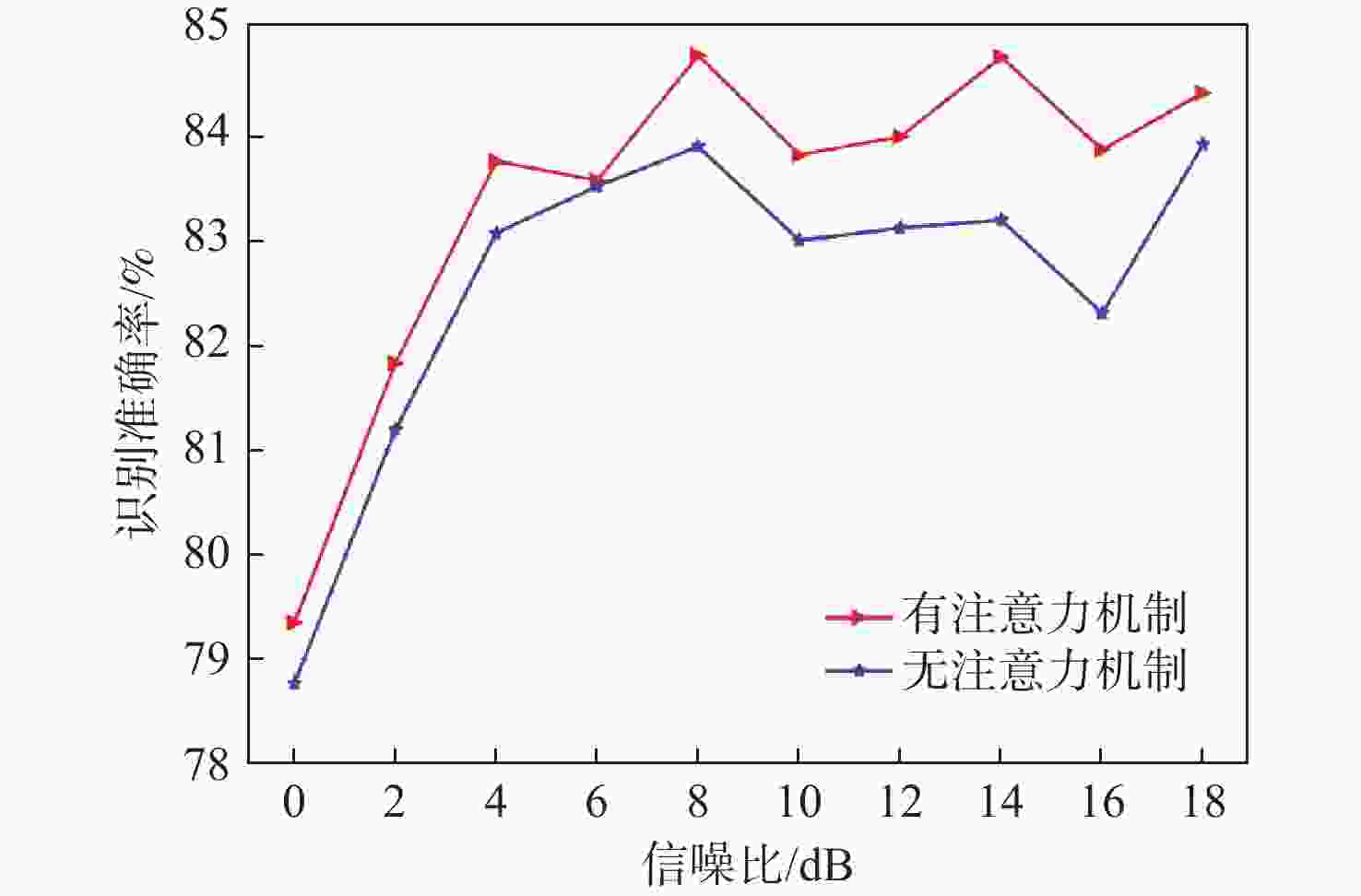
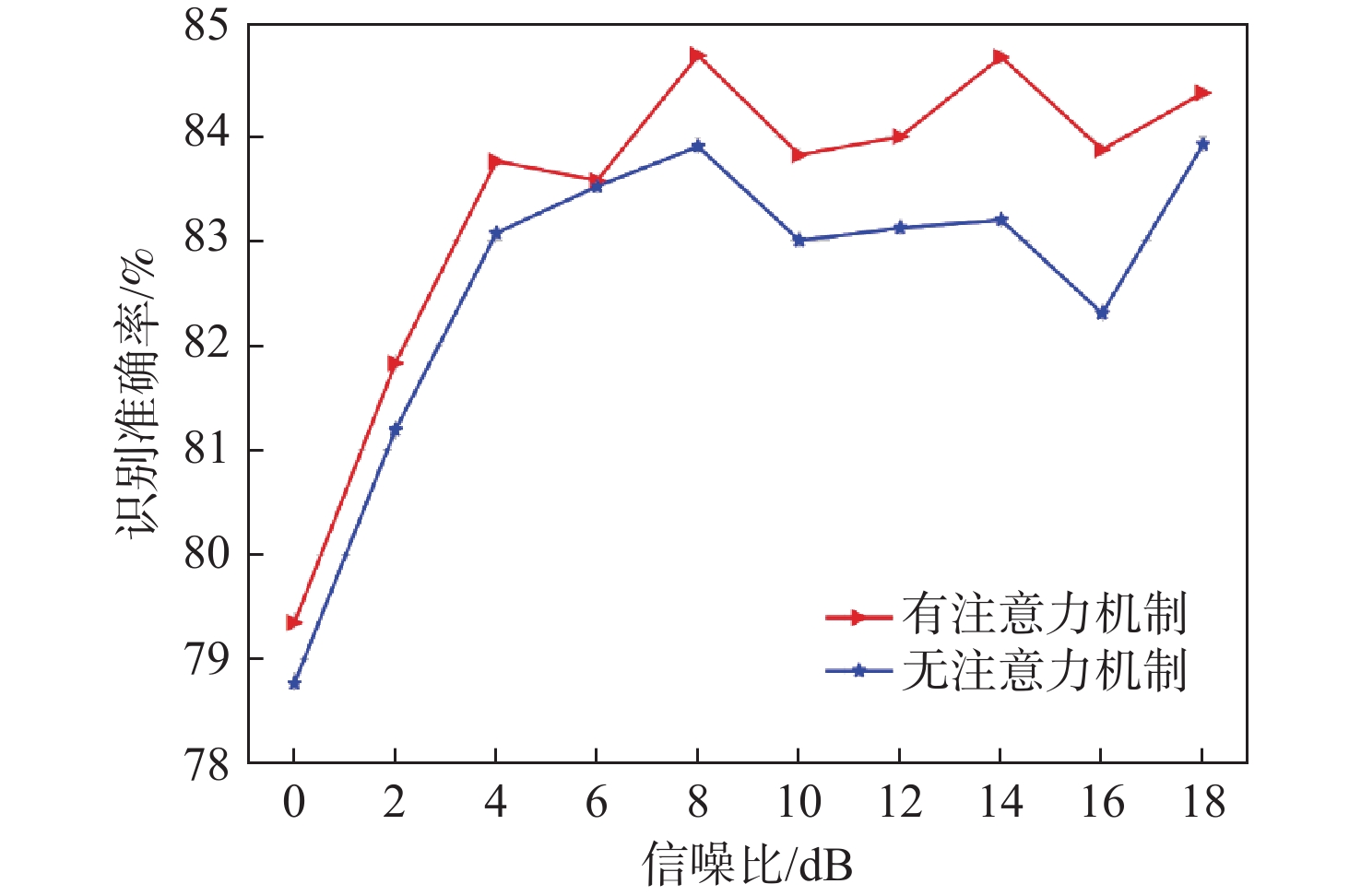
图 5 有/无多尺度注意力的识别性能
Figure 5. Recognition performance with/without multi-scale attention
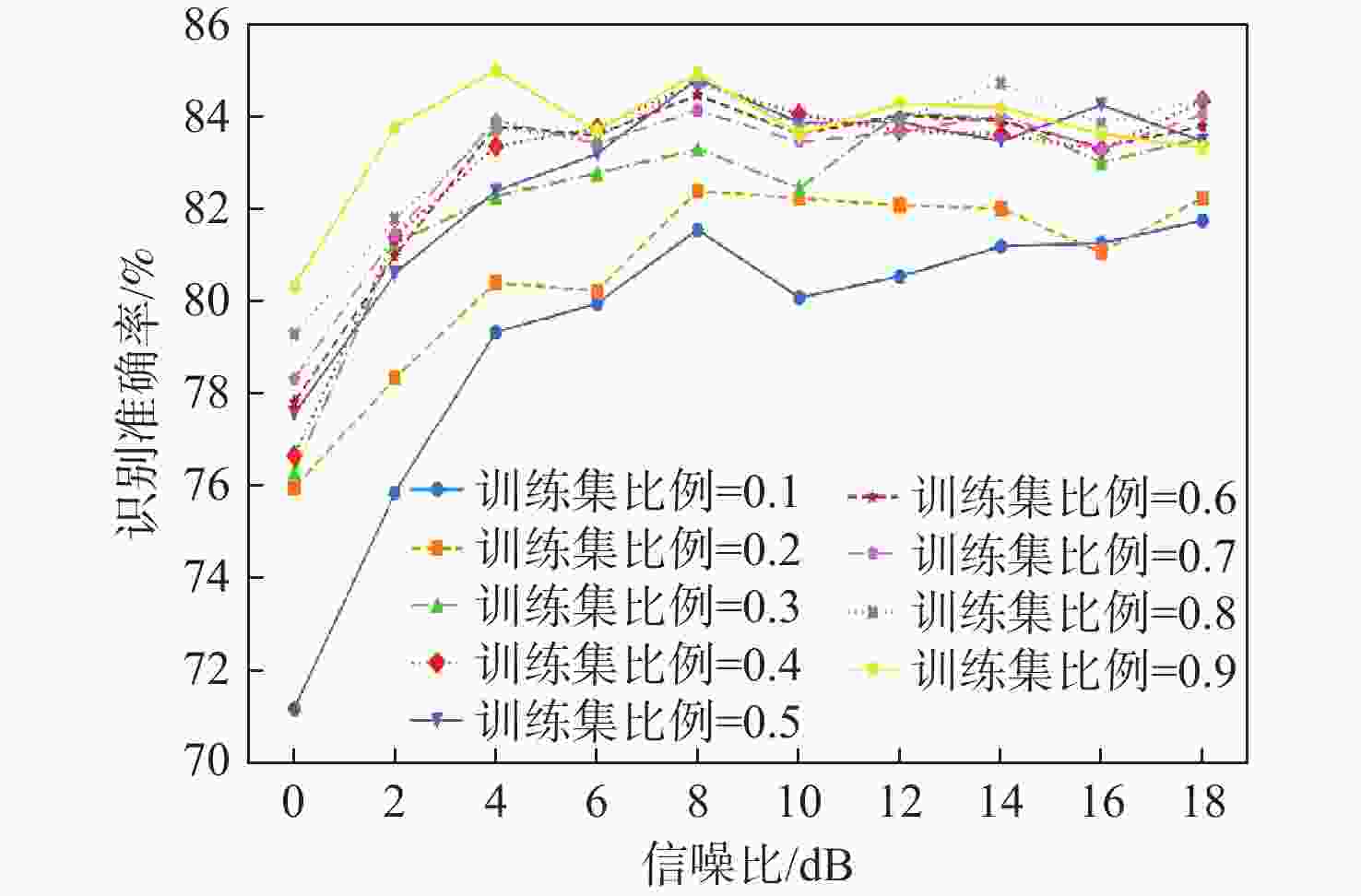
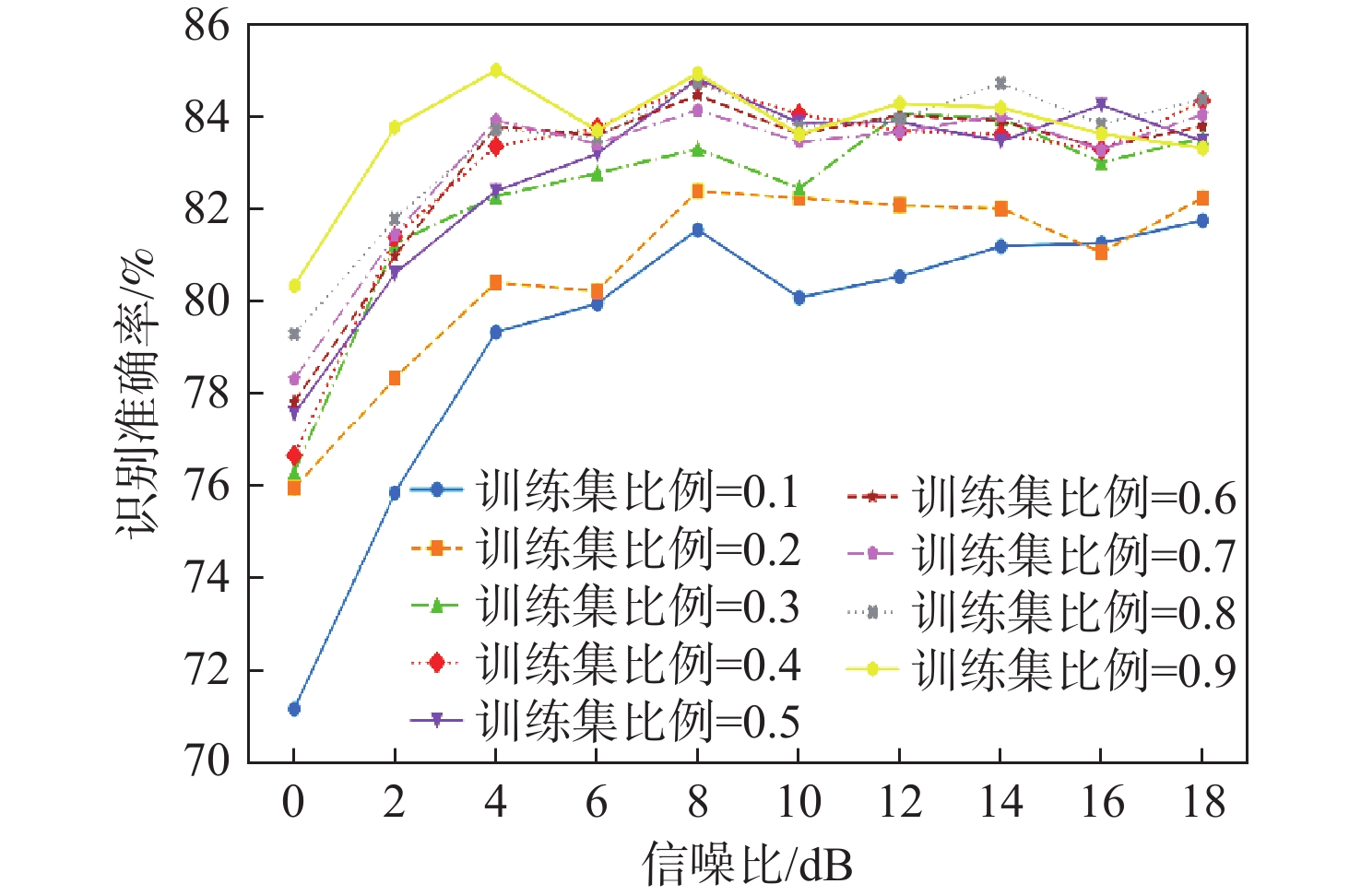
图 6 MATLA在不同训练集比例下的识别性能
Figure 6. Recognition performance of MATLA under different proportions of training sets
表 1 不同卷积核大小下的识别性能
Table 1. Recognition performance under different convolution kernel sizes
卷积核大小 准确率/% 1, 3, 5 83.42 1, 5, 9 81.18 3, 7, 11 80.32 5, 7, 9 81.07 7, 9, 11 80.29  下载: 导出CSV
表 3 不同权重因子作用下的识别性能
Table 3. Recognition performance under different weight factors
$ {\lambda }_{{\mathrm{tf}}} $ $ {\lambda }_{{\mathrm{ct}}} $ 准确率/% 0 0 75.98 0 0.5 76.59 0.5 0 82.83 0.5 0.5 83.16 0.5 1.0 83.22 1.0 0 83.02 1.0 0.5 83.20 1.0 1.0 83.42 1.0 1.5 84.07
下载: 导出CSV
-
[1] 张海燕, 闫文君, 张立民, 等. 通信信号调制识别综述[J]. 海军航空大学学报, 2022, 37(1): 126-132.ZHANG H Y, YAN W J, ZHANG L M, et al. An overview of communication signal modulation recognition[J]. Journal of Naval Aviation University, 2022, 37(1): 126-132(in Chinese). [2] 林冲, 闫文君, 张立民, 等. 通信信号调制识别综述[J]. 中国电子科学研究院学报, 2021, 16(11): 1074-1085.LIN C, YAN W J, ZHANG L M, et al. An overview of communication signals modulation recognition[J]. Journal of China Academy of Electronics and Information Technology, 2021, 16(11): 1074-1085(in Chinese). [3] WEI W, MENDEL J M. Maximum-likelihood classification for digital amplitude-phase modulations[J]. IEEE Transactions on Communications, 2000, 48(2): 189-193. [4] HASSAN K, DAYOUB I, HAMOUDA W, et al. Automatic modulation recognition using wavelet transform and neural networks in wireless systems[J]. EURASIP Journal on Advances in Signal Processing, 2010, 2010(1): 532898. [5] ORLIC V D, DUKIC M L. Automatic modulation classification algorithm using higher-order cumulants under real-world channel conditions[J]. IEEE Communications Letters, 2009, 13(12): 917-919. [6] YANG W C, REN K, DU Y, et al. Modulation recognition method of mixed signals based on cyclic spectrum projection[J]. Scientific Reports, 2023, 13: 21459. [7] MALIK M, MALIK M K, MEHMOOD K, et al. Automatic speech recognition: a survey[J]. Multimedia Tools and Applications, 2021, 80(6): 9411-9457. [8] GUO M H, XU T X, LIU J J, et al. Attention mechanisms in computer vision: a survey[J]. Computational Visual Media, 2022, 8(3): 331-368. [9] O’SHEA T J, CORGAN J, CLANCY T C. Convolutional radio modulation recognition networks[C]//Proceedings of the Engineering Applications of Neural Networks. Berlin: Springer, 2016: 213-226. [10] O’SHEA T, WEST N E. Radio machine learning dataset generation with gnu radio[C]//Proceedings of the GNU Radio Conference. Boulder: GNU Radio, 2016, 1(1): 1-6. [11] O’SHEA T J, ROY T, CLANCY T C. Over-the-air deep learning based radio signal classification[J]. IEEE Journal of Selected Topics in Signal Processing, 2018, 12(1): 168-179. [12] WEST N E, O’SHEA T. Deep architectures for modulation recognition[C]//Proceedings of the IEEE International Symposium on Dynamic Spectrum Access Networks. Piscataway: IEEE Press, 2017: 1-6. [13] 哈晖, 高翔, 姚秀娟, 等. 基于STF-Net的信号调制波形识别方法[J]. 北京航空航天大学学报, 2025, 51(9): 3150-3160.HA H, GAO X, YAO X J, et al. Signal modulation waveform recognition method based on STF-Net[J]. Journal of Beijing University of Aeronautics and Astronautics, 2025, 51(9): 3150-3160(in Chinese). [14] RAJENDRAN S, MEERT W, GIUSTINIANO D, et al. Deep learning models for wireless signal classification with distributed low-cost spectrum sensors[J]. IEEE Transactions on Cognitive Communications and Networking, 2018, 4(3): 433-445. [15] PENG S L, JIANG H Y, WANG H X, et al. Modulation classification based on signal constellation diagrams and deep learning[J]. IEEE Transactions on Neural Networks and Learning Systems, 2019, 30(3): 718-727. [16] WANG Y, LIU M, YANG J, et al. Data-driven deep learning for automatic modulation recognition in cognitive radios[J]. IEEE Transactions on Vehicular Technology, 2019, 68(4): 4074-4077. [17] 姬丽彬, 朱岩, 崔天舒, 等. 基于时频重排算法的LPI雷达信号识别[J]. 北京航空航天大学学报, 2025, 51(4): 1324-1331.JI L B, ZHU Y, CUI T S, et al. LPI radar signal recognition based on time-frequency reassignment algorithm[J]. Journal of Beijing University of Aeronautics and Astronautics, 2025, 51(4): 1324-1331(in Chinese). [18] WONG L J, MICHAELS A J. Transfer learning for radio frequency machine learning: a taxonomy and survey[J]. Sensors, 2022, 22(4): 1416. [19] PAN S J, YANG Q. A survey on transfer learning[J]. IEEE Transactions on Knowledge and Data Engineering, 2010, 22(10): 1345-1359. [20] 庞伊琼, 许华, 张悦, 等. 基于迁移元学习的调制识别算法[J]. 兵工学报, 2023, 44(10): 2954-2963.PANG Y Q, XU H, ZHANG Y, et al. Modulation recognition algorithm based on transfer meta-learning[J]. Acta Armamentarii, 2023, 44(10): 2954-2963(in Chinese). [21] 李晓慧, 陈壮志, 徐东伟, 等. 基于知识迁移的深度学习无线电信号聚类方法[J]. 高技术通讯, 2023, 33(11): 1172-1180.LI X H, CHEN Z Z, XU D W, et al. A deep learning radio signal clustering method based on knowledge transfer[J]. Chinese High Technology Letters, 2023, 33(11): 1172-1180(in Chinese). [22] 毛红霞. 无监督领域自适应调制识别方法[J]. 探测与控制学报, 2021, 43(4): 117-122.MAO H X. Unsupervised domain adaptation based automatic modulation recognition[J]. Journal of Detection & Control, 2021, 43(4): 117-122(in Chinese). [23] WANG Q, DU P F, YANG J Y, et al. Transferred deep learning based waveform recognition for cognitive passive radar[J]. Signal Processing, 2019, 155: 259-267. [24] BU K, HE Y, JING X J, et al. Adversarial transfer learning for deep learning based automatic modulation classification[J]. IEEE Signal Processing Letters, 2020, 27: 880-884. [25] SAITO K, WATANABE K, USHIKU Y, et al. Maximum classifier discrepancy for unsupervised domain adaptation[C]//Proceedings of the IEEE/CVF Conference on Computer Vision and Pattern Recognition. Piscataway: IEEE Press, 2018: 3723-3732. [26] JIN Y, WANG X M, LONG M S, et al. Minimum class confusion for versatile domain adaptation[C]//Proceedings of the Computer Vision-ECCV. Berlin: Springer, 2020: 464-480. [27] TZENG E, HOFFMAN J, ZHANG N, et al. Deep domain confusion: maximizing for domain invariance[EB/OL]. (2014-12-10)[2024-04-05]. https://arxiv.org/abs/1412.3474. [28] LONG M S, CAO Y, WANG J M, et al. Learning transferable features with deep adaptation networks[EB/OL]. (2015-02-10)[2024-04-05]. https://arxiv.org/abs/1502.02791. [29] BA J L, KIROS J R, HINTON G E. Layer normalization[EB/OL]. (2016-07-21)[2024-04-05]. https://arxiv.org/abs/1607.06450. [30] GRETTON A, SRIPERUMBUDUR B, SEJDINOVIC D, et al. Optimal kernel choice for large-scale two-sample tests[C]//Proceedings of the 26th International Conference on Neural Information Processing Systems. New York: ACM, 2012: 1205-1213. -

 下载:
下载:

 点击查看大图
计量
- 文章访问数: 345
- HTML全文浏览量: 167
- PDF下载量: 2
- 被引次数: 0
