





-
摘要:
基于驾驶舱环境下飞行员执行飞行任务时的操作,进行飞行员工作负荷预测评估,提出一种考虑影响因素、任务单元任务负荷、任务冲突系数、多任务系数的飞行员工作负荷定量实时预测模型。选择DA 42 公务机的正常五边飞行作为预测计算的实例,设计任务场景,确定飞行操作程序,进行任务分解,通过所提模型计算出起飞、爬升、巡航、下降、进近5个飞行阶段下的飞行工作负荷实时预测值,并通过综合计算式计算得到不同飞行阶段下的平均工作负荷预测值。在DA 42公务机飞行模拟器上进行验证实验,采用NASA-TLX、Bedford、Overall工作负荷、SWAT这4种主观评价量表对不同飞行阶段的飞行工作负荷进行主观评价,得到的主观评价值与采用所提模型预测得到的工作负荷值存在非常高的相关性,值的差异性也非常小,从而验证了所提模型的准确性和可用性。
Abstract:Quantitative real-time prediction model of workload that take into account influencing factors, task unit load, task conflict coefficient, and multi-task coefficient are proposed based on the operational tasks of pilots conducting flying activities in the cockpit environment. Selecting the normal pentagonal flight of the DA42 business jet as an example for prediction calculation, designing task scenarios, determining flight operation procedures, decomposing tasks, and calculating the real-time predicted flight workload values for different flight stages through a comprehensive calculation formula. In order to subjectively assess the flight workload under various flying stages, a validation experiment was carried out on the DA42 business jet flight simulator utilizing four subjective assessment scales: NASA-TLX, Bedford, Overall workload, and SWAT. The subjective evaluation values obtained were highly correlated with the workload values predicted by the prediction model. This verified the correctness and usability of the proposed model of workload proposed in this study.
-
Key words:
- pilot workload /
- flight tasks /
- decomposing tasks /
- subjective evaluation /
- prediction model
-
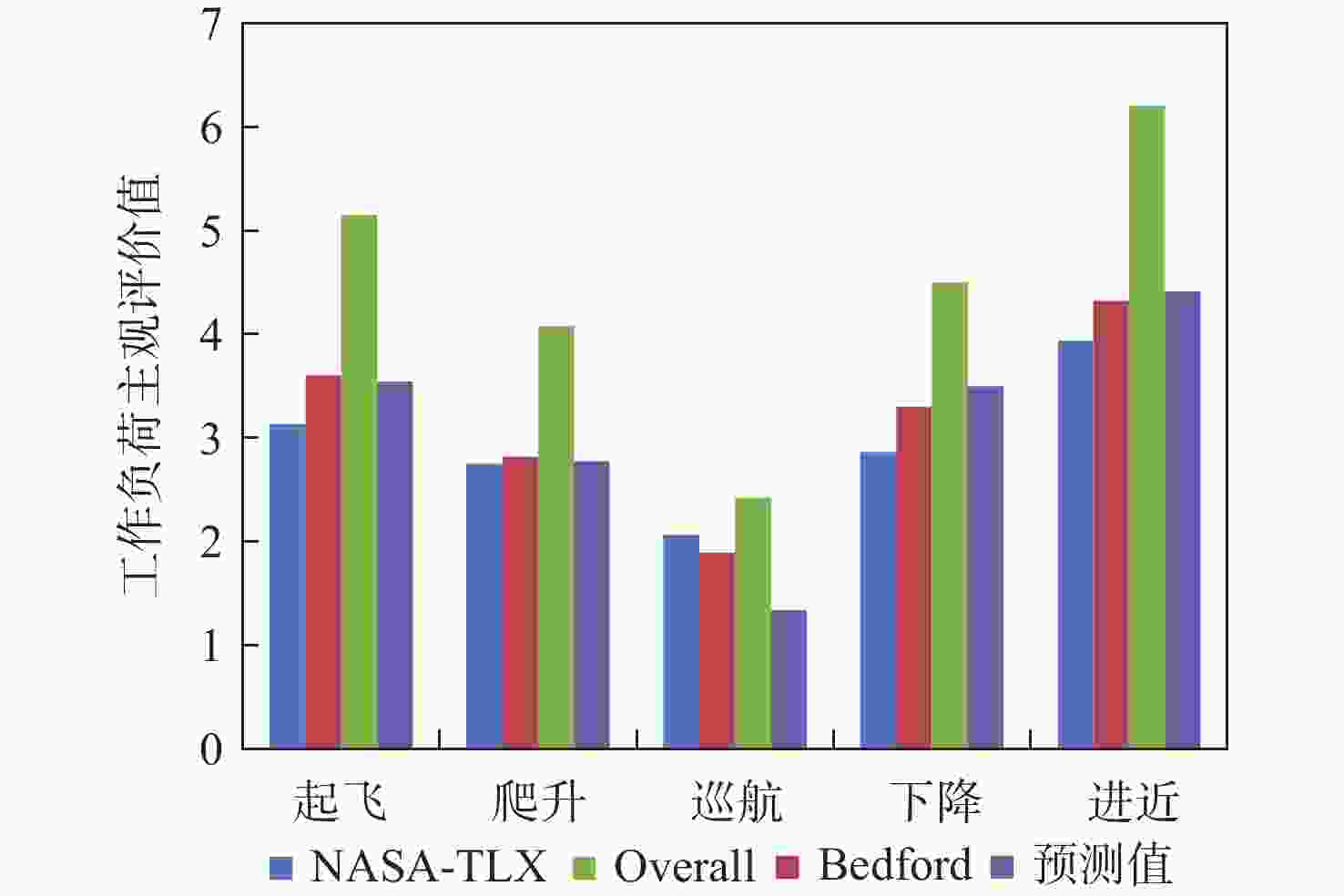
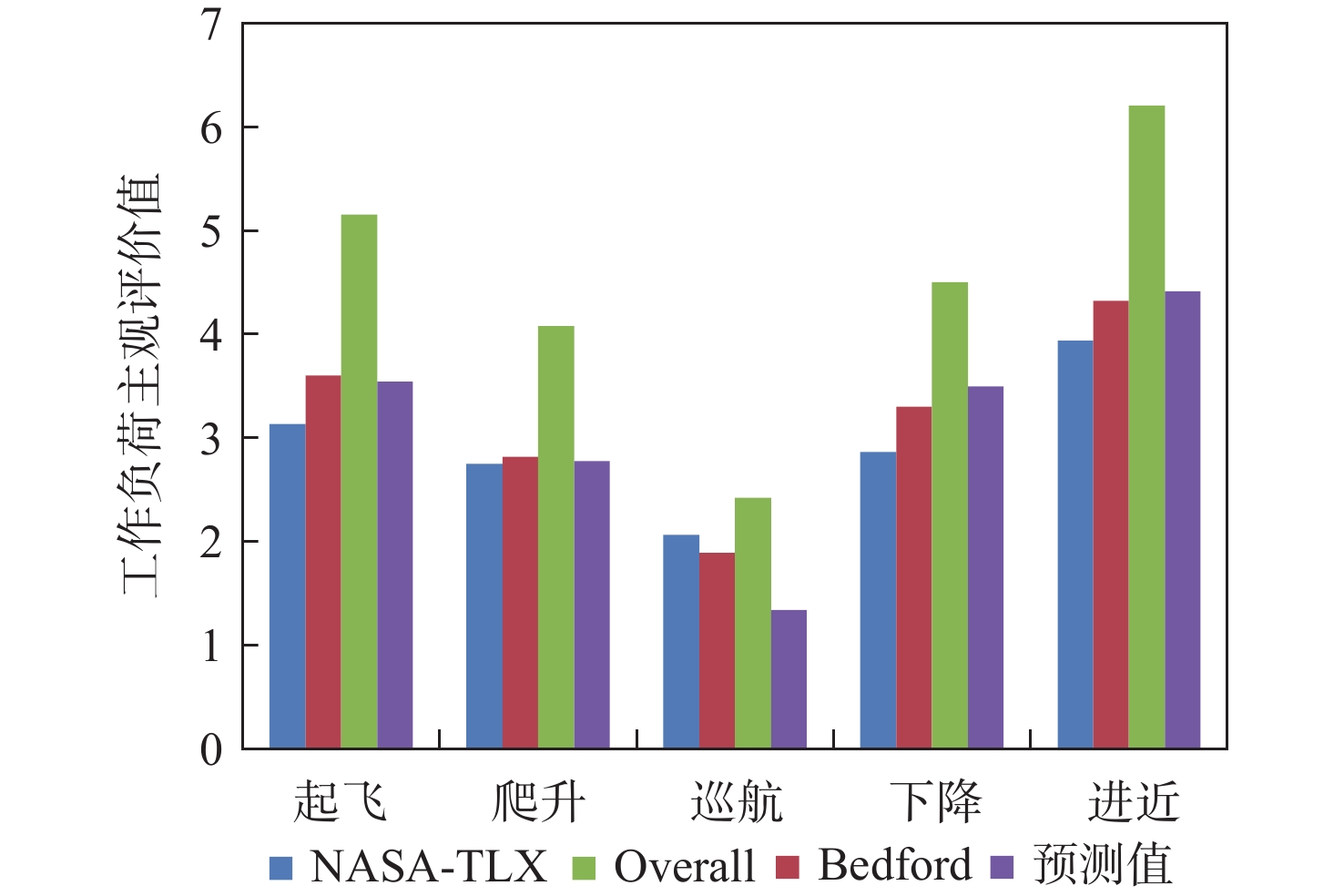
图 3 工作负荷主观评价值与预测值对比
Figure 3. Contrast analysis of subjective value and predictive value
表 1 不同飞行阶段下的工作负荷预测值
Table 1. Predictive value of pilot workload under different flight phases
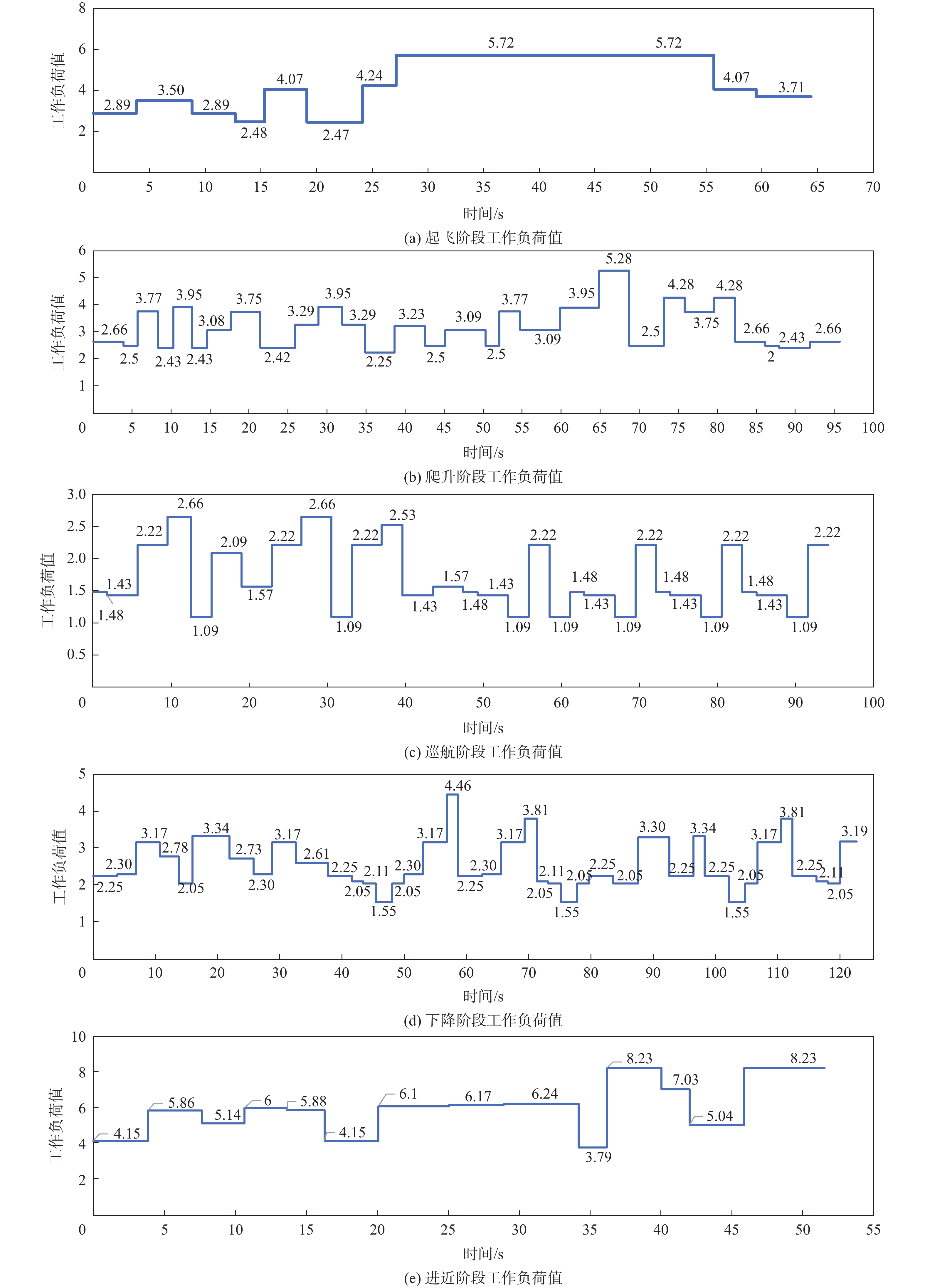
飞行阶段 工作负荷预测值 起飞阶段 3.55 爬升阶段 2.78 巡航阶段 1.34 下降阶段 3.50 进近阶段 4.42  下载: 导出CSV
表 2 不同飞行阶段下工作负荷主观评价值
Table 2. Subjective value of pilot workload under different flight phases
主观评价量表 工作负荷 起飞阶段 爬升阶段 巡航阶段 下降阶段 进近阶段 NASA-TLX 6.27 5.50 4.13 5.73 7.87 Bedford 3.60 2.82 1.89 3.30 4.32 Overall 51.54 40.77 24.23 45.00 62.08 SWAT 1.32 1.19 1.01 1.50 1.80
下载: 导出CSV
表 3 不同主观评价负荷值相关性分析结果
Table 3. Correlations analysis between different subjective evaluation load value
主观评价量表 Pearson 相关性 显著性(双侧) NASA-TLX 0.953* 0.012 Bedford 0.989** 0.001 Overall 0.984** 0.002 SWAT 0.925* 0.024 注:** 表示在0.01 水平(双侧)上显著相关;* 表示在 0.05 水平(双侧)上显著相关。
下载: 导出CSV
表 4 成对样本检验
Table 4. Sensitive measure test
成对样本 差分的 95% 置信
区间下限差分的 95% 置信
区间上限显著性 起飞-爬升 0.67 0.96 0 爬升-巡航 0.58 1.24 0.002 巡航-起飞 −2.18 −1.27 0
下载: 导出CSV
-
[1] XIE B, SALVENDY G. Review and reappraisal of modelling and predicting mental workload in single-and multi-task environments[J]. Work & Stress, 2000, 14(1): 74-99. [2] MEGAW T. The definition and measurement of mental workload[M]//3rd ed. Evaluation of Human Work. Boca Raton: CRC Press, 2005: 525-551. [3] PARKS D L, BOUCEK J P. Workload prediction, diagnosis, and continuing challenges[M]//Applications of Human Performance Models to System Design. Berlin: Springer, 1989: 47-63. [4] PATEL U H, SALVENDY G, GEDDES L A, et al. An electrical-circuit model for predicting mental workload in computer-based tasks[J]. Journal of the Chinese Institute of Industrial Engineers, 2002, 19(1): 1-15. [5] SIEGEL A I, WOLF J J. Man-machine simulation models[M]. New York: John Wiley & Sons, 1969. [6] PEI H N, MA Y J, LI W H, et al. Mental workload evaluation model of receiver aircraft pilots based on multiple resource theory[J]. Human Factors and Ergonomics in Manufacturing & Service Industries, 2024, 34(2): 159-173. [7] BRADLEY R, MACDONALD C A, BUGGY T W. Quantification and prediction of pilot workload in the helicopter/ship dynamic interface[J]. Proceedings of the Institution of Mechanical Engineers, Part G: Journal of Aerospace Engineering, 2005, 219(5): 429-443. [8] YAN X F, CHEN R L. Augmented flight dynamics model for pilot workload evaluation in tilt-rotor aircraft optimal landing procedure after one engine failure[J]. Chinese Journal of Aeronautics, 2019, 32(1): 92-103. [9] YU Z M, YAN X F, CHEN R L. Prediction of pilot workload in helicopter landing after one engine failure[J]. Chinese Journal of Aeronautics, 2020, 33(12): 3112-3124. [10] HAMILTON D B, BIERBAUM C R. Task analysis/workload (TAWL): a methodology for predicting operator workload[J]. Proceedings of the Human Factors Society Annual Meeting, 1990, 34(16): 1117-1121. [11] MCCRACKEN J H, ALDRICH T B. Analysis of selected lhx mission functions: implications for operator workload and system automation goals: DTIC ADA232330[R]. Washington, D. C. : Army Research Institute Aviation Research and Development Activity, 1984. [12] ALDRICH T B, SZABO S M, BIERBAUM C R. The development and application of models to predict operator workload during system design[M]//Applications of Human Performance Models to System Design. Berlin: Springer, 1989: 65-80. [13] RAYMOND C S. Data elements for workload analysis of armored vehicle crews: DTIC ADA228422[R]. Washington, D. C. : United States Army Research Institute Aviation Research and Development Activity. 1990. [14] EDGAR M J. Task analysis of the UH-60 mission and decision rules for developing a UH-60 workload prediction model: DTIC ADA201317[R]. Washington, D. C. : Army Research Institute Aviation Research and Development Activity, 1989. [15] LIANG S M, RAU C L, TSAI P F, et al. Validation of a task demand measure for predicting mental workloads of physical therapists[J]. International Journal of Industrial Ergonomics, 2014, 44(5): 747-752. [16] NORTH R A, RILEY V A. W/INDEX: a predicted model of operator workload[M]. New York: Plenum, 1989: 81-90. [17] STAVELAND L E. MIDAS TLM: man-machine integrated design and analysis system task loading model[C]//Proceedings of the IEEE International Conference on Systems, Man and Cybernetics. Piscataway: IEEE Press, 1991: 1219-1224. [18] WICKENS C D. Processing resources in attention[M]. New York: Academy Press, 1984: 63-101. [19] WICKENS C D. Multiple Resource time sharing model, handbook of human factors and ergonomics methods[M]. Boca Raton: CRC Press, 2005. [20] WICKENS C D. Multiple resources and performance prediction[J]. Theoretical Issues in Ergonomics Science, 2002, 3(2): 159-177. [21] LI M, WANG M, WANG G Q, et al. Predictive mental workload modeling methodology for single-pilot operations system design[J]. Journal of Aerospace Information Systems, 2024, 21(3): 249-262. [22] MESHKATI N, LOEWENTHAL A. The effects of individual differences in information processing behavior on experiencing mental workload and perceived task difficulty: a preliminary investigation[J]. Advances in Psychology, 1988, 52: 269-288. [23] VAN TONDER J A. Certificate in industrial ergonomics[D]. Pretoria: University of Pretoria, 1999. [24] WELFORD A T. The ‘psychological refractory period’ and the timing of high-speed performance: a review and a theory[J]. British Journal of Psychology General Section, 1952, 43(1): 2-19. [25] DONOHUE S E, APPELBAUM L G, PARK C J, et al. Cross-modal stimulus conflict: the behavioral effects of stimulus input timing in a visual-auditory stroop task[J]. PLoS One, 2013, 8(4): e62802. [26] YUVAL-GREENBERG S, DEOUELL L Y. The dog’s meow: asymmetrical interaction in cross-modal object recognition[J]. Experimental Brain Research, 2009, 193(4): 603-614. [27] YUVAL-GREENBERG S, TOMER O, KEREN A S, et al. Transient induced gamma-band response in EEG as a manifestation of miniature saccades[J]. Neuron, 2008, 58(3): 429-441. [28] HEYDE G C. The concept and history "MODAPTS plus"[R]. Sydney: Australian Association for Predetermined Time Standards and Research, 1982. [29] HART S G, STAVELAND L E. Development of NASA-TLX (Task Load Index) results of empirical and theoretical research[M]. Amsterdam: North-Holland, 1988: 139-183. [30] 杜俊敏, 何雪丽, 康卫勇. 飞行员工作负荷[M]. 北京: 北京航空航天大学出版社, 2021: 35-74.DU J M, HE X L, KANG W Y. Pilot workload[M]. Beijing: Beijing University of Aeronautics & Astronautics Press, 2021: 35-74(in Chinese). [31] SARAH M. Literature review workload measures: RTO-TR-HFM-121-Part-II [R]. Iowa: The University of IOWA. 2001. [32] LIN C J, LIN P H, CHEN H J, et al. Effects of controller-pilot communication medium, flight phase and the role in the cockpit on pilots’ workload and situation awareness[J]. Safety Science, 2012, 50(9): 1722-1731. [33] CORWIN W H, SANDRY-GARZA D L, BIFERNO M H, et al. Assessment of crew workload measurement methods, techniques, and procedures: process, methods and results: WRDC-TR-89-7006 [R]. Wright-Patterson AFBOH: Wright Research and Development Center, 1989. [34] Diamond Aircraft. Airplane flight manual DA 42[EB/OL].(2004-04-29)[2024-04-27]. https://www.manualslib.com/manual/1422391/Diamond-Da-42.html?page=3#manual. [35] HE X L, DING L, MIAO C C, et al. Effects of flight environment on pilot workload in simulated and actual flight[C]//Proceedings of the Asia-Pacific International Symposium on Aerospace Technology. Berlin: Springer, 2019: 3040-3051. [36] HE X L, DING L, MIAO C C, et al. Decomposition and classification of flight operation tasks of civil aircraft[C]//Proceedings of the Man–Machine–Environment System Engineering. Berlin: Springer, 2017: 789-801. [37] HE X L, DING L, MIAO C C, et al. The research on task unit workload of civil aircraft flight operation[C]//Proceedings of the Man–Machine–Environment System Engineering. Berlin: Springer, 2018: 249-259. -

 下载:
下载:

 点击查看大图
计量
- 文章访问数: 541
- HTML全文浏览量: 159
- PDF下载量: 15
- 被引次数: 0
