





-
摘要:
针对烧蚀传热问题进行不确定性量化研究,烧蚀预测采用双平台模型,对烧蚀动边界下的传热过程使用有限元方法进行数值求解。使用正交试验研究参数对目标变量的影响,发现在2种典型加热条件(高热流、短时间和低热流、长时间)下,输入参数对烧蚀量的影响有所不同,而对背面温度的影响大小一致。为得到更精准的不确定性量化结果,进一步使用蒙特卡罗(MC)方法和多项式混沌(PC)方法对烧蚀传热问题进行不确定性分析,通过敏感度分析发现,在2种加热条件下,热流是影响烧蚀量较为关键的因素。而对背面温度的影响,状态1(高热流、短时间)中的热导率影响最大,状态3(低热流、长时间)中的热流影响相对较大。相比MC方法,PC方法能够有效减少计算成本,获得较为满意的计算结果。
Abstract:A quantitative study on the uncertainty of ablation heat transfer is conducted, in which a dual platform model is used for ablation prediction, and the heat transfer process under the ablation dynamic boundary is numerically solved using the finite element method. Firstly, an orthogonal experimental study was conducted to analyze the influence of parameters on the target variable. It was discovered that while the input parameters had consistent impacts on the backside temperature, they had distinct effects on the ablation quantity under two common heating situations (high heat flow, short time and low heat flow, long time). In order to obtain more accurate uncertainty quantification results, Monte Carlo (MC) and polynomial chaos (PC) methods were further used to conduct uncertainty analysis on the ablation heat transfer problem. Through sensitivity analysis, it was found that under two heating conditions, heat flux was the key factor affecting the ablation amount. The back temperature is most affected by the material’s thermal conductivity in state 1 (high heat flow, short time), but heat flow in state 3 (low heat flow, long time) has a comparatively bigger effect. Compared to the MC method, the PC method can effectively reduce computational costs and obtain satisfactory computational results.
-
Key words:
- carbon-based materials /
- dual platform theory /
- uncertainty /
- polynomial chaos /
- orthogonal test
-
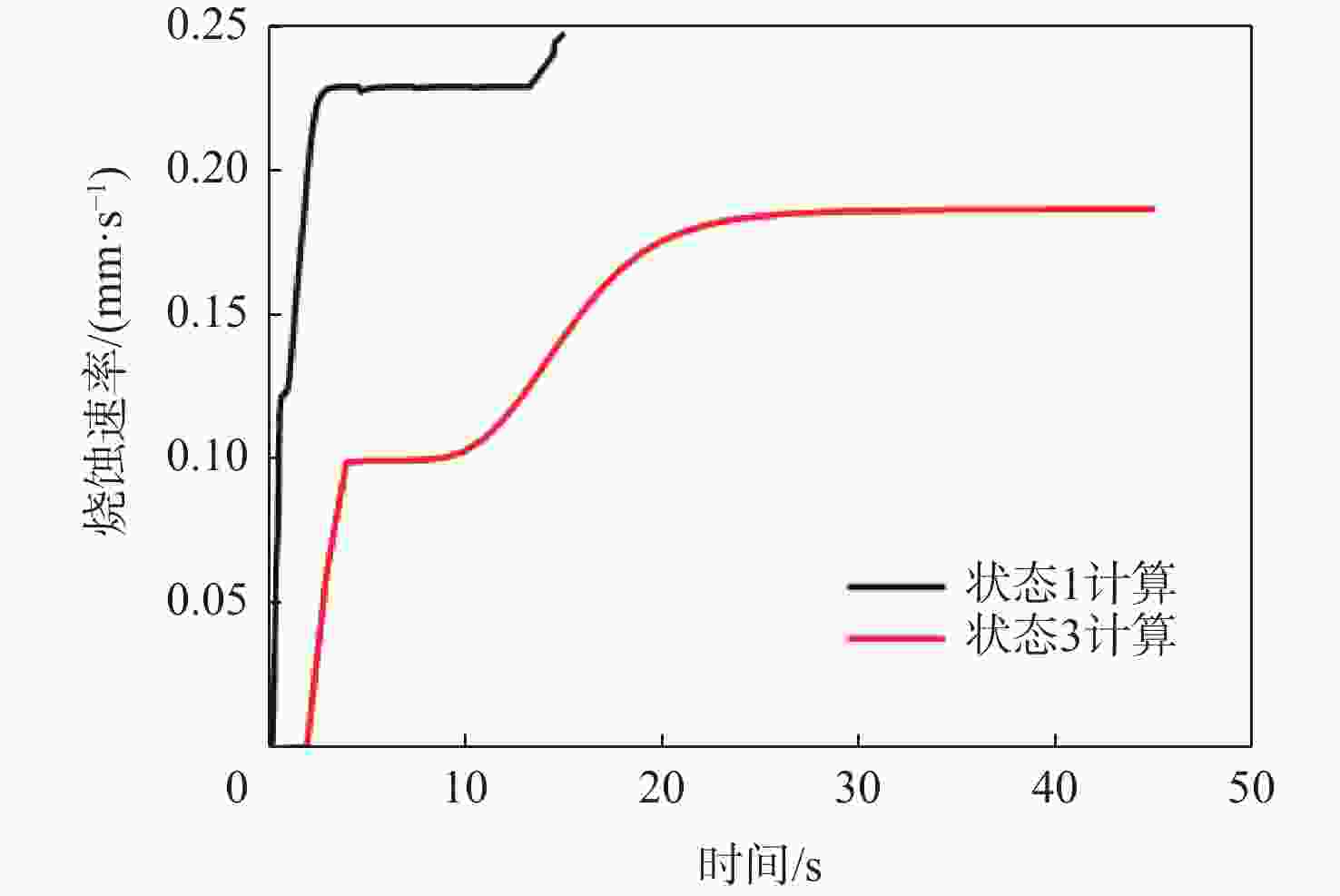
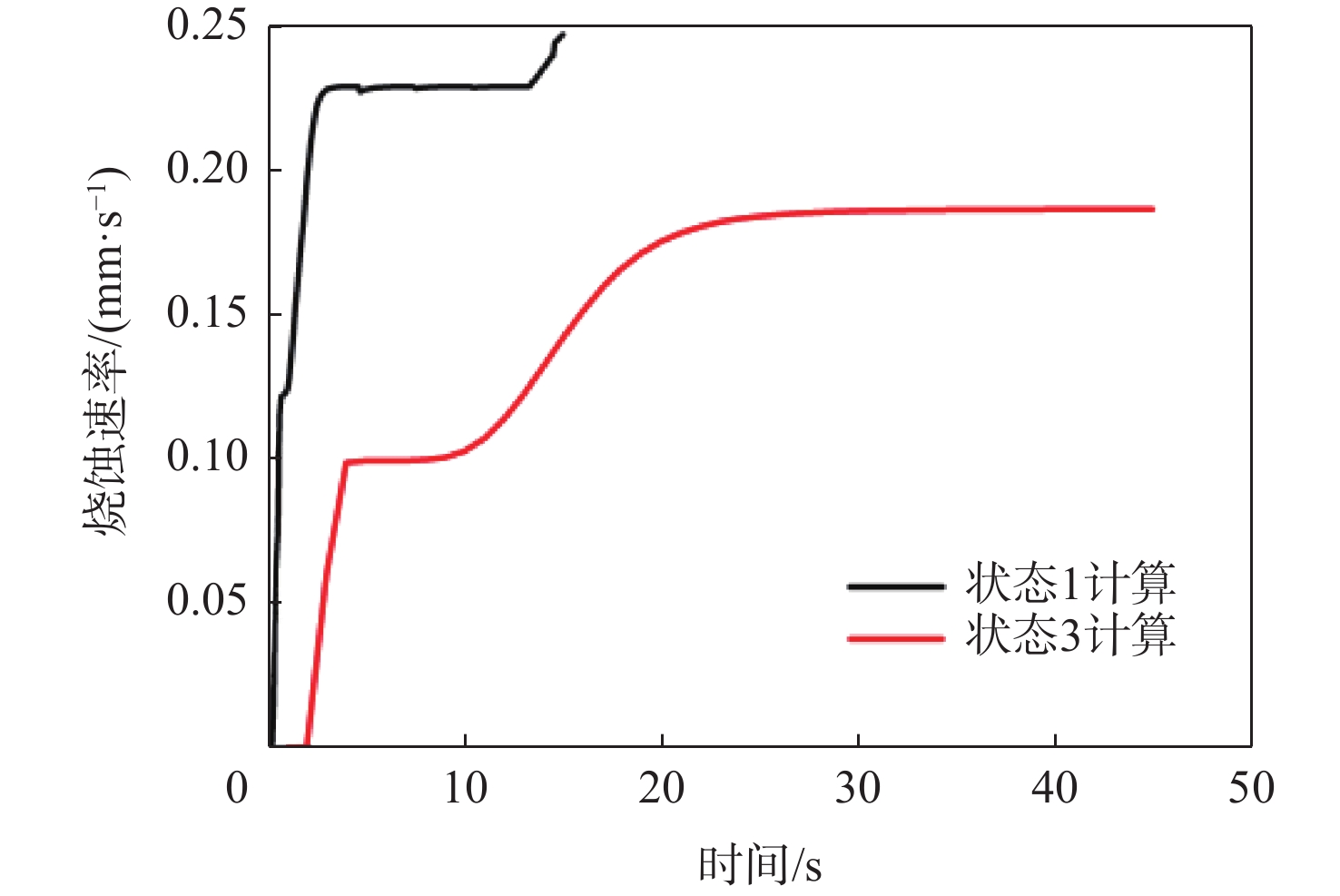
图 2 状态1和状态3烧蚀速率随时间变化
Figure 2. The ablation velocity of state 1 and state 3 changes over time
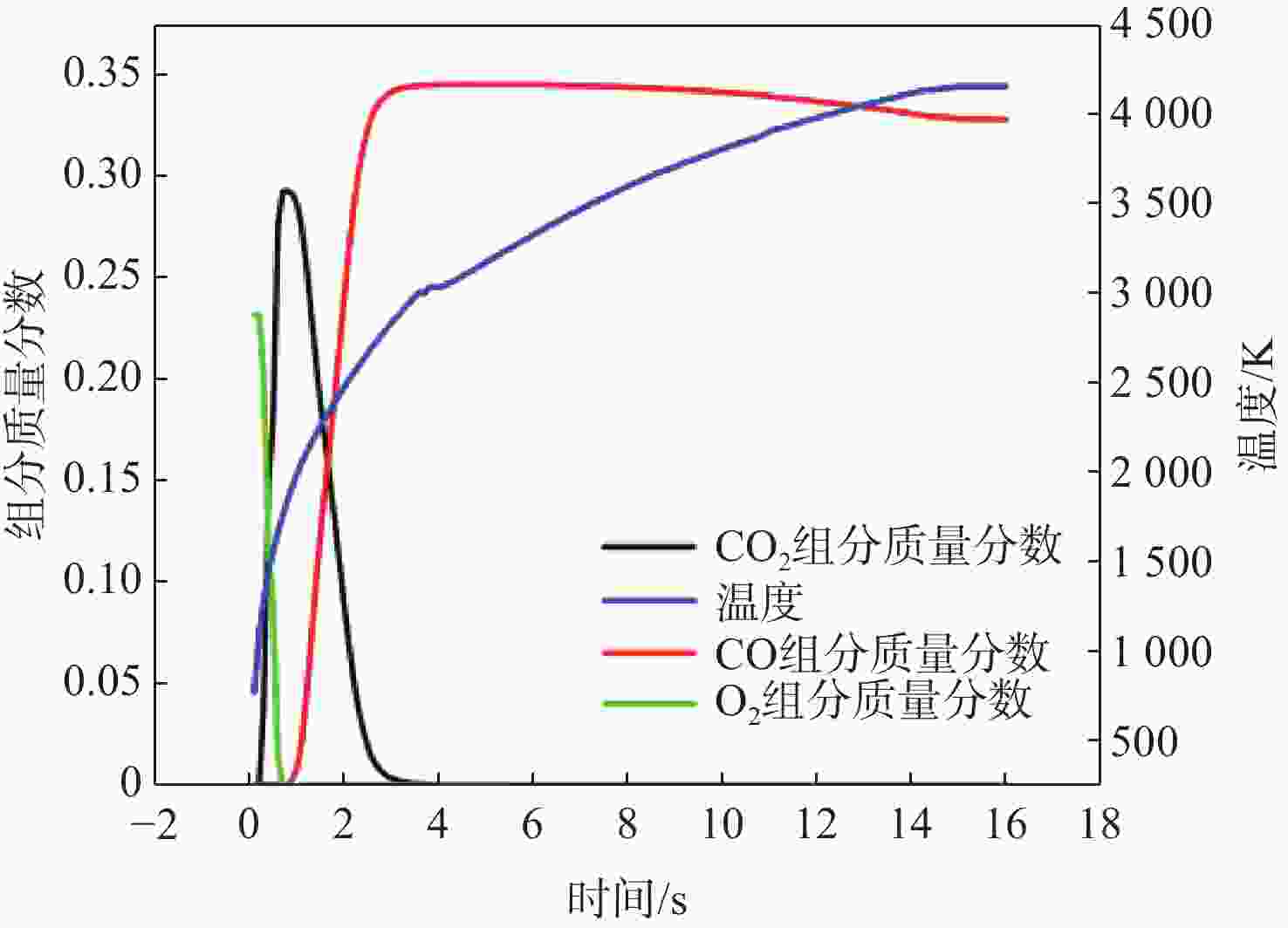
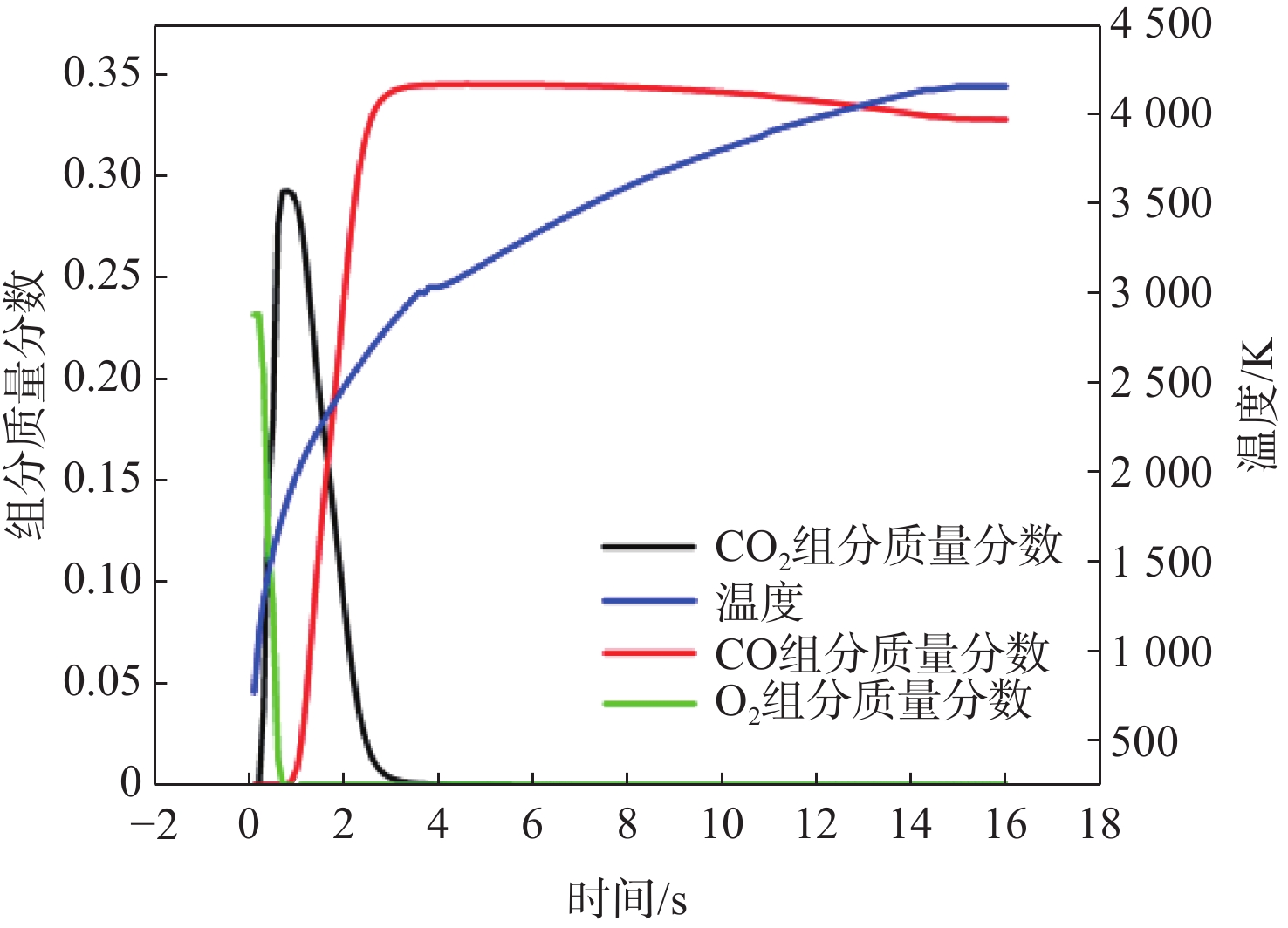
图 3 状态1碳-氧反应相关组分质量分数曲线及表面温升曲线
Figure 3. Concentration curve and surface temperature rise curve of carbon oxygen reaction related components in state 1
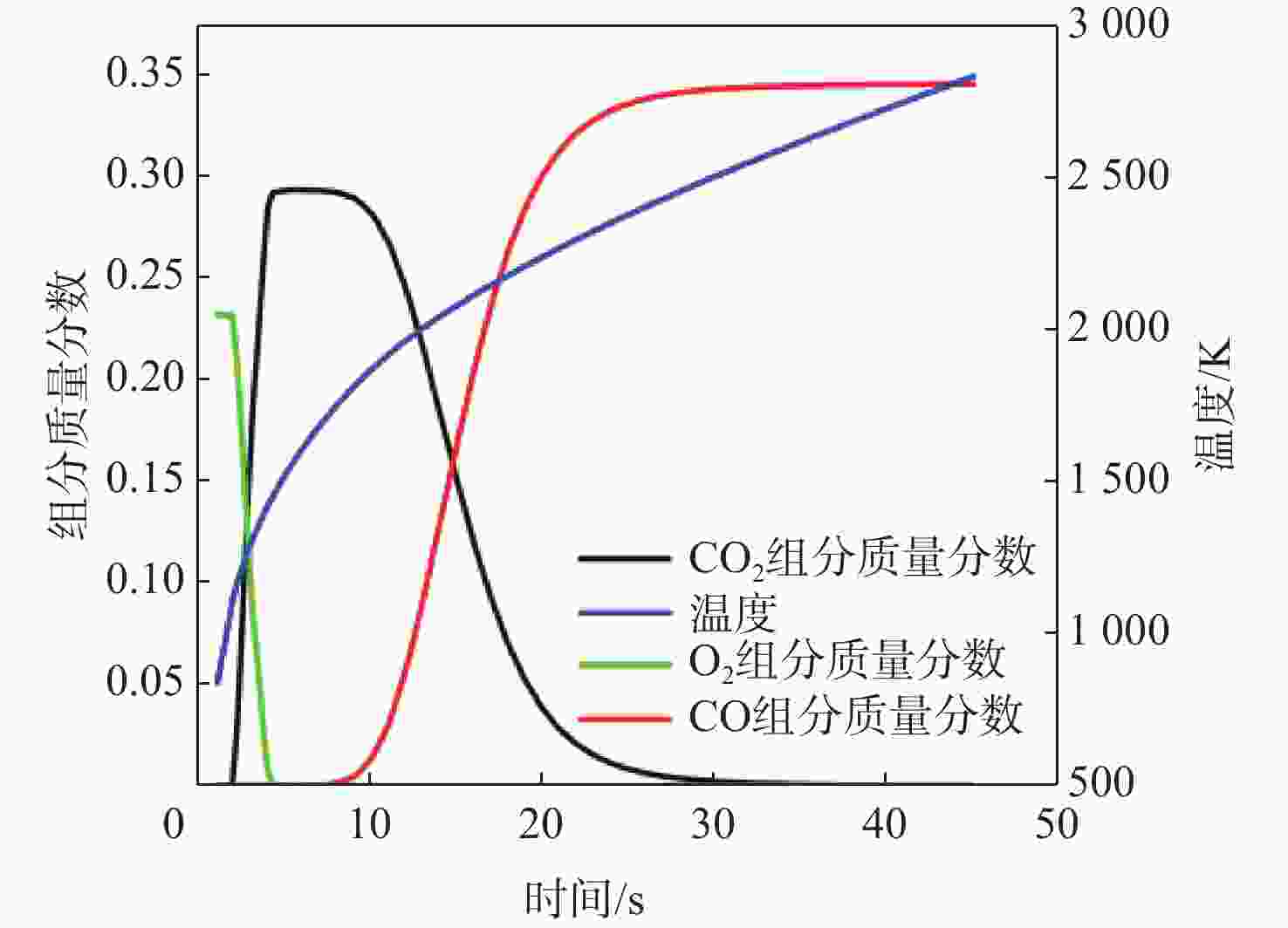
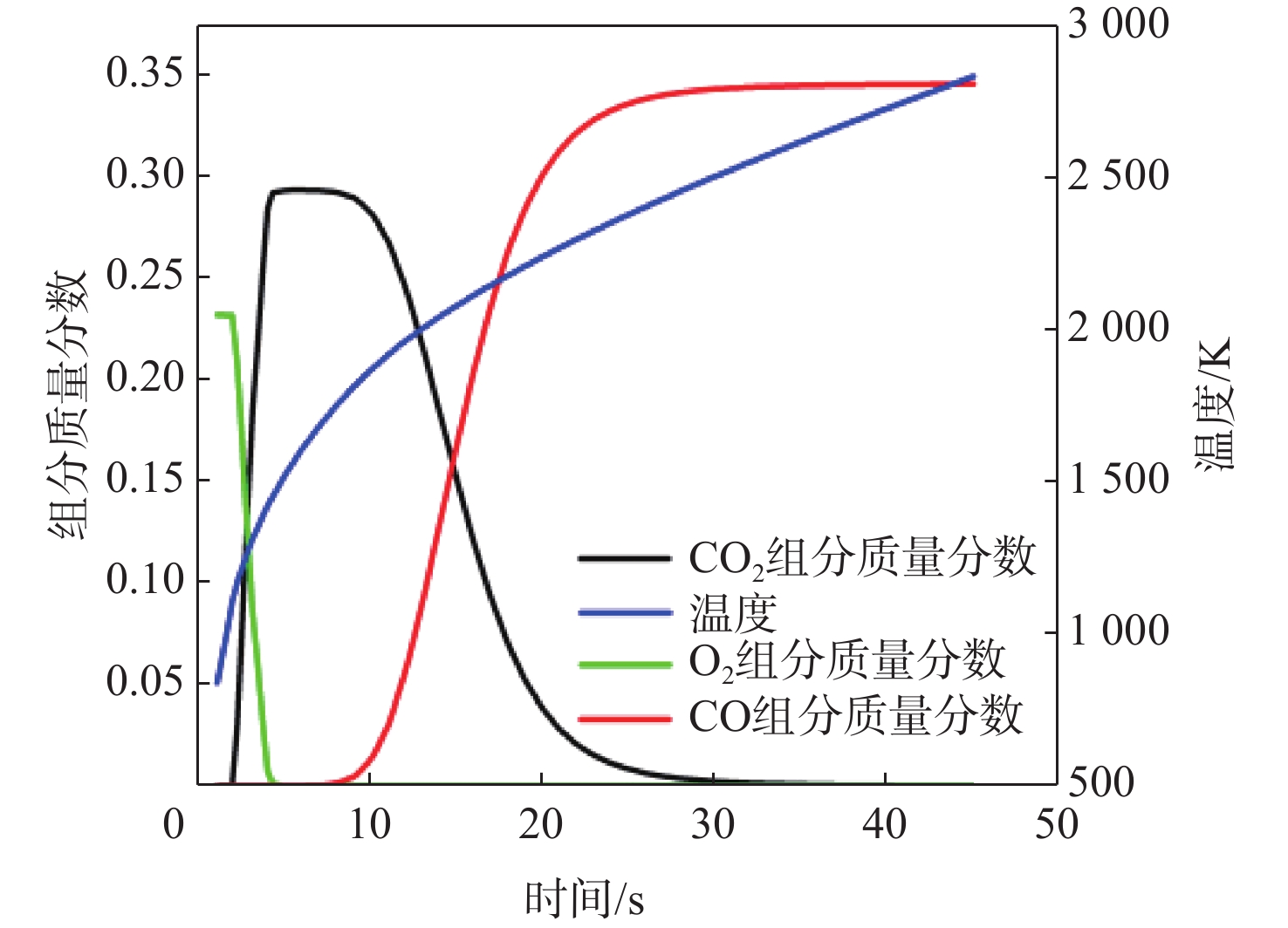
图 4 状态3碳-氧反应相关组分质量分数曲线及表面温升曲线
Figure 4. Concentration curve and surface temperature rise curve of carbon oxygen reaction related components in state 3
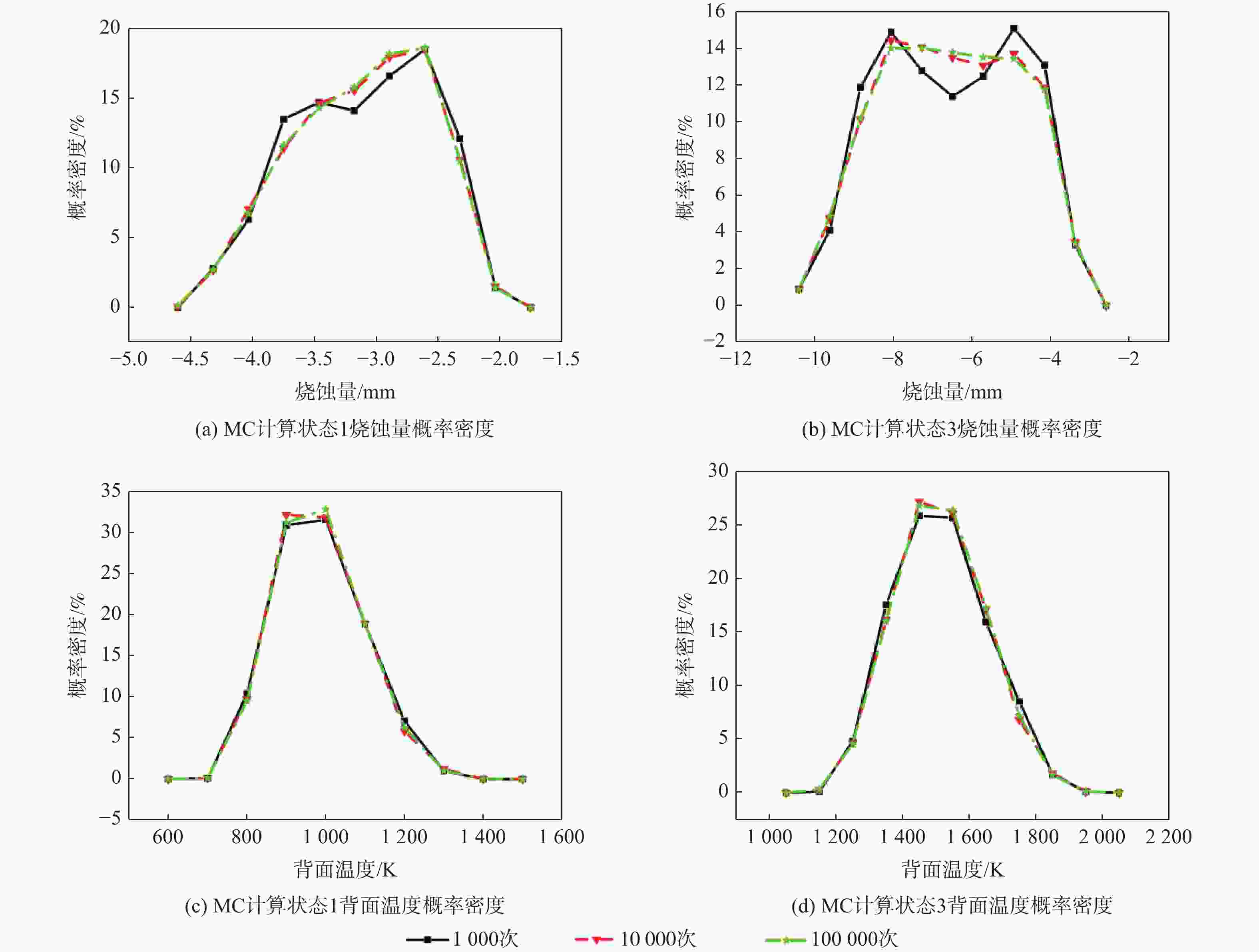
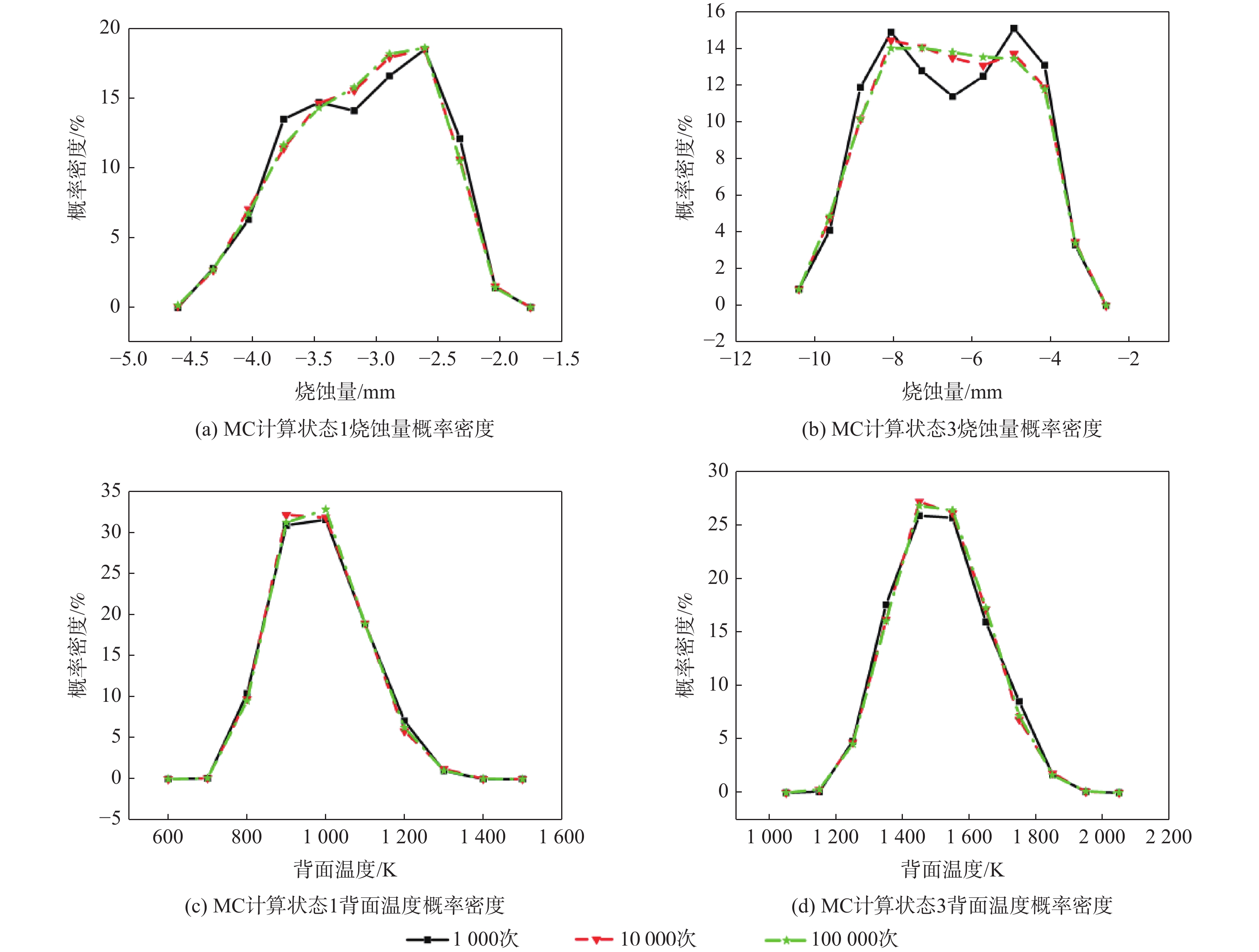
图 6 2种状态下不同MC计算次数下目标变量的概率密度
Figure 6. Probability density of target variable under different MC calculation times in two states
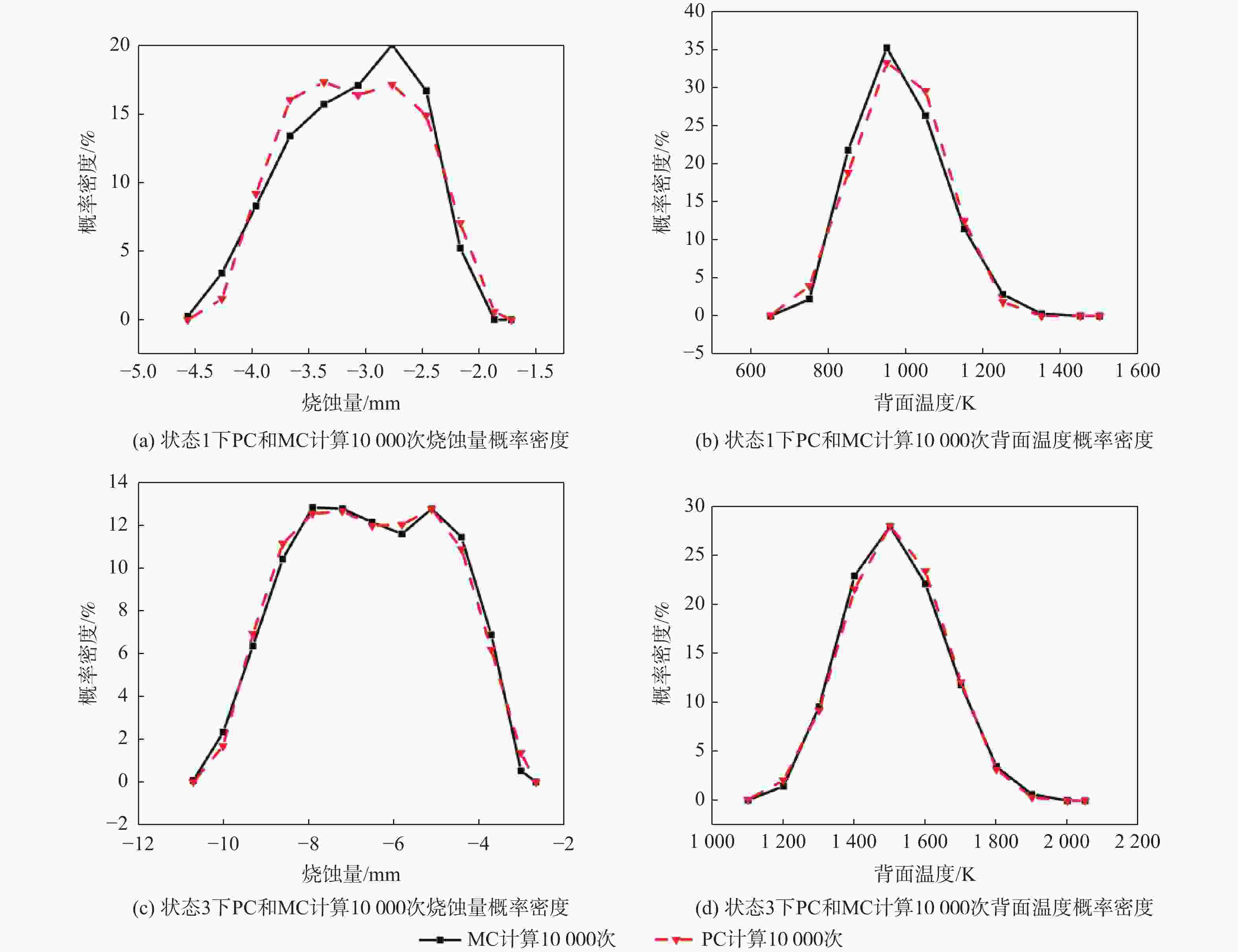
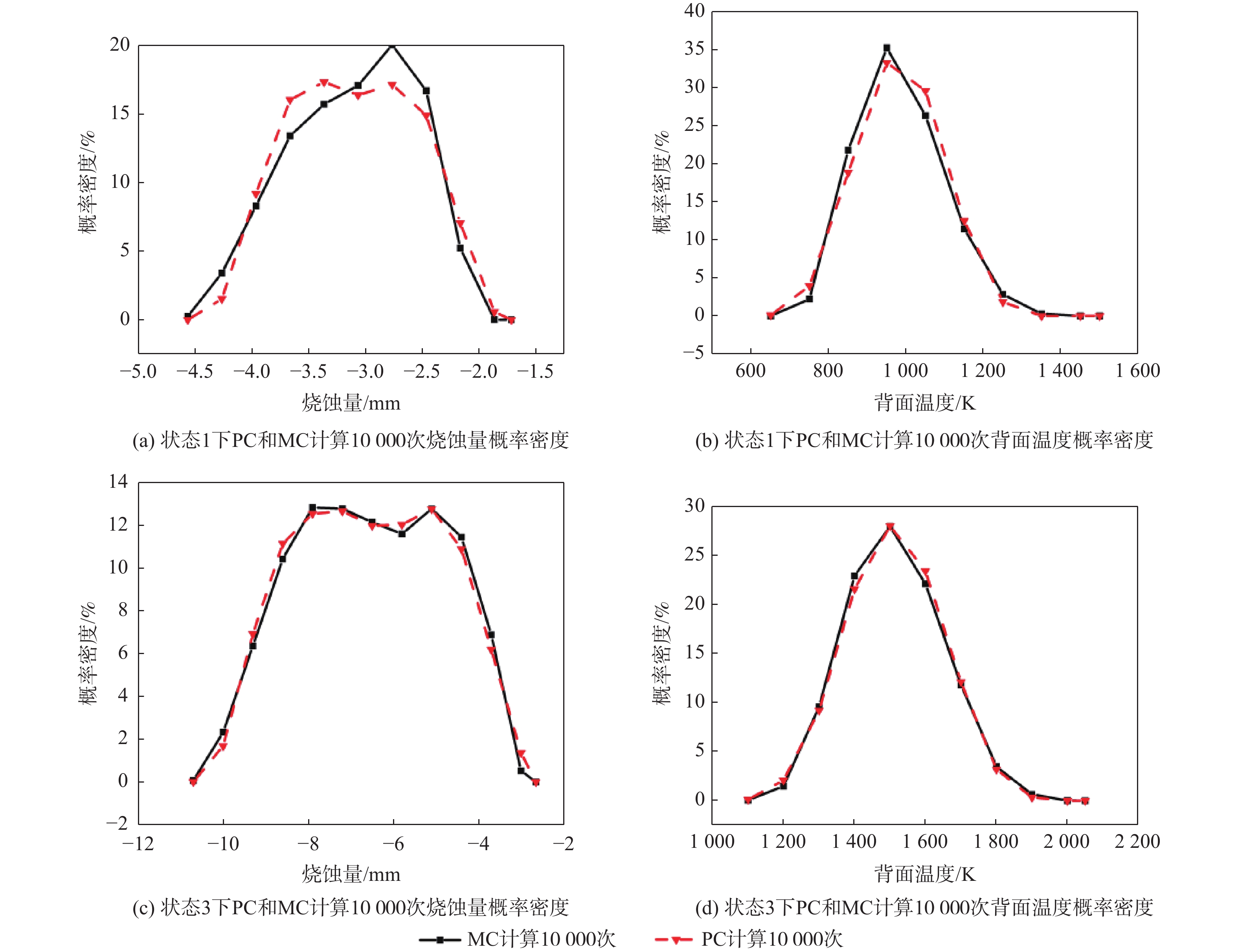
图 7 2种状态下PC和MC计算
10000 次目标变量概率密度Figure 7. PC and MC calculate the probability density of target variables
10000 times in two states表 1 碳/碳材料模型试验状态及烧蚀测量结果
Table 1. Carbon/carbon material model test status and ablation measurement results
状态 烧蚀前
尺寸/mm烧蚀后
尺寸/mm焓值/
(MJ·kg−1)热流/
(MW·m−2)烧蚀
时间/s状态1 40.12 36.5 10 30 15 状态2 40.06 38.5 5 10 15 状态3 40.05 33.5 5 10 45  下载: 导出CSV
表 2 正交试验结果
Table 2. Orthogonal test results
分组 热导率水平/% 比热容水平/% 密度水平/% 热流水平/% 烧蚀量/mm 背面温度/K 状态1 状态3 状态1 状态3 1 110 110 110 110 − 3.0644 − 6.3687 910.9497 1429.1593 2 110 120 120 120 − 3.0975 − 6.3096 807.6277 1293.7382 3 110 130 130 130 − 2.9984 − 6.2558 725.7529 1174.8075 4 120 110 120 130 − 3.5560 − 7.7881 920.5961 1457.9038 5 120 120 130 110 − 2.8395 − 5.1888 790.2486 1241.3909 6 120 130 110 120 − 2.8127 − 5.7344 858.4754 1357.6171 7 130 110 130 120 − 3.3521 − 6.6127 895.9407 1395.9750 8 130 120 110 130 − 3.3006 − 7.0547 974.7811 1515.5080 9 130 130 120 110 − 2.6967 − 4.7004 829.1743 1287.5658
下载: 导出CSV
表 3 烧蚀量的极差分析结果
Table 3. Range analysis results of ablation amount
状态 因素 k1/mm k2/mm k3/mm 极差/mm 状态1 热导率 −3.053 −3.069 −3.116 0.063 比热容 −3.324 −3.079 −2.836 0.488 密度 −3.059 −3.117 −3.063 0.058 热流 −2.867 −3.087 −3.285 0.418 状态3 热导率 −6.311 −6.237 −6.064 0.189 比热容 −6.923 −6.184 −5.505 1.360 密度 −6.386 −6.208 −6.019 0.367 热流 −5.361 −6.219 −7.033 1.614 注:k1、k2、k3分别为因素在110%、120%、130%水平下对结果的影响。
下载: 导出CSV
表 4 背面温度的极差分析结果
Table 4. Range analysis results of back temperature
状态 因素 k1/K k2/K k3/K 极差/K 状态1 热导率 814.777 856.44 899.965 85.188 比热容 909.162 857.552 804.468 104.694 密度 914.735 852.466 803.981 110.754 热流 843.458 854.015 873.71 30.252 状态3 热导率 1299.235 1352.304 1375.694 100.448 比热容 1427.679 1350.212 1249.341 154.349 密度 1434.095 1322.414 1270.724 163.370 热流 1295.383 1349.11 1382.74 63.368
下载: 导出CSV
表 5 输入随机变量及其变化范围
Table 5. Input random variables and their variation range
输入参数 不确定度/% 热导率 ±20 比热容 ±10 密度 ±10 热流 ±30
下载: 导出CSV
表 6
100000 次MC计算目标最值Table 6.
100000 MC calculations target most value状态 烧蚀量/mm 背面温度/K 最小值 最大值 最小值 最大值 状态1 −4.58 −2 716.3427 1404.27678 状态3 −10.73 −2.97 1120.52157 1986.70322
下载: 导出CSV
表 7 目标变量统计矩
Table 7. Target variable statistical moment
方法 烧蚀量
均值/mm烧蚀量
标准差/mm背面温度
均值/K背面温度
标准差/KMC计算状态1 −3.11 0.545479 982.9026 106.7819 PC计算状态1 −3.11 0.543199 983.10855 105.95302 MC计算状态3 −6.56 1.72 1512.02263 133.02574 PC计算状态3 − 6.56 1.71 1512.31966 132.35831
下载: 导出CSV
表 8 目标变量Sobol指标
Table 8. Target variable Sobol index
因素 烧蚀量Sobol指标 背面温度Sobol指标 状态1 状态3 状态1 状态3 热导率 1.41×10⁻⁵ 0.005923237 0.512097066 0.300210835 密度 0.109554085 0.077289485 0.191548295 0.182521824 比热容 1.19×10⁻⁵ 0.003586252 0.209484497 0.205598757 热流 0.890419977 0.913201026 0.086870142 0.311668585
下载: 导出CSV
-
[1] 杨琼梁, 史晓鸣, 许斌, 等. 烧蚀防热层与结构耦合热传导分析的交替计算法[J]. 宇航学报, 2011, 32(8): 1854-1858.YANG Q L, SHI X M, XU B, et al. Alternative algorithm for heat transfer analysis of ablative protection layer coupled with structure[J]. Journal of Astronautics, 2011, 32(8): 1854-1858(in Chinese). [2] 孟松鹤, 疏浩, 易法军, 等. 烧蚀防热材料在线后退测试技术研究进展[J]. 宇航学报, 2023, 44(7): 957-972.MENG S H, SHU H, YI F J, et al. Research progress of online recession test technology for ablative thermal protection materials[J]. Journal of Astronautics, 2023, 44(7): 957-972(in Chinese). [3] 杨驰, 刘娜, 孔维萱, 等. 高超声速再入热环境下防热复合材料烧蚀传热计算及影响因素分析[J]. 玻璃钢/复合材料, 2017(4): 35-41.YANG C, LIU N, KONG W X, et al. Study on ablation heat transfer calculation and influencing factors of thermal protection materials under hypersonic thermal environment[J]. Fiber Reinforced Plastics/Composites, 2017(4): 35-41(in Chinese). [4] 高铁锁, 江涛, 丁明松, 等. 再入体碳基防热材料烧蚀流场红外辐射模拟[J]. 红外与激光工程, 2023, 52(5): 20220606.GAO T S, JIANG T, DING M S, et al. Simulation of flow field infrared radiation over reentry vehicle with ablation of carbon-based thermal protection material[J]. Infrared and Laser Engineering, 2023, 52(5): 20220606(in Chinese). [5] 周印佳, 张志贤, 付新卫, 等. 再入飞行器烧蚀热防护一体化计算方法[J]. 航空学报, 2021, 42(7): 202-211.ZHOU Y J, ZHANG Z X, FU X W, et al. Integrated computing method for ablative thermal protection system of reentry vehicles[J]. Acta Aeronautica et Astronautica Sinica, 2021, 42(7): 202-211(in Chinese). [6] 周述光, 国义军, 贺立新, 等. 再入弹头三维非对称烧蚀外形模拟[J]. 航空学报, 2017, 38(12): 114-125.ZHOU S G, GUO Y J, HE L X, et al. Simulation of 3D asymmetric ablation shape of reentry missile[J]. Acta Aeronautica et Astronautica Sinica, 2017, 38(12): 114-125(in Chinese). [7] DEC J A, MITCHELTREE R A. Probabilistic design of a Mars Sample Return Earth entry vehicle thermal protection system[C]//Proceedings of the 40th AIAA Aerospace Sciences Meeting & Exhibit. Reston: AIAA, 2002: 910. [8] CHEN Y K, SQUIRE T, LAUB B, et al. Monte Carlo analysis for spacecraft thermal protection system design[C]//Proceedings of the 9th AIAA/ASME Joint Thermophysics and Heat Transfer Conference. Reston: AIAA, 2006: 2951. [9] SEPKA S, WRIGHT M. A Monte Carlo approach to fiat uncertainties-improvements and results for MSL[C]//Proceedings of the 41st AIAA Thermophysics Conference. Reston: AIAA, 2009: 4234. [10] DEC J A, BRAUN R D. Three-dimensional finite element ablative thermal response and design of thermal protection systems[J]. Journal of Spacecraft and Rockets, 2013, 50(4): 725-734. [11] TOBIN S A, DEC J A. Probabilistic design demonstration of a flexible thermal protection system for a hypersonic inflatable aerodynamic decelerator[C]//Proceedings of the 53rd AIAA Aerospace Sciences Meeting. Reston: AIAA, 2015: 1895. [12] 陈江涛, 章超, 刘骁, 等. 基于稀疏多项式混沌方法的不确定性量化分析[J]. 航空学报, 2020, 41(3): 123382.CHEN J T, ZHANG C, LIU X, et al. Uncertainty quantification analysis with sparse polynomial chaos method[J]. Acta Aeronautica et Astronautica Sinica, 2020, 41(3): 123382(in Chinese). [13] 国义军, 代光月, 桂业伟, 等. 碳基材料氧化烧蚀的双平台理论和反应控制机理[J]. 空气动力学学报, 2014, 32(6): 755-760.GUO Y J, DAI G Y, GUI Y W, et al. A dual platform theory for carbon-based material oxidation with reaction-diffusion rate controlled kinetics[J]. Acta Aerodynamica Sinica, 2014, 32(6): 755-760(in Chinese). [14] SCALA S M. The ablation of graphite in dissociated air: part 1: theory: R62SD72[R]. Philadelphia: General Electric, 1962. [15] 刘骁. 烧蚀热防护系统三维热响应有限元计算方法研究[D]. 绵阳: 中国空气动力研究与发展中心, 2016.LIU X. Study on three-dimensional finite element thermal response calculation method applied to ablative thermal protection system[D]. Mianyang: China Aerodynamics Research and Development Center, 2016(in Chinese). [16] 王臣, 梁军, 吴世平, 等. 高温烧蚀条件下 C/C材料热力耦合场模拟[J]. 复合材料学报, 2006, 23(5): 143-148.WANG C, LIANG J, WU S P, et al. Numerical simulation of C/C composites coupled thermo-mechanical field under the condition of high temperatures and ablation[J]. Acta Materiae Compositae Sinica, 2006, 23(5): 143-148(in Chinese). [17] ASKEY R A, WILSON J. Some basic hypergeometric orthogonal polynomials that generalize Jacobi polynomials[M]. Providence: American Mathematical Society, 1985. -

 下载:
下载:

 点击查看大图
计量
- 文章访问数: 480
- HTML全文浏览量: 311
- PDF下载量: 9
- 被引次数: 0
