





Satellite platform classification method based on deep neural network using photometric data
-
摘要:
空间目标的光度序列数据与目标的形状、尺寸、材质和运动等特性信息紧密相关,为利用光度序列数据反演卫星平台的类别,提出基于深度神经网络和光度序列数据的卫星平台分类识别方法。对用于神经网络训练的光度序列数据进行了距离修正、相位角修正、平滑滤波和插值等预处理分析。构建了可以同时提取空间目标时序特征和空间特征的卷积长短时记忆网络,该网络对火箭、铱星、GlobalStar卫星和空间碎片4类目标分类的平均准确率为73.80%,优于卷积神经网络的平均值70.43%。仿真了白云卫星平台(WC)、气象卫星计划平台(DMSP)、未来成像卫星平台(FIA)、空间态势感知计划卫星平台(GSSAP)等7类卫星平台的光度序列数据,并进行深度神经网络扩展验证,得到的卫星平台分类准确率大幅度提升至超过90%。
Abstract:There is a high correlation between an object's photometric data and its shape, size, material, and movement. In order to classify the type of satellite platform using the photometric data, a deep neural network based satellite platform classification method is proposed. Preprocessing techniques like as interpolation, smooth filtering, distance correction, and phase correction are applied to the photometric data needed for network training. Convolutional long short-term neural network is constructed to extract the spatial and temporal features of space objects from photometric data, and the average classification accuracy of rocket, satellite Iridium, satellite GlobalStar and space debris is 73.8%, better than the 70.43% accuracy of the convolution neural network. Additionally, the deep neural network is further tested using simulated photometric data from seven satellite platforms, including White Cloud (WC), defense meteorological satellite program (DMSP), future imagery architecture (FIA), and geosynchronous space situational awareness program (GSSAP). The classification accuracy of the satellite platforms is significantly increased to better than 90%.
-

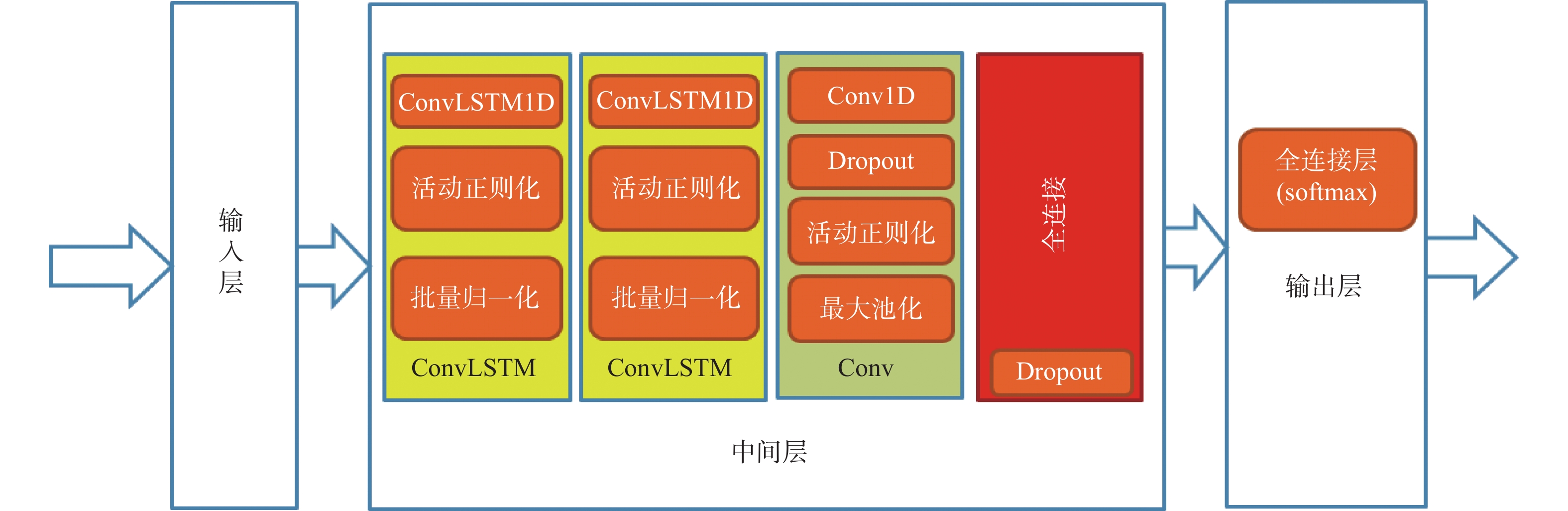
图 1 用于卫星平台分类的卷积循环神经网络
Figure 1. Constructed convolutional recurrent neural network for satellite platform classificaiton

图 3 对MMT系统实测光度序列数据的预处理过程
Figure 3. Preprocess steps for measured photometric data of MMT system

图 4 预处理过程对原始数据MMT系统实测光度序列的结果
Figure 4. Results of each preprocessing steps for original measured photometric data of MMT system
表 1 4类目标基本情况
Table 1. Basic information of four classes of objects
目标种类 目标示意图 说明 火箭残骸 
猎鹰9号, 1281 弧段铱星 
3509 弧段GlobalStar卫星 
3451 弧段空间碎片 3464 弧段 下载: 导出CSV
表 2 卷积循环神经网络某次训练后测试结果的召回率
Table 2. Recall rate of test results after a training epoch of convolutional recurrent neural network
类别 召回率/% 空间碎片 68.18 铱星 64.09 火箭残骸 99.09 GlobalStar 61.82
下载: 导出CSV
表 3 卷积循环神经网络10次训练的准确率结果
Table 3. Model accuracy of 10 training epochs of recurrent neural network
训练次数 迭代次数 模型准确率/% 1 200 73.56 2 200 74.09 3 200 74.55 4 200 72.80 5 200 73.67 6 200 74.51 7 200 72.80 8 200 73.71 9 200 73.86 10 200 74.47
下载: 导出CSV
表 4 各类别的召回率
Table 4. Recall rates by category
类别 召回率/% 类别 召回率/% 碎片 47 火箭残骸 98 铱星 54 全球星 75
下载: 导出CSV
表 5 CNN的准确率
Table 5. Accuracy of CNN
训练次数 迭代次数 准确率/% 1 200 71.40 2 200 69.02 3 200 71.52 4 200 70.53 5 200 72.27 6 200 69.81 7 200 68.11 8 200 70.45 9 200 70.98 10 200 70.23
下载: 导出CSV
表 6 各类平台对应的卫星Norad编号
Table 6. Norad ID of each satellite platform
卫星平台 目标数量/根 Norad编号 WC[18] 12 38758 、37386 、31701 、28537 、38773 、40981 、42065 、42058 、40964 、31708 、28541 、37391 FIA[19] 5 38109 、39462 、37162 、41334 、43145 STSS[20] 3 35937 、35938 、34903 DMSP[21] 5 28054 、24753 、25991 、29522 、35951 GSSAP[22] 4 40100 、41744 、40099 、41745 WGS[23] 6 38070 、41879 、44071 、34713 、32258 、42075 TDRS[24] 3 26388 、23613 、19883
下载: 导出CSV
表 7 仿真选取的测站坐标
Table 7. Coordinate of simulated station
名称 东经度/(°) 北纬度/(°) 高程/m 测站1 41.43 43.64 2000 测站2 102.79 25.03 1000 测站3 121.19 31.09 100 测站4 97.41 22.92 600
下载: 导出CSV
表 9 基于训练好的各类模型的测试准确率
Table 9. Test accuracy of each trained models
神经网络模型 模型验证准确率/% 仿真样本测试准确率/% CNN 88.97 93.50 卷积循环神经网络 92.88 95.89
下载: 导出CSV
-
[1] Krizhevsky A, Sutskever I, Hinton G E. ImageNet classification with deep convolutional neural networks[J]. Advances in Neural Information Processing Systems, 2012, 25: 1097-1105. [2] Huang G, Liu Z, Van Der Maaten L, et al. Densely connected convolutional networks[C]//Proceedings of the IEEE Conference on Computer Vision and Pattern Recognition. Piscataway: IEEE Press, 2017: 2261-2269. [3] Szegedy C, Liu W, Jia Y Q, et al. Going deeper with convolutions[C]//Proceedings of the IEEE Conference on Computer Vision and Pattern Recognition. Piscataway: IEEE Press, 2015: 1-9. [4] Simonyan K, Zisserman A. Very deep convolutional networks for large-scale image recognition[EB/OL]. (2015-04-10)[2024-03-10]. https://arxiv.org/abs/1409.1556. [5] 何凯, 马红悦, 冯旭, 等. 基于改进VGG-16模型的英文笔迹鉴别方法[J]. 天津大学学报(自然科学与工程技术版), 2020, 53(9): 984-990.He K, Ma H Y, Feng X, et al. English handwriting identification method using an improved VGG-16 model[J]. Journal of Tianjin University (Science and Technology), 2020, 53(9): 984-990(in Chinese). [6] He K M, Zhang X Y, Ren S Q, et al. Deep residual learning for image recognition[C]//Proceedings of the IEEE Conference on Computer Vision and Pattern Recognition. Piscataway: IEEE Press, 2016: 770-778. [7] Nasr-esfahani E, Rafiei S, Jafari M H, et al. Dense pooling layers in fully convolutional network for skin lesion segmentation[J]. Computerized Medical Imaging and Graphics, 2019, 78: 101658. [8] Howard A G, Zhu M L, Chen B, et al. MobileNets: efficient convolutional neural networks for mobile vision applications[EB/OL]. (2017-04-17)[2024-03-10]. https://arxiv.org/abs/1704.04861. [9] Sandler M, Howard A, Zhu M L, et al. MobileNetV2: inverted residuals and linear bottlenecks[C]//Proceedings of the IEEE/CVF Conference on Computer Vision and Pattern Recognition. Piscataway: IEEE Press, 2018: 4510-4520. [10] Zhang X Y, Zhou X Y, Lin M X, et al. ShuffleNet: an extremely efficient convolutional neural network for mobile devices[C]//Proceedings of the IEEE/CVF Conference on Computer Vision and Pattern Recognition. Piscataway: IEEE Press, 2018: 6848-6856. [11] Ma N N, Zhang X Y, Zheng H T, et al. ShuffleNet V2: practical guidelines for efficient CNN architecture design[C]//Proceedings of the Computer Vision-ECCV. Berlin: Springer, 2018: 122-138. [12] Furfaro R, Linares R, Reddy V. Space objects classification via light-curve measurements: deep convolutional neural networks and model-based transfer learning[C]//Proceedings of the Advanced Maui Optical and Space Surveillance Technologies Conference. Kihei: Maui Economic Development Board, Inc. , 2018. [13] Dao P, Haynes K R, Gregory S, et al. Machine classification and sub-classification pipeline for GEO light curves[C]//Proceedings of the Advanced Maui Optical and Space Surveillance Technologies Conference. Kihei: Maui Economic Development Board, Inc., 2019. [14] 方建, 曹占辉, 李言俊. 基于蚁群算法和特征融合的空间目标分类[J]. 电子技术应用, 2009, 35(2): 74-77.Fang J, Cao Z H, Li Y J. Space object classification based on SVM and ACO[J]. Application of Electronic Technique, 2009, 35(2): 74-77(in Chinese). [15] 汪洋, 郑亲波, 张钧屏. 用证据理论方法进行多波段数据融合的目标分类[J]. 红外与毫米波学报, 2002, 21(3): 229-232.Wang Y, Zheng Q B, Zhang J P. Target classification of the data fusion in multichannel using dempster-shafer method[J]. Journal of Infrared and Millimeter Waves, 2002, 21(3): 229-232(in Chinese). [16] 张军, 马君国, 朱江, 等. 基于RCS序列的空间目标分类识别方法[J]. 火力与指挥控制, 2006, 31(12): 98-100.Zhang J, Ma J G, Zhu J, et al. Classification and recognition based on RCS sequence of space targets[J]. Fire Control and Command Control, 2006, 31(12): 98-100(in Chinese). [17] 鹿瑶, 赵长印. 基于光变曲线的空间碎片基本形状分类[J]. 天文学报, 2020, 61(6): 50-63.Lu Y, Zhao C Y. The basic shape classification of space debris with light curves[J]. Acta Astronomica Sinica, 2020, 61(6): 50-63(in Chinese). [18] 巫晓彤. 用于战争的美国“白云”海洋监视卫星[J]. 航天器工程, 2003(3): 63.Wu X T. US "White Cloud" ocean surveillance satellites used in warfare[J]. Spacecraft Engineering, 2003(3): 63(in Chinese). [19] 松堂. “未来成像结构”: 波音的滑铁卢[J]. 太空探索, 2024(12): 44-49.Song T. "Future imagery architecture": boeing’s waterloo[J]. Space Exploration, 2024(12): 44-49(in Chinese). [20] 朴美兰, 李斯戌, 齐艳丽, 等. 美国天基低轨预警系统发展分析[J]. 国际太空, 2022(8): 1-7.Piao M L, Li S X, Qi Y L, et al. Development analysis of US space-based low-orbit Early warning system[J]. International Space, 2022(8): 1-7(in Chinese). [21] 刘韬, 王丹, 武珺. 美军气象卫星的应用与管理[J]. 航天返回与遥感, 2019, 40(5): 1-8.Liu T, Wang D, Wu J. Application and management of US military meteorological satellites[J]. Spacecraft Recovery & Remote Sensing, 2019, 40(5): 1-8(in Chinese). [22] 王久龙, 王锐, 张鲁薇, 等. GSSAP卫星在轨应用研究与成像仿真分析[J]. 红外与激光工程, 2023, 52(4): 281-291.Wang J L, Wang R, Zhang L W, et al. On-orbit application research and imaging simulation analysis of GSSAP satellite[J]. Infrared and Laser Engineering, 2023, 52(4): 281-291(in Chinese). [23] 佚名. 美国空军首颗WGS卫星投入运行[J]. 系统工程与电子技术, 2008, 30(5): 846.Anonymous. First WGS satellite of US air force put into operation[J]. Systems Engineering and Electronics, 2008, 30(5): 846(in Chinese). [24] 李于衡, 郑军, 易克初. 中继卫星(TDRS)支持环月探测器的研究[J]. 空间科学学报, 2007, 27(3): 227-232.Li Y H, Zheng J, Yi K C. Research on relay satellite (TDRS) supporting lunar orbiting detector[J]. Chinese Journal of Space Science, 2007, 27(3): 227-232(in Chinese). -

 下载:
下载:


 点击查看大图
计量
- 文章访问数: 517
- HTML全文浏览量: 307
- PDF下载量: 22
- 被引次数: 0
