





-
摘要:
情感词典作为识别词汇情感的重要先验知识,对旅游评论文本的情感分析至关重要。在领域情感词典构建过程中,种子词集的筛选标准通常仅依赖于词频统计或语义向量,导致种子词集的情感代表性不足,进而影响词汇情绪识别的准确率。针对上述问题,提出一种基于多元特征融合策略与表情符号集成的情感种子词集筛选方法。该方法通过整合语料统计特征、情感强度特征和词汇语义特征,形成各类情绪种子词集的筛选依据,确保种子词汇与语料特性高度匹配,有效提升种子词集的代表性和覆盖率。同时,引入表情符号辅助情感词汇捕获情感特征,增强种子词集的情感表达能力,提高词汇归类精度,构建面向旅游领域的细粒度情感词典。实验结果表明:与通用情感词典相比,使用构建的领域情感词典在旅游评论情感分析任务上的精确率平均提升
0.0949 ,召回率平均提升0.0896 ,F 1值平均提升0.0923 。Abstract:Sentiment dictionaries are essential for sentiment analysis in tourism reviews since they provide valuable prior knowledge for identifying lexical emotions. The selection criteria for seed word sets in the conventional method of building the domain sentiment dictionary typically only utilize semantic vectors or term frequency statistics, which leaves the seed word set with insufficient emotional representation and, consequently, impairs the vocabulary emotion recognition accuracy. Therefore, we propose a method of sentiment seed word set selection based on a multiple feature fusion strategy and emoji integration. This method integrates corpus statistical features, emotional intensity features, and lexical semantic features as the screening criteria for various emotional seed word sets, ensuring a high match between seed vocabulary and corpus characteristics, improving the representativeness and coverage of the seed word set effectively. At the same time, emoticons are introduced to enhance the emotional expressive capabilities of the seed set and improve the accuracy of emotional classification of vocabulary by adding emotional aspects that emotional vocabulary might overlook. Finally, it constructed a fine-grained sentiment dictionary for the tourism field. According to experiments, sentiment analysis employing the tourism field’s sentiment dictionary enhances the accuracy rate by
0.0949 , recall rate by0.0896 , andF 1 value by0.0923 on average when compared to other Chinese general dictionaries in the tourism corpus.-
Key words:
- sentiment lexicon /
- sentiment analysis /
- multivariate feature /
- fine-grained /
- seed set
-

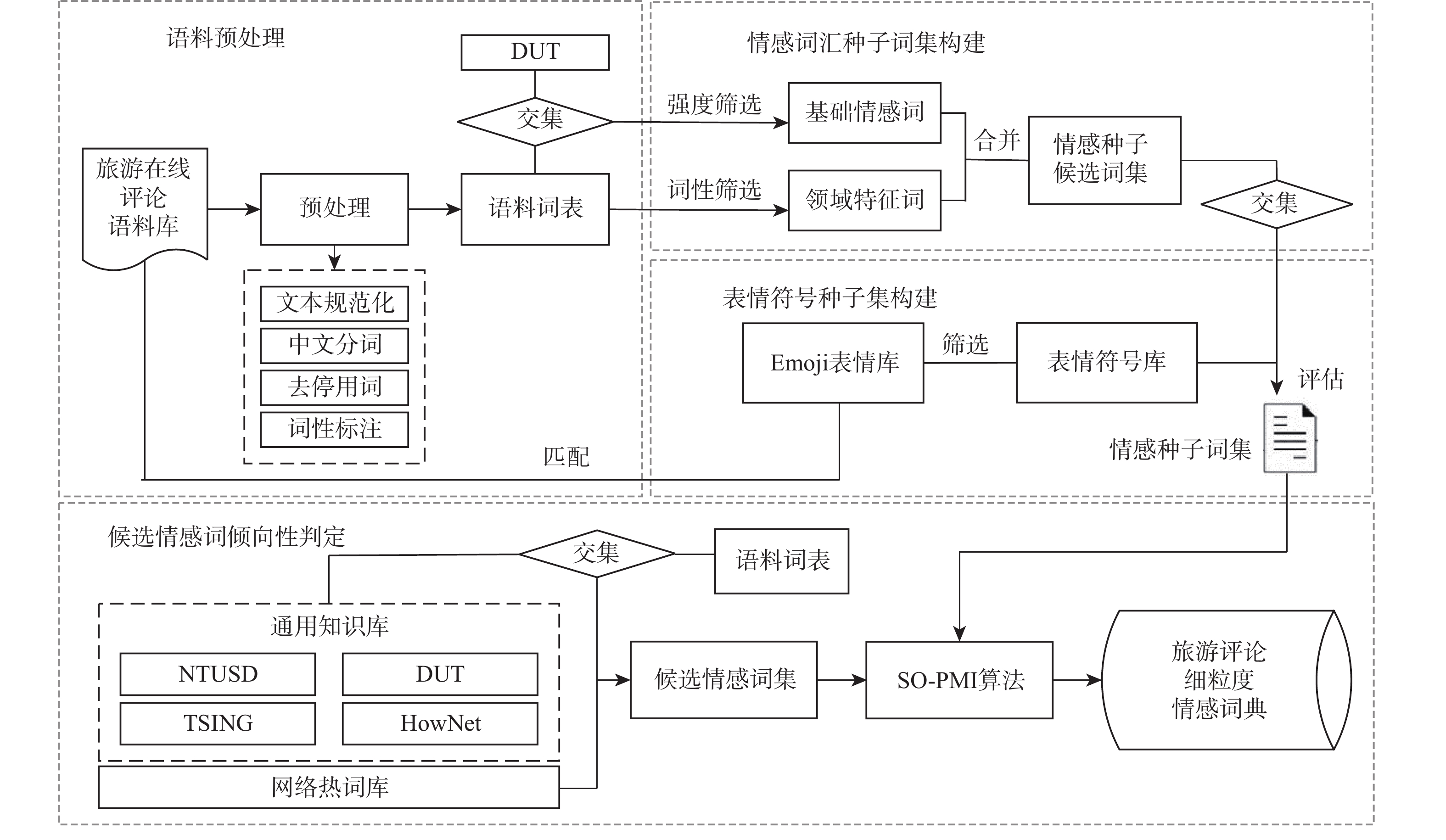
图 1 旅游领域细粒度情感词典构建框架
Figure 1. Framework for the construction of fine-grained sentiment dictionary in the tourism domain

图 4 不同情感词典综合性能对比
Figure 4. Comprehensive performance comparison among different sentiment lexicons
表 1 情感种子词集示例
Table 1. Examples of emotion seed set
情绪类别 情感词汇示例(部分) 表情符号 乐(30个) 意外之喜、畅通无阻、自由自在、欢声笑语、畅快、超爽、无拘无束、手舞足蹈、心旷神怡、满载而归、兴高采烈 
好(40个) 推荐、鬼斧神工、完美、超赞、气势磅礴、巧夺天工、无与伦比、顶级、回味无穷、哇塞、赞不绝口、历久弥坚 
哀(30个) 心心念念、孤零零、鬼哭狼嚎、大失所望、悲怆、惨不忍睹、空落落、凄凉、萧瑟、落寞、摧毁、痛苦、苍凉、衰败 
怒(35个) 投诉、爆发、瞪眼、恼羞成怒、催促、强词夺理、蛮横无理、过分、拥挤、忽悠、急眼、怒气冲冲、勃然大怒、强制 
惧(32个) 悬崖峭壁、震惊、毛骨悚然、震慑、胆战心惊、不堪设想、手忙脚乱、不知所措、阴森森、惊恐、惊慌、瞠目结舌 
恶(40个) 恶劣、一塌糊涂、凌乱不堪、脏乱差、毒辣、令人窒息、无赖、崩溃、烦躁、臭气熏天、践踏、肆无忌惮、暴殄天物 
惊(37个) 震撼人心、叹为观止、千奇百怪、不可思议、惊叹、惊喜惊讶、目瞪口呆、惊诧、动人心魄、不得了、惊愕 
 下载: 导出CSV
表 2 修饰词示例
Table 2. Examples of modifier word
类别 修饰词 情感强度 程度副词 最、极、无比 2 很、非常、太 1.7 颇、挺、蛮 1.2 稍、略、有点 0.8 否定词 不 −1 没有 −1 别 −1 勿 −1 语气词 哇、耶 2 啦、哩 1 呃、唉 −1 呜、呸 −2
下载: 导出CSV
表 3 扩充新词示例
Table 3. Examples of expanded new words
新词类别 词语 词性种类 情绪类别 情感强度 情感极性 领域新词 看头 noun. 好 3 1 审美疲劳 idiom. 哀 7 2 出片 verb. 好 3 1 深度游 noun. 好 5 1 网络新词 针不戳 nw. 好 5 1 避大坑 nw. 恶 7 2 鸡肋 nw. 哀 7 2 泰酷辣 nw. 乐 9 1 注:nw.表示网络新词。
下载: 导出CSV
表 4 实验数据
Table 4. Experimental data
评估方面 类别 数目 情感种子词集评估 乐 76 好 107 哀 69 怒 51 惧 57 恶 98 惊 42 情感词典评估 积极 1452 消极 1118
下载: 导出CSV
表 5 不同种子词集构建方法实验结果
Table 5. Experimental results of different seed word set construction methods
情绪 P R F1 TF-IDF Word2Vec Mul-feature TF-IDF Word2Vec Mul-feature TF-IDF Word2Vec Mul-feature 乐 0.6711 0.7763 0.8158 0.7647 0.7966 0.8226 0.7179 0.7865 0.8192 好 0.7196 0.7477 0.7757 0.7532 0.8500 0.8795 0.7364 0.7988 0.8276 哀 0.4058 0.5072 0.6087 0.5357 0.6857 0.7143 0.4708 0.5965 0.6615 怒 0.5686 0.6275 0.7059 0.6897 0.6563 0.6667 0.6291 0.6419 0.6863 惧 0.5439 0.6140 0.6667 0.6129 0.6000 0.6579 0.5784 0.6070 0.6623 恶 0.7245 0.7551 0.8061 0.7183 0.7432 0.7595 0.7214 0.7492 0.7828 惊 0.6905 0.7619 0.8333 0.4828 0.4688 0.5714 0.5866 0.6153 0.7024
下载: 导出CSV
表 6 领域情感词典与通用情感词典在正负评论上的实验结果
Table 6. Experimental results of domain-specific sentiment lexicon and general sentiment lexicons on positive and negative reviews
情感
词典P R F1 正面评论 负面评论 正面评论 负面评论 正面评论 负面评论 NTUSD 0.6472 0.6526 0.7197 0.7318 0.6835 0.6922 HowNet 0.6349 0.6548 0.7422 0.7526 0.6886 0.7037 DUT 0.7031 0.7105 0.7789 0.7847 0.7410 0.7476 TSING 0.6673 0.6891 0.7453 0.7525 0.7063 0.7208 ALL 0.6996 0.7182 0.7837 0.8043 0.7417 0.7613 Tourdict 0.7612 0.7840 0.8456 0.8527 0.8034 0.8184 注:加粗数值表示性能最优;ALL为NTUSD、HowNet、DUT、TSING这4种情感词典的并集。
下载: 导出CSV
表 7 旅游评论案例分析
Table 7. Case study of tourism reviews
例句 评论类型 人工标注 通用情感词典 领域情感词典 领域词典判定结果 “8号车师傅问我要小费$ \cdots $ 
歧义句 消极 中性 消极 (√) “导游的讲解虽然枯燥,但奈何他帅啊,耐了。 
网络热词 积极 消极 积极 (√) “卫生真的很**** 
无情感信息 消极 积极 消极 (√)
下载: 导出CSV
-
[1] Xiong G, Fang Y L, Liu Q. Automatic construction of domain-specific sentiment lexicon based on the semantics graph[C]//Proceedings of the 2017 IEEE International Conference on Signal Processing, Communications and Computing. Piscataway: IEEE Press, 2018: 1-6. [2] Barik K, Misra S. Analysis of customer reviews with an improved VADER lexicon classifier[J]. Journal of Big Data, 2024, 11(1): 10. [3] Wang Y B, Huang G M, Li M L, et al. Automatically constructing a fine-grained sentiment lexicon for sentiment analysis[J]. Cognitive Computation, 2023, 15(1): 254-271. [4] Myint P Y W, Lo S L, Zhang Y H. Unveiling the dynamics of crisis events: sentiment and emotion analysis via multi-task learning with attention mechanism and subject-based intent prediction[J]. Information Processing & Management, 2024, 61(4): 103695. [5] Sharma M, Kandasamy I, Vasantha W B. Emotion quantification and classification using the neutrosophic approach to deep learning[J]. Applied Soft Computing, 2023, 148: 110896. [6] Zeng X K, Yang C, Tu C C, et al. Chinese LIWC lexicon expansion via hierarchical classification of word embeddings with sememe attention[C]//Proceedings of the Thirty-Second AAAI Conference on Artificial Intelligence and Thirtieth Innovative Applications of Artificial Intelligence Conference and Eighth AAAI Symposium on Educational Advances in Artificial Intelligence. New York: ACM, 2018: 5650-5657. [7] 叶霞, 曹军博, 许飞翔, 等. 中文领域情感词典自适应学习方法[J]. 计算机工程与设计, 2020, 41(8): 2231-2237.Ye X, Cao J B, Xu F X, et al. Sentiment dictionary adaptive learning method in Chinese domain[J]. Computer Engineering and Design, 2020, 41(8): 2231-2237(in Chinese). [8] 汪韬, 张再跃. 面向电影评论的情感词典构建方法研究[J]. 计算机与数字工程, 2022, 50(4): 843-848.Wang T, Zhang Z Y. Research on the construction method of emotion lexicon for movie review[J]. Computer & Digital Engineering, 2022, 50(4): 843-848(in Chinese). [9] 左任衔, 唐振华, 黄晓, 等. 基于情感词典的引文文本情感识别研究[J]. 数字图书馆论坛, 2022, 18(2): 10-17.Zuo R X, Tang Z H, Huang X, et al. Research on emotion recognition of citation text based on sentiment dictionary[J]. Digital Library Forum, 2022, 18(2): 10-17(in Chinese). [10] 单睿康, 江涛, 张婷婷, 等. 基于改进SO-PMI的藏文情感词典自动构建方法[J]. 高原科学研究, 2022, 6(1): 104-112.Shan R K, Jiang T, Zhang T T, et al. Study on the method of automatic construction of Tibetan sentiment lexicon based on the improved SO-PMI[J]. Plateau Science Research, 2022, 6(1): 104-112(in Chinese). [11] 郭顺利, 张向先. 面向中文图书评论的情感词典构建方法研究[J]. 现代图书情报技术, 2016(2): 67-74.Guo S L, Zhang X X. Building sentiment analysis dictionary for Chinese book reviews[J]. New Technology of Library and Information Service, 2016(2): 67-74(in Chinese). [12] Li J, Li Y K. Constructing dictionary to analyze features sentiment of a movie based on danmakus[C]//Proceedings of the Advanced Data Mining and Applications. Berlin: Springer, 2019: 474-488. [13] 陈俊, 席宁丽, 李佳敏, 等. 融合Skip-gram与R-SOPMI的教育领域情感词典构建[J]. 应用科学学报, 2023, 41(5): 870-880.Chen J, Xi N L, Li J M, et al. Constructing sentiment lexicon in the education field by integrating Skip-gram and R-SOPMI[J]. Journal of Applied Sciences, 2023, 41(5): 870-880(in Chinese). [14] 严仲培, 陆文星, 束柬, 等. 面向旅游在线评论情感词典构建方法[J]. 计算机应用研究, 2019, 36(6): 1660-1664.Yan Z P, Lu W X, Shu J, et al. Construction method of sentiment lexicon for online travel reviews[J]. Application Research of Computers, 2019, 36(6): 1660-1664(in Chinese). [15] Yuan Z W, Duan L. Construction method of sentiment lexicon based on Word2Vec[C]//Proceedings of the 2019 IEEE 8th Joint International Information Technology and Artificial Intelligence Conference. Piscataway: IEEE Press, 2019: 848-851. [16] 赵妍妍, 秦兵, 刘挺. 文本情感分析[J]. 软件学报, 2010, 21(8): 1834-1848.Zhao Y Y, Qin B, Liu T. Sentiment analysis[J]. Journal of Software, 2010, 21(8): 1834-1848(in Chinese). [17] Baccianella S, Esuli A, Sebastiani F. SentiWordNet 3.0: an enhanced lexical resource for sentiment analysis and opinion mining[C]//Proceedings of the Seventh International Conference on Language Resources and Evaluation. Kerrville: Association for Computational Linguistics, 2010: 2200-2204. [18] Ku L W, Liang Y T, Chen H H. Opinion extraction, summarization and tracking in news and blog Corpora[C]//Proceedings of the AAAI Spring Symposium on Computational Approaches to Analyzing Weblogs. Menlo Park: AAAI Press, 2006: 100-107. [19] Fu X H, Liu G, Guo Y Y, et al. Multi-aspect sentiment analysis for Chinese online social reviews based on topic modeling and HowNet lexicon[J]. Knowledge-Based Systems, 2013, 37: 186-195. [20] 徐琳宏, 林鸿飞, 潘宇, 等. 情感词汇本体的构造[J]. 情报学报, 2008, 27(2): 180-185.Xu L H, Lin H F, Pan Y, et al. Constructing the affective lexicon ontology[J]. Journal of the China Society for Scientific and Technical Information, 2008, 27(2): 180-185(in Chinese). [21] Hatzivassiloglou V, Mckeown K R. Predicting the semantic orientation of adjectives[C]//Proceedings of the 35th Annual Meeting of the Association for Computational Linguistics and Eighth Conference of the European Chapter of the Association for Computational Linguistics. New York: ACM, 1997: 174-181. [22] Wiebe J. Learning subjective adjectives from Corpora[C]//Proceedings of the Seventeenth National Conference on Artificial Intelligence and Twelfth Conference on Innovative Applications of Artificial Intelligence. New York: ACM, 2000: 735-740. [23] Turney P D. Thumbs up or thumbs down: semantic orientation applied to unsupervised classification of reviews[C]//Proceedings of the 40th Annual Meeting on Association for Computational Linguistics. Morristown: Association for Computational Linguistics, 2001: 417. [24] 钟敏娟, 万常选, 刘德喜. 基于关联规则挖掘和极性分析的商品评论情感词典构建[J]. 情报学报, 2016, 35(5): 501-509.Zhong M J, Wan C X, Liu D X. Opinion lexicon construction based on association rule and orientation analysis for production review[J]. Journal of the China Society for Scientific and Technical Information, 2016, 35(5): 501-509(in Chinese). [25] 周知, 王春迎, 朱佳丽. 基于超短评论的图书领域情感词典构建研究[J]. 情报理论与实践, 2021, 44(9): 183-189.Zhou Z, Wang C Y, Zhu J L. Research on the construction of sentiment lexicon in book field based on extreme short reviews[J]. Information Studies (Theory & Application), 2021, 44(9): 183-189(in Chinese). [26] Kamps J, Marx M, Mokken R J, et al. Using WordNet to measure semantic orientations of adjectives[C]//Proceedings of the 4th International Conference on Language Resources and Evaluation. Paris: ELRA, 2004: 1115-1118. [27] Hu M Q, Liu B. Mining and summarizing customer reviews[C]//Proceedings of the Tenth ACM SIGKDD International Conference on Knowledge Discovery and Data Mining. New York: ACM, 2004: 168-177. [28] 朱嫣岚, 闵锦, 周雅倩, 等. 基于HowNet的词汇语义倾向计算[J]. 中文信息学报, 2006, 20(1): 14-20.Zhu Y L, Min J, Zhou Y Q, et al. Semantic orientation computing based on HowNet[J]. Journal of Chinese Information Processing, 2006, 20(1): 14-20(in Chinese). [29] 路斌, 万小军, 杨建武, 等. 基于同义词词林的词汇褒贬计算[C]//第七届中文信息处理国际会议. 北京: 中国中文信息学会, 2007: 17-23.Lu B, Wan X J, Yang J W, et al. Using tongyici cilin to compute word semantic polarity[C]//Proceedings of the 7th International Conference on Chinese Computing. Beijing: The Chinese Information Processing Society of China, 2007: 17-23(in Chinese). [30] 周咏梅, 阳爱民, 林江豪. 中文微博情感词典构建方法[J]. 山东大学学报(工学版), 2014, 44(3): 36-40.Zhou Y M, Yang A M, Lin J H. A method of building Chinese microblog sentiment lexicon[J]. Journal of Shandong University (Engineering Science), 2014, 44(3): 36-40(in Chinese). [31] Li W, Zhu L Y, Guo K, et al. Build a tourism-specific sentiment lexicon via Word2Vec[J]. Annals of Data Science, 2018, 5(1): 1-7. [32] 卫青蓝, 何雨, 宋金宝. 基于语义规则的自适应情感词典自动构建算法[J]. 北京航空航天大学学报, 2025, 51(7): 2450-2459.Wei Q L, He Y, Song J B. An adaptive automatic construction algorithm for sentiment dictionaries based on semantic rules[J]. Journal of Beijing University of Aeronautics and Astronautics, 2025, 51(7): 2450-2459(in Chinese). [33] 姜杰, 夏睿. 机器学习与语义规则融合的微博情感分类方法[J]. 北京大学学报(自然科学版), 2017, 53(2): 247-254.Jiang J, Xia R. Microblog sentiment classification via combining rule-based and machine learning methods[J]. Acta Scientiarum Naturalium Universitatis Pekinensis, 2017, 53(2): 247-254(in Chinese). -

 下载:
下载:


 点击查看大图
计量
- 文章访问数: 462
- HTML全文浏览量: 194
- PDF下载量: 37
- 被引次数: 0
