





-
摘要:
光学太阳反射镜(OSR)也称二次表面镜,具有很低的吸收发射比,空间应用稳定高,粘贴于辐射散热板外表面时,能够起到良好的散热或制冷效果。OSR空间环境的影响及热控性能退化机理是热控长寿命设计的重要课题。通过对地球静止轨道工作的4颗卫星载荷相机在轨7年、4年、3年及2.5年温度数据分析,结合热仿真分析模型,得到OSR的太阳吸收比退化模型。结果显示,发射第1年OSR的太阳吸收比为0.125,在轨2年后OSR的太阳吸收比退化为0.134,7年后变化为0.175,退化曲线呈线性特征,每年退化率约为0.74%。同时,根据该退化模型预测10年后的太阳吸收比为0.195, OSR空间适应性及稳定性较高,计算结果为后续在轨温控及新热控系统设计提供指导。
Abstract:Objective Optical solar reflector (OSR) exhibit a very low absorptance-emittance ratio, ensuring stability and high performance in space applications. They efficiently aid in cooling or heat dissipation when attached to the exterior of radiative cooling panels. Understanding the impact of space environment on the OSR and the degradation mechanisms of their thermal control properties is crucial for designing long-lasting thermal control systems. Through analysis of temperature data from cameras onboard four satellites operating in geostationary orbit for 7 years, 4 years, 3 years, and 2.5 years, coupled with thermal simulation analysis models, the degradation model of the OSR solar absorptance solar absorptance is obtained. The deterioration model of the OSR solar absorptance solar absorptance is derived by analyzing temperature data from cameras on four satellites that have been in geostationary orbit for seven, four, three, and two and a half years. This data is combined with thermal simulation analysis models. The results reveal that the solar absorptance of the OSR were 0.125 in the first year of operation, degraded to 0.134 after 2 years in orbit, and changed to 0.175 after 7 years, with the degradation curve exhibiting linear characteristics and an annual degradation rate of approximately 0.74%. Additionally, based on this degradation model, the solar absorptance is predicted to be 0.195 after 10 years. OSR has strong spatial adaptability and stability and the results of this article offering guidance for subsequent in-orbit temperature control and new thermal control system designs. -

图 2 不同节气下OSR吸收的外热流
Figure 2. External heat flux absorbed by OSR under different solar terms

图 3 OSR的太阳吸收比随在轨时间的变化
Figure 3. OSR solar absorption ratio as a function of time in orbit

图 4 Sensor01~Sensor04相机上散热面在冬至最高温度随在轨时间的变化及预测
Figure 4. Maximum temperature and future prediction of heat sink temperature with on-orbit time
表 1 内部热源功耗
Table 1. Internal heat sources power consumption meter
部件 发热量/W 部件数量 电路箱1 9.3 1 电路箱2 60.0 1 制冷机 160.0 2  下载: 导出CSV
表 2 Sensor01相机冬至散热板温度变化
Table 2. Temperature change of Sensor01 radiant heat sink during Winter Solstice
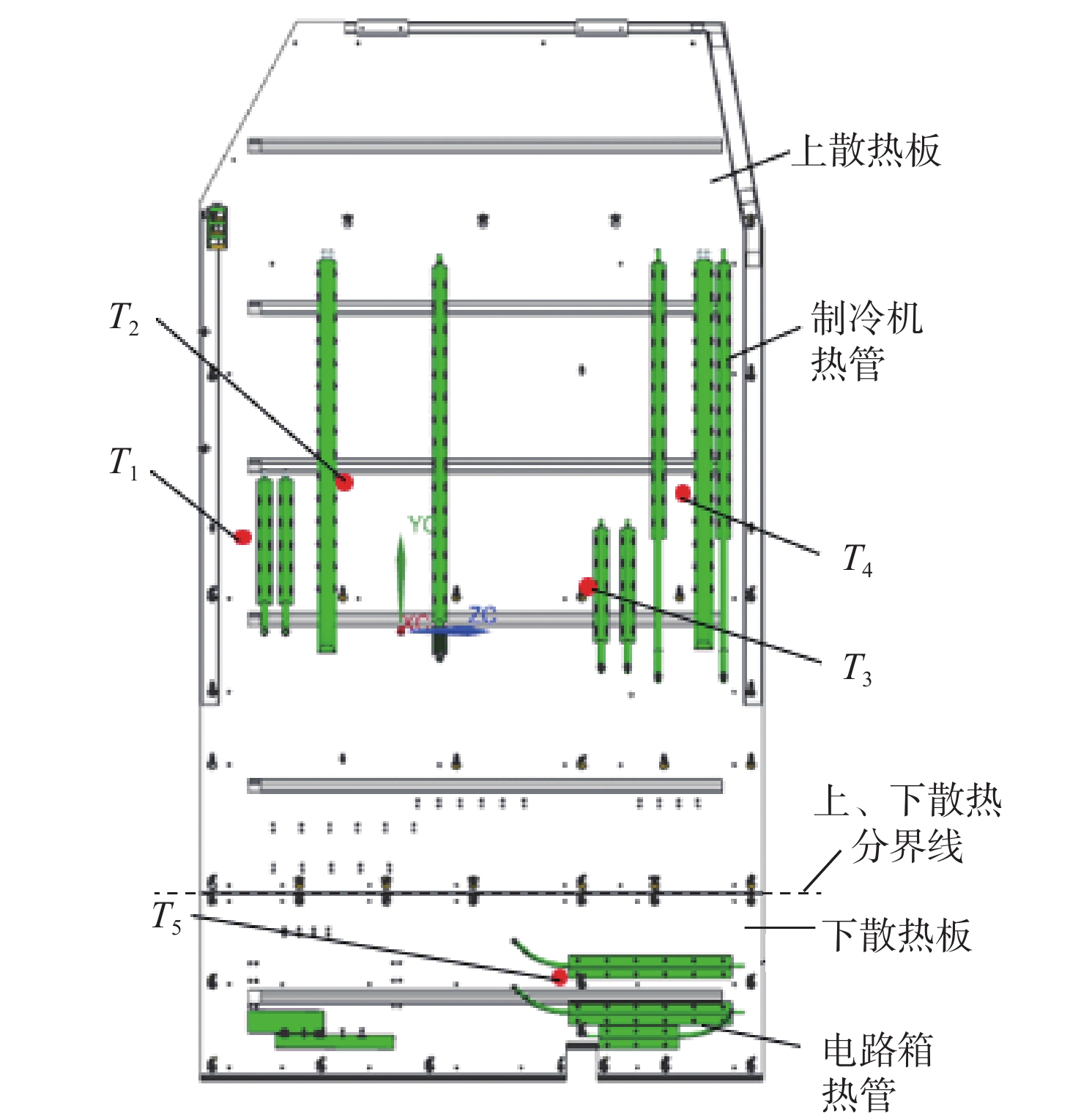
日期 T1/℃ T2/℃ T3/℃ T4/℃ T5/℃ 2017-12-22 −46.6~−38.5 −45.6~−37.5 −45.8~−36.7 −45.4~−37.6 −25.9~0.4 2018-12-22 −46.1~−36.1 −45.1~−35.5 −44.8~−35.2 −44.5~−35.6 −25.3~2.7 2019-12-22 −44.6~34.1 −44.1~33.5 −43.7~−33.2 −43.5~−34.1 −24.8~5.2 2020-12-22 −45.1~−32.9 −44.1~−31.4 −42.7~−31.7 −43~−32.5 −24.7~6.9 2021-12-22 −45.5~−30.9 −45~−29.1 −42.2~−31.1 −41.5~−31.5 −24.2~8.6 2022-12-22 −46.1~−27.9 −45~−27.3 −42.7~−27.6 −43.5~−28.4 −24.2~12.3
下载: 导出CSV
表 3 Sensor02相机冬至散热板温度变化
Table 3. Temperature change of Sensor02 radiant heat sink during Winter Solstice
日期 T1/℃ T2/℃ T3/℃ T4/℃ T5/℃ 2020-12-22 −46.88~−37.3 −46.82~−38.1 −46.26~−34.5 −46.9~−38.6 −24.3~0.1 2021-12-22 −45.0~−35.35 −45.4~−35.65 −45.3~−35.5 −45.9~−36.7 −22.7~2.43 2022-12-22 −42.6~−33.4 −43.4~−33.7 −43.8~−33.5 −44.6~−34.7 −22.3~4.9
下载: 导出CSV
表 4 Sensor03相机冬至散热板温度变化
Table 4. Temperature change of Sensor03 radiant heat sink during Winter Solstice
日期 T1/℃ T2/℃ T3/℃ T4/℃ T5/℃ 2021-12-22 −43.9~−37.0 −44.3~−37.1 −47.4~−38.0 −46.8~−38.0 −28.7~−0.4 2022-12-22 −43.8~−34.9 −44.1~−35.0 −47.3~−37.0 −46.5~−36.2 −28.5~1.3
下载: 导出CSV
表 5 Sensor04相机冬至散热板温度变化
Table 5. Temperature change of Sensor04 radiant heat sink during Winter Solstice
日期 T1/℃ T2/℃ T3/℃ T4/℃ T5/℃ 2022-12-22 −42.6~−34.4 −43.9~−35.1 −43.9~−36.2 −44.1~−35.9 −20.9~−3.5 2023-12-22 −42.5~−32.4 −43.7~−33.2 −43.7~−35.1 −44.0~−34.6 −20.7~−2.8
下载: 导出CSV
表 6 材料物理属性
Table 6. Physical properties of material
材料 部件 热导率/
(W·(m·K)−1)比热容/
(J·(kg·K)−1)密度/
(kg·m−3)铝合金 散热板蒙皮 167.0 960 2700 铝蜂窝 散热板芯 5.0 900 100 玻璃钢G10 隔热垫 0.2 700 2500
下载: 导出CSV
表 7 涂层表面辐射特性
Table 7. Surface radiation characteristics of coating surface
材料 部件 αS(地面测试) εh 聚酰亚胺二次表面镜 多层外部 0.35 0.67 OSR 散热板外立面 0.10 0.79 白漆 遮光罩外表面 0.27 0.92
下载: 导出CSV
表 8 仿真结果与热平衡试验及入轨一年飞行温度数据对比
Table 8. Simulation results of components compared with thermal equilibrium experiment and one-year flight temperature data in orbit
部件名称 仿真温度/℃ 热平衡实验温度/℃ 在轨一年温度/℃ 温度判定是否正常 转移轨道 地球静止轨道 电路箱1 −10.4~−0.6 −16.1 −16.1~0.1 −12.3~−1 正常 电路箱2 −0.2~11.7 −2.3 10.3~10.3 3.8~11 正常 制冷机压缩机 −34.4~−29.8 −34.6 −30.5~−30.7 −34.9~−28.2 正常 制冷机脉管 −35.5~−18.4 −28.9 −43~−19.7 −43.2~−19.9 正常
下载: 导出CSV
-
[1] 沈自才, 赵春晴, 冯伟泉, 等. 近紫外辐照对OSR二次表面镜导电性能影响研究[J]. 航天器环境工程, 2008, 25(5): 438-440.Shen Z C, Zhao C Q, Feng W Q, et al. Influence of near ultraviolet irradiation on the electrical property of OSR second surface mirror[J]. Spacecraft Environment Engineering, 2008, 25(5): 438-440(in Chinese). [2] 许阳晨, 张群. 射频磁控溅射工艺参数对掺钨氧化铟锡透明导电薄膜性能的影响[J]. 复旦学报(自然科学版), 2024, 63(2): 169-177.Xu Y C, Zhang Q. Effects of process parameters on the properties of W-doped ITO transparent conductive thin films prepared by RF magnetron sputtering[J]. Journal of Fudan University (Natural Science), 2024, 63(2): 169-177(in Chinese). [3] 常天海. 掺铈玻璃型二次表面镜热控性能稳定性研究[J]. 上海航天, 2003, 20(2): 48-51.Chang T H. Study on the space stability of thermal-control performances of glass adulterated with cerium type of second surface mirror[J]. Aerospace Shanghai, 2003, 20(2): 48-51(in Chinese). [4] 章俞之, 吴岭南, 曹韫真, 等. 铈玻璃镀银二次表面镜不同入射角的太阳反射率初步研究[C]//中国空间科学学会空间材料专业委员会学术交流会论文集. 长沙: 中国空间科学学会, 2009: 20-24.Zhang Y Z, Wu L N, Cao Y Z, et al. Preliminary study on solar reflectance of silver-coated cerium glass second surface mirrors at different incident angles[C]//Proceedings of the Academic Exchange Conference of the Space Materials Professional Committee, Chinese Society of Space Science. Changsha: Chinese Society of Space Science, 2009: 20-24(in Chinese). [5] 赵振明, 王兵, 高娟. 地球静止轨道凝视型相机热分析与热设计[J]. 航天返回与遥感, 2010, 31(3): 34-40.Zhao Z M, Wang B, Gao J. Preliminary research on the thermal design methods of the geosynchronous orbit staring camera[J]. Spacecraft Recovery & Remote Sensing, 2010, 31(3): 34-40(in Chinese). [6] 丁义刚. 空间综合环境对航天器热控涂层性能退化效应研究[D]. 长沙: 国防科学技术大学, 2005.Ding Y G. Investigation of space combined environment degradation effect on spacecraft thermal control coatings[D]. Changsha: National University of Defense Technology, 2005(in Chinese). [7] 黄本诚, 童靖宇. 空间环境工程学[M]. 北京: 中国科学技术出版社, 2010.Huang B C, Tong J Y. Space environmental engineering[M]. Beijing: China Science and Technology Press, 2010(in Chinese). [8] 赵印中, 李林, 许旻, 等. 玻璃型镀铝二次表面镜的模拟空间环境辐照试验研究[J]. 真空与低温, 2011, 17(4): 213-217.Zhao Y Z, Li L, Xu M, et al. Space environmental simulation irradiation tests of aluminized glass second surface mirrors[J]. Vacuum and Cryogenics, 2011, 17(4): 213-217(in Chinese). [9] 冯伟泉, 丁义刚, 闫德葵, 等. 地球同步轨道长寿命卫星热控涂层太阳吸收率性能退化研究[J]. 中国空间科学技术, 2005, 25(2): 34-40.Feng W Q, Ding Y G, Yan D K, et al. Study on long-term degradation of solar absorptance properties of geostationary satellite thermal control coatings[J]. Chinese Space Science and Technology, 2005, 25(2): 34-40(in Chinese). [10] 章俞之, 曹韫真, 吴岭南, 等. 几种热控涂层的真空-紫外辐照试验[J]. 航天器环境工程, 2011, 28(2): 126-131.Zhang Y Z, Cao Y Z, Wu L N, et al. Ultraviolet irradiation tests of some thermal control coatings in vacuum[J]. Spacecraft Environment Engineering, 2011, 28(2): 126-131(in Chinese). [11] Pippin H G. Materials on the international space station-6 (MISSE-6): FA9550-05-2-0001[R]. Amsterdam: Elsevier Inc., 2006. [12] Finckenor M M , Zwiener J M , Alvis A , et al. Thermal control materials on MISSE-6 with comparison to earlier flight data[C]//Proceedings of the National Space and Missile Materials Symposium. Scottsdale: NSMMS, 2010. [13] Pippin G. Space environments and induced damage mechanisms in materials[J]. Progress in Organic Coatings, 2003, 47(3-4): 424-431. [14] Stein B A. LDEF materials overview[C]//Proceedings of the Second LDEF Post-Retrieval Symposium Abstracts. Washington, D. C. : NASA, 1992. [15] 王磊, 满广龙. 热控涂层搭载飞行试验进展综述[J]. 航天器工程, 2012, 21(2): 108-113.Wang L, Man G L. Review of thermal control coatings flight test[J]. Spacecraft Engineering, 2012, 21(2): 108-113(in Chinese). -

 下载:
下载:


 点击查看大图
计量
- 文章访问数: 311
- HTML全文浏览量: 130
- PDF下载量: 19
- 被引次数: 0
