





-
摘要:
飞行器结构安全系数是设计载荷与使用载荷之比,传统的统一安全系数设计方法取值主观、难以量化不确定性,易导致设计保守,制约先进飞行器性能。为解决这一限制,在保证可靠性设计要求的前提下,更好地挖掘材料性能与设计空间,有必要发展一种分区差异化安全系数设计方法。运用概率可靠性设计优化理论来研究结构系统的不确定性,建立结构可靠度与分区差异化安全系数之间的映射关系,提出平衡安全性与经济性的分区差异化安全系数设计方法。以工程型号简化的翼尖结构等为验证算例,显示在满足结构强度可靠度99%设计要求前提下,实现了结构绝大部分子区域的分区差异化安全系数均小于统一安全系数1.45,从而使得结构设计质量相对更轻达3.926 kg。
Abstract:The structural safety factor of an aircraft, defined as the ratio of design load to service load, is a key parameter in aircraft design. Traditional design methods rely heavily on engineering experience, leading to subjective safety factor values and insufficient objectivity in quantifying uncertainties. For advanced aircraft requiring refined design, the uniform safety factor applied across all components results in overly conservative designs that limit ultimate flight performance. In order to solve this limitation, it is necessary to develop a sub-regional differentiated safety factor design method to better explore the material properties and design space on the premise of ensuring the reliability design requirements. In this paper, probabilistic reliability design optimization theory is used to study the uncertainty of the structural system, and the mapping relationship between structural reliability and sub-regional differentiated safety factors is established, and the design method of sub-regional differentiated safety factors is developed. Using the simplified engineering model of the wing-tip structure as an example, it is demonstrated that, assuming the design requirement of 99% structural strength reliability is met, the sub-regional differentiated safety factors in the majority of the structure's subregions are less than the unified safety factor of 1.45, resulting in a relatively lighter design weight of up to 3.926 kg.
-

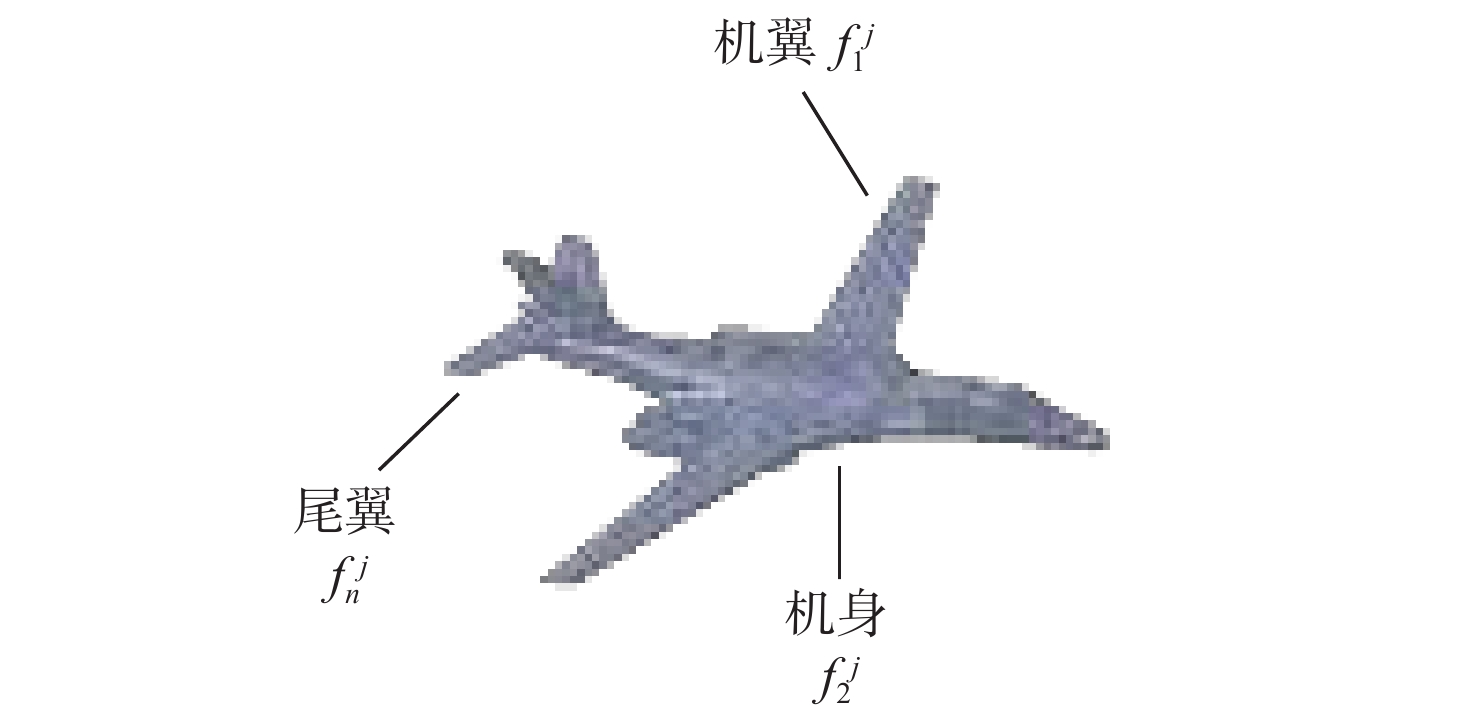
图 1 典型飞机结构不同子区域组件的安全系数
Figure 1. Safety factors for components in different sub-regions of aircraft

图 2 基于结构可靠性的分区差异化安全系数设计过程
Figure 2. Process of sub-regional differentiated safety factors design based on structural reliability

图 4 统一安全系数方法与分区差异化安全系数方法的可行设计域
Figure 4. Feasible region of unified safety factor and sub-regional differentiated safety factor scheme

图 5 分区差异化安全系数对子区域1结构可靠度的影响
Figure 5. Feasible region of unified safety factor and sub-regional differentiated safety factor scheme

图 6 分区差异化安全系数对两子区域结构可靠度的影响
Figure 6. Influence of sub-regional differentiated safety factors of two sub-regions on reliability index

图 7 双层嵌套优化设计问题的参数映射关系
Figure 7. Parameter relationships of two-layer nested optimization

图 8 非正态分布的等价正态变换
Figure 8. Equivalent normal transformations of non-normal distributions

图 9 分区差异化安全系数与可靠性之间的映射关系
Figure 9. Relationship about reliability and sub-regional differentiated safety factors

图 10 分区差异化安全系数设计的主要流程
Figure 10. Main procedure of sub-regional differentiated safety factors design

图 12 结构强度安全系数迭代曲线
Figure 12. Structural strength safety factor iteration solution curves of wing

图 13 结构刚度安全系数迭代曲线
Figure 13. Structural stiffness safety factor iteration solution curves of wing

图 16 翼尖结构最大位移的概率密度分布
Figure 16. Probability density distribution of maximum displacement of wing tip structure
表 1 飞行器翼面结构的细节参数
Table 1. Detailed information of wing
弹性模量
$ E $/GPa泊松比 密度/
(kg·m−3)边界条件 后掠角/(°) 强度极限
$ {\sigma }_{\max } $/MPa110 0.33 4510 根部固支 40 ≤465  下载: 导出CSV
表 2 翼面结构分区差异化安全系数设计结果
Table 2. Results of sub-regional differentiated safety factors design
子区域 $ i $ 结构可靠度$ \eta _{i}^{j} $ 安全系数 $ f_{i}^{j} $ 强度$ \eta _{i}^{1} $ 刚度$ \eta _{i}^{2} $ 强度$ f_{i}^{1} $ 刚度$ f_{i}^{2} $ $ i=1 $ 1 0.9529 1.3027 1.2890 $ i=2 $ 0.9684 1 1.3434 1.3124 $ i=3 $ 1 1 1.3577 1.3561 $ i=4 $ 0.9508 0.9536 1.1701 1.2248
下载: 导出CSV
表 3 统一安全系数设计与分区差异化安全系数设计结果对比
Table 3. Results comparison of traditional safety factor design and sub-regional differentiated safety factors design
子区域 $ i $ 安全系数$ f_{i}^{1} $ 结构可靠度$ R_{i}^{1} $ 传统安全
系数设计分区差异化
安全系数设计传统安全
系数设计分区差异化
安全系数设计1 1.45 1.249 1 0.999100 2 1.45 1.152 1 0.999720 3 1.45 1.305 1 0.995530 4 1.45 1.096 1 0.994800 5 1.45 1.311 1 0.996470 6 1.45 1.152 1 0.997200 7 1.45 1.297 0.99534 0.990740 8 1.45 1.413 1 0.999400 9 1.45 1.299 1 0.999940 10 1.45 1.210 1 0.994090 11 1.45 1.404 1 0.994930 12 1.45 1.261 1 0.993180 13 1.45 1.347 1 0.994490 14 1.45 1.449 1 0.996570 15 1.45 1.500 1 0.996160 16 1.45 1.500 1 0.994830 17 1.45 1.302 1 0.996290 18 1.45 1.402 1 0.997290 19 1.45 1.454 0.99697 0.990880 20 1.45 1.189 1 0.991960 21 1.45 1.246 1 0.992610 22 1.45 1.307 0.99410 0.990072 23 1.45 1.253 1 0.999970 24 1.45 1.352 1 0.991330 25 1.45 1.208 1 0.991290 26 1.45 1.247 1 0.999390 27 1.45 1.500 1 0.999110 28 1.45 1.451 1 0.999350 29 1.45 1.246 1 0.999190 30 1.45 1.303 1 0.998580 31 1.45 1.450 1 0.998380 32 1.45 1.401 1 0.999320
下载: 导出CSV
表 4 统一安全系数设计与分区差异化安全系数设计结果质量对比
Table 4. Structural mass comparison of traditional safety factor design and sub-regional differentiated safety factors design
方法 结构质量/kg 统一安全系数设计 101.370 分区差异化安全系数设计 97.444
下载: 导出CSV
-
[1] Wang G Y. On the development of uncertain structural mechanics[J]. Advances in Mechanics, 2002, 32(2): 205-211. [2] 王宇, 黄东东, 郭士钧, 等. 变体机翼后缘多学科设计与优化[J]. 南京航空航天大学学报, 2021, 53(3): 415-424.Wang Y, Huang D D, Guo S J, et al. Multidisciplinary design and optimization of trailing edge of morphing wing[J]. Journal of Nanjing University of Aeronautics & Astronautics, 2021, 53(3): 415-424(in Chinese). [3] Verderaime V. Aerostructural safety factor criteria using deterministic reliability[J]. Journal of Spacecraft and Rockets, 1993, 30(2): 244-247. [4] Elishakoff I. Safety factors and reliability: friends or foes? [M]. Berlin: Springer, 2004. [5] Ellingwood B, Galambos T V. Probability-based criteria for structural design[J]. Structural Safety, 1983, 1(1): 15-26. [6] Elishakoff I, Ferracuti B. Fuzzy sets based interpretation of the safety factor[J]. Fuzzy Sets and Systems, 2006, 157(18): 2495-2512. [7] Ben-haim Y. A non-probabilistic concept of reliability[J]. Structural Safety, 1994, 14(4): 227-245. [8] Lincoln J W. Risk assessment of an aging military aircraft[J]. Journal of Aircraft, 1985, 22(8): 687-691. [9] Frangopol D M, 刘东. 基于可靠性的结构优化概念和方法[J]. 力学进展, 1988, 18(4): 541-549.Frangopol D M, Liu D. Concept and method of structural optimization based on reliability[J]. Advances in Mechanics, 1988, 18(4): 541-549(in Chinese). [10] Lee B W, Lim O K. Application of stochastic finite element method to optimal design of structures[J]. Computers & Structures, 1998, 68(5): 491-497. [11] Papadrakakis M, Lagaros N D. Reliability-based structural optimization using neural networks and Monte Carlo simulation[J]. Computer Methods in Applied Mechanics and Engineering, 2002, 191(32): 3491-3507. [12] Youn B D, Choi K K. A new response surface methodology for reliability-based design optimization[J]. Computers & Structures, 2004, 82(2-3): 241-256. [13] Youn B D, Choi K K, Park Y H. Hybrid analysis method for reliability-based design optimization[J]. Journal of Mechanical Design, 2003, 125(2): 221-232. [14] Evgrafov A, Patriksson M. Stochastic structural topology optimization: discretization and penalty function approach[J]. Structural and Multidisciplinary Optimization, 2003, 25(3): 174-188. [15] Agarwal H. Reliability based design optimization: formulations and methodologies[M]. South Bend: University of Notre Dame, 2004. [16] Bae H R, Grandhi R, Canfield R. Reliability-based design optimization under imprecise uncertainty[C]//Proceedings of the 46th AIAA/ASME/ASCE/AHS/ASC Structures, Structural Dynamics and Materials Conference. Reston: AIAA, 2005. [17] Deb K, Gupta S, Daum D, et al. Reliability-based optimization using evolutionary algorithms[J]. IEEE Transactions on Evolutionary Computation, 2009, 13(5): 1054-1074. [18] Kharmanda G, Lambert S, Kourdi N, et al. Reliability-based topology optimization for different engineering applications[J]. International Journal of CAD/CAM, 2007, 7(1): 61-69. [19] Chen X, Wang X J, Wang L, et al. Uncertainty quantification of multi-dimensional parameters for composite laminates based on grey mathematical theory[J]. Applied Mathematical Modelling, 2018, 55: 299-313. [20] Elishakoff I, Elettro F. Interval, ellipsoidal, and super-ellipsoidal calculi for experimental and theoretical treatment of uncertainty: which one ought to be preferred?[J]. International Journal of Solids and Structures, 2014, 51(7-8): 1576-1586. [21] Wang L, Wang X J, Wang R X, et al. Time-dependent reliability modeling and analysis method for mechanics based on convex process[J]. Mathematical Problems in Engineering, 2015, 2015(1): 914893. [22] Jiang C, Bi R G, Lu G Y, et al. Structural reliability analysis using non-probabilistic convex model[J]. Computer Methods in Applied Mechanics and Engineering, 2013, 254: 83-98. [23] Meng Z, Zhou H L, Li G, et al. A decoupled approach for non-probabilistic reliability-based design optimization[J]. Computers & Structures, 2016, 175: 65-73. [24] Qiu Z P, Elishakoff I. Antioptimization of structures with large uncertain-but-non-random parameters via interval analysis[J]. Computer Methods in Applied Mechanics and Engineering, 1998, 152(3-4): 361-372. [25] Wang L, Cai Y R, Liu D L. Multiscale reliability-based topology optimization methodology for truss-like microstructures with unknown-but-bounded uncertainties[J]. Computer Methods in Applied Mechanics and Engineering, 2018, 339: 358-388. [26] Ching J. Equivalence between reliability and factor of safety[J]. Probabilistic Engineering Mechanics, 2009, 24(2): 159-171. [27] Zhang H W, Dong S H, Ling J T, et al. A modified method for the safety factor parameter: the use of big data to improve petroleum pipeline reliability assessment[J]. Reliability Engineering and System Safety, 2020, 198(C): 106892. [28] Yin J H, Du X P. A safety factor method for reliability-based component design[J]. Journal of Mechanical Design, 2021, 143(9): 091705. [29] Moghaddam P T, Dehkordi P F, Ghazavi M. Reliability analysis-based safety factor for stability of footings on frictional soils[J]. Geomechanics and Engineering, 2023, 33(6): 543-552. [30] Hao N, Li X, Li Y L, et al. A novel reliability-based method of calibrating safety factor: application to the cemented sand and gravel dams[J]. Engineering Geology, 2022, 306: 106719. [31] Wang X J, Wang L, Qiu Z P. Safety estimation of structural systems via interval analysis[J]. Chinese Journal of Aeronautics, 2013, 26(3): 614-623. [32] Wang X J, Shi Q H, Fan W C, et al. Comparison of the reliability-based and safety factor methods for structural design[J]. Applied Mathematical Modelling, 2019, 72: 68-84. [33] Bristow J W, Irving P E. Safety factors in civil aircraft design requirements[J]. Engineering Failure Analysis, 2007, 14(3): 459-470. [34] Sarja A, Vesikari E. Durability design of concrete structures[M]. Boca Raton: CRC Press, 2004. [35] Wang L, Xiong C, Yang Y W. A novel methodology of reliability-based multidisciplinary design optimization under hybrid interval and fuzzy uncertainties[J]. Computer Methods in Applied Mechanics and Engineering, 2018, 337: 439-457. [36] Heath W G. The changing scene of structural airworthiness[J]. The Aeronautical Journal, 1980, 84(831): 81-92. [37] Muller G E, Schmid C J. Factor of safety-USAF design practice: AFFDL-TR-78-8[R]. Dayton: Air Force Flight Dynamics Laboratory, Wright-Patterson Air Force Base, 1978. [38] Freudenthal A M. The safety of structures[J]. Transactions of the American Society of Civil Engineers, 1947, 112(1): 125-159. [39] Ang A H, Amin M. Reliability of structures and structural systems[J]. Journal of the Engineering Mechanics Division, 1968, 94(2): 671-694. [40] Cornell C A. Structural safety specification based on second-moment reliability analysis[C]//Proceedings of the Symposium on Concepts of Safety of Structures and Methods of Design. Zurich : International Association for Bridge and Structural Engineering , 1969. -

 下载:
下载:


 点击查看大图
计量
- 文章访问数: 444
- HTML全文浏览量: 187
- PDF下载量: 13
- 被引次数: 0
