





Nonfragile asynchronous control of fuzzy Markov jump systems under hybrid cyber-attacks
-
摘要:
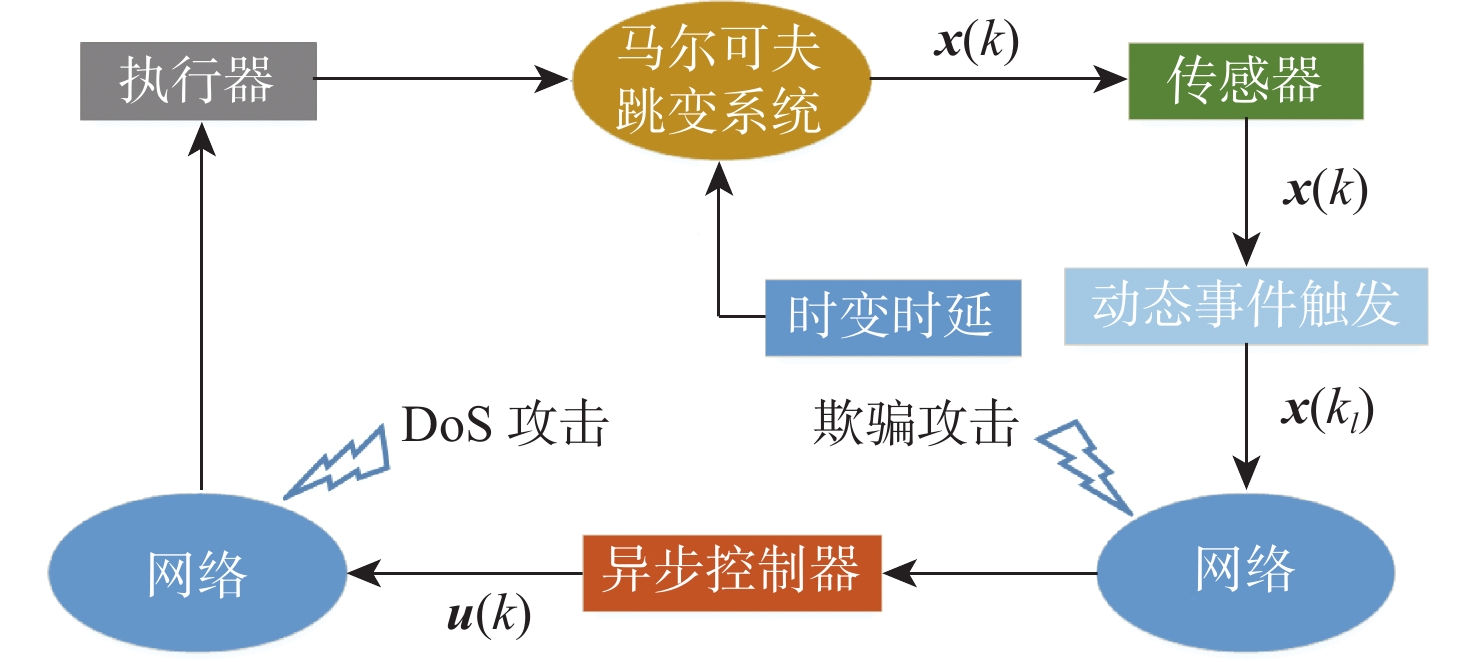
针对具有混合网络攻击和时变时延的Takagi-Sugeno (T-S)模糊马尔可夫跳变系统(MJSs),提出系统的非脆弱异步控制方法。利用T-S模糊方法基于模糊规则建立马尔可夫跳变系统模型,同时在通信网络中考虑由欺骗攻击和拒绝服务(DoS)攻击组成的混合网络攻击,并在测量信道中采用动态事件触发通信机制,从而降低不必要的数据传输;借助Lyapunov-Krasovskii方法和线性矩阵不等式技术推导出了闭环系统随机稳定性的充分条件,并利用线性不等式技术求解出非脆弱异步控制器增益矩阵。通过仿真算例验证了所提方法的正确性和有效性。
-
关键词:
- T-S模糊马尔可夫跳变系统 /
- 拒绝服务攻击 /
- 欺骗攻击 /
- 动态事件触发 /
- 非脆弱异步控制
Abstract:The nonfragile asynchronous control method is proposed for Takagi-Sugeno (T-S) fuzzy Markov jump systems (MJSs) with hybrid cyber-attacks and time-varying delays. Firstly, the Markov jump system model is established by utilizing the T-S fuzzy method under fuzzy rules. The hybrid cyber-attacks consisting of deception attacks and denial-of-service (DoS) attacks are considered in the communication network, and the dynamic event-triggered communication mechanism is adopted in the measurement channel to reduce unnecessary data transmission. Secondly, sufficient conditions for the stochastic stability of the closed-loop system are derived in terms of the Lyapunov-Krasovskii method and linear matrix inequality technique. The linear matrix inequality technique is used to solve the nonfragile asynchronous control gain matrices. Lastly, simulation examples verify the correctness and effectiveness of the proposed method.
-

图 2 被控对象和控制器的T-S模糊隶属函数
Figure 2. T-S fuzzy membership function of controlled objects and controllers
表 1 不同时延最大值的状态项指标比较
Table 1. Comparison of state item indicators under different maximum delay values
归一化时延最大值 状态项指标 仿真步数 3 32.6534 50 5 36.3448 50 7 44.5768 50  下载: 导出CSV
-
[1] Xu N, Sun L K. Synchronization control of Markov jump neural networks with mixed time-varying delay and parameter uncertain based on sample point controller[J]. Nonlinear Dynamics, 2019, 98(3): 1877-1890. [2] Van Hien L, Trinh H. Observer-based control of 2-D Markov jump systems[J]. IEEE Transactions on Circuits and Systems II: Express Briefs, 2017, 64(11): 1322-1326. [3] Xing M Q, Wang Y Q, Zhuang G M, et al. Dynamic event-based dissipative asynchronous control for T-S fuzzy singular Markov jump LPV systems against deception attacks[J]. Nonlinear Dynamics, 2021, 103(2): 1709-1731. [4] El Ghaoui L, Rami M A. Robust state-feedback stabilization of jump linear systems via LMIs[J]. International Journal of Robust and Nonlinear Control, 1996, 6(9-10): 1015-1022. [5] Feng J E, Lam J, Shu Z. Stabilization of Markovian systems via probability rate synthesis and output feedback[J]. IEEE Transactions on Automatic Control, 2010, 55(3): 773-777. [6] Shi L, Kao Y G. A fuzzy control approach to stabilization of Markovian jump systems with general unknown transition probabilities[J]. International Journal of Fuzzy Systems, 2016, 18(5): 1-11. [7] Shen H, Li F, Yan H C, et al. Finite-time event-triggered H∞ control for T-S fuzzy Markov jump systems[J]. IEEE Transactions on Fuzzy Systems, 2018, 26(5): 3122-3135. [8] Xie W Q, Nguang S K, Zhu H, et al. A novel event-triggered asynchronous H∞ control for T-S fuzzy Markov jump systems under hidden Markov switching topologies[J]. 2022, 443(B): 258-282. [9] Tan C, Gao C Z, Zhang Z Q, et al. Non-fragile guaranteed cost control for networked nonlinear Markov jump systems under multiple cyber-attacks[J]. Journal of the Franklin Institute, 2023, 360(13): 9446-9467. [10] Yan J J, Yang G H. Switching resilient control scheme for cyber-physical systems against DoS attacks[J]. Journal of the Franklin Institute, 2021, 358(8): 4257-4276. [11] Wu G P, Yang G H, Wang H M. ISS control synthesis of T-S fuzzy systems with multiple transmission channels under denial of service[J]. Journal of the Franklin Institute, 2021, 358(6): 3010-3032. [12] Zeng P Y, Deng F Q, Liu X H, et al. Event-triggered H∞ control for network-based uncertain markov jump systems under DoS attacks[J]. Journal of the Franklin Institute, 2021, 358(6): 2895-2914. [13] Su L, Ye D. Observer-based output feedback H(∞) control for cyber-physical systems under randomly occurring packet dropout and periodic DoS attacks[J]. ISA Transactions, 2019, 95: 58-67. [14] Aslam M S, Tiwari P, Pandey H M, et al. Observer-based control for a new stochastic maximum power point tracking for photovoltaic systems with networked control system[J]. IEEE Transactions on Fuzzy Systems, 2023, 31(6): 1870-1884. [15] Chen X L, Wang Y G, Hu S L. Event-based robust stabilization of uncertain networked control systems under quantization and denial-of-service attacks[J]. Information Sciences, 2018, 459: 369-386. [16] Gu Z, Zhou X H, Zhang T, et al. Event-triggered filter design for nonlinear cyber-physical systems subject to deception attacks[J]. ISA Transactions, 2020, 104: 130-137. [17] Liu J L, Yin T T, Cao J, et al. Security control for T-S fuzzy systems with adaptive event-triggered mechanism and multiple cyber-attacks[J]. IEEE Transactions on Systems, Man, and Cybernetics: Systems, 2021, 51(10): 6544-6554. [18] Han C S, Wu L G, Lam H K, et al. Nonfragile control with guaranteed cost of T-S fuzzy singular systems based on parallel distributed compensation[J]. IEEE Transactions on Fuzzy Systems, 2014, 22(5): 1183-1196. [19] Zheng Q X, Xu S Y, Du B Z. Asynchronous nonfragile guaranteed cost control for impulsive switched fuzzy systems with quantizations and its applications[J]. IEEE Transactions on Fuzzy Systems, 2022, 30(10): 4471-4483. [20] Aslam M S, Tiwari P, Pandey H M, et al. Robust stability analysis for class of Takagi-Sugeno (T-S) fuzzy with stochastic process for sustainable hypersonic vehicles[J]. Information Sciences, 2023, 641: 119044. [21] Lei Y W, Wang P Y, Ying Y M, et al. Stability and generalization for Markov chain stochastic gradient methods[J]. Advances in Neural Information Processing Systems, 2022, 35: 37735-37748. [22] Yin X X, Yue D, Hu S L, et al. Model-based event-triggered predictive control for networked systems with data dropout[J]. 2016, 54(2): 567-586. [23] Wu Z G, Dong S L, Shi P, et al. Fuzzy-model-based nonfragile guaranteed cost control of nonlinear Markov jump systems[J]. IEEE Transactions on Systems, Man, and Cybernetics: Systems, 2017, 47(8): 2388-2397. -

 下载:
下载:


 点击查看大图
计量
- 文章访问数: 231
- HTML全文浏览量: 138
- PDF下载量: 15
- 被引次数: 0
