





-
摘要:
针对Wilson-
θ 方法高频耗散不能由频率无穷大时的谱半径ρ ∞精确控制问题,建立了ρ ∞和θ 之间的关系,形成了Wilson-ρ ∞方法,并将其数值性能与广义-α 方法进行比较。在Wilson-ρ ∞方法中,给定一个ρ ∞,存在2个θ 。对应不同θ 的Jacobi矩阵具有不同的本征根, Wilson-ρ ∞方法也因此具有不同的数值性能,根据谱半径特性给出推荐使用的θ 。同时,基于Wilson-ρ ∞方法的阻尼比和频率,构造单自由度受迫振动系统的模拟系统,初始条件与作用在其上的外力和原系统相同。可以看出,Wilson-ρ ∞方法结果与模拟系统解析解吻合,且稳态响应不存在累计幅值误差和相位误差。数值比较结果验证了所得结论。-
关键词:
- Wilson-θ方法 /
- 模拟系统 /
- 幅值衰减 /
- 周期延长 /
- 解析解
Abstract:The Wilson-
ρ ∞ technique is formed by establishing a relationship betweenρ ∞ andθ , as the high-frequency dissipation of the Wilson-θ method cannot be properly controlled byρ ∞ (spectral radius at infinite frequency). The numerical performances of this approach are compared with those of the Generalized-α method. In the Wilson-ρ ∞ method, there are two differentθ for a givenρ ∞. The characteristic roots of the Jacobi matrix corresponding to bothθ are different, and the corresponding Wilson-ρ ∞ method has different numerical performances. A betterθ is recommended according to the properties of the spectral radius. In addition, an analog system of a single degree-of-freedom forced vibration system is constructed with the dissipation and frequency of the Wilson-ρ ∞ method, and the initial conditions of which and the forces acting on the analog system are the same with those of the original system. It is evident that the steady state responses have no cumulative amplitude errors and phase errors, and the results of the Wilson-ρ ∞ method match the analytical solutions of the analog system.-
Key words:
- Wilson-θ method /
- analog system /
- amplitude decay /
- period elongation /
- analytical solution
-

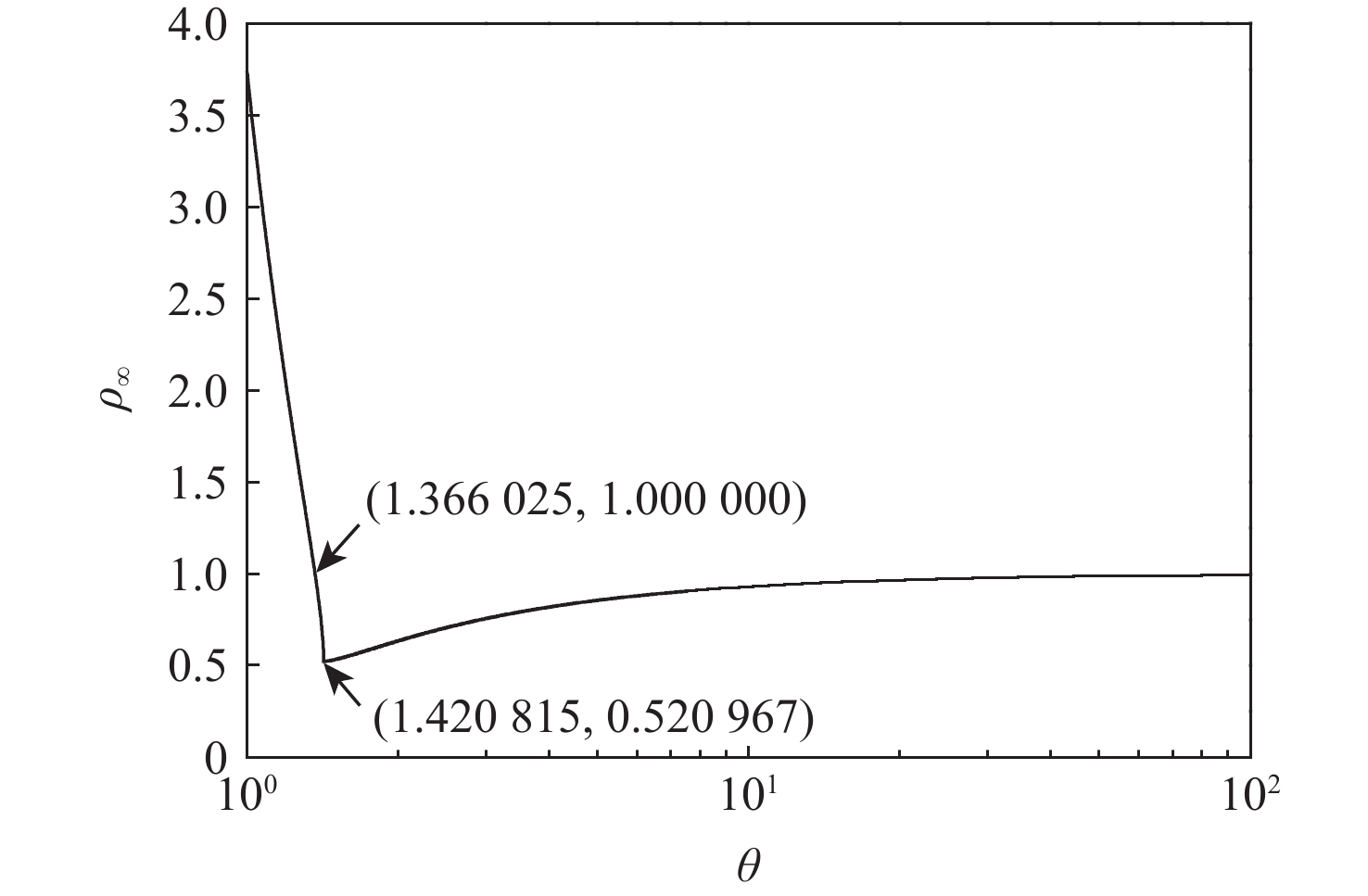
图 1 ρ∞和θ关系曲线 ($ \tau \rightarrow \mathrm{\infty } $)
Figure 1. Relationship curve of ρ∞ and θ($ \tau \rightarrow \mathrm{\infty } $)

图 2 Wilson-ρ∞方法与广义-α方法的谱半径
Figure 2. Spectral radii of Wilson-ρ∞ method and Generalized-α method

图 3 不同ξ情况下的Wilson-ρ∞方法的数值阻尼比
Figure 3. Numerical damping ratios of Wilson-ρ∞ method for different ξ

图 4 不同ξ情况下的广义-α 方法的数值阻尼比
Figure 4. Numerical damping ratios of Generalized-α method for different ξ

图 5 t=1时刻的位移、速度和加速度的绝对误差
Figure 5. Absolute errors of displacement, velocity, and acceleration at t=1

图 6 Wilson-ρ∞方法位移和模拟系统位移解析解与物理系统位移解析解的比较
Figure 6. Comparisons of Wilson-ρ∞ algorithmic displacements and analytical displacements of analog system with physical system
表 1 常用的$ {\rho }_{\mathrm{\infty }} $值及其对应θ
Table 1. Commonly used $ {\rho }_{\mathrm{\infty }} $ and corresponding θ
$ {\rho }_{\mathrm{\infty }} $ $ {\theta }_{1} $和分叉点$ {\tau }_{\text{b}} $ $ {\theta }_{2} $ 0.6 $ {\theta }_{1} $= 1.418259 , $ {\tau }_{\text{b}}=40.896\;625 $1.819322 0.7 $ {\theta }_{1} $= 1.409577 , $ {\tau }_{\text{b}}=19.537\;309 $2.441147 0.8 $ {\theta }_{1} $= 1.397065 , $ {\tau }_{\text{b}}=13.472\;628 $3.631715 0.9 $ {\theta }_{1} $= 1.382232 , $ {\tau }_{\text{b}}=10.601\;429 $7.156400 1.0 $ {\theta }_{1} $= 1.366025 , $ {\tau }_{\text{b}}=8.925\;094 $∞  下载: 导出CSV
-
[1] Bathe K J, Wilson E L. Numerical methods in finite element analysis[M]. Englewood Cliffs: Prentice-Hall, 1976. [2] 邢誉峰. 计算固体力学原理与方法[M]. 2版. 北京: 北京航空航天大学出版社, 2019: 31-40.Xing Y F. The principles and methods of computational solid mechanics[M]. 2nd ed. Beijing: Beihang University Press, 2019: 31-40(in Chinese). [3] Runge C. Ueber die numerische auflösung von differentialgleichungen[J]. Mathematische Annalen, 1895, 46(2): 167-178. [4] Kutta W. Beitrag zur näherungsweisen Integration totaler differentialgleichungen[J]. Zeitschrift für Mathematik und Physik, 1901, 46(1): 435-453. [5] Newmark N M. A method of computation for structural dynamics[J]. Journal of the Engineering Mechanics Division, 1959, 85(3): 67-94. [6] Wilson E L, Farhoomand I, Bathe K J. Nonlinear dynamic analysis of complex structures[J]. Earthquake Engineering & Structural Dynamics, 1972, 1(3): 241-252. [7] Hilber H M, Hughes T J R, Taylor R L. Improved numerical dissipation for time integration algorithms in structural dynamics[J]. Earthquake Engineering & Structural Dynamics, 1977, 5(3): 283-292. [8] Wood W L, Bossak M, Zienkiewicz O C. An alpha modification of Newmark’s method[J]. International Journal for Numerical Methods in Engineering, 1980, 15(10): 1562-1566. [9] Hoff C, Pahl P J. Development of an implicit method with numerical dissipation from a generalized single-step algorithm for structural dynamics[J]. Computer Methods in Applied Mechanics and Engineering, 1988, 67(3): 367-385. [10] 邵慧萍, 蔡承文. 结构动力学方程数值积分的三参数算法[J]. 应用力学学报, 1988, 5(4): 76-81.Shao H P, Cai C W. A three parameters algorithm for numerical integration of structural dynamic equations[J]. Chinese Journal of Applied Mechanics, 1988, 5(4): 76-81(in Chinese). [11] Chung J, Hulbert G M. A time integration algorithm for structural dynamics with improved numerical dissipation: the generalized-α method[J]. Journal of Applied Mechanics, 1993, 60(2): 371-375. [12] 邢誉峰, 李玉婷, 王雨竹. 具有可控数值阻尼的Newmark-ρ∞方法及模拟系统[J]. 力学与实践, 2025, 47(1): 195-200.Xing Y F, Li Y T, Wang Y Z. Newmark-ρ∞ method with controllable numerical damping and analog system[J]. Mechanics in Engineering, 2025, 47(1): 195-200(in Chinese). [13] Bank R E, Coughran W M, Fichtner W, et al. Transient simulation of silicon devices and circuits[J]. IEEE Transactions on Computer-Aided Design of Integrated Circuits and Systems, 1985, 4(4): 436-451. [14] Bathe K J, Baig M M I. On a composite implicit time integration procedure for nonlinear dynamics[J]. Computers & Structures, 2005, 83(31-32): 2513-2524. [15] Chandra Y, Zhou Y, Stanciulescu I, et al. A robust composite time integration scheme for snap-through problems[J]. Computational Mechanics, 2015, 55(5): 1041-1056. [16] Wen W B, Wei K, Lei H S, et al. A novel sub-step composite implicit time integration scheme for structural dynamics[J]. Computers & Structures, 2017, 182: 176-186. [17] Xing Y F, Ji Y, Zhang H M. On the construction of a type of composite time integration methods[J]. Computers & Structures, 2019, 221: 157-178. [18] Park K C. An improved stiffly stable method for direct integration of nonlinear structural dynamic equations[J]. Journal of Applied Mechanics, 1975, 42(2): 464-470. [19] Kuhl D, Crisfield M A. Energy-conserving and decaying algorithms in non-linear structural dynamics[J]. International Journal for Numerical Methods in Engineering, 1999, 45(5): 569-599. [20] Belytschko T, Schoeberle D F. On the unconditional stability of an implicit algorithm for nonlinear structural dynamics[J]. Journal of Applied Mechanics, 1975, 42(4): 865-869. [21] Zhang H M, Xing Y F, Ji Y. An energy-conserving and decaying time integration method for general nonlinear dynamics[J]. International Journal for Numerical Methods in Engineering, 2020, 121(5): 925-944. [22] Houbolt J C. A recurrence matrix solution for the dynamic response of elastic aircraft[J]. Journal of the Aeronautical Sciences, 1950, 17(9): 540-550. [23] Ji Y, Xing Y F, Wiercigroch M. An unconditionally stable time integration method with controllable dissipation for second-order nonlinear dynamics[J]. Nonlinear Dynamics, 2021, 105(4): 3341-3358. [24] Ji Y, Wu Y, Xing Y F. An accurate, controllably dissipative, unconditionally stable three-sub-step method for nonlinear dynamic analysis of structures[J]. International Journal of Structural Stability and Dynamics, 2023, 23(12): 2350138. [25] Xing Y F, Yao L, Ji Y. A solution strategy combining the mode superposition method and time integration methods for linear dynamic systems[J]. Acta Mechanica Sinica, 2022, 38(6): 521433. [26] 邢誉峰, 张慧敏, 季奕. 动力学常微分方程的时间积分方法 [M]. 北京: 科学出版社, 2022: 6-11.Xing Y F, Zhang H M, Ji Y. Time integral methods for dynamic ordinary differential equations[M]. Beijing: Science Press, 2022: 6-11(in Chinese). [27] Wang Y Z, Xue X D, Zhang T, et al. Overview and novel insights into implicit/explicit composite time integration type methods: fall under the RK: no ifs, ands, or buts[J]. Archives of Computational Methods in Engineering, 2023, 30(6): 3891-3940. [28] Zhang J. Optimal implicit single-step time integration methods with equivalence to the second-order-type linear multistep methods for structural dynamics: accuracy analysis based on an analytical framework[J]. Computer Methods in Applied Mechanics and Engineering, 2024, 418: 116503. [29] 邢誉峰, 季奕, 张慧敏. 时间积分方法的研究进展与挑战[J]. 北京航空航天大学学报, 2022, 48(9): 1692-1701.Xing Y F, Ji Y, Zhang H M. Advances and challenges in time integration methods[J]. Journal of Beijing University of Aeronautics and Astronautics, 2022, 48(9): 1692-1701(in Chinese). [30] 邢誉峰. 工程振动基础 [M]. 3版. 北京: 北京航空航天大学出版社, 2023: 18-24.Xing Y F. The foundations of engineering vibrations[M]. 3rd ed. Beijing: Beihang University Press, 2023: 18-24(in Chinese). [31] 邢誉峰, 郭静. 与结构动特性协同的自适应Newmark方法[J]. 力学学报, 2012, 44(5): 904-911.Xing Y F, Guo J. A self-adaptive newmark method with parameters dependent upon structural dynamic characteristics[J]. Chinese Journal of Theoretical and Applied Mechanics, 2012, 44(5): 904-911(in Chinese). [32] 邢誉峰, 杨蓉. 单步辛算法的相位误差分析及修正[J]. 力学学报, 2007, 39(5): 668-671.Xing Y F, Yang R. Phase errors and their correction in symplectic implicit single-step algorithm[J]. Chinese Journal of Theoretical Applied Mechanics, 2007, 39(5): 668-671(in Chinese). -

 下载:
下载:


 点击查看大图
计量
- 文章访问数: 353
- HTML全文浏览量: 192
- PDF下载量: 29
- 被引次数: 0
