





-
摘要:
胰岛素泵是糖尿病患者进行胰岛素强化治疗的先进设备,一旦发生故障会影响胰岛素的正常输注,进而引起血糖异常升高、引发酮症酸中毒等不良后果,危及生命安全。建立数学模型描述胰岛素泵组故障机理是实现其故障诊断的基础。但是胰岛素泵组涉及针头和软管的刚、弹性约束,以及胰岛素和泵管的流、固体多能域,这为胰岛素泵组故障机理建模及影响分析带来挑战。对此,基于功率流理论,针对堵塞和泄漏2种典型故障,建立胰岛素泵组健康和故障状态下的流体传动数学模型。在此基础上,定量分析了泄漏与堵塞故障对于胰岛素泵组流体流动的影响。通过计算与仿真,模型的计算结果与专业流体软件仿真结果最大误差为0.57%;定量分析了不同程度泄漏故障与堵塞故障对胰岛素泵组输出流量和腔体压力的影响程度;特别对于堵塞故障,当堵塞层厚度小于0.6 mm时,胰岛素的输出流量与腔体压力变化并不显著,当堵塞层厚度超过0.6 mm时,随着堵塞层厚度的增加,堵塞对流量和压力变化显著增大。
Abstract:An insulin pump is an advanced device used for intensive insulin therapy in diabetic patients. Failure of the insulin pump sets can disrupt normal insulin delivery, leading to abnormal blood glucose elevations and potentially causing diabetic ketoacidosis, which can be life-threatening. Establishing a mathematical model to describe the fault mechanisms of insulin pump sets is fundamental for its fault diagnosis. Insulin pumps, however, provide difficulties for modeling and fault mechanism analysis due to the stiff and elastic restrictions of the needles and tubes, as well as the multi-domain interactions between the fluid (insulin) and the solid parts of the pump. In response to these challenges, this paper establishes a mathematical model of fluid transmission in insulin pumps under both healthy and faulty conditions, based on power flow theory, focusing on two typical faults: blockages and leaks. The impact of these faults on fluid flow within the insulin pump sets is quantitatively analyzed. The computational results of the proposed model showed a maximum error of 0.57% when compared with professional fluid dynamics software simulations. Furthermore, the impact of varying degrees of leakage and blockage faults on the output flow rate and pressure of the insulin pump system is analyzed. Specifically, for blockage faults, it was observed that when the blockage layer thickness is less than 0.6 mm, the changes in insulin output flow rate and the pressure within the insulin pump chamber are not significant. However, the blockage has a considerable impact on both flow rate and pressure when the thickness of the blockage layer surpasses 0.6 mm. The impact grows with the thickness of the blockage layer.
-

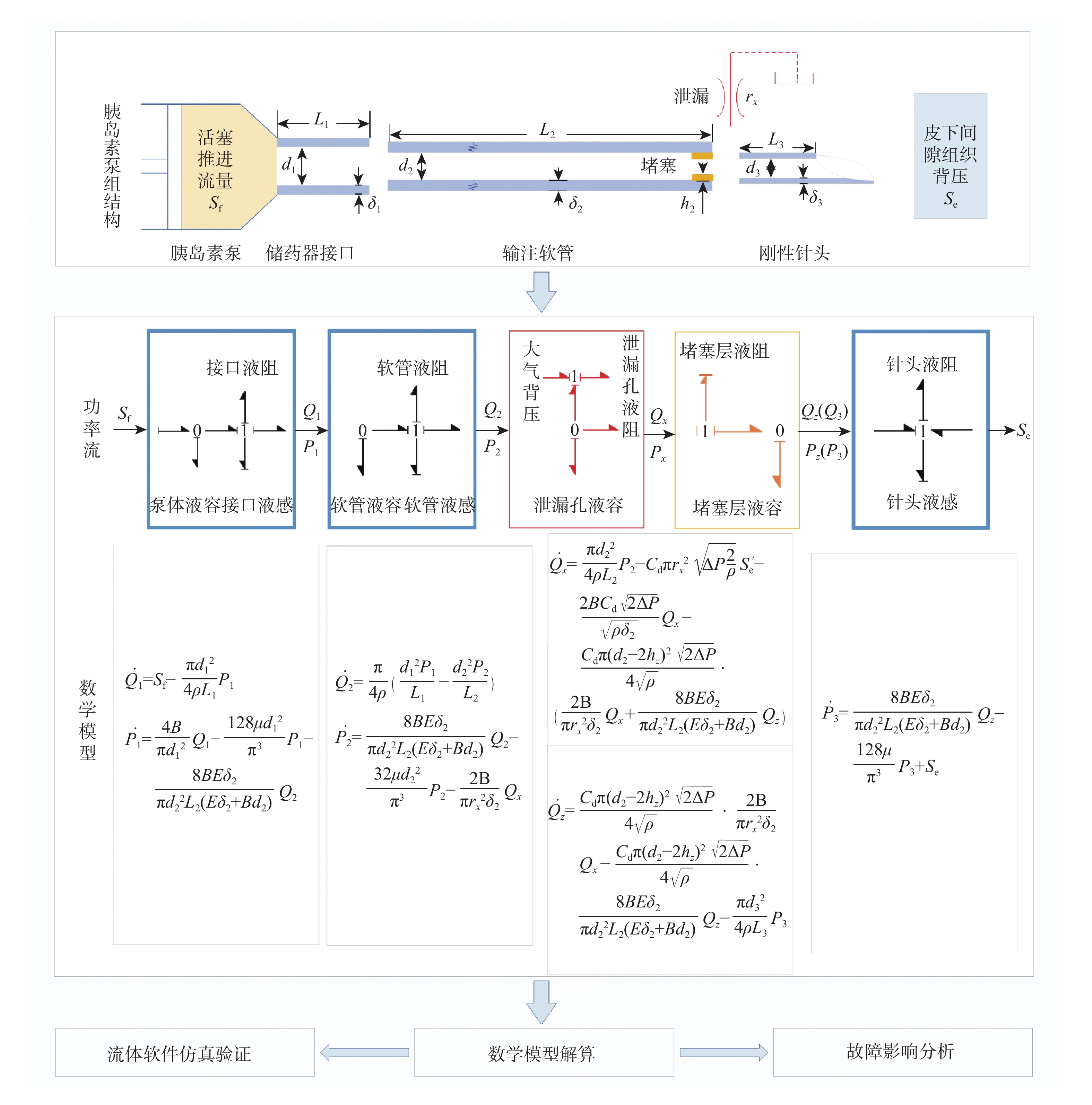
图 1 胰岛素泵组典型故障机理建模与仿真分析结构
Figure 1. Structure of typical fault mechanism modeling and simulation of insulin pump sets

图 2 基于功率流的储药器接口流体传动模型
Figure 2. Power-flow based fluid transmission model of reservoir interface

图 3 基于功率流的输注软管流体传动模型
Figure 3. Power-flow based fluid transmission model of pump infusion hose

图 4 基于功率流的刚性针头流体传动模型
Figure 4. Power-flow based fluid transmission model of rigid needle

图 5 基于功率流的泄漏孔流体传动模型
Figure 5. Power-flow based fluid transmission model of leakage hole

图 6 基于功率流的堵塞层流体传动模型
Figure 6. Power-flow based fluid transmission model of plugging layer

图 7 胰岛素泵组流体传动系统AMESim仿真模型
Figure 7. AMESim simulation model of fluid transmission system of insulin pump sets

图 9 3种泄漏半径下胰岛素泵组输出流量时域
Figure 9. Insulin output flow rate with leakage hole radius at three leakage radius

图 10 不同泄漏半径下胰岛素泵组输出流量
Figure 10. Performances of insulin output flow with different leakage radius

图 11 3种泄漏半径下腔体压力时域
Figure 11. Pump chamber pressure with leakage hole radius at three leakage radius

图 12 不同泄漏半径下胰岛素泵腔体压力
Figure 12. Performances of pump chamber pressure with different leakage radius

图 13 3种堵塞厚度下胰岛素泵组输出流量时域
Figure 13. Insulin output flow rate with plugging thickness at three leakage radius

图 14 不同堵塞厚度下胰岛素泵组输出流量结果
Figure 14. Performances of insulin output flow with different plugging thickness

图 15 3种堵塞厚度下腔体压力时域图
Figure 15. Pump chamber pressure with plugging thickness at three leakage radius

图 16 不同堵塞厚度下腔体压力结果
Figure 16. Performances of pump chamber pressure with different plugging thickness
表 1 元件参数
Table 1. Component parameters
元件 长度/m 内径/m 管壁厚度/m 管壁杨氏模量/MPa 储药器接口 0.034 0.0120 0.00100 194020 输注软管 1.100 0.0013 0.00010 147 刚性针头 0.009 0.0004 0.00001 194020  下载: 导出CSV
流体 密度/(kg·m−3) 体积弹性模量/Pa 绝对黏度/ (mPa·s) 胰岛素 1004.6 5.1×10 1.106
下载: 导出CSV
表 3 故障参数设置
Table 3. Fault parameter setting
泄漏孔半径$ {r}_{x} $/mm 堵塞层厚度$ {h}_{\textit{z}} $/mm 0/0.1/0.2/0.3/0.4/
0.5/0.6/0.650/0.2/0.4/0.6/0.615/
0.625/0.635/0.645/0.65
下载: 导出CSV
表 4 计算与仿真模型误差分析
Table 4. Error analysis between calculated model and simulation model
计算与仿真结果比较 输出流量/(L·h−1) 压力/Pa 健康状态 泄漏故障 堵塞故障 健康状态 泄漏故障 堵塞故障 模型计算 0.2151 0.0475 0.2151 102274 101535 251944 仿真结果 0.2159 0.0472 0.2159 102280 101534 251949
下载: 导出CSV
-
[1] Choudhury A A, Devi Rajeswari V. Gestational diabetes mellitus—a metabolic and reproductive disorder[J]. Biomedicine & Pharmacotherapy, 2021, 143: 112183. [2] Sun H, Saeedi P, Karuranga S, et al. IDF diabetes Atlas: global, regional and country-level diabetes prevalence estimates for 2021 and projections for 2045[J]. Diabetes Research and Clinical Practice, 2022, 183: 109119. [3] Nathan D M, Genuth S, Lachin J, et al. The effect of intensive treatment of diabetes on the development and progression of long-term complications in insulin-dependent diabetes mellitus[J]. The New England Journal of Medicine, 1993, 329(14): 977-986. [4] Nathan D M. Realising the long-term promise of insulin therapy: the DCCT/EDIC study[J]. Diabetologia, 2021, 64(5): 1049-1058. [5] Zhang J Y, Shang T, Chattaraj S, et al. Advances in insulin pump infusion sets symposium report[J]. Journal of Diabetes Science and Technology, 2021, 15(3): 705-709. [6] Heinemann L, Fleming G A, Petrie J R, et al. Insulin pump risks and benefits: a clinical appraisal of pump safety standards, adverse event reporting and research needs. A joint statement of the European Association for the Study of Diabetes and the American Diabetes Association Diabetes Technology Working Group[J]. Diabetologia, 2015, 58(5): 862-870. [7] Welsh J B, Vargas S, Williams G, et al. Designing the modern pump: engineering aspects of continuous subcutaneous insulin infusion software[J]. Diabetes Technology & Therapeutics, 2010, 12(Sl): S37-S42. [8] 姚远, 李建波. 胰岛素泵的故障分析及预防性维护[J]. 医疗装备, 2019, 32(15): 116-118.Yao Y, Li J B. Fault analysis and preventive maintenance of insulin pump[J]. Medical Equipment, 2019, 32(15): 116-118(in Chinese). [9] Kwa T, Zhang G, Shepard K, et al. The improved survival rate and cost-effectiveness of a 7-day continuous subcutaneous insulin infusion set[J]. Journal of Medical Economics, 2021, 24(1): 837-845. [10] Manzoni E, Rampazzo M, Facchinetti A, et al. Monitoring statistical properties of Kalman filter residuals in an artificial pancreas to detect overnight pump malfunctions causing insulin suspension[J]. Control Engineering Practice, 2023, 141: 105673. [11] Aiello E M, Laffel L M, Patti M E. Ketone-based alert system for insulin pump failures[J]. Journal of Diabetes Science and Technology, 2025, 19(3): 683-691. [12] Pickup J C, Yemane N, Brackenridge A, et al. Nonmetabolic complications of continuous subcutaneous insulin infusion: a patient survey[J]. Diabetes Technology & Therapeutics, 2014, 16(3): 145-149. [13] Mazzotta F A, Lucaccini Paoli L, Rizzi A, et al. The development and evolution of insulin pumps: from early beginnings to future prospects[J]. Minerva Endocrinology, 2024, 49(1): 85-99. [14] Ramkissoon C M, Aufderheide B, Bequette B W, et al. A review of safety and hazards associated with the artificial pancreas[J]. IEEE Reviews in Biomedical Engineering, 2017, 10: 44-62. [15] Freckmann G, Kamecke U, Waldenmaier D, et al. Occlusion detection time in insulin pumps at two different basal rates[J]. Journal of Diabetes Science and Technology, 2018, 12(3): 608-613. [16] Chakrabarti A, Macisaac R J, Mcauley S A. Insulin pump troubleshooting: a case vignette and systematic approach[J]. Medical Journal of Australia, 2022, 216(11): 595-596. [17] Formo M W, Stavdahl Ø, Fougner A L. Modelling and simulation of occlusions in insulin pumps[C]//Proceedings of the 43rd Annual International Conference of the IEEE Engineering in Medicine & Biology Society. Piscataway: IEEE Press, 2021: 1499-1503. [18] 王中双. 基于键合图理论的多体系统耦合动力学建模方法的研究[M]. 哈尔滨: 哈尔滨工业大学, 2007.Wang Z S. Research on coupling dynamics modeling method of multi-body system based on bond graph theory [M]. Harbin: Harbin Institute of Technology, 2007(in Chinese). [19] Adams G G, Meal A, Morgan P S, et al. Characterisation of insulin analogues therapeutically available to patients[J]. PLoS One, 2018, 13(3): e0195010. [20] Vasiliu N, Vasiliu D, Călinoiu C, et al. Simulation of fluid power systems with Simcenter Amesim[M]. Boca Raton: CRC Press, 2018. [21] Keramidas M E, Kölegård R, Sköldefors H, et al. In vivo pressure-flow relation of human cutaneous vessels following prolonged iterative exposures to hypergravity[J]. American Journal of Physiology Regulatory, Integrative and Comparative Physiology, 2023, 325(1): R21-R30. -

 下载:
下载:


 点击查看大图
计量
- 文章访问数: 356
- HTML全文浏览量: 162
- PDF下载量: 27
- 被引次数: 0
