





Fault exclusion method based on maximum a posteriori probability estimation for multi-constellation ARAIM
-
摘要:
针对异常观测量的准确检测与排除是高级接收机自主完好性监测(ARAIM)保障航空导航安全的关键。随着包括北斗、格洛纳斯等新兴星座的部署,待监测故障模式数量急剧上升,导致传统ARAIM故障排除算法难以同时顾及故障排除的成功率与计算效率。基于此,提出一种基于最大后验概率(MAP)估计的多星座ARAIM故障排除方法。通过结合观测量的异常先验概率信息实现健康卫星误排风险的控制;基于极大似然估计准确构建潜在故障模式假设下异常观测量的后验概率分布模型,避免异常观测量漏排事件的发生。此外,为提升故障排除的效率,结合所提MAP故障排除方法设计了一种基于异常观测量特征决策策略的ARAIM故障排除框架。仿真与实验结果表明:与传统ARAIM故障排除相比,所提方法可在提升ARAIM故障排除效率的同时保障单星及多星故障场景下异常观测量排除的准确性。
Abstract:Accurate detection and exclusion of faulty measurements is the key for advanced receiver autonomous integrity monitoring (ARAIM) to ensure the safety of navigation service in the aviation field. With the deployment of new constellations such as Beidou and GLONASS, the number of fault modes to be monitored increases sharply, and it is difficult for traditional ARAIM to take into account the success rate and computational efficiency at the same time by using recursive search method. This paper presents a multi-constellation ARAIM fault exclusion method based on maximum a posteriori probability (MAP). On the one hand, this method realizes the risk control of misarrangement of healthy satellites by combining the prior probability information of faulty measurements. On the other hand, the posterior probability distribution model of faulty measurements under the hypothesis of potential failure mode is accurately constructed based on the maximum likelihood estimation to avoid the occurrence of incomplete exclusion events of faulty measurements. Additionally, this article incorporates the suggested MAP fault exclusion approach with the fault feature judgment of faulty measurements to create an ARAIM fault exclusion framework that enhances fault exclusion efficiency. Simulation and experimental results show that, compared with the traditional ARAIM fault exclusion method, the proposed method can improve ARAIM fault exclusion efficiency and ensure the accuracy of fault exclusion in both single-satellite and multi-satellite fault scenarios.
-
Key words:
- faulty measurements /
- ARAIM /
- fault exclusion /
- maximum a posteriori probability /
- multi-constellation
-

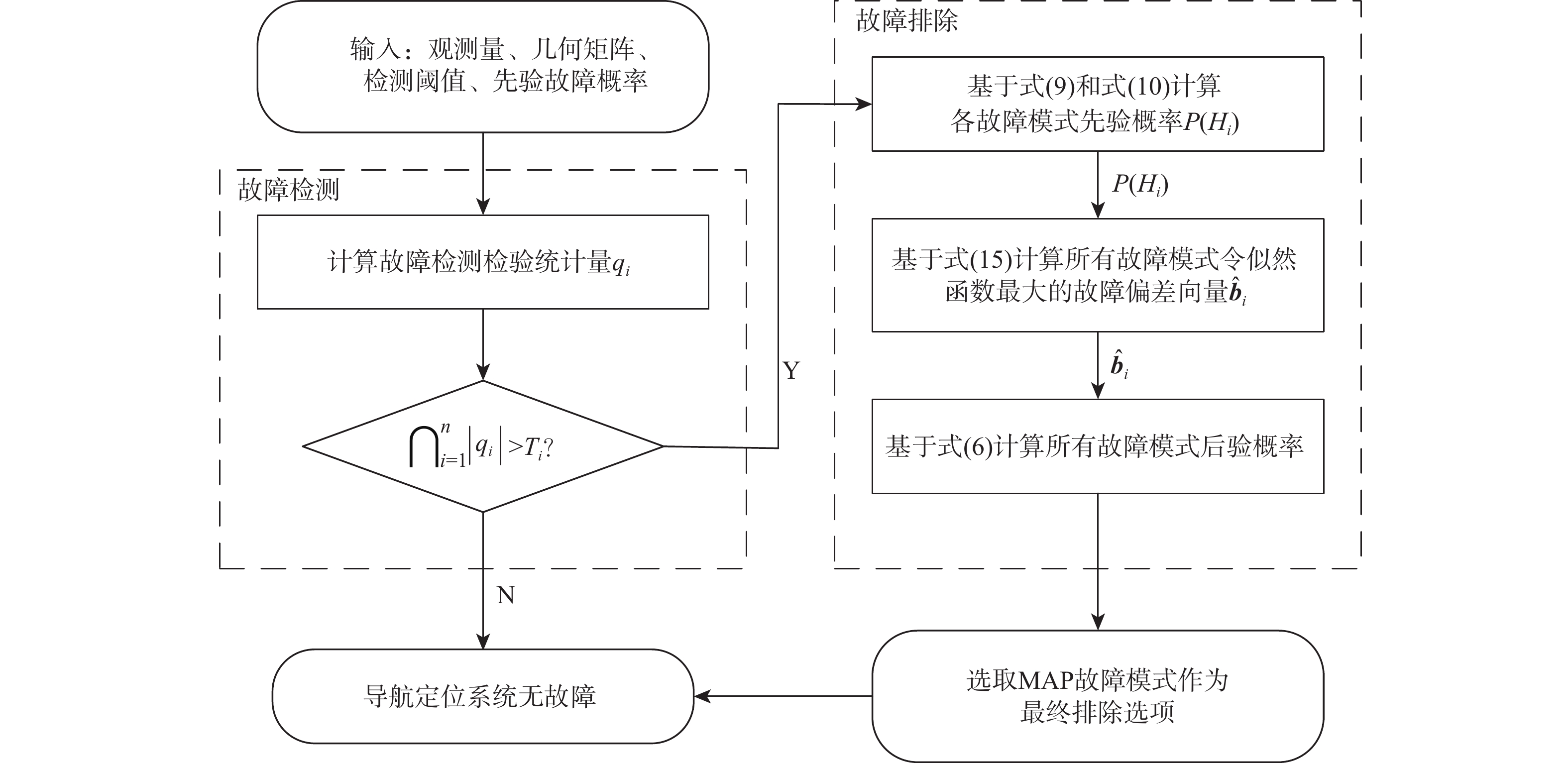
图 1 基于MAP估计的ARAIM故障排除流程
Figure 1. ARAIM fault exclusion flow chart based on MAP estimation

图 2 当前历元可视卫星高度角和方位角
Figure 2. Elevating angles and azimuth angles of visible satellites in current epoch

图 3 二维奇偶空间中奇偶矢量和故障线
Figure 3. Parity vector and fault lines in two-dimensional parity space

图 4 正确排除与漏排似然函数对比
Figure 4. Comparison of likelihood function of correct exclusion and incomplete exclusion

图 5 正确排除与误排似然函数及后验概率对比
Figure 5. Comparison of likelihood function and posterior probability of correct exclusion and incomplete exclusion

图 6 双星故障场景下本文方法故障排除成功率
Figure 6. The success rate of fault exclusion of the proposed method under two-fault satellite scenario

图 7 不同故障偏差下,4类排除方法排除成功率
Figure 7. The success rate of fault exclusion of four kinds under different fault deviations

图 9 不同故障场景下4类故障排除方法性能对比
Figure 9. Performance comparison of four fault exclusion methods under different fault scenarios

图 10 本文方法与RS法计算效率对比
Figure 10. Comparison of calculation efficiency between the proposed method and RS method

图 11 3类基于FFD故障排除方法定位误差对比
Figure 11. Comparison of positioning errors of three kinds of fault exclusion methods based on FFD

图 12 本文方法与Chi法HPL对比
Figure 12. Comparison of the HPL between the proposed method and Chi method
-
[1] 喻思琪, 张小红, 郭斐, 等. 卫星导航进近技术进展[J]. 航空学报, 2019, 40(3): 11-32.Yu S Q, Zhang X H, Guo F, et al. Recent advances in precision approach based on GNSS[J]. Acta Aeronautica et Astronautica Sinica, 2019, 40(3): 11-32(in Chinese). [2] 赵昂, 杨元喜, 许扬胤, 等. GNSS单系统及多系统组合完好性分析[J]. 武汉大学学报(信息科学版), 2020, 45(1): 72-80.Zhao A, Yang Y X, Xu Y Y, et al. Integrity analysis of gnss single system and multi-system combination[J]. Geomatics and Information Science of Wuhan University, 2020, 45(1): 72-80(in Chinese). [3] 王尔申, 杨福霞, 庞涛, 等. BDS/GPS组合导航接收机自主完好性监测算法[J]. 北京航空航天大学学报, 2018, 44(4): 684-690.Wang E S, Yang F X, Pang T, et al. BDS/GPS combined navigation receiver autonomous integrity monitoring algorithm[J]. Journal of Beijing University of Aeronautics and Astronautics, 2018, 44(4): 684-690(in Chinese). [4] Zhai Y W, Joerger M, Pervan B. Continuity and availability in dual-frequency multi-constellation ARAIM[C]//Proceedings of the 28th International Technical Meeting of the Satellite Division of The Institute of Navigation (ION GNSS+ 2015). Tampa: ION, 2015: 664-674. [5] 程春, 赵玉新, 李亮, 等. BDS空间信号异常实时检测与排除方法[J]. 中国科学: 信息科学, 2020, 50(4): 603-616.Cheng C, Zhao Y X, Li L, et al. Real-time detection and elimination method for BDS signal-in-space anomalies[J]. Scientia Sinica (Informationis), 2020, 50(4): 603-616(in Chinese). [6] Blanch J, Walter T, Enge P. RAIM with optimal integrity and continuity allocations under multiple failures[J]. IEEE Transactions on Aerospace and Electronic Systems, 2010, 46(3): 1235-1247. [7] Joerger M, Pervan B. Fault detection and exclusion using solution separation and Chi-squared ARAIM[J]. IEEE Transactions on Aerospace and Electronic Systems, 2016, 52(2): 726-742. [8] Ge Y S, Wang Z P, Zhu Y B. Reduced ARAIM monitoring subset method based on satellites in different orbital planes[J]. GPS Solutions, 2017, 21(4): 1443-1456. [9] Wang S Z, Zhai Y W, Chi C, et al. Implementation and analysis of fault grouping for multi-constellation advanced RAIM[J]. Advances in Space Research, 2023, 71(11): 4765-4786. [10] Gerbeth D, Felux M, Circiu M S, et al. Optimized selection of satellite subsets for a multi-constellation GBAS[C]//Proceedings of the 2016 International Technical Meeting of the Institute of Navigation. Monterey: ION, 2016: 360-367. [11] Walter T, Blanch J, Kropp V. Satellite selection for multi-constellation SBAS[C]//Proceedings of the 29th International Technical Meeting of the Satellite Division of the Institute of Navigation (ION GNSS+ 2016). Portland: ION, 2016: 1350-1359. [12] Zhai Y W, Pervan B, Joerger M. H-ARAIM exclusion: requirements and performance[C]//Proceedings of the 29th International Technical Meeting of the Satellite Division of The Institute of Navigation (ION GNSS+ 2016). Portland: ION, 2016: 1713-1725. [13] Blanch J, Walter T, Enge P, et al. Baseline advanced RAIM user algorithm and possible improvements[J]. IEEE Transactions on Aerospace and Electronic Systems, 2015, 51(1): 713-732. [14] Zhai Y W, Zhan X Q, Chang J. An integrated fault detection and exclusion scheme to support aviation navigation[J]. Aerospace Systems, 2020, 3(1): 29-39. [15] Chan F C, Joerger M, Khanafseh S, et al. Bayesian fault-tolerant position estimator and integrity risk bound for GNSS navigation[J]. Journal of Navigation, 2014, 67(5): 753-775. [16] Joerger M, Chan F C, Pervan B. Solution separation versus residual-based RAIM: solution separation versus residual-based RAIM[J]. Navigation, 2014, 61(4): 273-291. [17] Joerger M, Chan F C, Langel S, et al. RAIM detector and estimator design to minimize the integrity risk[C]//Proceedings of the 25th International Technical Meeting of the Satellite Division of the Institute of Navigation (ION GNSS 2012). Nashville: ION, 2012: 2785-2807. [18] Bang E, Milner C, Macabiau C. Cross-correlation effect of ARAIM test statistic on false alarm risk[J]. GPS Solutions, 2020, 24(4): 107. [19] Blanch J, Walter T, Enge P. Exclusion for advanced RAIM: requirements and a baseline algorithm[C]//Proceedings of the 2014 International Technical Meeting of The Institute of Navigation. San Diego: ION, 2014: 99-107. [20] 李瑞杰, 李亮, 蒋家昌, 等. 基于多星最差故障搜索的RAIM完好性风险估计方法[J]. 航空学报, 2024, 45(2): 328684.Li R J, Li L, Jiang J C, et al. RAIM integrity risk estimation method based on worst multi-satellite faults searching[J]. Acta Aeronautica et Astronautica Sinica, 2024, 45(2): 328684(in Chinese). -

 下载:
下载:


 点击查看大图
计量
- 文章访问数: 292
- HTML全文浏览量: 127
- PDF下载量: 22
- 被引次数: 0
