





Lightweight multi-scale feature fusion enhancement algorithm for spatial non-cooperative small target detection
-
摘要:
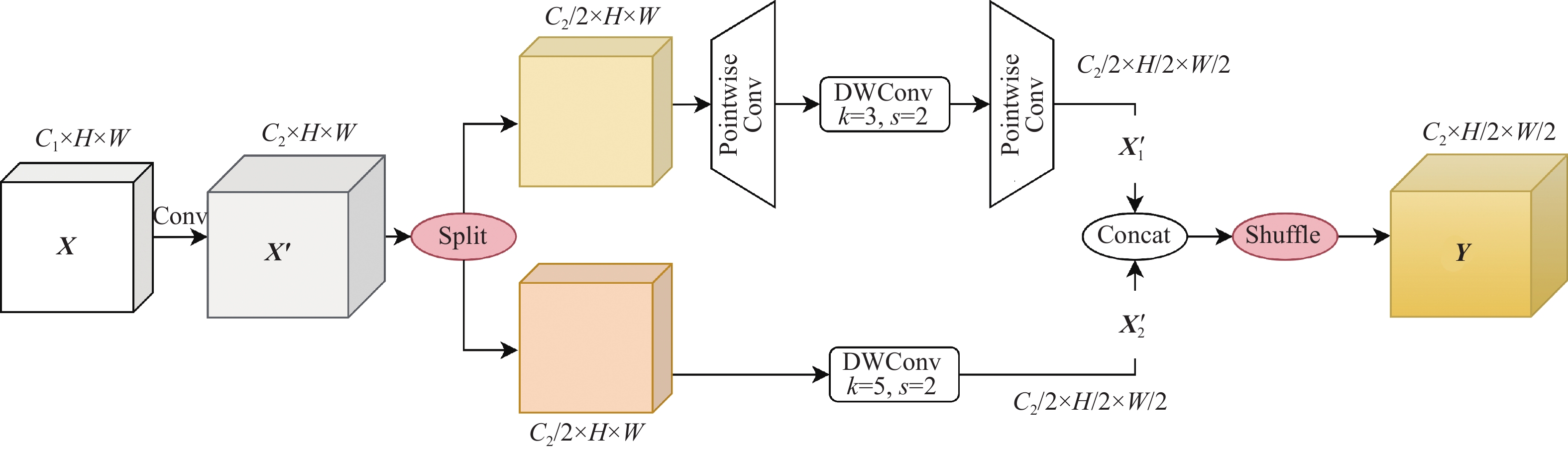
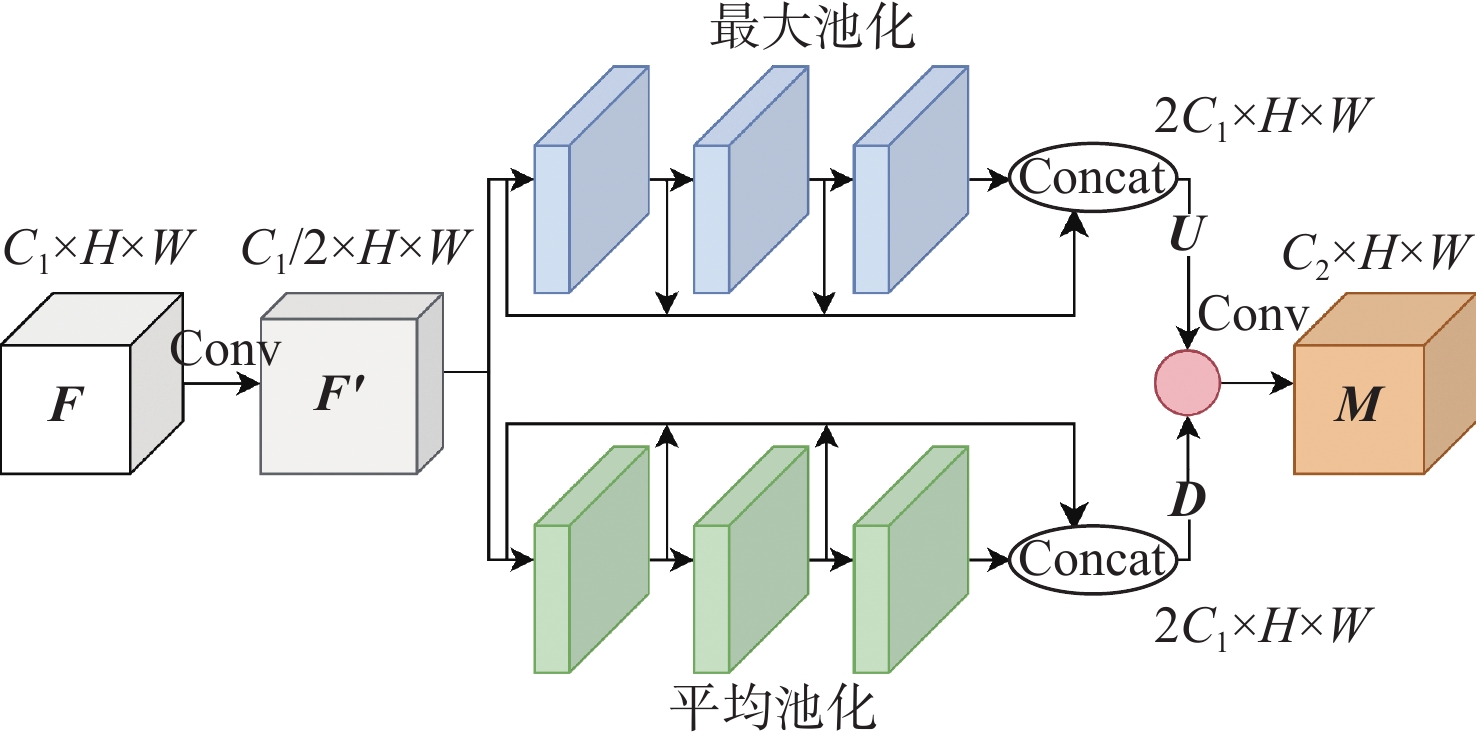
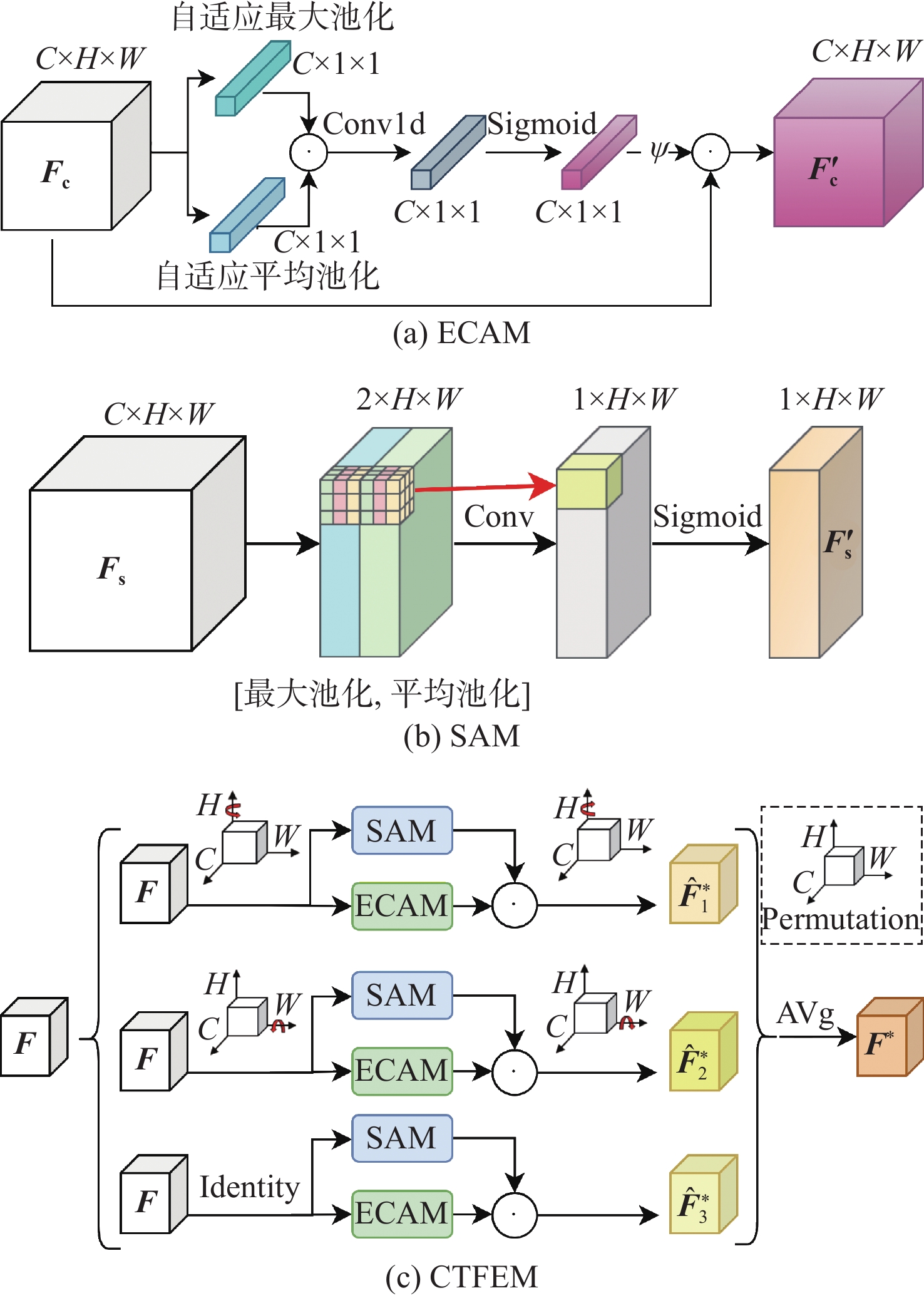
针对深空背景下空间非合作小目标特征提取不充分而检测精度低、空间计算资源有限等问题,提出一种轻量级多尺度特征融合增强和上下文感知的空间目标检测算法。设计一种轻量级多特征下采样模块实现空间非合作目标的多尺度特征提取,加强对细粒度特征提取能力;设计快速双空间金字塔池化模块加强对目标全局上下文特征提取,并聚合局部显著特征和全局特征以提高特征泛化能力;设计跨维度三重特征增强模块(CTFEM)对不同维度信息进行全局上下文建模,进一步增强小目标特征信息,抑制易混淆背景信息,从而提高对小目标检测能力。使用VisDrone2019公开的小目标数据集和自建空间态势感知数据集(SSAD)对所提算法进行验证,实验结果表明:所提算法与基准模型YOLOv8n相比,模型参数量减少19.38%,在SSAD数据集上mAP50和mAP50-95分别提高0.2%和1.2%,在VisDrone2019数据集上mAP50和mAP50-95分别提高2.0%和1.4%。
Abstract:In deep space environments, the feature of the non-cooperative small targets cannot be fully extracted, so the detection accuracy of uncooperative small targets will decrease. Furthermore, the computational resources are limited for space applications. To solve the above-mentioned problems, a lightweight multi-scale feature fusion, enhancement and context-aware spatial target detection algorithm is proposed. Multi-scale characteristics of spatially non-cooperative targets are extracted using a lightweight multi-feature downsampling module, which may improve the capacity to obtain fine-grained features. A fast dual spatial pyramid pooling module is developed to enhance the extraction of global contextual features, and the locally salient and global features are aggregated to improve the ability of feature generalization. A cross-dimension triple feature enhancement module (CTFEM) is designed, which could model the global context in term of different dimensional information. Therefore, the CTFEM module could further enhance the feature information of small targets and suppress the confused background information. The VisDrone2019 dataset and a self-built spatial situational awareness dataset (SSAD) are used to validate the suggested method in this research. The experimental findings show that the proposed method decreases the model parameters by 19.38% when compared to the benchmark model YOLOv8n. On the SSAD dataset, the mAP50 and mAP50-95 of the proposed method are improved by 0.2% and 1.2%, respectively. On the VisDrone2019 dataset, the mAP50 and mAP50-95 of the proposed method are improved by 2.0% and 1.4%, respectively.
-
表 1 网络模型的训练参数
Table 1. Training parameters of the network model
参数 数值 训练轮数 200 批次大小 32 输入图像尺寸/(像素×像素) 640×640 早停耐心值 100 初始学习率 0.01 最终学习率系数 0.01 动量系数 0.937 权重衰减系数 0.000 5 Mosaic数据增强系数 1.0  下载: 导出CSV
表 2 SSAD数据集类别及标签统计
Table 2. SSAD dataset categories and labelling statistics
ID 类别名称 标签数量 ID 类别名称 标签数量 0 space debris 3 342 11 hubble 3 117 1 satellite 2 710 12 ikonos 3 221 2 aces 3 167 13 inmarsat4 3 070 3 apollo-soyuz 3 287 14 intelsat8 3 251 4 beidou 3 220 15 iss_stg3r 2 996 5 chandra 3 095 16 meteor 3 051 6 discoverer 3 123 17 mgs 3 287 7 dmsp 3 216 18 milstar 3 062 8 est-vil 3 149 19 mir 3 055 9 gps2 3 138 20 msx 3 271 10 gravityprobe 3 002 21 quickbird2 3 095
下载: 导出CSV
表 3 S-YOLO的消融实验结果
Table 3. Ablation experiment results of S-YOLO
模型 LMFD DSPPF CTFEM DySample 参数量 浮点运算量/109次 P/% R/% mAP50/% mAP50-95/% 1 3.20×10⁶ 8.2 43.2 32.4 32.1 18.3 2 √ 2.57×10⁶ 8.0 43.8 32.8 32.6 18.9 3 √ √ 2.57×10⁶ 8.0 43.9 34.0 33.1 19.1 4 √ √ √ 2.57×10⁶ 8.2 44.3 34.1 33.5 19.4 5 √ √ √ √ 2.58×10⁶ 8.2 45.8 33.7 34.1 19.7
下载: 导出CSV
表 4 不同检测算法在SSAD数据集上的实验结果
Table 4. Experimental results of different detection algorithms on SSAD dataset
模型 参数量 浮点运算量/109次 P/% R/% mAP50/% mAP50-95/% APS/% APM/% APL/% 检测速度/(帧·s−1) 模型权重/MB YOLOv3-tiny*[34] 12.14×10⁶ 19.1 94.2 87.6 92.2 79.2 36.5 78.1 92.8 240 24.4 YOLOv5n* 2.51×106 7.2 96.8 94.6 96.0 83.1 48.5 80.3 93.0 138 5.3 YOLOv6n*[35] 4.24×10⁶ 11.9 96.4 94.4 95.7 82.4 46.5 80.1 93.0 163 8.7 YOLOv7-tiny*[36] 8.12×10⁶ 21.3 96.5 94.5 95.9 82.6 48.4 80.2 92.9 140 16.5 YOLOv8n[28] 3.20×10⁶ 8.2 96.9 94.7 96.2 83.8 48.6 80.6 93.9 150 6.3 CS-YOLO[22] 7.18×10⁶ 15.1 96.7 94.6 96.2 83.3 48.6 80.7 94.0 87 14.7 LACTA[37] 1.20×10⁶ 9.6 96.2 94.2 95.9 81.8 48.5 80.4 93.0 157 2.6 YOLOv10n[38] 2.71×10⁶ 8.4 96.3 94.5 95.8 81.9 48.5 80.4 93.8 111 5.8 S-YOLO 2.58×10⁶ 8.2 96.9 94.9 96.4 85.0 49.8 82.4 94.0 77 5.5 注:*表示将网络模型的骨干网络移植到YOLOv8工程。
下载: 导出CSV
表 5 不同检测算法在VisDrone2019数据集上的实验结果
Table 5. Experimental results of different detection algorithms on VisDrone2019 dataset
模型 参数量 浮点运算量/109次 P/% R/% mAP50/% mAP50-95/% APS/% APM/% APL/% 检测速度/(帧·s−1) 模型大小/MB YOLOv3-tiny*[34] 12.14×10⁶ 19.1 37.7 23.6 22.9 12.7 3.8 19.7 35.5 179 24.4 YOLOv5n* 2.51×106 7.2 43.1 32.2 32.0 18.0 8.6 26.2 35.5 112 5.3 YOLOv6n*[35] 4.24×10⁶ 11.9 40.8 30.2 29.6 17.0 7.4 24.9 34.6 129 8.7 YOLOv7-tiny*[36] 8.12×10⁶ 21.3 42.3 32.5 32.3 18.1 8.6 27.7 35.7 116 16.5 CS-YOLO[22] 7.18×10⁶ 15.1 42.0 32.2 31.9 18.3 8.6 25.9 35.9 76 14.7 LACTA[37] 1.20×10⁶ 9.6 42.3 33.1 32.4 18.5 8.9 26.6 35.7 128 2.6 YOLOv8n[28] 3.20×10⁶ 8.2 43.2 32.4 32.1 18.3 8.6 27.2 35.2 118 6.3 YOLOv10n[38] 2.71×10⁶ 8.4 43.3 31.9 31.7 18.4 8.5 27.1 35.2 113 5.8 S-YOLO 2.58×10⁶ 8.2 45.8 33.6 34.1 19.7 9.6 28.4 36.8 70 5.5
下载: 导出CSV
-
[1] Zhang Z P, Deng C W, Deng Z Y. A diverse space target dataset with multidebris and realistic on-orbit environment[J]. IEEE Journal of Selected Topics in Applied Earth Observations and Remote Sensing, 2022, 15: 9102-9114. [2] Miao L N, Zhou D, Li X. Spatial non-cooperative object detection based on deep learning[C]// Proceedings of the 2021 China Automation Congress. Piscataway: IEEE Press, 2022: 116-121. [3] Wu A D, Zhang S Y, Shu L Z, et al. Non-cooperative spacecraft relative navigation based on monocular camera in space on-orbit servicing[C]// Proceedings of the 2022 International Conference on Service Robotics. Piscataway: IEEE Press, 2023: 133-138. [4] Shan M H, Guo J, Gill E. Review and comparison of active space debris capturing and removal methods[J]. Progress in Aerospace Sciences, 2016, 80: 18-32. [5] Massimi F, Ferrara P, Petrucci R, et al. Deep learning-based space debris detection for space situational awareness: a feasibility study applied to the radar processing[J]. IET Radar, Sonar & Navigation, 2024, 18(4): 635-648. [6] Girshick R. Fast R-CNN[C]// Proceedings of the 2015 IEEE International Conference on Computer Vision. Piscataway: IEEE Press, 2016: 1440-1448. [7] Liu W, Anguelov D, Erhan D, et al. SSD: single shot MultiBox detector[M]// Computer Vision-ECCV 2016. Cham: Springer International Publishing, 2016: 21-37. [8] Redmon J, Divvala S, Girshick R, et al. You only look once: unified, real-time object detection[C]// Proceedings of the 2016 IEEE Conference on Computer Vision and Pattern Recognition. Piscataway: IEEE Press, 2016: 779-788. [9] 王坤, 冯康威. 基于改进YOLOv5-s的交通场景小目标检测算法[J]. 北京航空航天大学学报, 2026, 52(4): 1015-1027.Wang K, Feng K W. Small target detection algorithm for traffic scenes based on improved YOLOv5-s[J]. Journal of Beijing University of Aeronautics and Astronautics, 2026, 52(4): 1015-1027 (in Chinese). [10] Wu T, Yang X, Song B, et al. T-SCNN: a two-stage convolutional neural network for space target recognition[C]// Proceedings of the 2019 IEEE International Geoscience and Remote Sensing Symposium. Piscataway: IEEE Press, 2019: 1334-1337. [11] Xiang Y B, Xi J B, Cong M, et al. Space debris detection with fast grid-based learning[C]// Proceedings of the 2020 IEEE 3rd International Conference of Safe Production and Informatization. Piscataway: IEEE Press, 2021: 205-209. [12] Wang G J, Lei N W, Liu H M. Improved-YOLOv3 network for object detection in simulated Space Solar Power Systems images[C]// Proceedings of the 2020 39th Chinese Control Conference. Piscataway: IEEE Press, 2020: 7177-7181. [13] Jia P, Liu Q, Sun Y Y. Detection and classification of astronomical targets with deep neural networks in wide-field small aperture telescopes[J]. The Astronomical Journal, 2020, 159(5): 212. [14] Ren S Q, He K M, Girshick R, et al. Faster R-CNN: towards real-time object detection with region proposal networks[J]. IEEE Transactions on Pattern Analysis and Machine Intelligence, 2017, 39(6): 1137-1149. [15] Aldahoul N, Karim H A, De Castro A, et al. Localization and classification of space objects using EfficientDet detector for space situational awareness[J]. Scientific Reports, 2022, 12: 21896. [16] Mahendrakar T, White R T, Wilde M, et al. SpaceYOLO: a human-inspired model for real-time, on-board spacecraft feature detection[C]// Proceedings of the 2023 IEEE Aerospace Conference. Piscataway: IEEE Press, 2023: 1-11. [17] Tang Q, Li X W, Xie M L, et al. Intelligent space object detection driven by data from space objects[J]. Applied Sciences, 2024, 14(1): 333. [18] Ai H, Zhang H F, Ren L, et al. Detection and recognition of spatial non-cooperative objects based on improved YOLOX_L[J]. Electronics, 2022, 11(21): 3433. [19] Guo X J, Chen T, Liu J C, et al. Dim space target detection via convolutional neural network in single optical image[J]. IEEE Access, 2022, 10: 52306-52318. [20] Jiang Y X, Tang Y J, Ying C C. Finding a needle in a haystack: faint and small space object detection in 16-bit astronomical images using a deep learning-based approach[J]. Electronics, 2023, 12(23): 4820. [21] Tao J, Cao Y F, Ding M. SDebrisNet: a spatial-temporal saliency network for space debris detection[J]. Applied Sciences, 2023, 13(8): 4955. [22] Yuan Y M, Bai H Y, Wu P F, et al. An intelligent detection method for small and weak objects in space[J]. Remote Sensing, 2023, 15(12): 3169. [23] 刘一诺, 张琪, 王蓉, 等. 针对航拍小目标检测的YOLOv7改进方法[J]. 北京航空航天大学学报, 2025, 51(7): 2506-2512.Liu Y N, Zhang Q, Wang R, et al. Improved YOLOv7 method for aerial small target detection in aerial photography[J]. Journal of Beijing University of Aeronautics and Astronautics, 2025, 51(7): 2506-2512 (in Chinese). [24] 邓天民, 余洋, 陈月田, 等. 基于自适应复合卷积的航拍小目标检测算法[J]. 北京航空航天大学学报, 2024: 1-14.Deng T M, Yu Y, Cheng Y T, et al. Small object detection algorithm for aerial photography based on adaptive compound convolution[J]. Journal of Beijing University of Aeronautics and Astronautics, 2024: 1-14 (in Chinese). [25] Howard A G, Zhu M L, Chen B, et al. MobileNets: efficient convolutional neural networks for mobile vision applications[EB/OL]. (2017-04-17)[2024-07-03]. https://arxiv.org/abs/1704.04861. [26] Zhang X Y, Zhou X Y, Lin M X, et al. ShuffleNet: an extremely efficient convolutional neural network for mobile devices[C]// Proceedings of the 2018 IEEE/CVF Conference on Computer Vision and Pattern Recognition. Piscataway: IEEE Press, 2018: 6848-6856. [27] Girshick R, Donahue J, Darrell T, et al. Rich feature hierarchies for accurate object detection and semantic segmentation[C]// Proceedings of the 2014 IEEE Conference on Computer Vision and Pattern Recognition. Piscataway: IEEE Press, 2014: 580-587. [28] Varghese R, M S. YOLOv8: a novel object detection algorithm with enhanced performance and robustness[C]// Proceedings of the 2024 International Conference on Advances in Data Engineering and Intelligent Computing Systems. Piscataway: IEEE Press, 2024: 1-6. [29] Zeng N Y, Li X Y, Wu P S, et al. A novel tensor decomposition-based efficient detector for low-altitude aerial objects with knowledge distillation scheme[J]. IEEE/CAA Journal of Automatica Sinica, 2024, 11(2): 487-501. [30] Wang Q L, Wu B G, Zhu P F, et al. ECA-net: efficient channel attention for deep convolutional neural networks[C]// Proceedings of the 2020 IEEE/CVF Conference on Computer Vision and Pattern Recognition. Piscataway: IEEE Press, 2020: 11531-11539. [31] Wang J Q, Chen K, Xu R, et al. CARAFE: content-aware ReAssembly of FEatures[C]// Proceedings of the 2019 IEEE/CVF International Conference on Computer Vision. Piscataway: IEEE Press, 2019: 3007-3016. [32] Liu W Z, Lu H, Fu H T, et al. Learning to upsample by learning to sample[C]// Proceedings of the 2023 IEEE/CVF International Conference on Computer Vision. Piscataway: IEEE Press, 2024: 6004-6014. [33] Zhu P F, Wen L Y, Du D W, et al. Detection and tracking meet drones challenge[J]. IEEE Transactions on Pattern Analysis and Machine Intelligence, 2022, 44(11): 7380-7399. [34] Redmon J, Farhadi A. YOLOv3: an incremental improvement[EB/OL]. (2018-04-08)[2024-07-03]. https://arxiv.org/abs/1804.02767. [35] Li C Y, Li L L, Jiang H L, et al. YOLOv6: a single-stage object detection framework for industrial applications[EB/OL]. (2022-09-07)[2024-07-03]. https://arxiv.org/abs/2209.02976. [36] Wang C Y, Bochkovskiy A, Liao H M. YOLOv7: trainable bag-of-freebies sets new state-of-the-art for real-time object detectors[C]// Proceedings of the 2023 IEEE/CVF Conference on Computer Vision and Pattern Recognition. Piscataway: IEEE Press, 2023: 7464-7475. [37] Gao J, Zhang J X, Zhang F, et al. LACTA: a lightweight and accurate algorithm for cherry tomato detection in unstructured environments[J]. Expert Systems with Applications, 2024, 238: 122073. [38] Wang A, Chen H, Liu L H, et al. YOLOv10: real-time end-to-end object detection[EB/OL]. (2024-05-23)[2024-07-03]. https://arxiv.org/abs/2405.14458. -

 下载:

计量
- 文章访问数: 884
- HTML全文浏览量: 241
- PDF下载量: 125
- 被引次数: 0
