





Low-light image enhancement algorithm for UAV aerial photography base on low-light instances
-
摘要:
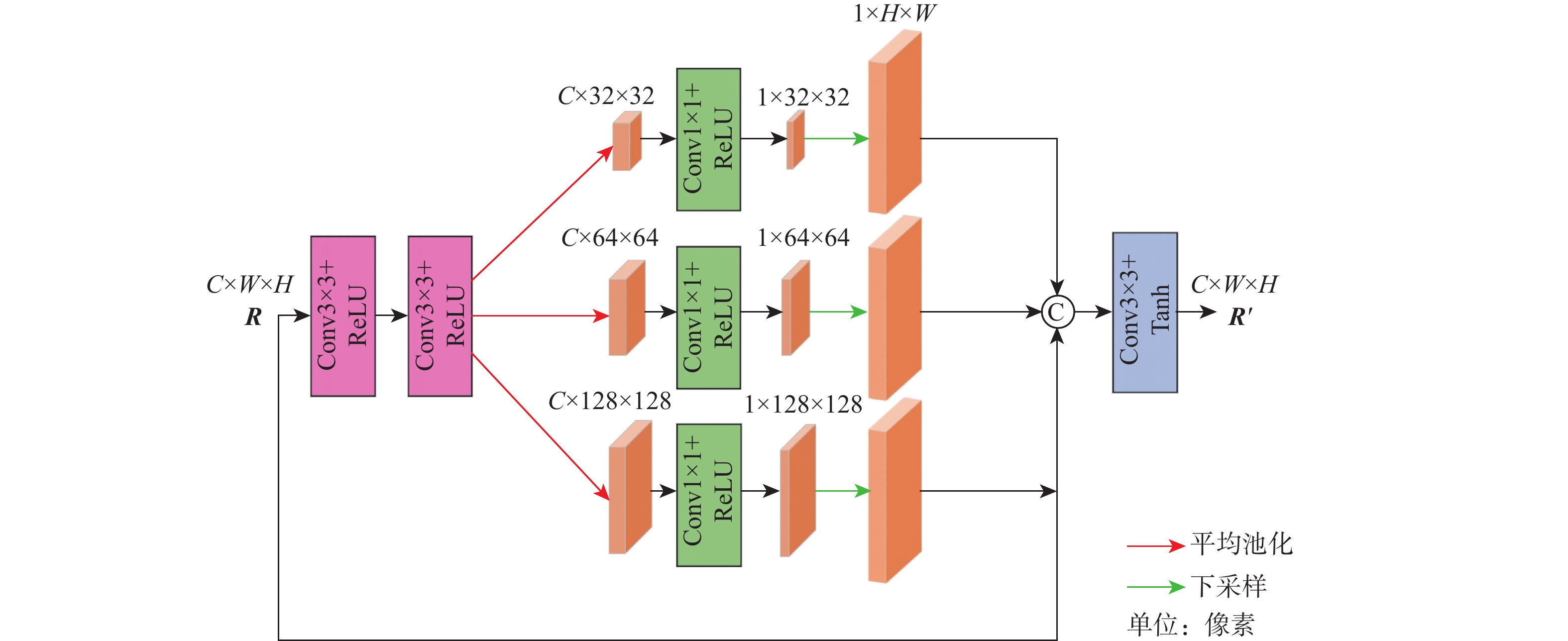
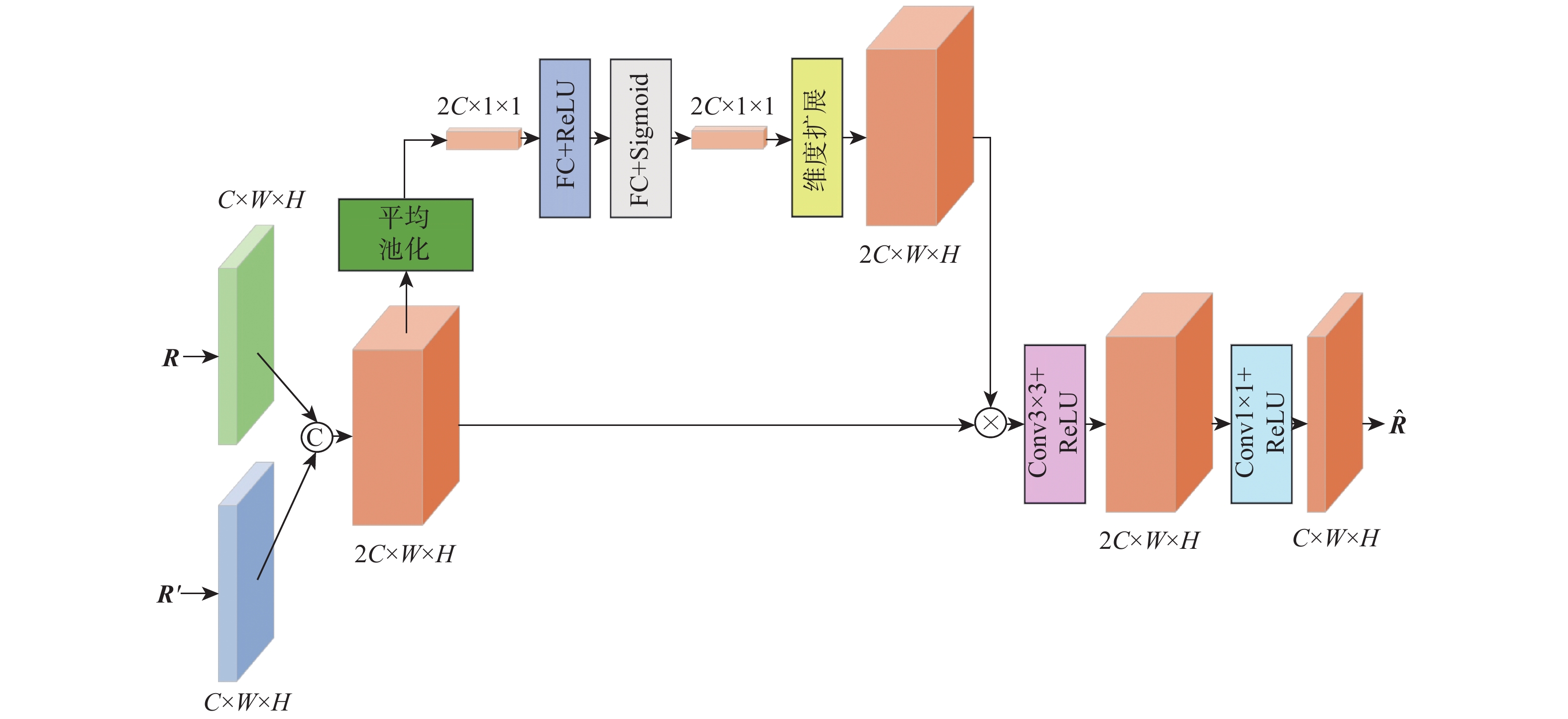
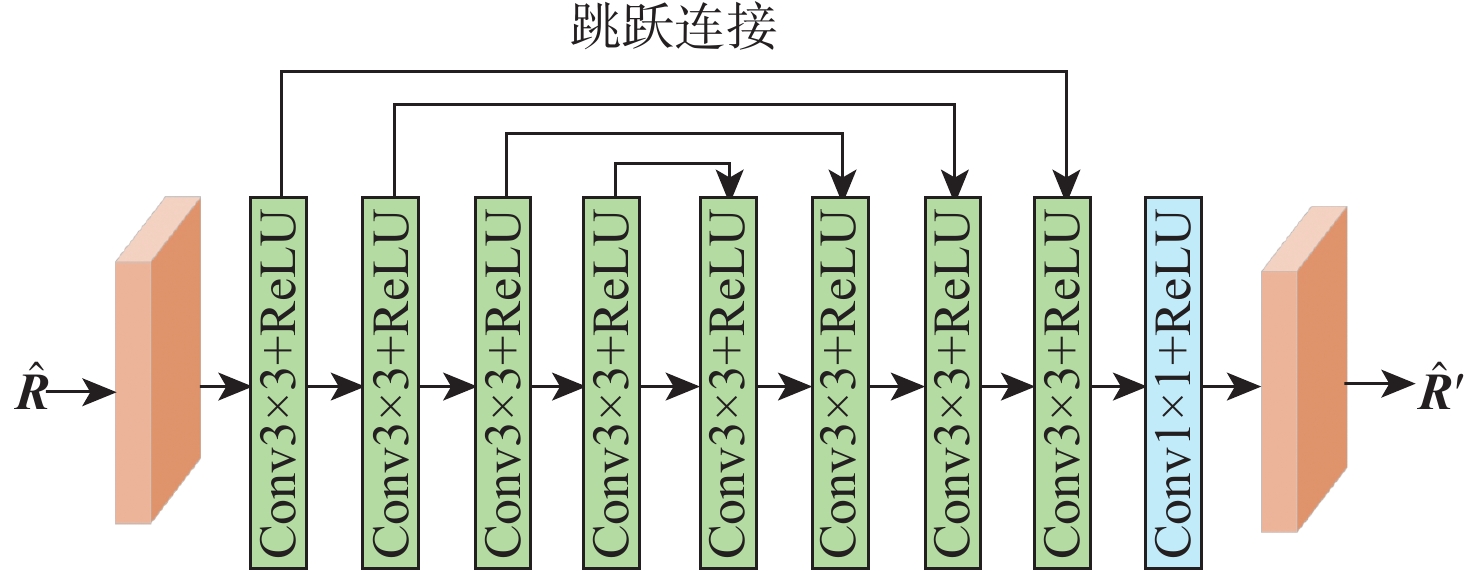
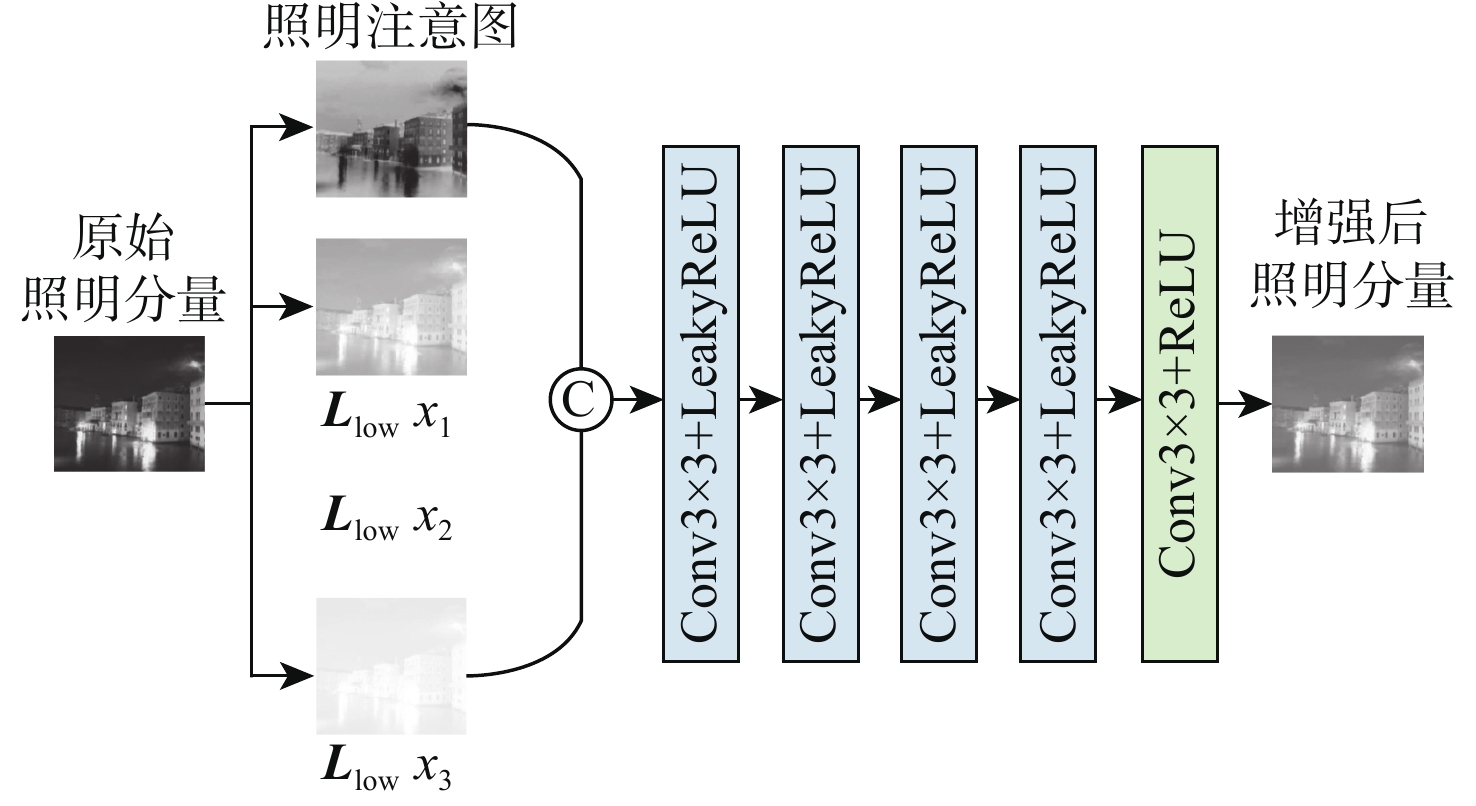
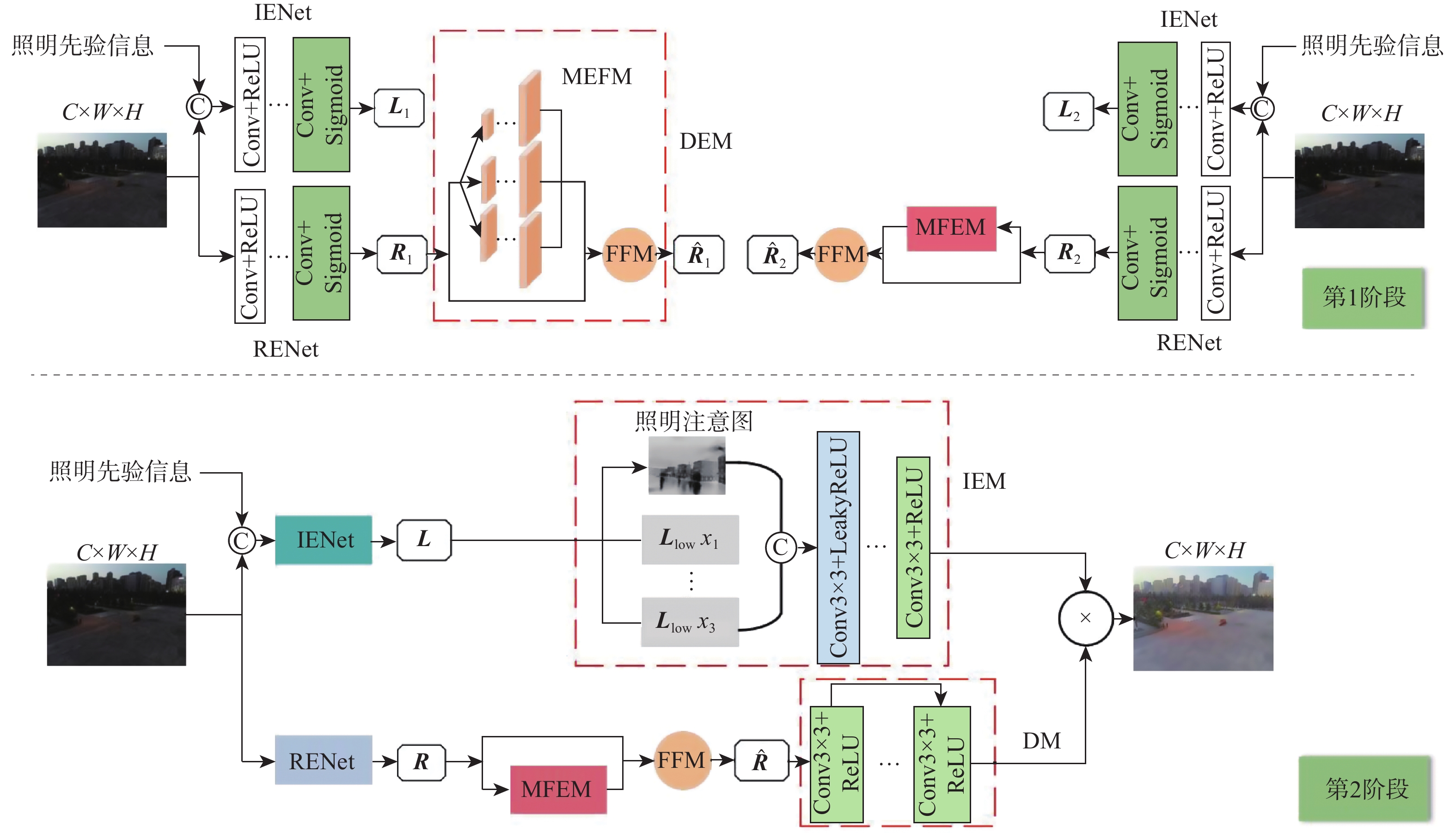
低光照图像增强是许多计算机视觉应用的重要预处理环节,针对低光照图像存在的亮度低、细节模糊、噪声干扰及成对低光/正常光训练数据获取困难等问题,提出一种新的两阶段无人机(UAV)航拍低光照图像增强算法。基于Retinex理论中内容相同的图像共享一致的反射分量,使用2张内容相同的低光照图像进行训练学习先验信息,不依赖于成对低光/正常光数据对。在第1阶段中提出细节增强模块(DEM),通过捕获不同尺度的特征信息,增强反射分量的细节及边缘信息;在第2阶段中设计照明增强模块(IEM),并引入照明注意图,增强照明分量的同时避免高对比度区域出现过曝光现象;构建去噪模块(DM)抑制反射分量中的噪声干扰。实验结果表明:所提算法在多个数据集上的视觉质量和客观评价指标优于当前先进算法,增强后的图像有助于目标检测算法在低光照图像处理上取得良好效果。
Abstract:A two-stage low-light image enhancement algorithm for unmanned aerial vehicle (UAV) aerial photography is proposed to address low-light image issues, including low brightness, fuzzy details, noise interference, and challenges in obtaining paired low/normal light training data. Low-light image enhancement is a crucial preprocessing component of many computer vision applications. Based on the Retinex theory that images with the same content share consistent reflection components, two low-light images with the same content are used for training to learn a priori information, which does not depend on paired low/normal light data pairs. The first stage features a detail enhancement module (DEM) that captures multi-scale feature information to enhance details and edges in the reflection component. To prevent overexposure in high-contrast areas while improving illumination, the second stage incorporates an illumination enhancement module (IEM) and an illumination attention map. Additionally, a denoise module (DM) is incorporated to suppress noise in the reflection component. Experimental results indicate that our method outperforms current state-of-the-art algorithms in visual quality and objective evaluation metrics across multiple datasets. Moreover, the enhanced images significantly improve the performance of target detection algorithms in low-light conditions.
-
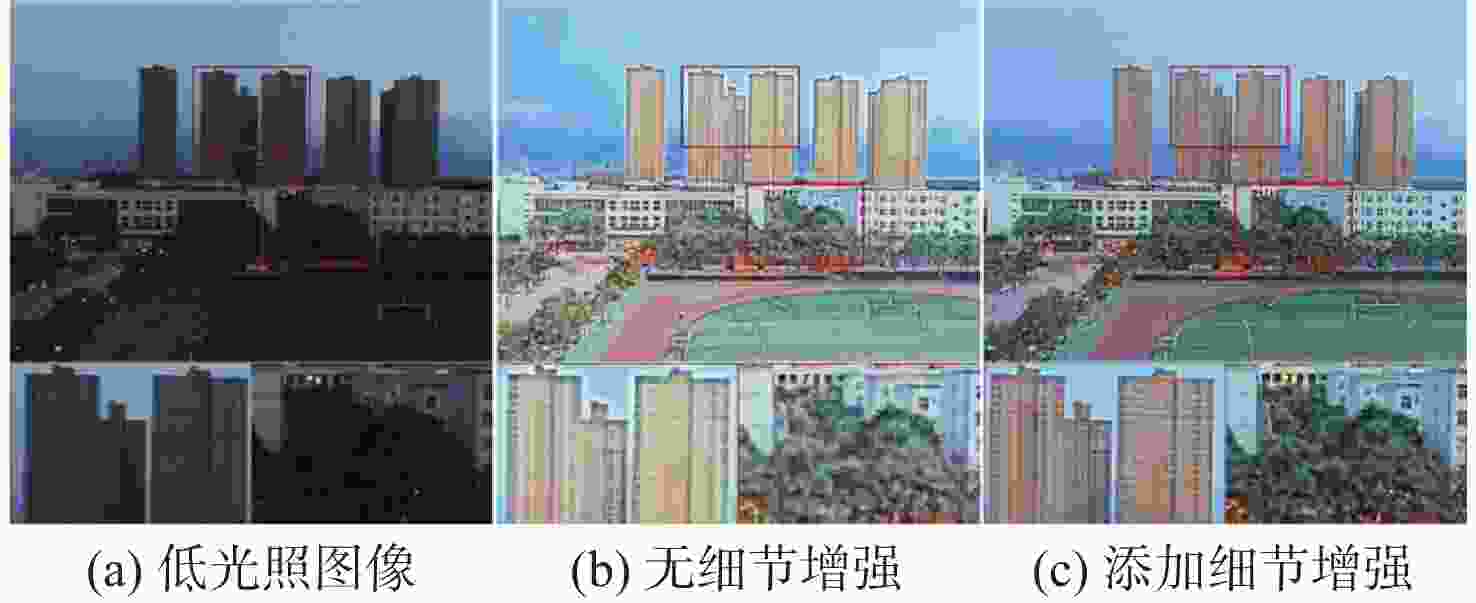
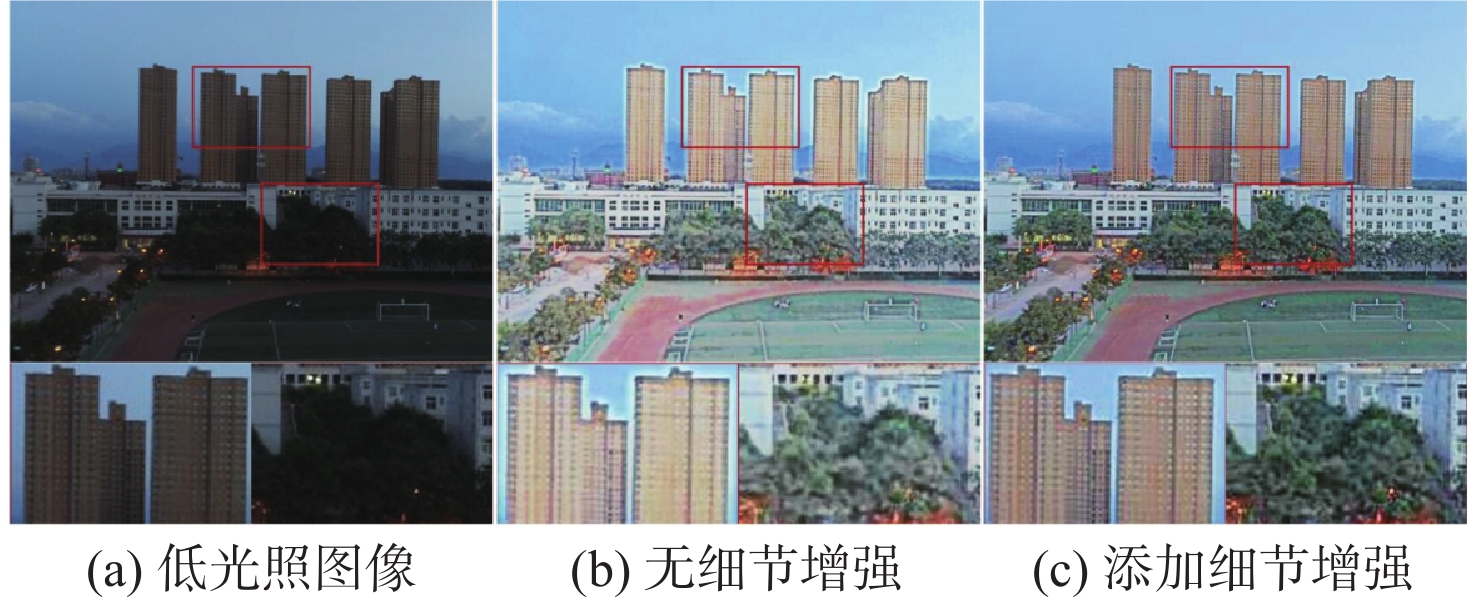
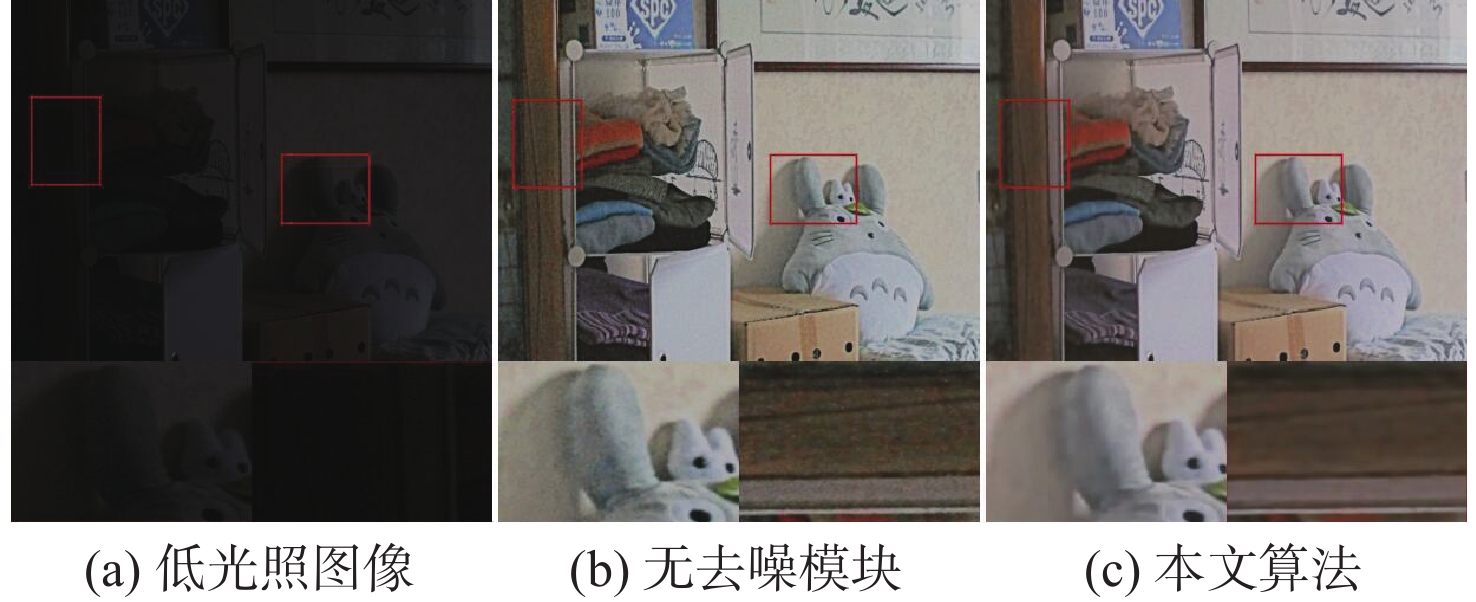
图 4 细节增强模块消融实验对比
Figure 4. Comparison of detail enhancement module ablation experiments
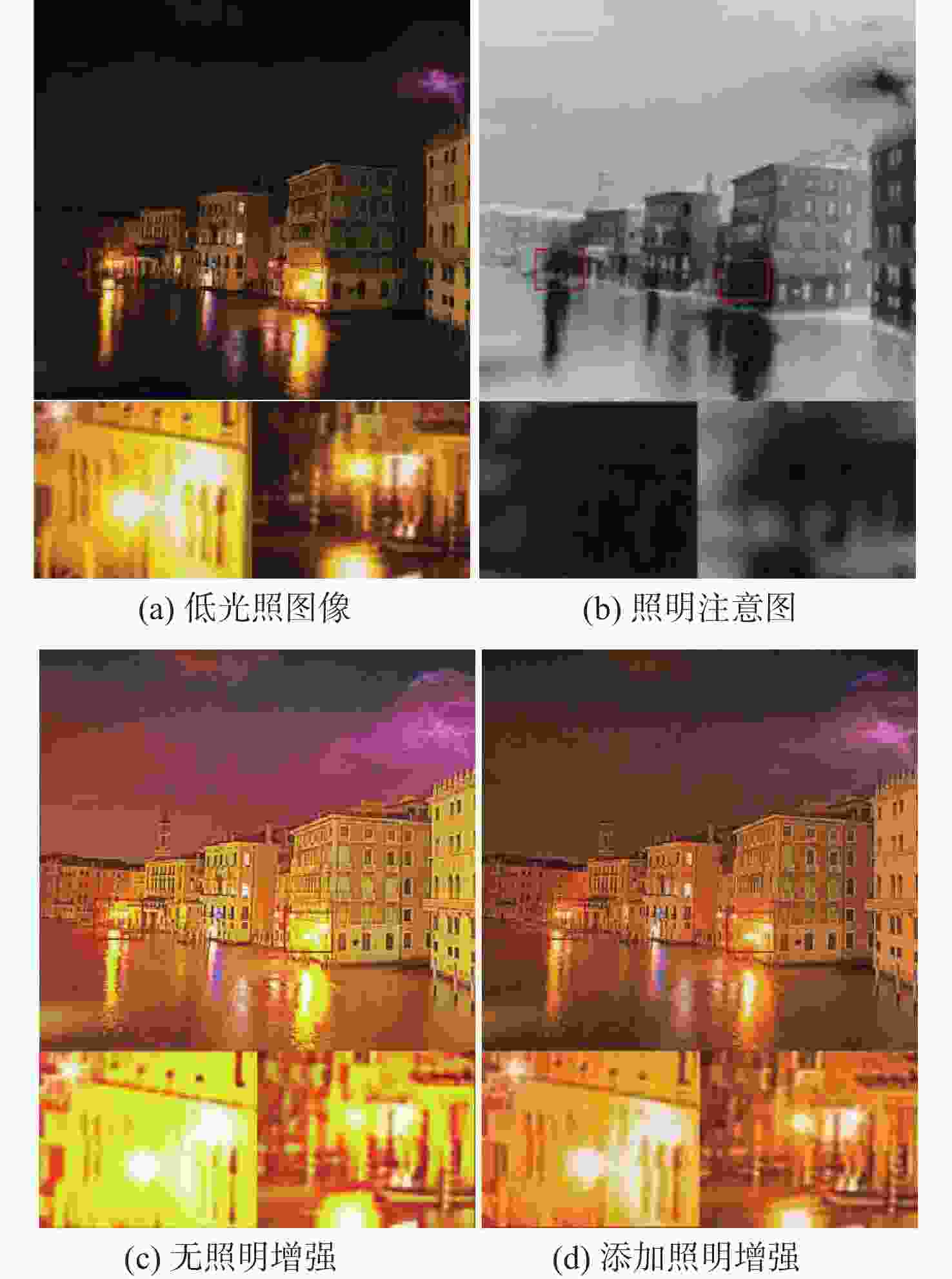
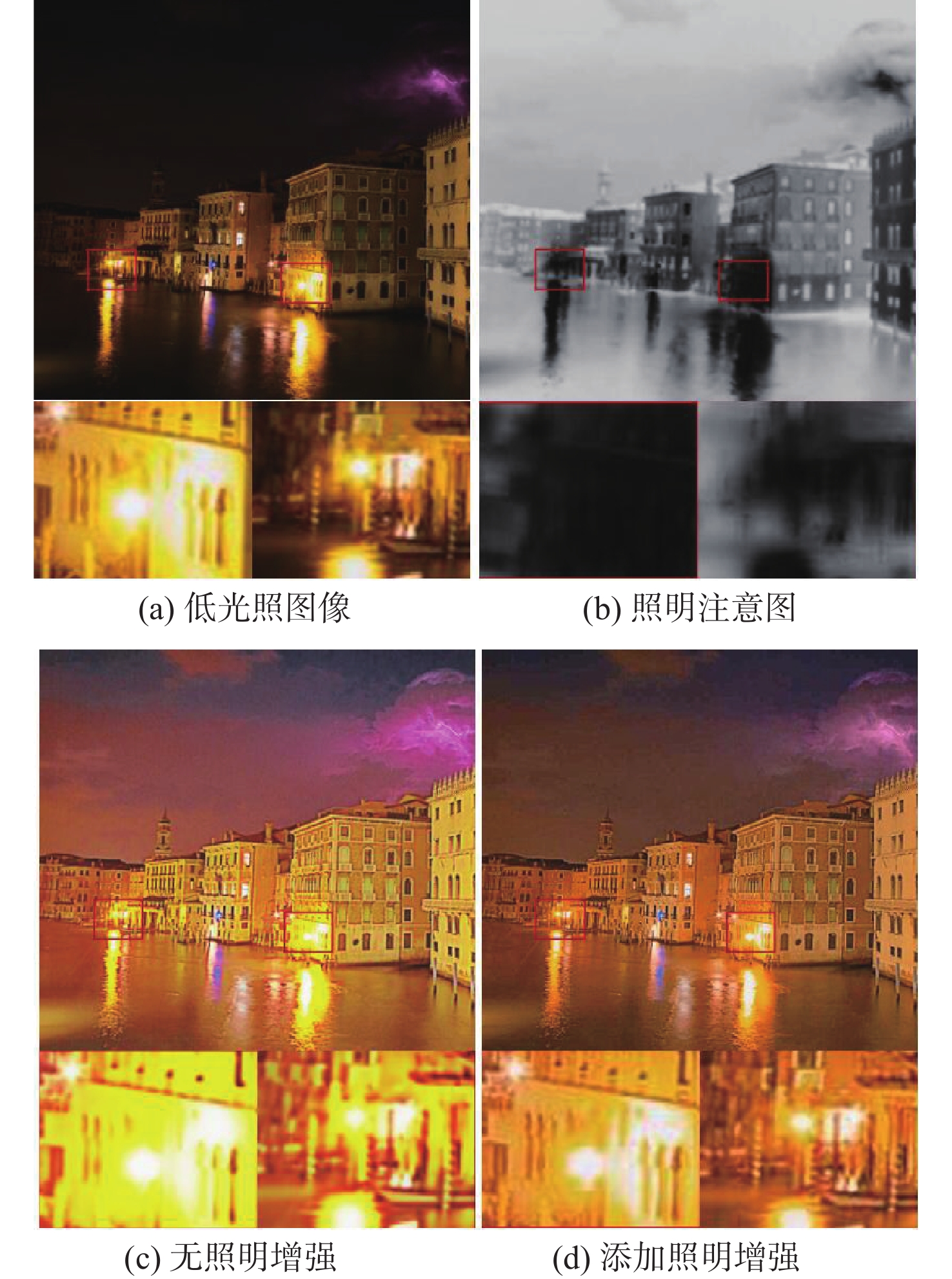
图 7 照明增强模块消融实验对比
Figure 7. Comparison of illumination enhancement module ablation experiments
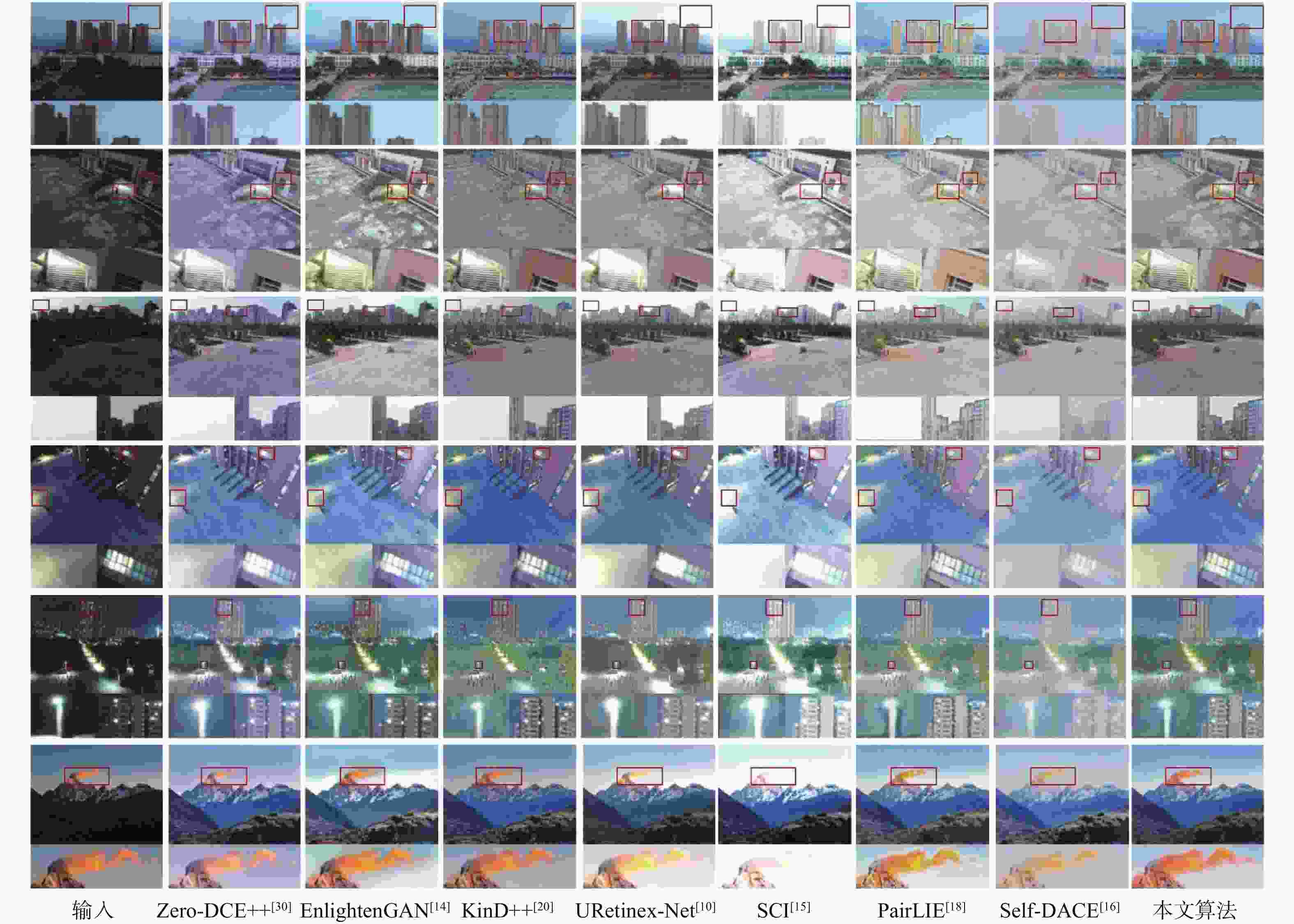
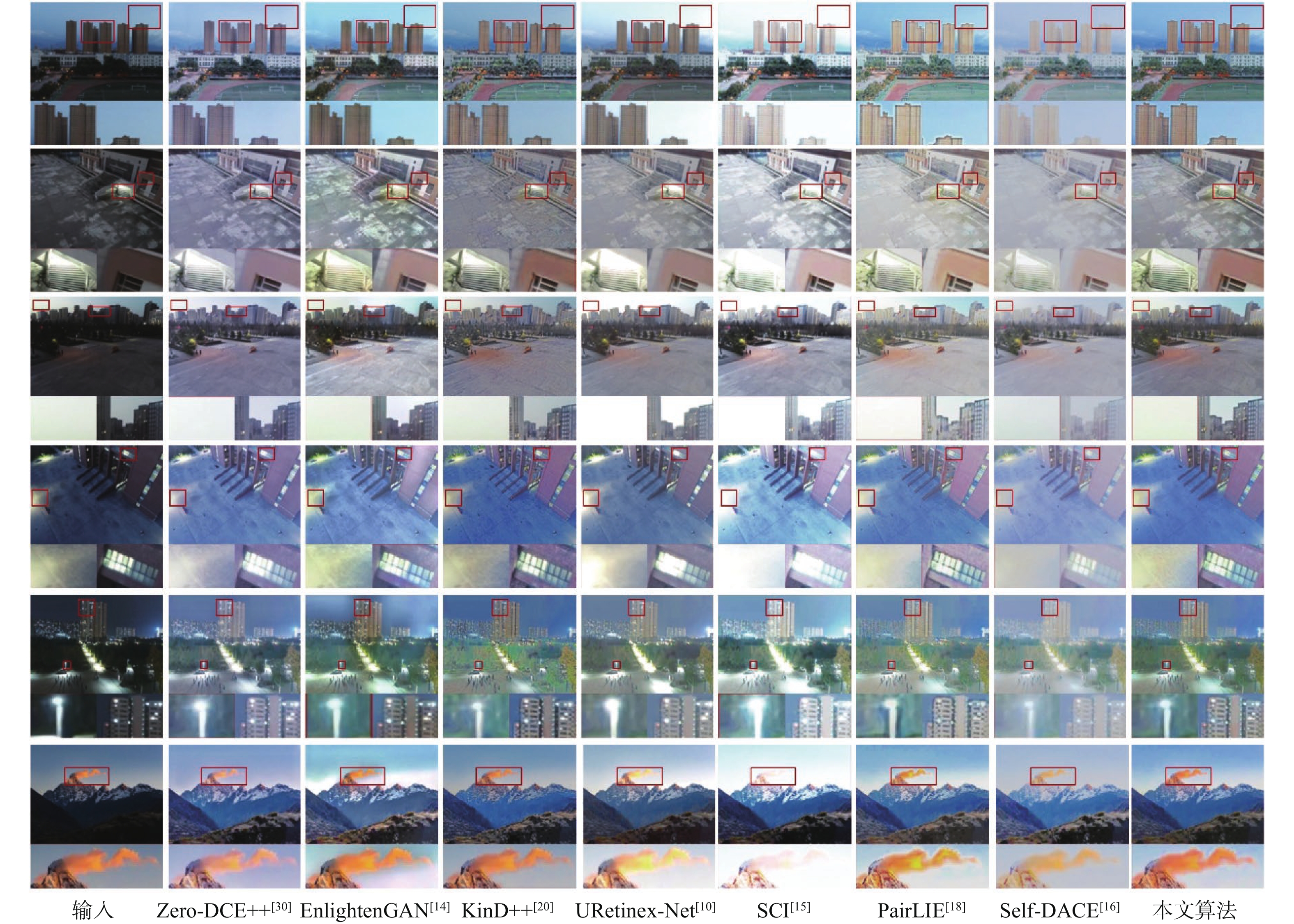
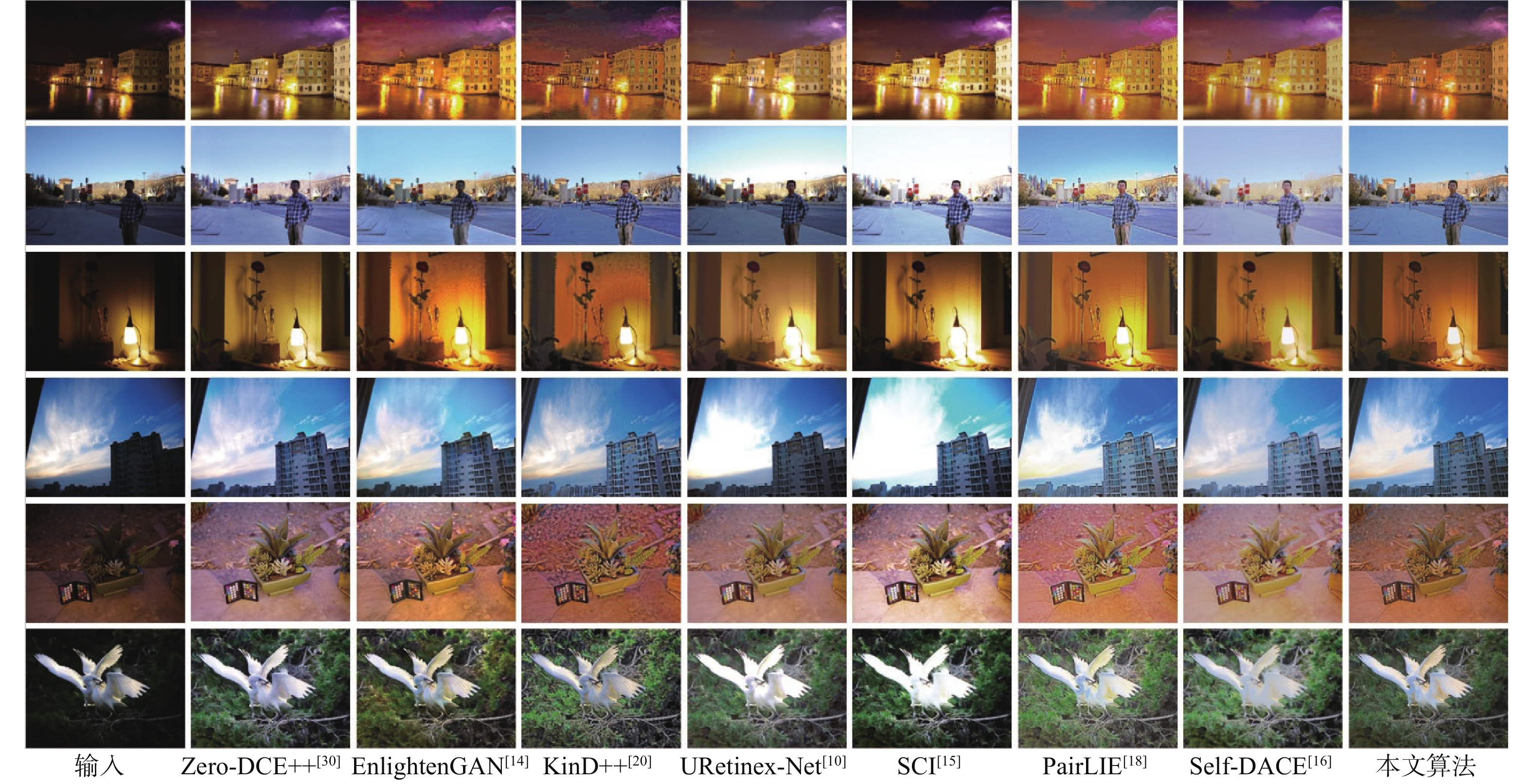
图 9 不同算法在自建数据集上的增强结果
Figure 9. Enhancement results of different algorithms on the self-built dataset
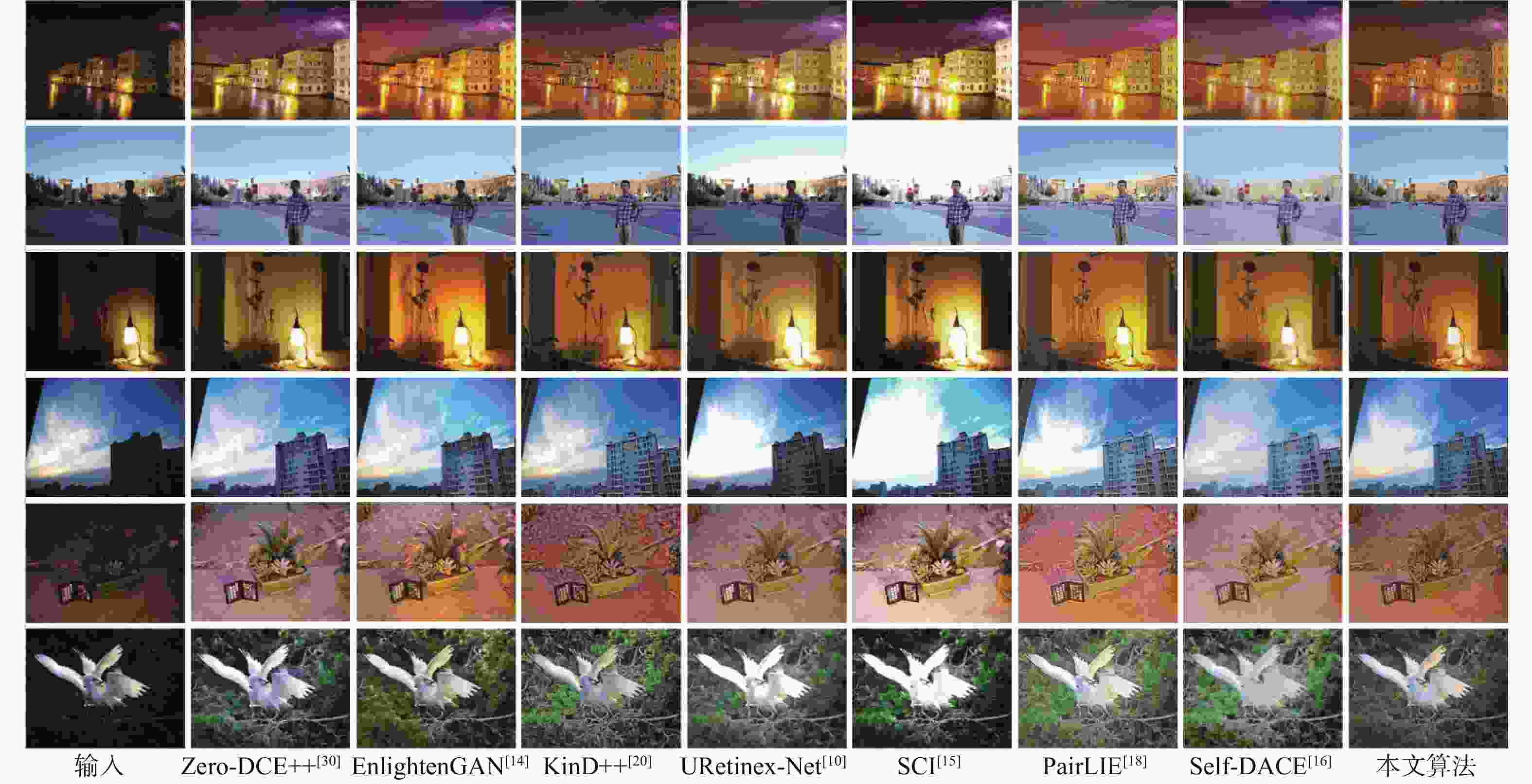
图 10 不同算法在公开数据集上的增强结果
Figure 10. Enhancement results of different algorithms on public datasets
表 1 不同算法的客观评价指标
Table 1. Objective evaluation indicators for different algorithms
算法 LOE BRISQUE NIQE 时间/s 参数量 RetinexNet[8] 702.80 31.47 3.663 0.120 0.555×10⁶ MBLLEN[25] 361.15 32.92 3.849 13.991 0.450×10⁶ KinD[9] 723.10 25.22 3.904 0.148 8.160×10⁶ DRBN[26] 462.32 28.69 3.450 0.878 0.577×10⁶ TBEFN[27] 406.56 19.00 3.419 0.050 0.486×10⁶ Zero-DCE[13] 263.77 29.66 3.550 0.003 0.079×10⁶ DSLR[28] 200.29 18.41 3.438 0.074 14.931 ×10⁶KinD++[20] 609.83 23.05 3.813 1.068 8.275×10⁶ RUAS[29] 614.95 51.41 6.071 0.006 0.003×10⁶ Zero-DCE++[30] 287.97 24.91 3.423 0.001 0.011×10⁶ EnlightenGAN[14] 408.01 17.64 3.297 0.008 8.637×10⁶ R2RNet[31] 227.57 28.55 3.896 0.667 35.740×10⁶ URetinex-Net[10] 153.29 19.83 3.434 0.037 0.917×10⁶ SCI[15] 222.67 20.14 3.568 0.002 0.011×10⁶ PairLIE[18] 322.69 20.59 3.892 0.003 0.342×10⁶ Self-DACE[16] 288.52 30.19 3.990 0.007 0.699×10⁶ 本文算法 169.87 18.86 3.276 0.013 0.773×10⁶  下载: 导出CSV
表 2 不同算法在公开数据集上的NIQE
Table 2. NIQE of different algorithms on public datasets
算法 NIQE LIME MEF NPE DICM RetinexNet[8] 4.887 4.923 4.447 4.695 MBLLEN[25] 4.458 4.949 4.385 4.868 KinD[9] 4.323 3.716 4.379 3.824 DRBN[26] 4.143 3.775 4.096 3.787 TBEFN[27] 3.954 3.560 4.028 3.670 Zero-DCE[13] 3.769 3.754 3.976 3.446 DSLR[28] 4.231 4.025 4.313 4.519 KinD++[20] 4.197 3.567 4.223 3.687 RUAS[29] 4.358 4.746 4.483 4.471 Zero-DCE++[30] 3.967 3.629 4.022 3.337 EnlightenGAN[14] 3.719 3.317 4.113 3.567 R2RNet[31] 4.272 4.460 4.213 4.358 URetinex-Net[10] 4.241 3.987 4.041 3.707 SCI[15] 4.180 3.723 4.370 4.005 PairLIE[18] 4.294 3.975 4.107 3.796 Self-DACE[16] 4.143 4.562 4.367 3.949 本文算法 3.617 3.491 3.964 3.512
下载: 导出CSV
表 3 消融实验客观评价指标
Table 3. Objective evaluation indicators for ablation experiments
DEM DM PSNR/dB SSIM 19.53 0.729 √ 20.23 0.779 √ 19.16 0.735 √ √ 19.92 0.761
下载: 导出CSV
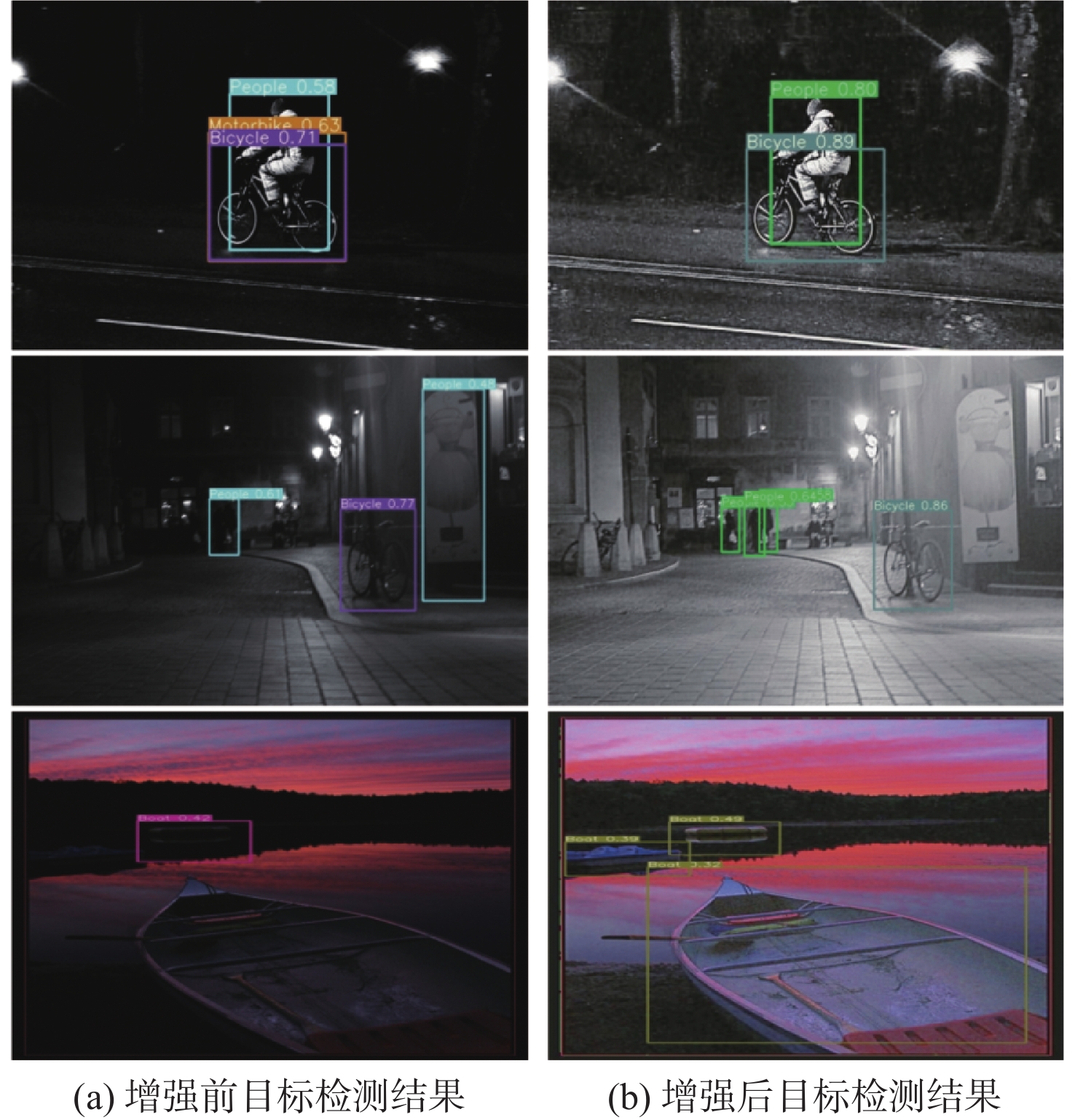
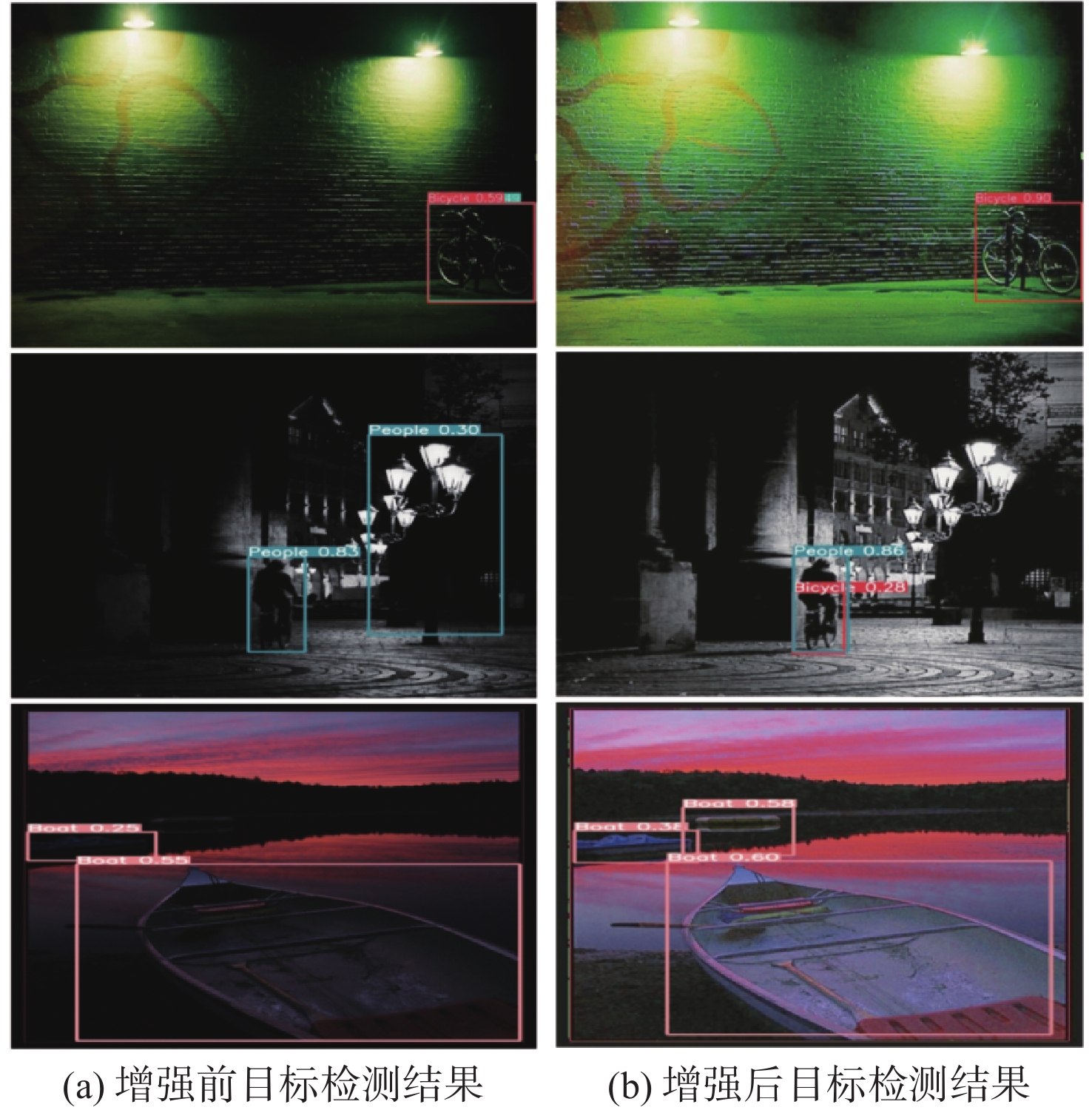
表 4 增强前后目标检测算法的精度对比
Table 4. Comparison of accuracy of object detection algorithms before and after enhancement
下载: 导出CSV
-
[1] Yang K F, Cheng C, Zhao S X, et al. Learning to adapt to light[J]. International Journal of Computer Vision, 2023, 131(4): 1022-1041. [2] 王殿伟, 刘旺, 房杰, 等. 颜色一致性的无人机航拍低光照图像增强算法[J]. 北京航空航天大学学报, 2025, 51(4): 1096-1106.Wang D W, Liu W, Fang J, et al. Low illumination image enhancement algorithm for UAV aerial photography with color consistency[J]. Journal of Beijing University of Aeronautics and Astronautics, 2025, 51(4): 1096-1106(in Chinese). [3] Pizer S M, Amburn E P, Austin J D, et al. Adaptive histogram equalization and its variations[J]. Computer Vision, Graphics, and Image Processing, 1987, 39(3): 355-368. [4] Pisano E D, Zong S Q, Hemminger B M, et al. Contrast limited adaptive histogram equalization image processing to improve the detection of simulated spiculations in dense mammograms[J]. Journal of Digital Imaging, 1998, 11(4): 193. [5] Land E H. The retinex theory of color vision[J]. Scientific American, 1977, 237(6): 108-129. [6] Jobson D J, Rahman Z, Woodell G A. A multiscale retinex for bridging the gap between color images and the human observation of scenes[J]. IEEE Transactions on Image Processing, 1997, 6(7): 965-976. [7] Guo X, Li Y, Ling H. LIME: low-light image enhancement via illumination map estimation[J]. IEEE Transactions on Image Processing, 2017, 26(2): 982-993. [8] Wei C, Wang W J, Yang W H, et al. Deep retinex decomposition for low-light enhancement[EB/OL]. (2018-08-14)[2024-05-15]. https://arxiv.org/abs/1808.04560. [9] Zhang Y H, Zhang J W, Guo X J. Kindling the darkness: a practical low-light image enhancer[C]//Proceedings of the 27th ACM International Conference on Multimedia. New York: ACM, 2019: 1632-1640. [10] Wu W H, Weng J, Zhang P P, et al. URetinex-Net: retinex-based deep unfolding network for low-light image enhancement[C]//Proceedings of the IEEE/CVF Conference on Computer Vision and Pattern Recognition. Piscataway: IEEE Press, 2022: 5891-5900. [11] Yi X P, Xu H, Zhang H, et al. Diff-Retinex: rethinking low-light image enhancement with a generative diffusion model[C]//Proceedings of the IEEE/CVF International Conference on Computer Vision. Piscataway: IEEE Press, 2024: 12268-12277. [12] Cai Y H, Bian H, Lin J, et al. Retinexformer: one-stage retinex-based transformer for low-light image enhancement[C]//Proceedings of the IEEE/CVF International Conference on Computer Vision. Piscataway: IEEE Press, 2024: 12470-12479. [13] Guo C L, Li C Y, Guo J C, et al. Zero-reference deep curve estimation for low-light image enhancement[C]//Proceedings of the IEEE/CVF Conference on Computer Vision and Pattern Recognition. Piscataway: IEEE Press, 2020: 1777-1786. [14] Jiang Y F, Gong X Y, Liu D, et al. EnlightenGAN: deep light enhancement without paired supervision[J]. IEEE Transactions on Image Processing, 2021, 30: 2340-2349. [15] Ma L, Ma T Y, Liu R S, et al. Toward fast, flexible, and robust low-light image enhancement[C]//Proceedings of the IEEE/CVF Conference on Computer Vision and Pattern Recognition. Piscataway: IEEE Press, 2022: 5627-5636. [16] Wen J Y, Wu C H, Zhang T, et al. Self-reference deep adaptive curve estimation for low-light image enhancement[EB/OL]. (2023-09-10)[2024-05-15]. https://arxiv.org/abs/2308.08197. [17] Li C Y, Guo C L, Han L H, et al. Low-light image and video enhancement using deep learning: a survey[J]. IEEE Transactions on Pattern Analysis and Machine Intelligence, 2022, 44(12): 9396-9416. [18] Fu Z Q, Yang Y, Tu X T, et al. Learning a simple low-light image enhancer from paired low-light instances[C]//Proceedings of the IEEE/CVF Conference on Computer Vision and Pattern Recognition. Piscataway: IEEE Press, 2023: 22252-22261. [19] Cai J R, Gu S H, Zhang L. Learning a deep single image contrast enhancer from multi-exposure images[J]. IEEE Transactions on Image Processing, 2018, 27(4): 2049-2062. [20] Zhang Y H, Guo X J, Ma J Y, et al. Beyond brightening low-light images[J]. International Journal of Computer Vision, 2021, 129(4): 1013-1037. [21] Wang L W, Liu Z S, Siu W C, et al. Lightening network for low-light image enhancement[J]. IEEE Transactions on Image Processing, 2020, 29: 7984-7996. [22] Hu J, Shen L, Sun G. Squeeze-and-excitation networks[C]//Proceedings of the IEEE/CVF Conference on Computer Vision and Pattern Recognition. Piscataway: IEEE Press, 2018: 7132-7141. [23] Wei K X, Fu Y, Zheng Y Q, et al. Physics-based noise modeling for extreme low-light photography[J]. IEEE Transactions on Pattern Analysis and Machine Intelligence, 2022, 44(11): 8520-8537. [24] Zhu M F, Pan P B, Chen W, et al. EEMEFN: low-light image enhancement via edge-enhanced multi-exposure fusion network[J]. Proceedings of the AAAI Conference on Artificial Intelligence, 2020, 34(7): 13106-13113. [25] Lv F F, Lu F, Wu J H, et al. MBLLEN: low-light image/video enhancement using CNNs[C]//Proceedings of the British Machine Vision Conference. Durham: BMVA Press, 2018. [26] Yang W H, Wang S Q, Fang Y M, et al. From fidelity to perceptual quality: a semi-supervised approach for low-light image enhancement[C]//Proceedings of the IEEE/CVF Conference on Computer Vision and Pattern Recognition. Piscataway: IEEE Press, 2020: 3060-3069. [27] Lu K, Zhang L H. TBEFN: a two-branch exposure-fusion network for low-light image enhancement[J]. IEEE Transactions on Multimedia, 2021, 23: 4093-4105. [28] Lim S, Kim W. DSLR: deep stacked Laplacian restorer for low-light image enhancement[J]. IEEE Transactions on Multimedia, 2021, 23: 4272-4284. [29] Liu R S, Ma L, Zhang J A, et al. Retinex-inspired unrolling with cooperative prior architecture search for low-light image enhancement[C]//Proceedings of the IEEE/CVF Conference on Computer Vision and Pattern Recognition. Piscataway: IEEE Press, 2021: 10556-10565. [30] Li C Y, Guo C L, Loy C C. Learning to enhance low-light image via zero-reference deep curve estimation[J]. IEEE Transactions on Pattern Analysis and Machine Intelligence, 2022, 44(8): 4225-4238. [31] Hai J, Xuan Z, Yang R, et al. R2RNet: low-light image enhancement via real-low to real-normal network[J]. Journal of Visual Communication and Image Representation, 2023, 90: 103712. [32] Ahn H, Keum B, Kim D, et al. Adaptive local tone mapping based on retinex for high dynamic range images[C]//Proceedings of the IEEE International Conference on Consumer Electronics. Piscataway: IEEE Press, 2013: 153-156. [33] Mittal A, Moorthy A K, Bovik A C. No-reference image quality assessment in the spatial domain[J]. IEEE Transactions on Image Processing, 2012, 21(12): 4695-4708. [34] Mittal A, Soundararajan R, Bovik A C. Making a “completely blind” image quality analyzer[J]. IEEE Signal Processing Letters, 2013, 20(3): 209-212. [35] Loh Y P, Chan C S. Getting to know low-light images with the Exclusively Dark dataset[J]. Computer Vision and Image Understanding, 2019, 178: 30-42. [36] Wang C Y, Bochkovskiy A, Liao H M. YOLOv7: trainable bag-of-freebies sets new state-of-the-art for real-time object detectors[C]//Proceedings of the IEEE/CVF Conference on Computer Vision and Pattern Recognition. Piscataway: IEEE Press, 2023: 7464-7475. [37] Varghese R, Sambath M. YOLOv8: a novel object detection algorithm with enhanced performance and robustness[C]//Proceedings of the International Conference on Advances in Data Engineering and Intelligent Computing Systems. Piscataway: IEEE Press, 2024: 1-6. -

 下载:

计量
- 文章访问数: 903
- HTML全文浏览量: 287
- PDF下载量: 173
- 被引次数: 0
