





-
摘要:
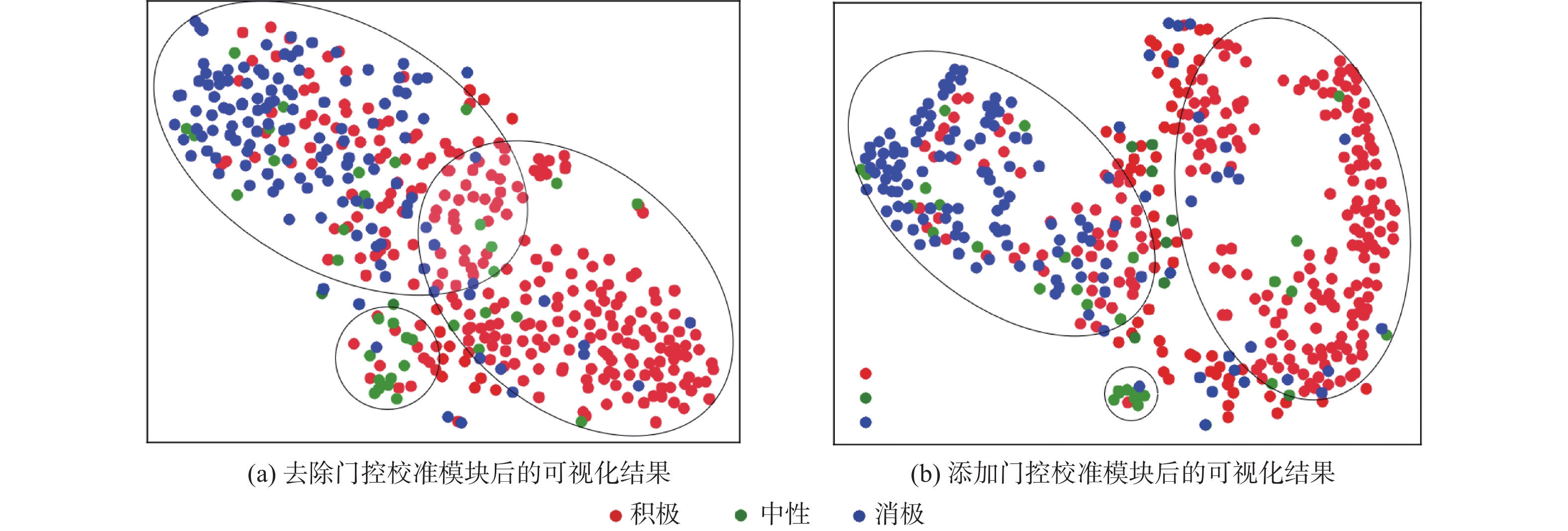
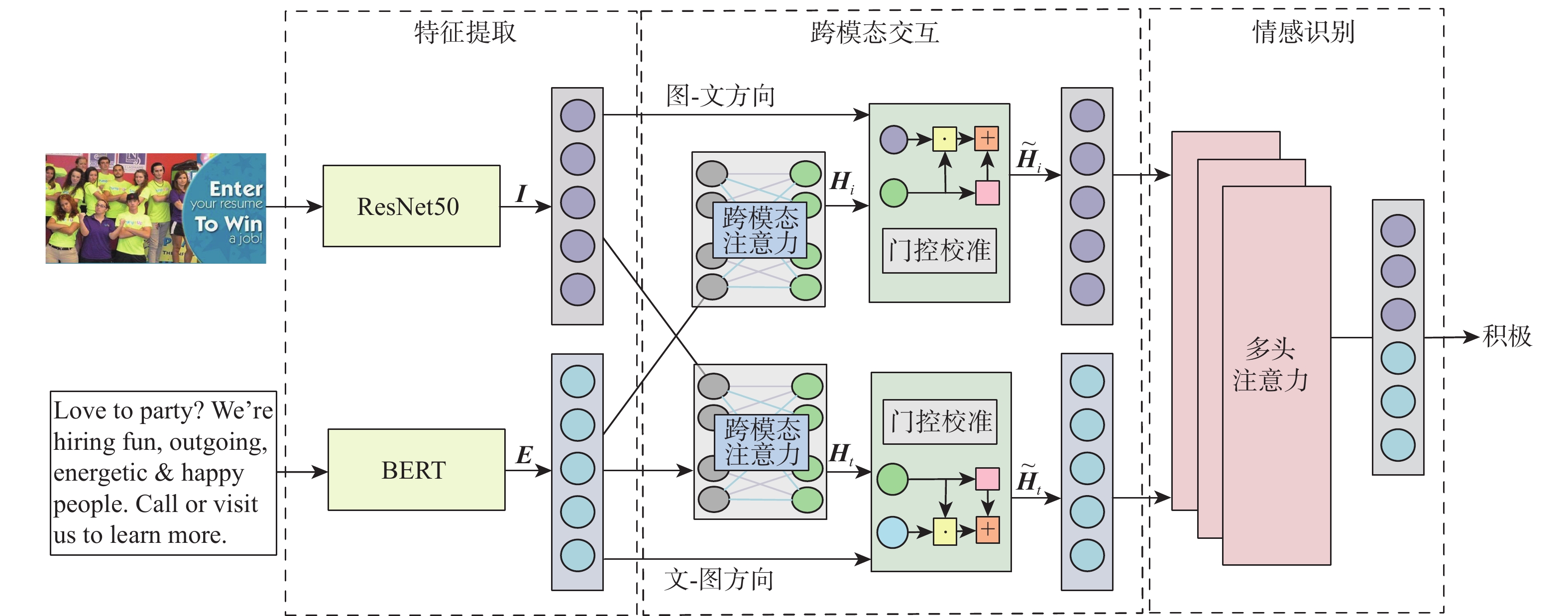
随着社交媒体用户更多地使用图文表达观点,挖掘多模态数据关联性以辅助分析用户情感成为挑战。目前的研究方法对模态间信息的交互不充分,且跨模态交互易引入噪声,导致学习到的图文表示出现情感表征偏移。为此,提出一种基于情感表征校准的图文情感分析模型。通过特征提取模块获取图文特征;在跨模态交互模块中,利用跨模态的注意力进行“图-文”和“文-图”2个方向上的双向交互,以充分利用模态间的互补信息,再通过门控校准模块过滤交互后特征中的噪声信息,来校准交互后图文表示的情感表征偏移;通过多头注意力融合图文特征进行情感识别。在2个公开的多模态数据集上进行实验,结果表明:所提方法优于CLMLF、MVCN等先进方法,能提高情感识别的准确性。
Abstract:Exploring the association of multi-modal data for sentiment analysis is made more difficult by the growing trend of social media users expressing their opinions through both text and visuals. Existing research methods lack sufficient interaction between modalities and cross-modal interactions often introduce noise, which leads to sentiment representation bias of learned image and text representations. To address this issue, we introduce a sentiment representation calibration-based model for image-text sentiment analysis. Firstly, we encode the image and text through a feature extraction module to capture image and text features. In order to fully utilize the inter-modal complementary information, the cross-modal attention is then employed in the cross-modal interaction module to carry out bidirectional interaction in the "image-to-text" and "text-to-image" directions. Next, noise is filtered out from the interaction-enhanced features through a gated calibration module to correct the sentiment representation bias in the interaction-enhanced features. Finally, in the sentiment detection module, feature fusion is achieved by using multi-head attention to integrate the calibrated feature representations for sentiment detection. Experimental results on two public benchmark datasets demonstrate that the proposed model outperforms state-of-the-art image-text sentiment analysis methods, such as CLMLF and MVCN, thereby improving the accuracy of sentiment recognition.
-
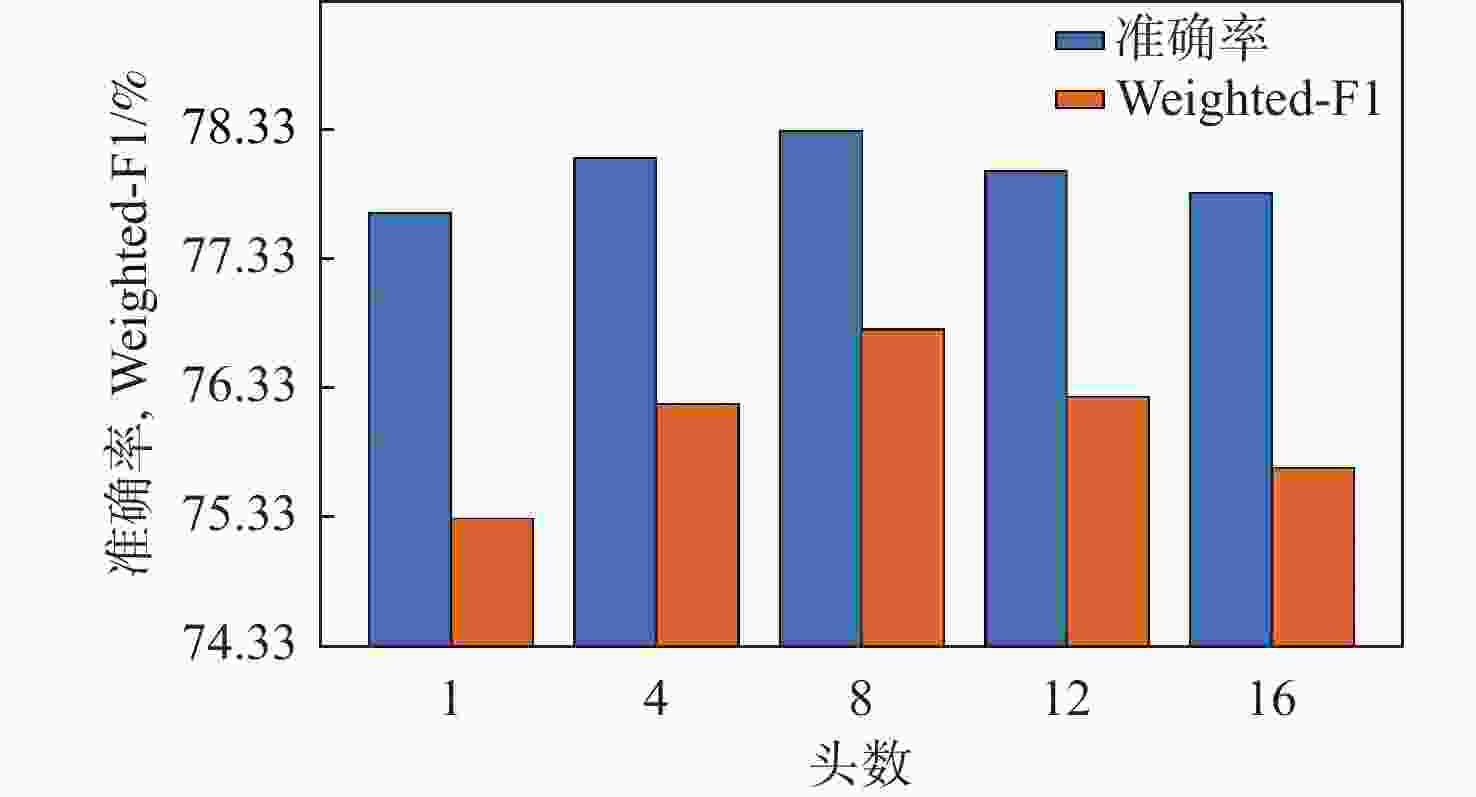
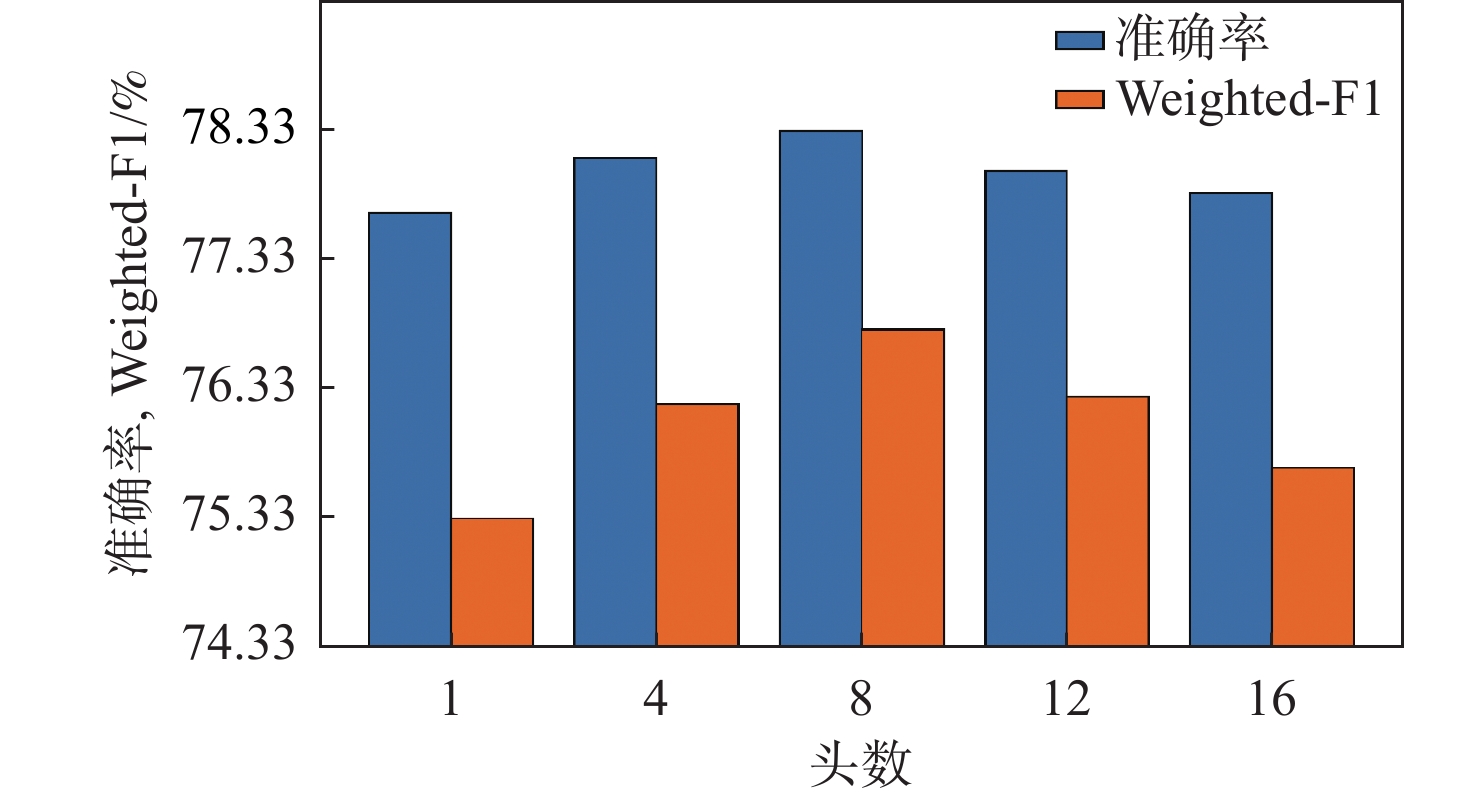
图 4 注意力头数对准确率和Weighted-F1值的影响
Figure 4. Effect of attention heads on accuracy and Weighted-F1
表 1 MVSA数据集数据
Table 1. Statistics of MVSA datasets
数据集 积极 中性 消极 总计 MVSA-Single 2683 470 1358 4511 MVSA-Multiple 11318 4407 1299 17024  下载: 导出CSV
表 2 参数设置
Table 2. Parameter settings
数据集 批大小 学习率 权重衰减系数 训练轮数 $ \gamma $ MVSA-Single 16 1×10⁻⁵ 1×10⁻⁴ 10 2 MVSA-Multiple 32 8×10⁻⁵ 1×10⁻⁴ 10 2
下载: 导出CSV
表 3 不同模型在MVSA-Single和MVSA-Multiple数据集上的对比实验结果
Table 3. Comparative experimental results of different models on MVSA-Single and MVSA-Multiple datasets
模态 模型 准确率/% Weighted-F1/% MVSA-Single MVSA-Multiple MVSA-Single MVSA-Multiple 文本 BERT[12] 72.35 67.70 70.81 67.10 图像 ResNet50[25] 67.04 62.83 64.41 60.94 ViT[30] 67.92 65.12 67.88 62.99 多模态 HSAN[16] 69.88 67.96 66.90 67.76 MultiSentiNet[17] 69.84 68.86 69.63 68.11 Co-MN-Hop6[31] 70.51 68.92 70.01 68.83 MGNNS[32] 73.77 72.49 72.70 69.34 CLMLF[23] 75.33 72.00 73.46 69.83 MVCN[24] 76.06 72.07 74.55 70.01 SRC-Model(本文) 78.32 72.81 76.79 70.13
下载: 导出CSV
表 4 MVSA-Single数据集上的消融实验结果
Table 4. Ablation results on MVSA-Single dataset
模型 准确率/% Weighted-F1/% BERT 72.35 70.81 ResNet50 67.04 64.41 SRC+M 74.56 74.54 SRC+M+A 76.33 76.07 SRC-TI 77.21 76.72 SRC-Model 78.32 76.79
下载: 导出CSV
表 5 MVSA-Multiple数据集上的消融实验结果
Table 5. Ablation results on MVSA-Multiple dataset
模型 准确率/% Weighted-F1/% BERT 67.70 67.10 ResNet50 62.83 60.94 SRC+M 69.41 67.47 SRC+M+A 71.99 67.89 SRC-TI 72.58 68.72 SRC-Model 72.81 70.13
下载: 导出CSV
表 6 不同模型的分类结果示例
Table 6. Examples classified by different models
图像 文本 真实情感 BERT ResNet50 SRC-Model 
RT@dynamitefilm:A light hearted moment on set with our actor@IANMHARDING 积极 积极(√) 积极(√) 积极(√) 
Martha said for Valentine’s Day she wanted a heart shaped pancake for lunch. Being the doting husband I am... 积极 积极(√) 中性(×) 积极(√) 
I HAVE NO WORDS IM SPEECHLESS 积极 消极(×) 积极(√) 积极(√)
下载: 导出CSV
-
[1] 张亚洲, 戎璐, 宋大为, 等. 多模态情感分析研究综述[J]. 模式识别与人工智能, 2020, 33(5): 426-438.Zhang Y Z, Rong L, Song D W, et al. A survey on multimodal sentiment analysis[J]. Pattern Recognition and Artificial Intelligence, 2020, 33(5): 426-438(in Chinese). [2] Das R, Singh T D. Multimodal sentiment analysis: a survey of methods, trends, and challenges[J]. ACM Computing Surveys, 2023, 55(13s): 1-38. [3] Kaur P, Pannu H S, Malhi A K. Comparative analysis on cross-modal information retrieval: a review[J]. Computer Science Review, 2021, 39: 100336. [4] Serrano-Guerrero J, Romero F P, Olivas J A. Fuzzy logic applied to opinion mining: a review[J]. Knowledge-Based Systems, 2021, 222: 107018. [5] 郑祎豪, 郭奕君, 毋立芳, 等. 知识驱动的多模态语义理解研究综述[J]. 模式识别与人工智能, 2023, 36(12): 1127-1138.Zheng Y H, Guo Y J, Wu L F, et al. A survey on knowledge-driven multimodal semantic understanding[J]. Pattern Recognition and Artificial Intelligence, 2023, 36(12): 1127-1138(in Chinese). [6] Wiebe J M, Bruce R F, O’Hara T P. Development and use of a gold-standard data set for subjectivity classifications[C]//Proceedings of the 37th Annual Meeting of the Association for Computational Linguistics on Computational Linguistics. New York: ACM, 1999: 246-253. [7] Zhang S X, Zhu A Q, Zhu G L, et al. Building fake review detection model based on sentiment intensity and PU learning[J]. IEEE Transactions on Neural Networks and Learning Systems, 2023, 34(10): 6926-6939. [8] Pashchenko Y, Rahman M F, Hossain M S, et al. Emotional and the normative aspects of customers’ reviews[J]. Journal of Retailing and Consumer Services, 2022, 68: 103011. [9] Kim Y. Convolutional neural networks for sentence classification[C]//Proceedings of the Conference on Empirical Methods in Natural Language Processing. Kerrville: ACL, 2014: 1746-1751. [10] Wang L, Cao H, Yuan L. Gated tree-structured RecurNN for detecting biomedical event trigger[J]. Applied Soft Computing, 2022, 126: 109251. [11] Vaswani A, Shazeer N, Parmar N, et al. Attention is all you need[C]//Proceedings of the 31st International Conference on Neural Information Processing Systems. New York: ACM, 2017: 6000-6010. [12] Devlin J, Chang M W, Lee K, et al. BERT: pre-training of deep bidirectional Transformers for language understanding[C]//Proceedings of the Conference of the North American Chapter of the Association for Computational Linguistics: Human Language Technologies, Volume 1. Kerrville: ACL, 2019: 4171-4186. [13] Dai J Q, Yan H, Sun T X, et al. Does syntax matter? a strong baseline for aspect-based sentiment analysis with RoBERTa[C]// Proceedings of the Conference of the North American Chapter of the Association for Computational Linguistics: Human Language Technologies. Kerrville: ACL, 2021: 1816-1829. [14] Liu Y H, Ott M, Goyal N, et al. RoBERTa: a robustly optimized BERT pretraining approach[PP/OL]. arXiv (2019-07-26)[2024-07-14]. https://arxiv.org/abs/1907.11692. [15] Liu N N, Dellandréa E, Chen L M, et al. Multimodal recognition of visual concepts using histograms of textual concepts and selective weighted late fusion scheme[J]. Computer Vision and Image Understanding, 2013, 117(5): 493-512. [16] Xu N. Analyzing multimodal public sentiment based on hierarchical semantic attentional network[C]//Proceedings of the IEEE International Conference on Intelligence and Security Informatics. Piscataway: IEEE Press, 2017: 152-154. [17] Xu N, Mao W J. MultiSentiNet: a deep semantic network for multimodal sentiment analysis[C]//Proceedings of the ACM on Conference on Information and Knowledge Management. New York: ACM, 2017: 2399-2402. [18] Huang C Q, Zhang J L, Wu X M, et al. TeFNA: text-centered fusion network with crossmodal attention for multimodal sentiment analysis[J]. Knowledge-Based Systems, 2023, 269: 110502. [19] Yang X C, Feng S, Wang D L, et al. Image-text multimodal emotion classification via multi-view attentional network[J]. IEEE Transactions on Multimedia, 2021, 23: 4014-4026. [20] Zhu T, Li L D, Yang J F, et al. Multimodal sentiment analysis with image-text interaction network[J]. IEEE Transactions on Multimedia, 2023, 25: 3375-3385. [21] Chen D L, Su W, Wu P, et al. Joint multimodal sentiment analysis based on information relevance[J]. Information Processing & Management, 2023, 60(2): 103193. [22] 吴思思, 马静. 基于感知融合的多任务多模态情感分析模型[J]. 数据分析与知识发现, 2023, 7(10): 74-84.Wu S S, Ma J. Multi-task & multi-modal sentiment analysis model based on aware fusion[J]. Data Analysis and Knowledge Discovery, 2023, 7(10): 74-84(in Chinese). [23] Li Z, Xu B, Zhu C H, et al. CLMLF: a contrastive learning and multi-layer fusion method for multimodal sentiment detection[C]// Proceedings of the Findings of the Association for Computational Linguistics. Kerrville: ACL, 2022: 2282-2294. [24] Wei Y W, Yuan S Z, Yang R S, et al. Tackling modality heterogeneity with multi-view calibration network for multimodal sentiment detection[C]//Proceedings of the 61st Annual Meeting of the Association for Computational Linguistics. Kerrville: ACL, 2023: 5240-5252. [25] He K M, Zhang X Y, Ren S Q, et al. Deep residual learning for image recognition[C]//Proceedings of the IEEE Conference on Computer Vision and Pattern Recognition. Piscataway: IEEE Press, 2016: 770-778. [26] Yang K C, Xu H, Gao K. CM-BERT: cross-modal BERT for text-audio sentiment analysis[C]//Proceedings of the 28th ACM International Conference on Multimedia. New York: ACM, 2020: 521-528. [27] Du Y P, Liu Y, Peng Z, et al. Gated attention fusion network for multimodal sentiment classification[J]. Knowledge-Based Systems, 2022, 240: 108107. [28] Lin T Y, Goyal P, Girshick R, et al. Focal loss for dense object detection[PP/OL]. arXiv (2018-02-07)[2024-07-14]. https://doi.org/10.48550/arxiv.1708.02002. [29] Niu T, Zhu S A, Pang L, et al. Sentiment analysis on multi-view social data[C]//Proceedings of the MultiMedia Modeling. Berlin: Springer, 2016: 15-27. [30] Dosovitskiy A, Beyer L, Kolesnikov A, et al. An image is worth 16×16 words: Transformers for image recognition at scale[PP/OL]. arXiv (2021-06-03)[2024-07-14]. https://doi.org/10.48550/arxiv.2010.11929. [31] Xu N, Mao W J, Chen G D. A co-memory network for multimodal sentiment analysis[C]//Proceedings of the 41st International ACM SIGIR Conference on Research & Development in Information Retrieval. New York: ACM, 2018: 929-932. [32] Yang X C, Feng S, Zhang Y F, et al. Multimodal sentiment detection based on multi-channel graph neural networks[C]//Proceedings of the 59th Annual Meeting of the Association for Computational Linguistics and the 11th International Joint Conference on Natural Language Processing. Kerrville: ACL, 2021: 328-339. -

 下载:

计量
- 文章访问数: 396
- HTML全文浏览量: 149
- PDF下载量: 134
- 被引次数: 0
