





-
摘要:
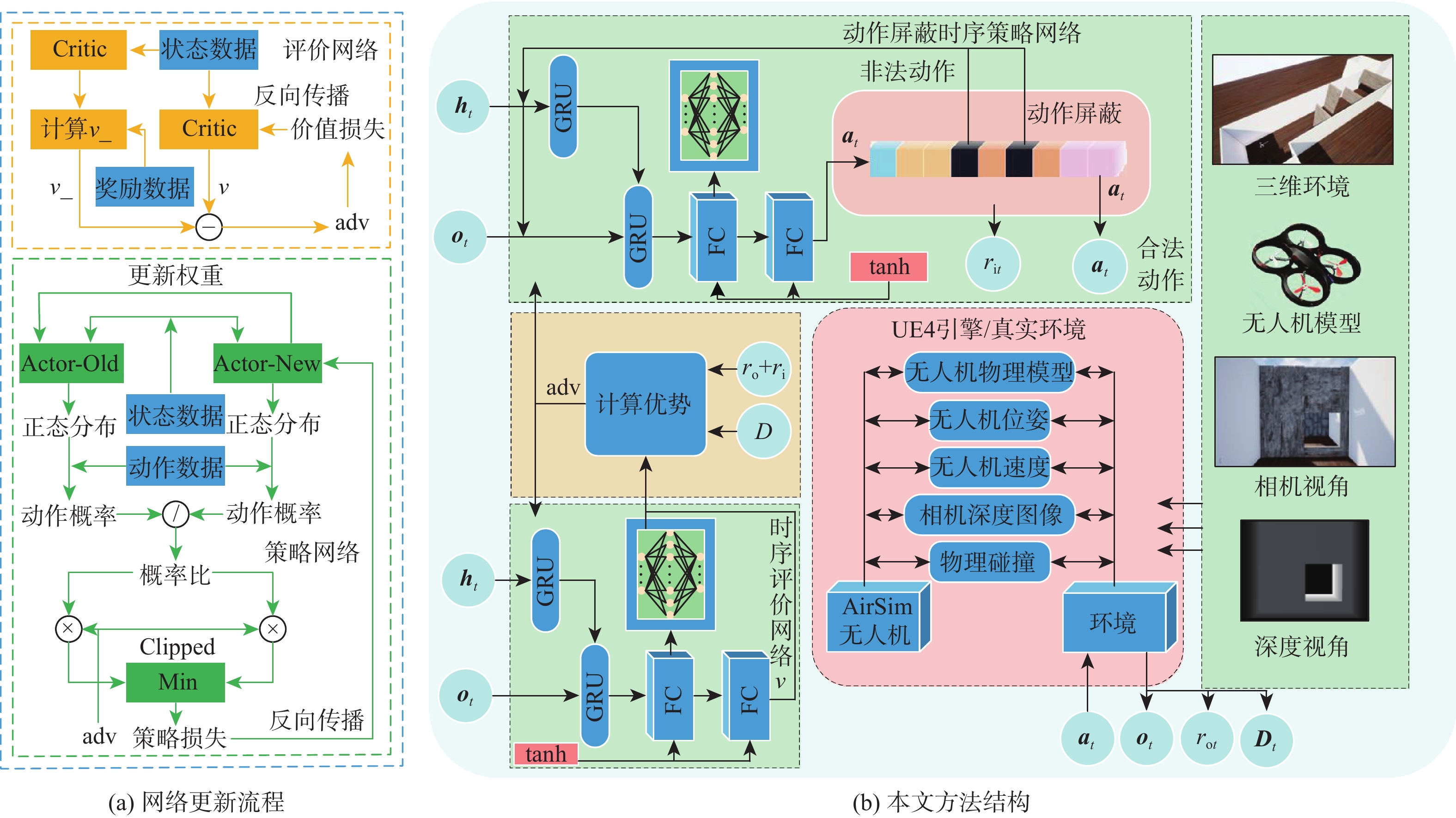
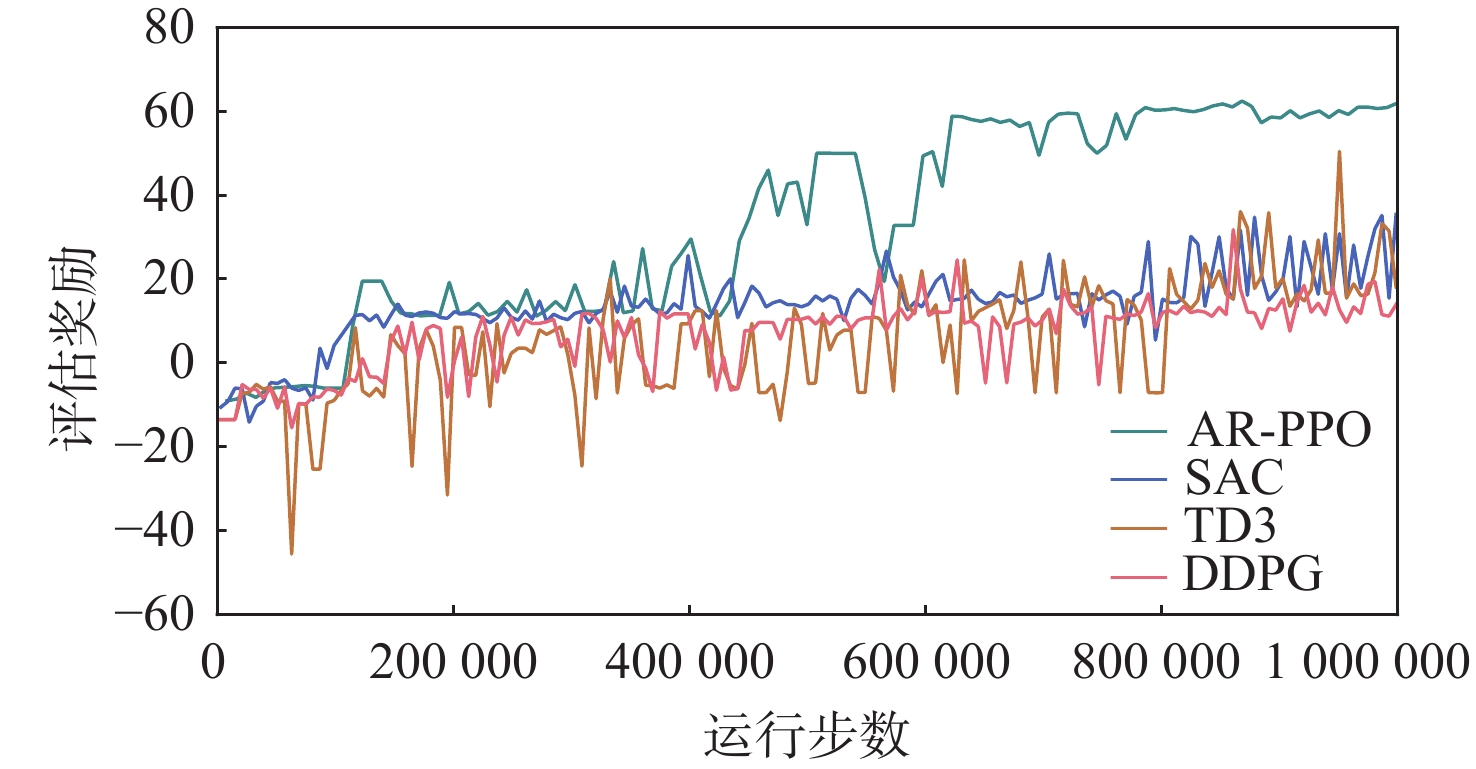
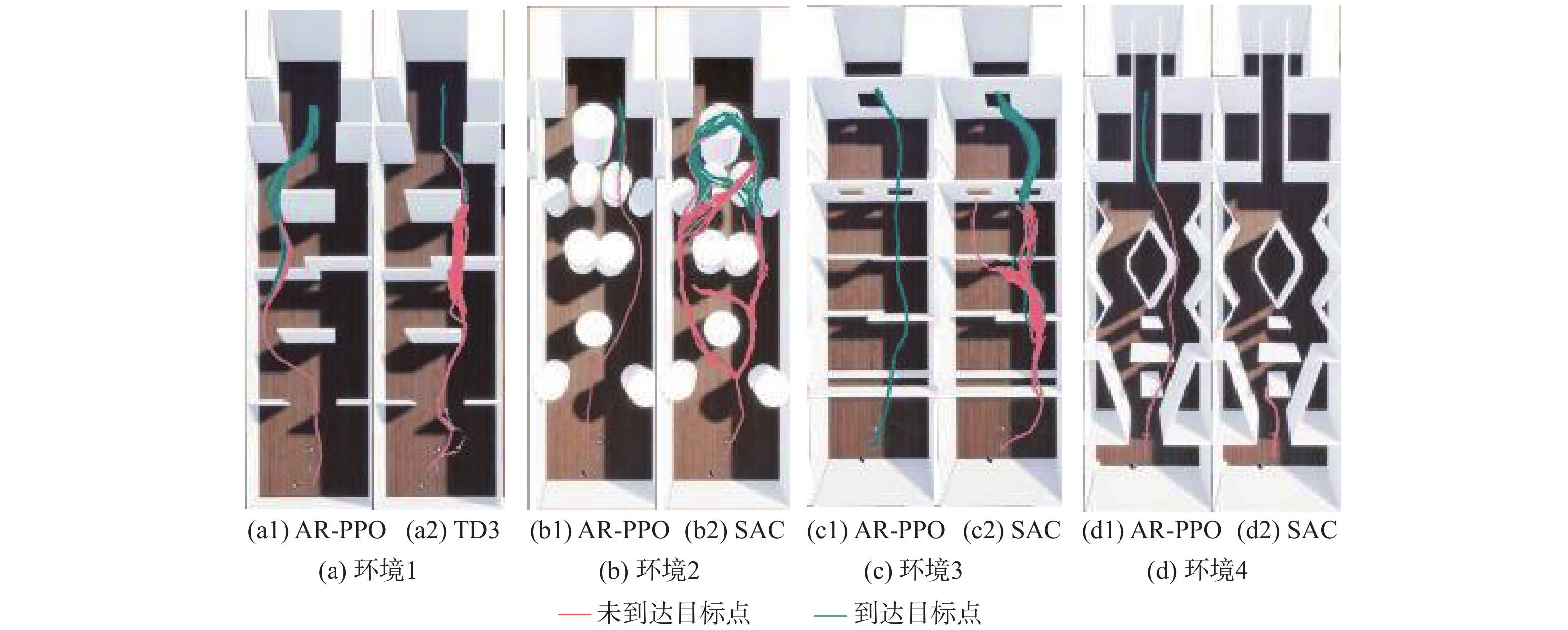
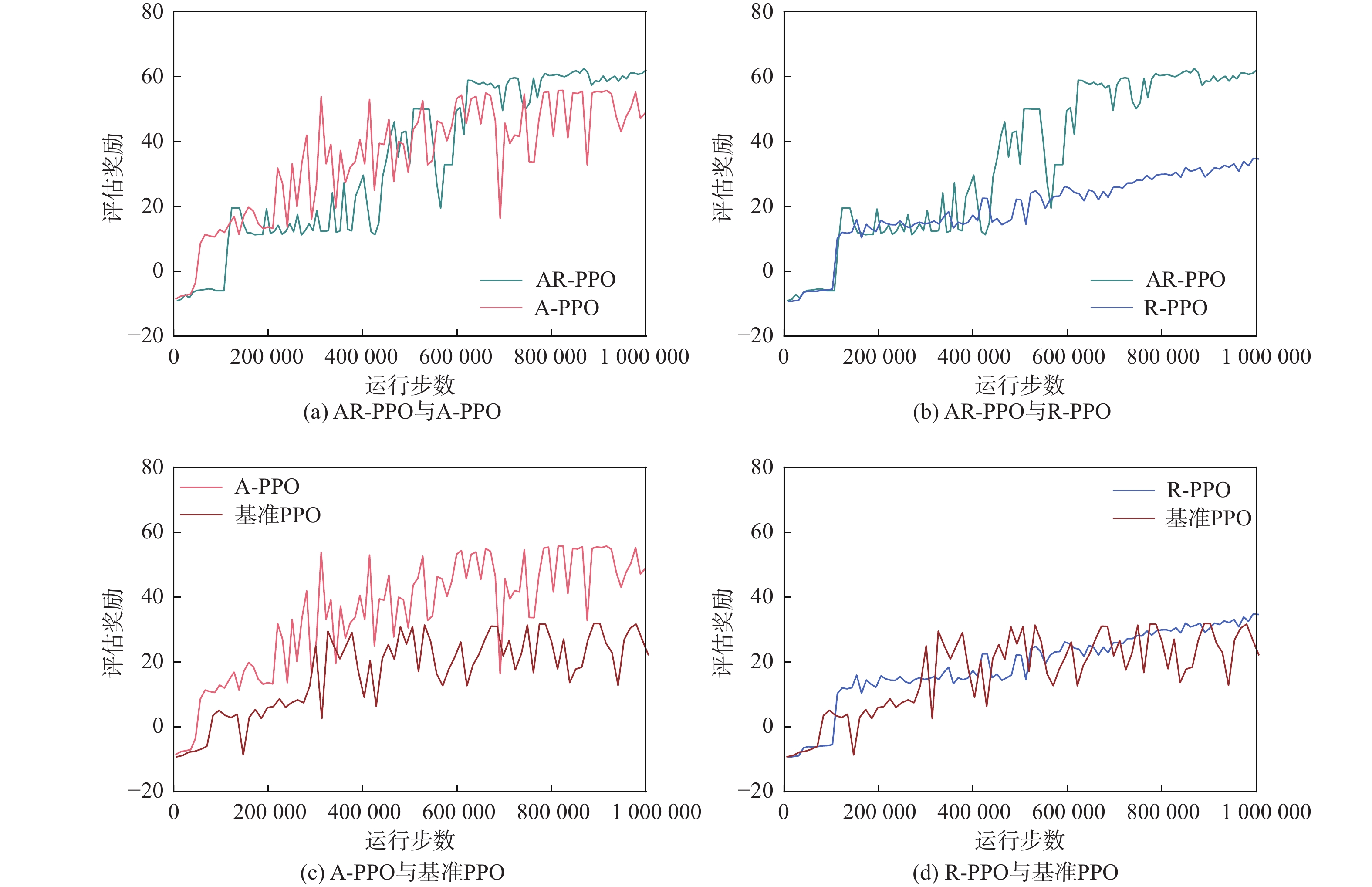
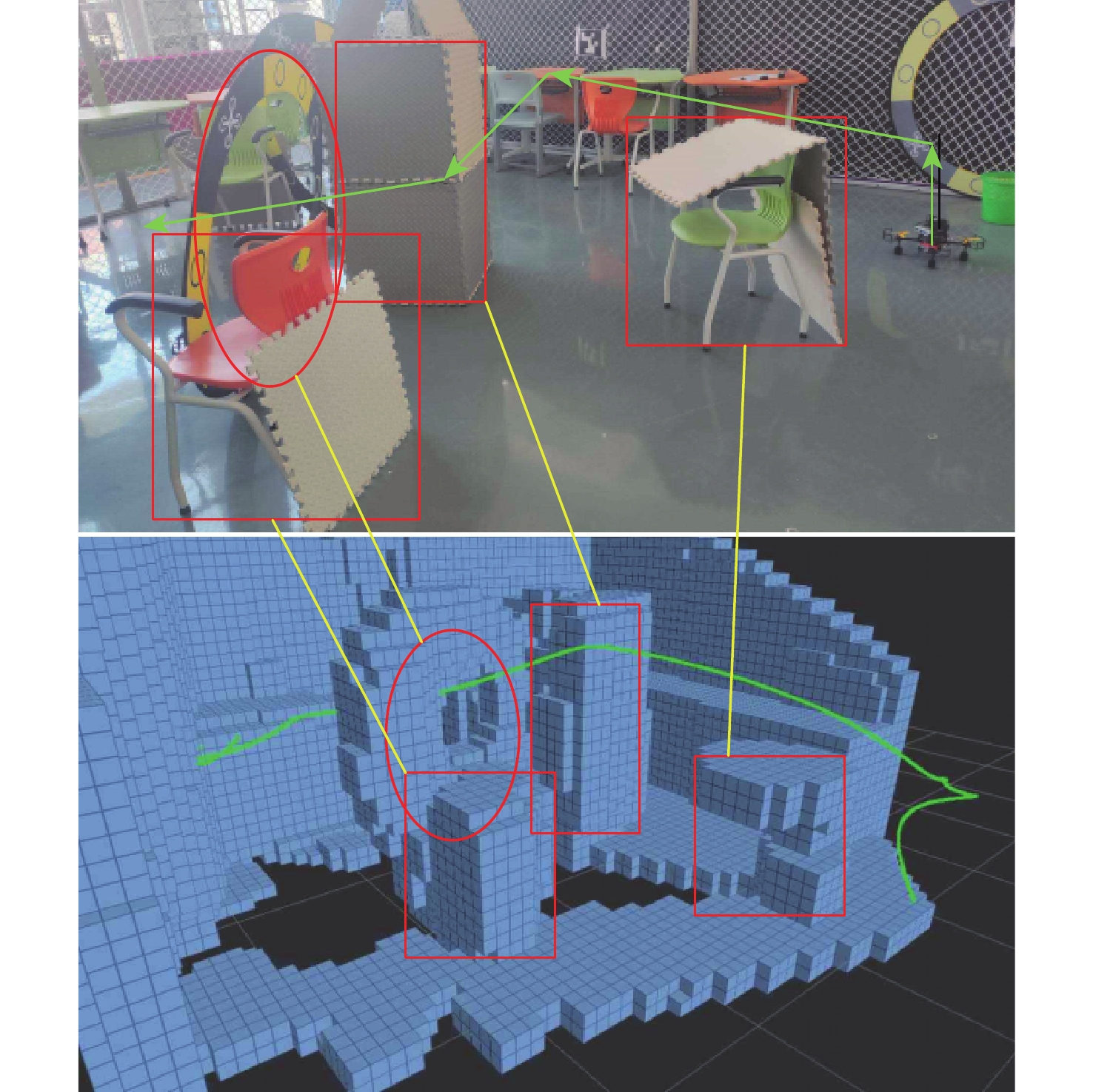
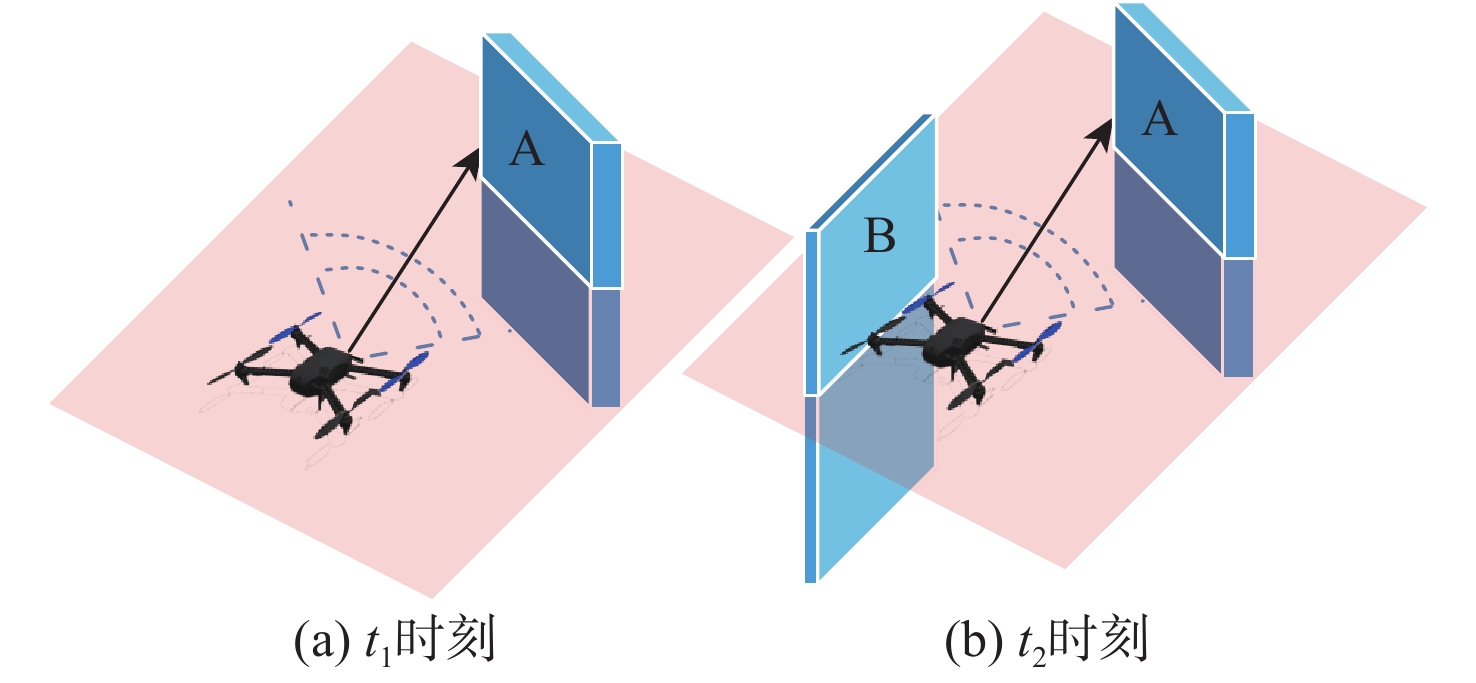
针对基于深度强化学习(DRL)的无人机导航方法面临的部分环境不可观测、训练难度高等问题,提出一种基于动作屏蔽-循环-近端策略优化(AR-PPO)的端到端无人机自主导航方法。引入门控循环神经网络处理历史信息,为策略网络引入历史基准信息以解决复杂环境下部分信息不可观测问题;设计适用于连续动作空间强化学习任务的动作屏蔽方法,排除非法动作的干扰并加快模型训练速度;建立演员-评论家框架的三维连续动作空间DRL端到端模型并于训练环境进行训练。与主流DRL方法进行对比实验,AR-PPO训练收敛速度最快,能取得最高奖励,在4种泛化测试环境中均取得了85%以上的成功率,在实机实验中能够安全地进行避障导航任务,表明所提方法能够有效实现无人机的精确避障与安全导航。
Abstract:We propose an end-to-end autonomous navigation method for drones based on action masking-temporal-proximal policy optimization (AR-PPO) to address problems with deep reinforcement learning (DRL) algorithms for drone navigation, such as partial observability of the environment and high training difficulty. First, we introduce a gated recurrent network to process historical information, allowing the policy network to incorporate historical baseline information to tackle the problem of partial observability in complex environments. Second, we design an action masking method suitable for continuous action space reinforcement learning tasks, which excludes the interference of illegal actions and accelerates the model training speed. Then, we establish an actor-critic framework for a three-dimensional continuous action space DRL end-to-end model, which directly outputs control actions based on sensor perception results. Finally, we conduct comparative experiments with mainstream DRL methods. With an over 85% success rate in four generalized test contexts, the AR-PPO approach has the fastest training convergence speed and the largest rewards. Drones can safely perform obstacle avoidance navigation in real machine experiments. The results show that the proposed method effectively enables precise obstacle avoidance and safe navigation for drones.
-
表 1 模型超参数设置
Table 1. Model hyperparameters setting
算法 学习率 折扣率 Horizon 经验池 探索噪声 策略噪声 软更新 裁剪系数 广义优势估计平滑函数 熵系数 小批次 AR-PPO/PPO $ 2\times {10}^{-4} $ 0.97 4096 0.25 0.95 0.01 512 SAC $ 1\times {10}^{-3} $ 0.97 4096 $ 1\times {10}^{6} $ $ 5\times {10}^{-3} $ TD3 $ 1\times {10}^{-4} $ 0.97 4096 $ 1\times {10}^{6} $ 0.05 0.10 DDPG $ 1\times {10}^{-4} $ 0.97 4096 $ 1\times {10}^{6} $ 0.05  下载: 导出CSV
表 2 实验结果
Table 2. Experimental results
环境 目标成功到达率/% 最高单步平均奖励 飞行距离众数/m AR-PPO DDPG TD3 SAC AR-PPO DDPG TD3 SAC AR-PPO DDPG TD3 SAC 环境1 85 9 48 44 0.70 0.18 0.42 0.31 30 12 30 26 环境2 96 4 36 64 0.77 0.18 0.38 0.68 30 27 18 30 环境3 100 21 51 57 0.82 0.42 0.65 0.67 30 16 30 30 环境4 92 0 0 0 0.82 0.14 0.14 0.14 30 7 7 7
下载: 导出CSV
表 3 消融对比结果
Table 3. Comparison results of ablation
环境 目标成功到达率/% 最高单步平均奖励 飞行距离众数/m AR-PPO A-PPO R-PPO AR-PPO A-PPO R-PPO AR-PPO A-PPO R-PPO 环境1 85 47 87 0.70 0.71 0.68 30 26 30 环境2 96 64 84 0.77 0.79 0.75 30 30 30 环境3 100 73 24 0.82 0.81 0.65 30 30 25 环境4 92 3 0 0.82 0.47 0.14 30 7 14
下载: 导出CSV
-
[1] Han S F, He Y, Fang H, Recent development in automatic guidance and autonomous vehicle for agriculture: a review [J]. Journal of Zhejiang University, 2018, 44(4): 381-391. [2] 徐国艳, 熊绎维, 周彬, 等. 基于PPO的移动平台自主导航[J]. 北京航空航天大学学报, 2022, 48(11): 2138-2145.Xu G Y, Xiong Y W, Zhou B, et al. Autonomous navigation based on PPO for mobile platform[J]. Journal of Beijing University of Aeronautics and Astronautics, 2022, 48(11): 2138-2145(in Chinese). [3] 董豪, 杨静, 李少波, 等. 基于深度强化学习的机器人运动控制研究进展[J]. 控制与决策, 2022, 37(2): 278-292.Dong H, Yang J, Li S B, et al. Research progress of robot motion control based on deep reinforcement learning[J]. Control and Decision, 2022, 37(2): 278-292(in Chinese). [4] 户高铭, 蔡克卫, 王芳, 等. 基于深度强化学习的无地图移动机器人导航[J]. 控制与决策, 2024, 39(3): 985-993.Hu G M, Cai K W, Wang F, et al. Mapless navigation based on deep reinforcement learning for mobile robots[J]. Control and Decision, 2024, 39(3): 985-993(in Chinese). [5] Marchesini E, Farinelli A. Discrete deep reinforcement learning for mapless navigation[C]//Proceedings of the IEEE International Conference on Robotics and Automation. Piscataway: IEEE Press, 2020: 10688-10694. [6] Singla A, Padakandla S, Bhatnagar S. Memory-based deep reinforcement learning for obstacle avoidance in UAV with limited environment knowledge[J]. IEEE Transactions on Intelligent Transportation Systems, 2021, 22(1): 107-118. [7] 魏瑶, 刘志成, 蔡彬, 等. 基于深度循环双Q网络的无人机避障算法研究[J]. 西北工业大学学报, 2022, 40(5): 970-979.Wei Y, Liu Z C, Cai B, et al. Study on UAV obstacle avoidance algorithm based on deep recurrent double Q network[J]. Journal of Northwestern Polytechnical University, 2022, 40(5): 970-979(in Chinese). [8] 张耀中, 许佳林, 姚康佳, 等. 基于DDPG算法的无人机集群追击任务[J]. 航空学报, 2020, 41(10): 309-321.Zhang Y Z, Xu J L, Yao K J, et al. Pursuit missions for UAV swarms based on DDPG algorithm[J]. Acta Aeronautica et Astronautica Sinica, 2020, 41(10): 309-321(in Chinese). [9] 唐蕾, 刘广钟. 改进TD3算法在四旋翼无人机避障中的应用[J]. 计算机工程与应用, 2021, 57(11): 254-259.Tang L, Liu G Z. Application for improved TD3 algorithm in obstacle avoidance of quad-rotor UAV[J]. Computer Engineering and Applications, 2021, 57(11): 254-259(in Chinese). [10] 张云燕, 魏瑶, 刘昊, 等. 基于深度强化学习的端到端无人机避障决策[J]. 西北工业大学学报, 2022, 40(5): 1055-1064.Zhang Y Y, Wei Y, Liu H, et al. End-to-end UAV obstacle avoidance decision based on deep reinforcement learning[J]. Journal of Northwestern Polytechnical University, 2022, 40(5): 1055-1064(in Chinese). [11] 赵静, 裴子楠, 姜斌, 等. 基于深度强化学习的无人机虚拟管道视觉避障[J]. 自动化学报, 2024, 50(11): 2245-2258.Zhao J, Pei Z N, Jiang B, et al. Virtual tube visual obstacle avoidance for UAV based on deep reinforcement learning[J]. Acta Automatica Sinica, 2024, 50(11): 2245-2258(in Chinese). [12] 寇凯, 杨刚, 张文启, 等. 基于SAC的无人机自主导航方法研究[J]. 西北工业大学学报, 2024, 42(2): 310-318.Kou K, Yang G, Zhang W Q, et al. Exploring UAV autonomous navigation algorithm based on soft actor-critic[J]. Journal of Northwestern Polytechnical University, 2024, 42(2): 310-318(in Chinese). [13] Yu C, Velu A, Vinitsky E, et al. The surprising effectiveness of PPO in cooperative multi-agent games[C]//Proceedings of the Advances in Neural Information Processing Systems 35. San Diego: Neural Information Processing Systems Foundation, Inc., 2022: 24611-24624. [14] Dey R, Salem F M. Gate-variants of gated recurrent unit (GRU) neural networks[C]//Proceedings of the IEEE 60th International Midwest Symposium on Circuits and Systems. Piscataway: IEEE Press, 2017: 1597-1600. [15] Schulman J, Wolski F, Dhariwal P, et al. Proximal policy optimization algorithms[EB/OL]. (2017-07-17)[2024-07-20]. https://arxiv.org/pdf/1707.06347v1. [16] Baker B, Kanitscheider I, Markov T, et al. Emergent tool use from multi-agent autocurricula[C]//Proceedings of the International Conference on Learning Representations. Appleton: ICLR, 2020. [17] Ouahouah S, Bagaa M, Prados-Garzon J, et al. Deep-reinforcement-learning-based collision avoidance in UAV environment[J]. IEEE Internet of Things Journal, 2022, 9(6): 4015-4030. [18] Xue Y T, Chen W S. A UAV navigation approach based on deep reinforcement learning in large cluttered 3D environments[J]. IEEE Transactions on Vehicular Technology, 2023, 72(3): 3001-3014. [19] Engstrom L, Ilyas A, Santurkar S, et al. Implementation matters in deep RL: a case study on PPO and TRPO[C]//Proceedings of the International Conference on Learning Representations. Appleton: ICLR, 2020. -

 下载:

计量
- 文章访问数: 822
- HTML全文浏览量: 255
- PDF下载量: 210
- 被引次数: 0
