





BN-based comprehensive evaluation model for display interface usability in civil aircraft cockpit
-
摘要:
研究民机驾驶舱显示界面可用性有助于优化设计界面,针对民机驾驶舱显示界面可用性评价的不确定性,提出一种基于贝叶斯网络(BN)的可用性综合评价模型。基于执行过程交互控制(EPIC)模型获取的可用性评价指标体系建立贝叶斯网络,定量根节点以专家眼动度量指标的加权评价为先验概率,定性根节点采用专家三角模糊数评价为先验概率;为降低专家的决策次数,使用Noisy-OR模型填充贝叶斯网络的条件概率表,并利用GeNIe软件搭建模型。以主飞行显示器界面进行实例验证,结果表明:模型因果推理结果与系统可用性量表(SUS)评价结果一致,该界面的评价等级均为“良”,验证所提模型的有效性,并对模型敏感性分析得到的敏感因子提出改进措施。
Abstract:Optimizing the design interface is aided by research on the usability of display interfaces in civil aircraft cockpits. Aiming at the uncertainty of usability evaluation of civil aircraft cockpit display interface, this paper proposes a comprehensive usability evaluation model based on the Bayesian network (BN). Firstly, a Bayesian network is established based on the usability evaluation indicator system obtained from the executive process-interactive control model (EPIC). Both the experts' triangle fuzzy number evaluation and the quantitative root nodes' weighted evaluation of expert eye movement measures served as prior probabilities. Secondly, in order to reduce the number of experts’ decision-making, the Noisy-OR model was used to fill the conditional probability table of the Bayesian network, and the model was built using GeNIe software. A primary flight display interface is taken as an example for instance verification. The results show that the causal reasoning results of the model are consistent with evaluation results of the system usability scale (SUS) scale. The evaluation grade of the interface is "good", which verifies the effectiveness of the model, and proposes improvement measures for sensitive factors obtained by the model sensitivity analysis.
-
Key words:
- civil aircraft cockpit /
- display interface /
- usability evaluation /
- Bayesian network /
- eye movement
-
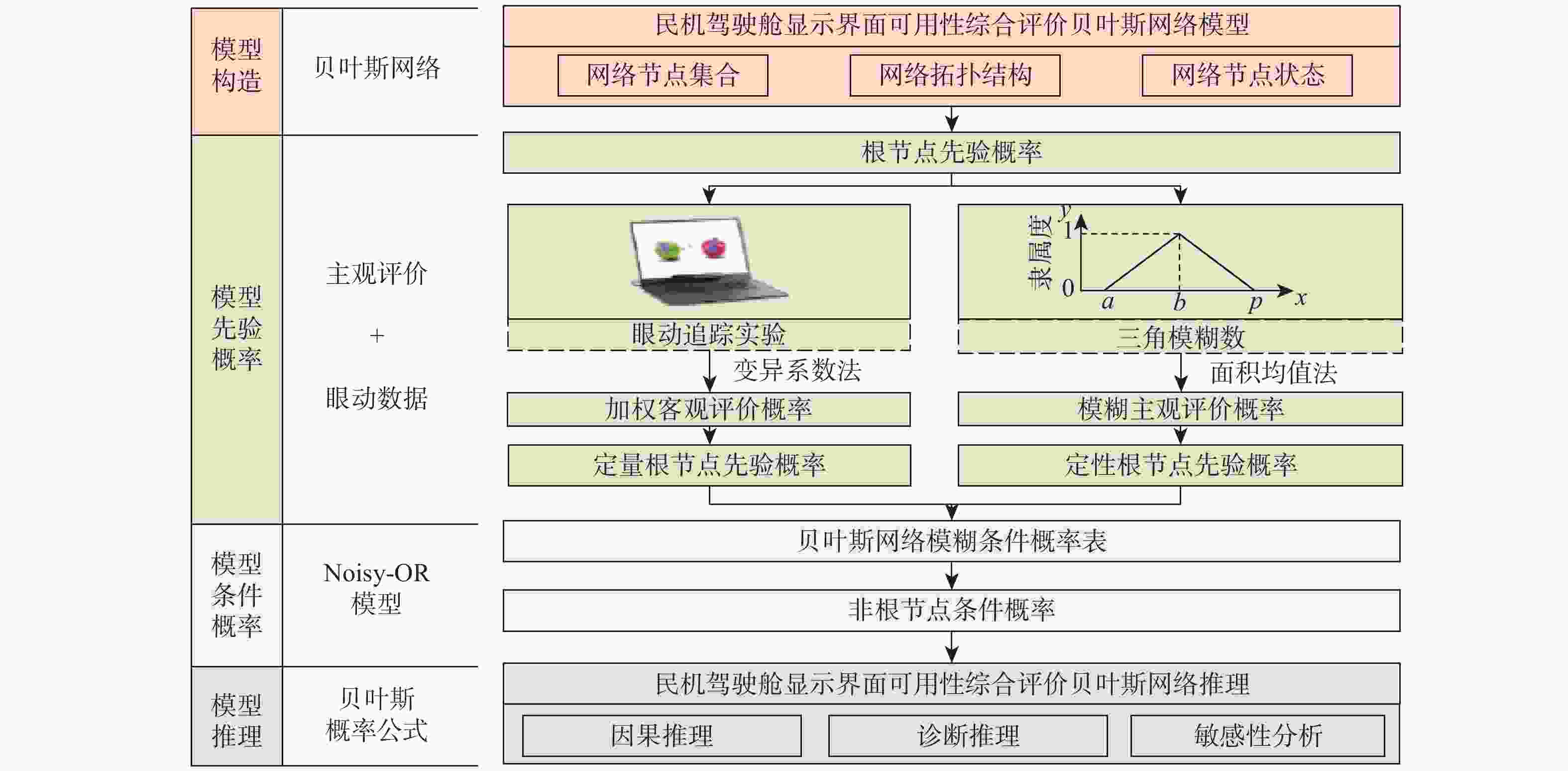
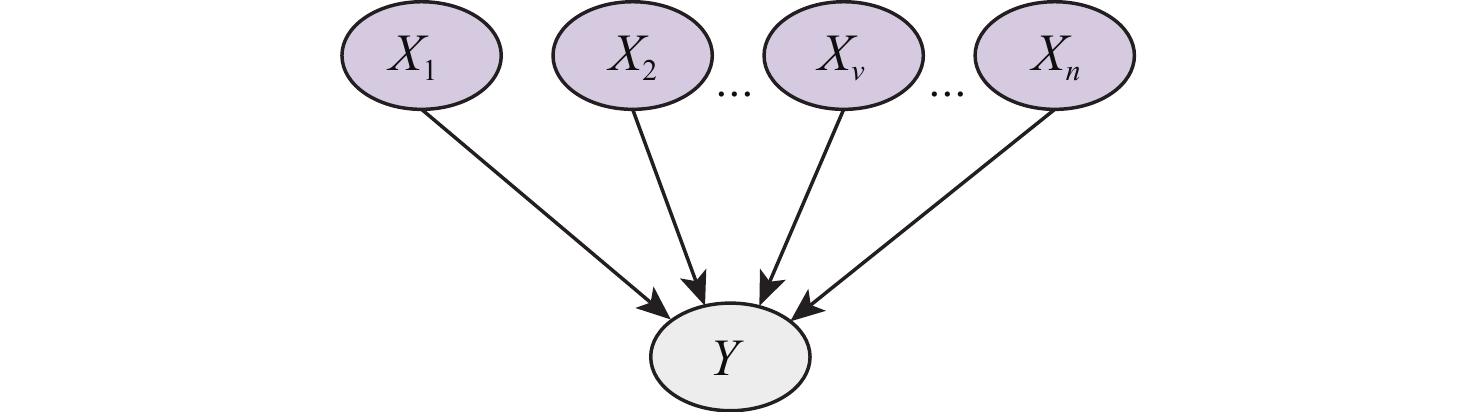
图 2 基于贝叶斯网络的民机驾驶舱显示界面可用性综合评价模型
Figure 2. Comprehensive evaluation model for cockpit display interfaces of civil aircraft based on Bayesian network
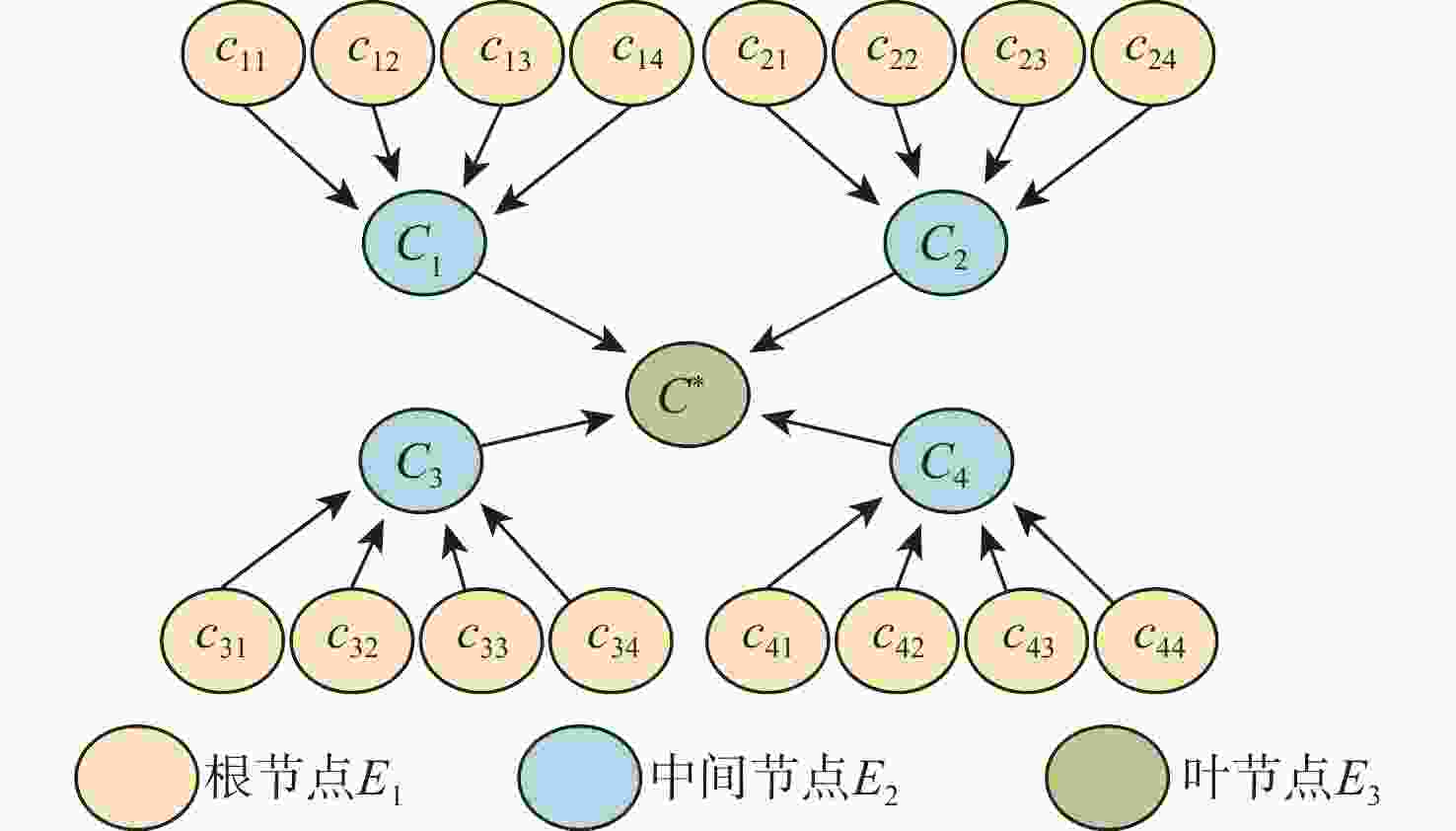
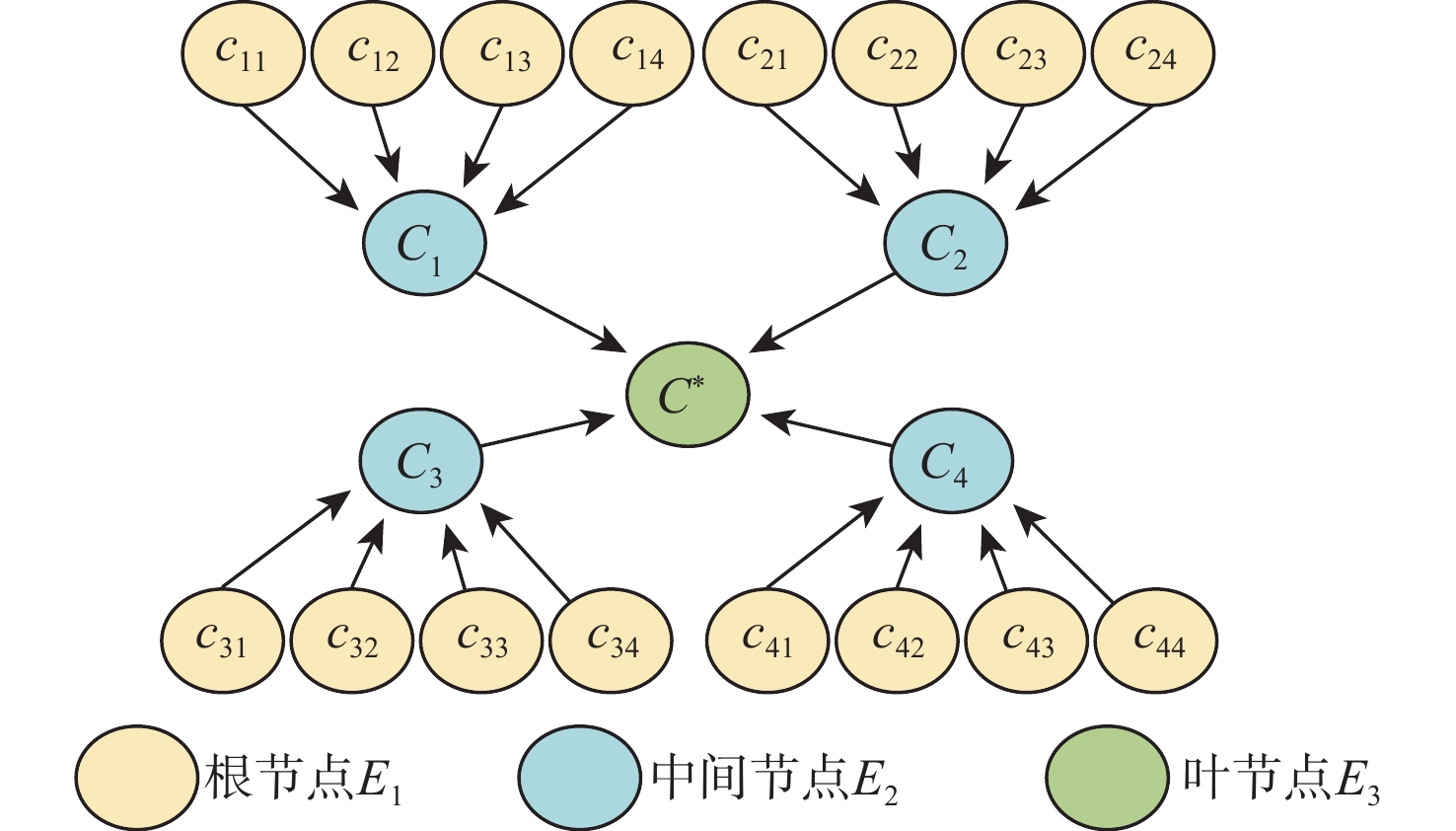
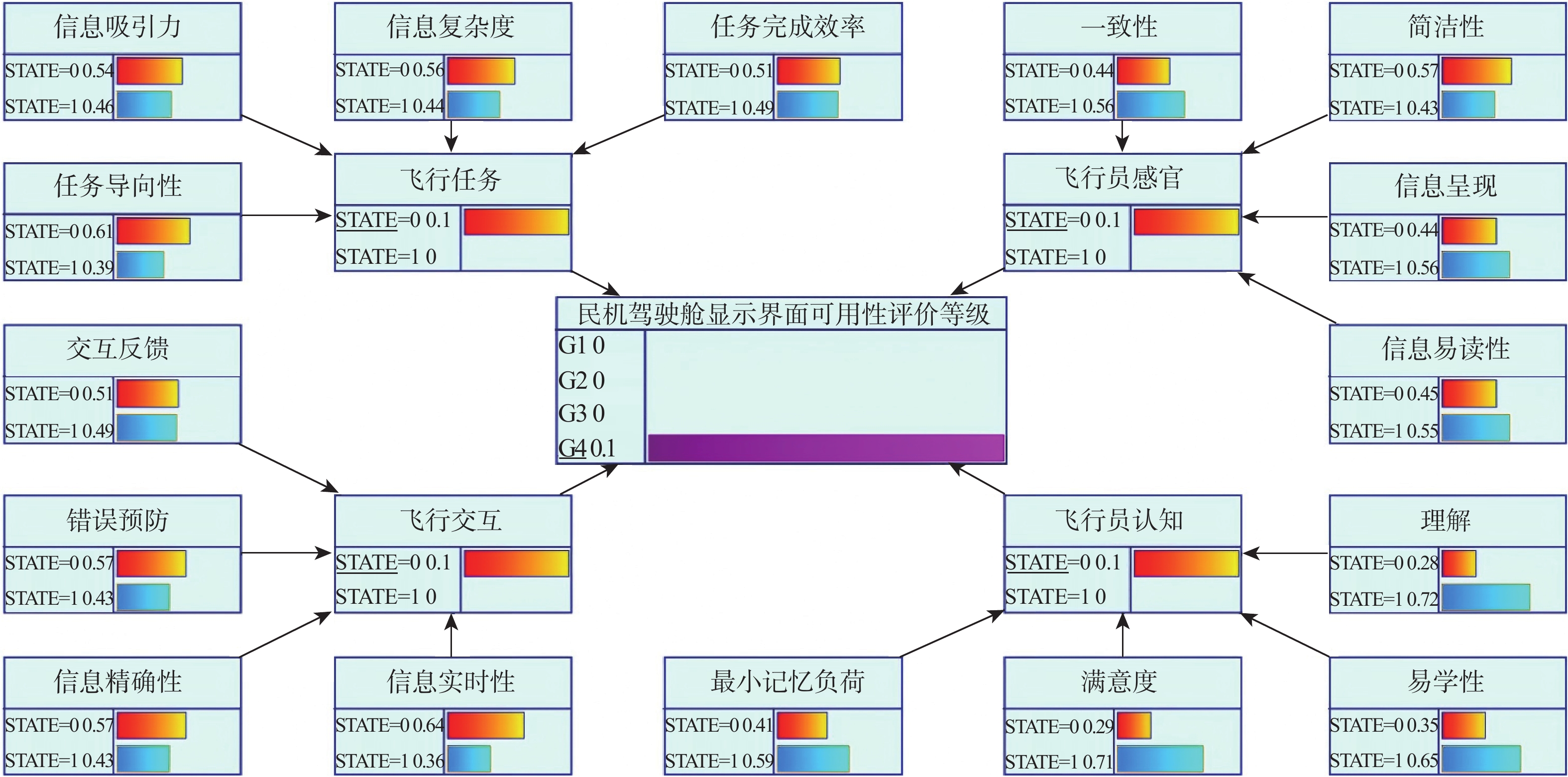
图 3 民机驾驶舱显示界面可用性评价贝叶斯网络模型
Figure 3. Bayesian network modelling for usability evaluation in cockpit display interfaces of civil aircraft
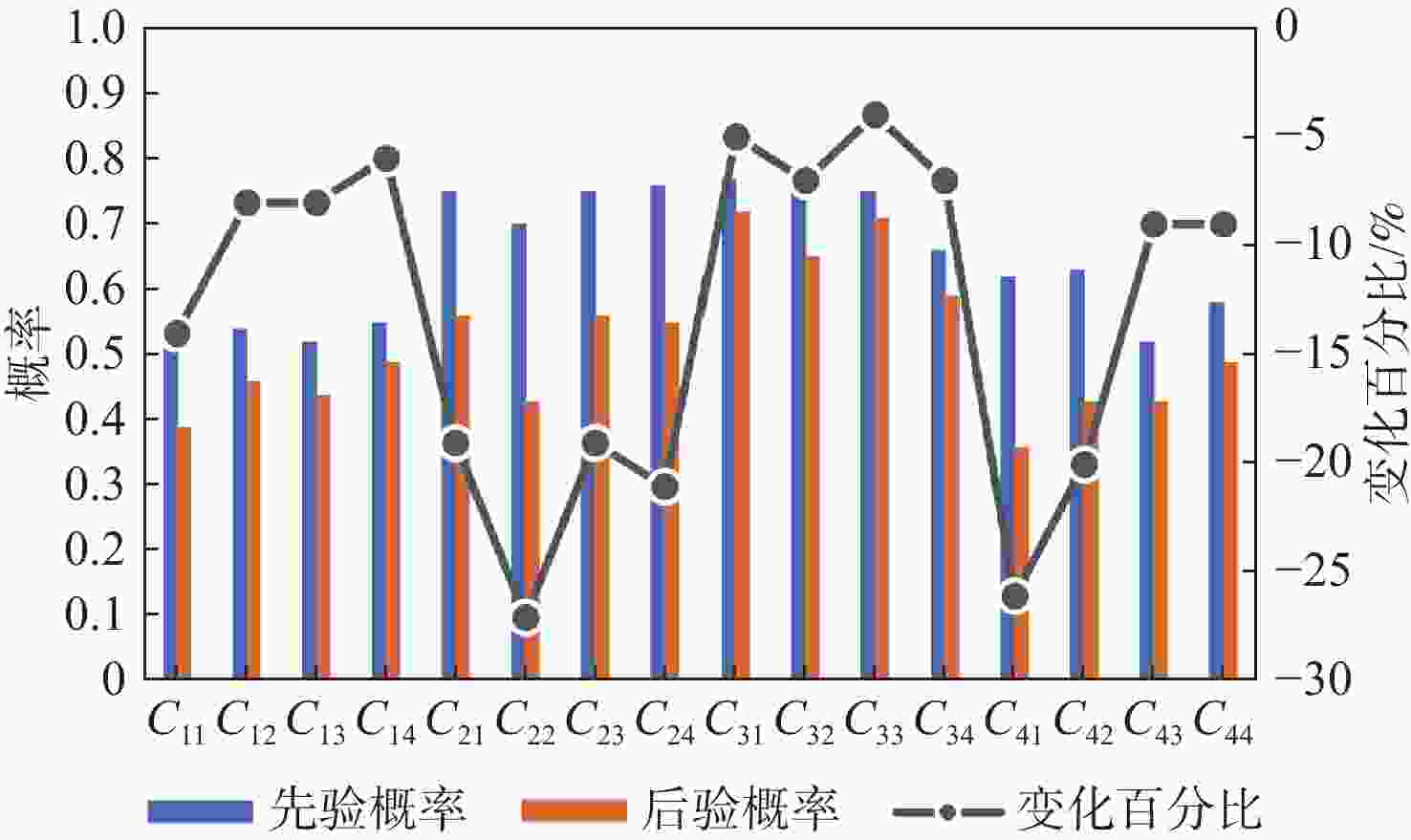
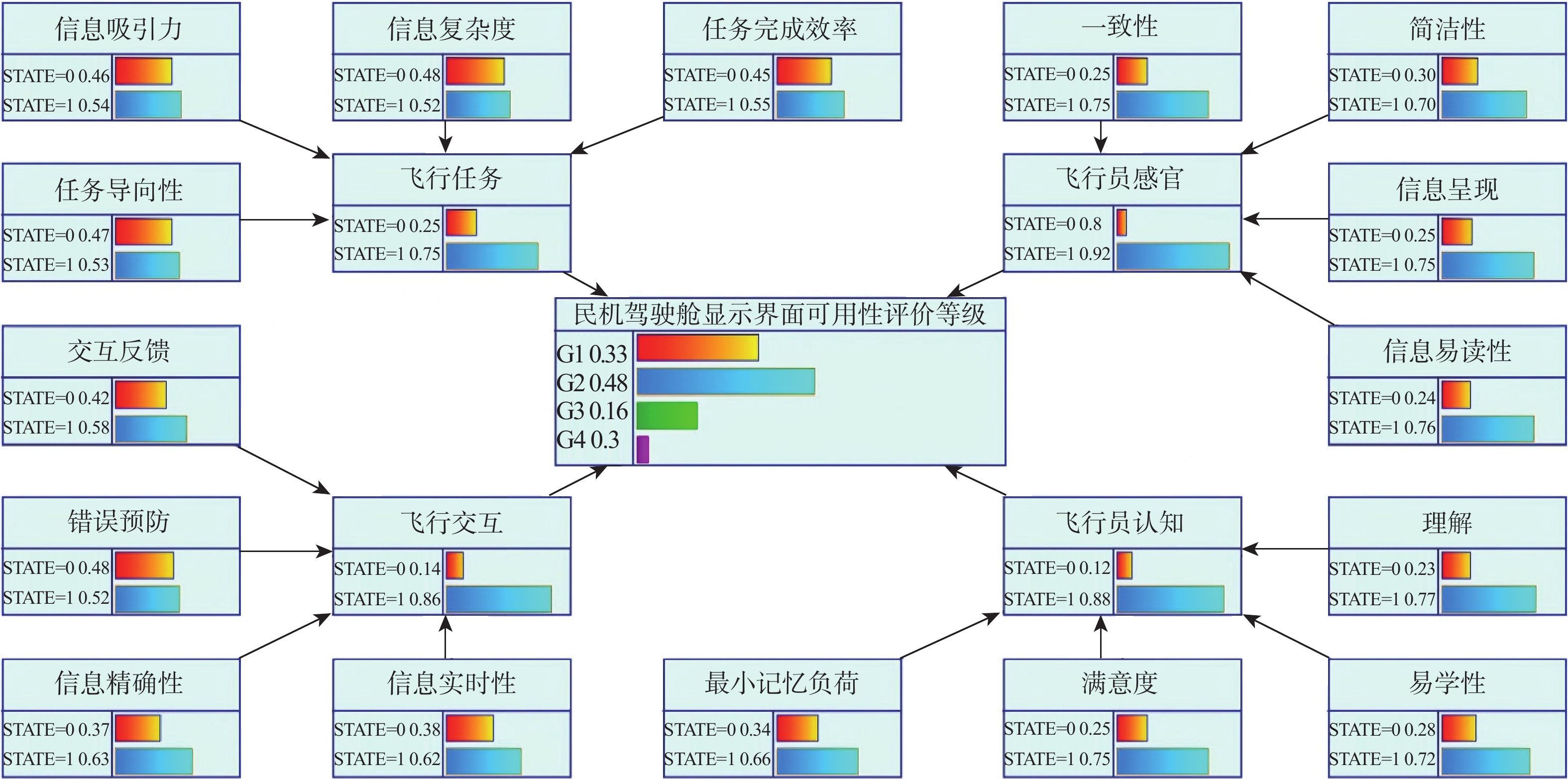
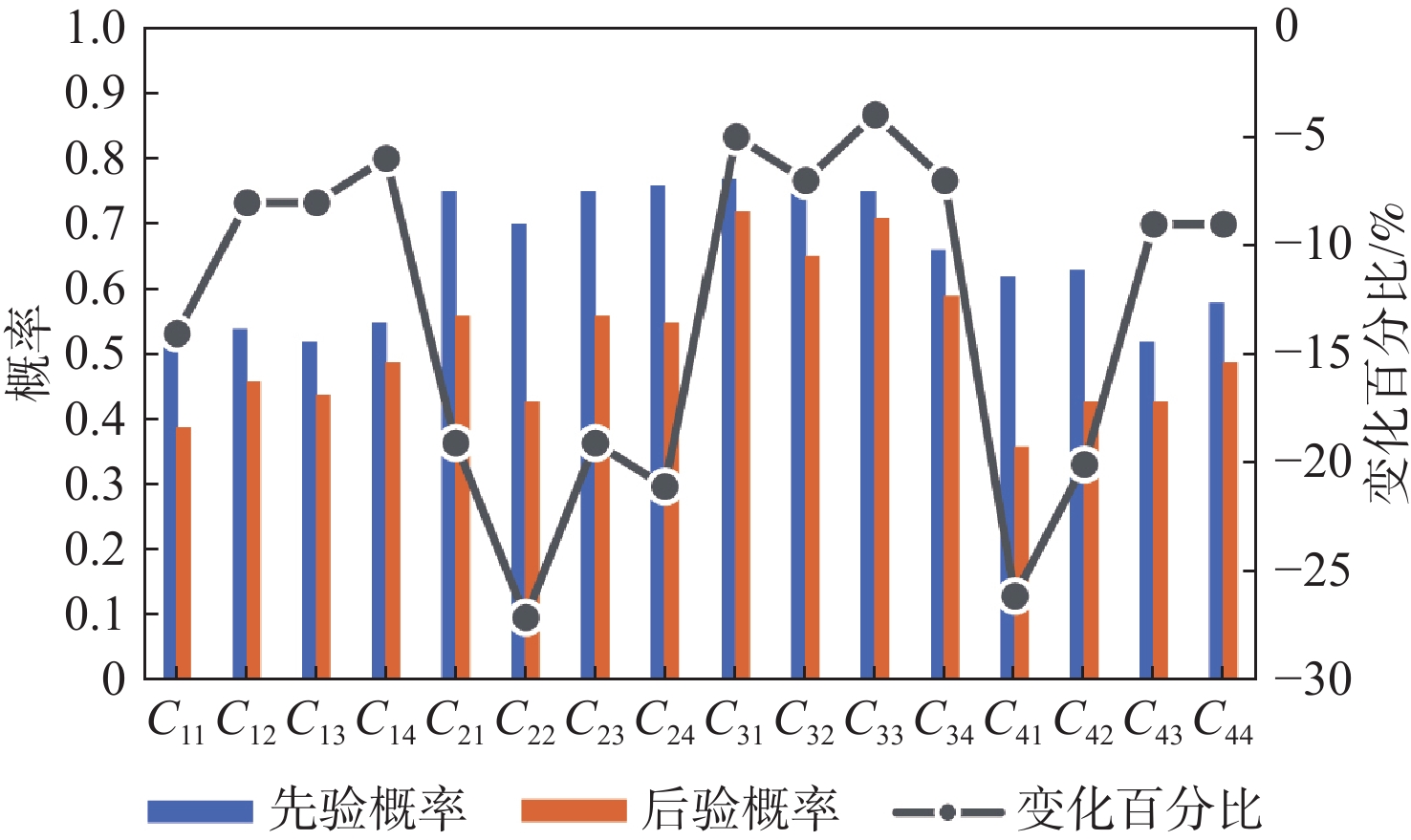
图 8 根节点处于“STATE=1”状态下的先验概率、后验概率和变化百分比
Figure 8. Priori probability, posterior probability and percentage change of each root node in "STATE=1" state
表 1 民机驾驶舱显示界面可用性评价指标体系
Table 1. Usability indicator system for cockpit display interfaces of civil aircraft
目标层 维度层 指标层 指标编号 指标语义 指标类型 删除指标 指标来源 民机驾驶
舱显示界
面可用性
$ {C}^{*} $飞行任务$ {C}_{1} $ 任务导向性 $ {c}_{11} $ 界面是否引导飞行员进行操作 定量 时间压力、任务适应性、任务优先级、任务匹配、任务完成时间、任务熟悉度、任务导航性、任务流畅度 文献[14] 信息吸引力 $ {c}_{12} $ 界面信息是否吸引飞行员执行任务 信息复杂度 $ {c}_{13} $ 界面信息是否降低飞行任务复杂度 任务完成效率 $ {c}_{14} $ 界面是否能提高飞行员的任务完成度 飞行员感官$ {C}_{2} $ 一致性 $ {c}_{21} $ 界面色彩、图标等方面是否有一致性 定性 层次性、均衡性、语音清晰度、音频可调性、音频优化、语音告警提示、语音确认操作 文献[14] 简洁性 $ {c}_{22} $ 界面是否不包括重叠、冗余信息 信息呈现 $ {c}_{23} $ 界面呈现方式是否科学合理 信息易读性 $ {c}_{24} $ 界面信息是否易于飞行员阅读和查阅 飞行员认知$ {C}_{3} $ 理解 $ {c}_{31} $ 界面是否能让飞行员快速地理解 定性 学习时长、熟悉、学习效率、回忆、注意力、可学习性 文献[3,16-17] 易学性 $ {c}_{32} $ 界面是否降低飞行员学习使用的难度 满意度 $ {c}_{33} $ 界面是否能提高飞行员的视觉满意度 最小记忆负荷 $ {c}_{34} $ 界面是否尽量减少飞行员的记忆负荷 飞行交互$ {C}_{4} $ 信息实时性 $ {c}_{41} $ 界面信息是否实现实时更新 定性 可预测性、交互规范性、交互及时响应、防撞预警、告警提示、信息容错、更改设置 文献[18-19] 信息精确性 $ {c}_{42} $ 界面信息是否精确无误 错误预防 $ {c}_{43} $ 界面是否提供错误预防与恢复机制 交互反馈 $ {c}_{44} $ 界面是否提供明确的交互信息反馈  下载: 导出CSV
表 2 定量根节点的度量指标分析
Table 2. Metrics analysis of quantitative root nodes
定量根节点 度量指标Y 正负性 任务导向性$ {c}_{11} $ 眼跳次数Y1 负相关 扫描路径时间$ {Y}_{2} $ 负相关 扫描路径长度$ {Y}_{3} $ 负相关 信息吸引力$ {c}_{12} $ AOI注视总持续时间$ {Y}_{4} $ 正相关 AOI内注视次数$ {Y}_{5} $ 正相关 AOI首次注视持续时间$ {Y}_{6} $ 正相关 信息复杂度$ {c}_{13} $ 注视点数量$ {Y}_{7} $ 负相关 回视次数$ {Y}_{8} $ 负相关 任务完成效率$ {c}_{14} $ 任务准确率$ {Y}_{9} $ 正相关 任务完成时间$ {Y}_{10} $ 负相关 注:兴趣区域(area of interest,AOI)。
下载: 导出CSV
表 3 7个语言变量与三角模糊数的对应关系
Table 3. Corresponding relationship between 7 linguistic variables and triangular fuzzy numbers
序号 语言变量 $ \tilde{P}(x)=(a,b,q) $ 1 非常低(VL) (0,0,0.1) 2 低(L) (0,0.1,0.3) 3 较低(FL) (0.1,0.3,0.5) 4 中等(M) (0.3,0.5,0.7) 5 较高(FH) (0.5,0.7,0.9) 6 高(H) (0.7,0.9,1.0) 7 非常高(VH) (0.9,1.0,1.0)
下载: 导出CSV
表 4 专家权重
Table 4. Weight of experts
项目 类别 权重 项目 类别 权重 年龄 $ \geqslant $50岁 $ {w}_{1}= $1.0 职称 机长 $ w_{3}= $1.0 40~50岁 $ {w}_{1}= $0.9 副机长 $ w_{3}= $0.9 30`40岁 $ {w}_{1}= $0.8 飞行学员 $ w_{3}= $0.8 $ \leqslant $30岁 $ {w}_{1}= $0.7 研究人员 $ w_{3}= $0.7 学历 博士 $ {w}_{2}= $1.0 工作
年限$ \geqslant $20年 $ w_{4}= $1.0 硕士 $ {w}_{2}= $0.9 10~20年 $ w_{4}= $0.9 学士 $ {w}_{2}= $0.8 5~10年 $ w_{4}= $0.8 专科 $ {w}_{2}= $0.7 $ \leqslant $5年 $ w_{4}= $0.7
下载: 导出CSV
表 5 民机驾驶舱显示界面可用性评价等级区间
Table 5. Grade scale for cockpit display interface of civil aircraft usability evaluation
目标 评价等级$ {G}_{\beta } $ 等级区间 民机驾驶舱显示界面
可用性评价等级$ {G}_{1} $=优 [0.95,1.00] $ {G}_{2} $=良 [0.85,0.95) $ {G}_{3} $=中 [0.70,0.85) $ {G}_{4} $=差 [0.00,0.70)
下载: 导出CSV
表 6 主飞行显示器的异常信息范围设置
Table 6. Abnormal message range settings for primary flight display
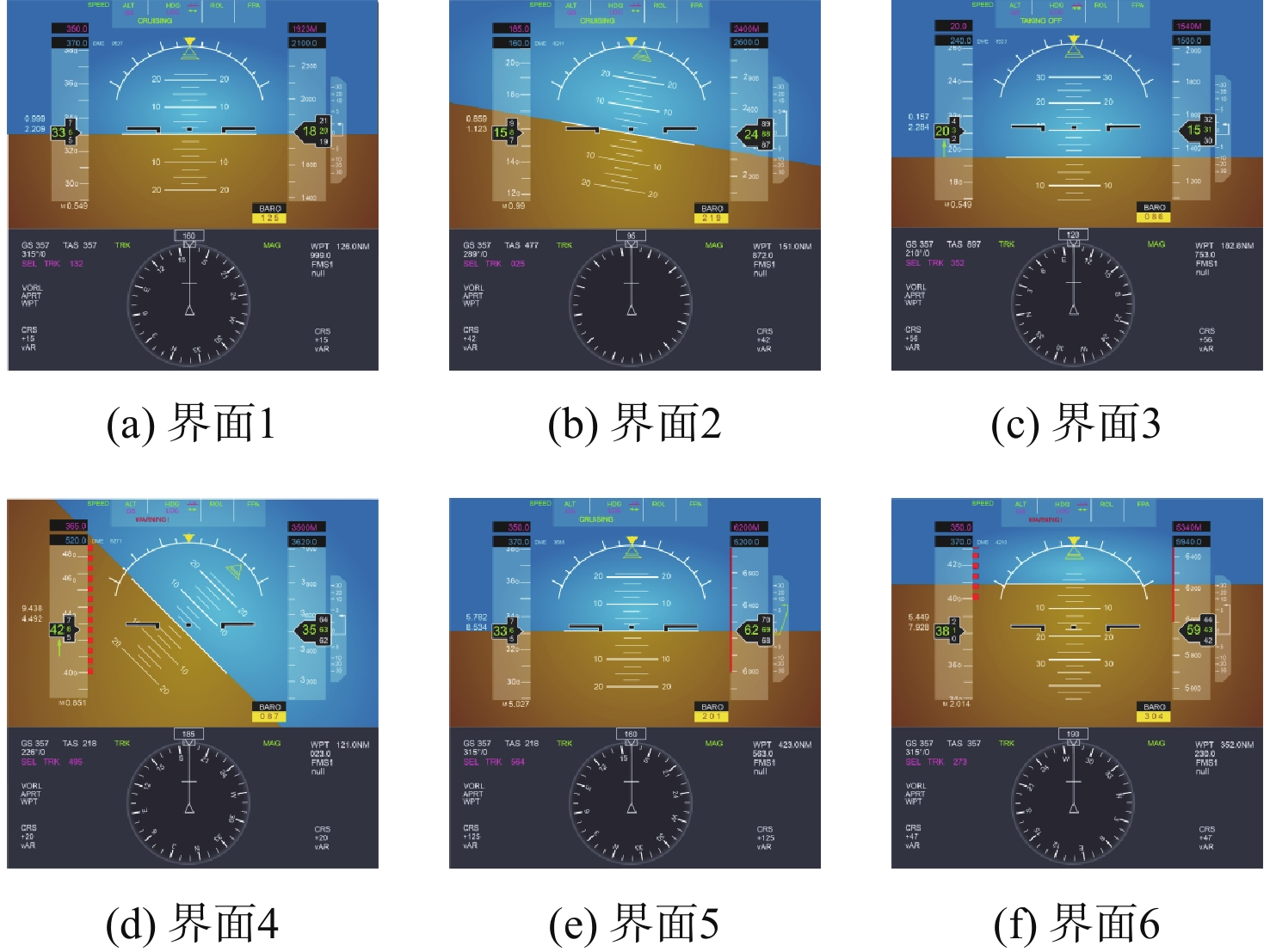
仪表类型 仪表信息 异常值 姿态仪 横滚角 >20° 俯仰角 仰角>30°;俯角>15° 罗盘标尺 航向角 >180° 空速表 空速 >400 kn 高度和垂直速度表 高度 > 1828.80 m
下载: 导出CSV
表 7 “STATE=1”状态下眼动度量指标部分标准化结果
Table 7. Results of partial standardisation of eye movement metrics in “STATE=1” state
被试t $ {Y}_{1} $/次 $ {Y}_{2} $/ms $ {Y}_{3} $/像素 $ {Y}_{4} $/ms $ {Y}_{5} $/ms $ {Y}_{6} $/ms $ {Y}_{7} $/个 $ {Y}_{8} $/次 $ {Y}_{9} $/% $ {Y}_{10} $/ms $ {t}_{1} $ 0.772 3 0.545 0 0.533 3 0.547 3 0.941 7 0.474 9 0.533 3 0.121 2 0.25 0.062 0 $ {t}_{2} $ 0.960 4 0.472 7 0.644 8 0.814 6 0.210 8 0.698 6 0.644 8 0.151 5 0.25 0.076 3 $ {t}_{14} $ 0.643 6 0.728 3 0 0.520 5 1 0.783 1 0 0.939 4 0.25 0.065 2 $ {t}_{15} $ 0.703 0 1 0.433 2 0.246 8 0.403 6 0.421 2 0.433 2 0.484 8 0.5 0.097 8
下载: 导出CSV
表 8 “STATE=1”状态下定量根节点的先验概率
Table 8. Prior probabilitiy of eye movement metrics for quantitative root nodes in “STATE=1” state
$ {c}_{1m} $ $ Y $ $ {\overline{r}}_{\rho } $ $ {\sigma }_{\rho } $ $ {\varphi }_{\rho } $ $ {\delta }_{\rho } $ $ P({c}_{1mj}) $ $ {c}_{11} $ $ {Y}_{1} $ 0.674 0 0.263 0 0.390 0 0.242 3 0.528 8 $ {Y}_{2} $ 0.474 0 0.310 0 0.654 0 0.406 1 $ {Y}_{3} $ 0.492 0 0.279 0 0.566 0 0.351 7 $ {c}_{12} $ $ {Y}_{4} $ 0.579 0 0.317 0 0.548 0 0.339 2 0.536 3 $ {Y}_{5} $ 0.469 0 0.303 0 0.646 0 0.399 9 $ {Y}_{6} $ 0.584 0 0.246 0 0.421 0 0.260 8 $ {c}_{13} $ $ {Y}_{7} $ 0.612 0 0.319 0 0.521 0 0.438 8 0.523 3 $ {Y}_{8} $ 0.454 0 0.302 0 0.666 0 0.561 2 $ {c}_{14} $ $ {Y}_{9} $ 0.555 0 0.358 0 0.646 0 0.488 5 0.547 8 $ {Y}_{10} $ 0.541 0 0.366 0 0.677 0 0.511 5
下载: 导出CSV
表 9 定性根节点的三角模糊概率和先验概率
Table 9. Triangular fuzzy and prior probabilities for qualitative root nodes
$ {c}_{im}\left(i=2,3,4; m \in N^{*} \right) $ $ {t}_{1} $ $ {t}_{2} $ $ {t}_{3} $ ··· $ {t}_{15} $ 三角模糊概率 先验概率 一致性$ {c}_{21} $ 高(H) 较高(FH) 高(H) ··· 较高(FH) (0.588 6,0.756 6,0.883 8) 0.746 4 (0.7,0.9,1.0) (0.5,0.7,0.9) (0.7,0.9,1.0) (0.5,0.7,0.9) 简洁性$ {c}_{22} $ 较高(FH) 高(H) 中等(M) ··· 较高(FH) (0.538 4,0.702 6,0.845 5) 0.696 4 (0.5,0.7,0.9) (0.7,0.9,1.0) (0.3,0.5,0.7) (0.9,1.0,1.0) 信息呈现$ {c}_{23} $ 中等(M) 高(H) 较高(FH) ··· 中等(M) (0.581 7,0.756 1,0.894 3) 0.747 0 (0.3,0.5,0.7) (0.7,0.9,1.0) (0.7,0.9,1.0) (0.3,0.5,0.7) 信息易读性$ {c}_{24} $ 较高(FH) 高(H) 高(H) ··· 较高(FH) (0.606 2,0.768 2,0.894 3) 0.759 2 (0.5,0.7,0.9) (0.7,0.9,1.0) (0.7,0.9,1.0) (0.9,1.0,1.0) 理解$ {c}_{31} $ 中等(M) 高(H) 中等(M) ··· 较高(FH) (0.610 8,0.779 0,0.896 1) 0.766 2 (0.3,0.5,0.7) (0.7,0.9,1.0) (0.3,0.5,0.7) (0.7,0.9,1.0) 易学性$ {c}_{32} $ 高(H) 非常高(VH) 高(H) ··· 中等(M) (0.567 8,0.729 8,0.868 7) 0.724 0 (0.7,0.9,1.0) (0.9,1.0,1.0) (0.7,0.9,1.0) (0.3,0.5,0.7) 满意度$ {c}_{33} $ 中等(M) 高(H) 较高(FH) ··· 中等(M) (0.591 3,0.758 4,0.887 4) 0.748 9 (0.3,0.5,0.7) (0.7,0.9,1.0) (0.7,0.9,1.0) (0.3,0.5,0.7) 最小记忆负荷$ {c}_{34} $ 中等(M) 高(H) 中等(M) ··· 中等(M) (0.490 9,0.665 1,0.807 1) 0.657 0 (0.3,0.5,0.7) (0.7,0.9,1.0) (0.3,0.5,0.7) (0.3,0.5,0.7) 信息实时性$ {c}_{41} $ 较低(FL) 高(H) 较低(FL) ··· 高(H) (0.454 5,0.628 7,0.785 4) 0.624 4 (0.1,0.3,0.5) (0.7,0.9,1.0) (0.1,0.3,0.5) (0.7,0.9,1.0) 信息精确性$ {c}_{42} $ 较高(FH) 高(H) 较高(FH) ··· 高(H) (0.478 1,0.638 6,0.767 8) 0.630 7 (0.7,0.9,1.0) (0.7,0.9,1.0) (0.7,0.9,1.0) (0.7,0.9,1.0) 错误预防$ {c}_{43} $ 较低(FL) 较高(FH) 较高(FH) ··· 高(H) (0.351 9,0.519 9,0.685 6) 0.519 3 (0.1,0.3,0.5) (0.7,0.9,1.0) (0.7,0.9,1.0) (0.7,0.9,1.0) 交互反馈$ {c}_{44} $ 低(L) 较高(FH) 中等(M) ··· 较高(FH) (0.430 4,0.584 3,0.738 2) 0.584 3 (0,0.1,0.3) (0.7,0.9,1.0) (0.3,0.5,0.7) (0.7,0.9,1.0)
下载: 导出CSV
表 10 “STATE=1”状态下父节点对叶节点$ {C}^{*} $影响下的条件概率表
Table 10. Conditional probability table under the influence of parent nodes on leaf node $ {C}^{*} $ in “STATE=1” state
$ {C}^{*} $处于$ {G}_{1} $状态时 条件概
率值$ {C}^{*} $处于$ {G}_{2} $状态时 条件概
率值$ {C}^{*} $处于$ {G}_{3} $状态时 条件概
率值$ {C}^{*} $处于$ {G}_{4} $状态时 条件概
率值$ P({C}^{*}={G}_{2}\leftarrow {C}_{1}) $ 0.315 4 $ P({C}^{*}={G}_{2}\leftarrow {C}_{1}) $ 0.425 6 $ P({C}^{*}={G}_{3}\leftarrow {C}_{1}) $ 0.213 3 $ P({C}^{*}={G}_{4}\leftarrow {C}_{1}) $ 0.047 5 $ P({C}^{*}={G}_{1}\leftarrow {C}_{2}) $ 0.421 7 $ P({C}^{*}={G}_{2}\leftarrow {C}_{2}) $ 0.512 5 $ P({C}^{*}={G}_{3}\leftarrow {C}_{2}) $ 0.065 5 $ P({C}^{*}={G}_{4}\leftarrow {C}_{2}) $ 0.003 0 $ P({C}^{*}={G}_{1}\leftarrow {C}_{3}) $ 0.414 6 $ P({C}^{*}={G}_{2}\leftarrow {C}_{3}) $ 0.425 9 $ P({C}^{*}={G}_{3}\leftarrow {C}_{3}) $ 0.147 6 $ P({C}^{*}={G}_{4}\leftarrow {C}_{3}) $ 0.019 9 $ P({C}^{*}={G}_{1}\leftarrow {C}_{4}) $ 0.145 2 $ P({C}^{*}={G}_{2}\leftarrow {C}_{4}) $ 0.264 3 $ P({C}^{*}={G}_{3}\leftarrow {C}_{4}) $ 0.387 2 $ P({C}^{*}={G}_{4}\leftarrow {C}_{4}) $ 0.203 3 $ P({C}^{*}={G}_{1}\leftarrow {C}_{1},{C}_{2}) $ 0.369 7 $ P({C}^{*}={G}_{2}\leftarrow {C}_{1},{C}_{2}) $ 0.421 8 $ P({C}^{*}={G}_{3}\leftarrow {C}_{1},{C}_{2}) $ 0.129 7 $ P({C}^{*}={G}_{4}\leftarrow {C}_{1},{C}_{2}) $ 0.078 8 $ P({C}^{*}={G}_{1}\leftarrow {C}_{1},{C}_{3}) $ 0.258 7 $ P({C}^{*}={G}_{2}\leftarrow {C}_{1},{C}_{3}) $ 0.346 4 $ P({C}^{*}={G}_{3}\leftarrow {C}_{1},{C}_{3}) $ 0.358 8 $ P({C}^{*}={G}_{4}\leftarrow {C}_{1},{C}_{3}) $ 0.036 1 $ P({C}^{*}={G}_{1}\leftarrow {C}_{1},{C}_{4}) $ 0.123 1 $ P({C}^{*}={G}_{2}\leftarrow {C}_{1},{C}_{4}) $ 0.310 5 $ P({C}^{*}={G}_{3}\leftarrow {C}_{1},{C}_{4}) $ 0.456 3 $ P({C}^{*}={G}_{4}\leftarrow {C}_{1},{C}_{4}) $ 0.110 1 $ P({C}^{*}={G}_{1}\leftarrow {C}_{2},{C}_{3}) $ 0.454 3 $ P({C}^{*}={G}_{2}\leftarrow {C}_{2},{C}_{3}) $ 0.425 1 $ P({C}^{*}={G}_{3}\leftarrow {C}_{2},{C}_{3}) $ 0.116 0 $ P({C}^{*}={G}_{4}\leftarrow {C}_{2},{C}_{3}) $ 0.004 6 $ P({C}^{*}={G}_{1}\leftarrow {C}_{2},{C}_{4}) $ 0.297 6 $ P({C}^{*}={G}_{2}\leftarrow {C}_{2},{C}_{4}) $ 0.402 0 $ P({C}^{*}={G}_{3}\leftarrow {C}_{2},{C}_{4}) $ 0.214 1 $ P({C}^{*}={G}_{4}\leftarrow {C}_{2},{C}_{4}) $ 0.086 3 $ P({C}^{*}={G}_{1}\leftarrow {C}_{3},{C}_{4}) $ 0.265 2 $ P({C}^{*}={G}_{2}\leftarrow {C}_{3},{C}_{4}) $ 0.396 8 $ P({C}^{*}={G}_{3}\leftarrow {C}_{3},{C}_{4}) $ 0.278 1 $ P({C}^{*}={G}_{4}\leftarrow {C}_{3},{C}_{4}) $ 0.059 9 $ P({C}^{*}={G}_{1}\leftarrow {C}_{1},{C}_{2},{C}_{3}) $ 0.394 4 $ P({C}^{*}={G}_{2}\leftarrow {C}_{1},{C}_{2},{C}_{3}) $ 0.362 3 $ P({C}^{*}={G}_{3}\leftarrow {C}_{1},{C}_{2},{C}_{3}) $ 0.156 3 $ P({C}^{*}={G}_{4}\leftarrow {C}_{1},{C}_{2},{C}_{3}) $ 0.087 0 $ P({C}^{*}={G}_{1}\leftarrow {C}_{1},{C}_{2},{C}_{4}) $ 0.375 2 $ P({C}^{*}={G}_{2}\leftarrow {C}_{1},{C}_{2},{C}_{4}) $ 0.412 0 $ P({C}^{*}={G}_{3}\leftarrow {C}_{1},{C}_{2},{C}_{4}) $ 0.118 9 $ P({C}^{*}={G}_{4}\leftarrow {C}_{1},{C}_{2},{C}_{4}) $ 0.093 9 $ P({C}^{*}={G}_{1}\leftarrow {C}_{2},{C}_{3},{C}_{4}) $ 0.218 9 $ P({C}^{*}={G}_{2}\leftarrow {C}_{1},{C}_{3},{C}_{4}) $ 0.371 3 $ P({C}^{*}={G}_{3}\leftarrow {C}_{1},{C}_{3},{C}_{4}) $ 0.301 1 $ P({C}^{*}={G}_{4}\leftarrow {C}_{1},{C}_{3},{C}_{4}) $ 0.106 9 $ P({C}^{*}={G}_{1}\leftarrow {C}_{2},{C}_{3},{C}_{4}) $ 0.192 3 $ P({C}^{*}={G}_{2}\leftarrow {C}_{2},{C}_{3},{C}_{4}) $ 0.421 0 $ P({C}^{*}={G}_{3}\leftarrow {C}_{2},{C}_{3},{C}_{4}) $ 0.376 4 $ P({C}^{*}={G}_{4}\leftarrow {C}_{2},{C}_{3},{C}_{4}) $ 0.010 3 $ P({C}^{*}={G}_{2}\leftarrow {C}_{1},{C}_{2},{C}_{3},{C}_{4}) $ 0.365 4 $ P({C}^{*}={G}_{2}\leftarrow {C}_{1},{C}_{2},{C}_{3},{C}_{4}) $ 0.552 1 $ P({C}^{*}={G}_{3}\leftarrow {C}_{1},{C}_{2},{C}_{3},{C}_{4}) $ 0.075 1 $ P({C}^{*}={G}_{4}\leftarrow {C}_{1},{C}_{2},{C}_{3},{C}_{4}) $ 0.007 4 $ P({C}^{*}={G}_{2}\leftarrow \overline{{C}_{1}},\overline{{C}_{2}},\overline{{C}_{3}},\overline{{C}_{4}}) $ 0.075 0 $ P({C}^{*}={G}_{2}\leftarrow \overline{{C}_{1}},\overline{{C}_{2}},\overline{{C}_{3}},\overline{{C}_{4}}) $ 0.008 6 $ P({C}^{*}={G}_{3}\leftarrow {C}_{1},{C}_{2},{C}_{3},{C}_{4}) $ 0.258 2 $ P({C}^{*}={G}_{4}\leftarrow {C}_{1},{C}_{2},{C}_{3},{C}_{4}) $ 0.658 2
下载: 导出CSV
-
[1] 郑秀梅, 田晓康, 柳青, 等. 通用航空事故致因文本挖掘和社会网络分析[J]. 安全与环境学报, 2024, 24(2): 602-609.Zheng X M, Tian X K, Liu Q, et al. Text mining and social network analysis of general aviation accident causes[J]. Journal of Safety and Environment, 2024, 24(2): 602-609(in Chinese). [2] 王君, 孙宏. 航空飞行事故原因分析及预防[J]. 物流科技, 2021, 44(1): 81-84.Wang J, Sun H. Analysis and prevention of aviation accidents[J]. Logistics Sci Tech, 2021, 44(1): 81-84(in Chinese). [3] Al-Kilidar H, Cox K, Kitchenham B. The use and usefulness of the ISO/IEC 9126 quality standard[C]//Proceedings of the 2005 International Symposium on Empirical Software Engineering. Piscataway: IEEE Press, 2005: 7. [4] Xue H J, Li T, Zhang X Y. An approach for assessing the usability of cockpit display system[C]//Proceedings of the Engineering psychology and cognitive ergonomics: Cognition and design. Berlin: Springer, 2017: 317-325. [5] 张惠琳. 飞机驾驶舱数字界面的可用性评估研究[D]. 南京: 南京航空航天大学, 2020.Zhang H L. Research on usability evaluationof aircraft cockpit digital interface[D]. Nanjing: Nanjing University of Aeronautics and Astronautics, 2020(in Chinese). [6] Lewis J R. The system usability scale: past, present, and future[J]. International Journal of Human-Computer Interaction, 2018, 34(7): 577-590. [7] Zhong X, Cheng Y N, Yang J H, et al. Evaluation and optimization of in-vehicle HUD design by applying an entropy weight-VIKOR hybrid method[J]. Applied Sciences, 2023, 13(6): 3789. [8] Choi H, Kim S, Jang W. User experience evaluation of a spinal surgery robot: workload, usability, and satisfaction study[J]. JMIR Human Factors, 2024, 11: e54425. [9] 李亚鸿, 董占勋, 储程. 基于质量屋的数字孪生系统用户界面优化和可用性评价[J]. 计算机集成制造系统, 2023, 29(6): 1941-1949.Li Y H, Dong Z X, Chu C. User interface optimization and usability evaluation for digital twin system based on house of quality[J]. Computer Integrated Manufacturing Systems, 2023, 29(6): 1941-1949(in Chinese). [10] Chiu M C, Huang P H, Tsao S H. Redesigning the user interface of a healthcare management system for the elderly with a systematic usability testing method[J]. Journal of Industrial and Production Engineering, 2019, 36(5): 324-334. [11] 江涛, 葛正浩, 雷静, 等. 基于模糊层次分析法的工业缝纫机可用性评价[J]. 机械设计, 2022, 39(12): 119-124.Jiang T, Ge Z H, Lei J, et al. Usability evaluation of industrial sewing machine based on fuzzy analytic hierarchy process[J]. Journal of Machine Design, 2022, 39(12): 119-124(in Chinese). [12] Kabir S, Papadopoulos Y. Applications of Bayesian networks and Petri nets in safety, reliability, and risk assessments: a review[J]. Safety Science, 2019, 115: 154-175. [13] 杨海波, 汪洋, 张磊. 人机交互的GOMS模型与EPIC模型的比较[J]. 包装工程, 2015, 36(8): 96-99.Yang H B, Wang Y, Zhang L. Comparison of human-computer interaction model of GOMS and EPIC[J]. Packaging Engineering, 2015, 36(8): 96-99(in Chinese). [14] Nielsen J. The usability engineering life cycle[J]. Computer, 1992, 25(3): 12-22. [15] 徐美姣, 薛善良, 张惠, 等. 基于BP-AdaBoost算法的复杂产品装配制造成熟度等级评估方法[J]. 中国机械工程, 2023, 34(20): 2513-2519.Xu M J, Xue S L, Zhang H, et al. Manufacturing readiness level assessment method of complex product assembly based on BP-AdaBoost algorithm[J]. China Mechanical Engineering, 2023, 34(20): 2513-2519(in Chinese). [16] Weichbroth P. Usability of mobile applications: a systematic literature study[J]. IEEE Access, 2020, 8: 55563-55577. [17] Chen D K, Zhu M Y, Qiao Y D, et al. An ergonomic design method of manned cabin driven by human operation performance[J]. Advanced Design Research, 2023, 1(1): 12-20. [18] 赵欣, 丁怡, 侯文军, 等. 复杂信息系统界面可用性指标体系研究[J]. 图学学报, 2018, 39(4): 716-722.Zhao X, Ding Y, Hou W J, et al. On the usability evaluation index system of complex information system interface[J]. Journal of Graphics, 2018, 39(4): 716-722(in Chinese). [19] Mohanavelu K, Poonguzhali S, Ravi D, et al. Cognitive workload analysis of fighter aircraft pilots in flight simulator environment[J]. Defence Science Journal, 2020, 70(2): 131-139. [20] 李敏, 林志军, 鲁义, 等. 基于模糊贝叶斯网络的煤矿瓦斯爆炸风险评估[J]. 煤炭学报, 2023, 48(增刊2): 626-637.Li M, Lin Z J, Lu Y, et al. Risk assessment of gas explosionin coal mines based on fuzzy Bayesian network[J]. Journal of China Coal Society, 2023, 48(Sup 2): 626-637(in Chinese). -

 下载:

计量
- 文章访问数: 297
- HTML全文浏览量: 122
- PDF下载量: 100
- 被引次数: 0
