





-
摘要:
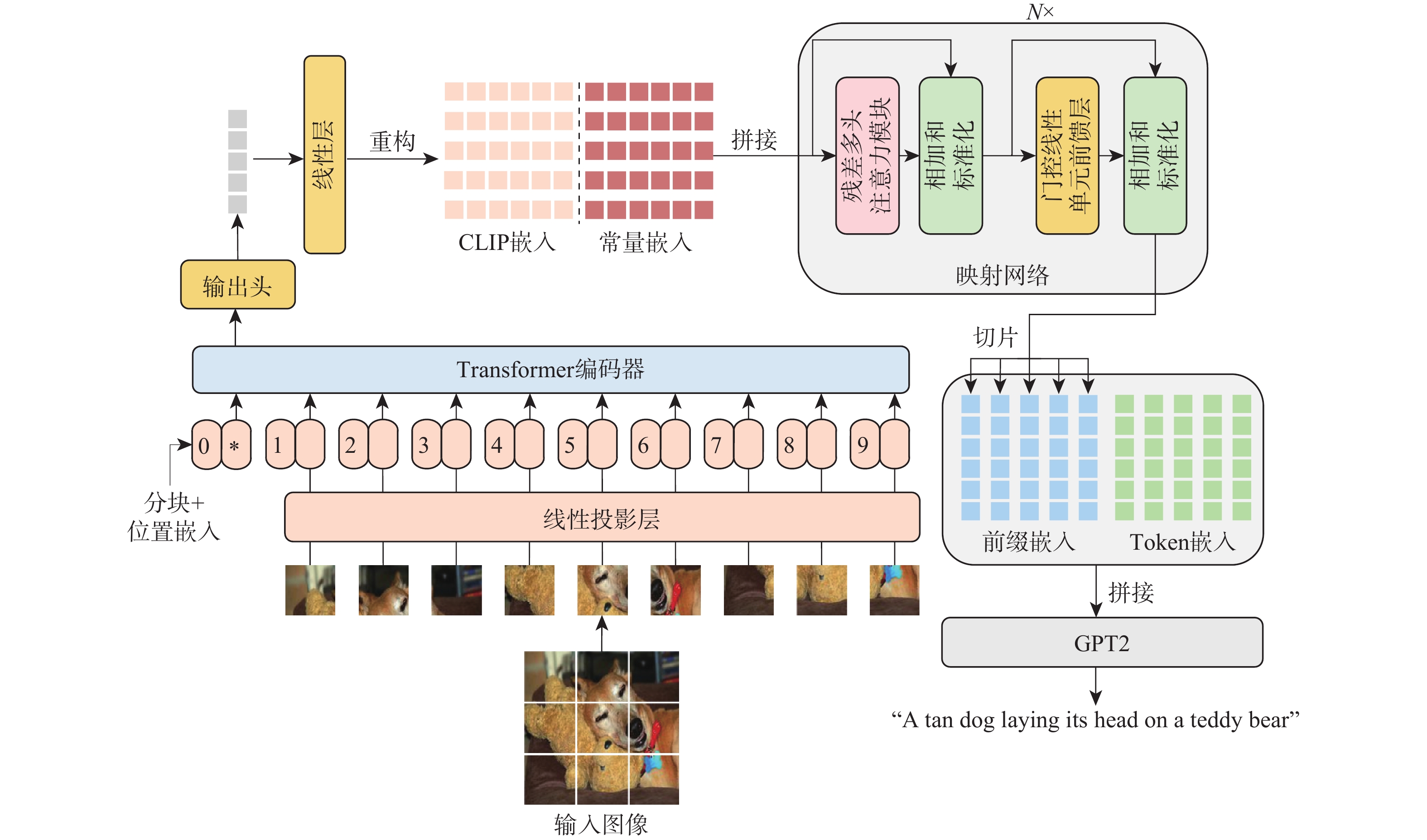
图像字幕是一项结合计算机视觉和自然语言处理的跨模态任务,模型需要为图像生成恰当的描述。为了应对这一挑战,提出一种带有残差注意力模块和门控线性单元的增强Transformer——残差门控 Transformer (RGFormer)。基于CLIP和RGFormer,提出一种生成图像字幕的模型——CRM。CRM利用CLIP的图像编码器提取特征作为图像字幕的前缀,该前缀通过映射网络RGFormer被投影到文本空间,然后被输入GPT-2语言模型中生成图像字幕。CLIP是在一个大型的图像-文本对数据集上进行训练的,包含丰富的视觉和语义信息,非常适合完成视觉-语言跨模态任务。CRM的核心理念是使用RGFormer映射网络来缩小视觉与文本表示之间的差距,从而完成图像字幕任务。CRM可以在短时间内为大规模的数据集生成有意义的描述,且无需额外监督。定量评估实验表明,CRM在COCO Caption数据集上的表现可与一些先进模型相媲美,且效率更高。
-
关键词:
- 图像字幕 /
- CLIP /
- Transformer /
- 门控线性单元 /
- 残差多头注意力
Abstract:Natural language processing and computer vision are combined in the cross-modal job of image captioning. The model is required to generate an appropriate caption for the given image. To address this challenge, we proposed residual gated Transformer (RGFormer) as an enhancement of the Transformer architecture. The model, based on CLIP and RGFormer, CRM, is then proposed for image captioning. CRM utilizes the encoder of CLIP to extract image features as a prefix to the caption. RGFormer, a lightweight mapping network, projects the prefix into language space before feeding it into GPT-2 to produce captions. CLIP was trained on an extensive dataset comprising image-text pairs, which contains rich visual and semantic information and is exceptionally well-suited for vision-language tasks. The core idea of CRM is to reduce the disparity between visual and textual representations by using RGFormer to accomplish the cross-modal task. CRM could generate meaningful captions for large-scale datasets in a short training time without additional annotations or pre-training. Quantitative evaluation experiments show that CRM achieves results comparable to some advanced models on the COCO Caption dataset more efficiently.
-
Key words:
- image caption /
- CLIP /
- Transformer /
- gated linear unit /
- residual multi-head attention
-
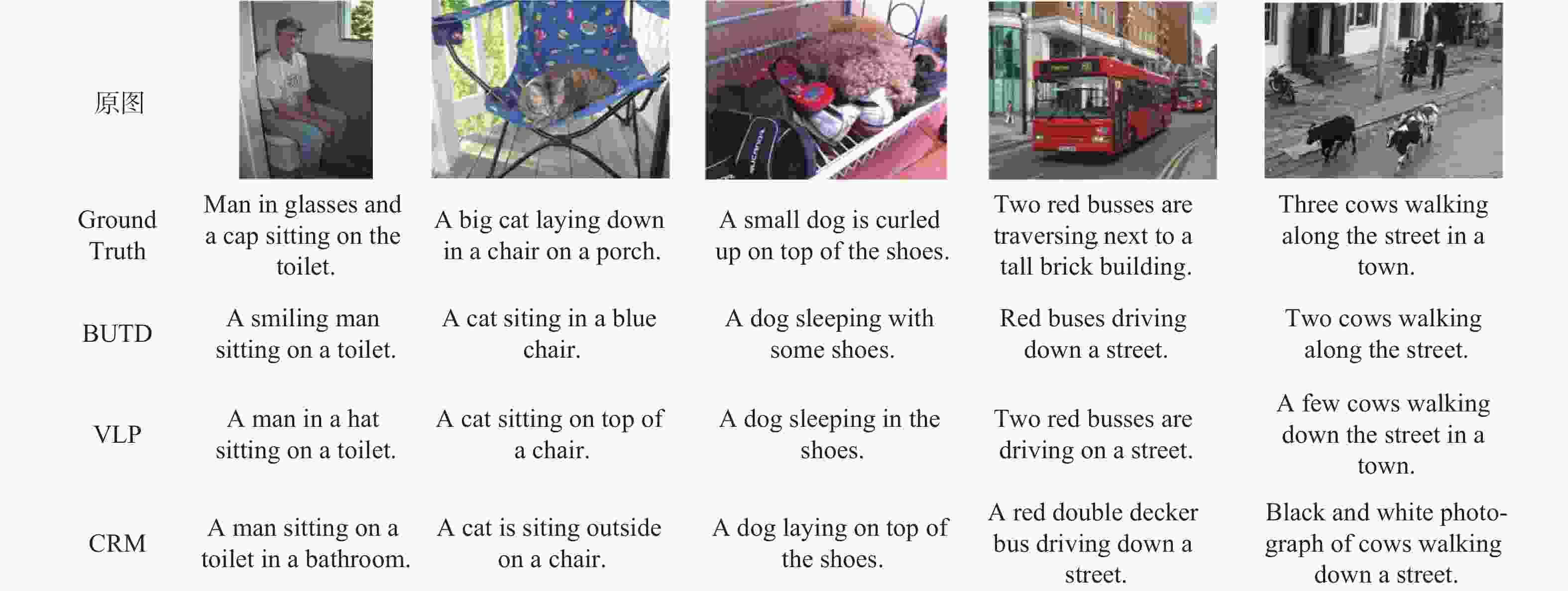
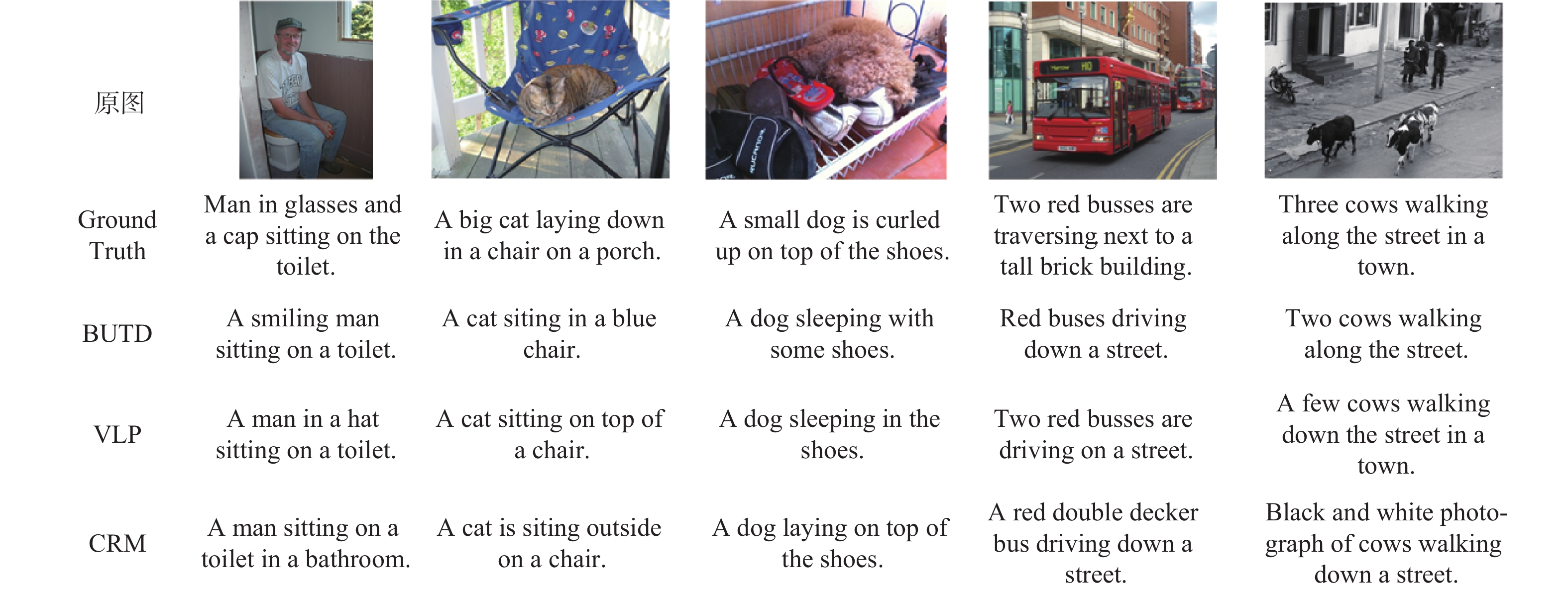
图 6 COCO Caption测试集中随机选择图像的未筛选结果
Figure 6. Unfiltered results of randomly selected images from COCO Caption test set
表 1 COCO Caption数据集定量评估结果
Table 1. Quantitative evaluation on COCO caption dataset
模型 BLEU@4 METEOR CIDEr SPICE 参数规模 训练时间/h 设备型号 BUTD[1] 36.2 27.0 113.5 20.3 5.20×10⁷ 960 M40 VLP[14] 36.5 28.4 117.7 21.3 1.15×10⁸ 48 V100 VL-T5[34] 34.5 28.7 116.5 21.9 2.70×10⁸ VLKD[35] 34.1 27.5 114.3 21.0 Oscar[3] 36.58 30.4 124.12 23.17 1.35×10⁸ 74 V100 CRM 33.61 27.85 114.60 21.67 4.60×10⁷ 4 3090 Ti  下载: 导出CSV
表 2 RGFormer消融实验结果
Table 2. Results of ablation experiment of RGFormer
模型 BLEU@4 METEOR CIDEr SPICE CTM 33.53 27.45 113.08 21.05 CTM+RMHA 33.59 27.73 114.27 21.56 CTM+GLU 33.50 27.62 113.49 21.23 CTM+RGFormer(CRM) 33.61 27.85 114.60 21.67
下载: 导出CSV
-
[1] Anderson P, He X D, Buehler C, et al. Bottom-up and top-down attention for image captioning and visual question answering[C]//Proceedings of the 2018 IEEE/CVF Conference on Computer Vision and Pattern Recognition. Piscataway Palo Alto: IEEE Press, 2018: 6077-6086. [2] Chen X L, Zitnick C L. Learning a recurrent visual representation for image caption generation[EB/OL]. (2014-11-20)[ 2024-12-18]. https://doi.org/10.48550/arXiv.1411.5654. [3] Li X J, Yin X, Li C Y, et al. Oscar: object-semantics aligned pre-training for vision-language tasks[C]//Computer Vision-ECCV 2020. Cham: Springer International Publishing, 2020: 121-137. [4] Stefanini M, Cornia M, Baraldi L, et al. From show to tell: a survey on deep learning-based image captioning[J]. IEEE Transactions on Pattern Analysis and Machine Intelligence, 2023, 45(1): 539-559. [5] Tan H, Bansal M. LXMERT: learning cross-modality encoder representations from transformers[EB/OL]. (2019-12-03)[2024-12-20]. https://doi.org/10.48550/arXiv.1908.07490. [6] Xu K, Ba J L, Kiros R, et al. Show, attend and tell: neural image caption generation with visual attention[C]//International Conference on Machine Learning. New York: ACM, 2015: 2048-2057. [7] Yao T, Pan Y W, Li Y H, et al. Exploring visual relationship for image captioning[C]//Computer Vision-ECCV 2018. Cham: Springer International Publishing, 2018: 711-727. [8] Radford A, Kim J W, Hallacy C, et al. Learning transferable visual models from natural language supervision[C]//International Conference on Machine Learning. Virtual Event: PMLR, 2021: 8748-8763. [9] Chen X L, Fang H, Lin T Y, et al. Microsoft COCO captions: data collection and evaluation server[EB/OL]. (2015-04-03)[2024-12-20]. https://doi.org/10.48550/arXiv.1504.00325. [10] Lin T Y, Maire M, Belongie S, et al. Microsoft COCO: common objects in context[C]//Computer Vision-ECCV 2014. Cham: Springer International Publishing, 2014: 740-755. [11] Simonyan K, Zisserman A. Very deep convolutional networks for large-scale image recognition[EB/OL]. (2015-04-10)[2024-12-20]. https://arxiv.org/abs/1409.1556. [12] He K M, Zhang X Y, Ren S Q, et al. Deep residual learning for image recognition[C]//Proceedings of the 2016 IEEE Conference on Computer Vision and Pattern Recognition. Piscataway: IEEE Press, 2016: 770-778. [13] Ren S Q, He K M, Girshick R, et al. Faster R-CNN: towards real-time object detection with region proposal networks[J]. IEEE Transactions on Pattern Analysis and Machine Intelligence, 2017, 39(6): 1137-1149. [14] Zhou L, Palangi H, Zhang L, et al. Unified vision-language pre-training for image captioning and VQA[C]//Proceedings of the 34th AAAI Conference on Artificial Intelligence Palo Alto: AAAI Press, 2020: 13041-13049. [15] Conde M V, Turgutlu K. CLIP-art: contrastive pre-training for fine-grained art classification[C]//Proceedings of the 2021 IEEE/CVF Conference on Computer Vision and Pattern Recognition Workshops. Piscataway: IEEE Press, 2021: 3951-3955. [16] Zhang R R, Zhang W, Fang R Y, et al. Tip-adapter: training-free adaption of CLIP for few-shot classification[C]//Computer Vision-ECCV 2022. Cham: Springer Nature Switzerland, 2022: 493-510. [17] Liu H D, Xu S Y, Fu J M, et al. CMA-CLIP: cross-modality attention CLIP for image-text classification[EB/OL]. (2021-12-09)[2024-12-21]. https://arxiv.org/abs/2112.03562. [18] Vidit V, Engilberge M, Salzmann M. CLIP the gap: a single domain generalization approach for object detection[C]//Proceedings of the 2023 IEEE/CVF Conference on Computer Vision and Pattern Recognition. Piscataway: IEEE Press, 2023: 3219-3229. [19] Teng Z, Duan Y N, Liu Y, et al. Global to local: clip-LSTM-based object detection from remote sensing images[J]. IEEE Transactions on Geoscience and Remote Sensing, 2022, 60: 5603113. [20] Gu X Y, Lin T Y, Kuo W C, et al. Open-vocabulary object detection via vision and language knowledge distillation[EB/OL]. (2022-05-12)[2024-12-21]. https://doi.org/10.48550/arXiv.2104.13921. [21] Anderson P, Fernando B, Johnson M, et al. SPICE: semantic propositional image caption evaluation[C]//Computer Vision-ECCV 2016. Cham: Springer International Publishing, 2016: 382-398. [22] Yong C, Fei H, Lian Z, et al. A hierarchical multimodal attention-based neural network for image captioning[J]. ACM SIGIR Forum, 2017, 51(CD): 889-892. [23] Ji J Y, Luo Y P, Sun X S, et al. Improving image captioning by leveraging intra-and inter-layer global representation in transformer network[C]//Proceedings of the AAAI Conference on Artificial Intelligence. Palo Alto: AAAI Press, 2021, 35(2): 1655-1663. [24] Luo Y P, Ji J Y, Sun X S, et al. Dual-level collaborative transformer for image captioning[C]//Proceedings of the AAAI Conference on Artificial Intelligence. Palo Alto: AAAI Press, 2021, 35(3): 2270-2277. [25] Hochreiter S, Schmidhuber J. Long short-term memory[J]. Neural Computation, 1997, 9(8): 1735-1780. [26] Vaswani A, Shazeer N, Parmar N, et al. Attention is all you need[C]//Advances in Neural Information Processing Systems. Long Beach: Curran Associates, Inc. , 2017, 30: 5998-6008. [27] Devlin J, Chang M W, Lee K, et al. BERT: pre-training of deep bidirectional transformers for language understanding[EB/OL]. (2019-05-24)[2024-12-24]. https://doi.org/10.48550/arXiv.1810.04805. [28] Lu J, Batra D, Parikh D, et al. Vilbert: pretraining task-agnostic visiolinguistic representations for vision-and-language tasks[J]. Advances in neural information processing systems, 2019, 32. [29] Radford A, Wu J, Child R, et al. Language models are unsupervised multitask learners[J]. OpenAI Blog, 2019, 1(8): 9. [30] Zhang P C, Li X J, Hu X W, et al. VinVL: revisiting visual representations in vision-language models[C]//Proceedings of the 2021 IEEE/CVF Conference on Computer Vision and Pattern Recognition. Piscataway: IEEE Press, 2021: 5575-5584. [31] Li X L, Liang P. Prefix-tuning: optimizing continuous prompts for generation[EB/OL]. (2021-01-01)[2024-12-25]. https://doi.org/10.48550/arXiv.2101.00190. [32] Dosovitskiy A, Beyer L, Kolesnikov A, et al. An image is worth 16x16 words: transformers for image recognition at scale[EB/OL]. V2. (2021-06-03)[2024-12-25]. https://doi.org/10.48550/arXiv.2010.11929. [33] Karpathy A, Li F F. Deep visual-semantic alignments for generating image descriptions[C]//Proceedings of the 2015 IEEE Conference on Computer Vision and Pattern Recognition. Piscataway: IEEE Press, 2015: 3128-3137. [34] Cho J, Lei J, Tan H, et al. Unifying vision-and-language tasks via text generation[C]//International Conference on Machine Learning. Virtual Event: PMLR, 2021: 1931-1942. [35] Sun L, Li Y W, Dong Y M. Learning from expert: vision-language knowledge distillation for unsupervised cross-modal hashing retrieval[C]//Proceedings of the 2023 ACM International Conference on Multimedia Retrieval. New York: ACM, 2023: 499-507. [36] Raffel C, Shazeer N, Roberts A, et al. Exploring the limits of transfer learning with a unified text-to-text transformer[J]. Journal of Machine Learning Research, 2020, 21(140): 1-67. [37] Lewis M, Liu Y H, Goyal N, et al. BART: denoising sequence-to-sequence pre-training for natural language generation, translation, and comprehension[EB/OL]. (2019-10-29)[2024-12-25]. https://doi.org/10.48550/arXiv.1910.13461. [38] Papineni K, Roukos S, Ward T, et al. Bleu: a method for automatic evaluation of machine translation[C]//Proceedings of the 40th Annual Meeting of the Association for Computational Linguistics. Philadelphia: Association for Computational Linguistics, 2002: 311-318. [39] Denkowski M, Lavie A. Meteor universal: language specific translation evaluation for any target language[C]//Proceedings of the Ninth Workshop on Statistical Machine Translation. Philadelphia: Association for Computational Linguistics, 2014: 376-380. [40] Vedantam R, Zitnick C L, Parikh D. CIDEr: consensus-based image description evaluation[C]//Proceedings of the 2015 IEEE Conference on Computer Vision and Pattern Recognition. Piscataway: IEEE Press, 2015: 4566-4575. -

 下载:

计量
- 文章访问数: 95
- HTML全文浏览量: 9
- PDF下载量: 97
- 被引次数: 0
