





-
摘要:
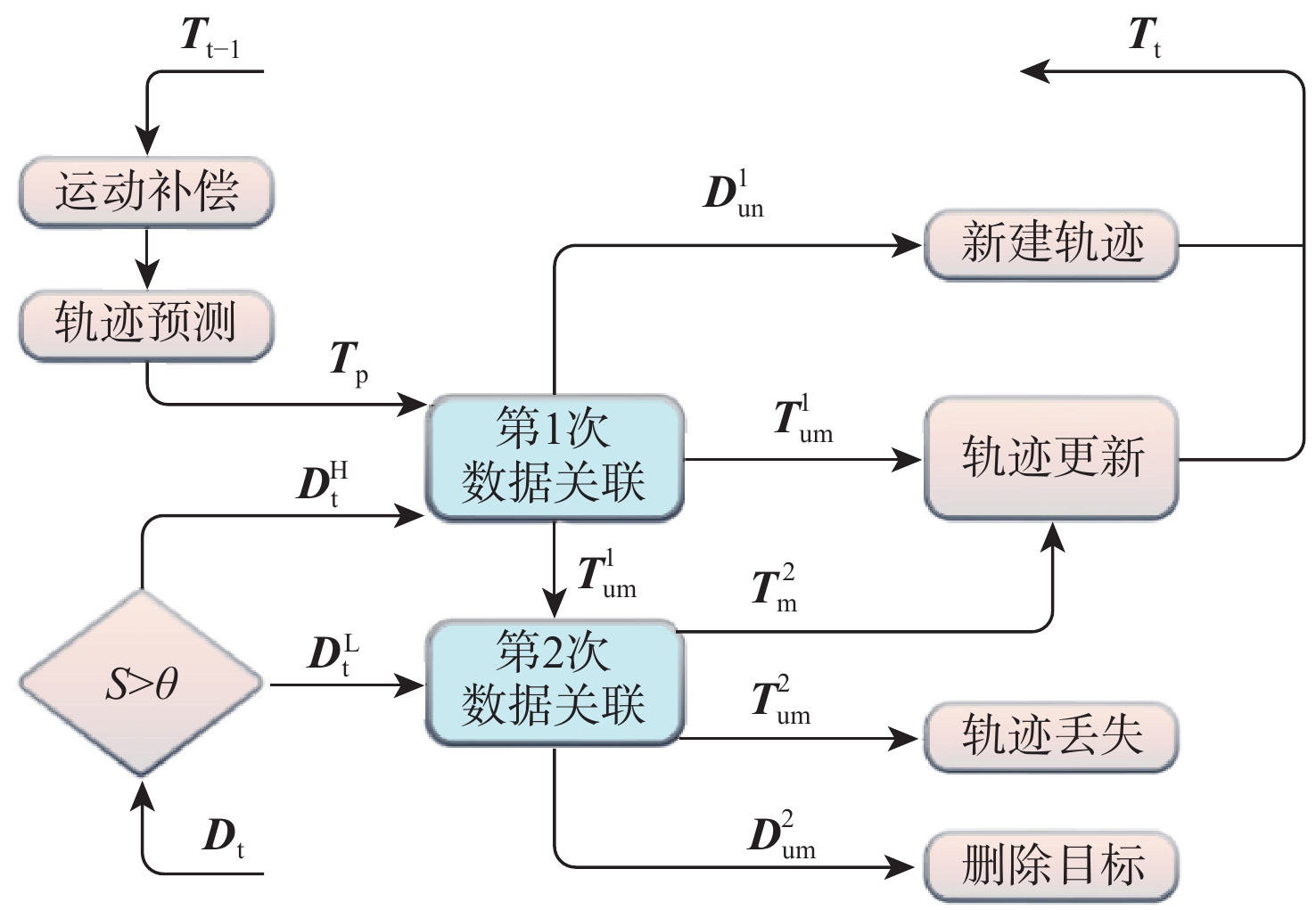
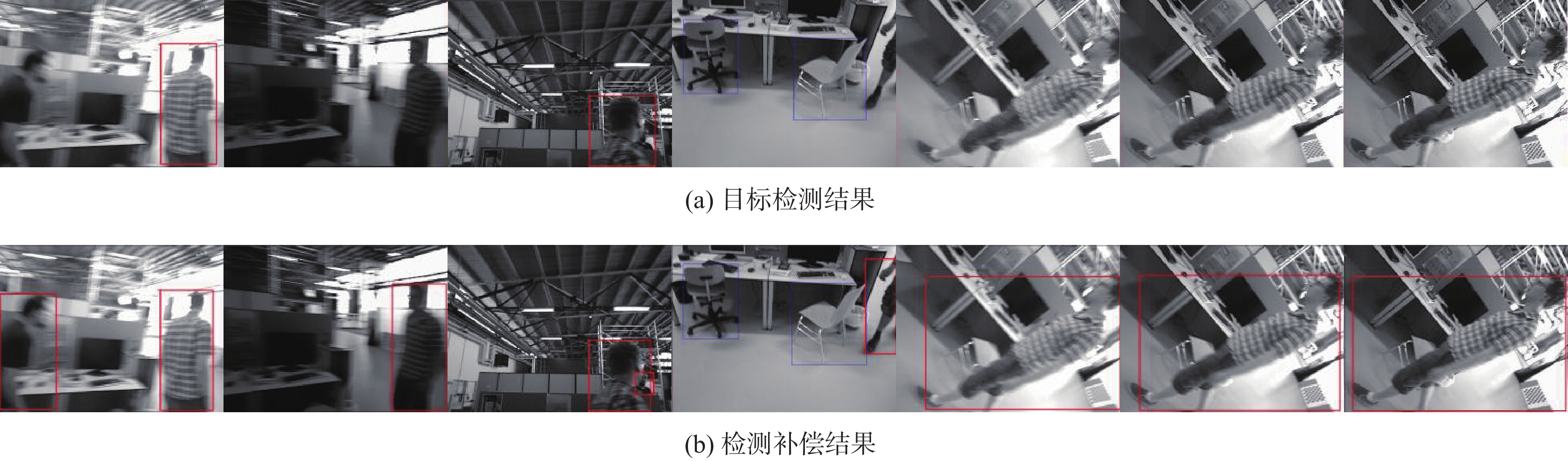
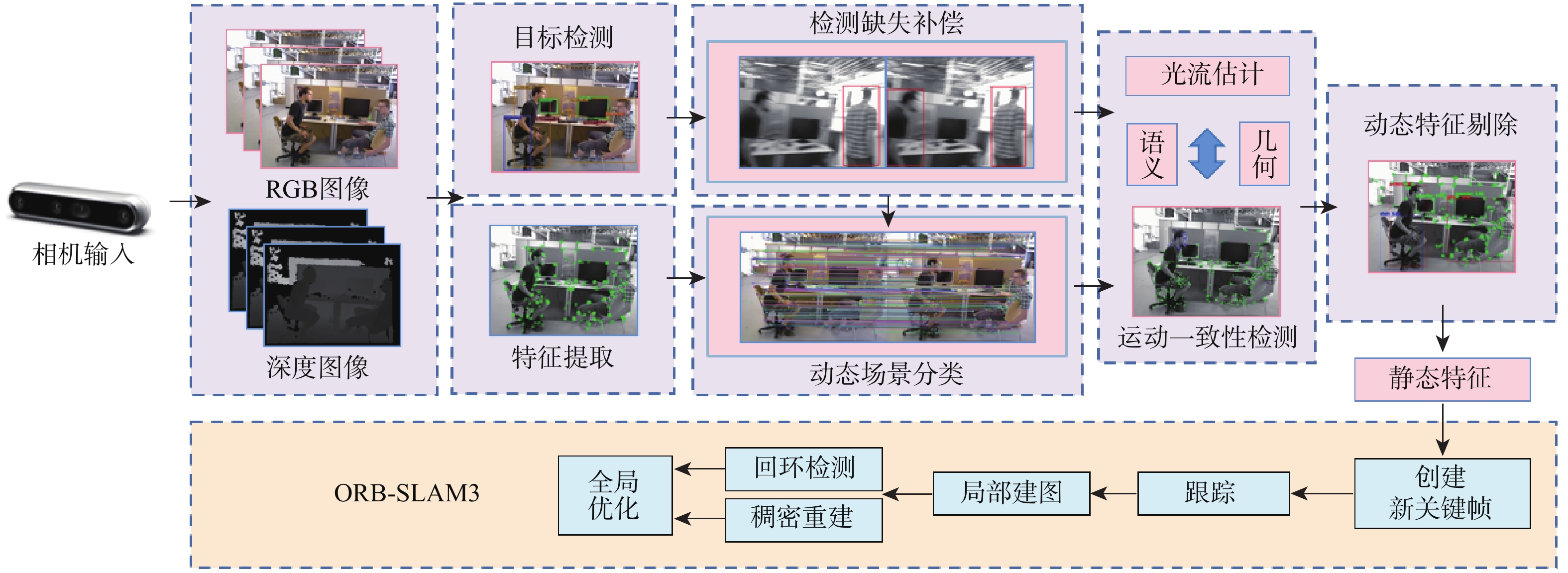
针对存在动态物体的一般性或复杂动态场景下同步定位与地图构建(SLAM)系统往往存在强假设性条件或定位精度不足乃至失效等多种问题,提出一种复杂动态场景实时视觉SLAM算法。该算法以ORB-SLAM3为基础,部署基于加速模型推理的YOLOX-s获取语义先验信息以处理动态目标,并结合卡尔曼滤波和匈牙利算法补偿目标检测缺失;为提升算法定位精度和泛化性能,在利用基于网格的运动统计(GMS)特征匹配算法快速筛选有效匹配点的基础上,提出一种双类别动态场景处理策略,根据图像匹配精度将场景分为两类处理:对低动态帧,采用GMS算法快速过滤动态特征,避免进行大量矩阵运算从而提升运行效率;对高动态帧,在利用卡方检验识别运动异常值的同时,提出一种动态特征剔除策略,根据自适应阈值剔除动态点并保持跟踪稳定性。标准数据集与真实场景下的实验测试均表明,所提算法能解决室内外复杂动态场景下的实时定位问题,表现出良好的精确性、鲁棒性和及时性。
Abstract:Simultaneous localization and mapping (SLAM) systems frequently have a number of issues in general or sophisticated dynamic scenarios with dynamic objects, including strong assumptions, inadequate positioning precision, or even failure. To solve these problems, a real-time visual SLAM algorithm for complex dynamic scenarios is proposed, which is built on ORB-SLAM3. The algorithm deploys YOLOX-s based on accelerated model inference to obtain semantic prior information to process dynamic objects, and the Kalman filter and Hungarian algorithm are combined to compensate for missing object detection. A two-category dynamic scenario processing strategy is proposed based on the grid-based motion statistics (GMS) feature matching algorithm to rapidly screen reliable matching points, which separates the scenarios into two categories based on the image matching accuracy, in order to enhance the positioning accuracy and generalization ability of the algorithm. For low dynamic frames, the GMS algorithm is used to quickly filter out dynamic features, so as to avoid a large number of matrix operations and improve operational efficiency. For high dynamic frames, the Chi-square test is utilized to identify motion outliers, and a dynamic feature culling strategy is proposed to cull dynamic points according to the adaptive threshold and keep the tracking stability. The experimental results on standard datasets and real scenarios show that the algorithm effectively addresses the real-time localization challenges, demonstrating its superior accuracy, robustness and real-time performance in complex indoor and outdoor dynamic scenarios.
-
Key words:
- visual SLAM /
- dynamic object /
- deep learning /
- object detection /
- scenario classification
-
表 1 TUM数据集绝对轨迹误差结果
Table 1. Results of ATE on TUM dataset
m 序列 RMSE S.D. ORB-
SLAM3[14]ORB-
SLAM3[11]ORB-
SLAM3[12]ORB-
SLAM3[13]本文算法 ORB-
SLAM3[14]ORB-
SLAM3[11]ORB-
SLAM3[12]ORB-
SLAM3[13]本文算法 fr3/s/half 0.032 5 0.022 6 0.019 6 0.012 9 0.011 7 0.011 0 fr3/s/rpy 0.022 8 0.035 5 0.020 6 0.014 6 0.025 9 0.009 5 fr3/s/static 0.007 9 0.008 5 0.008 0 0.006 5 0.006 3 0.003 9 0.004 6 0.004 0 0.002 9 0.002 8 fr3/s/xyz 0.009 4 0.016 4 0.012 9 0.012 8 0.011 6 0.004 6 0.008 9 0.006 7 0.008 8 0.007 2 fr3/w/half 0.191 5 0.023 7 0.022 7 0.019 2 0.018 9 0.069 2 0.011 3 0.012 6 0.009 1 0.009 9 fr3/w/rpy 0.562 7 0.060 9 0.046 0 0.032 4 0.034 2 0.211 0 0.042 1 0.030 1 0.018 0 0.019 0 fr3/w/static 0.027 8 0.007 4 0.007 6 0.006 6 0.006 3 0.022 1 0.003 5 0.004 1 0.003 1 0.002 9 fr3/w/xyz 0.395 7 0.017 3 0.015 0 0.014 5 0.013 5 0.151 8 0.009 6 0.008 3 0.006 9 0.006 9 注:每个序列的最优结果用粗体突出显示,次优结果用下划线突出显示。  下载: 导出CSV
表 2 TUM数据集平移漂移结果
Table 2. Results of translational drifton TUM dataset
m 序列 RMSE S.D. ORB-
SLAM3[14]ORB-
SLAM3[11]ORB-
SLAM3[12]ORB-
SLAM3[13]本文算法 ORB-
SLAM3[14]ORB-
SLAM3[11]ORB-
SLAM3[12]ORB-
SLAM3[13]本文算法 fr3/s/half 0.007 8 0.016 6 0.014 1 0.004 2 0.009 6 0.008 7 fr3/s/rpy 0.013 6 0.019 1 0.009 7 0.009 2 0.013 8 0.005 5 fr3/s/static 0.005 8 0.006 0 0.009 0 0.005 7 0.004 9 0.003 1 0.003 1 0.004 7 0.002 9 0.002 5 fr3/s/xyz 0.008 4 0.014 1 0.011 9 0.012 0 0.009 6 0.004 3 0.008 5 0.006 3 0.007 9 0.005 5 fr3/w/half 0.337 3 0.019 3 0.018 0 0.013 8 0.013 8 0.190 8 0.011 5 0.011 1 0.007 4 0.008 0 fr3/w/rpy 0.8632 0.042 2 0.030 3 0.020 1 0.021 1 0.457 0 0.030 5 0.023 5 0.012 0 0.012 5 fr3/w/static 0.040 5 0.007 4 0.007 7 0.005 6 0.006 0 0.031 0 0.003 8 0.004 3 0.002 7 0.003 2 fr3/w/xyz 0.607 5 0.015 2 0.013 8 0.013 0 0.012 2 0.370 4 0.009 5 0.008 1 0.007 1 0.006 7 注:每个序列的最优结果用粗体突出显示,次优结果用下划线突出显示。
下载: 导出CSV
表 3 TUM数据集旋转漂移结果
Table 3. Results of rotational drifton TUM dataset
m 序列 RMSE S.D. ORB-
SLAM3[14]ORB-
SLAM3[11]ORB-
SLAM3[12]ORB-
SLAM3[13]本文算法 ORB-
SLAM3[14]ORB-
SLAM3[11]ORB-
SLAM3[12]ORB-
SLAM3[13]本文算法 fr3/s/half 0.981 6 1.034 6 1.001 4 0.446 8 0.493 4 0.499 7 fr3/s/rpy 0.955 2 1.046 8 0.894 7 0.451 1 0.533 9 0.438 5 fr3/s/static 0.384 6 0.351 8 0.327 7 0.335 3 0.313 1 0.167 5 0.161 9 0.149 7 0.157 6 0.153 3 fr3/s/xyz 0.606 8 0.694 1 0.628 2 0.668 1 0.600 9 0.311 5 0.322 6 0.320 1 0.349 8 0.308 8 fr3/w/half 6.930 9 1.223 4 1.019 0 0.926 2 0.880 8 4.138 8 0.652 8 0.540 3 0.425 8 0.455 7 fr3/w/rpy 15.564 7 2.077 1 1.342 6 0.984 2 1.066 3 9.287 3 1.246 7 0.748 2 0.504 9 0.564 9 fr3/w/static 0.658 0 0.312 2 0.308 6 0.279 8 0.265 7 0.431 1 0.138 0 0.139 1 0.121 7 0.122 3 fr3/w/xyz 9.083 1 0.659 0 0.663 2 0.631 8 0.615 4 6.001 5 0.333 1 0.348 5 0.325 6 0.321 9 注:每个序列的最优结果用粗体突出显示,次优结果用下划线突出显示。
下载: 导出CSV
表 4 BONN 数据集绝对轨迹误差结果
Table 4. Results of ATE on BONN dataset
m 序列 RMSE S.D. ORB-
SLAM3[14]ORB-
SLAM3[11]ORB-
SLAM3[12]ORB-
SLAM3[13]本文算法 ORB-
SLAM3[14]ORB-
SLAM3[11]ORB-
SLAM3[12]ORB-
SLAM3[13]本文算法 crowd 0.331 7 0.017 0 0.018 7 0.016 9 0.015 3 0.211 3 0.008 6 0.008 6 0.008 0 0.006 5 crowd2 1.488 5 0.033 3 0.032 2 0.025 9 0.019 4 0.595 8 0.019 9 0.021 1 0.019 2 0.009 4 crowd3 0.459 3 0.039 8 0.028 9 0.021 8 0.020 2 0.221 9 0.022 0 0.017 9 0.012 0 0.010 5 move_no_box 0.325 6 0.012 8 0.017 7 0.013 7 0.013 8 0.154 0 0.006 0 0.012 5 0.006 8 0.006 4 move_no_box2 0.038 2 0.024 0 0.019 0 0.023 0 0.021 5 0.016 9 0.011 1 0.008 5 0.008 5 0.008 2 person_tracking 0.561 1 0.034 3 0.031 1 0.036 0 0.026 4 0.229 9 0.020 4 0.014 9 0.014 9 0.013 0 person_tracking2 0.753 8 0.034 6 0.034 3 0.034 9 0.032 0 0.416 9 0.011 7 0.012 2 0.013 0 0.012 4 注:每个序列的最优结果用粗体突出显示,次优结果用下划线突出显示。
下载: 导出CSV
表 5 KITTI数据集绝对轨迹误差的均方根误差结果
Table 5. Results of RMSE for ATE on KITTI dataset
m 序列 ORB-SLAM3[14] DynaSLAM[7] DOT-SLAM[21] DynaSLAM Ⅱ[22] 本文算法 00 0.96 1.4 1.18 1.29 0.96 01 11.89 9.4 1.33 2.31 7.50 02 4.81 6.7 1.04 0.91 3.56 03 0.29 0.6 1.00 0.69 0.38 04 0.18 0.2 1.00 1.42 0.15 05 0.39 0.8 1.14 1.34 0.46 06 0.71 0.8 1.07 0.19 0.37 07 0.43 0.5 1.00 3.10 0.41 08 3.08 3.5 1.24 1.68 2.73 09 1.62 1.6 3.89 5.02 1.06 10 1.11 1.2 1.02 1.30 1.23 注:每个序列的最优结果用粗体突出显示。
下载: 导出CSV
表 6 不同配置的绝对轨迹误差结果
Table 6. Results of ATE with different configurations
m 序列 RMSE S.D. 本文算法 W/O-GMS W/O-MCC W/O-DAT 本文算法 W/O-GMS W/O-MCC W/O-MCC fr3/s/half 0.0196 0.0565 0.0316 0.0191 0.0110 0.0423 0.0168 0.0087 fr3/s/rpy 0.0206 0.0308 0.0339 0.0212 0.0095 0.0209 0.0250 0.0133 fr3/s/static 0.0063 0.0077 0.0074 0.0068 0.0028 0.0040 0.0034 0.0034 fr3/s/xyz 0.0116 0.0130 0.0093 0.0104 0.0072 0.0067 0.0052 0.0054 fr3/w/half 0.0189 0.0242 0.0234 0.0279 0.0099 0.0140 0.0125 0.0127 fr3/w/rpy 0.0342 0.0415 0.0449 0.0546 0.0190 0.0232 0.0270 0.0342 fr3/w/static 0.0063 0.0082 0.0083 0.0147 0.0029 0.0039 0.0039 0.0072 fr3/w/xyz 0.0135 0.0133 0.0142 0.0192 0.0069 0.0068 0.0068 0.0095 注:每个序列的最优结果用粗体突出显示,次优结果用下划线突出显示。
下载: 导出CSV
表 7 不同算法的运行时间比较
Table 7. Runtime comparison of different systems
算法 每帧跟踪时间/ms 实验平台 本文算法 28.20~29.96 Intel i9, Nvidia RTX 4060 laptop DynaSLAM >350 CPU, Nvidia Tesla M40 GPU DS-SLAM 59.4 Intel i7, P4000 GPU ORB-SLAM3 20.24~22.79 Intel i9, Nvidia RTX 4060 laptop ORB-SLAM3 27.61~29.77 Intel i9, Nvidia RTX 4060 laptop ORB-SLAM3 20.68~23.35 Intel i9, Nvidia RTX 4060 laptop W/O-GMS 30.22~32.67 Intel i9, Nvidia RTX 4060 laptop ORB-SLAM3 14.32~17.58 Intel i9
下载: 导出CSV
-
[1] Davison A J, Reid I D, Molton N D, et al. MonoSLAM: real-time single camera SLAM[J]. IEEE Transactions on Pattern Analysis and Machine Intelligence, 2007, 29(6): 1052-1067. [2] Mur-Artal R, Tardós J D. ORB-SLAM2: an open-source SLAM system for monocular, stereo, and RGB-D cameras[J]. IEEE Transactions on Robotics, 2017, 33(5): 1255-1262. [3] Klein G, Murray D. Parallel tracking and mapping for small AR workspaces[C]//Proceedings of the 2007 6th IEEE and ACM International Symposium on Mixed and Augmented Reality. Piscataway: IEEE Press, 2007: 225-234. [4] Cheng J Y, Wang C Q, Meng M Q H. Robust visual localization in dynamic environments based on sparse motion removal[J]. IEEE Transactions on Automation Science and Engineering, 2020, 17(2): 658-669. [5] Dai W C, Zhang Y, Li P, et al. RGB-D SLAM in dynamic environments using point correlations[J]. IEEE Transactions on Pattern Analysis and Machine Intelligence, 2022, 44(1): 373-389. [6] Du Z J, Huang S S, Mu T J, et al. Accurate dynamic SLAM using CRF-based long-term consistency[J]. IEEE Transactions on Visualization and Computer Graphics, 2022, 28(4): 1745-1757. [7] Bescos B, Fácil J M, Civera J, et al. DynaSLAM: tracking, mapping, and inpainting in dynamic scenes[J]. IEEE Robotics and Automation Letters, 2018, 3(4): 4076-4083. [8] Yu C, Liu Z X , Liu X J, et al. DS-SLAM: a semantic visual SLAM towards dynamic environments[C]//Proceedings of the 2018 IEEE/RSJ International Conference on Intelligent Robots and Systems. Piscataway: IEEE Press, 2018: 1168-1174. [9] 王浩, 卢德玖, 方宝富. 动态环境下基于增强分割的RGB-D SLAM方法[J]. 机器人, 2022, 44(4): 418-430.Wang H, Lu D J, Fang B F. RGB-D SLAM method based on enhanced segmentation in dynamic environment[J]. Robot, 2022, 44(4): 418-430 (in Chinese). [10] 齐浩, 付悦欣, 胡祝华, 等. 基于自适应阈值和速度优化的轻量化语义VSLAM方法[J]. 北京航空航天大学学报, 2025, 51(7): 2562-2572.Qi H, Fu Y X, Hu Z H, et al. A lightweight semantic VSLAM approach based on adaptive thresholding and speed optimization[J]. Journal of Beijing University of Aeronautics and Astronautics, 2025, 51(7): 2562-2572(in Chinese). [11] Soares J C V, Gattass M, Meggiolaro M A. Crowd-SLAM: visual SLAM towards crowded environments using object detection[J]. Journal of Intelligent & Robotic Systems, 2021, 102(2): 50. [12] Cheng S H, Sun C H, Zhang S J, et al. SG-SLAM: a real-time RGB-D visual SLAM toward dynamic scenes with semantic and geometric information[J]. IEEE Transactions on Instrumentation and Measurement, 2023, 72: 7501012. [13] He J M, Li M R, Wang Y Y, et al. OVD-SLAM: an online visual SLAM for dynamic environments[J]. IEEE Sensors Journal, 2023, 23(12): 13210-13219. [14] Campos C, Elvira R, Rodriguez J J G, et al. ORB-SLAM3: an accurate open-source library for visual, visual-inertial, and multimap SLAM[J]. IEEE Transactions on Robotics, 2021, 37(6): 1874-1890. [15] Ge Z, Liu S T, Wang F, et al. YOLOX: exceeding YOLO series in 2021[EB/OL]. V2. arXiv (2021-08-06)[2021-08-06]. https://doi.org/10.48550/arXiv.2107.08430. [16] Aharon N, Orfaig R, Bobrovsky B Z. BoT-SORT: robust associations multi-pedestrian tracking[EB/OL]. (2022-07-07)[2022-07-26]. https://doi.org/10.48550/arXiv.2206.14651. [17] Bian J W, Lin W Y, Liu Y, et al. GMS: grid-based motion statistics for fast, ultra-robust feature correspondence[J]. International Journal of Computer Vision, 2020, 128(6): 1580-1593. [18] Liu G H, Zeng W L, Feng B, et al. DMS-SLAM: a general visual SLAM system for dynamic scenes with multiple sensors[J]. Sensors, 2019, 19(17): 3714. [19] Sturm J, Engelhard N, Endres F, et al. A benchmark for the evaluation of RGB-D SLAM systems[C]//Proceedings of the 2012 IEEE/RSJ International Conference on Intelligent Robots and Systems. Piscataway: IEEE Press, 2012: 573-580. [20] Palazzolo E, Behley J, Lottes P, et al. ReFusion: 3D reconstruction in dynamic environments for RGB-D cameras exploiting residuals[C]//Proceedings of the 2019 IEEE/RSJ International Conference on Intelligent Robots and Systems. Piscataway: IEEE Press, 2019: 7855-7862. [21] Ballester I, Fontán A, Civera J, et al. DOT: dynamic object tracking for visual SLAM[C]//Proceedings of the 2021 IEEE International Conference on Robotics and Automation. Piscataway: IEEE Press, 2021: 11705-11711. [22] Bescos B, Campos C, Tardós J D, et al. DynaSLAM II: tightly-coupled multi-object tracking and SLAM[J]. IEEE Robotics and Automation Letters, 2021, 6(3): 5191-5198. [23] Geiger A, Lenz P, Urtasun R. Are we ready for autonomous driving? The KITTI vision benchmark suite[C]//Proceedings of the 2012 IEEE Conference on Computer Vision and Pattern Recognition. Piscataway: IEEE Press, 2012: 3354-3361. -

 下载:

计量
- 文章访问数: 559
- HTML全文浏览量: 203
- PDF下载量: 116
- 被引次数: 0
