





GTA-Seq2Seq multi-step 4D trajectory prediction model based on spatio-temporal feature extraction
-
摘要:
高精度多步航迹预测有助于实时调整飞行路径,避免潜在冲突,提高飞行安全。传统模型通常面临多步预测精度低、难以捕获飞行轨迹中时空特征之间非线性关系的问题。为此,提出一种在序列到序列(Seq2Seq)模型中使用门控循环单元(GRU)、时间卷积网络(TCN)和时序模式注意力(TPA)机制的多步4D航迹预测模型GTA-Seq2Seq。该模型分为编码器和解码器部分,编码器使用GRU提取航迹数据中时间依赖性,并结合TCN-GRU网络提取航迹数据的空间特征,通过TPA分配各隐藏特征的权重。在解码器部分,时空特征经过拼接后输入GRU中,实现高精度的多步航迹预测。实验表明:所提模型在预测精度上优于传统模型,该模型中第5步预测相较于对比模型中最优模型——基于时空特征融合的编码器-解码器(STED)模型,均方根误差(RMSE)减小了27.70%,平均绝对误差(MAE)减小了23.82%。此外,GTA-Seq2Seq模型在训练过程中所需的参数量相较于STED模型减少了67.42%,提高了模型的运算效率。
Abstract:Real-time flight path correction, conflict avoidance, and increased flight safety are all made possible by high-precision multi-step trajectory prediction. Traditional models usually face problems such as low multi-step prediction accuracy and difficulty in capturing the nonlinear relationship between spatial and temporal features in flight trajectories. Therefore, this paper proposes a multi-step 4D trajectory prediction model GTA-Seq2Seq that uses a gate recurrent unit (GRU), temporal convolutional network (TCN) and temporal pattern attention (TPA) mechanism in a sequence-to-sequence (Seq2Seq) model. The model is divided into an encoder part and a decoder part. The encoder extracts the time dependence in trajectory data by using GRU and combines the TCN-GRU network to extract the spatial features of trajectory data. To accomplish high-precision multi-step trajectory prediction, the spatial and temporal information are concatenated in the decoder section and sent into GRU. The experiment shows that the proposed model outperforms traditional models in terms of prediction accuracy. The fifth step prediction in the model reduces the root mean square error (RMSE) by 27.70% and the mean absolute error (MAE) by 23.82% compared to the optimal model—spatio-temporal encoder-decoder (STED) among the comparison models. In addition, the required number of parameters of the GTA-Seq2Seq model in the training process is reduced by 67.42% compared to STED model, improving the operational efficiency of the model.
-
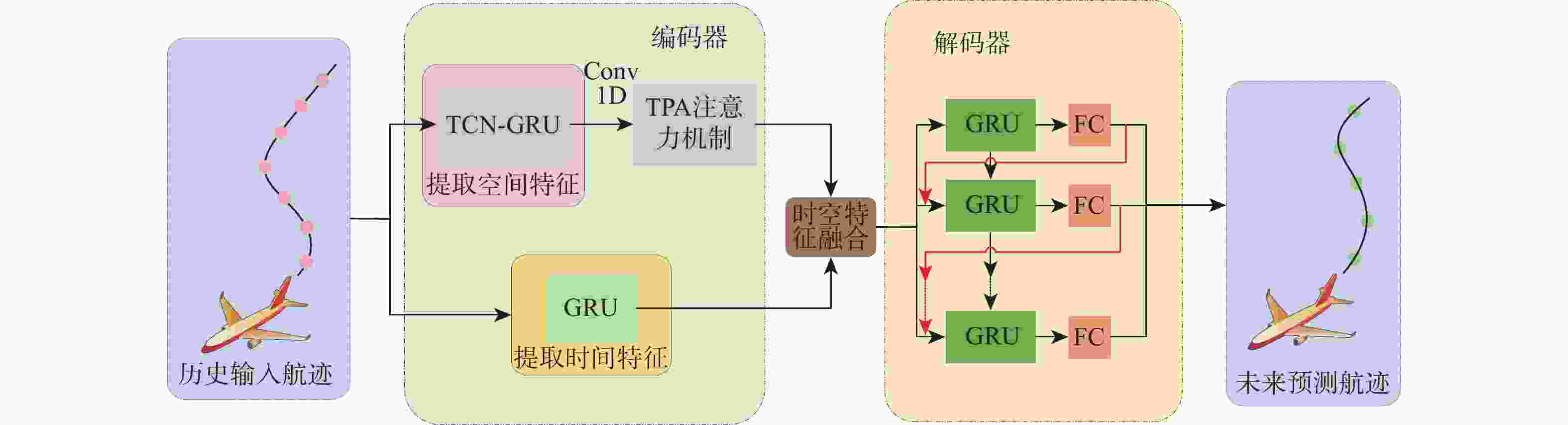
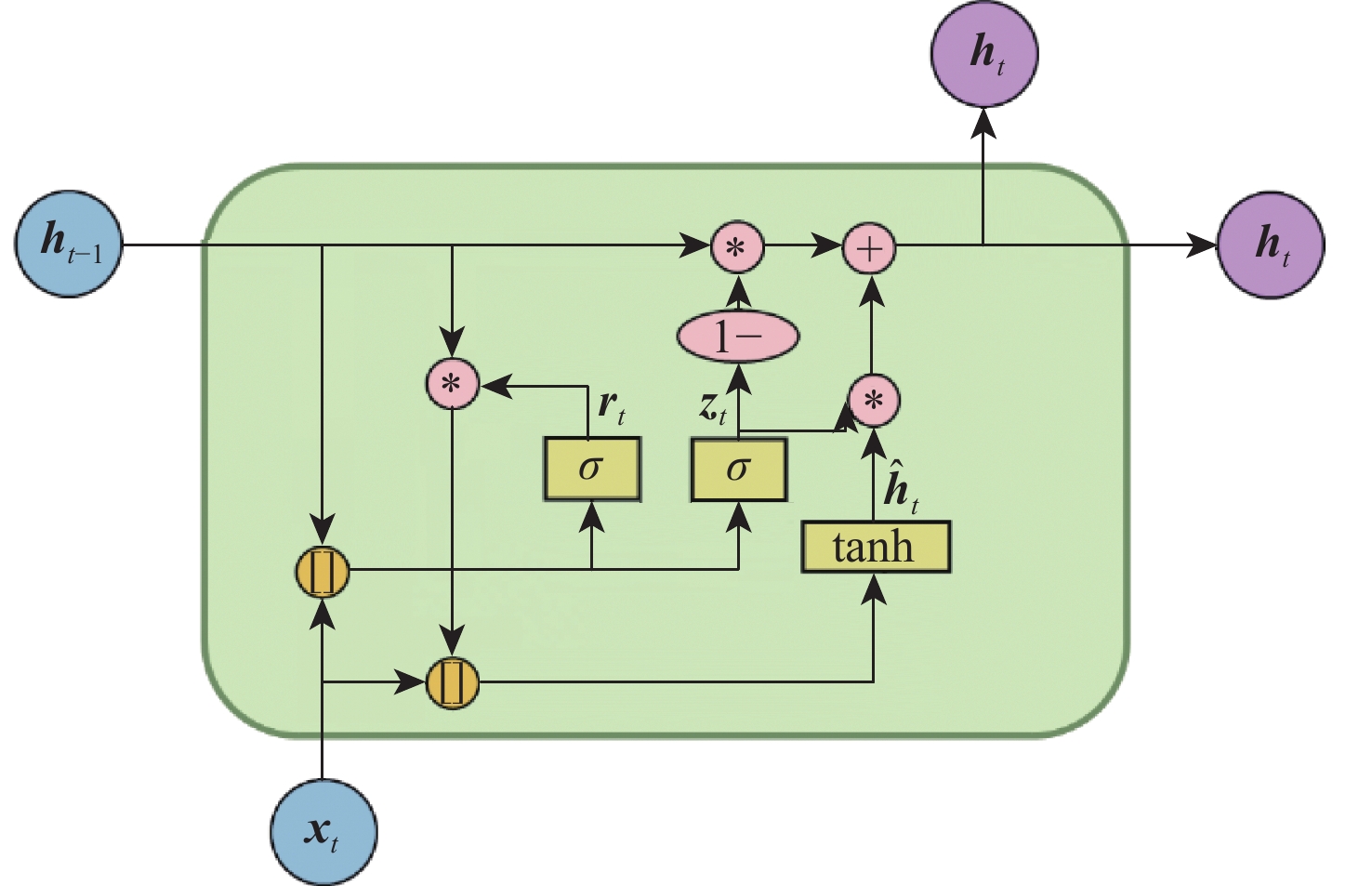
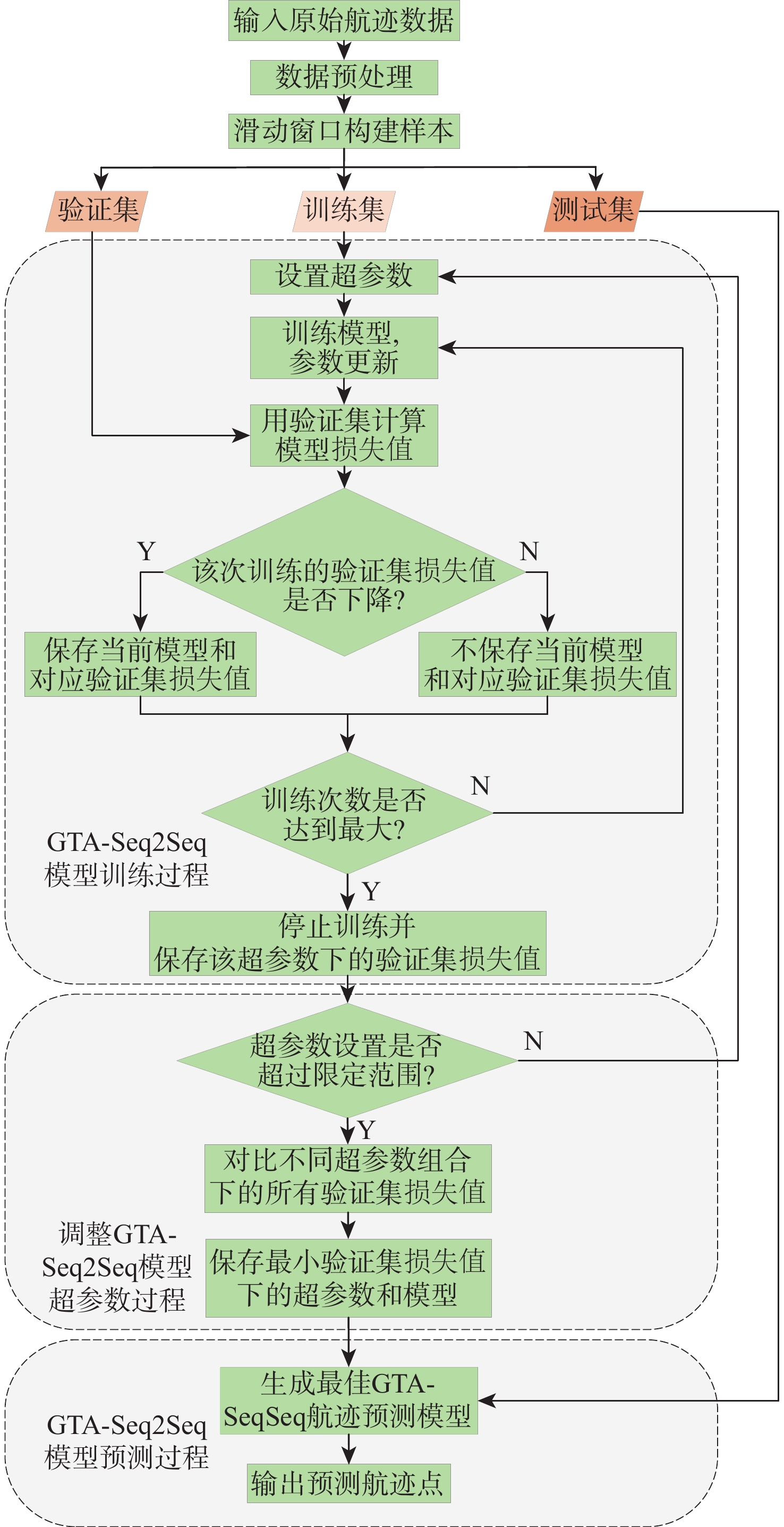
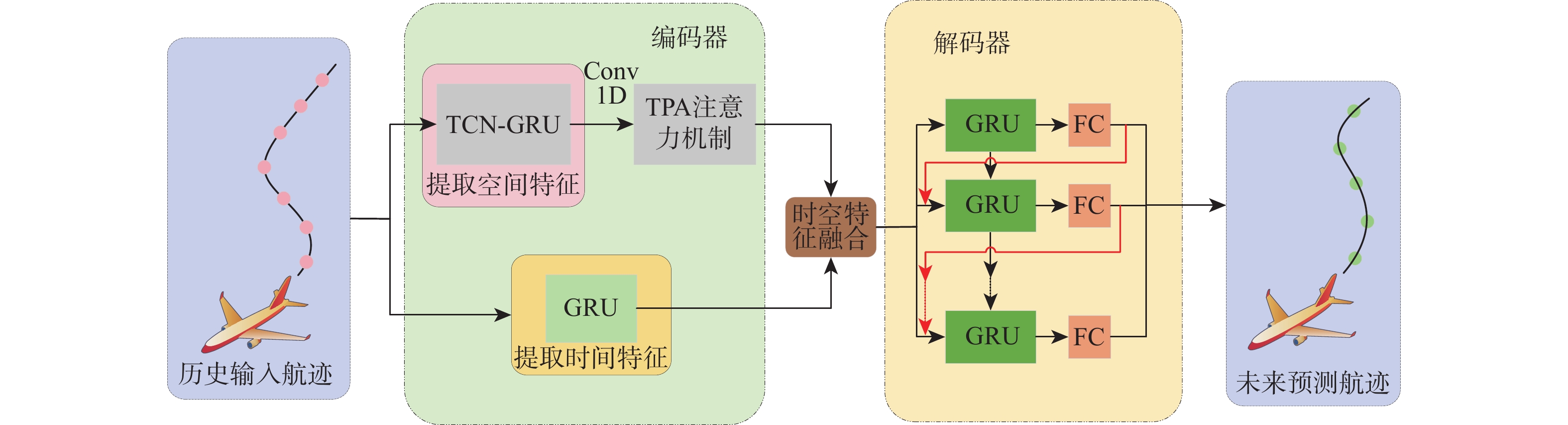
图 1 GTA-Seq2Seq航迹预测模型总体结构
Figure 1. GTA-Seq2Seq overall structure of trajectory prediction model
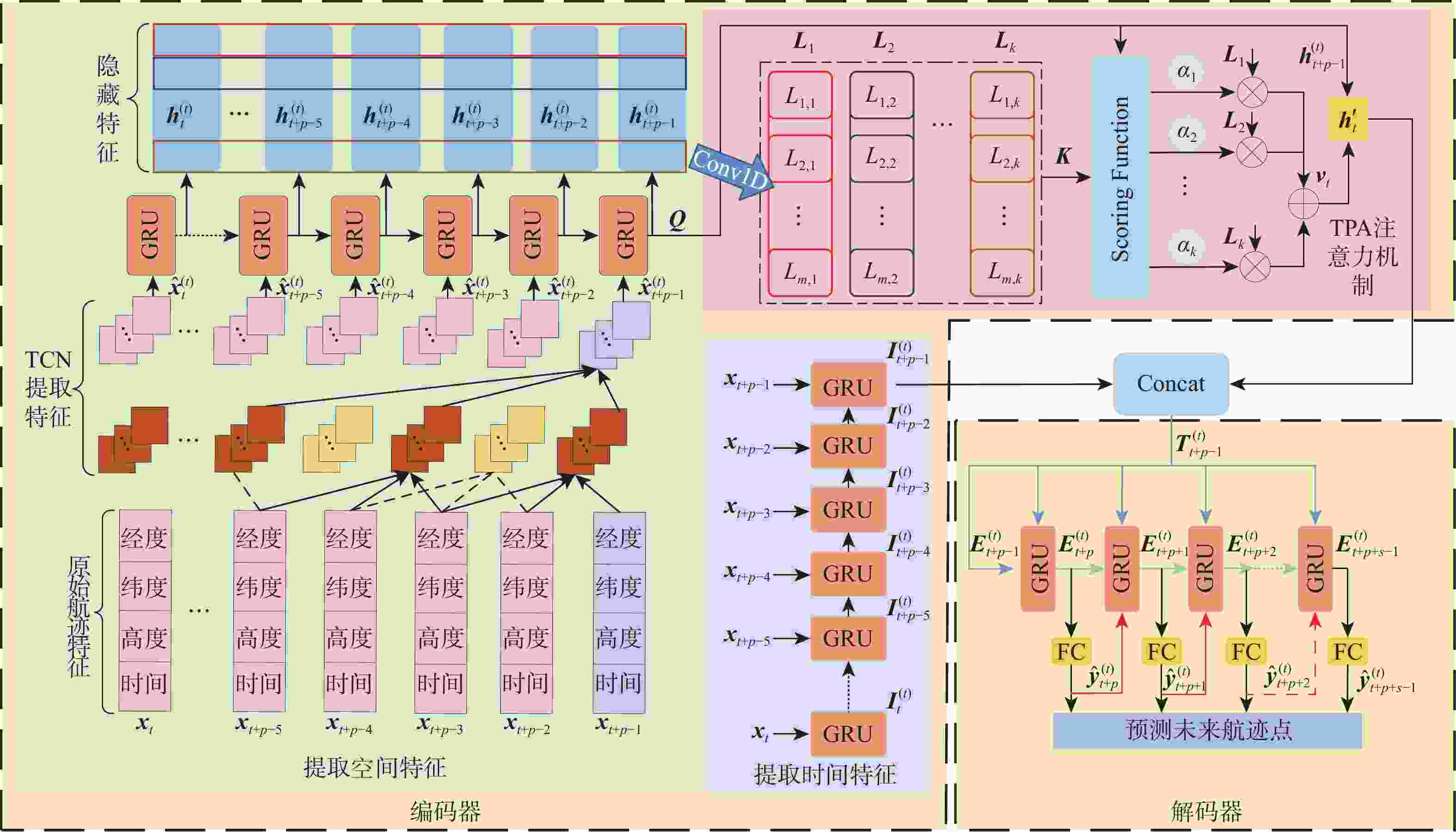
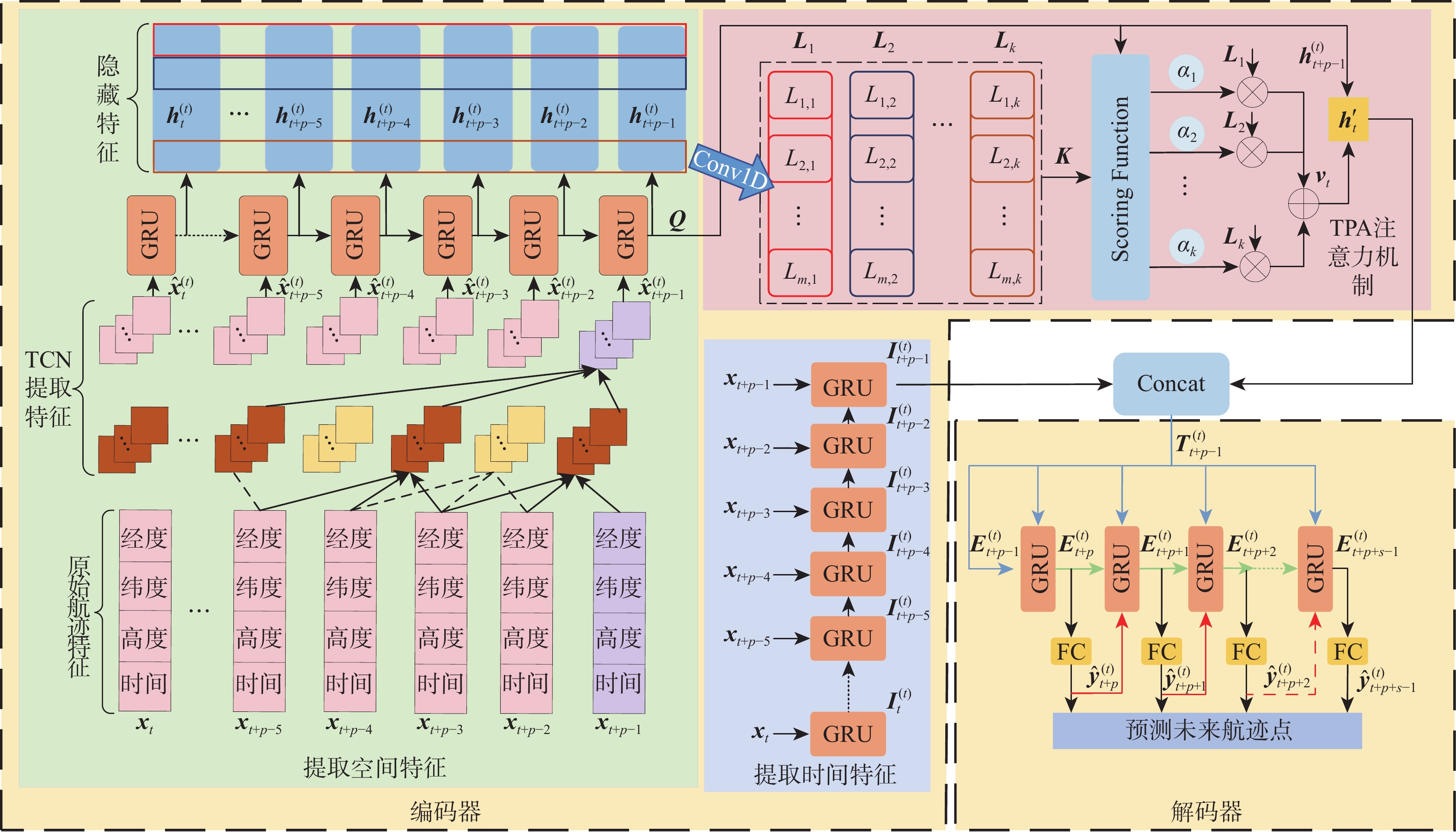
图 2 GTA-Seq2Seq航迹预测模型结构
Figure 2. Structure of GTA-Seq2Seq trajectory prediction model
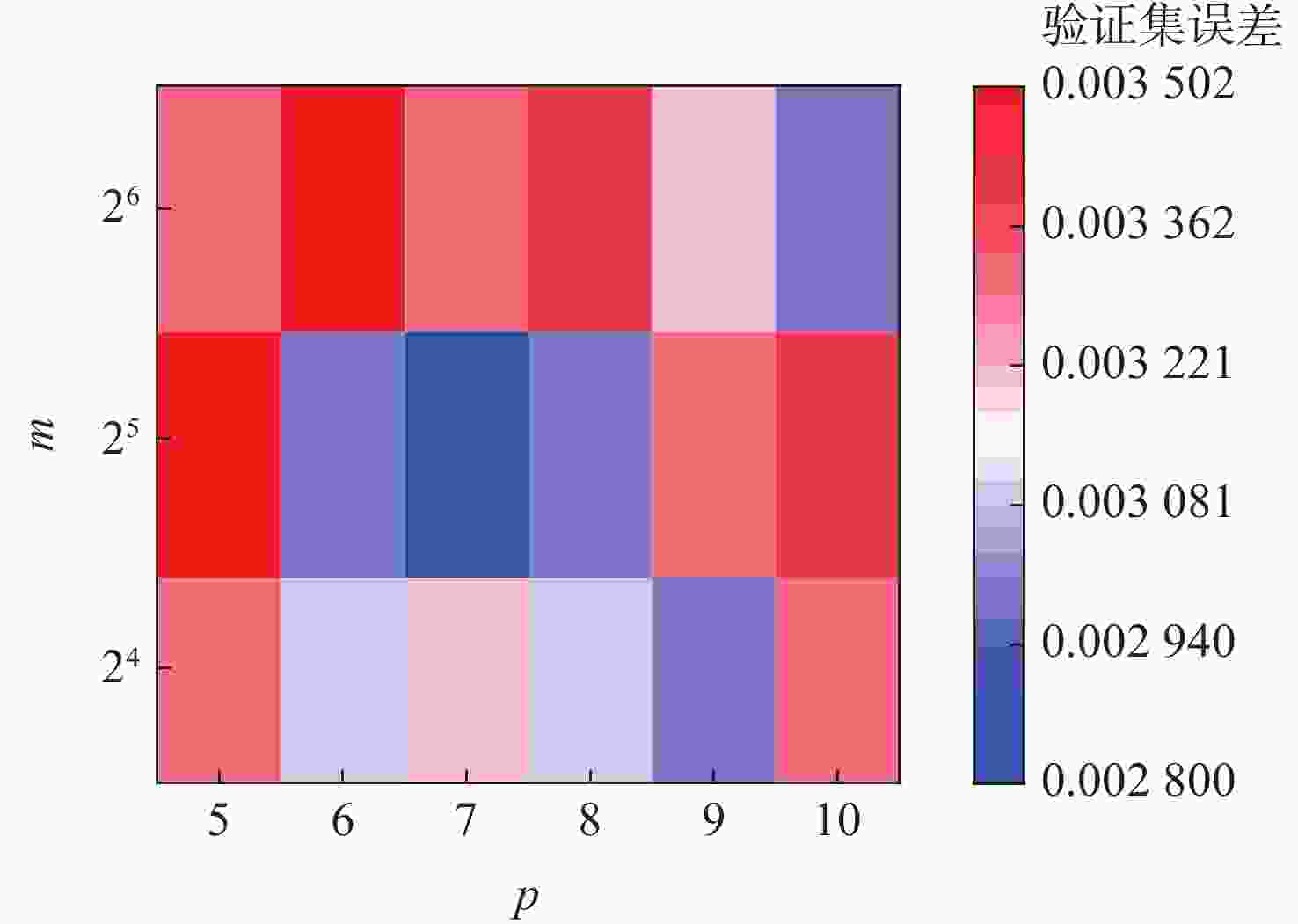
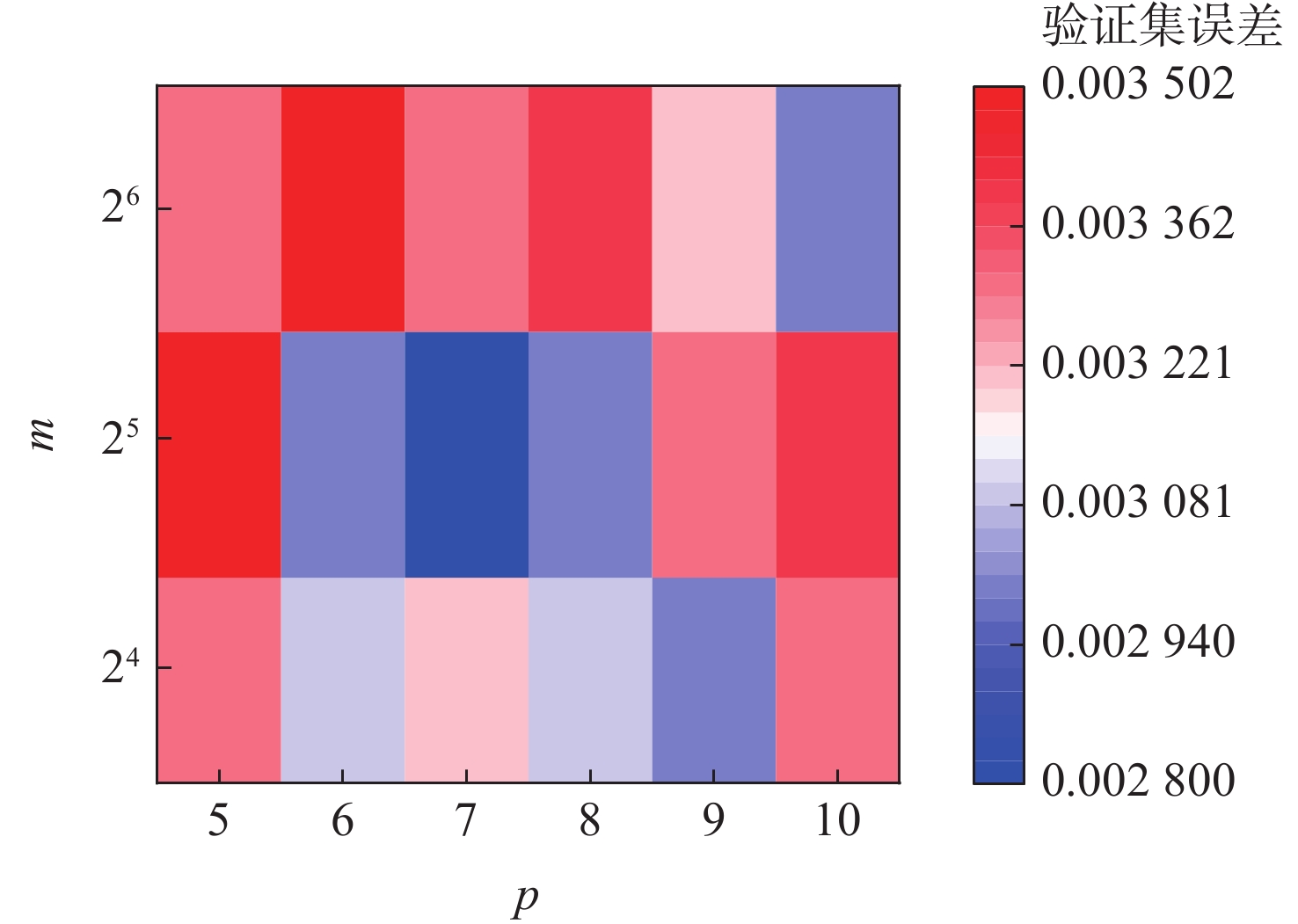
图 7 不同超参数组合下的验证集误差
Figure 7. Verification set error under different combinations of hyperparameters
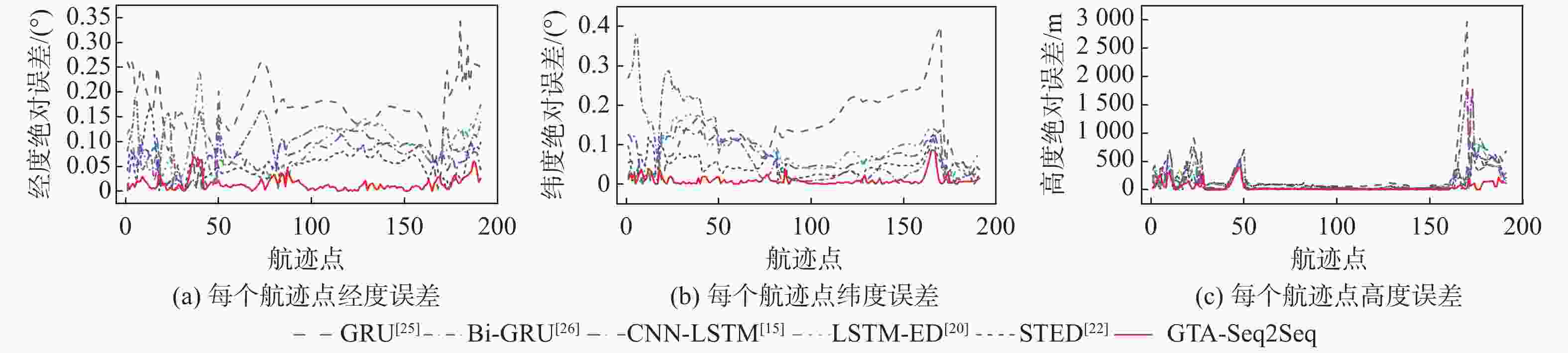
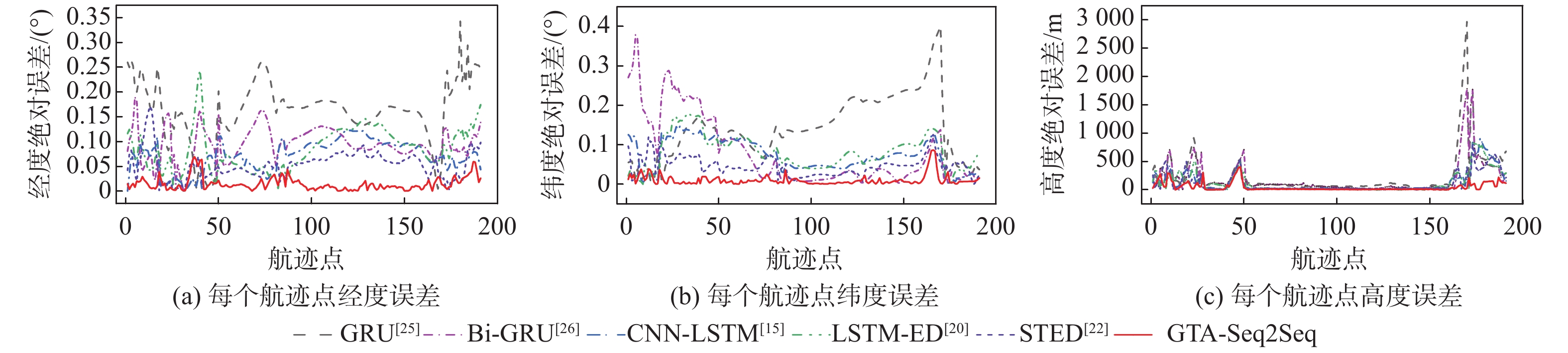
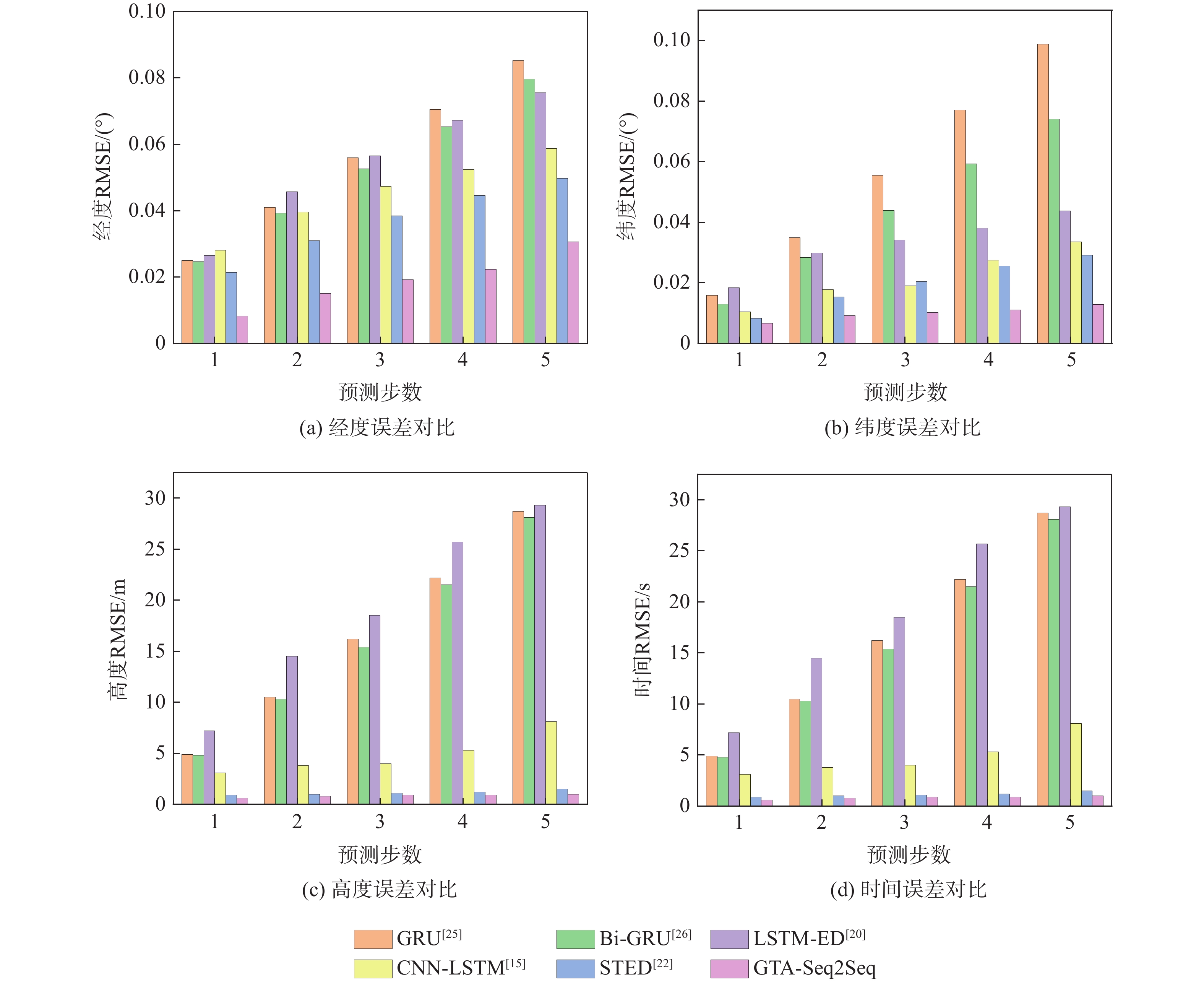
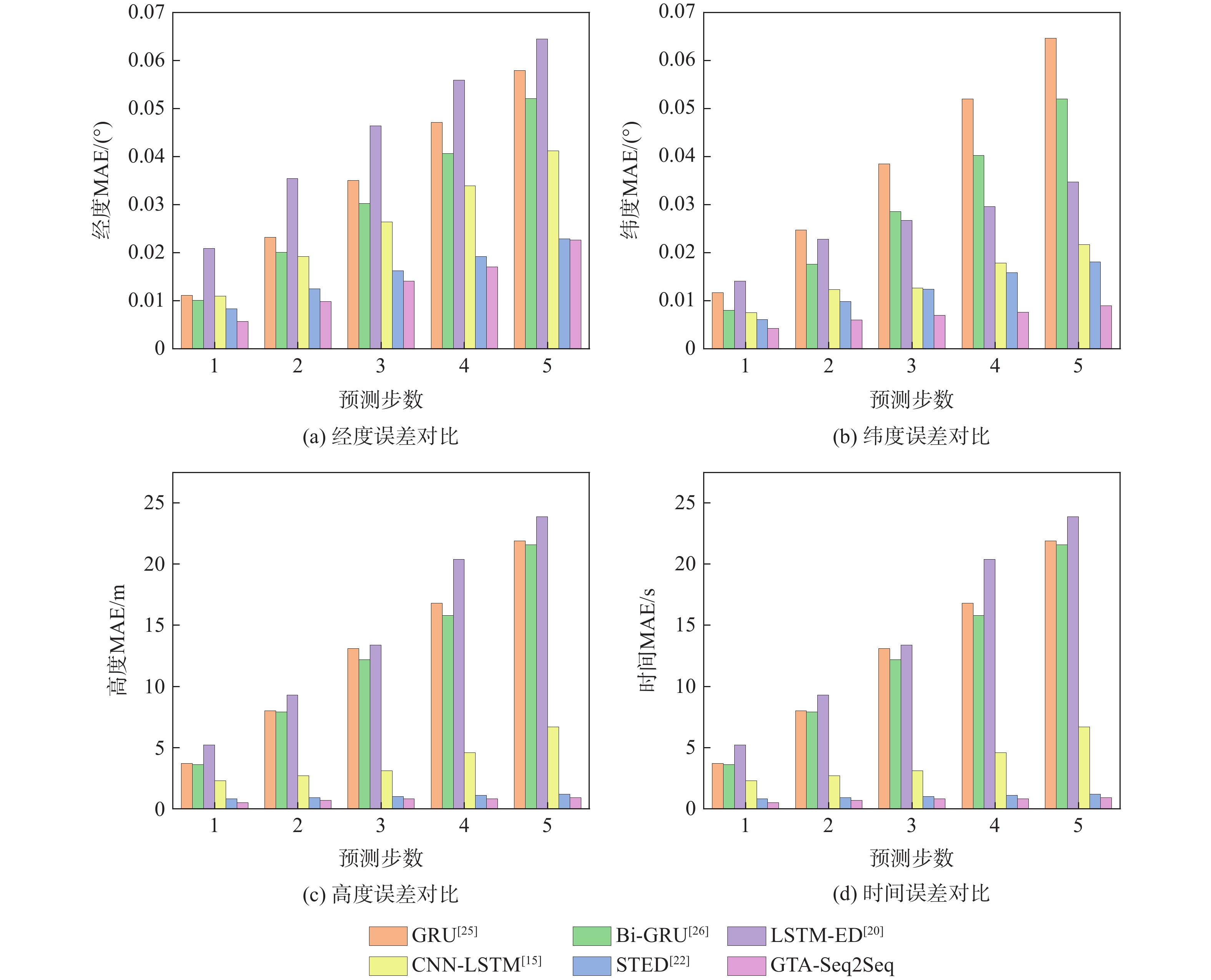
图 8 每个航迹点纬度、经度、高度的预测误差
Figure 8. Forecast error of latitude, longitude and altitude for each trajectory point
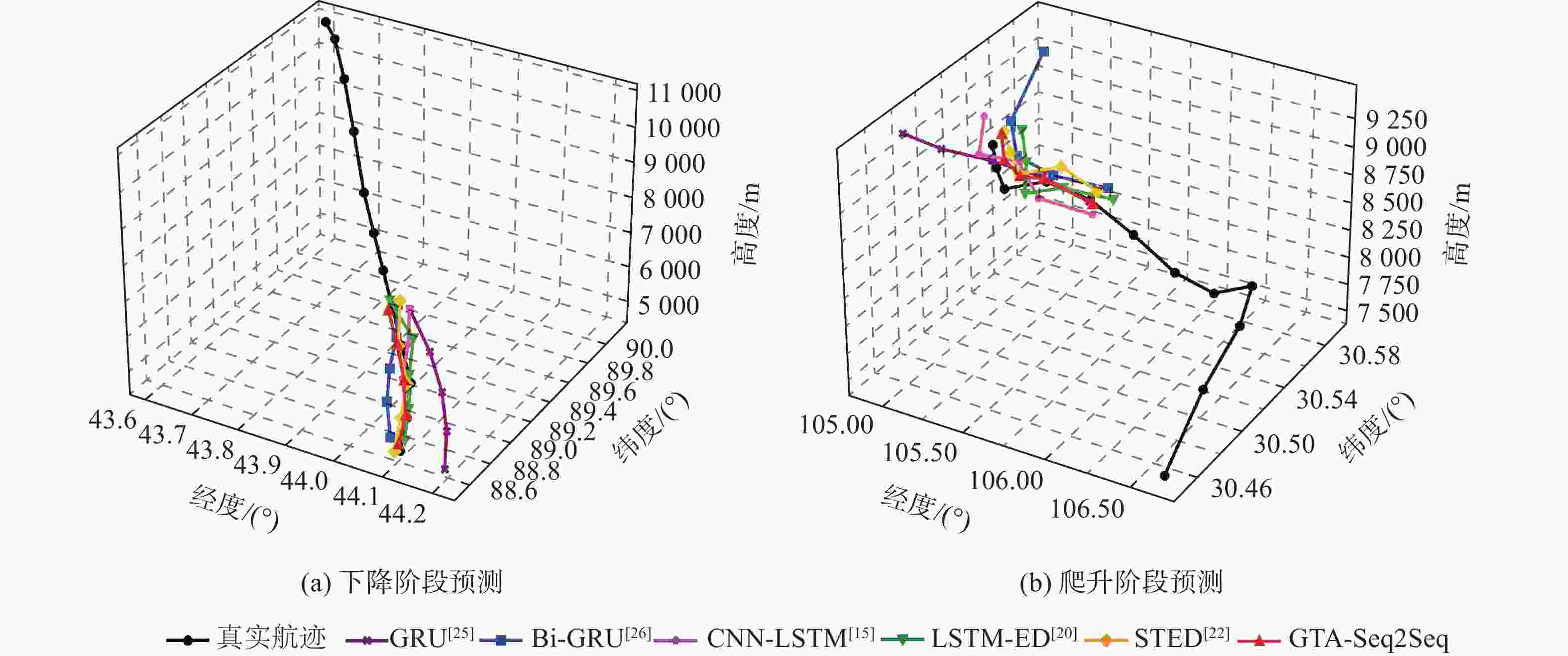
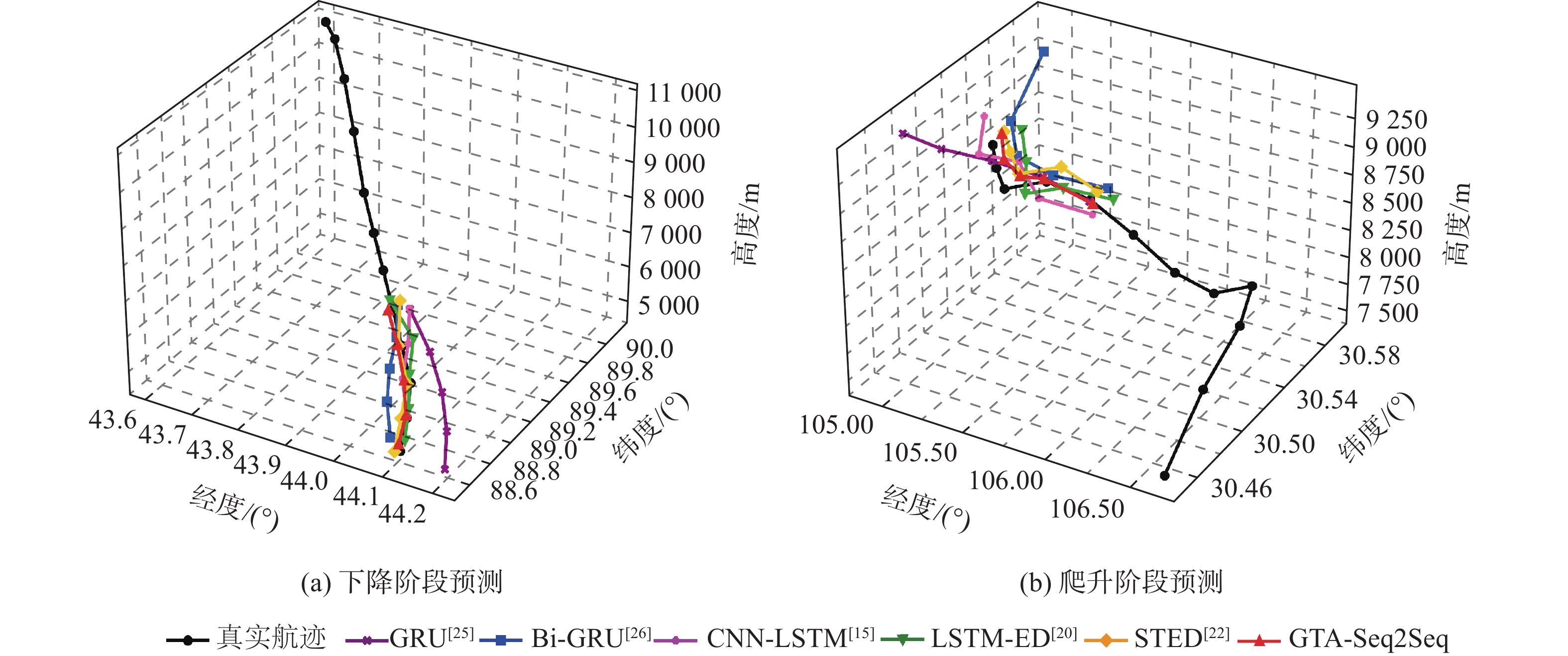
图 11 不同飞行状态下航迹误差比较
Figure 11. Comparison of trajectory errors under different flight states
表 1 模型超参数优选结果
Table 1. Optimization results of model hyperparameter
TCN第1、第2层
卷积核个数TCN卷积核
尺寸TCN的膨胀系数 CNN卷积核
个数批尺寸 学习率 输入历史航迹点
个数pGRU隐藏层
神经元个数预测航迹点
个数s16、32 3 [1,2] 64 128 0.001 7 32 5  下载: 导出CSV
表 2 各模型预测误差比较
Table 2. Comparison of prediction errors of each model
模型 预测步数 经度RMSE/(°) 经度MAE/(°) 纬度RMSE/(°) 纬度MAE/(°) 高度RMSE/m 高度MAE/m 时间RMSE/s 时间MAE/s GRU[25] 1 0.0186 0.0138 0.0231 0.0181 92.1 34.5 6.7 5.2 2 0.0370 0.0272 0.0463 0.0363 202.1 76.6 11.2 8.3 3 0.5440 0.0398 0.0674 0.0530 325.1 127.5 14.7 10.4 4 0.0714 0.0528 0.0871 0.0689 435.3 179.9 18.1 12.5 5 0.0881 0.0658 0.1057 0.0841 535.5 229.4 21.5 14.5 Bi-
GRU[26]1 0.0157 0.0126 0.0151 0.0118 91.1 33.9 5.6 4.4 2 0.0315 0.0247 0.0315 0.0250 196.3 71.7 8.9 7.0 3 0.0483 0.0372 0.0490 0.0391 306.8 118.2 11.5 8.9 4 0.0670 0.0501 0.0673 0.0532 396.8 162.0 13.8 10.6 5 0.0872 0.0634 0.0866 0.0672 467.3 201.7 15.7 12.3 CNN-
LSTM[15]1 0.0132 0.0098 0.0165 0.0127 96.8 47.7 6.7 5.5 2 0.0198 0.0156 0.0170 0.0121 151.5 70.9 7.2 5.6 3 0.0271 0.0208 0.0226 0.0168 206.4 94.1 8.1 5.8 4 0.0334 0.0260 0.0260 0.0169 229.1 110.5 8.8 6.7 5 0.0417 0.0327 0.0338 0.0228 243.7 119.2 9.7 7.7 LSTM-
ED[20]1 0.0223 0.0171 0.0220 0.0184 100.3 43.5 9.6 6.6 2 0.0312 0.0227 0.0283 0.0181 186.1 74.8 14.9 10.2 3 0.0470 0.0353 0.0344 0.0218 250.8 98.5 15.4 10.8 4 0.0626 0.0479 0.0378 0.0248 277.1 115.6 16.7 11.0 5 0.0783 0.0601 0.0414 0.0281 274.5 126.1 17.2 12.0 STED[22] 1 0.0134 0.0094 0.0090 0.0073 86.1 38.2 0.8 0.7 2 0.0182 0.0117 0.0155 0.0106 123.6 50.9 1.2 0.9 3 0.0250 0.0128 0.0190 0.0131 187.1 75.2 1.3 1.0 4 0.0330 0.0164 0.0224 0.0153 224.2 90.2 1.4 1.1 5 0.0359 0.0199 0.0260 0.0167 254.0 105.9 1.6 1.2 GTA-
Seq2Seq1 0.0077 0.0057 0.0056 0.0036 65.8 28.5 0.7 0.5 2 0.0139 0.0089 0.0097 0.0058 96.2 38.3 0.9 0.7 3 0.0175 0.0115 0.0133 0.0077 119.3 47.5 1.0 0.7 4 0.0212 0.0142 0.0165 0.0097 131.1 55.3 1.1 0.8 5 0.0259 0.0175 0.0197 0.0117 136.6 58.3 1.4 1.1
下载: 导出CSV
表 3 消融实验结果
Table 3. Results of ablation experiment
模型 预测步数 经度RMSE/(°) 经度MAE/(°) 纬度RMSE/(°) 纬度MAE/(°) 高度RMSE/m 高度MAE/m 时间RMSE/s 时间MAE/s 移除GRU模块的
GTA-Seq2Seq1 0.0189 0.0152 0.0112 0.0080 79.3 30.7 2.4 1.8 2 0.0214 0.0165 0.0163 0.0105 120.6 43.8 2.7 2.0 3 0.0289 0.0214 0.0212 0.0132 162.1 61.3 2.9 2.2 4 0.0342 0.0239 0.0252 0.0160 191.5 76.9 3.0 2.3 5 0.0390 0.0267 0.0284 0.0185 213.8 90.7 3.4 2.6 移除TCN模块的
GTA-Seq2Seq1 0.0165 0.0131 0.0122 0.0085 76.9 29.8 2.3 1.9 2 0.0236 0.0166 0.0178 0.0115 137.7 53.4 2.4 2.0 3 0.0349 0.0230 0.0238 0.0157 170.0 67.2 3.1 2.5 4 0.0448 0.0287 0.0294 0.0203 182.4 76.4 3.9 3.1 5 0.0536 0.0346 0.0332 0.0238 191.6 84.2 4.5 3.5 移除TPA模块的
GTA-Seq2Seq1 0.0146 0.0101 0.0105 0.0078 77.2 35.3 2.2 1.8 2 0.0161 0.0114 0.0155 0.0119 117.7 45.6 2.3 1.9 3 0.0219 0.0151 0.0213 0.0155 149.0 59.0 2.6 2.1 4 0.0276 0.0192 0.0259 0.0184 169.9 73.3 2.9 2.3 5 0.0325 0.0224 0.0293 0.0207 185.2 82.7 3.5 2.9 移除FC模块的
GTA-Seq2Seq1 0.0156 0.0107 0.0110 0.0075 77.5 38.6 2.5 1.9 2 0.0185 0.0129 0.0152 0.0102 129.7 48.6 2.8 2.1 3 0.0205 0.0149 0.0190 0.0122 147.0 64.5 3.0 2.3 4 0.0234 0.0171 0.0222 0.0137 151.5 65.4 3.3 2.5 5 0.0283 0.0202 0.0249 0.0151 158.6 68.5 3.5 2.7 GTA-Seq2Seq 1 0.0077 0.0057 0.0056 0.0036 65.8 28.5 0.7 0.5 2 0.0139 0.0089 0.0097 0.0058 96.2 38.3 0.9 0.7 3 0.0175 0.0115 0.0133 0.0077 119.3 47.5 1.0 0.7 4 0.0212 0.0142 0.0165 0.0097 131.1 55.3 1.1 0.8 5 0.0259 0.0175 0.0197 0.0117 136.6 58.3 1.4 1.1
下载: 导出CSV
-
[1] 中国民用航空局, 国家发展和改革委员会, 交通运输部. 中国民用航空发展第十三个五年规划[EB/OL]. (2017-04-05)[2024-08-28]. http://www.caac.gov.cn/XXGK/XXGK/FZGH/201704/t20170405_43502.html.Civil Aviation Administration of China, National Development and Reform Commission, Ministry of Transport. The 13th five-year plan for the development of civil aviation in China[EB/OL]. (2017-04-05)[2024-08-28]. http://www.caac.gov.cn/XXGK/XXGK/FZGH/201704/t20170405_43502.html(in Chinese). [2] Ramasamy S, Sabatini R, Gardi A, et al. Next generation flight management system for real-time trajectory based operations[J]. Applied Mechanics and Materials, 2014, 629: 344-349. [3] Zeng W L, Chu X, Xu Z F, et al. Aircraft 4D trajectory prediction in civil aviation: a review[J]. Aerospace, 2022, 9(2): 91. [4] Hao S Q, Cheng S W, Zhang Y P. A multi-aircraft conflict detection and resolution method for 4-dimensional trajectory-based operation[J]. Chinese Journal of Aeronautics, 2018, 31(7): 1579-1593. [5] 中国民用航空局空中交通管理局. 中国民航基于航迹运行(TBO)的推进进展: WP/462[EB/OL]. 2022[2026-10-18]. https://www.icao.int/sites/default/files/Meetings/a41/Documents/WP/wp_462_zh.pdf.Air Traffic Management Bureau of Civil Aviation Administration of China. Progress of China civil aviation on trajectory-based operations(TBO): WP/462[EB/OL]. 2022[2026-10-18]. https://www.icao.int/sites/default/files/Meetings/a41/Documents/WP/wp_462_zh.pdf(in Chinese). [6] Liu C Y, Zheng Q, Chang J C, et al. Summary and outlook of 4D track prediction methods[J]. Journal of Mechanical Engineering, Automation and Control Systems, 2020, 1(1): 46-55. [7] 彭瑛, 胡明华, 张颖. 动态航迹推测方法[J]. 交通运输工程学报, 2005, 5(1): 61-65.Peng Y, Hu M H, Zhang Y. Conjecture method of dynamic flying track[J]. Journal of Traffic and Transportation Engineering, 2005, 5(1): 61-65(in Chinese). [8] 汤新民, 李腾, 陈强超, 等. 基于交互式多模型的短期4D航迹预测[J]. 武汉理工大学学报(交通科学与工程版), 2020, 44(1): 39-45.Tang X M, Li T, Chen Q C, et al. Short-term 4D trajectory prediction based on interactive multi-models[J]. Journal of Wuhan University of Technology (Transportation Science & Engineering), 2020, 44(1): 39-45(in Chinese). [9] Wu Z J, Tian S, Ma L. A 4D trajectory prediction model based on the BP neural network[J]. Journal of Intelligent Systems, 2019, 29(1): 1545-1557. [10] Shi Z Y, Xu M, Pan Q, et al. LSTM-based flight trajectory prediction[C]//Proceedings of the 2018 International Joint Conference on Neural Networks. Piscataway: IEEE Press, 2018: 1-8. [11] Sahadevan D, M H P, Ponnusamy P, et al. Ground-based 4d trajectory prediction using bi-directional LSTM networks[J]. Applied Intelligence, 2022, 52(14): 16417-16434. [12] 石庆研, 岳聚财, 韩萍, 等. 基于LSTM-ARIMA模型的短期航班飞行轨迹预测[J]. 信号处理, 2019, 35(12): 2000-2009.Shi Q Y, Yue J C, Han P, et al. Short-term flight trajectory prediction based on LSTM-ARIMA model[J]. Journal of Signal Processing, 2019, 35(12): 2000-2009(in Chinese). [13] Han P, Wang W Q, Shi Q Y, et al. A combined online-learning model with K-means clustering and GRU neural networks for trajectory prediction[J]. Ad Hoc Networks, 2021, 117: 102476. [14] 韩萍, 张启, 石庆研, 等. 基于DBSCAN-GRU算法的终端区4D航迹预测[J]. 信号处理, 2023, 39(3): 439-449.Han P, Zhang Q, Shi Q Y, et al. 4D trajectory prediction of terminal area based on DBSCAN-GRU algorithm[J]. Journal of Signal Processing, 2023, 39(3): 439-449(in Chinese). [15] Ma L, Tian S. A hybrid CNN-LSTM model for aircraft 4D trajectory prediction[J]. IEEE Access, 2020, 8: 134668-134680. [16] Bai S J, Kolter J Z, Koltun V. An empirical evaluation of generic convolutional and recurrent networks for sequence modeling[EB/OL]. (2018-04-19)[2024-08-28]. https://doi.org/10.48550/arXiv.1803.01271. [17] 焦卫东, 杨蓓. 一种融合MSC和时空双重注意力的TCN航迹预测方法[J]. 北京航空航天大学学报, 2026, 52(1): 15-27.Jiao W D, Yang B. TCN trajectory prediction method fusing MSC and spatio-temporal dual attention[J]. Journal of Beijing University of Aeronautics and Astronautics, 2026, 52(1): 15-27(in Chinese). [18] 卢婷婷, 刘博, 李纯柱. 基于注意力Seq2Seq模型的终端区航空器航迹预测[J]. 科学技术与工程, 2024, 24(9): 3882-3895.Lu T T, Liu B, Li C Z. Aircraft trajectory prediction within terminal area based on Seq2Seq-attention model[J]. Science Technology and Engineering, 2024, 24(9): 3882-3895(in Chinese). [19] Tran P N, Nguyen H Q V, Pham D T, et al. Aircraft trajectory prediction with enriched intent using encoder-decoder architecture[J]. IEEE Access, 2022, 10: 17881-17896. [20] Zeng W L, Quan Z B, Zhao Z Y, et al. A deep learning approach for aircraft trajectory prediction in terminal airspace[J]. IEEE Access, 2020, 8: 151250-151266. [21] Zhang Z, Guo D Y, Zhou S Z, et al. Flight trajectory prediction enabled by time-frequency wavelet transform[J]. Nature Communications, 2023, 14: 5258. [22] 石庆研, 张泽中, 韩萍. 基于时空特征融合的Encoder-Decoder多步4D短期航迹预测[J]. 信号处理, 2023, 39(11): 2037-2048.Shi Q Y, Zhang Z Z, Han P. Multi-step 4D short-term trajectory prediction using encoder-decoder with spatio-temporal features fusion[J]. Journal of Signal Processing, 2023, 39(11): 2037-2048(in Chinese). [23] Hochreiter S, Schmidhuber J. Long short-term memory[J]. Neural Computation, 1997, 9(8): 1735-1780. [24] Chung J, Gulcehre C, Cho K, et al. Empirical evaluation of gated recurrent neural networks on sequence modeling[EB/OL]. (2014-12-11)[2024-08-28]. https://arxiv.org/abs/1412.3555(in Chinese). [25] 王文青. GRU神经网络在航迹预测中的研究与应用[D]. 天津: 中国民航大学, 2021.Wang W Q. Research and application of GRU neural network in trajectory prediction[D]. Tianjin: Civil Aviation University of China, 2021(in Chinese). [26] Chen Z X, Wang L. Aircraft trajectory prediction model based on improved GRU structure[C]//Proceedings of the 2023 3rd International Conference on Consumer Electronics and Computer Engineering. Piscataway: IEEE Press, 2023: 225-228. -

 下载:

计量
- 文章访问数: 742
- HTML全文浏览量: 232
- PDF下载量: 146
- 被引次数: 0
