





Artificial intelligence for asteroid proximity exploration research progress and future perspectives
-
摘要:
小行星已成为深空探测领域的主要目标之一。围绕小行星抵近探测安全、高效处置的需求,综述了主要航天强国面向小行星抵近探测的人工智能(AI)技术应用及设想。从深空环境智能感知、智能规划及决策2个方面梳理了当前的研究进展,分析了当前人工智能技术应用于小行星抵近探测任务中面临的模型可靠性难以度量、未知环境适应性不足、星载计算资源受限等难点与挑战。结合中国未来的小行星抵近探测任务和行星防御系统构建任务,探讨和展望小行星抵近探测中人工智能技术的未来发展方向与应用趋势。
Abstract:One of the main goals of deep space exploration is asteroid exploration, which has great scientific significance. Faced with the challenges of long distances and limited knowledge of asteroid exploration targets, the rapidly evolving technology of artificial intelligence (AI) has emerged as a promising complement to existing space mission implementation paradigms. In addition to introducing the current state of research on the application of AI methods in asteroid exploration, this paper analyzes the methods of AI systems used in space exploration missions and asteroid ground observation systems. It also summarizes the challenges that these methods face. It also proposes key technologies with developmental potential for asteroid exploration.
-
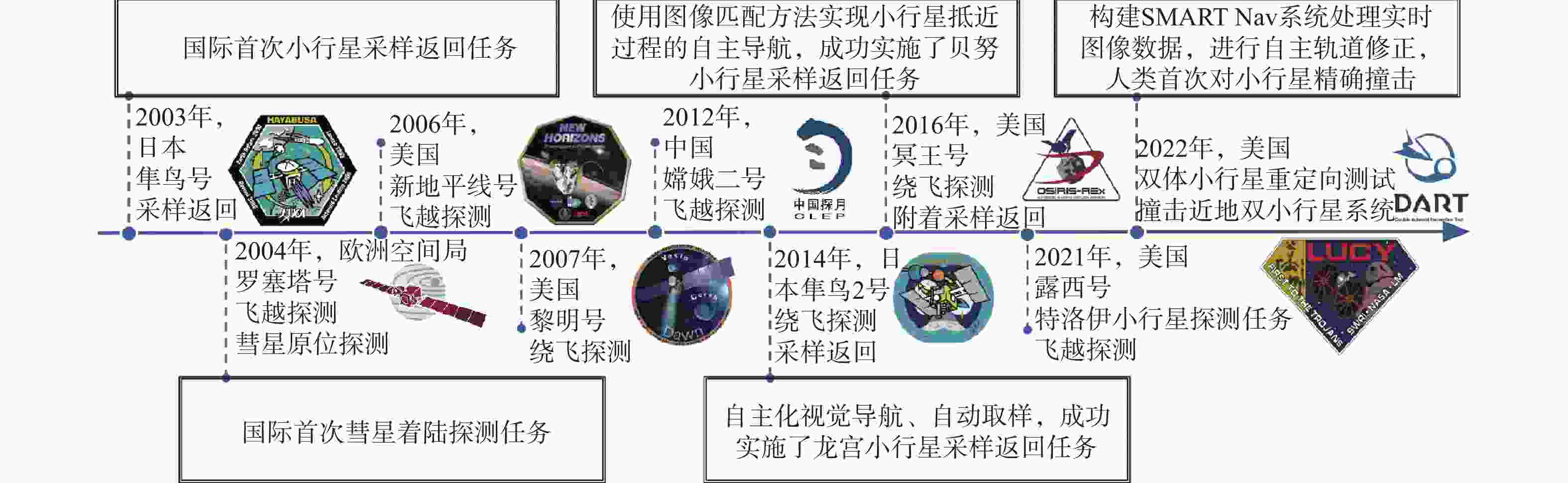
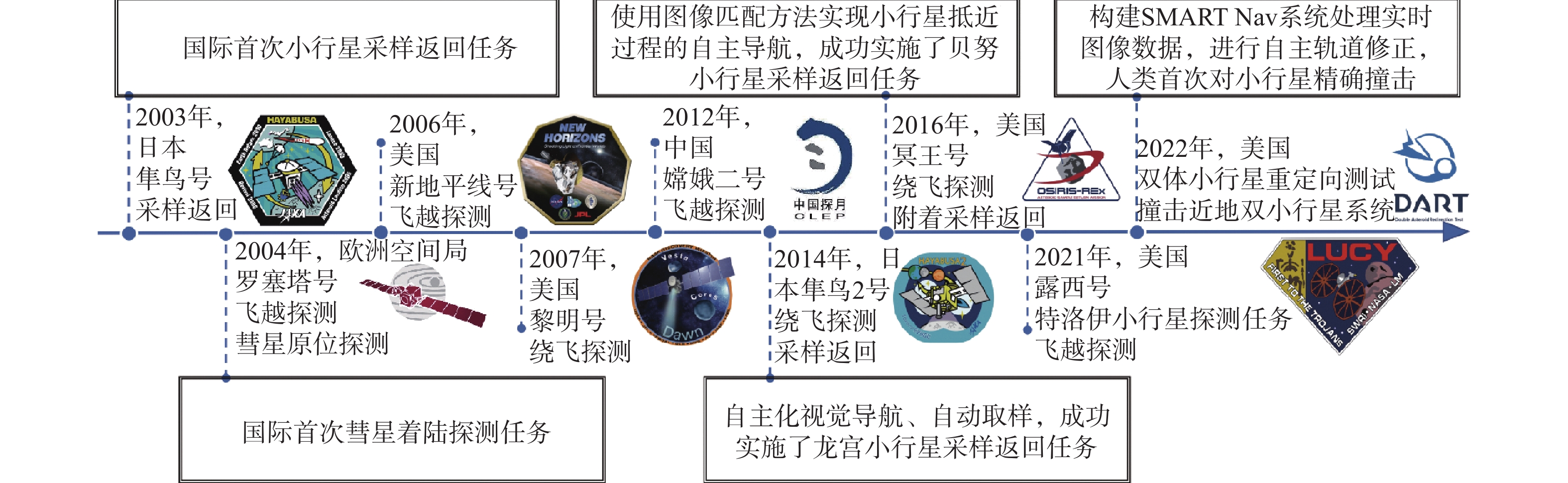
图 1 21世纪已实施的小行星抵近探测活动
Figure 1. Asteroids proximity exploration missions implemented in the 21th century

图 4 SMART Nav基于光学影像实现对Dimorphos小行星撞击的引导
Figure 4. SMART Nav system utilizes optical imaging for navigation to Dimorphos
表 1 小行星探测中人工智能技术的发展趋势
Table 1. Evolutionary trends of AI techniques for asteroids exploration
技术领域 大规模预训练模型 可信人工智能 内嵌数理知识的人工智能 具身化智能 发展方向 实现多样数据和任务的协同促进,形
成小行星特性反演的通用智能范式实现人工智能模型的稳定可
靠、增强人工智能使用信心引入数理规律先验知识,实现
可控、可信的环境感知支持智能模型向真实物理世界迁移,
实现智能模型决策和应变能力提升实现目标 提升智能模型性能 增强智能方法可靠性 提高深空未知环境下的适应性 提高深空未知环境下的适应性  下载: 导出CSV
-
[1] 于登云, 张哲, 泮斌峰, 等. 深空探测人工智能技术研究与展望[J]. 深空探测学报, 2020, 7(1): 11-23.Yu D Y, Zhang Z, Pan B F, et al. Development and trend of artificial intelligent in deep space exploration[J]. Journal of Deep Space Exploration, 2020, 7(1): 11-23(in Chinese). [2] 叶培建, 孟林智, 马继楠, 等. 深空探测人工智能技术应用及发展建议[J]. 深空探测学报, 2019, 6(4): 303-316.Ye P J, Meng L Z, Ma J N, et al. Suggestions on artificial intelligence technology application and development in deep space exploration[J]. Journal of Deep Space Exploration, 2019, 6(4): 303-316(in Chinese). [3] 叶培建, 彭兢. 深空探测与我国深空探测展望[J]. 中国工程科学, 2006, 8(10): 13-18.Ye P J, Peng J. Deep space exploration and its prospect in China[J]. Engineering Science, 2006, 8(10): 13-18(in Chinese). [4] 李俊峰, 曾祥远. 不规则小行星引力场内的飞行动力学[J]. 力学进展, 2017, 47(1): 429-451.Li J F, Zeng X Y. Flight dynamics in the gravitational fields of irregular asteroids[J]. Advances in Mechanics, 2017, 47(1): 429-451(in Chinese). [5] Izzo D, Märtens M, Pan B F. A survey on artificial intelligence trends in spacecraft guidance dynamics and control[J]. Astrodynamics, 2019, 3(4): 287-299. [6] 乔栋, 黄江川, 崔平远, 等. 嫦娥二号卫星飞越探测小行星的目标选择[J]. 中国科学: 技术科学, 2013, 43(6): 602-608.Qiao D, Huang J C, Cui P Y, et al. Target selection of Chang’e-2 satellite flying over to detect asteroids[J]. Scientia Sinica (Technologica), 2013, 43(6): 602-608(in Chinese). [7] 张荣桥, 黄江川, 赫荣伟, 等. 小行星探测发展综述[J]. 深空探测学报, 2019(5): 417-423.Zhang R Q, Huang J C, He R W, et al. The development overview of asteroid exploration[J]. Journal of Deep Space Exploration, 2019(5): 417-423(in Chinese). [8] 程林, 蒋方华, 李俊峰. 深度学习在飞行器动力学与控制中的应用研究综述[J]. 力学与实践, 2020, 42(3): 267-276.Cheng L, Jiang F H, Li J F. A review on the applications of deep learning in aircraft dynamics and control[J]. Mechanics in Engineering, 2020, 42(3): 267-276(in Chinese). [9] 郑志明, 吕金虎, 韦卫, 等. 精准智能理论: 面向复杂动态对象的人工智能[J]. 中国科学: 信息科学, 2021, 51(4): 678-690.Zheng Z M, Lyu J H, Wei W, et al. Refined intelligence theory: artificial intelligence regarding complex dynamic objects[J]. Scientia Sinica (Informationis), 2021, 51(4): 678-690(in Chinese). [10] 张钹, 朱军, 苏航. 迈向第三代人工智能[J]. 中国科学(信息科学), 2020, 50(9): 1281-1302.Zhang B, Zhu J, Su H. Toward the third generation of artificial intelligence[J]. Science in China (Information Sciences), 2020, 50(9): 1281-1302(in Chinese). [11] 国家国防科工局. 国家国防科工局: 务实推动国防科技工业高质量发展[EB/OL]. (2023-08-22) [2024-09-25]. https://www.sastind.gov.cn/n10086200/n10100131/c10347911/content.html.State Administration of Science, Technology and Industry for National Defense. Pragmatically promoting high-quality development of National Defense Science and Technology Industry[EB/OL]. (2023-08-22) [2024-09-25]. https://www.sastind.gov.cn/n10086200/n10100131/c10347911/content.html(in Chinese). [12] 张熇. 小行星探测任务的信息技术挑战[EB/OL]. (2021-11-24) [2024-09-25]. http://academics.casad.cas.cn/xsjl/kxyjsqylt/2021/d122c/202111/t20211124_4979344.html.Zhang H. Information technology challenges in asteroid exploration missions[EB/OL]. (2021-11-24)[2024-09-25]. http://academics.casad.cas.cn/xsjl/kxyjsqylt/2021/d122c/202111/t20211124_4979344.html(in Chinese). [13] International Astronomical Union. Minor planet center: latest published data [EB/OL]. (2023-04-01)[2024-09-25]. https://www.minorplanetcenter.net/mpc/summary. [14] Smith B, Sherwood R, Govindjee A, et al. Representing spacecraft mission planning knowledge in ASPEN[C]//Proceedings of the Artificial Intelligence Planning Systems Workshop on Knowledge Acquisition. Palo Alto: AAAI Press, 1998. [15] Chien S A, Rabideau G, Tran D Q, et al. Activity-based scheduling of science campaigns for the Rosetta orbiter[J]. Journal of Aerospace Information Systems, 2021, 18(10): 711-727. [16] Clark P, Rilee M, Curtis S, et al. BEES for ANTS: space mission applications for the autonomous NanoTechnology swarm[C]//Proceedings of the AIAA 1st Intelligent Systems Technical Conference. Reston: AIAA, 2004. [17] Ogawa N, Terui F, Mimasu Y, et al. Image-based autonomous navigation of Hayabusa2 using artificial landmarks: the design and brief in-flight results of the first landing on asteroid Ryugu[J]. Astrodynamics, 2020, 4(2): 89-103. [18] Doyle R, Kubota T, Picard M, et al. Recent research and development activities on space robotics and AI[J]. Advanced Robotics, 2021, 35(21-22): 1244-1264. [19] Cocaud C, Kubota T. Development of an intelligent simulator with SLAM functions for visual autonomous landing on small celestial bodies[J]. Journal of Advanced Computational Intelligence and Intelligent Informatics, 2011, 15(8): 1167-1174. [20] Otsu K, Kubota T. Energy-aware terrain analysis for mobile robot exploration[C]//Proceedings of the Field and Service Robotics: Results of the 10th International Conference. Berlin: Springer, 2016: 373-388. [21] Ishigami G, Otsuki M, Kubota T. Range-dependent terrain mapping and multipath planning using cylindrical coordinates for a planetary exploration rover[J]. Journal of Field Robotics, 2013, 30(4): 536-551. [22] Michel P, Küppers M, Bagatin A C, et al. The ESA Hera mission: detailed characterization of the DART impact outcome and of the binary asteroid (65803) Didymos[J]. The Planetary Science Journal, 2022, 3(7): 160. [23] Kaluthantrige A, Feng J L, Gil-Fernández J. CNN-based image processing algorithm for autonomous optical navigation of Hera mission to the binary asteroid Didymos[J]. Acta Astronautica, 2023, 211: 60-75. [24] Daly R T, Ernst C M, Barnouin O S, et al. Shape modeling of dimorphos for the double asteroid redirection test (DART)[J]. The Planetary Science Journal, 2022, 3(9): 207. [25] Gaskell R W, Barnouin-Jha O S, Scheeres D J, et al. Characterizing and navigating small bodies with imaging data[J]. Meteoritics & Planetary Science, 2008, 43(6): 1049-1061. [26] Hirata N, Hirata N, Tanaka S, et al. Initial results of shape modeling on the asteroid Ryugu from observations by Hayabusa2 for landing site selection[C]//Proceedings of the AAS/Division for Planetary Sciences Meeting Abstracts#50. Washington, D. C.: AAS/Division for Planetary Sciences, 2018, 50: 501.05. [27] Barnouin O S, Daly M G, Palmer E E, et al. Digital terrain mapping by the OSIRIS-REx mission[J]. Planetary and Space Science, 2020, 180: 104764. [28] Gaskell R W, Jorda L, Palmer E, et al. Comet 67P/CG: preliminary shape and topography from SPC[C]//Proceedings of the AAS/Division for Planetary Sciences Meeting Abstracts. Washington, D. C.: AAS/Division for Planetary Sciences #46, 2014, 46: 209.04. [29] Brandonisio A, Lavagna M, Guzzetti D. Reinforcement learning for uncooperative space objects smart imaging path-planning[J]. The Journal of the Astronautical Sciences, 2021, 68(4): 1145-1169. [30] Chen H, Hu X Y, Willner K, et al. Neural implicit shape modeling for small planetary bodies from multi-view images using a mask-based classification sampling strategy[J]. ISPRS Journal of Photogrammetry and Remote Sensing, 2024, 212: 122-145. [31] Chen S H, Wu B, Li H L, et al. Asteroid-NeRF: a deep-learning method for 3D surface reconstruction of asteroids[J]. Astronomy & Astrophysics, 2024, 687: A278. [32] 冯军华, 崔祜涛, 崔平远, 等. 行星表面陨石坑检测与匹配方法[J]. 航空学报, 2010, 31(9): 1858-1863.Feng J H, Cui H T, Cui P Y, et al. Autonomous crater detection and matching on planetary surface[J]. Acta Aeronautica et Astronautica Sinica, 2010, 31(9): 1858-1863(in Chinese). [33] 崔平远, 贾贺, 朱圣英, 等. 小天体光学导航特征识别与提取研究进展[J]. 宇航学报, 2020, 41(7): 880-888.Cui P Y, Jia H, Zhu S Y, et al. Research progress on optical navigation feature recognition and extraction technologies for small body exploration[J]. Journal of Astronautics, 2020, 41(7): 880-888(in Chinese). [34] Pugliatti M, Topputo F. Small-body shape recognition with convolutional neural network and comparison with explicit features based method[J]. Advances in the Astronautical Sciences, 2021, 175: 2539-2558. [35] Latorre F, Spiller D, Sasidharan S T, et al. Transfer learning for real-time crater detection on asteroids using a fully convolutional neural network[J]. Icarus, 2023, 394: 115434. [36] Caroselli E, Belien F, Falke A, et al. Deep learning-based passive hazard detection for asteroid landing in unexplored environment[C]//Proceedings of the 44th Annual American Astronautical Society Guidance, Navigation, and Control Conference. Berlin: Springer, 2024: 319-334. [37] Werner R A. Spherical harmonic coefficients for the potential of a constant-density polyhedron[J]. Computers & Geosciences, 1997, 23(10): 1071-1077. [38] Werner R A, Scheeres D J. Exterior gravitation of a polyhedron derived and compared with harmonic and mascon gravitation representations of asteroid 4769 Castalia[J]. Celestial Mechanics and Dynamical Astronomy, 1996, 65(3): 313-344. [39] Turgut B. Application of back propagation artificial neural networks for gravity field modelling[J]. Acta Montanistica Slovaca, 2016, 21(3): 200-207. [40] Gao A, Liao W T. Efficient gravity field modeling method for small bodies based on Gaussian process regression[J]. Acta Astronautica, 2019, 157: 73-91. [41] Furfaro R, Barocco R, Linares R, et al. Modeling irregular small bodies gravity field via extreme learning machines and Bayesian optimization[J]. Advances in Space Research, 2021, 67(1): 617-638. [42] Cheng L, Wang Z B, Song Y, et al. Real-time optimal control for irregular asteroid landings using deep neural networks[J]. Acta Astronautica, 2020, 170: 66-79. [43] Raissi M, Perdikaris P, Karniadakis G E. Physics-informed neural networks: a deep learning framework for solving forward and inverse problems involving nonlinear partial differential equations[J]. Journal of Computational Physics, 2019, 378: 686-707. [44] Martin J, Schaub H. Physics-informed neural networks for gravity field modeling of the Earth and Moon[J]. Celestial Mechanics and Dynamical Astronomy, 2022, 134(2): 13. [45] Pasquale A, Silvestrini S, Capannolo A, et al. Small bodies non-uniform gravity field on-board learning through hopfield neural networks[J]. Planetary and Space Science, 2022, 212: 105425. [46] Zhao Y J, Yang H W, Li S, et al. On-board modeling of gravity fields of elongated asteroids using Hopfield neural networks[J]. Astrodynamics, 2023, 7(1): 101-114. [47] Adams E, O’Shaughnessy D, Reinhart M, et al. Double asteroid redirection test: the Earth strikes back[C]//Proceedings of the IEEE Aerospace Conference. Piscataway: IEEE Press, 2019: 1-11. [48] Daly R T, Ernst C M, Barnouin O S, et al. Successful kinetic impact into an asteroid for planetary defence[J]. Nature, 2023, 616(7957): 443-447. [49] Pesce V, Agha-Mohammadi A A, Lavagna M. Autonomous navigation & mapping of small bodies[C]//Proceedings of the IEEE Aerospace Conference. Piscataway: IEEE Press, 2018: 1-10. [50] Piccinin M, Lunghi P, Lavagna M. Deep reinforcement learning-based policy for autonomous imaging planning of small celestial bodies mapping[J]. Aerospace Science and Technology, 2022, 120: 107224. [51] Chan D M, Agha-Mohammadi A A. Autonomous imaging and mapping of small bodies using deep reinforcement learning[C]//Proceedings of the IEEE Aerospace Conference. Piscataway: IEEE Press, 2019: 1-12. [52] Piccinin M, Lavagna M R. Deep reinforcement learning approach for small bodies shape reconstruction enhancement[C]//Proceedings of the AIAA Scitech 2020 Forum. Reston: AIAA, 2020: 1909. [53] Zhou D, Sun G H, Lei W X, et al. Space noncooperative object active tracking with deep reinforcement learning[J]. IEEE Transactions on Aerospace and Electronic Systems, 2022, 58(6): 4902-4916. [54] Li B, Yan J J, Wu W, et al. High performance visual tracking with Siamese Region proposal network[C]//Proceedings of the IEEE/CVF Conference on Computer Vision and Pattern Recognition. Piscataway: IEEE Press, 2018: 8971-8980. [55] 张永隆, 闫翛然, 李俊峰, 等. 小行星2016 HO3表面动力学环境分析及采样挑战[J]. 力学与实践, 2021, 43(5): 674-679.Zhang Y L, Yan X R, Li J F, et al. The analysis of surface dynamical environments and sampling difficulties for asteroid 2016 Ho3[J]. Mechanics in Engineering, 2021, 43(5): 674-679(in Chinese). [56] Jiang F H, Baoyin H, Li J F. Practical techniques for low-thrust trajectory optimization with homotopic approach[J]. Journal of Guidance, Control, and Dynamics, 2012, 35(1): 245-258. [57] Pinson R, Lu P. Rapid generation of optimal asteroid powered descent trajectories via convex optimization[C]//Proceedings of the AAS/AIAA Astrodynamics Specialist Conference. San Diego: Univelt, 2015: 2655-2672. [58] 崔平远, 朱圣英, 崔祜涛. 小天体自主软着陆脉冲机动控制方法研究[J]. 宇航学报, 2008, 29(2): 511-516.Cui P Y, Zhu S Y, Cui H T. Autonomous impulse maneuver control method for soft landing on small bodies[J]. Journal of Astronautics, 2008, 29(2): 511-516(in Chinese). [59] Song Y, Cheng L, Gong S. Fast estimation of gravitational field of irregular asteroids based on deep neural network and its application[J]. Advances in the Astronautical Sciences, 2019, 168: 1721-1735. [60] Gaudet B, Linares R, Furfaro R. Seeker based adaptive guidance via reinforcement meta-learning applied to asteroid close proximity operations[EB/OL]. (2019-07-13)[2026-06-28]. https://arxiv.org/abs/1907.06098. [61] Qi J, Gao H B, Yu H T, et al. Integrated attitude and landing control for quadruped robots in asteroid landing mission scenarios using reinforcement learning[J]. Acta Astronautica, 2023, 204: 599-610. [62] Xiao Y, Li S, Wang G Z, et al. Deep learning prediction frame matching algorithm of small celestial navigation landmarks[J]. Journal of Deep Space Exploration, 2022, 9(4): 400-406(in Chinese). [63] Tian Y, Yu M. A novel crater recognition based visual navigation approach for asteroid precise pin-point landing[J]. Aerospace Science and Technology, 2017, 70: 1-9. [64] Yu M, Cui H T. Robust hazard matching approach for visual navigation application in planetary landing[J]. Aerospace Science and Technology, 2015, 47: 378-387. [65] Johnson A, Montgomery J, Matthies L. Vision guided landing of an autonomous helicopter in hazardous terrain[C]//Proceedings of the IEEE International Conference on Robotics and Automation. Piscataway: IEEE Press, 2006: 3966-3971. [66] Ravani K, Mathavaraj S, Padhi R. Site detection for autonomous soft-landing on asteroids using deep learning[J]. Transactions of the Indian National Academy of Engineering, 2021, 6(2): 365-375. [67] Mancini P, Cannici M, Matteucci M. Deep learning for asteroids autonomous terrain relative navigation[J]. Advances in Space Research, 2023, 71(9): 3748-3760. [68] Cazeneuve D, Marchis F, Blaclard G, et al. ODNet: a convolutional neural network for asteroid occultation detection[J]. The Astronomical Journal, 2023, 165(1): 11. [69] Kaluthantrige A, Feng J, Gil-Fernández J. Pseudorange measurement and Sun phase angle estimation using CNN-based image processing algorithm for Hera mission[C]//Proceedings of the Advanced Maui Optical and Space Surveillance Technologies Conference. Hawaii: Maui Economic Development Board, 2022: 371-377. [70] Rabeendran A C, Denneau L. A two-stage deep learning detection classifier for the ATLAS asteroid survey[EB/OL]. (2021-01-22)[2026-06-28]. https://arxiv.org/abs/2101.08912. [71] Carruba V, Aljbaae S, Caritá G, et al. Optimization of artificial neural networks models applied to the identification of images of asteroids’ resonant arguments[J]. Celestial Mechanics and Dynamical Astronomy, 2022, 134(6): 59. [72] Naul B, Bloom J S, PÉRez F, et al. A recurrent neural network for classification of unevenly sampled variable stars[J]. Nature Astronomy, 2018, 2(2): 151-155. [73] Carruba V, Aljbaae S, Domingos R C, et al. Machine learning applied to asteroid dynamics[J]. Celestial Mechanics and Dynamical Astronomy, 2022, 134(4): 36. [74] Zappalà V, Bendjoya P, Cellino A, et al. Asteroid families: search of a 12, 487-asteroid sample using two different clustering techniques[J]. Icarus, 1995, 116(2): 291-314. [75] Zappala V, Cellino A, Farinella P, et al. Asteroid families. I-Identification by hierarchical clustering and reliability assessment[J]. The Astronomical Journal, 1990, 100: 2030. [76] Kirillov A, Mintun E, Ravi N, et al. Segment anything[EB/OL]. (2023-04-05)[2024-09-20]. https://arxiv.org/abs/2304.02643. [77] Bi K F, Xie L X, Zhang H H, et al. Pangu-weather: a 3D high-resolution model for fast and accurate global weather forecast[EB/OL]. (2022-11-03)[2024-09-20]. https://arxiv.org/abs/2211.02556. [78] Deng Y P, Karam L J. Universal adversarial attack via enhanced projected gradient descent[C]//Proceedings of the IEEE International Conference on Image Processing. Piscataway: IEEE Press, 2020: 1241-1245. [79] Liu T L, Tao D C, Song M L, et al. Algorithm-dependent generalization bounds for multi-task learning[J]. IEEE Transactions on Pattern Analysis and Machine Intelligence, 2017, 39(2): 227-241. [80] He F X, Liu T L, Tao D C. Control batch size and learning rate to generalize well: theoretical and empirical evidence[C]//Proceedings of the 33rd Conference on Neural Information Processing Systems. Red Hook: Curran Associates, Inc. , 2019: 1141-1150. [81] Karniadakis G E, Kevrekidis I G, Lu L, et al. Physics-informed machine learning[J]. Nature Reviews Physics, 2021, 3: 422-440. [82] Srivastava S, Li C S, Lingelbach M, et al. BEHAVIOR: benchmark for everyday household activities in virtual, interactive, and ecological environments[EB/OL]. (2021-08-06)[2024-09-20]. https://arxiv.org/abs/2108.03332. [83] Gupta A, Savarese S, Ganguli S, et al. Embodied intelligence via learning and evolution[J]. Nature Communications, 2021, 12: 5721. [84] 杜德嵩, 宋以拓, 刘延芳, 等. 面向空间航天器机器人学习算法研究的高保真仿真平台[J]. 空间控制技术与应用, 2023, 49(3): 10-17.Du D S, Song Y T, Liu Y F, et al. A high-fidelity simulation environment for spacecrafts with robot learning algorithms[J]. Aerospace Control and Application, 2023, 49(3): 10-17(in Chinese). [85] 姚文龙, 刘毅, 邵巍, 等. 小天体地形动态模拟与着陆视景仿真系统设计[J]. 深空探测学报(中英文), 2022, 9(4): 427-437.Yao W L, Liu Y, Shao W, et al. Design of terrain dynamic simulation and landing view simulation system for small celestial bodies[J]. Journal of Deep Space Exploration, 2022, 9(4): 427-437(in Chinese). [86] Wei X D, Cui L Y, Liu C K, et al. Integrating neural radiance fields with deep reinforcement learning for autonomous mapping of small bodies[J]. IEEE Transactions on Geoscience and Remote Sensing, 2024, 62: 5642717. [87] Song Y N, Li Z, Zhang Z Y, et al. SSC-KA: a framework of space situational knowledge acquisition for status-cognition of satellites[J]. IEEE Access, 2022, 10: 101750-101761. [88] Liu Y, Chen W X, Bai Y J, et al. Aligning cyber space with physical world: a comprehensive survey on embodied AI[EB/OL]. (2024-07-09)[2024-09-20]. https://arxiv.org/abs/2407.06886. -

 下载:



 点击查看大图
计量
- 文章访问数: 542
- HTML全文浏览量: 160
- PDF下载量: 48
- 被引次数: 0
