





-
摘要:
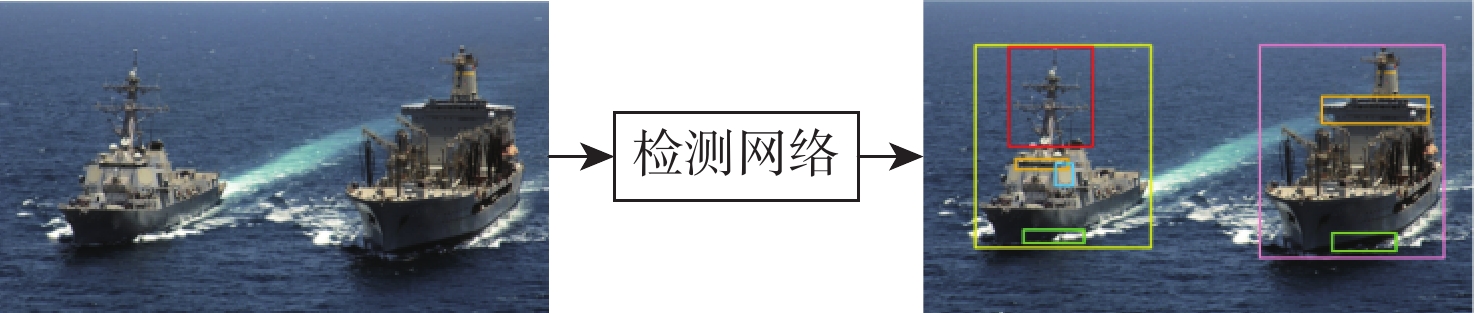
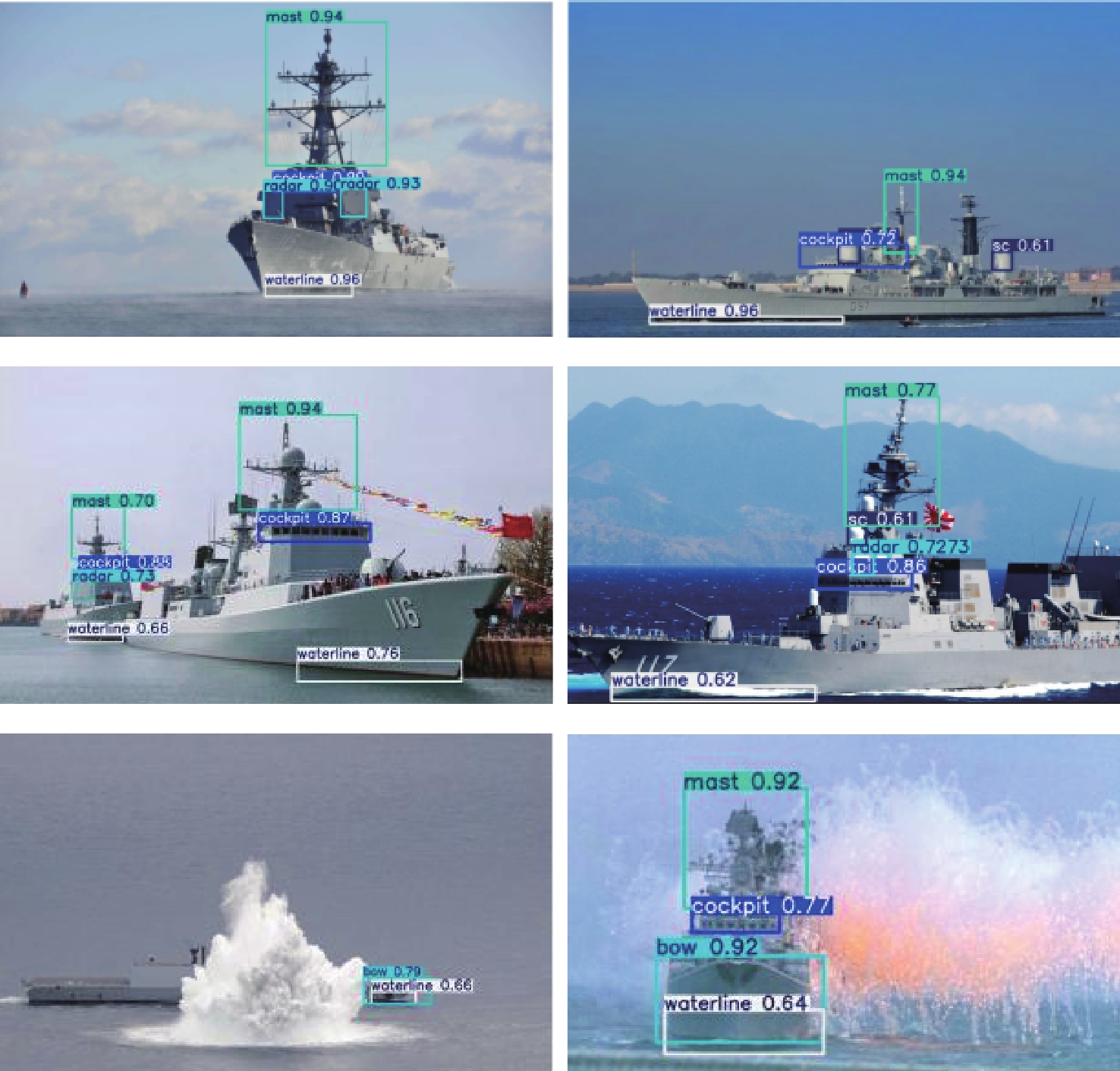
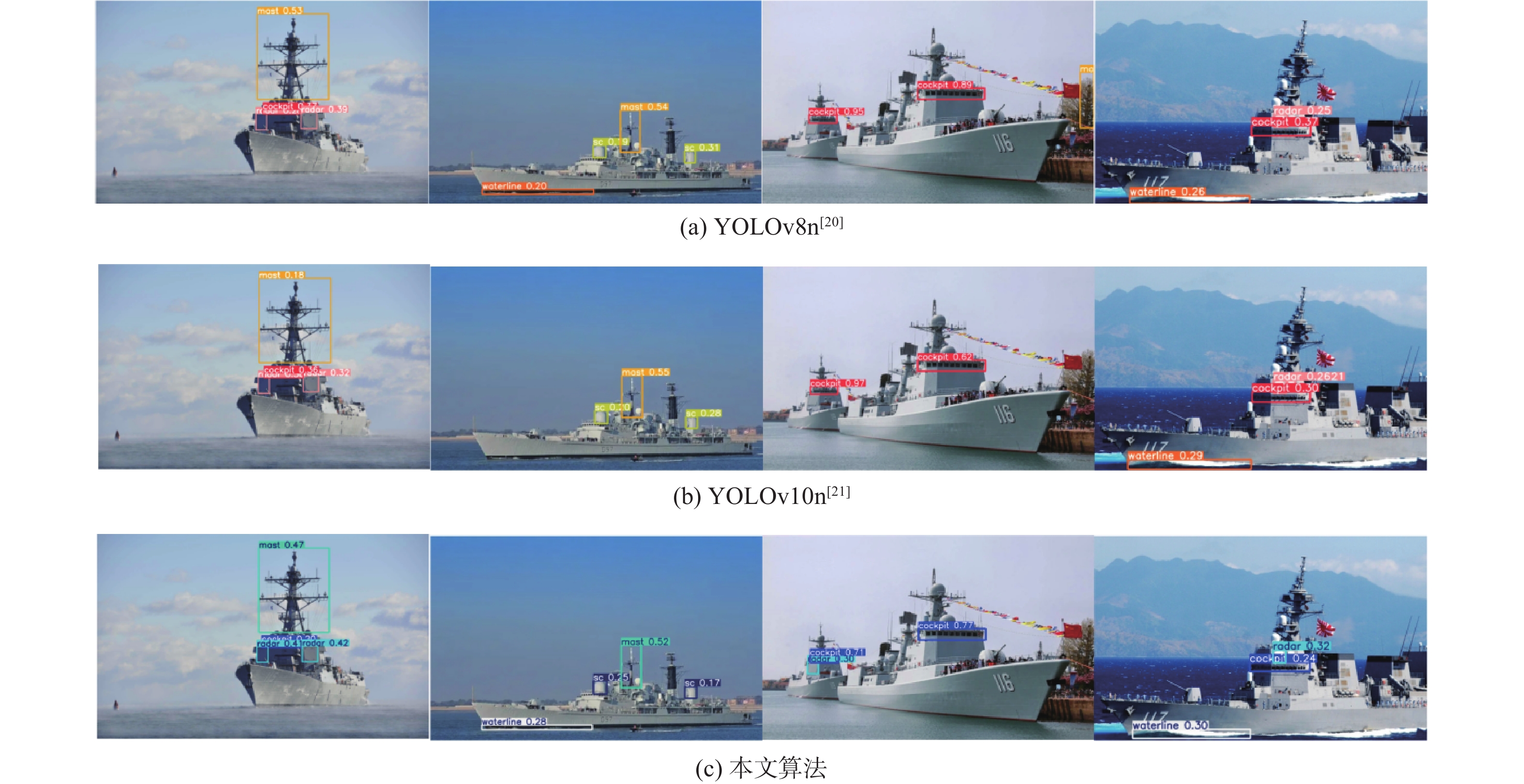
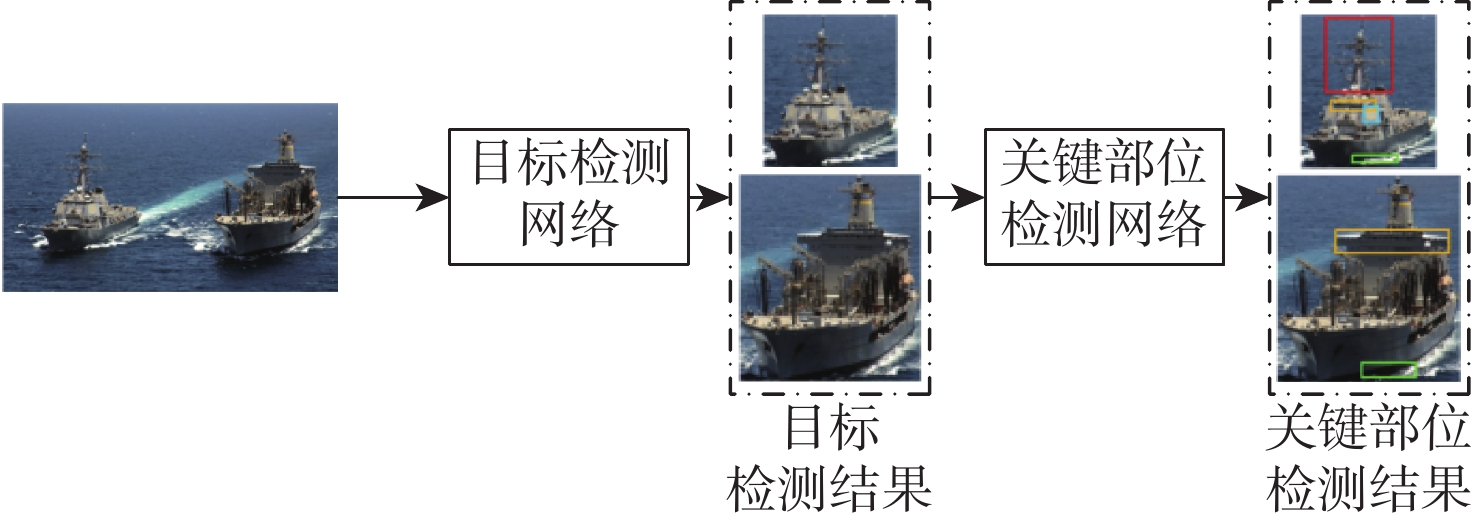
在当前及未来海上维权及海域监测活动中研究如何迅速准确获取舰船关键部位信息,有效判读海域实时情况,具有非常重要的实际意义。基于深度学习的目标检测算法能够区分多类型目标信息,但针对舰船关键部位检测算法的研究较少,且对多通道特征图间的关联性分析不足,对尺度不同的舰船关键部位目标的特征利用率较低,容易错失重要特征信息而使检测精度降低。对此,提出一种基于YOLOv11的舰船关键部位检测算法,提升对关键部位的精准高效检测水平。对当前舰船关键部位检测存在的重难点问题进行深入剖析,结合现有算法进行对比研究;根据实际问题提出舰船关键部位检测的YOLOv11目标检测算法的改进方案;构建可见光舰船关键部位数据集,通过设计对比实验及消融实验,充分证明了所提算法对舰船关键部位检测的精准性及时效性,能够为实现复杂海洋环境中对多类型舰船关键要害部位的精细区分、有效监测海上舰船信息提供可行技术支持和理论支撑。
Abstract:In contemporary and forthcoming maritime rights safeguarding and oceanic surveillance endeavors, it is critically important to investigate methods for swiftly and precisely acquiring data on essential components of vessels and adeptly analyzing real-time marine conditions. Despite the capability of deep learning-based object identification algorithms to identify various types of target information, there is a deficiency in research focused on algorithms for recognizing critical components of ships, and the examination of the relationship between multi-channel feature maps is inadequate. The feature utilization rate of key parts of ships with different scales is low, which may lead to the loss of important feature information and a decrease in detection accuracy. To address this issue, a ship key part detection method based on YOLOv11 is proposed to improve the accuracy and efficiency of key part detection. This manuscript initially performs a thorough examination of the critical and challenging issues in the present detection of essential ship components and engages in a comparative analysis with existing methods. Then, an improved YOLOv11 object detection network for ship key part detection is proposed based on actual problems. Ultimately, a dataset of key components for visible light ships has been established, and through the implementation of comparative and ablation experiments, it is thoroughly evidenced that the proposed algorithm developed in this study exhibits high precision and promptness in identifying ship key components, thereby offering viable technical assistance and a theoretical foundation for the meticulous differentiation of essential and critical parts across various ship types in intricate marine settings and the efficient surveillance of maritime vessel information.
-
Key words:
- ship targets /
- critical parts /
- YOLOv11 /
- attention mechanism /
- feature fusion
-
模型 参数量 帧率/(帧·s−1) AP/% AP(S)/% AP(M)/% AP(L)/% FP32 FP16 Swin-T 48.2×10⁶ 37 50 51.1 34.3 53.9 66.1 ConvNext-T 48.5×10⁶ 39 54 51.0 33.5 53.9 65.8 InternImage-T 48.7×10⁶ 33 37 53.9 37.7 57.7 68.7 FlashInterImage-T 48.5×10⁶ 39 48 57.7 37.9 58.6 69.8  下载: 导出CSV
表 2 引入不同数量AKConv的网络性能对比[15]
Table 2. Performance comparison of networks with different numbers of AKConv introduced[15]
模型 AKConv卷积数量 精确率/% 召回率/% mAP50/% mAP/% 浮点运算量/次 参数量 基线模型 77.3 69.8 76.4 50.2 13.2×10⁹ 6.06×10⁶ YOLOv7-tiny 3 80.1 68.4 76.1 50.3 12.4×10⁹ 5.56×10⁶ 4 78.2 70.3 76.2 50.7 12.4×10⁹ 5.66×10⁶ 5 77.0 71.1 76.5 50.8 12.6×10⁹ 5.75×10⁶ 6 79.6 69.9 76.9 51.0 12.9×10⁹ 5.85×10⁶ 8 78.6 70.1 76.7 51.2 13.4×10⁹ 6.04×10⁶ 9 81.0 69.3 76.7 51.3 13.7×10⁹ 6.14×10⁶
下载: 导出CSV
卷积模块 mAP50/% mAP95/% 浮点运算量/次 SC 58.9 35.8 4.2×10⁹ DSC 56.9 34.6 3.3×10⁹ ShuffleNet 56.5 34.1 3.3×10⁹ GhostNet 59.3 37.0 3.8×10⁹ GSConv 59.8 38.1 3.7×10⁹
下载: 导出CSV
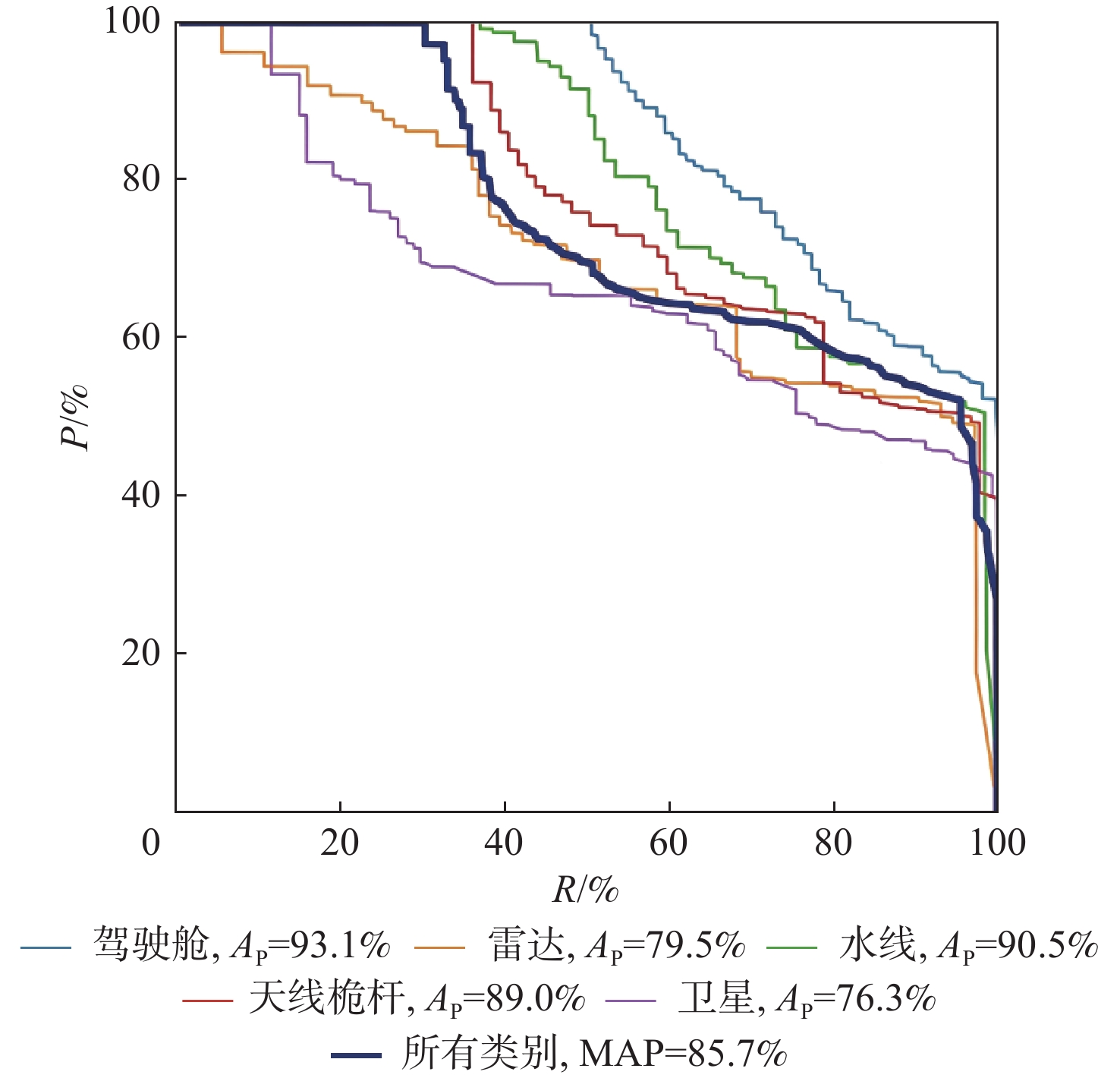
表 5 要害部位检测精度
Table 5. Detection accuracy of critical parts
类型 AP/% 驾驶舱 93.1 雷达 79.5 水线 90.5 天线桅杆 89.0 卫通 76.3
下载: 导出CSV
表 7 消融实验结果对比
Table 7. Comparison of ablation experiment results
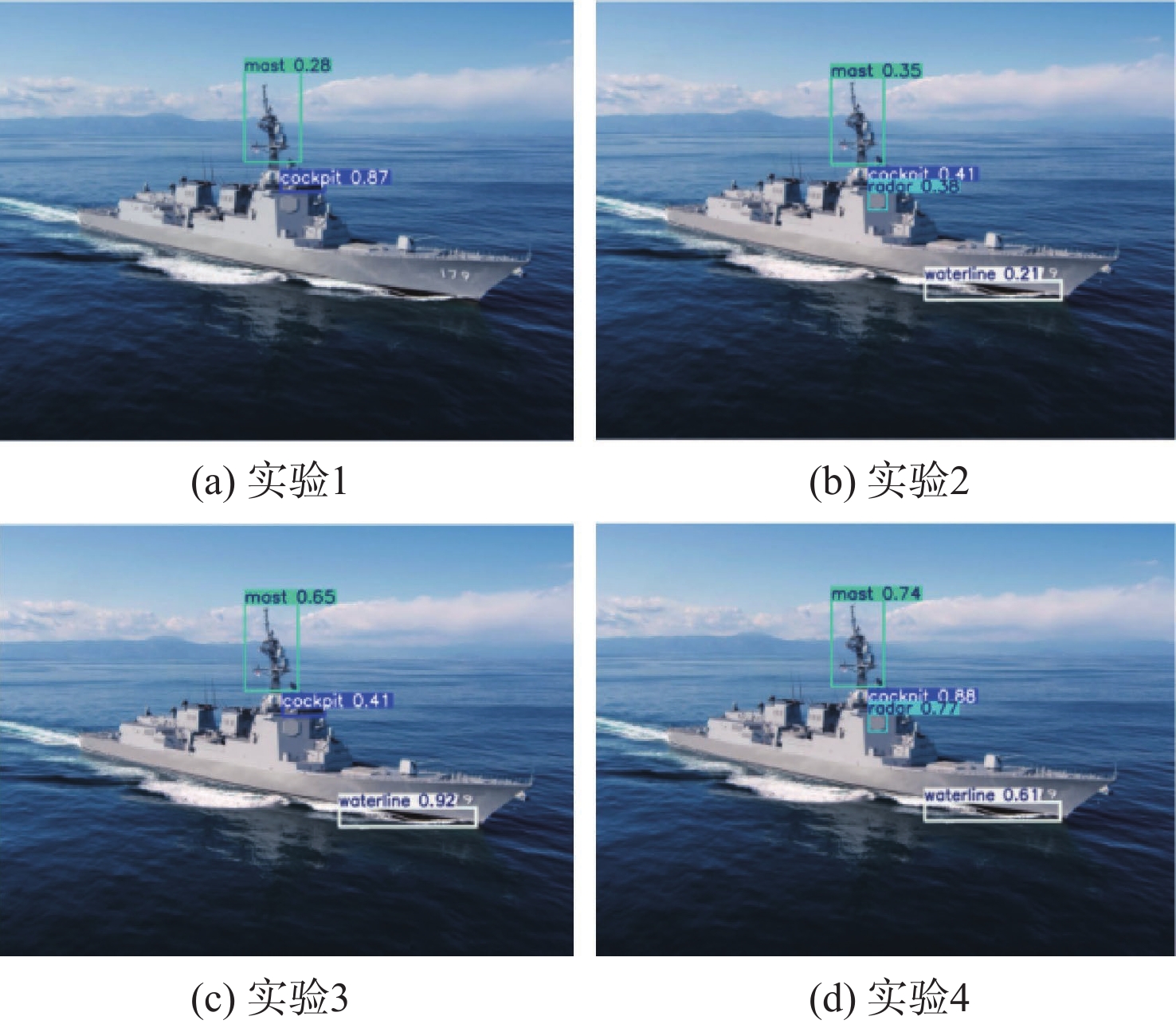
C3k2_DCNv4 Bi-AVB-FPN GSConv 精确率/% 召回率/% mAP50/% 参数量 时间/ms × × × 65.3 82.1 80.8 2 583 127 1.4 √ × × 68.6 87.4 83.9 2 571 439 1.0 √ √ × 70.3 86.7 85.2 2 527 319 0.9 √ √ √ 70.6 87.7 85.7 2 437 559 1.1
下载: 导出CSV
-
[1] Gao F, He Y S, Wang J, et al. Anchor-free convolutional network with dense attention feature aggregation for ship detection in SAR images[J]. Remote Sensing, 2020, 12(16): 2619. [2] 白玉, 迟文恺, 谢宝蓉, 等. 结合目标提取和深度学习的红外舰船检测[J]. 电讯技术, 2023, 63(2): 193-198.Bai Y, Chi W K, Xie B R, et al. Infrared ship detection by combining target extraction and deep learning[J]. Telecommunication Engineering, 2023, 63(2): 193-198(in Chinese). [3] Tang G, Liu S B, Fujino I, et al. H-YOLO: a single-shot ship detection approach based on region of interest preselected network[J]. Remote Sensing, 2020, 12(24): 4192. [4] 刘忻伟, 朴永杰, 郑亮亮, 等. 面向航天光学遥感复杂场景图像的舰船检测[J]. 光学精密工程, 2023, 31(6): 892-904.Liu X W, Piao Y J, Zheng L L, et al. Ship detection for complex scene images of space optical remote sensing[J]. Optics and Precision Engineering, 2023, 31(6): 892-904(in Chinese). [5] 林鑫伟, 徐志京, 黄海. 复杂背景下的SAR图像多尺度舰船检测[J]. 中国航海, 2023, 46(2): 17-24.Lin X W, Xu Z J, Huang H. Multi-scale detection of ship target against complex background out of SAR image[J]. Navigation of China, 2023, 46(2): 17-24(in Chinese). [6] 王玺坤, 姜宏旭, 林珂玉. 基于改进型YOLO算法的遥感图像舰船检测[J]. 北京航空航天大学学报, 2020, 46(6): 1184-1191.Wang X K, Jiang H X, Lin K Y. Remote sensing image ship detection based on modified YOLO algorithm[J]. Journal of Beijing University of Aeronautics and Astronautics, 2020, 46(6): 1184-1191(in Chinese). [7] 李双伟. 基于红外偏振成像的近岸舰船目标识别和抗干扰技术研究[D]. 烟台: 烟台大学, 2016: 12-15.Li S W. Research on inshore ship target recognition and antijamming technology based on infrared polarization imaging[D]. Yantai: Yantai University, 2016: 12-15(in Chinese) . [8] 乔延军. 面向户外增强现实的地理实体目标识别与检测[D]. 武汉: 武汉大学, 2017: 10-30.Qiao Y J. Object recognition and detection of geographical entity based on outdoor augmented reality[D]. Wuhan: Wuhan University, 2017: 10-30(in Chinese) . [9] Hinton G E, Salakhutdinov R P. Reducing the dimensionality of data with neural networks[J]. Science, 2006, 313(5786): 504-507. [10] 苏娟, 杨龙, 黄华, 等. 用于SAR图像小目标舰船检测的改进SSD算法[J]. 系统工程与电子技术, 2020, 42(5): 1026-1034.Su J, Yang L, Huang H, et al. Improved SSD algorithm for small-sized SAR ship detection[J]. Systems Engineering and Electronics, 2020, 42(5): 1026-1034(in Chinese). [11] Ahn S, Chang J W, Kang S J. An efficient accelerator design methodology for deformable convolutional networks[C]//Proceedings of the IEEE International Conference on Image Processing. Piscataway: IEEE Press, 2020: 3075-3079. [12] He K M, Zhang X Y, Ren S Q, et al. Deep residual learning for image recognition[EB/OL]. (2015-12-10)[2024-11-20]. https://doi.org/10.48550/arXiv.1512.03385. [13] Xiong Y W, Li Z Q, Chen Y T, et al. Efficient deformable ConvNets: rethinking dynamic and sparse operator for vision applications[C]//Proceedings of the IEEE/CVF Conference on Computer Vision and Pattern Recognition. Piscataway: IEEE Press, 2024: 5652-5661. [14] Tan M X, Pang R M, Le Q V. EfficientDet: scalable and efficient object detection[C]//Proceedings of the IEEE/CVF Conference on Computer Vision and Pattern Recognition. Piscataway: IEEE Press, 2020: 10778-10787. [15] Zhang X, Song Y Z, Song T T, et al. AKConv: convolutional kernel with arbitrary sampled shapes and arbitrary number of parameters[EB/OL]. (2023-11-20)[2024-11-22]. https://arxiv.org/abs/2311.11587v1. [16] Li Y K, Shen H B, Fu Y P, et al. A method of dense point cloud SLAM based on improved YOLOV8 and fused with ORB-SLAM3 to cope with dynamic environments[J]. Expert Systems with Applications, 2024, 255: 124918. [17] Li H L, Li J, Wei H B, et al. Slim-neck by GSConv: a lightweight-design for real-time detector architectures[EB/OL]. (2024-07-02)[2024-11-22]. https://doi.org/10.48550/arXiv.2206.02424. [18] Liu W, Anguelov D, Erhan D, et al. SSD: single shot multibox detector[C]//Proceedings of the Computer Vision-ECCV 2016. Berlin: Springer, 2016: 21-37. [19] Newell A, Yang K, Deng J. Stacked hourglass networks for human pose estimation[C]//Proceedings of the European Conference on Computer Vision. Berlin: Springer, 2016: 486-499. [20] Yaseen M. What is YOLOv8: an in-depth exploration of the internal features of the next-generation object detector[EB/OL]. (2024-08-28)[2024-11-20]. https://arxiv.org/abs/2408.15857. [21] Wang A, Chen H, Liu L H, et al. YOLOv10: real-time end-to-end object detection[C]//Proceedings of the Advances in Neural Information Processing Systems 37. Vancouver: NeurIPS, 2024: 107984-108011. [22] Khanam R, Hussain M. YOLOv11: an overview of the key architectural enhancements[EB/OL]. (2024-11-23)[2024-11-25]. https://arxiv.org/abs/2408.15857. -

 下载:


计量
- 文章访问数: 291
- HTML全文浏览量: 104
- PDF下载量: 114
- 被引次数: 0
