





An interference magnetic field compensation method based on a model-data hybrid drive
-
摘要:
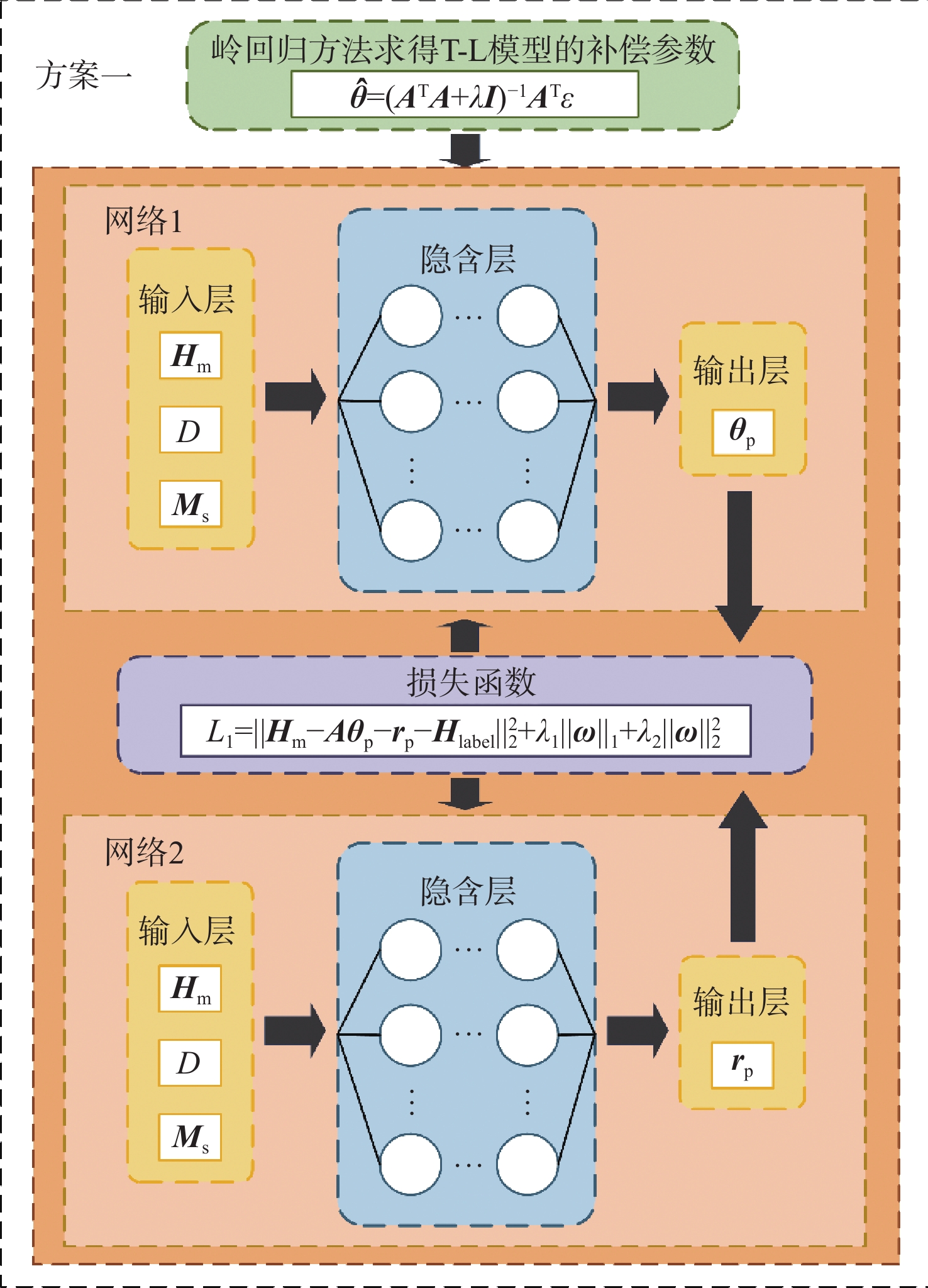
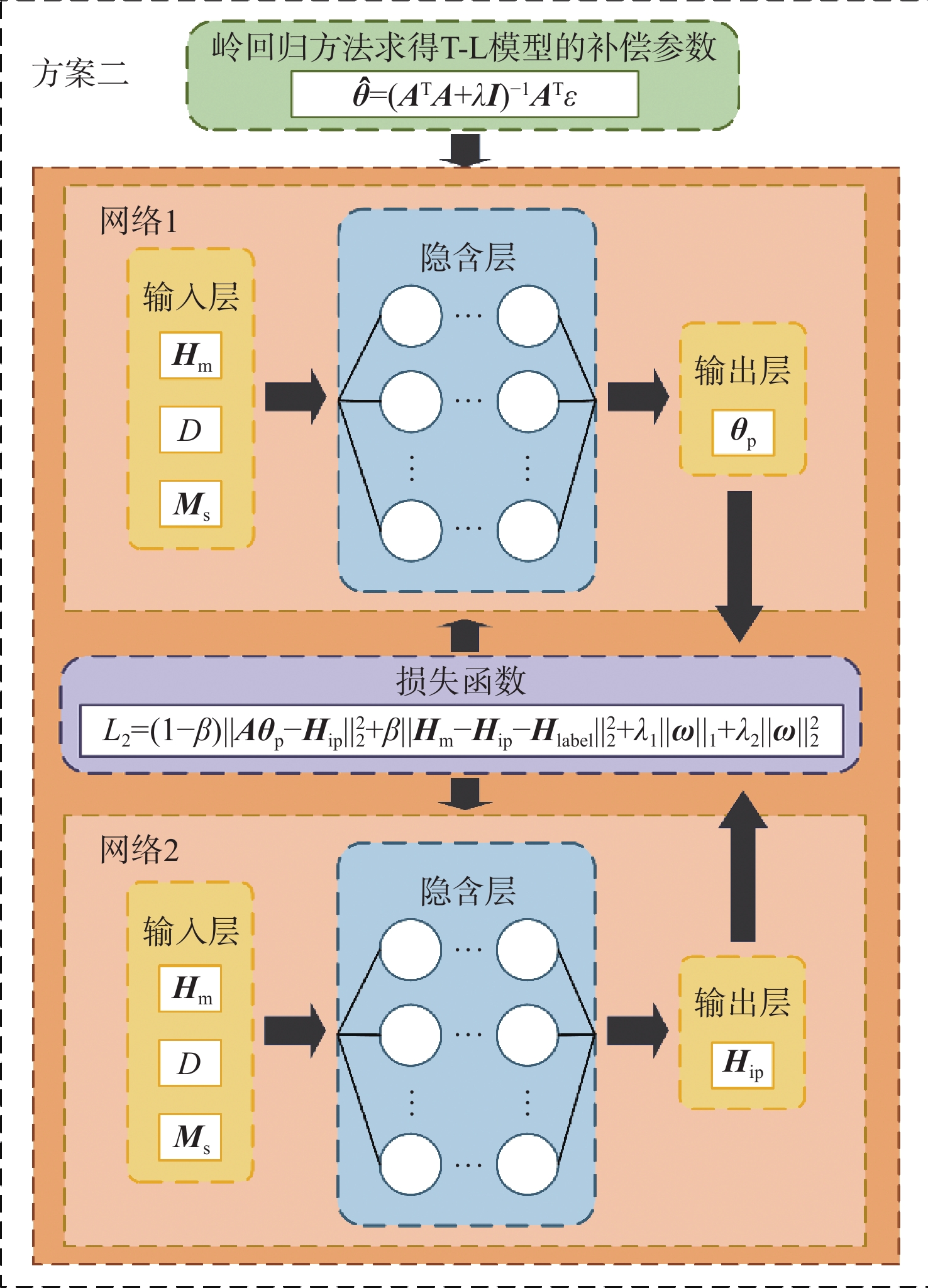
载体自身干扰磁场的精确补偿是提升地磁导航精度的关键挑战。针对传统补偿方法受限于线性假设和难以适应复杂场景的泛化需求等问题,提出2种基于模型数据混合驱动的磁干扰协同补偿方案。在预处理阶段,采用主成分分析方法对数据进行降维处理,并利用物理模型所求补偿参数对神经网络进行初始化处理;方案一通过分析传统补偿模型的缺陷,利用神经网络求解补偿参数,打破传统模型求解范式并预防可能存在的复共线问题,同时,在干扰磁场中引入随机因子项模拟非线性较强的随机干扰磁场;方案二通过构造损失函数联动数据驱动与模型驱动,将磁场特征的高效提取与干扰场的物理约束深度耦合。实验结果表明:所提方法较纯模型和纯数据补偿方法具有补偿精度高、泛化能力强等优点,在不同高度、不同地域进行泛化能力测试的最高补偿精度分别提高了69.64%和69.39%,验证了所提方法的有效性。
Abstract:The precise compensation of the carrier’s self-interference magnetic field is a key challenge in improving the accuracy of geomagnetic navigation. Two model-data hybrid-driven magnetic interference collaborative compensation strategies are presented in response to the drawbacks of conventional compensation techniques, including the linear assumption and the challenge of responding to complex settings. In the preprocessing stage, principal component analysis is used to reduce the dimensionality of the data, and the compensation parameters obtained from the physical model are used to initialize the neural network. In scheme one, the shortcomings of the conventional compensation model are analyzed, the compensation parameters are solved using a neural network, the traditional model-solving paradigm is broken and potential multicollinearity issues are avoided, and a random factor term is introduced in the interference magnetic field to simulate the random interference magnetic field with strong nonlinearity. Scheme two constructs a loss function to link data-driven and model-driven, deeply coupling the efficient extraction of magnetic field features with the physical constraints of the interference field. Experimental results show that the proposed methods have the advantages of high compensation accuracy and strong generalization ability compared with pure model and pure data compensation methods. The highest compensation accuracy in generalization ability tests at different heights and different regions has increased by 69.64% and 69.39%, respectively, verifying the effectiveness of the proposed methods.
-
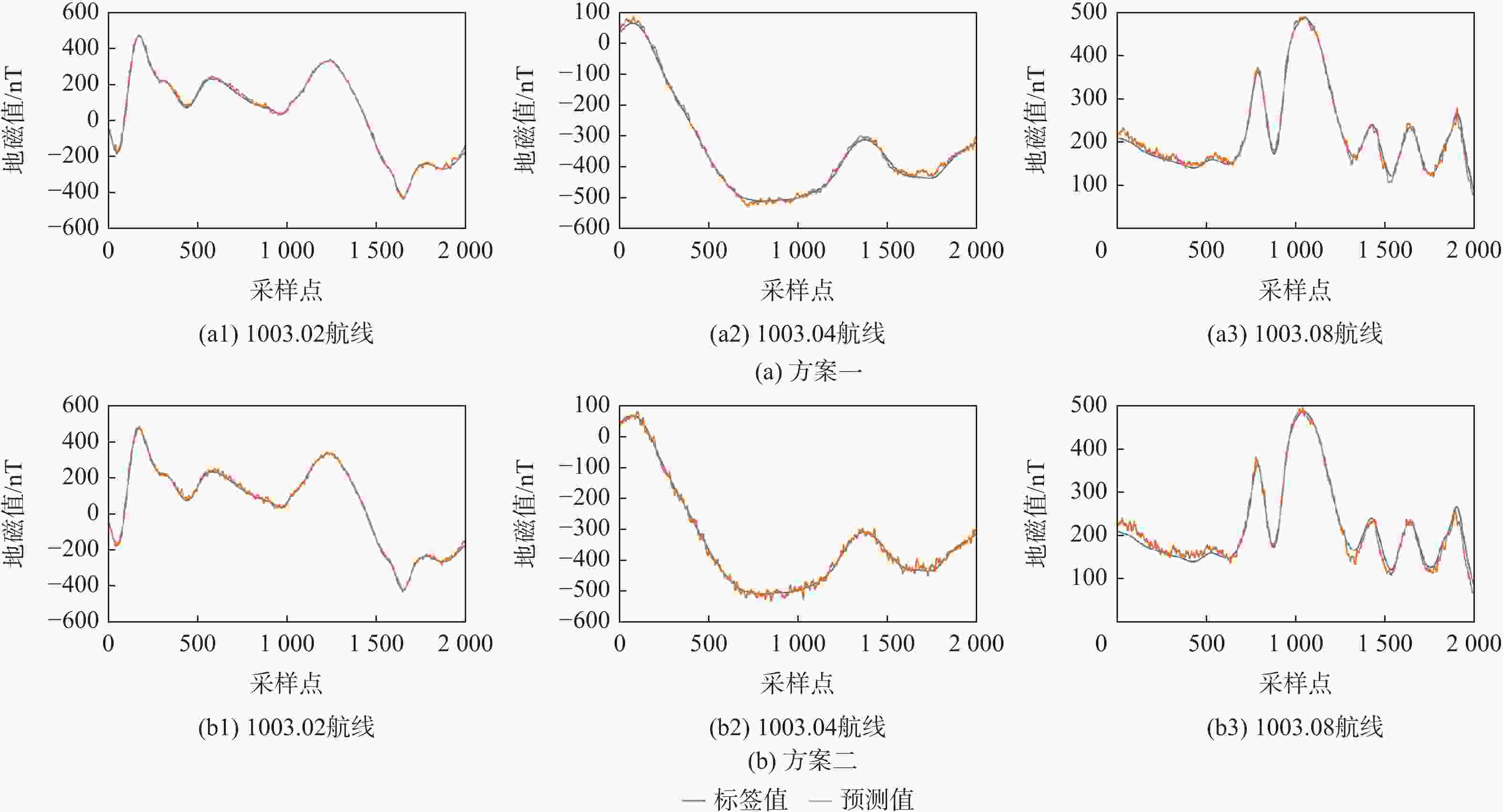
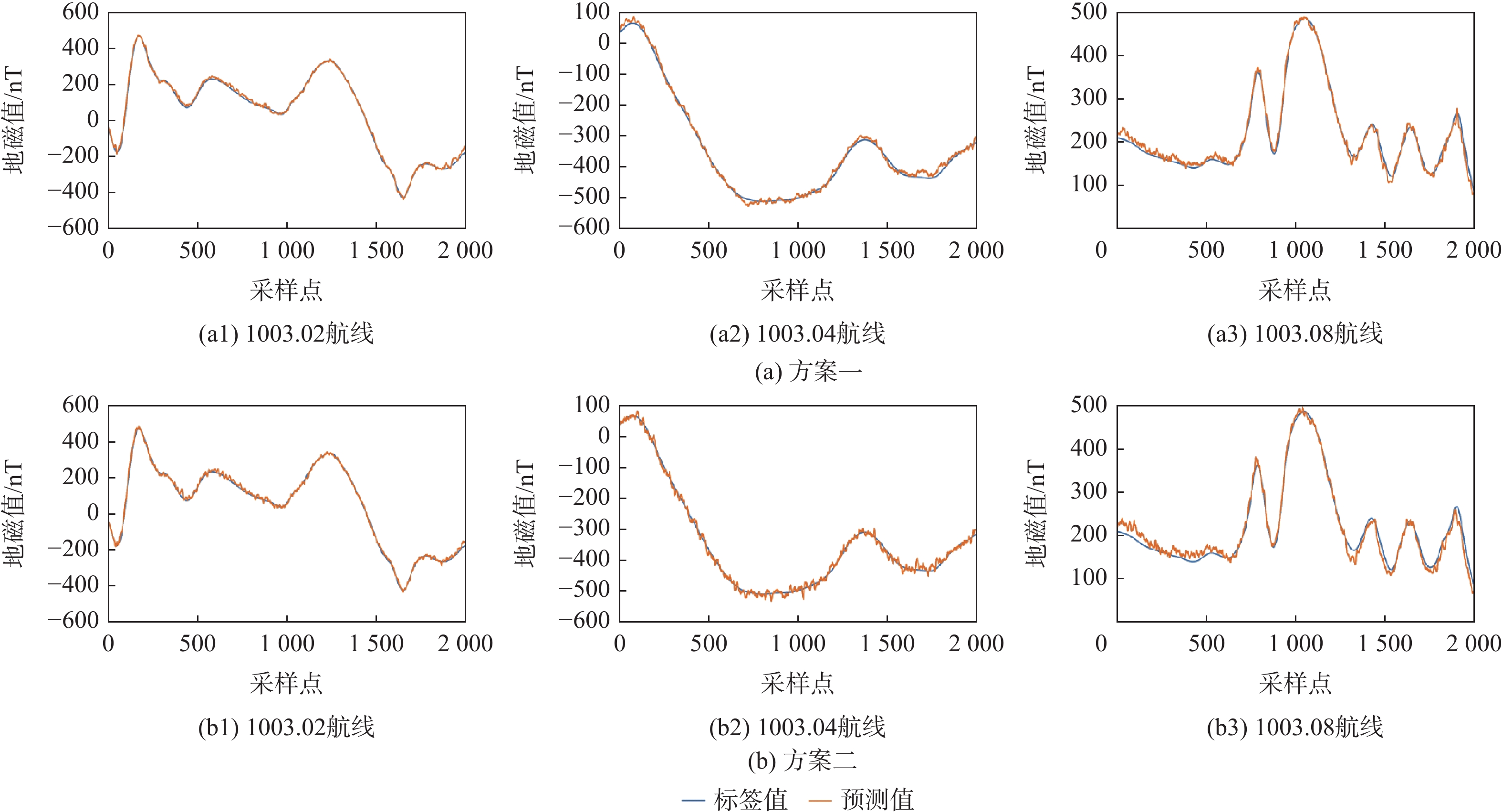
图 8 不同航线泛化能力测试结果
Figure 8. Test results of generalization ability for different routes
表 1 2种方案的共同网络参数设置
Table 1. Common network parameter settings for the two schemes
模型输入 学习率 批量大小 迭代次数 L1正则化系数 L2正则化系数 激活函数 优化器 45个特征 0.000 1 128 300 0.000 01 0.000 001 Swish(·)函数 Adam  下载: 导出CSV
表 2 不同航线数据解读
Table 2. Interpretation of data for different routes
航线编号 描述 1003.02 安大略省东部400 m高度自由飞行 1003.04 安大略省东部800 m高度自由飞行 1003.08 伦弗鲁省400 m高度自由飞行
下载: 导出CSV
表 3 神经网络的输入、标签信息描述
Table 3. Description of input and label information for neural networks
特征量 描述 mag_4_iuc 4号标量磁力计未经补偿的磁异常数据 flux_b_x 磁通门B的X轴方向的磁场大小 flux_b_y 磁通门B的Y轴方向的磁场大小 flux_b_z 磁通门B的Z轴方向的磁场大小 cur_strb 频闪灯的电流传感器 cur_ac_hi 空调风扇高速的电流传感器 cur_heat 惯性导航系统加热器的电流传感器 vol_bat_1 电池1的电压传感器 vol_block 模块的电压传感器 mag_1_ic 1号标量磁力计经补偿后的磁异常数据
下载: 导出CSV
表 4 不同方案的补偿能力对比
Table 4. Comparison of compensation capabilities of different schemes
方案 RMSE/nT R2 岭回归 33.944 0.985 83 神经网络 9.301 0.998 82 方案一 6.871 0.999 36 方案二 7.313 0.999 27
下载: 导出CSV
表 5 不同方案的泛化能力对比
Table 5. Comparison of generalization capabilities of different schemes
方案 RMSE/nT R2 1003.02航线 1003.04航线 1003.08航线 1003.02航线 1003.04航线 1003.08航线 岭回归 86.490 73.191 133.078 0.834 9 0.811 4 −0.836 4 神经网络未初始化 14.561 31.465 31.153 0.995 7 0.963 4 0.895 3 神经网络初始化 10.849 13.302 16.574 0.997 6 0.993 5 0.970 4 方案一 9.796 9.552 9.536 0.998 0 0.996 6 0.990 2 方案二 9.746 9.761 10.304 0.998 3 0.996 5 0.988 5
下载: 导出CSV
-
[1] 何康辉, 董朝阳, 王青. 一种考虑GPS信号中断的导航滤波算法[J]. 北京航空航天大学学报, 2019, 45(9): 1874-1881.He K H, Dong C Y, Wang Q. A navigation filtering algorithm considering GPS signal interruption[J]. Journal of Beijing University of Aeronautics and Astronautics, 2019, 45(9): 1874-1881(in Chinese). [2] 陈飞强, 孙一凡, 唐小妹, 等. GNSS信号功率增强对调零抗干扰接收机的性能影响[J]. 国防科技大学学报, 2023, 45(5): 72-77.Chen F Q, Sun Y F, Tang X M, et al. Effect of signal power enhancement on the performance of GNSS null-steering anti-jamming receiver[J]. Journal of National University of Defense Technology, 2023, 45(5): 72-77(in Chinese). [3] 吴德伟, 苗强, 何思璇, 等. 量子传感的导航应用研究现状与展望[J]. 空军工程大学学报(自然科学版), 2021, 22(6): 67-76.Wu D W, Miao Q, He S X, et al. A study of existing status and prospects for quantum sensor in navigation[J]. Journal of Air Force Engineering University (Natural Science Edition), 2021, 22(6): 67-76(in Chinese). [4] 朱祥维, 沈丹, 肖凯, 等. 类脑导航的机理、算法、实现与展望[J]. 航空学报, 2023, 44(19): 1-33.Zhu X W, Shen D, Xiao K, et al. Mechanisms, algorithms, implementation and perspectives of brain-inspired navigation[J]. Acta Aeronautica et Astronautica Sinica, 2023, 44(19): 1-33(in Chinese). [5] 李婷, 王仕成, 张金生. 磁场测量误差补偿技术综述[J]. 电光与控制, 2018, 25(6): 66-71.Li T, Wang S C, Zhang J S. A review on geomagnetic measurement error compensation technologies[J]. Electronics Optics & Control, 2018, 25(6): 66-71(in Chinese). [6] 缪林良, 米洒洒, 王玮琳, 等. 航磁矢量测量的误差分析和补偿算法研究[J]. 电子测量与仪器学报, 2021, 35(12): 15-23.Miao L L, Mi S S, Wang W L, et al. Error analysis and compensation algorithm research of aeromagnetic vector measurement[J]. Journal of Electronic Measurement and Instrumentation, 2021, 35(12): 15-23(in Chinese). [7] 周斌, 王劲东. 卫星磁部件分布对梯度法消除剩磁的影响分析[J]. 中国空间科学技术, 2013, 33(5): 29-34.Zhou B, Wang J D. Influence of magnetic component distribution of satellite on eliminating remanant magnetic field by gradient method[J]. Chinese Space Science and Technology, 2013, 33(5): 29-34(in Chinese). [8] 吕禺萱, 雷华明. 磁异常探测中载体干扰磁场RLS补偿方法[J]. 电子测量与仪器学报, 2022, 36(3): 96-104.Lyu Y X, Lei H M. RLS method for carrier interference compensation in magnetic anomaly detection[J]. Journal of Electronic Measurement and Instrumentation, 2022, 36(3): 96-104(in Chinese). [9] Ye L W, Yu Z T, Zhang Y X, et al. An aeromagnetic compensation strategy for large UAVs[J]. Sensors, 2024, 24(12): 3775. [10] Ma X Y, Zhang J S, Liao S Y, et al. Aeromagnetic compensation method based on recursive least square and elastic weight consolidation[J]. Applied Geophysics, 2025, 22(2): 279-290. [11] 张宇, 陈正想, 覃涛. 基于BP神经网络的航磁补偿方法研究[J]. 数字海洋与水下攻防, 2023, 6(6): 734-742.Zhang Y, Chen Z X, Qin T. Research on aeromagnetic compensation method based on BP neural network[J]. Digital Ocean & Underwater Warfare, 2023, 6(6): 734-742(in Chinese). [12] Wang Y Z, Han Q, Zhan D C, et al. A data-driven OBE magnetic interference compensation method[J]. Sensors, 2022, 22(20): 7732. [13] 王劲楠, 张晓明, 张鸽, 等. 基于GAN-LSTM改进T-L磁补偿方法[J]. 电子测量技术, 2025, 48(5): 50-56.Wang J N, Zhang X M, Zhang G, et al. Improved T-L magnetic compensation method based on GAN-LSTM[J]. Electronic Measurement Technology, 2025, 48(5): 50-56(in Chinese). [14] Xu Y J, Liu Z Y, Zhang Q, et al. Interference model guided neural network for aeromagnetic compensation[J]. IEEE Sensors Journal, 2024, 24(8): 12266-12275. [15] 王晨阳. PCA和GA-BP结合的地磁导航适配区选择方法[J]. 电光与控制, 2018, 25(6): 110-114.Wang C Y. Geomagnetic navigation matching area selection based on PCA and GA-BP neural network[J]. Electronics Optics & Control, 2018, 25(6): 110-114(in Chinese). [16] 林沂, 孙晶京, 闫旭. 地磁导航定位技术原理与方法综述[J]. 全球定位系统, 2023, 48(6): 32-41.Lin Y, Sun J J, Yan X. A review of the principles and methods of geomagnetic navigation and positioning technology[J]. GNSS World of China, 2023, 48(6): 32-41(in Chinese). [17] 李季. 地磁测量中载体干扰磁场特性及补偿方法研究[D]. 长沙: 国防科学技术大学, 2013: 99-100.Li J. Study on the characteristics and compensation method of vehicle interferential magnetic field in geomagnetic measurement[D]. Changsha: National University of Defense Technology, 2013: 99-100(in Chinese). [18] Tolles W E, Lawson J D. Magnetic compensation of mad equipped aircraft, 201-1[R]. Mineola: Airborne Instruments Laboratory, 1950: 201-211. [19] Leliak P. Identification and evaluation of magnetic-field sources of magnetic airborne detector equipped aircraft[J]. IRE Transactions on Aerospace and Navigational Electronics, 1961, ANE-8(3): 95-105. [20] Su Z N, Jiao J, Zhou S, et al. Aeromagnetic compensation method based on ridge regressional gorithm[J]. Global Geology, 2022, 25(1): 41-48. [21] 戚德虎, 康继昌. BP神经网络的设计[J]. 计算机工程与设计, 1998, 19(2): 48-50.Qi D H, Kang J C. On design of the BP neural network[J]. Computer Engineering and Design, 1998, 19(2): 48-50(in Chinese). [22] 徐文耀, 白春华, 康国发. 地壳磁异常的全球模型[J]. 地球物理学进展, 2008, 23(3): 641-651.Xu W Y, Bai C H, Kang G F. Global models of earth’s crust magnetic anomalies[J]. Progress in Geophysics, 2008, 23(3): 641-651(in Chinese). -

 下载:
下载:

 点击查看大图
计量
- 文章访问数: 245
- HTML全文浏览量: 135
- PDF下载量: 9
- 被引次数: 0
