





Remaining useful life prediction of lithium-ion batteries in low-altitude vehicles based on MTL-sLSTM
-
摘要:
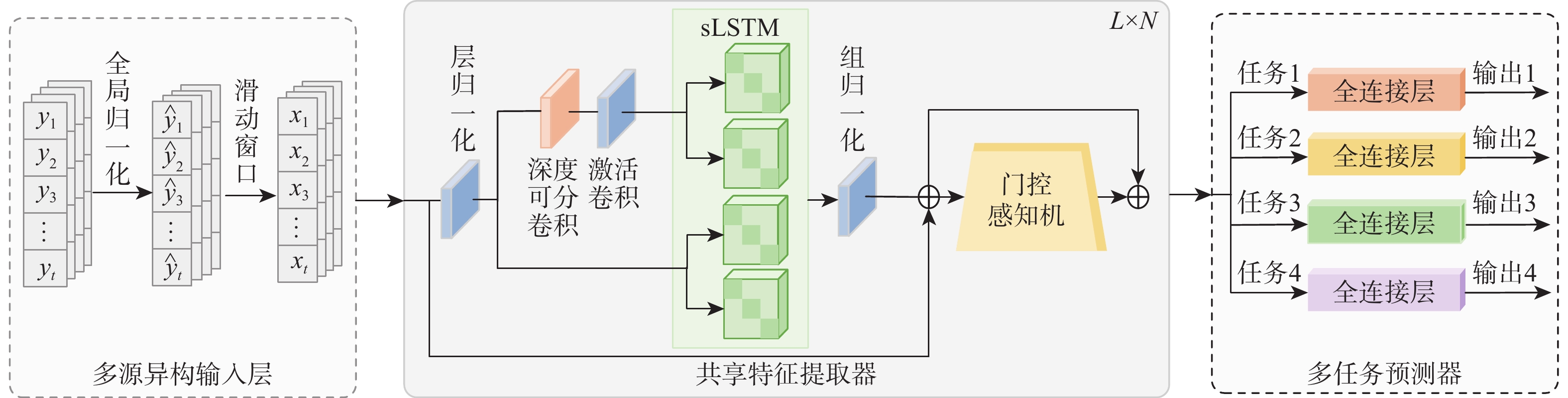
针对低空经济载具锂离子电池在多工况耦合下的剩余寿命(RUL)预测问题,提出一种基于多任务学习的标量长短期记忆网络(MTL-sLSTM)预测方法。该方法通过多源异构输入层融合跨飞行工况的多维度时序数据,采用层级堆叠的sLSTM结构作为共享特征提取器,实现跨时间尺度的深度特征融合与非线性退化共性特征提取;结合任务ID硬编码索引动态调整网络权重,通过多任务学习机制自适应捕捉不同工况的退化模式,同步实现跨工况知识共享与独立RUL预测。实验结果表明:MTL-sLSTM的预测性能显著优于注意力混合专家模型(AttMoE)、双通道LSTM(Dual-LSTM)等6种时序方法,在eVTOL数据集上均方根误差(RMSE)较对比方法降低60.7%~92.3%,验证了多任务学习机制在增强复杂工况下退化特征泛化能力与提升预测精度方面的有效性。
Abstract:A prediction technique based on multi-task learning with scalar long short-term memory (MTL-sLSTM) was presented to solve the problem of remaining useful life (RUL) prediction for lithium-ion batteries in low-altitude economy vehicles under multi-condition coupling. Firstly, a heterogeneous input layer integrates multi-dimensional time-series data from diverse flight conditions. Then, a hierarchical stacked sLSTM structure serves as a shared feature extractor, enabling deep cross-scale feature integration and the capture of common nonlinear degradation patterns. Finally, by hard-coding task IDs to dynamically modulate network weights, the multi-task learning mechanism adaptively identifies each operating condition’s unique aging behavior while simultaneously promoting knowledge transfer across domains for independent RUL estimation. According to experimental results, MTL-sLSTM achieves a 60.7%–92.3% reduction in root mean square error (RMSE) on the eVTOL dataset, outperforming six temporal approaches, including the attention mixture of experts (AttMoE) and dual-channel LSTM (Dual-LSTM). This validates the effectiveness of the multi-task learning mechanism in enhancing the generalization capability of degradation features and improving prediction accuracy under complex operating conditions.
-
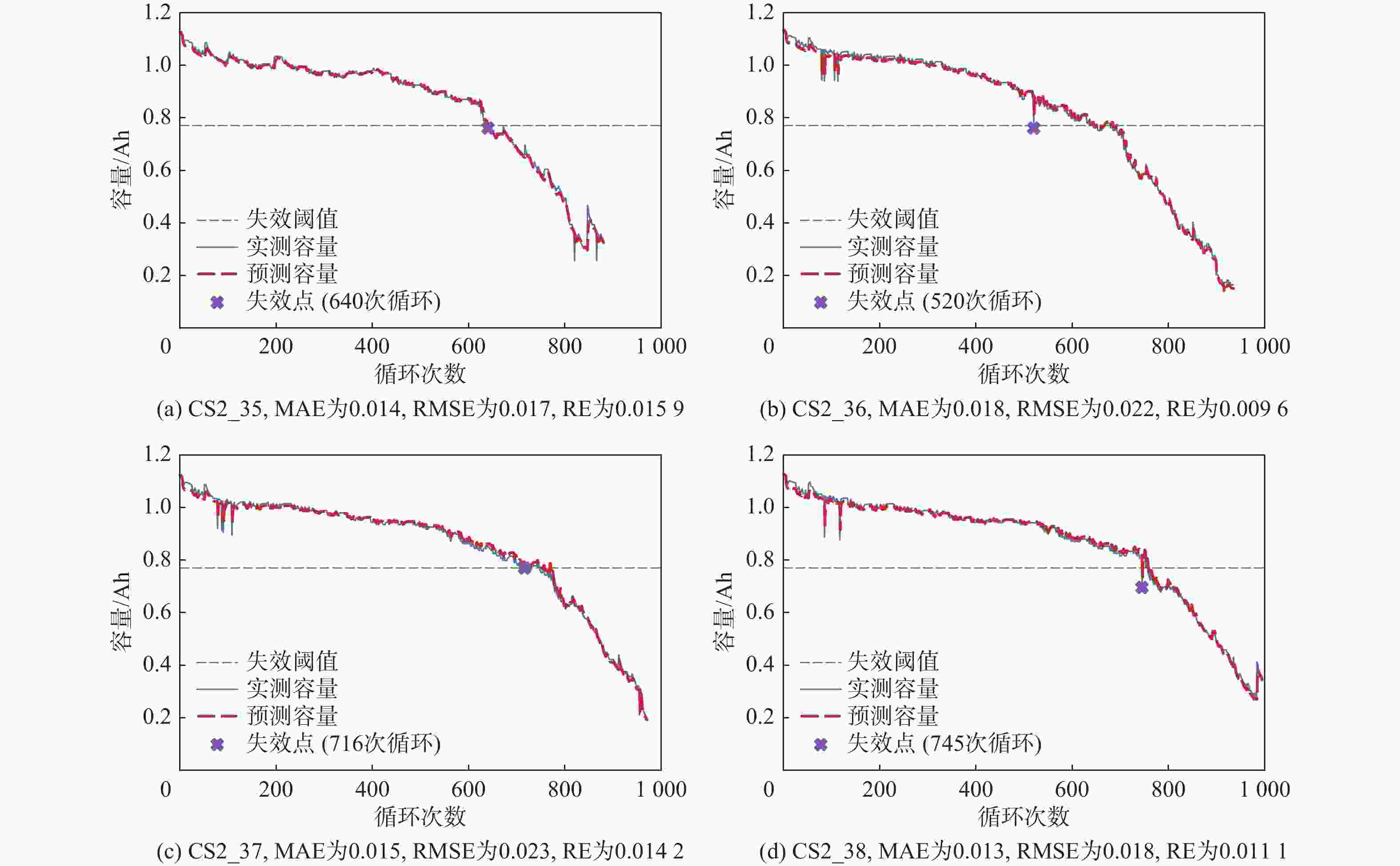
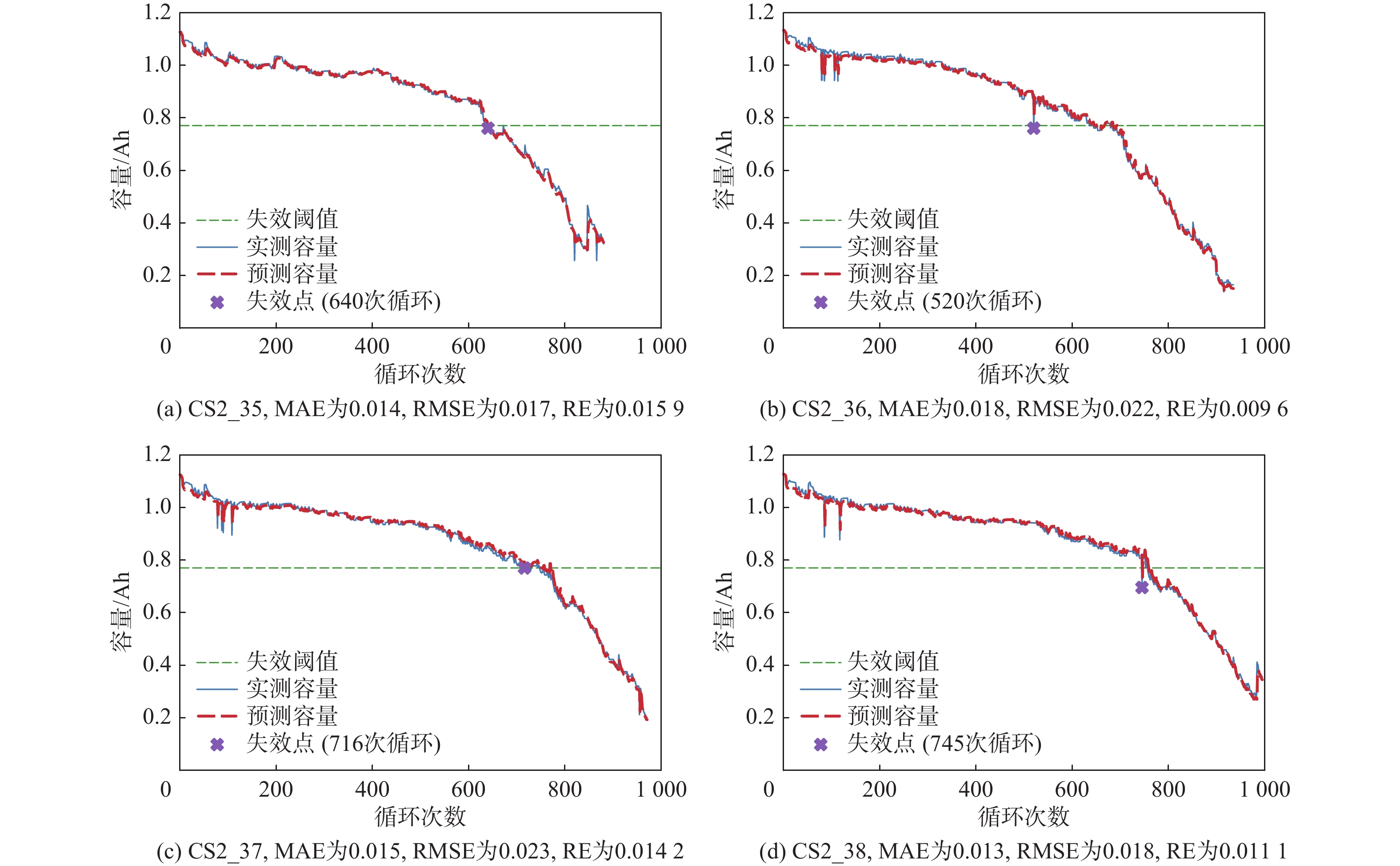
图 8 MTL-sLSTM模型在CALCE数据集4个子集的真实值与预测值对比
Figure 8. Comparison of true values and predicted values for MTL-sLSTM model on four subsets of CALCE dataset
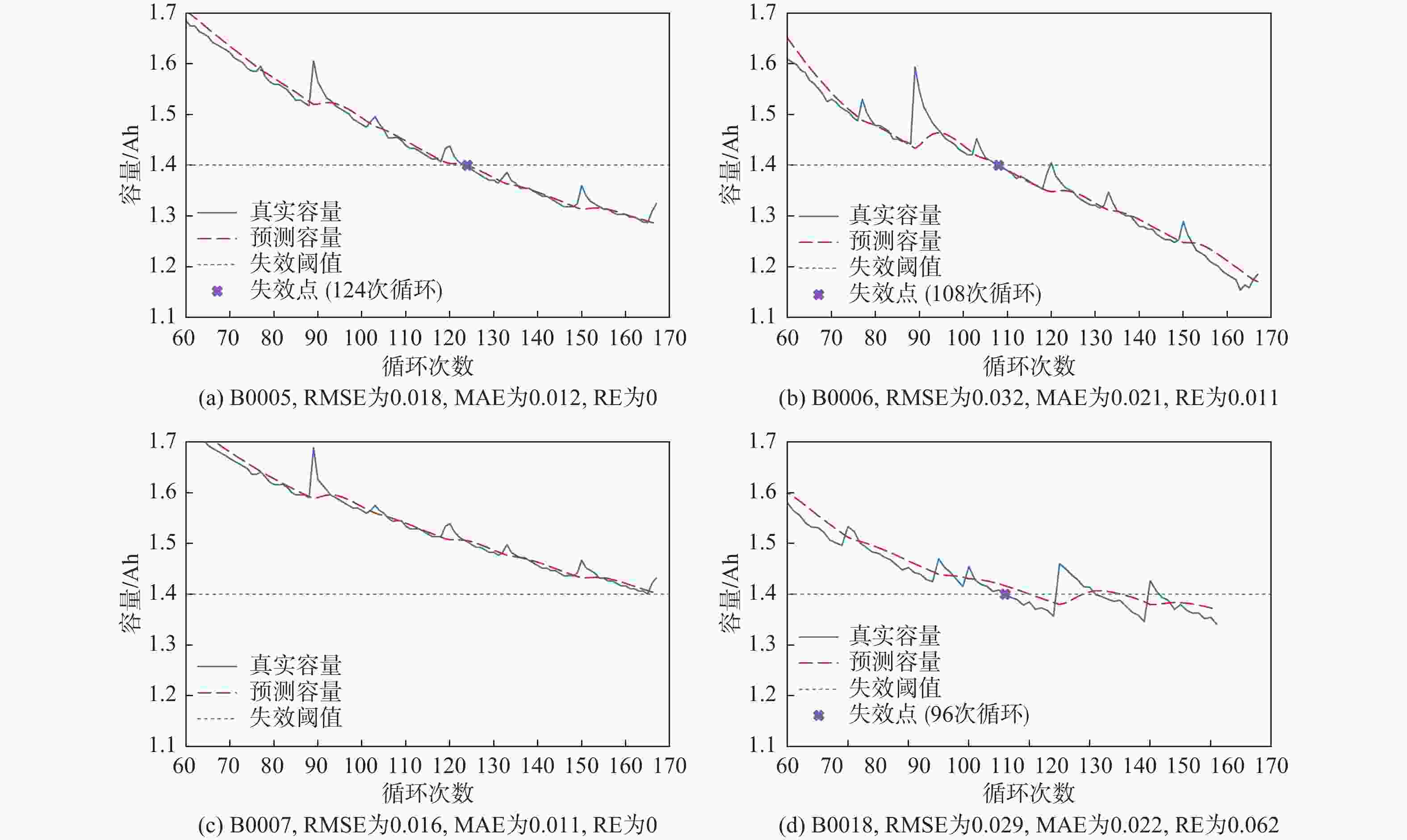
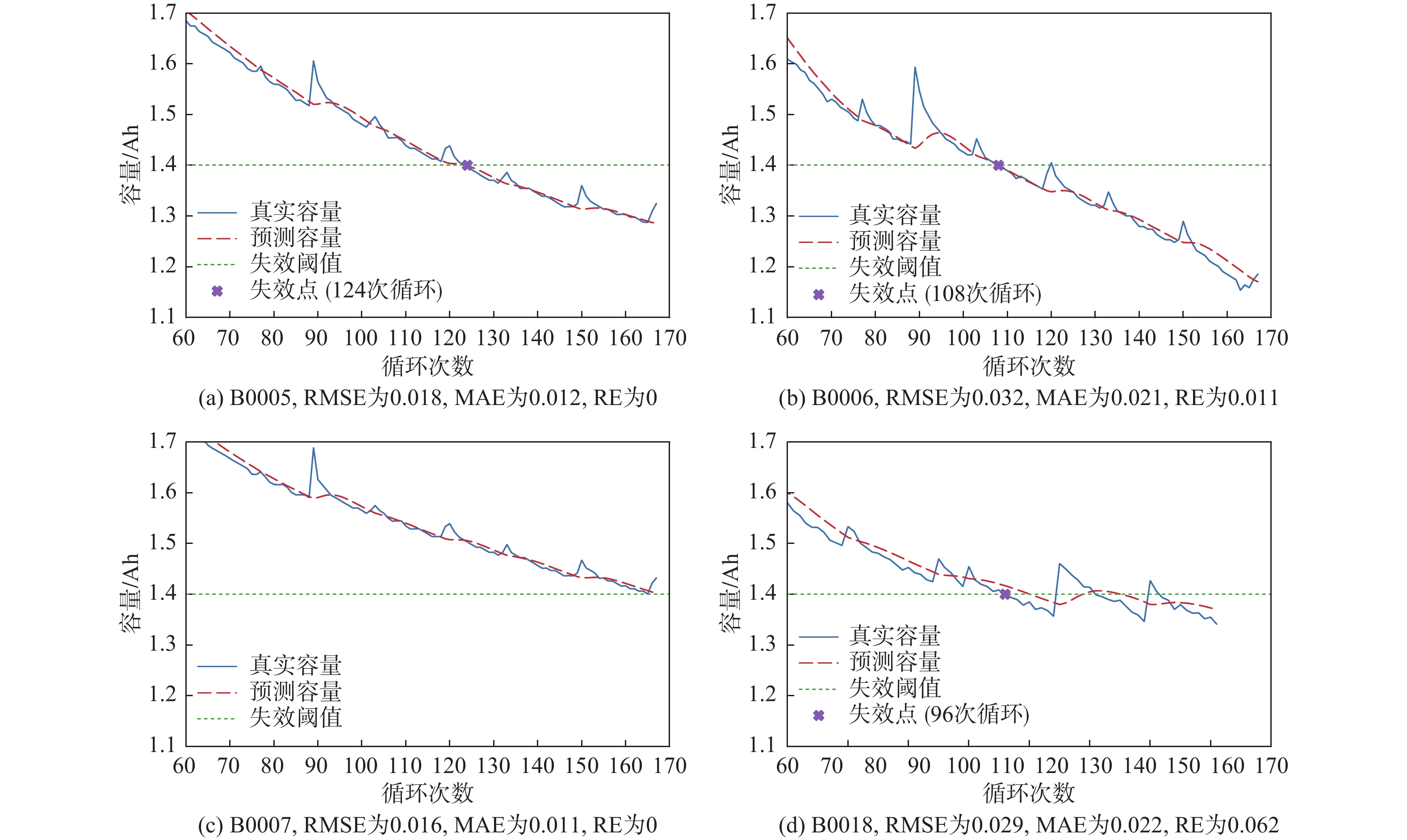
图 9 MTL-sLSTM模型在NASA数据集4个子集的真实值与预测值对比
Figure 9. Comparison of true values and predicted values for MTL-sLSTM model on four subsets of NASA dataset
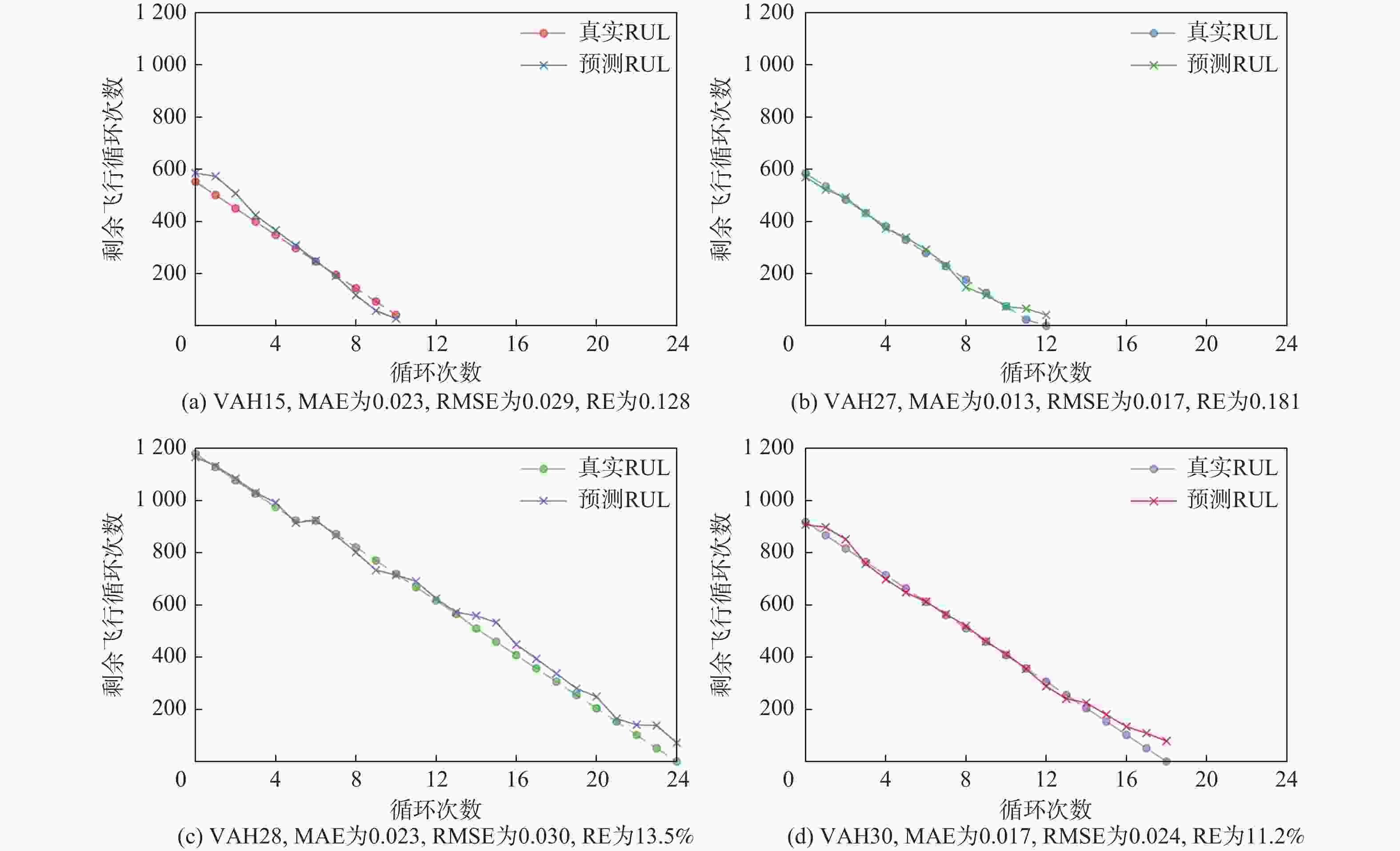
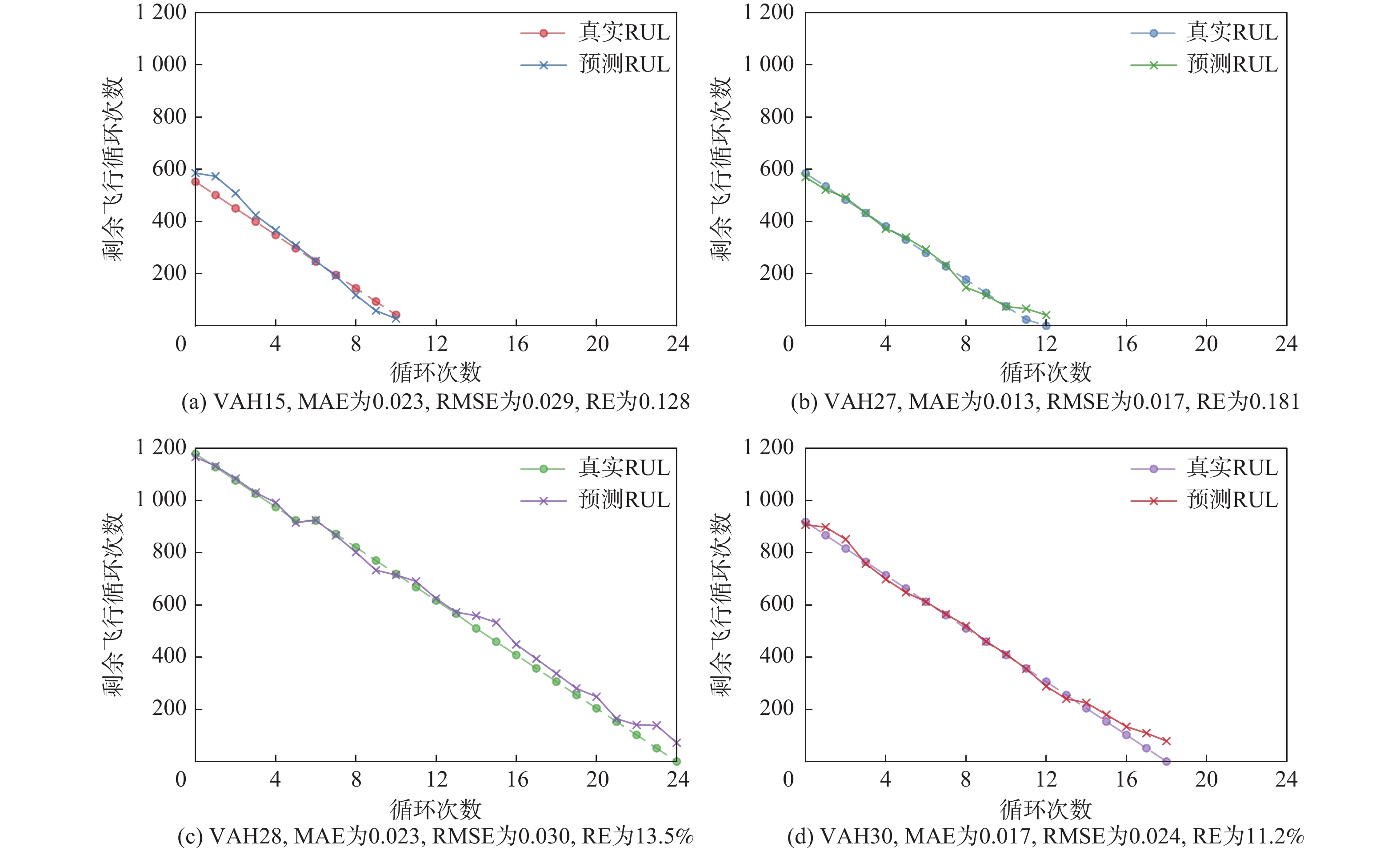
图 10 MTL-sLSTM模型在eVTOL数据集4个子集的真实值与预测值对比
Figure 10. Comparison of true values and predicted values for MTL-sLSTM model on four subsets of eVTOL dataset
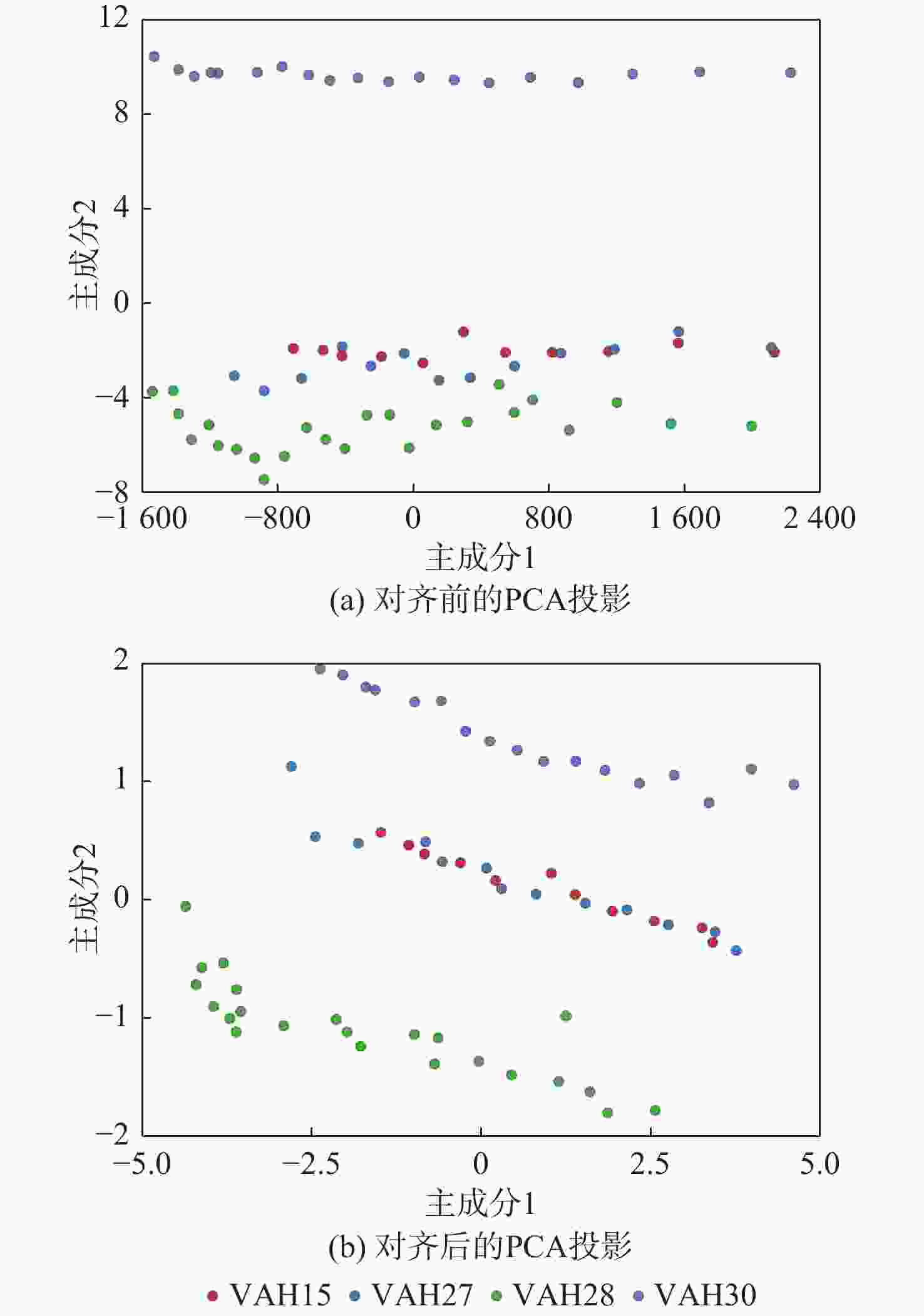
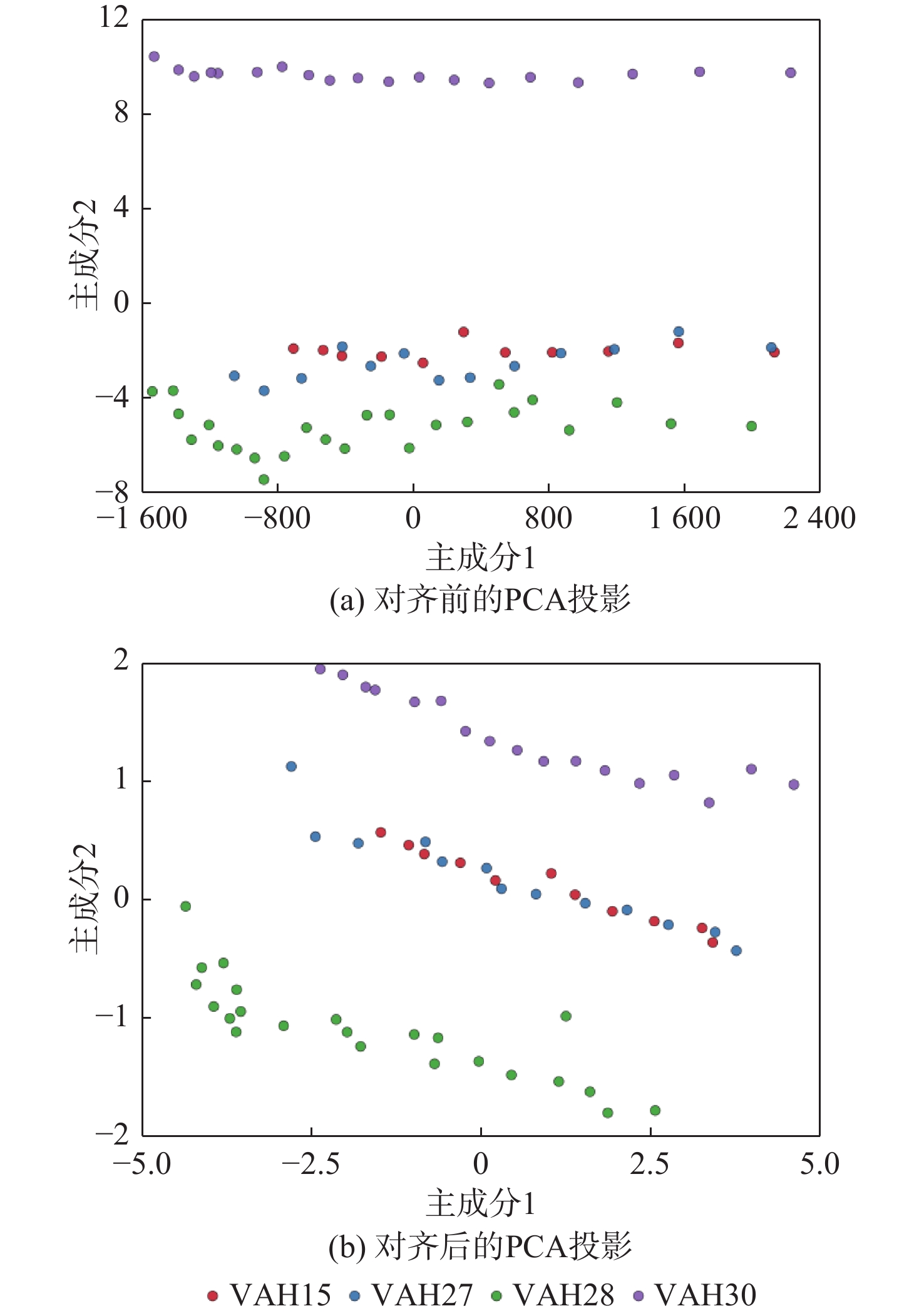
图 11 eVTOL数据集子集的特征对齐前后对比
Figure 11. Comparison of feature alignment before and after for eVTOL dataset subsets
表 1 各方法在CALCE数据集上RUL预测性能对比
Table 1. Comparison of RUL prediction performance of various methods on CALCE dataset
方法 RE MAE RMSE MLP 0.4018 0.1557 0.2038 LSTM 0.0902 0.0582 0.0736 Dual-LSTM 0.0885 0.0636 0.0874 GRU 0.1319 0.0671 0.0946 AttMoE 0.0761 0.0577 0.0794 sLSTM 0.0485 0.0469 0.0537 MTL-sLSTM 0.0127 0.0151 0.0202  下载: 导出CSV
表 2 各方法在NASA数据集上RUL预测性能对比
Table 2. Comparison of RUL prediction performance of various methods on NASA dataset
方法 RE MAE RMSE MLP 0.3851 0.1379 0.1541 LSTM 0.2648 0.0829 0.0905 Dual-LSTM 0.2557 0.0815 0.0879 GRU 0.3044 0.0806 0.0921 AttMoE 0.2000 0.0760 0.0872 sLSTM 0.1898 0.0617 0.0735 MTL-sLSTM 0.0587 0.0124 0.0181
下载: 导出CSV
表 3 各方法在eVTOL数据集上的RUL预测性能对比
Table 3. Comparison of RUL prediction performance of various methods on eVTOL dataset
方法 RE MAE RMSE MLP 0.2817 0.0995 0.1475 LSTM 0.5801 0.1189 0.1537 Dual-LSTM 0.1996 0.2587 0.1900 GRU 0.4077 0.0918 0.1253 AttMoE 0.9213 0.3174 0.3298 sLSTM 0.2572 0.0547 0.0644 MTL-sLSTM 0.1386 0.0187 0.0253
下载: 导出CSV
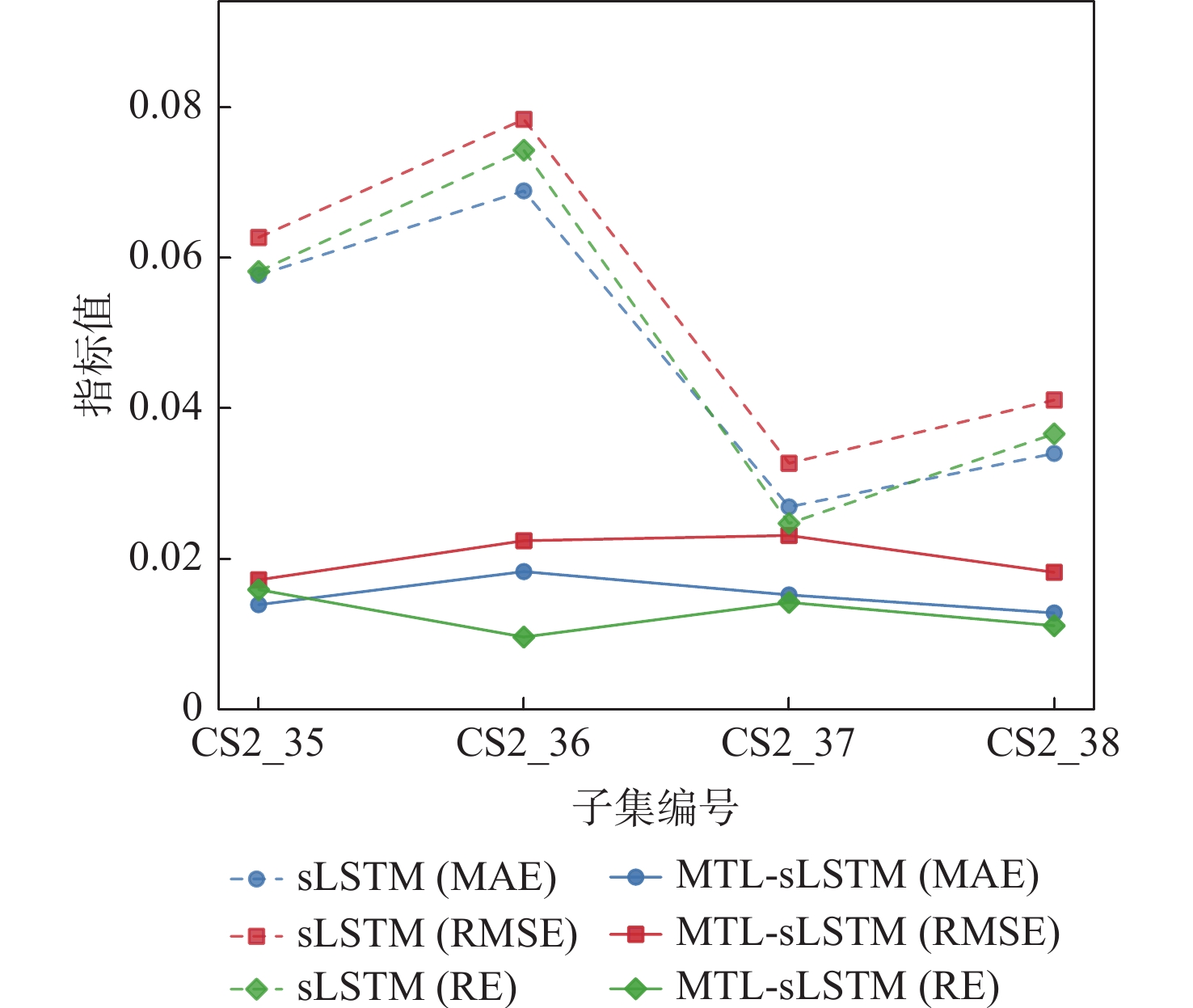
表 4 CALCE数据集子集在基础模型上启用MTL与未启用MTL时的评估指标对比
Table 4. Comparison of evaluation metrics for CALCE dataset subsets between enabling MTL and not enabling MTL on base model
模型 RE MAE RMSE CS2_35 CS2_36 CS2_37 CS2_38 CS2_35 CS2_36 CS2_37 CS2_38 CS2_35 CS2_36 CS2_37 CS2_38 GRU 0.0742 0.1168 0.1030 0.0560 0.0635 0.1091 0.0777 0.0727 0.0834 0.1441 0.1051 0.0955 GRU +MTL 0.0268 0.0242 0.0201 0.0209 0.0258 0.0291 0.0260 0.0200 0.0346 0.0365 0.0319 0.0292 LSTM 0.1090 0.1164 0.0984 0.0913 0.0806 0.1085 0.0785 0.0869 0.1033 0.1436 0.1045 0.1130 LSTM +MTL 0.0322 0.0194 0.0137 0.0150 0.0248 0.0184 0.0158 0.0175 0.0315 0.0238 0.0192 0.0233 sLSTM 0.0582 0.0743 0.0247 0.0366 0.0577 0.0689 0.0269 0.0340 0.0627 0.0784 0.0327 0.0411 sLSTM +MTL 0.0097 0.0075 0.0076 0.0071 0.0146 0.0093 0.0121 0.0093 0.0177 0.0127 0.0101 0.0119
下载: 导出CSV
表 5 本文方法在NASA数据集上的超参数
Table 5. Hyperparameters of the proposed method on NASA dataset
参数 数值 滑动窗口大小 32 隐藏层维度 128 循环神经网络层数 2 学习率 0.001 最大训练轮数 1000 早停耐心参数 50 CNN通道数 16 MLP隐藏层单元数 256
下载: 导出CSV
表 6 NASA数据集子集在多任务模型中的评估指标对比
Table 6. Comparison of evaluation metrics of NASA dataset subsets in multi-task models
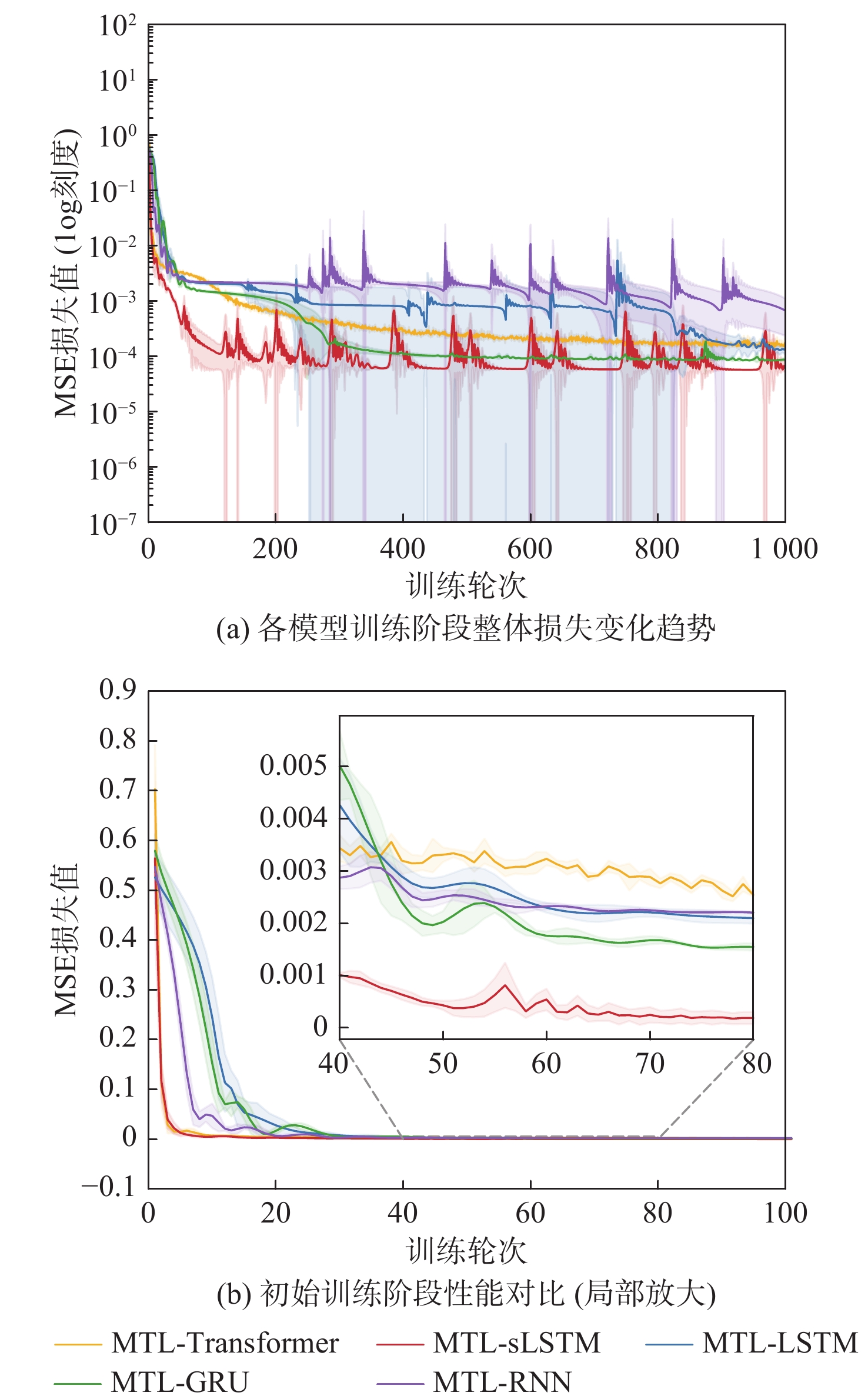
模型 MAE RMSE B0005 B0006 B0007 B0018 B0005 B0006 B0007 B0018 MTL-GRU 0.0836 0.0873 0.0642 0.0384 0.0949 0.1051 0.0746 0.0452 MTL-LSTM 0.0948 0.0963 0.0695 0.0413 0.1076 0.1158 0.0805 0.0502 MTL-CNN 0.0793 0.0841 0.0592 0.0381 0.0900 0.1005 0.0687 0.0447 MTL-MLP 0.0815 0.0786 0.0587 0.0408 0.0925 0.0961 0.0682 0.0480 MTL-Transformer 0.0826 0.0841 0.0611 0.0412 0.0939 0.1004 0.0709 0.0481 MTL-sLSTM 0.0094 0.0138 0.0074 0.0150 0.0143 0.0228 0.0129 0.0213
下载: 导出CSV
-
[1] Mohtat P, Lee S, Siegel J B, et al. Comparison of expansion and voltage differential indicators for battery capacity fade[J]. Journal of Power Sources, 2022, 518: 230714. [2] Yang J F, Cai Y F, Mi C. Lithium-ion battery capacity estimation based on battery surface temperature change under constant-current charge scenario[J]. Energy, 2022, 241: 122879. [3] Yang J F, Li X, Sun X D, et al. An efficient and robust method for lithium-ion battery capacity estimation using constant-voltage charging time[J]. Energy, 2023, 263: 125743. [4] Mitici M, Hennink B, Pavel M, et al. Prognostics for lithium-ion batteries for electric vertical take-off and landing aircraft using data-driven machine learning[J]. Energy and AI, 2023, 12: 100233. [5] Chang V W, Gallman J W, Richardson M E, et al. Development and test of safe, high power lithium ion main batteries for general aviation aircraft[J]. SAE International Journal of Aerospace, 2008, 1(1): 982-999. [6] 韩露, 史贤俊, 林云. 航空锂电池寿命预测方法研究[J]. 电子测量技术, 2021, 44(1): 20-25.Han L, Shi X J, Lin Y. Research on life prediction method of aviation lithium battery[J]. Electronic Measurement Technology, 2021, 44(1): 20-25(in Chinese). [7] Zraibi B, Okar C, Chaoui H, et al. Remaining useful life assessment for lithium-ion batteries using CNN-LSTM-DNN hybrid method[J]. IEEE Transactions on Vehicular Technology, 2021, 70(5): 4252-4261. [8] 贺宁, 张思媛, 李若夏, 等. 粒子滤波和GRU神经网络融合的锂电池RUL预测[J]. 哈尔滨工业大学学报, 2024, 56(5): 142-151.He N, Zhang S Y, Li R X, et al. RUL prediction of lithium battery based on particle filter and GRU neural network fusion[J]. Journal of Harbin Institute of Technology, 2024, 56(5): 142-151(in Chinese). [9] 董渊昌, 庞晓琼, 贾建芳, 等. 基于SVD-SAE-GPR的锂离子电池RUL预测[J]. 储能科学与技术, 2023, 12(4): 1257-1267.Dong Y C, Pang X Q, Jia J F, et al. Remaining useful life prediction of lithium-ion batteries based on SVD-SAE-GPR[J]. Energy Storage Science and Technology, 2023, 12(4): 1257-1267(in Chinese). [10] 陈欣, 李云伍, 梁新成, 等. 基于模态分解的Transformer-GRU联合电池健康状态估计[J]. 储能科学与技术, 2023, 12(9): 2927-2936.Chen X, Li Y W, Liang X C, et al. Battery health state estimation of combined Transformer-GRU based on modal decomposition[J]. Energy Storage Science and Technology, 2023, 12(9): 2927-2936(in Chinese). [11] Chen D Q, Zhou X Z. AttMoE: attention with mixture of experts for remaining useful life prediction of lithium-ion batteries[J]. Journal of Energy Storage, 2024, 84: 110780. [12] Alharthi M, Mahmood A. xLSTMTime: long-term time series forecasting with xLSTM[J]. AI, 2024, 5(3): 1482-1495. [13] Ragab M, Chen Z H, Wu M, et al. Contrastive adversarial domain adaptation for machine remaining useful life prediction[J]. IEEE Transactions on Industrial Informatics, 2021, 17(8): 5239-5249. [14] Zhang Z, Wang Y Y, Ruan X X, et al. Lithium-ion batteries lifetime early prediction using domain adversarial learning[J]. Renewable and Sustainable Energy Reviews, 2025, 208: 115062. [15] Chen J X, Li D P, Huang R Y, et al. Aero-engine remaining useful life prediction method with self-adaptive multimodal data fusion and cluster-ensemble transfer regression[J]. Reliability Engineering & System Safety, 2023, 234: 109151. [16] Wang H Q, Lin T J, Cui L L, et al. Multitask learning-based self-attention encoding atrous convolutional neural network for remaining useful life prediction[J]. IEEE Transactions on Instrumentation and Measurement, 2022, 71: 3516108. [17] Kim T S, Sohn S Y. Multitask learning for health condition identification and remaining useful life prediction: deep convolutional neural network approach[J]. Journal of Intelligent Manufacturing, 2021, 32(8): 2169-2179. [18] Zhang Y, Xin Y Q, Liu Z W, et al. Health status assessment and remaining useful life prediction of aero-engine based on BiGRU and MMoE[J]. Reliability Engineering and System Safety, 2022, 220: 108263. [19] Park K, Choi Y, Choi W J, et al. LSTM-based battery remaining useful life prediction with multi-channel charging profiles[J]. IEEE Access, 2020, 8: 20786-20798. [20] Semeraro C, Caggiano M, Olabi A G, et al. Battery monitoring and prognostics optimization techniques: challenges and opportunities[J]. Energy, 2022, 255: 124538. [21] Pecht M. CALCE battery group [EB/OL]. (2025-06-28)[2026-07-16]. https://doi.org/10.21227/w9rg-7173. [22] Saha B, Goebel K. Battery data set[EB/OL]. (2025-07-18)[2026-07-16]. http://data.nasa.gov/dataset/li-ion-battery-aging-datasets. [23] Bills A, Sripad S, Fredericks L, et al. A battery dataset for electric vertical takeoff and landing aircraft[J]. Scientific Data, 2023, 10: 344. -

 下载:
下载:

 点击查看大图
计量
- 文章访问数: 252
- HTML全文浏览量: 99
- PDF下载量: 12
- 被引次数: 0
