





A bi-level programming method for urban low-altitude travel public air route network driven by multi-source data
-
摘要:
城市低空出行是低空经济高质量发展的核心,也是形成低空赋能和经济辐射的重要纽带。因此,提出多源数据驱动的城市低空出行公共航路网络双层规划方法,构建航路网络规划与低空需求分配的互馈优化机制,提出面向低空出行的航段路阻函数标定方法,设计多目标模拟退火-遗传算法(MOSA-GA)混合进化搜索求解算法;以典型大都市为例,提取空域、建筑物、用地、人流及噪声分布等多源城市数据,对比验证所提双层规划方法。实验结果表明:所提MOSA-GA算法有效平衡了解集的分布广度和目标函数优度,显著提升了低空出行公共航路网络运行效率;求解结果可以在帕累托前沿得到多个相互非支配的最优解,多目标之间存在显著的制约关系,并对交通流量分配产生影响;通过敏感性实验发现,安全间隔和最短航段长度显著影响网络优化结果。研究成果有助于指导城市低空出行公共航路网络的部署,提升低空出行服务水平。
Abstract:Urban low-altitude travel is the core of high-quality development in the low-altitude economy and an important link for enabling low-altitude empowerment and economic radiation. For urban low-altitude public flight routes, this study suggests a multi-source data-driven dual-layer planning approach that creates a feedback optimization mechanism between low-altitude demand allocation and flight route network planning. A road impedance function calibration method tailored for low-altitude travel is presented, and the multi-objective simulated annealing-genetic algorithm (MOSA-GA) hybrid evolutionary algorithm is designed for solution search. Finally, taking a typical metropolitan area as a case study, multi-source urban data such as airspace, buildings, land use, pedestrian flow, and noise distribution are extracted, and the proposed dual-layer planning method is validated through comparison. The experimental findings demonstrate that the MOSA-GA algorithm successfully strikes a compromise between the optimality of the goal functions and the diversity of the solution set, greatly enhancing the low-altitude route network’s operational efficiency. The solution results yield multiple Pareto-optimal solutions that are mutually non-dominated, with significant trade-offs between multiple objectives, which impact traffic flow allocation. Additionally, sensitivity analysis reveals that safety intervals and minimum segment lengths significantly affect the network optimization outcomes. The research findings are expected to guide the deployment of urban low-altitude public flight route networks and improve the level of low-altitude travel services.
-
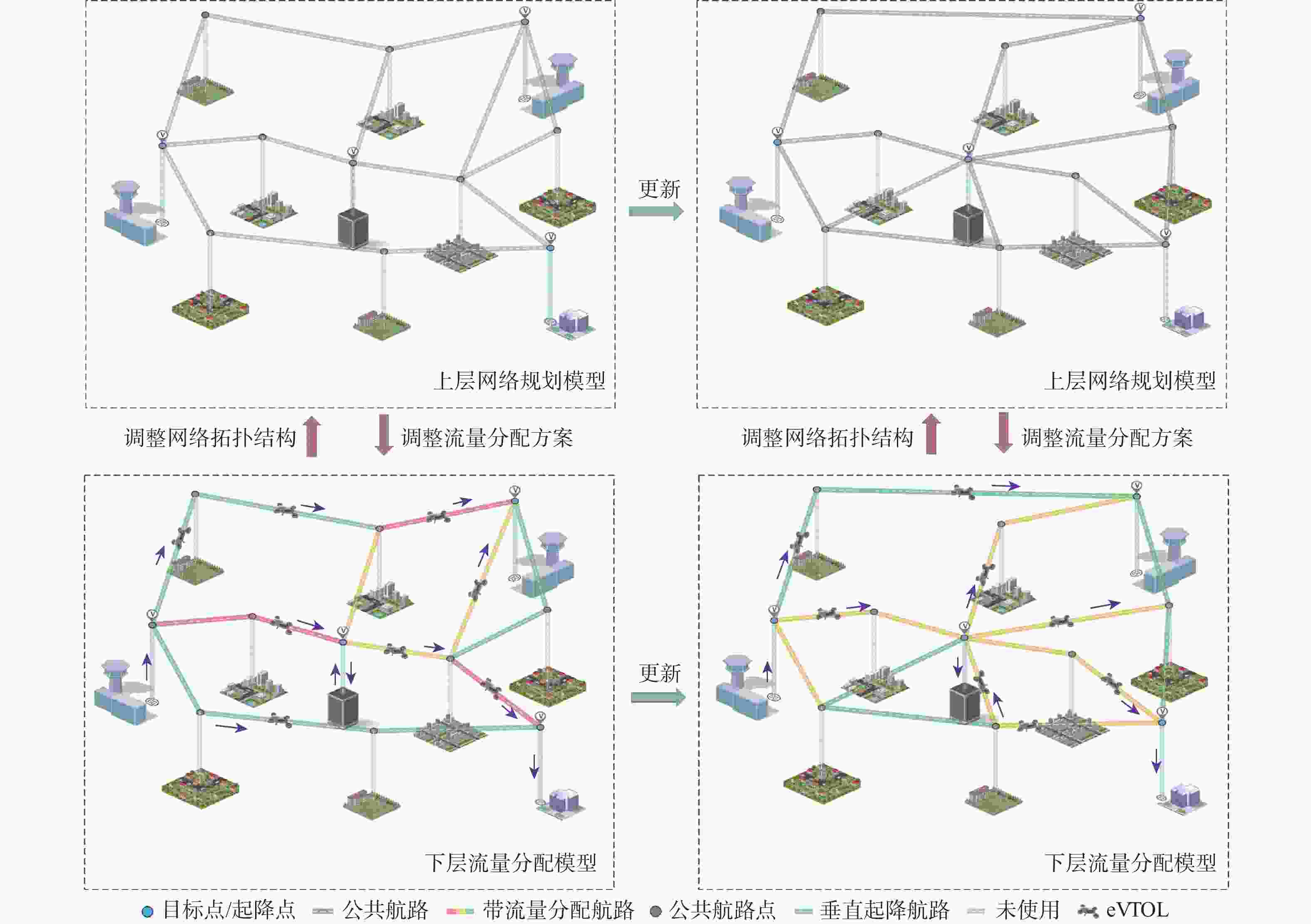
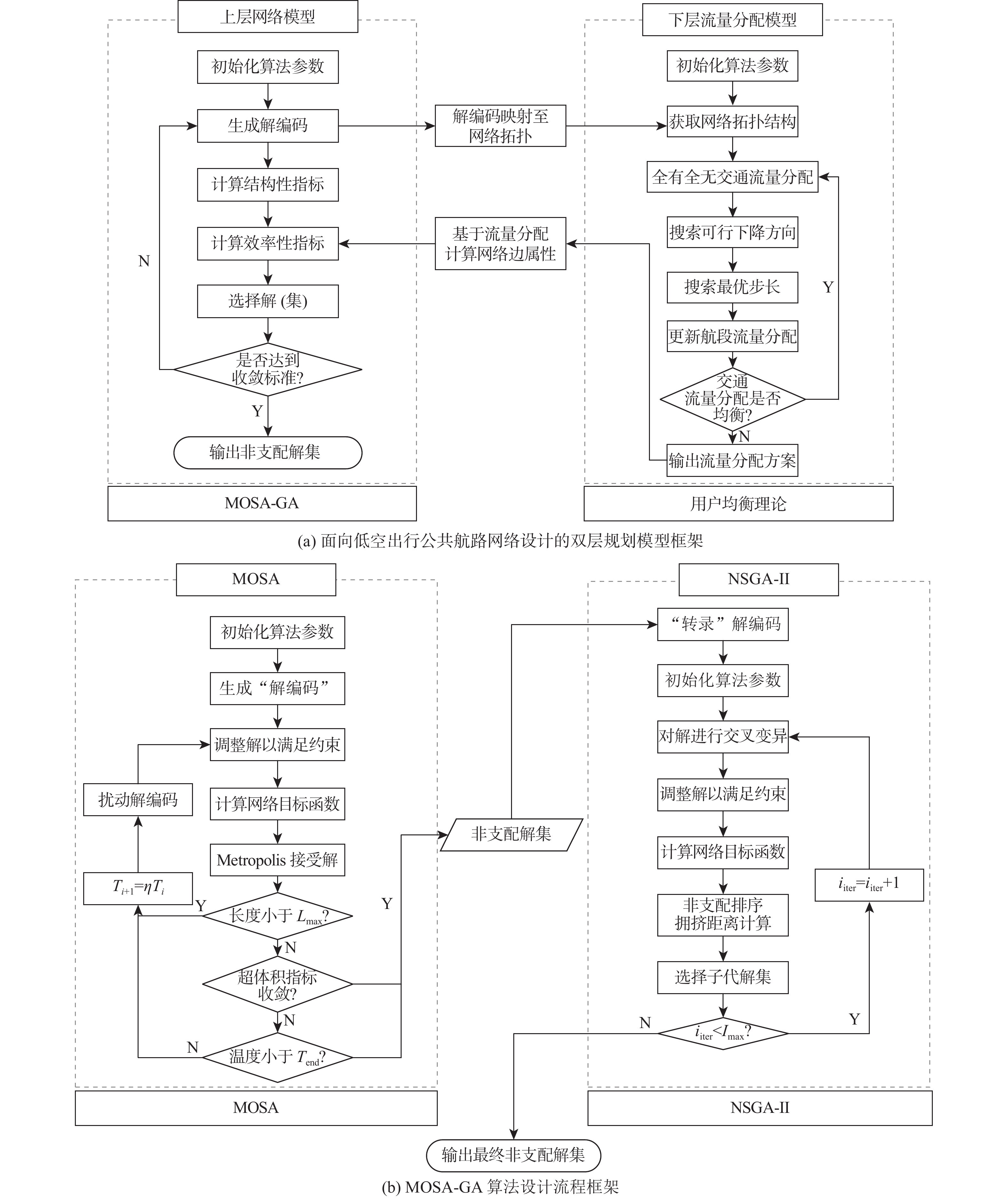
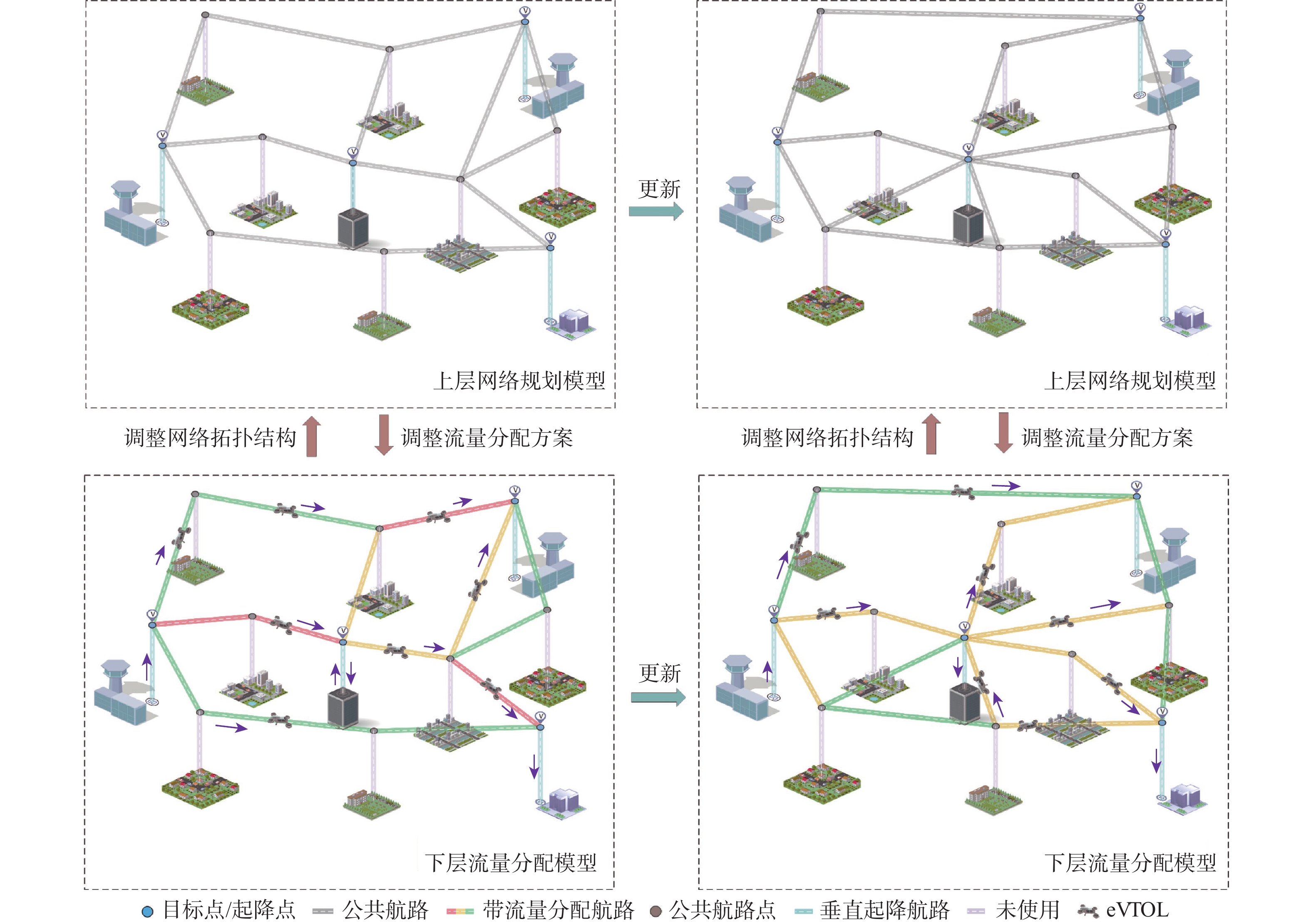
图 1 基于双层规划的低空出行公共航路网络规划示意图
Figure 1. Schematic diagram of low-altitude travel public air route network planning based on bi-level programming
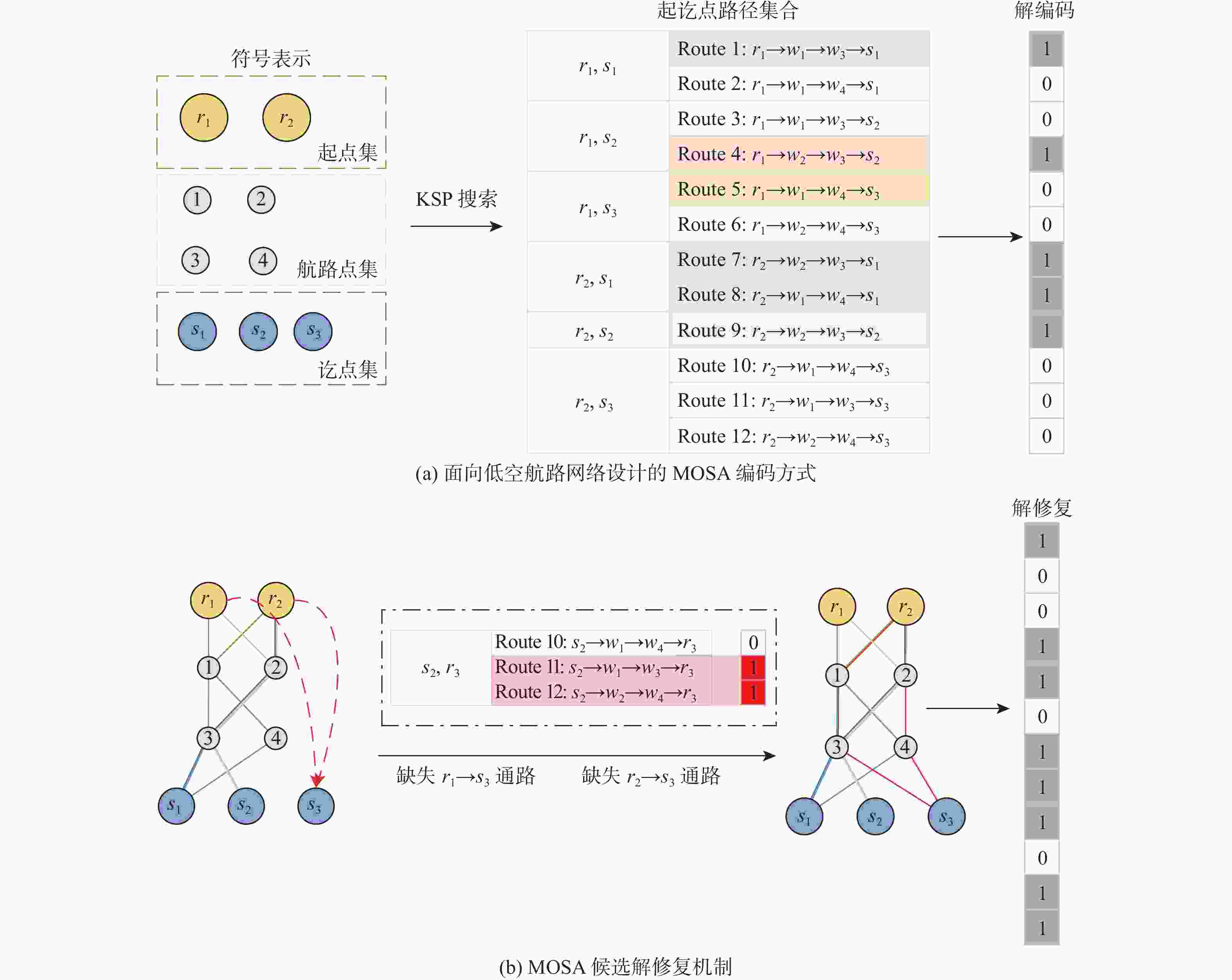
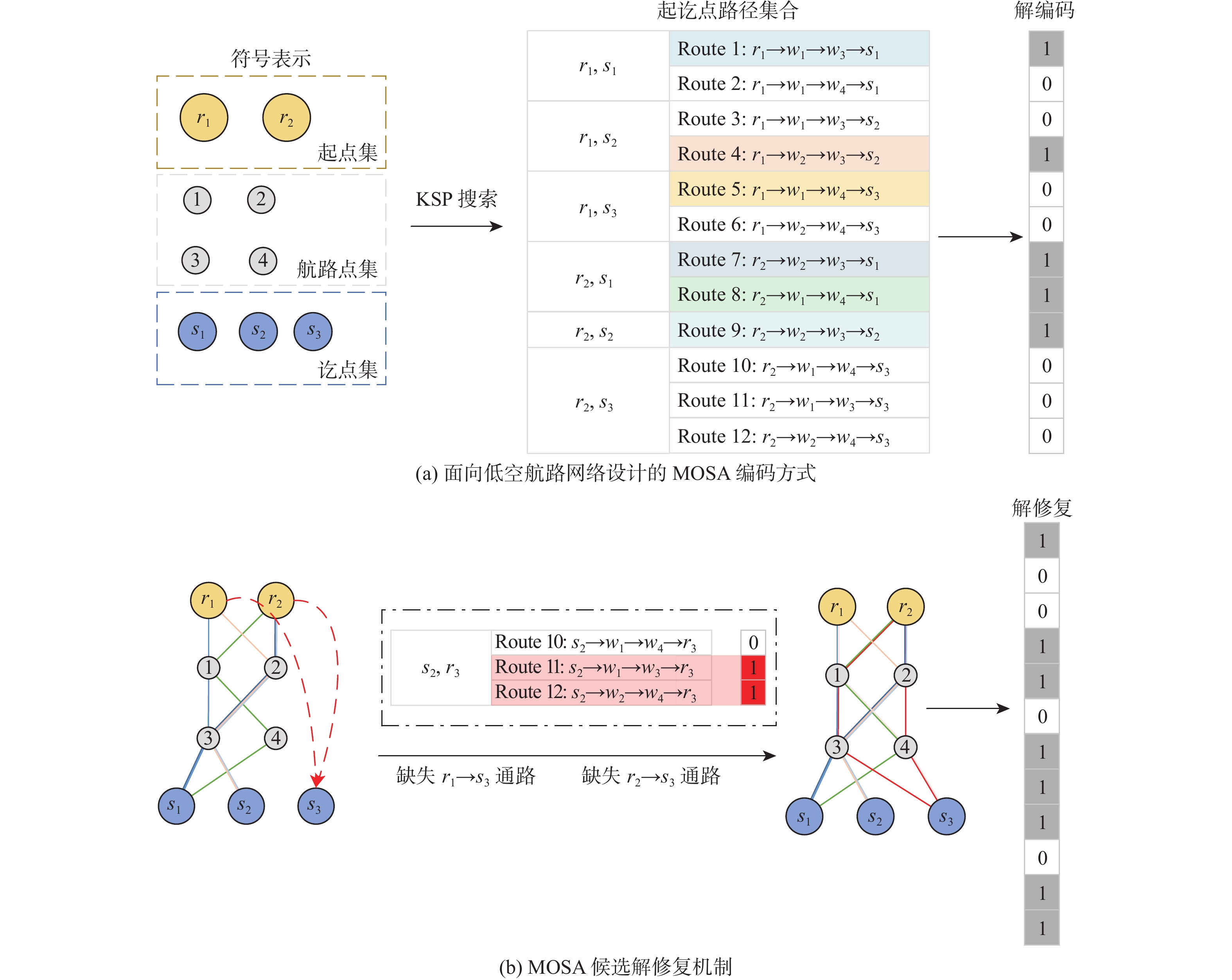
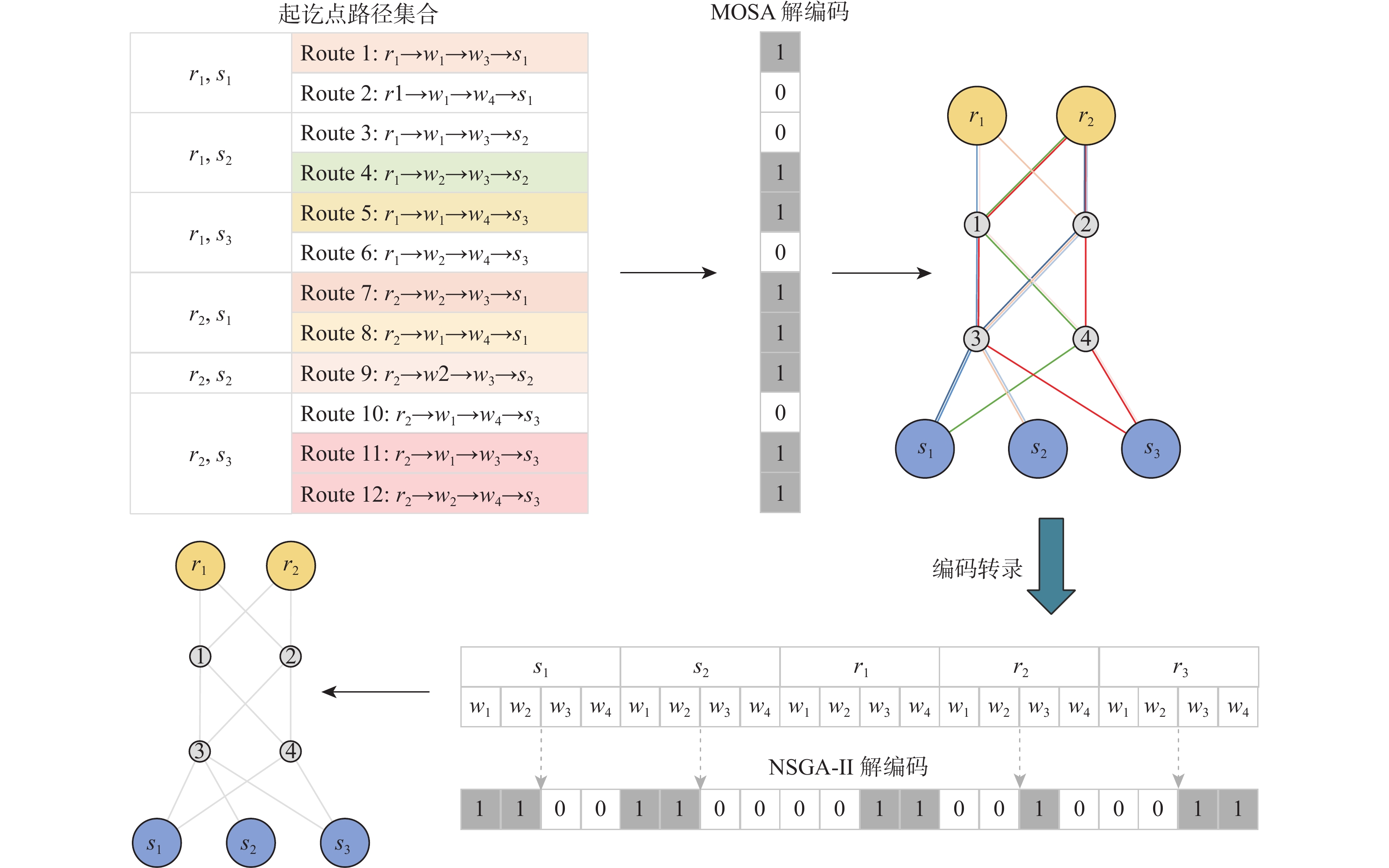
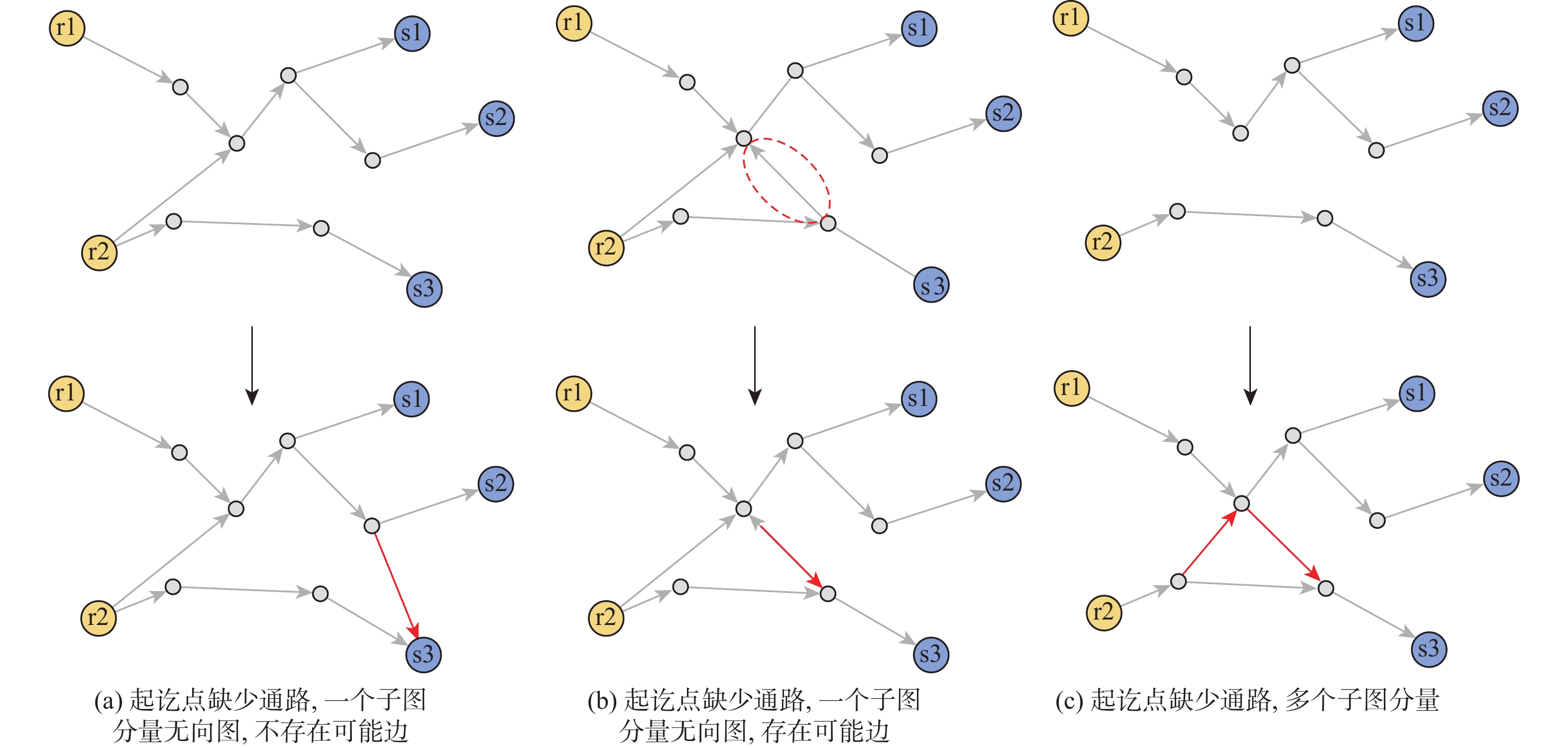
图 3 MOSA编码与候选解修复示意图
Figure 3. Schematic diagram of MOSA coding and candidate solution repair
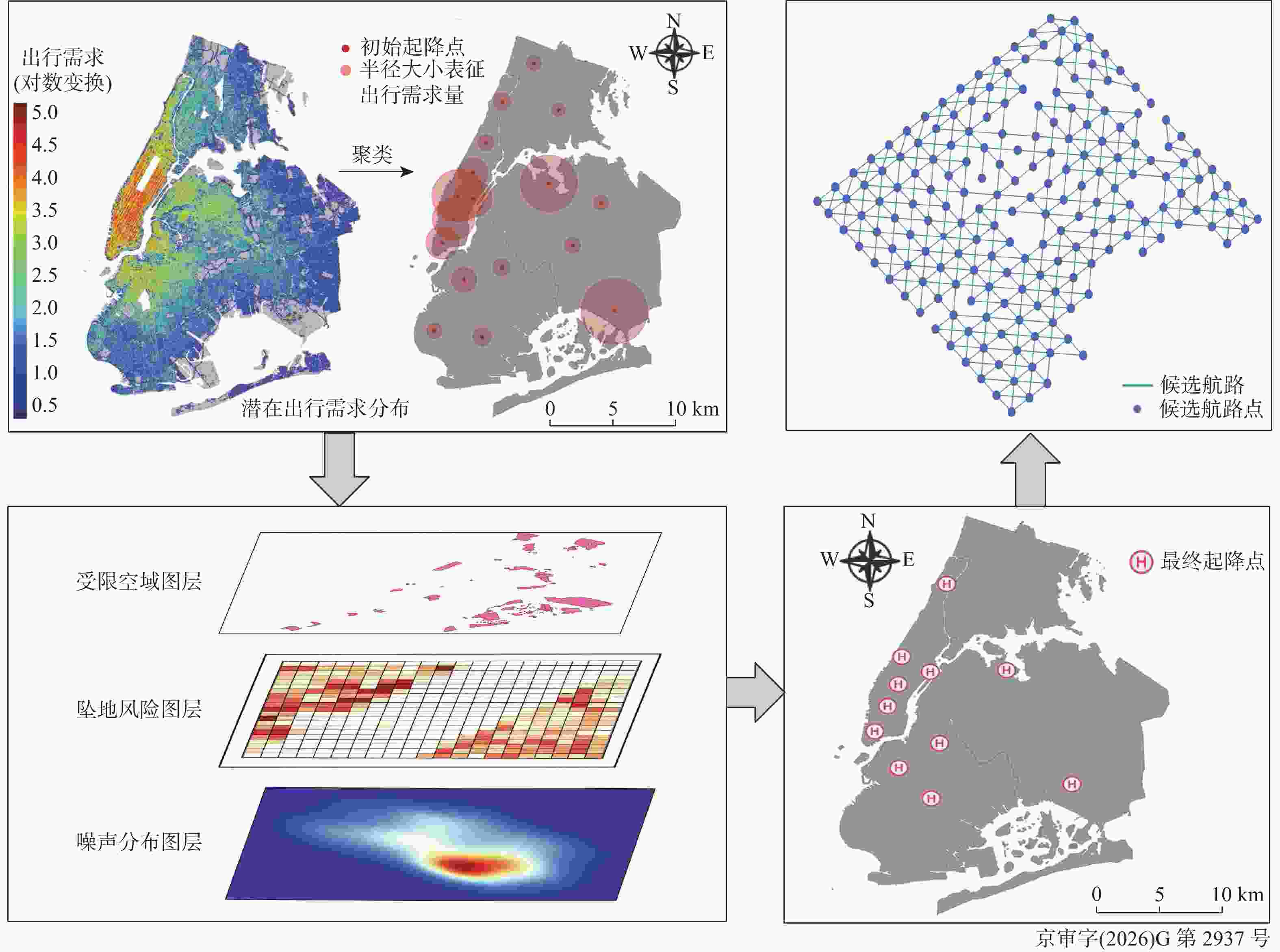
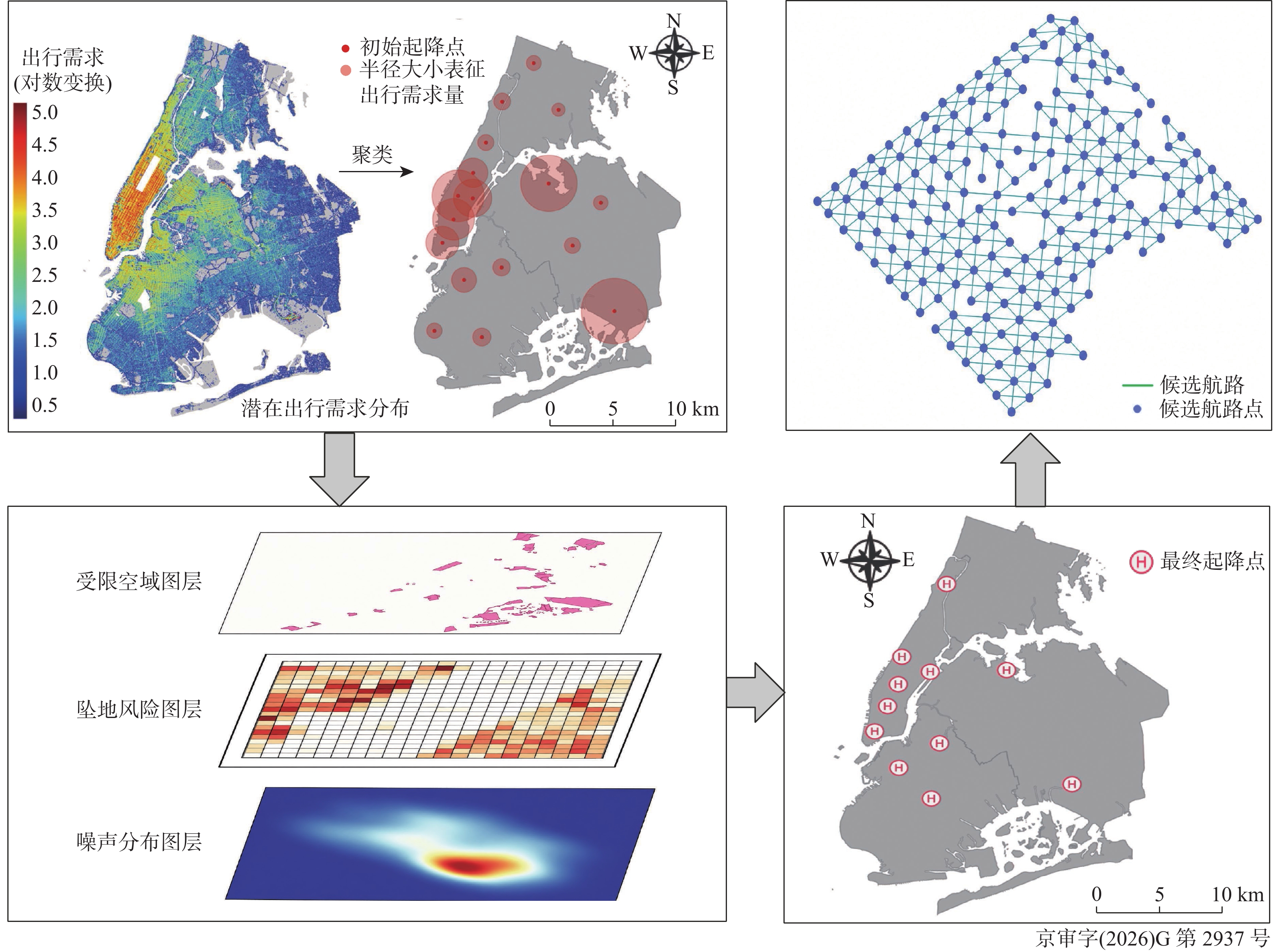
图 6 多源数据驱动的垂直起降点选址和空域栅格化处理
Figure 6. Multi-source data-driven vertiports location and airspace rasterization processing
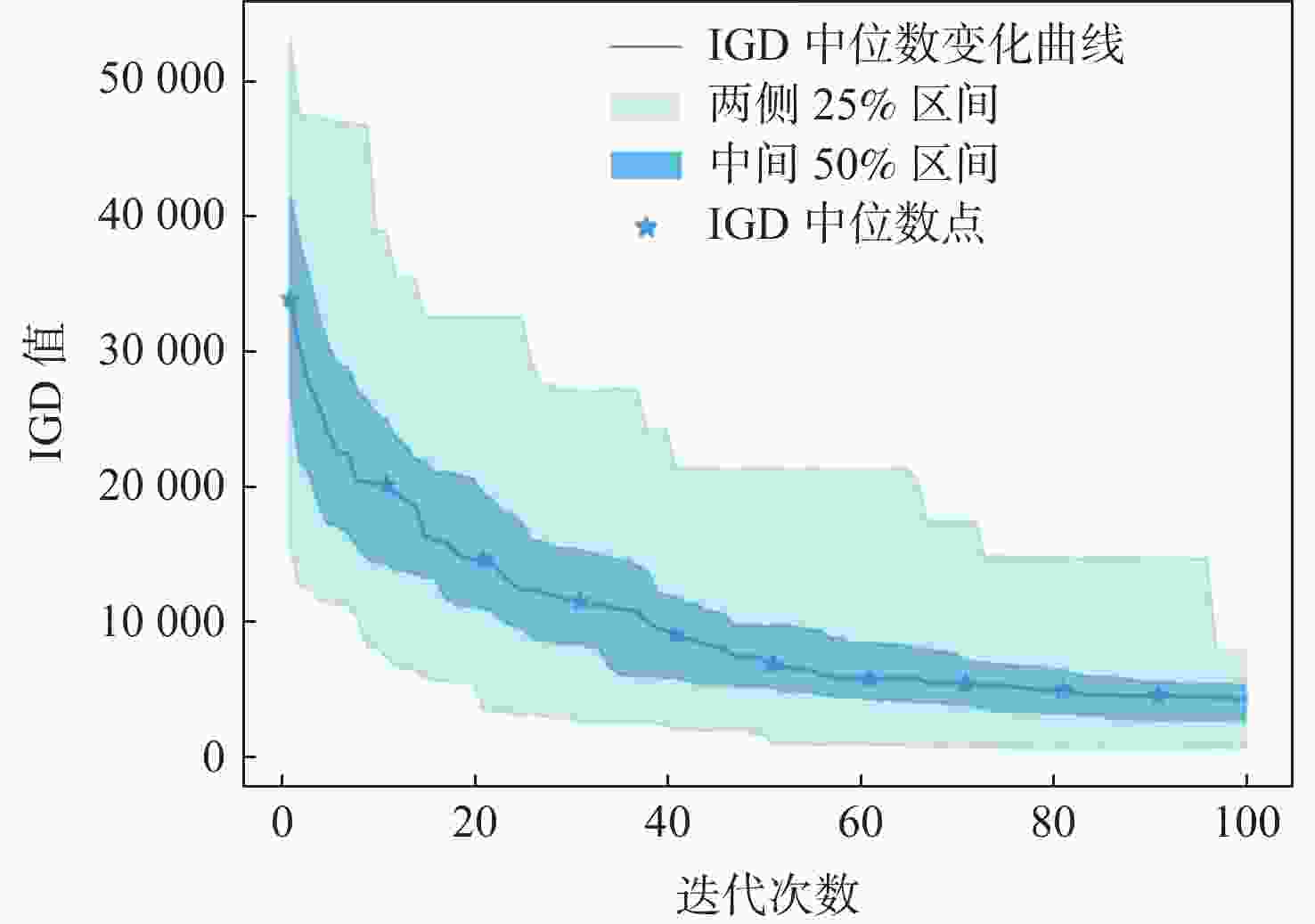
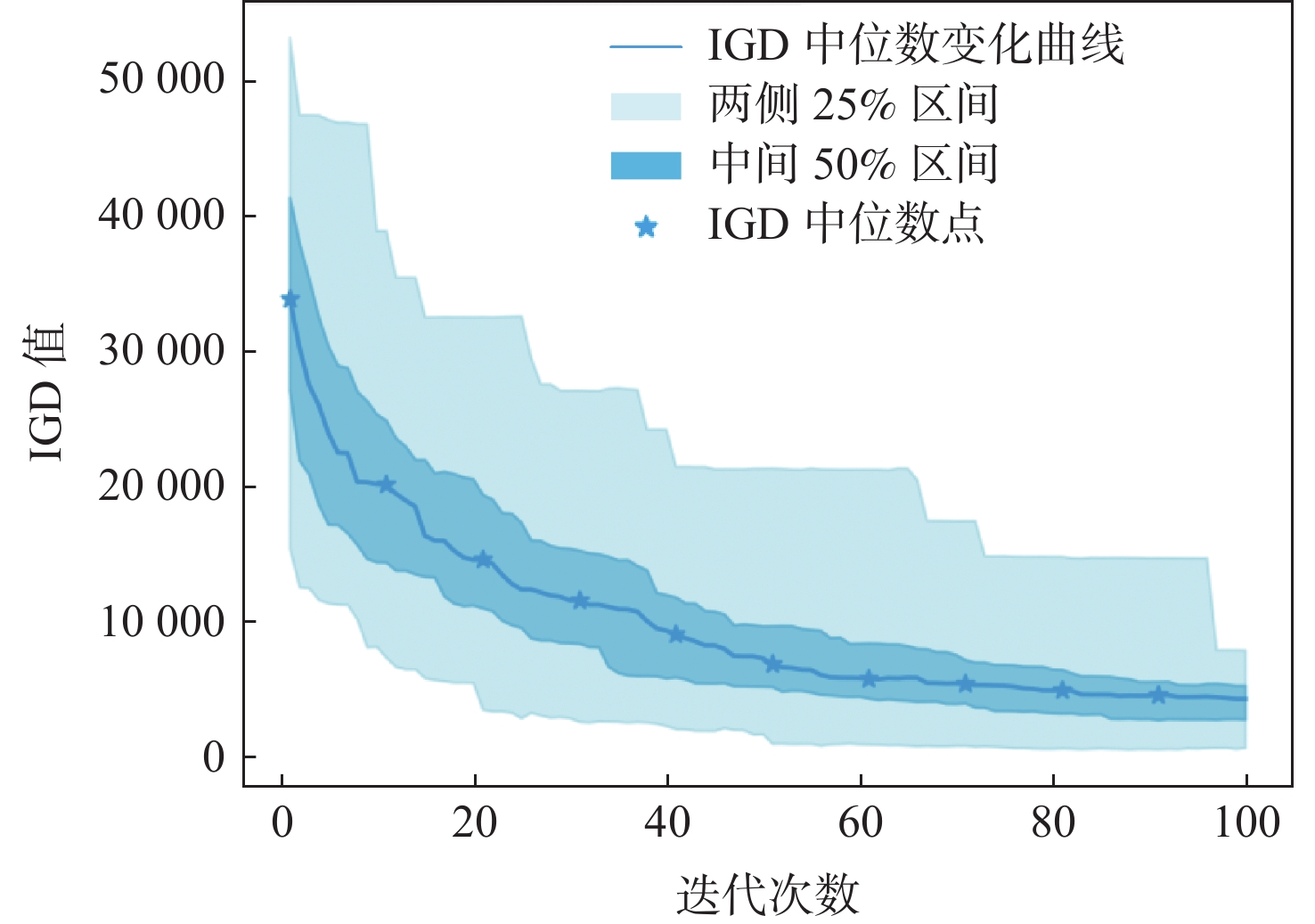
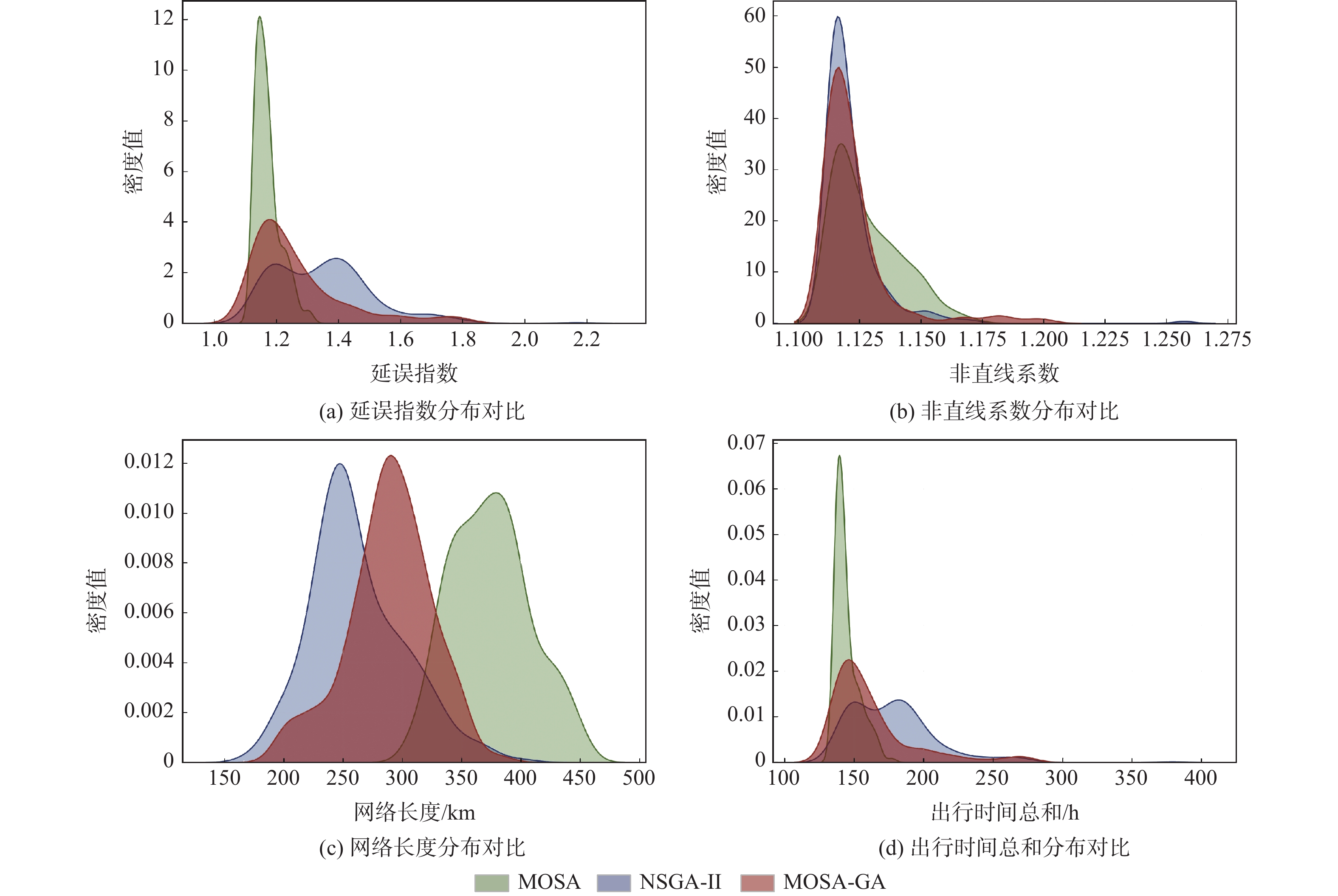
图 7 IGD随迭代次数变化趋势及分布
Figure 7. The variation trend and distribution of IGD with the number of iterations
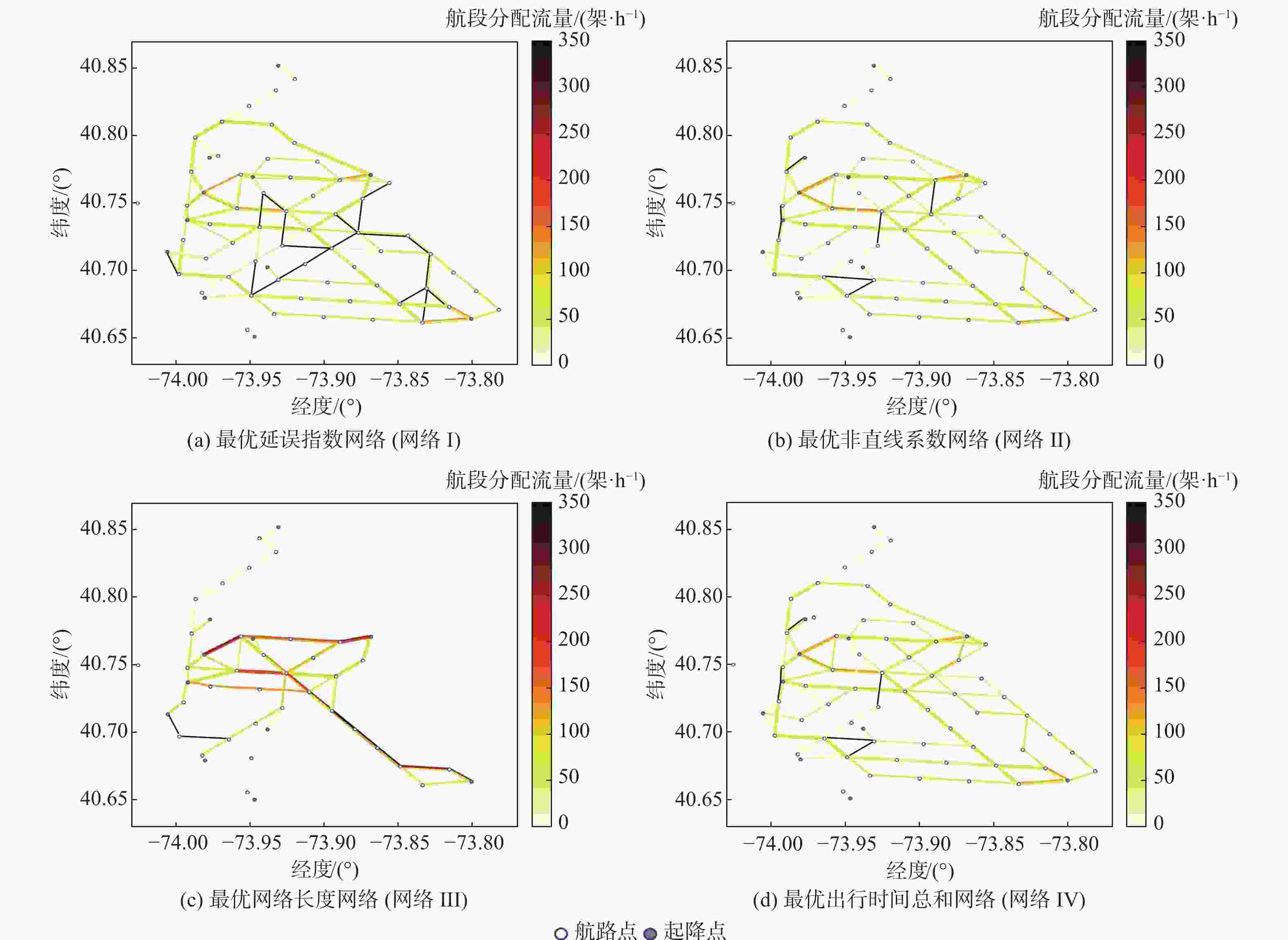
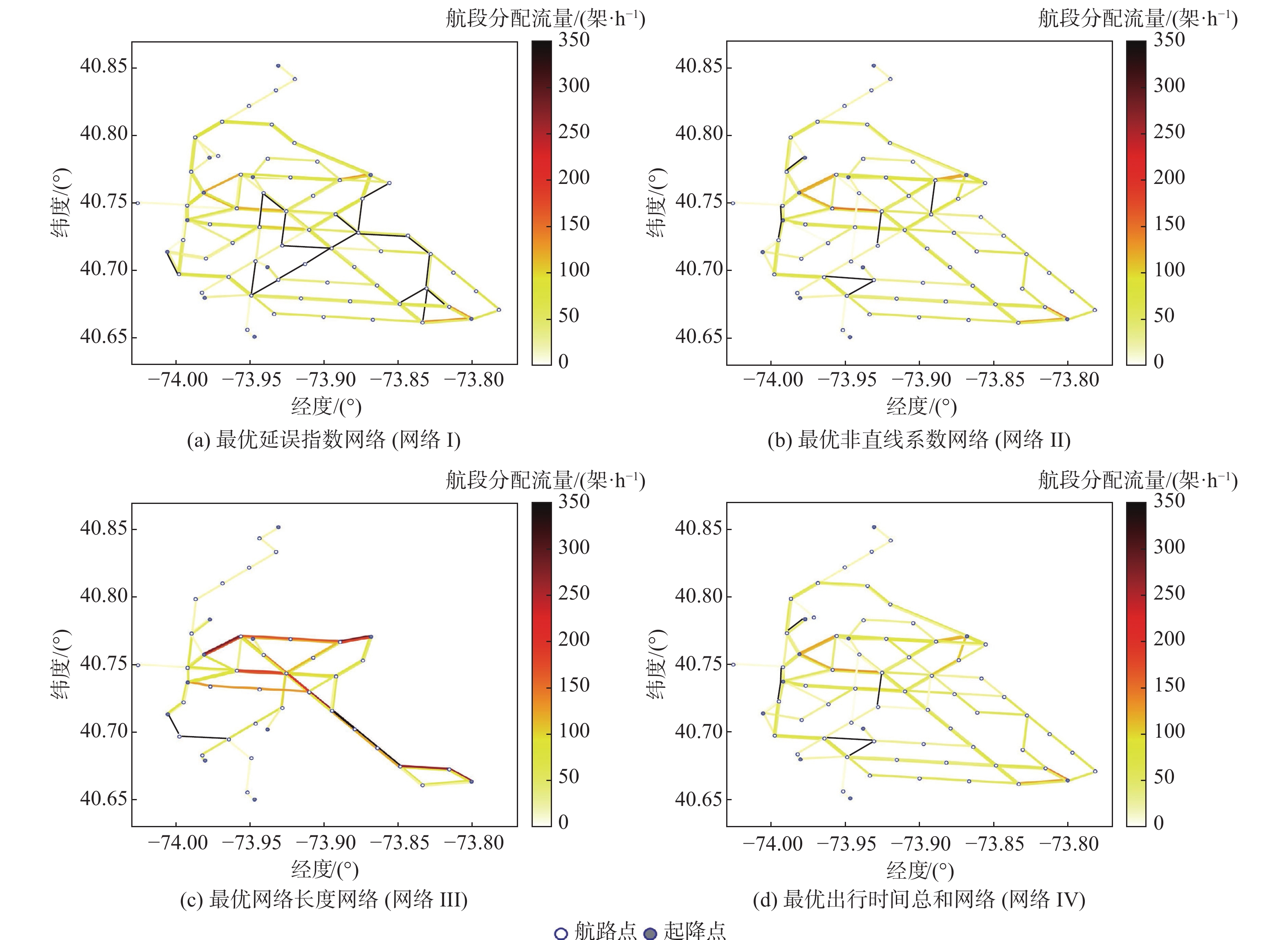
图 10 低空出行公共航路网络优化结果示意图
Figure 10. Schematic diagram of low-altitude travel public air route network optimization results
表 1 参数标定结果
Table 1. Parameter calibration results
航段
长度/m时间窗内航段
饱和容量/(架·h−1)自由流状态航段
行程时间/s阻滞
系数α阻滞
系数β决定
系数R22000 84.652 44.003 0.246 5.130 0.976 2150 85.654 47.303 0.261 5.130 0.976 2300 84.872 50.604 0.249 5.130 0.976 2450 86.724 54.013 0.278 5.130 0.976 2600 88.019 57.314 0.300 5.130 0.976 2750 85.755 60.724 0.262 5.130 0.976 2900 86.373 63.804 0.272 5.130 0.976  下载: 导出CSV
表 2 数据来源及用途
Table 2. Data sources and uses
数据类型 来源 用途 出租车出行记录 https://data.cityofnewyork.us/Transportation/2015-Yellow-Taxi-Trip-Data/2yzn-sicd/about_data 挖掘并刻画潜在低空出行需求分布 城市用地属性 https://data.cityofnewyork.us/City-Government/Primary-Land-Use-Tax-Lot-Output-PLUTO-/64uk-42ks/about_data 获取敏感空域分布及用地特征信息 建筑物高程分布 https://data.cityofnewyork.us/City-Government/3-D-Building-Model/tnru-abg2/about_data 获取建筑物高程分布及机场等重要设施位置 噪声投诉数据 https://data.cityofnewyork.us/Social-Services/Noise-Complaints-in-2017-/be8n-q3nj 刻画噪声敏感区域分布
下载: 导出CSV
表 3 算法参数设置
Table 3. Algorithm parameter settings
自由
流速度/
(m·s−1)飞行器最大
制动加速
度/(m·s−2)时间
窗/sMOSA初始
温度/℃MOSA结束
温度/℃马尔可夫
链长度MOSA超体积
收敛阈值Frank-Wolfe
收敛阈值NSGA-II最大
进化次数NSGA-II
种群大小NSGA-II
变异概率NSGA-II
交叉概率45 10 3600 10 0.1 50 10−6 10−4 100 100 10−4 1
下载: 导出CSV
表 4 最优网络目标函数值
Table 4. Optimal network objective function value
网络/目标函数 延误
指数网络
长度/km非直线
系数出行时间
总和/h网络Ⅰ 1.11177 384.8 1.12126 136.49 网络Ⅱ 1.11824 352.7 1.11331 135.75 网络Ⅲ 1.80809 195.4 1.20054 264.32 网络Ⅳ 1.11551 354.2 1.11544 135.69
下载: 导出CSV
-
[1] 廖小罕, 屈文秋, 徐晨晨, 等. 城市空中交通及其新型基础设施低空公共航路研究综述[J]. 航空学报, 2023, 44(24): 1-29.Liao X H, Qu W Q, Xu C C, et al. A review of urban air mobility and its new infrastructure low-altitude public routes[J]. Acta Aeronautica et Astronautica Sinica, 2023, 44(24): 1-29(in Chinese). [2] 中国人民大学课题组. 中国低空经济城市发展指数(LCDI)2025(发布版)[EB/OL]. [2025-04-30]. http://keyan.ruc.edu.cn/docs/2025-03/ae9eb3d4bb36483fbf7489577e5ba097.blk.pdf.Research Group of Renmin University of China. China low-altitude economy urban development index 2025 (release)[EB/OL]. [2025-04-30]. http://keyan.ruc.edu.cn/docs/2025-03/ae9eb3d4bb36483fbf7489577e5ba097.blk.pdf(in Chinese). [3] 钱欣悦, 张洪海, 张芳, 等. 末端配送物流无人机起降点选址分配问题研究[J]. 武汉理工大学学报(交通科学与工程版), 2021, 45(4): 682-687.Qian X Y, Zhang H H, Zhang F, et al. Research on location allocation of UAV landing points for terminal distribution logistics[J]. Journal of Wuhan University of Technology (Transportation Science & Engineering), 2021, 45(4): 682-687(in Chinese). [4] Rajendran S, Zack J. Insights on strategic air taxi network infrastructure locations using an iterative constrained clustering approach[J]. Transportation Research Part E: Logistics and Transportation Review, 2019, 128: 470-505. [5] Rath S, Chow J Y J. Air taxi skyport location problem with single-allocation choice-constrained elastic demand for airport access[J]. Journal of Air Transport Management, 2022, 105: 102294. [6] Wu Z Q, Zhang Y. Integrated network design and demand forecast for on-demand urban air mobility[J]. Engineering, 2021, 7(4): 473-487. [7] Wang K, Li A Y, Qu X B. Urban aerial mobility: network structure, transportation benefits, and Sino-US comparison[J]. The Innovation, 2023, 4(2): 100393. [8] Li S, Zhang H H, Yi J, et al. A bi-level planning approach of logistics unmanned aerial vehicle route network[J]. Aerospace Science and Technology, 2023, 141: 108572. [9] Willey L C, Salmon J L. A method for urban air mobility network design using hub location and subgraph isomorphism[J]. Transportation Research Part C: Emerging Technologies, 2021, 125: 102997. [10] 唐志星, 黄山, 潘卫军. 灵活使用空域中的空中交通流量分配方法研究[J]. 兵器装备工程学报, 2019, 40(12): 90-94.Tang Z X, Huang S, Pan W J. Research on scheduling method for air traffic flow allocation in FUA[J]. Journal of Ordnance Equipment Engineering, 2019, 40(12): 90-94(in Chinese). [11] 王兴隆, 齐雁楠, 潘维煌. 基于功能脆弱性的空中交通相依网络流量分配[J]. 航空学报, 2020, 41(4): 179-187.Wang X L, Qi Y N, Pan W H. Flow allocation of air traffic interdependent network based on functional vulnerability[J]. Acta Aeronautica et Astronautica Sinica, 2020, 41(4): 179-187(in Chinese). [12] 张兆宁, 王帝. 基于容流匹配的机场群流量分配策略研究[J]. 现代电子技术, 2019, 42(22): 113-116.Zhang Z N, Wang D. Research on flow allocation strategy based on capacity matching for airport group[J]. Modern Electronics Technique, 2019, 42(22): 113-116(in Chinese). [13] 陈艺君, 余莎莎, 张学军. 城市低空场景下无人机运行对地风险量化评估[J]. 北京航空航天大学学报, 2025, 51(3): 806-815.Chen Y J, Yu S S, Zhang X J. Ground risk quantitative assessment for UAV operations in urban low-altitude scenarios[J]. Journal of Beijing University of Aeronautics and Astronautics, 2025, 51(3): 806-815(in Chinese). [14] Wardrop J G, Whitehead J I. Correspondence. some theoretical aspects of road traffic research[J]. Proceedings of the Institution of Civil Engineers, 1952, 1(5): 767-768. [15] Frank M, Wolfe P. An algorithm for quadratic programming[J]. Naval Research Logistics Quarterly, 1956, 3(1-2): 95-110. [16] Liu H P, Jin C Q, Yang B, et al. Finding top-k shortest paths with diversity[J]. IEEE Transactions on Knowledge and Data Engineering, 2018, 30(3): 488-502. [17] Lim E, Hwang H. The selection of vertiport location for on-demand mobility and its application to Seoul metro area[J]. International Journal of Aeronautical and Space Sciences, 2019, 20(1): 260-272. [18] Wang Z, Delahaye D, Farges J L, et al. Route network design in low-altitude airspace for future urban air mobility operations: a case study of urban airspace of Singapore[C]//Proceedings of the International Conference on Research in Air Transportation. Tampa: International Conference on Research in Air Transportation, 2022. -

 下载:

计量
- 文章访问数: 434
- HTML全文浏览量: 131
- PDF下载量: 158
- 被引次数: 0
