





Semantic segmentation algorithms of aerial images via context-aware attention guidance
-
摘要:
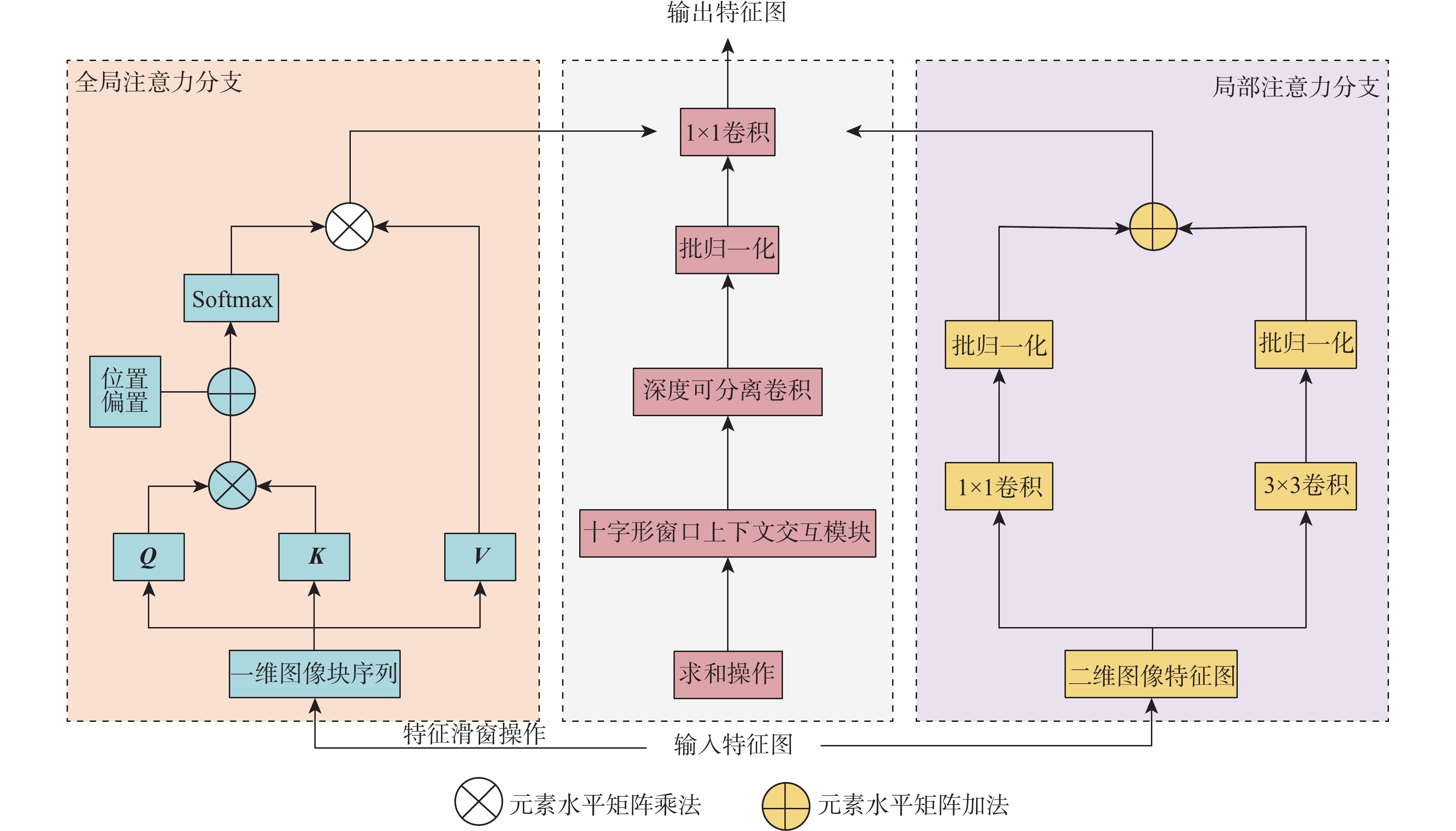
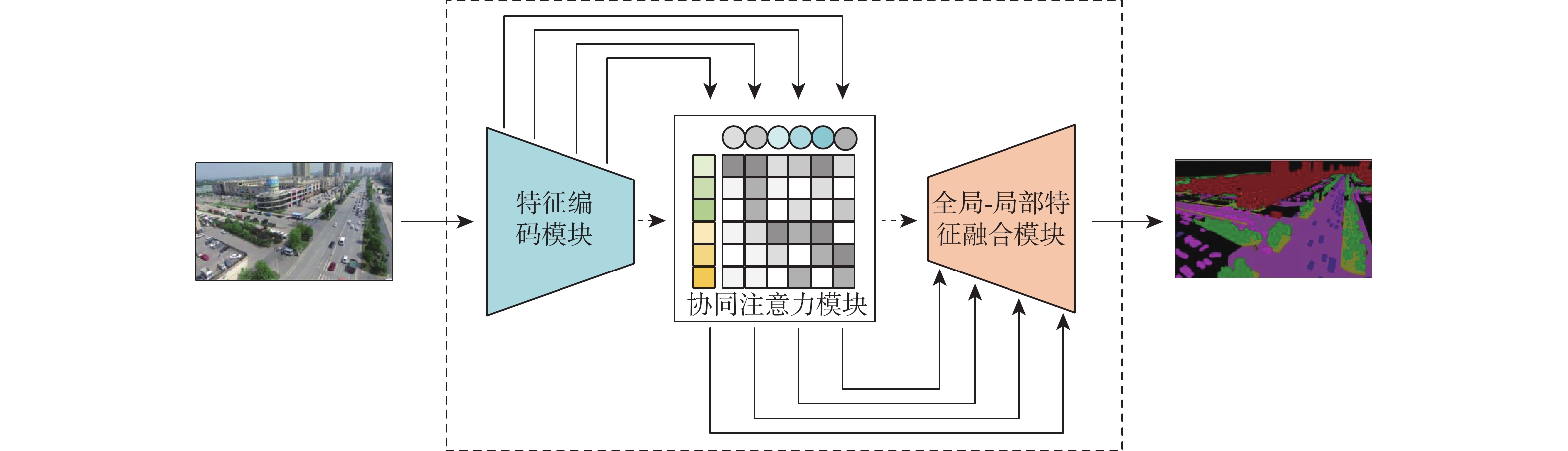
航拍图像语义分割算法在土地利用、环境监测、资源调查、城市规划等领域具有重要的研究和应用价值。针对高分辨率航拍图像中地物关系复杂、目标尺度多变、类内差异大、类间相似高的问题,提出上下文注意力引导的语义分割算法。在模型的编码阶段引入协同注意力模块,采用空间与通道多维度特征提取的方式,对全局的上下文特征信息进行挖掘,提升模型的特征表征能力。在模型的解码阶段构建全局-局部特征融合模块,利用全局与局部平行支路的方式,实现语义信息和细节特征的提取,并借助十字语义交互模块进行特征融合,提升模型对类别边缘的辨别能力。实验结果表明:所提算法在UAVID数据集上的平均交并比(MIoU)达到了71.0%,在速度与精度上显著优于对比算法。
Abstract:Semantic segmentation algorithms for aerial images have significant research and application value in fields such as land use classification, environmental monitoring, resource surveying, and urban planning. To address the challenges posed by high-resolution aerial images—such as complex spatial relationships among objects, varying target scales, large intra-class variations, and high inter-class similarities—this paper proposes a context attention-guided semantic segmentation algorithm. In order to improve the network's ability to represent features, a collaborative attention module is added to the encoder stage of the model. This module pulls features from both spatial and channel dimensions. To efficiently extract both semantic information and detailed features, a global-local feature fusion module is built in the decoder stage using concurrent global and local branches. Furthermore, a crisscross semantic interaction module is employed to fuse multi-level features, improving the model’s ability to distinguish object boundaries. Experimental results demonstrate that the proposed algorithm achieves a mean intersection-over-union(MIoU)of 71.0% on the UAVID dataset, significantly outperforming state-of-the-art algorithms in both accuracy and inference speed.
-
Key words:
- semantic segmentation /
- aerial images /
- attention mechanism /
- deep learning /
- feature fusion
-
表 1 不同算法的速度与精度对比
Table 1. Comparison of speed and accuracy for different algorithms
算法 内存量 参数量 复杂度 推理速度/(帧·s−1) MIoU/% Fast-SCNN[26] 619.4×10⁶ 1.1×10⁶ 3.4×10⁹ 222.7 45.9 Segmenter[25] 828.6×10⁶ 6.7×10⁶ 26.8×10⁹ 14.7 58.7 BiSeNet[18] 970.6×10⁶ 12.9×10⁶ 51.8×10⁹ 121.9 61.5 DANet[16] 611.1×10⁶ 12.6×10⁶ 39.6×10⁹ 189.4 60.6 FANet[27] 971.9×10⁶ 13.6×10⁶ 86.8×10⁹ 94.9 ShelfNet[28] 579.0×10⁶ 14.6×10⁶ 46.7×10⁹ 141.4 47.0 SwiftNet[17] 835.8×10⁶ 11.8×10⁶ 51.6×10⁹ 138.7 61.1 MANet[19] 1169.2 ×10612.0×106 51.7×10⁹ 75.6 62.6 ABCNet[20] 1105.1 ×10614.0×106 62.9×10⁹ 102.2 63.8 Segformer[21] 933.2×10⁶ 13.7×10⁶ 63.3×10⁹ 31.3 66.0 BoTNet[23] 710.5×10⁶ 17.6×10⁶ 49.9×10⁹ 135.0 63.2 CoaT[24] 3133.8 ×10611.1×106 104.8×10⁹ 10.6 65.8 CAGNet 1203.7 ×10612.4×106 49.3×10⁹ 110.3 71.0  下载: 导出CSV
表 2 不同算型的类别精度对比
Table 2. Comparison of class-wise accuracy for different algorithms
算法 IoU/% MIoU/% 杂波 建筑 道路 树木 植被 移动汽车 静止汽车 人类 MSD[14] 57.0 79.8 74.0 74.5 55.9 62.9 32.1 19.7 57.0 CANet[15] 66.0 86.6 62.1 79.3 78.1 47.8 68.3 19.9 63.5 DANet[16] 64.9 85.9 77.9 78.3 61.5 59.6 47.4 9.1 60.6 SwiftNet[17] 64.1 85.3 61.5 78.3 76.4 51.1 62.1 15.7 61.1 BiSeNet[18] 64.7 85.7 61.1 78.3 77.3 48.6 63.4 17.5 61.5 MANet[19] 64.5 85.4 77.8 77.0 60.3 67.2 53.6 14.9 62.6 ABCNet[20] 67.4 86.4 81.2 79.9 63.1 69.8 48.4 13.9 63.8 Segmenter[25] 64.2 84.4 79.8 76.1 57.6 59.2 34.5 14.2 58.7 SegFormer[21] 66.6 86.3 80.1 79.6 62.3 72.5 52.5 28.5 66.0 BANet[22] 66.7 85.4 80.7 78.9 62.1 69.3 52.8 21.0 64.6 BoTNet[23] 64.5 84.9 78.6 77.4 60.5 65.8 51.9 22.4 63.2 CoaT[24] 69.0 88.5 80.0 79.3 62.0 70.0 59.1 18.9 65.8 CAGNet 72.2 89.5 84.7 82.1 67.9 76.8 59.6 34.8 71.0
下载: 导出CSV
-
[1] Zhong H F, Sun H M, Han D N, et al. Lake water body extraction of optical remote sensing images based on semantic segmentation[J]. Applied Intelligence, 2022, 52(15): 17974-17989. [2] Yuan Q Q, Shen H F, Li T W, et al. Deep learning in environmental remote sensing: achievements and challenges[J]. Remote Sensing of Environment, 2020, 241: 111716. [3] Zhang Q L, Seto K C. Mapping urbanization dynamics at regional and global scales using multi-temporal DMSP/OLS nighttime light data[J]. Remote Sensing of Environment, 2011, 115(9): 2320-2329. [4] Long J, Shelhamer E, Darrell T. Fully convolutional networks for semantic segmentation[C]//Proceedings of the IEEE Conference on Computer Vision and Pattern Recognition. Piscataway: IEEE Press, 2015: 3431-3440. [5] Noh H, Hong S, Han B. Learning deconvolution network for semantic segmentation[C]//Proceedings of the IEEE International Conference on Computer Vision. Piscataway: IEEE Press, 2016: 1520-1528. [6] Badrinarayanan V, Kendall A, Cipolla R. SegNet: a deep convolutional encoder-decoder architecture for image segmentation[J]. IEEE Transactions on Pattern Analysis and Machine Intelligence, 2017, 39(12): 2481-2495. [7] Ronneberger O, Fischer P, Brox T. U-Net: convolutional networks for biomedical image segmentation[M]//Medical Image Computing and Computer-Assisted Intervention-MICCAI. Berlin: Springer, 2015: 234-241. [8] Liu W, Rabinovich A, Berg A C. ParseNet: looking wider to see better[EB/OL]. (2015-06-15)[2025-06-02]. https://arxiv.org/abs/1506.04579. [9] Zhao H S, Shi J P, Qi X J, et al. Pyramid scene parsing network[C]//Proceedings of the IEEE Conference on Computer Vision and Pattern Recognition. Piscataway: IEEE Press, 2017: 6230-6239. [10] Chen L C, Papandreou G, Kokkinos I, et al. Semantic image segmentation with deep convolutional nets and fully connected CRFs[EB/OL]. (2014-12-22)[2025-06-02]. https://arxiv.org/abs/1412.7062. [11] Schwing A G, Urtasun R. Fully connected deep structured networks[EB/OL]. (2015-03-09)[2025-06-02]. https://arxiv.org/abs/1503.02351. [12] Zheng S, Jayasumana S, Romera-paredes B, et al. Conditional random fields as recurrent neural networks[C]//Proceedings of the IEEE International Conference on Computer Vision. Piscataway: IEEE Press, 2016: 1529-1537. [13] Lin G S, Shen C H, Van Den Hengel A, et al. Efficient piecewise training of deep structured models for semantic segmentation[C]//Proceedings of the IEEE Conference on Computer Vision and Pattern Recognition. Piscataway: IEEE Press, 2016: 3194-3203. [14] Lyu Y, Vosselman G, Xia G S, et al. UAVid: a semantic segmentation dataset for UAV imagery[J]. ISPRS Journal of Photogrammetry and Remote Sensing, 2020, 165: 108-119. [15] Yang M Y, Kumaar S, Lyu Y, et al. Real-time semantic segmentation with context aggregation network[J]. ISPRS Journal of Photogrammetry and Remote Sensing, 2021, 178: 124-134. [16] Fu J, Liu J, Tian H J, et al. Dual attention network for scene segmentation[C]//Proceedings of the IEEE/CVF Conference on Computer Vision and Pattern Recognition. Piscataway: IEEE Press, 2020: 3141-3149. [17] Oršić M, Šegvić S. Efficient semantic segmentation with pyramidal fusion[J]. Pattern Recognition, 2021, 110: 107611. [18] Yu C Q, Wang J B, Peng C, et al. BiSeNet: bilateral segmentation network for real-time semantic segmentation[C]//Proceedings of the European Conference on Computer Vision-ECCV. Berlin: Springer, 2018: 334-349. [19] Li R, Zheng S Y, Zhang C, et al. Multiattention network for semantic segmentation of fine-resolution remote sensing images[J]. IEEE Transactions on Geoscience and Remote Sensing, 2022, 60: 5607713. [20] Li R, Zheng S Y, Zhang C, et al. ABCNet: attentive bilateral contextual network for efficient semantic segmentation of Fine-Resolution remotely sensed imagery[J]. ISPRS Journal of Photogrammetry and Remote Sensing, 2021, 181: 84-98. [21] Xie E Z, Wang W H, Yu Z D, et al. SegFormer: simple and efficient design for semantic segmentation with transformers[J]. Advances in neural information processing systems, 2021, 34: 12077-12090. [22] Wang L B, Li R, Wang D Z, et al. Transformer meets convolution: a bilateral awareness network for semantic segmentation of very fine resolution urban scene images[J]. Remote Sensing, 2021, 13(16): 3065. [23] Srinivas A, Lin T Y, Parmar N, et al. Bottleneck transformers for visual recognition[C]//Proceedings of the IEEE/CVF Conference on Computer Vision and Pattern Recognition. Piscataway: IEEE Press, 2021: 16514-16524. [24] Xu W J, Xu Y F, Chang T, et al. Co-scale conv-attentional image transformers[C]//Proceedings of the IEEE/CVF International Conference on Computer Vision. Piscataway: IEEE Press, 2022: 9961-9970. [25] Strudel R, Garcia R, Laptev I, et al. Segmenter: transformer for semantic segmentation[C]//Proceedings of the IEEE/CVF International Conference on Computer Vision. Piscataway: IEEE Press, 2022: 7242-7252. [26] Poudel R P K, Liwicki S, Cipolla R. Fast-SCNN: fast semantic segmentation network[EB/OL]. (2019-02-12)[2025-06-03]. https://arxiv.org/abs/1902.04502. [27] Hu P, Perazzi F, Heilbron F C, et al. Real-time semantic segmentation with fast attention[J]. IEEE Robotics and Automation Letters, 2021, 6(1): 263-270. [28] Zhuang J T, Yang J L, Gu L, et al. ShelfNet for fast semantic segmentation[C]//Proceedings of the IEEE/CVF International Conference on Computer Vision Workshop. Piscataway: IEEE Press, 2020: 847-856. -

 下载:

计量
- 文章访问数: 325
- HTML全文浏览量: 112
- PDF下载量: 118
- 被引次数: 0
