





-
摘要:
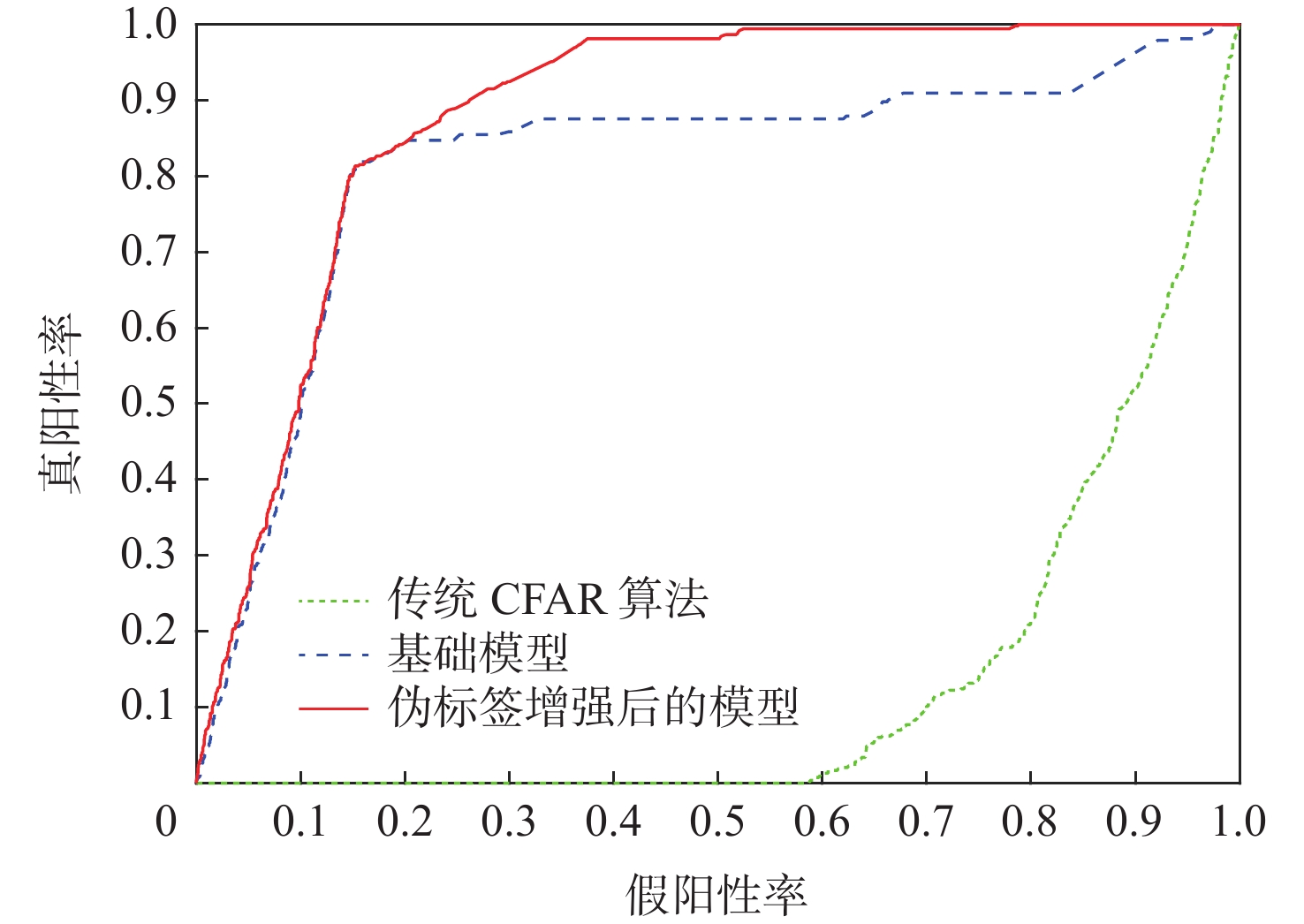
针对毫米波雷达无人机检测领域,开展了基于多特征融合与伪标签增强的弱监督学习方法研究。采用恒定虚警率(CFAR)算法对毫米波雷达回波信号进行目标预检测,从中提取频谱能量分布特征、运动轨迹变化特征及统计分布特征,综合反映无人机的距离、速度及运动状态;利用LogitBoost提升算法构建分类模型,通过迭代加权弱分类器,有效提高了分类准确性。为缓解标注样本不足问题,进一步引入伪标签自训练机制,并通过人工辅助修正,实现了未标注数据的利用,并提升了模型的泛化能力。基于自建的毫米波雷达数据集,开展了多轮实验验证,结果表明:所提方法在3种不同场景的弱监督条件下,接收者工作特征曲线下面积(AUC)分别提升约7.2%/1.6%/6.6%,虚警率降低约36.9%/0%/10.6%,检测准确率较传统方法有显著提高。此外,所提方法表现出较强的环境适应能力,能够在复杂背景下稳定识别小型飞行目标。研究表明,多特征融合结合伪标签增强策略为毫米波雷达无人机检测提供了一种有效的解决方案,具备较高的实用价值和推广潜力。
Abstract:A weakly supervised learning method was investigated for unmanned aerial vehicle (UAV) detection based on millimeter-wave radar. To enhance feature representation, multiple categories of information were fused, including spectral energy distribution, motion trajectory variation, and statistical descriptors. Target pre-detection was conducted using a constant false alarm rate (CFAR) algorithm, which adaptively filtered the radar echo data and provided coarse localization. Doppler-related indexes were employed to reflect target motion parameters, and time-frequency domain information was used to derive energy characteristics for feature extraction. To further characterize the echo distribution, statistical measures like skewness, kurtosis, and energy ratio across close and far range bins were calculated. A LogitBoost ensemble classifier was employed to train the detection model by combining multiple weighted weak learners through iterative optimization. To address the scarcity of labeled samples, a pseudo-labeling strategy was introduced. The self-training mechanism automatically generated pseudo-labels from high-confidence predictions on unlabeled data and incorporated them into subsequent training cycles. Experimental validation was performed using a dataset comprising multiple real-world radar recordings with UAVs and empty field scenarios. The proposed method demonstrated robust performance under weak supervised conditions in three different scenarios. Compared with the baseline model, the final model achieved an improvement of approximately 7.2%/1.6%/6.6% in the area under the receiver operating characteristic curve (AUC) and a reduction of approximately 36.9%/0%/10.6% in the false alarm rate. Moreover, the model exhibited consistent detection accuracy in challenging environments with noise and background clutter. This study demonstrates that millimeter-wave radar detection performance for low-altitude, small-size UAVs can be significantly enhanced by combining multi-domain features and implementing pseudo-label augmentation techniques. The method provides practical value for real-time surveillance and airspace security applications.
-
表 1 硬件平台各模块介绍及说明
Table 1. Introduction and description of each module in the hardware platform
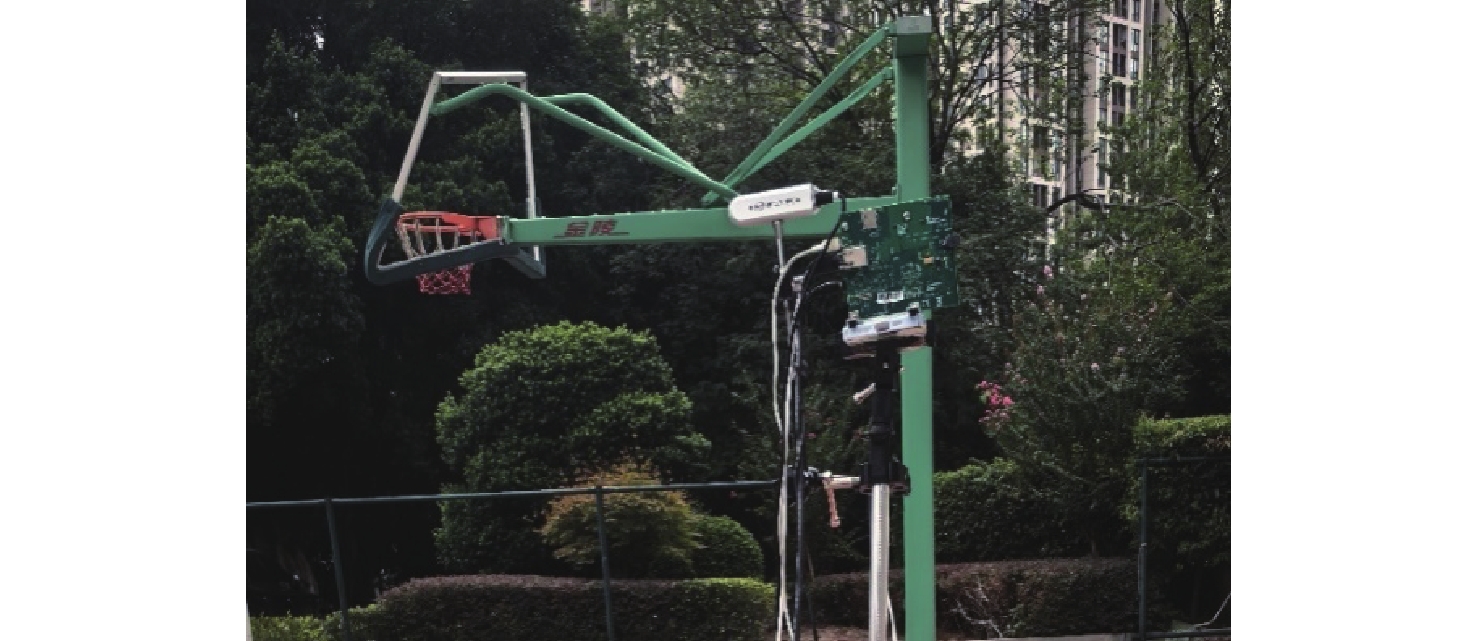
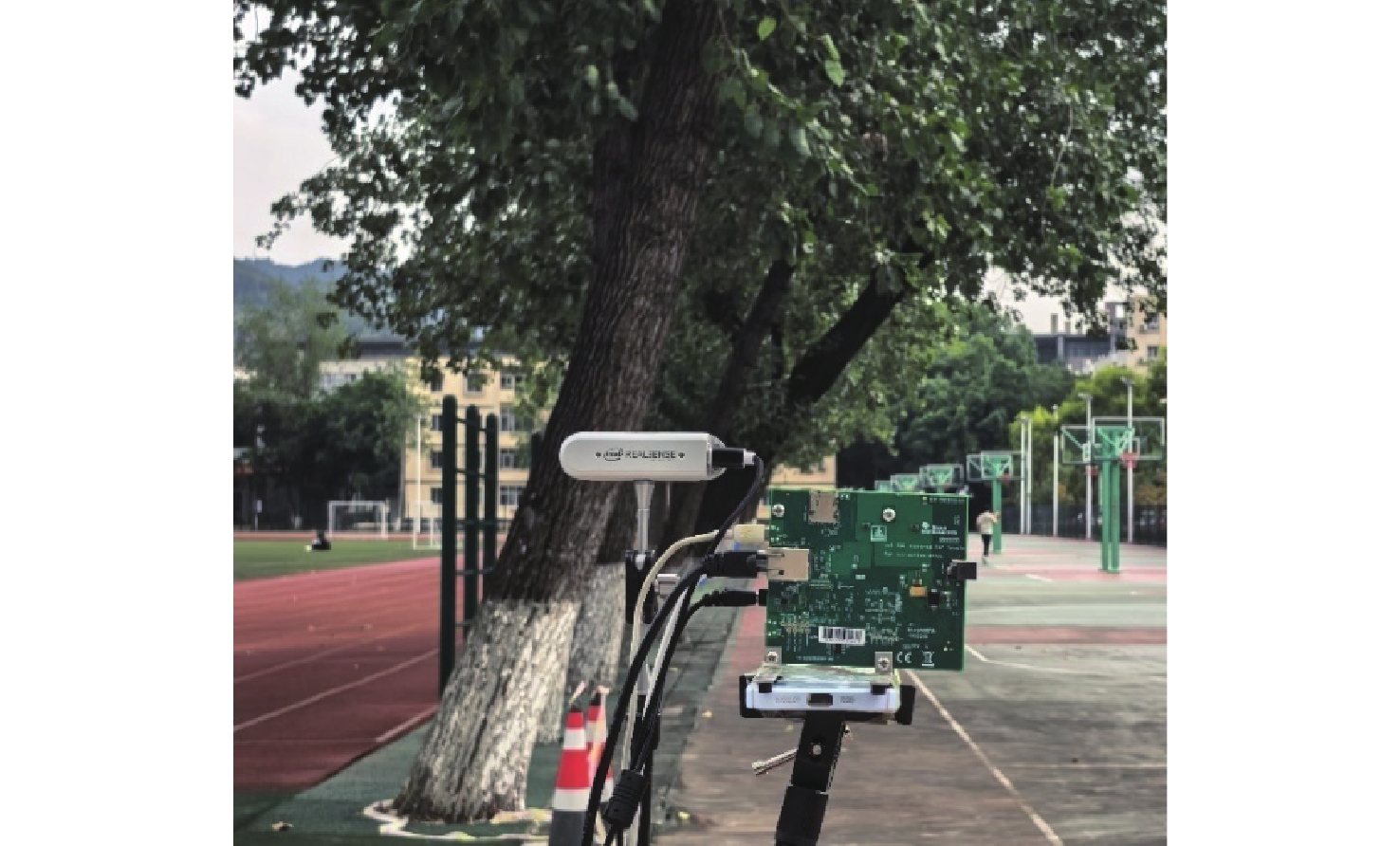
模块 设备 说明 毫米波雷达 AWR2243+DCA1000 3T4R MIMO,支持IF数据采集 相机 Realsense D435 获取RGB+D(深度)图像,
用于同步与辅助标注无人机平台 DJI MINI 2SE 四旋翼无人机 支撑设备 三脚架、激光尺 雷达定位与高度标定 可选扩展 GPS/RTK/IMU模块 提升轨迹精度(用于对齐与评估,
本次未使用) 下载: 导出CSV
表 2 各动作任务编号及动作分类
Table 2. Numbering of each action task and action classification
编号 动作类型 动作描述 A1 起飞悬停 起飞至1~3 m,悬停30 s A2 缓慢匀速左右飞行 起飞至3~10 m,左右缓慢飞行 A3 缓慢匀速上下飞行 起飞至3~10 m,上下缓慢飞行 A4 快速无规则飞行 起飞至10~25 m/25~35 m/35~50 m,
无规则快速飞行A5 遮挡穿越 在金属、树木障碍物之前、之后运动
下载: 导出CSV
表 3 模型及其数据集
Table 3. Model and its dataset
阶段 输入特征集 目标 基础模型$ {M}_{0} $ X_label,Y_label 仅用真实标签训练初始分类器 增强模型$ {M}_{\text{pseudo}} $ X_pseudo,Y_pseudo 引入置信伪标签+人工选取阈值
下载: 导出CSV
表 4 数据集构成与划分
Table 4. Dataset composition and partitioning
数据集类型 帧数 用途 已标注训练集(X_label) 900×2×m帧(900×m帧正样本,900×m帧负样本) 用于基础模型训练 未标注集(X_unlabel) 900×2×n帧(900×n帧正样本,900×n帧负样本) 采用伪标签方法提取可信帧,
增强训练集测试集(X_test) 900×2×o帧(900×o帧正样本,900×o帧负样本) 包含均衡的正负样本,用于
最终性能评估
下载: 导出CSV
表 5 仿真参数与实验设置汇总
Table 5. Summary of simulation parameters and experimental settings
参数类别 参数名称 取值 场景适配性 雷达参数 中心频率/GHz $77$ 全场景统一 ADC采样率/MHz $ 10 $ 全场景统一 发射/接收天线数 3发射,4接收 全场景统一 信号参数 chirp个数 $ 64 $ 全场景统一 chirp采样点数 $256 $ 全场景统一 chirp调频斜率/(GHz·μs−1) 29.982 全场景统一 模型参数 LogitBoost迭代次数 70/100/50 开阔/金属/树木场景分别设定 伪标签正类阈值 $ -12.128/-6.573/6.205 $ 开阔/金属/树木场景分别设定 伪标签负类阈值 $-6.827/-11.046/-9.495 $ 开阔/金属/树木场景分别设定 运动特征滑窗 5 全场景统一 采集参数 雷达距地高度/m 1.2~1.5 全场景统一 无人机飞行距离/m 5/15/25/35/50 全场景覆盖 每.bin文件帧数 900 全场景统一
下载: 导出CSV
-
[1] Zhang Z X. Drone-YOLO: an efficient neural network method for target detection in drone images[J]. Drones, 2023, 7(8): 526. [2] Sun Y M, Li J G, Wang L W, et al. Deep Learning-based drone acoustic event detection system for microphone arrays[J]. Multimedia Tools and Applications, 2024, 83(16): 47865-47887. [3] Bi L T, Xu Z X, Yang L. Low-cost UAV detection via WiFi traffic analysis and machine learning[J]. Scientific Reports, 2023, 13(1): 20892. [4] Pereira A, Warwick S, Moutinho A, et al. Infrared and visible camera integration for detection and tracking of small UAVs: Systematic evaluation[J]. Drones, 2024, 8(11): 650. [5] Khawaja W, Ezuma M, Semkin V, et al. A survey on detection, classification, and tracking of UAVs using radar and communications systems[J]. IEEE Communications Surveys & Tutorials, 2026, 28: 3272-3310. [6] Semenyuk V, Kurmashev I, Lupidi A, et al. Advances in UAV detection: integrating multi-sensor systems and AI for enhanced accuracy and efficiency[J]. International Journal of Critical Infrastructure Protection, 2025, 49: 100744. [7] Soriano C G. Review of radar detectors with constant false alarm rate[J]. Revista Telemática, 2020, 19: 78-90. [8] Bhatia J, Dayal A, Jha A, et al. Classification of targets using statistical features from range FFT of mmWave FMCW radars[J]. Electronics, 2021, 10(16): 1965. [9] Qin X Y, Deng B, Wang H Q. Micro-Doppler feature extraction of rotating structures of aircraft targets with terahertz radar[J]. Remote Sensing, 2022, 14(16): 3856. [10] Kim J H, Kwon S Y, Kim H N. Spectral-kurtosis and image-embedding approach for target classification in micro-Doppler signatures[J]. Electronics, 2024, 13(2): 376. [11] Chen S, Luo F, Hu C, et al. Small target detection in sea clutter background based on Tsallis entropy of Doppler spectrum[J]. Journal of Radars, 2019, 8(3): 344-354. [12] Li Y B, Ge J, Lin Y, et al. Radar emitter signal recognition based on multi-scale wavelet entropy and feature weighting[J]. Journal of Central South University, 2014, 21(11): 4254-4260. [13] Tang X J, Chen W G, Zhu W G. Radar emitter recognition method based on AdaBoost and decision tree[C]//Proceedings of the 2017 2nd International Conference on Automation, Mechanical Control and Computational Engineering. [S.l.]: Atlantis Press, 2017: 326-330. [14] Bell M A, Rahman S, Robertson D A. Fast classification of drones and birds with an LSTM network applied to 1D phase data[C]//Proceedings of the 2023 IEEE International Radar Conference. Piscataway: IEEE Press, 2023: 1-6. [15] Larrat M, Sales C. Classification of flying drones using millimeter-wave radar: comparative analysis of algorithms under noisy conditions[J]. Sensors, 2025, 25(3): 721. [16] Dornaika F, Ibrahim Z, Bosaghzadeh A, et al. Scalable and inductive semi-supervised classifier with sample weighting based on graph topology[J]. ACM Transactions on Knowledge Discovery from Data, 2024, 18(5): 1-18. [17] Wang Y X, Liang J, Zhang Z X. A curriculum-style self-training approach for source-free semantic segmentation[EB/OL]. (2024-07-19)[2025-07-01]. https://arxiv.org/abs/2106.11653. -

 下载:
下载:

 点击查看大图
计量
- 文章访问数: 268
- HTML全文浏览量: 151
- PDF下载量: 13
- 被引次数: 0
