





-
摘要:
针对欠驱动与参数不确定性耦合导致的固定翼无人机控制设计与稳定性分析难题,提出一种基于触发式批处理辨识的自适应分层控制方法。为处理欠驱动问题,基于独轮车模型将原固定翼无人机模型转换为虚拟积分器与线性参数化模型;结合反步法与固定时间控制技术,建立等效飞行跟踪控制器。通过分析参数不确定性对无人机运动状态的作用机理,采用谱分解技术构造线性回归方程以定量收集激励信息,确保收集激励信息的丰富性和线性回归方程的有界性。为消除参数不确定性的影响,建立触发式批处理参数估计器,在触发函数满足特定条件时充分利用已收集的激励信息更新参数估计。与固定翼无人机的现有分层控制策略相比,所提框架实现了误差收敛性、激励丰富性与参数辨识精度的统一。
Abstract:In this paper, an adaptive hierarchical control method based on a regulation-triggered batch identifier is proposed. This approach addresses the challenges in stability analysis and control design of fixed-wing UAVs, which are complicated by the coupling of underactuated characteristics and parametric uncertainty. In order to deal with the underactuated problem, the original fixed-wing UAV model is transformed into a virtual integrator and linear parameterized model based on the unicycle model. Backstepping is then combined with fixed-time control methods to create an equivalent flight tracking controller. By analyzing the mechanism of parameter uncertainty on the motion state of the UAV, a linear regression equation is constructed by spectral decomposition technology to quantitatively collect excitation information, which ensures the richness of the collected excitation information and the boundedness of the linear regression equation. A regulation-triggered batch identifier is created to update the parameter estimation using the gathered excitation data when the trigger function satisfies specific requirements in order to remove the impact of parametric uncertainty. Compared with the existing hierarchical control strategies for fixed-wing UAVs, the proposed framework achieves the unity of error convergence, excitement richness and parameter identification accuracy.
-
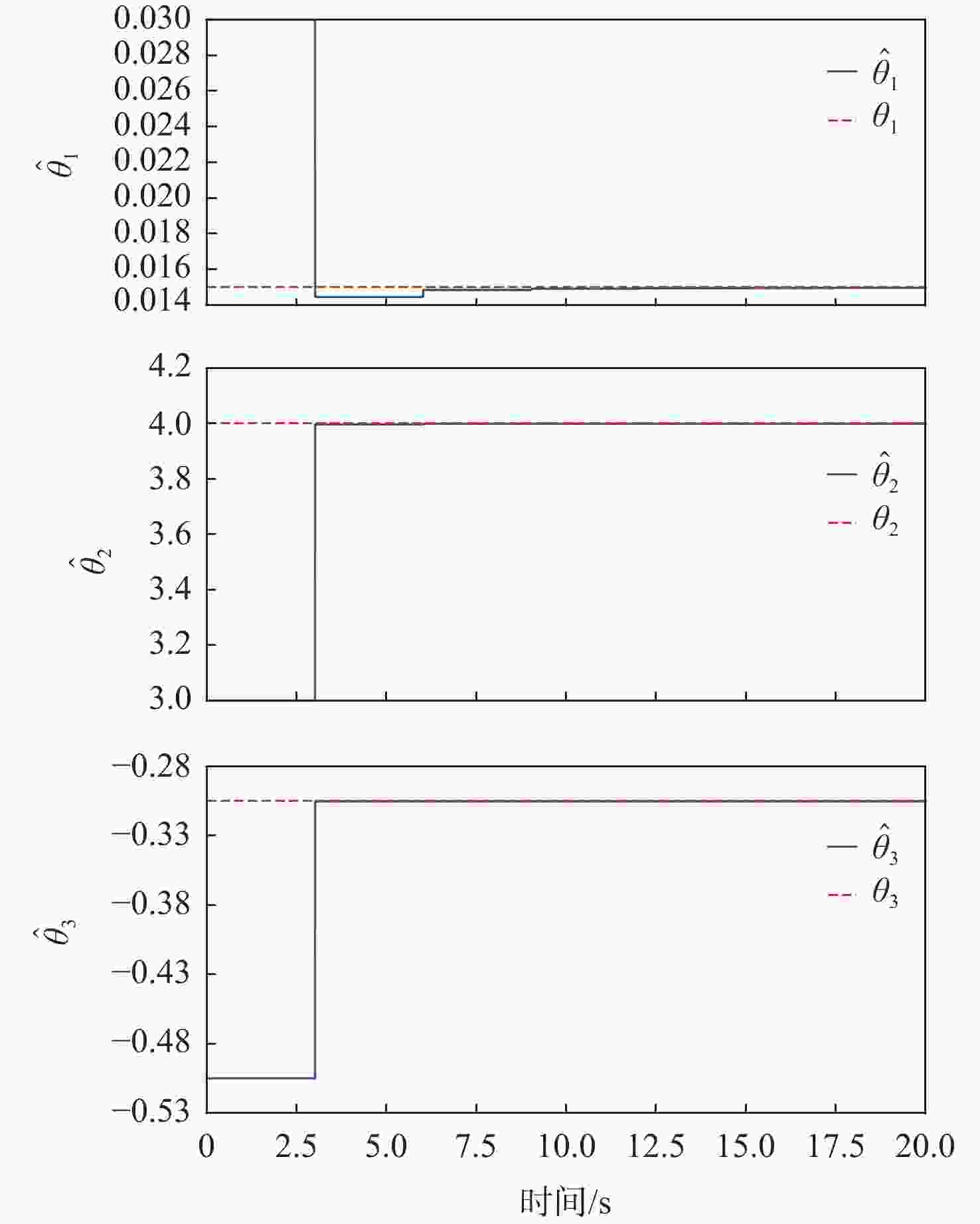
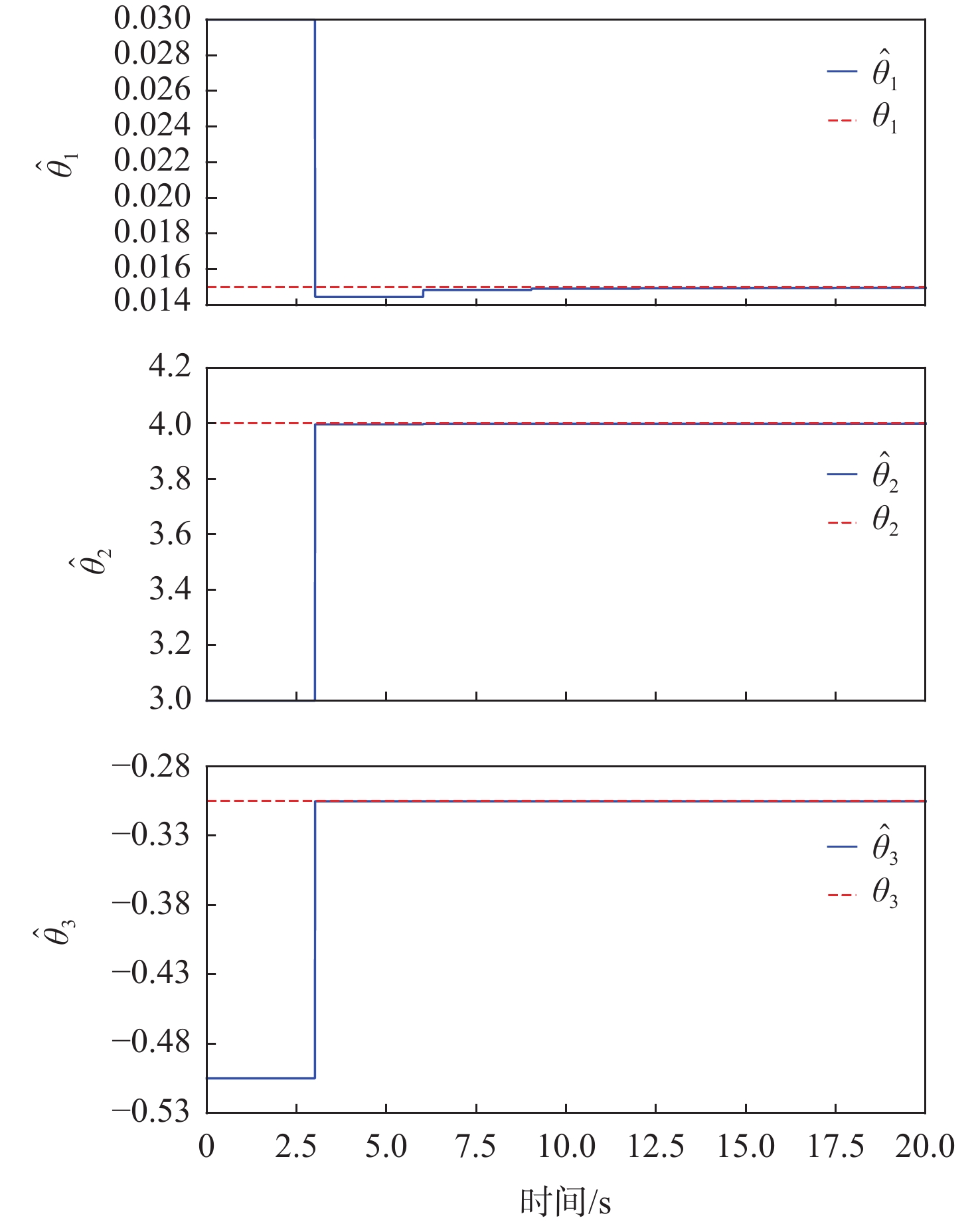
图 6 参数估计$ \hat{\boldsymbol{\theta }} $
Figure 6. Parameter estimate $ \hat{\boldsymbol{\theta }} $
表 1 激励收集方式对比
Table 1. Comparison of excitation collection methods
 下载: 导出CSV
-
[1] Zhuang X, Li D G, Wang Y, et al. Optimization of high-speed fixed-wing UAV penetration strategy based on deep reinforcement learning[J]. Aerospace Science and Technology, 2024, 148: 109089. [2] Nugroho G, Taha Z, Nugraha T S, et al. Development of a fixed wing unmanned aerial vehicle (UAV) for disaster area monitoring and mapping[J]. Journal of Mechatronics, Electrical Power, and Vehicular Technology, 2015, 6(2): 83-88. [3] Hinzmann T, Schneider T, Dymczyk M, et al. Robust map generation for fixed-wing UAVs with low-cost highly-oblique monocular cameras[C]//2016 IEEE/RSJ International Conference on Intelligent Robots and Systems (IROS). Piscataway: IEEE Press, 2016: 3261-3268. [4] Raffo G V, Ortega M G, Rubio F R. Path tracking of a UAV via an underactuated control strategy[J]. European Journal of Control, 2011, 17(2): 194-213. [5] Wang Z, Bao W M, Li H F. Second-order dynamic sliding-mode control for nonminimum phase underactuated hypersonic vehicles[J]. IEEE Transactions on Industrial Electronics, 2017, 64(4): 3105-3112. [6] Huang J S, Wen C Y, Wang W, et al. Adaptive output feedback tracking control of a nonholonomic mobile robot[J]. Automatica (Journal of IFAC), 2014, 50(3): 821-831. [7] Long J, Guo Y M, Liu Z, et al. Filtering-based concurrent learning adaptive attitude tracking control of rigid spacecraft with inertia parameter identification[J]. International Journal of Robust and Nonlinear Control, 2023, 33(8): 4562-4576. [8] Parikh A, Kamalapurkar R, Dixon W E. Integral concurrent learning: adaptive control with parameter convergence using finite excitation[J]. International Journal of Adaptive Control and Signal Processing, 2019, 33(12): 1775-1787. [9] Guo K, Pan Y P, Zheng D D, et al. Composite learning control of robotic systems: a least squares modulated approach[J]. Automatica (Journal of IFAC), 2020, 111: 108612. [10] Shen J J, Liu Y H, Wang W, et al. Composite learning adaptive safety critical control with application to adaptive cruise of Intelligent vehicles[J]. IEEE Transactions on Industrial Electronics, 2025, 72(10): 10793-10803. [11] Shen J J, Wang W, Wen C Y, et al. Composite learning adaptive control under non-persistent partial excitation[EB/OL]. (2024-08-11)[2025-08-26]. https://arxiv.org/abs/2408.01731. [12] Karafyllis I, Krstic M. Adaptive certainty-equivalence control with regulation-triggered finite-time least-squares identification[J]. IEEE Transactions on Automatic Control, 2018, 63(10): 3261-3275. [13] Shen J J, Wang W, Zhou J, et al. Adaptive safety with control barrier functions and triggered batch least-squares identifier[J]. Automatica (Journal of IFAC), 2025, 173: 112059. [14] Karafyllis I, Kontorinaki M, Krstic M. Adaptive control by regulation-triggered batch least squares[J]. IEEE Transactions on Automatic Control, 2020, 65(7): 2842-2855. [15] Roshanian J, Rahimzade E. Model reference adaptive control using a new adaptation law based on power-series quadratic lyapunov functions for the single degree of freedom wing rock phenomenon[J]. Journal of Aerospace Science and Technology, 2021, 14(1): 11-29. [16] Xu B. Composite learning finite-time control with application to quadrotors[J]. IEEE Transactions on Systems, Man, and Cybernetics: Systems, 2018, 48(10): 1806-1815. [17] Cho N, Shin H S, Kim Y, et al. Composite model reference adaptive control with parameter convergence under finite excitation[J]. IEEE Transactions on Automatic Control, 2018, 63(3): 811-818. [18] Pan Y P, Aranovskiy S, Bobtsov A, et al. Efficient learning from adaptive control under sufficient excitation[J]. International Journal of Robust and Nonlinear Control, 2019, 29(10): 3111-3124. [19] Lee H I, Shin H S, Tsourdos A. Concurrent learning adaptive control with directional forgetting[J]. IEEE Transactions on Automatic Control, 2019, 64(12): 5164-5170. [20] Goel A, Bruce A L, Bernstein D S. Recursive least squares with variable-direction forgetting: compensating for the loss of persistency [lecture notes][J]. IEEE Control Systems Magazine, 2020, 40(4): 80-102. [21] Lai B, Bernstein D S. SIFt-RLS: subspace of information forgetting recursive least squares[EB/OL]. (2024-04-16)[2025-08-26]. https://arxiv.org/abs/2404.10844. [22] Baldi S, Roy S, Yang K, et al. An underactuated control system design for adaptive autopilot of fixed-wing drones[J]. IEEE/ASME Transactions on Mechatronics, 2022, 27(5): 4045-4056. [23] Bao C C, Guo Y F, Luo L R, et al. Design of a fixed-wing UAV controller based on adaptive backstepping sliding mode control method[J]. IEEE Access, 2021, 9: 157825-157841. [24] Schlanbusch S M, Zhou J, Schlanbusch R. Adaptive attitude control of a rigid body with input and output quantization[J]. IEEE Transactions on Industrial Electronics, 2022, 69(8): 8296-8305. [25] Fjetland A K, Zhou J, Abeyrathna D, et al. Kick detection and influx size estimation during offshore drilling operations using deep learning[C]//2019 14th IEEE Conference on Industrial Electronics and Applications (ICIEA). Piscataway: IEEE Press, 2019: 2321-2326. [26] Shen J J, Wang W, Wu X K, et al. Regulation-triggered batch identifier-based adaptive control for nonlinear systems with unknown control coefficients[J]. Journal of Control and Decision, 2026, 13(5): 1324-1339. [27] Bhat S P, Bernstein D S. Finite-time stability of continuous autonomous systems[J]. SIAM Journal on Control and Optimization, 2000, 38(3): 751-766. [28] Lancaster P, Tismenetsky M. The theory of matrices[M]. 2nd ed. San Diego: Academic Press, 1985. [29] De Luca A, Oriolo G, Vendittelli M. Stabilization of the unicycle via dynamic feedback linearization[J]. IFAC Proceedings Volumes, 2000, 33(27): 687-692. -

 下载:

 点击查看大图
计量
- 文章访问数: 247
- HTML全文浏览量: 128
- PDF下载量: 7
- 被引次数: 0
