





-
摘要:
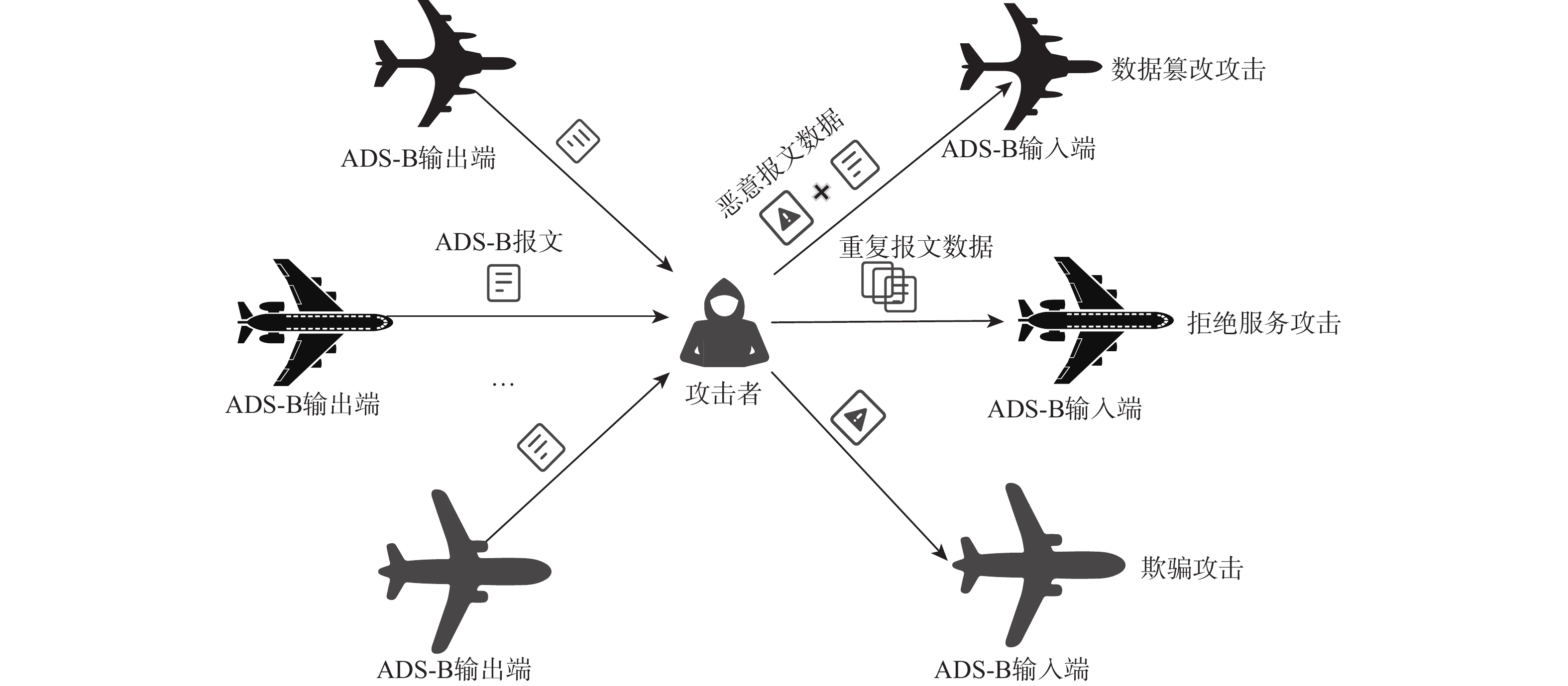
广播式自动相关监视(ADS-B)系统作为航空监视技术的重要组成部分,已得到广泛部署应用,显著提高了空中交通监视的覆盖范围和定位精度,但开放的广播通信机制使该系统易受数据篡改、恶意报文注入和干扰攻击等多种安全威胁,严重影响空中交通安全与管制决策,针对ADS-B系统的异常检测成为研究热点。基于此,系统总结并分析了当前国内外ADS-B系统异常检测的研究现状。对导致ADS-B系统出现异常数据的原因进行分析,总结该系统易遭受的攻击类型及其影响;从基于一致性检验的方法和基于深度学习的方法深入探讨ADS-B异常检测研究现状,分析各类方法在检测精度、泛化性与实际部署中的优缺点,并结合相应的应用场景对当前ADS-B异常检测产品进行分析总结;在总结已有研究成果的基础上,深入讨论当前面向ADS-B的异常检测方法所面临的主要挑战,并提出未来的研究方向与发展趋势。
Abstract:The automatic dependent surveillance broadcast (ADS-B) system, as an important component of aviation surveillance technology, has been widely deployed and applied. The application of the ADS-B system significantly improves the coverage and positioning accuracy of air traffic surveillance. Nonetheless, owing to its open broadcast communication framework, this system is susceptible to numerous security risks including data manipulation, harmful message insertion, and interference assaults, which significantly compromise air traffic safety and control determinations. Anomaly detection for the ADS-B system has gradually become a research hotspot. This paper systematically summarizes and analyzes the current research status of anomaly detection in ADS-B systems at home and abroad. Firstly, it analyzes the causes of abnormal data in ADS-B systems and summarizes the types of attacks that this system is vulnerable to and their impacts. The present state of research on ADS-B anomaly detection is thoroughly examined from two perspectives: the consistency check-based approach and the deep learning-based approach. The merits and demerits of several techniques regarding detection precision, generalisation, and practical implementation are examined, with an analysis and summary of existing ADS-B anomaly detection products in relation to their respective application contexts. Ultimately, a comprehensive synthesis of the current research findings reveals the primary obstacles encountered by contemporary anomaly detection techniques for ADS-B, alongside potential future research avenues and developmental trajectories.
-
表 1 STRIDE威胁模型在ADS-B领域的映射
Table 1. Mapping of STRIDE threat model in ADS-B domain
元素 交互 在ADS-B系统中的具体表现形式和攻击示例 S
(欺骗)T
(数据篡改)R
(抵赖)I
(信息泄露)D
(拒绝服务)E
(权限提升)航空器 广播ADS-B报文给地面站或邻机 “幽灵飞机”注入,伪造航班或位置广播导致
错误感知★ ★ 航空器 从进程接收ADS-B报文 伪装为地面服务下发错误情报;接收方日志
被篡改后无法追溯★ ★ 进程 地面站监视系统获取航空器报文并处理 中间处理被篡改影响告警;处理日志被删除;
接收缓存泄露★ ★ ★ ★ ★ 进程 地面站监视系统向航空器广播报文 下发被篡改的交通/天气信息 ★ ★ ★ ★ 进程 ATC系统与数据库接口 中间报文或响应被篡改;审计记录被擦除 ★ ★ 进程 写入或读取飞行日志与数据库 写入端被回写假轨迹;数据库敏感字段被泄露 ★ ★ ★ 数据流 航空器向地面站广播 广播被仿冒或重放;广播可被任何接收机窃听 ★ ★ ★ 数据流 地面站向航空器回传 地面注入错误情报 ★ ★ ★ 数据流 空对空广播 空对空“幽灵飞机”广播;广播被重放或延迟 ★ ★ ★ 注:★表示对应交互中可能遭受的攻击类型。  下载: 导出CSV
表 2 ADS-B攻击方式分类
Table 2. ADS-B attack modes classification
攻击
方式攻击
层次所属攻击
类型攻击
手段技术
难度影响
范围检测
难度攻击数据
组成典型
危害参考
文献无线电干扰 物理层 干扰攻击 频谱干扰 中等 区域性 中等 无报文数据 区域通信瘫痪 [27] GNSS干扰 物理层 干扰攻击 GNSS频段干扰 中等 广泛 中等 无报文数据 导航失效 [42] 信号特征篡改 物理层 数据篡改攻击 无线电信号伪造 高 单一目标 高 虚假报文与真实报文 指纹识别失效 [38-41] 比特位反转篡改 物理层 数据篡改攻击 信号叠加造成数据位反转 高 单一目标 高 虚假报文与真实报文 误导性数据传播 [12-13] 机载设备篡改 物理层 数据篡改攻击 内部设备篡改 高 单一目标 高 虚假报文与真实报文 破坏设备 [37] 被动窃听 数据链路层 被动窃听攻击 ADS-B信号截获 低 单一目标 高 真实报文 信息泄露 [18-19] ADS-B身份欺骗 数据链路层 欺骗攻击 伪造ICAO代码 中等 单一目标 中等 虚假报文与真实报文 身份识别混乱 [25-28] SSR应答干扰 数据链路层 干扰攻击 大量类似报文干扰 中等 广泛 高 虚假报文与真实报文 真实目标识别困难 [43] GNSS欺骗 数据链路层 欺骗攻击 伪造GNSS信号 高 单一目标 高 虚假报文与真实报文 位置错误 [20-21] 错误警报注入 数据链路层 注入攻击 伪造ADS-B广播 低 广泛 中等 虚假报文 管制决策混乱 [31] “幽灵飞机”注入 数据链路层 注入攻击 大量虚假航迹注入 低 广泛 中等 虚假报文 空管超载 [14-16] 时序篡改 数据链路层 数据篡改攻击 延迟合法报文传播 中等 单一目标 高 真实报文 时序错误导致决策混乱 [19] ADS-B报文篡改 数据链路层 数据篡改攻击 截获并篡改真实报文 高 单一目标 高 虚假报文与真实报文 数据误导 [35-36] 轨迹伪造 数据链路层 注入攻击 轨迹生成算法 高 单一目标 高 虚假报文与真实报文 位置误判 [32-34] 速度欺骗 数据链路层 欺骗攻击 伪造速度数据 中等 单一目标 中等 虚假报文与真实报文 错误避让决策 [22-24] 重放 数据链路层 欺骗攻击 报文重播 中等 单一目标 中等 虚假报文与真实报文 数据时间混乱 [29-31] 数据泛洪 网络层 干扰攻击 报文泛洪 较低 广泛 高 虚假报文 系统瘫痪 [44] 分布式拒绝服务 网络层 干扰攻击 多点伪造信息 中等 广泛 高 虚假报文 全面服务中断 [4] 地面站目标注入 网络层 注入攻击 伪造信息格式 低 区域性 中等 虚假报文 虚假目标干扰 [24]
下载: 导出CSV
表 3 基于独立定位的异常检测方法总结
Table 3. Summary of anomaly detection methods based on independent positioning
检测方法 数据集 针对攻击/
异常类型应用场景 优点 缺点 AOA[43] Beechcraft B300飞机航行实验数据集 欺骗攻击 扇区天线部署区域 在WAM系统空域背景下,抗欺骗水平高 严重依赖扇区天线方向校准,偏差过大时抗欺骗效果降低 KNN+TDOA[19] OpenSky+自建仿真数据集 欺骗攻击 传感器分布稀疏区域 无需部署高精度接收设备,非理想几何条件下定位精度高 网格划分较细的情况下,计算复杂度变高,实时处理时延增加 TEKF+TDOA[14] OpenSky GNSS干扰攻击 多个TDOA传感器部署区域 无需求解非线性多点问题,检测范围更广 受网络布局影响较大,容易导致TDOA精度下降 IMM+TDOA[46] CCA1516航班数据集+自建仿真数据集 GNSS欺骗攻击、轨迹伪造攻击 GNSS信号易受攻击
区域在复杂航路下定位精度较高 受实时性影响较大,大范围部署难度较大,泛化性较差 TSOA+TDOA+
AOA[47]自建仿真数据集 欺骗攻击、轨迹伪造攻击 无人机参与的协作监视区域 定位精度高,适用于复杂场景 对硬件要求较高,更适用于军事或管制场景,泛化性较差 IDOA[21] 自建仿真数据集 轨迹伪造攻击 时钟同步不理想区域 不再依赖地面站时间同步,计算复杂度更低 对ADS-B报文中水平和垂直位置数据要求较高,仍需多个地面站协调工作
下载: 导出CSV
表 4 基于多源数据融合的异常检测方法总结
Table 4. Summary of anomaly detection methods based on multi-source data fusion
检测方法 数据集 针对攻击/异常类型 应用场景 优点 缺点 MNOS[45] OpenSky 轨迹伪造攻击、ADS-B
身份欺骗攻击地面站少,低资源环境 无需额外传感器,适用于低资源环境 对历史数据依赖较大,所用算法对实时性要求较高 MKSVDD[48] OpenSky+SSR 拒绝服务攻击 高安全空域,具有SSR区域 适用于复杂空域,适应新航线能力较强 计算复杂度较大,异常数据解释性较弱 DBSCAN[49] OpenSky 轨迹伪造攻击 航班密度大,海量轨迹数据 适用于大批量数据分析 需人工设定参数,对小幅异常位置检测能力有限 TD[50] 欺骗攻击 禁飞空域、机场周边 误报率低,对欺骗攻击检测精确度较高 依赖多地面站,对短时欺骗信号检测能力有限
下载: 导出CSV
表 5 基于密码学的异常检测方法总结
Table 5. Summary of anomaly detection methods based on cryptography
检测方法 数据集 针对攻击/异常类型 应用场景 优点 缺点 AES-GCM[51] 自采集数据集 ADS-B身份欺骗、ADS-B
报文篡改、重放攻击区域广播环境 不改变ADS-B原协议,实时性好,
运算高效,低带宽占用仍需密钥分发管理,丢包严重 ECDH[52] 数据篡改攻击、重放攻击 全球/洲际级广播
环境区域化分级密钥管理,实时性较
好,性能开销适中对跨区域管理场景关注不足,
未处理丢包严重问题BHIS[53] 数据篡改攻击 大规模/分层结构
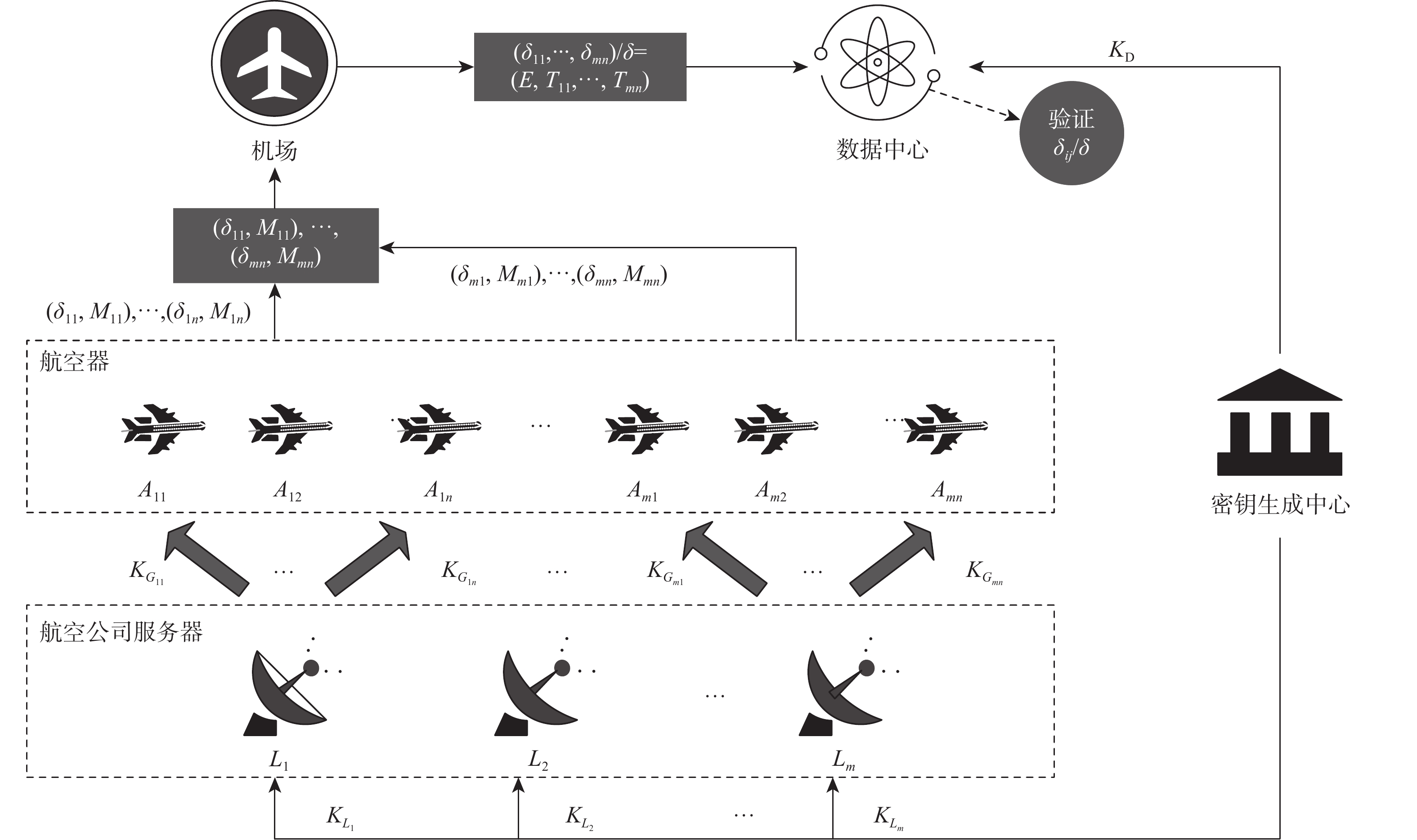
广播环境有效解决跨区域管理场景下报文
传输效率问题计算开销相对较高,未有效处
理消息丢包问题ECB-CLS[54] 自采集数据集 欺骗攻击、数据篡改攻击、
重放攻击、数据丢包分布式/资源受限
广播环境无需证书管理,具备区块链透明
性与抗丢包性,批量验证高效系统复杂度高,区块链部署成
本较高,增加通信开销
下载: 导出CSV
表 6 基于一致性检验的ADS-B异常检测方法总结
Table 6. Summary of ADS-B anomaly detection methods based on conformance test
检测方法 主要针对的
攻击类型方法描述 优点 缺点 基于独立定位的
异常检测方法GNSS干扰攻击、欺骗攻击、轨迹
伪造攻击将独立物理测量量与广播信息对齐,构建检测统计量与误差度量,并与预设阈值比较进行检验 算法机制透明,可解释性强,且
具有独立验证能力依赖多站协同测量,部署与维护成本高,对测量误差及噪声较敏感 基于多源数据融合的
异常检测方法拒绝服务攻击、
欺骗攻击通过融合多源特征对正常轨迹进行建模,并计算当前轨迹与正常轨迹模型之间的偏差,实现异常检测 支持无监督学习,适应场景广
泛,泛化性较好计算复杂度较高,依赖大量训练数
据,可解释性较差基于密码学的完整性
与真实性验证方法重放攻击、数据
篡改攻击、欺骗
攻击利用对称密钥或无证书签名算法对ADS-B报文进行加密,接收端获取公钥对报文进行验证 无需改变当前ADS-B协议格式,
具有较好的向后部署性,并且具备批量验证与抗丢包能力密钥分发管理需要消耗额外的资源,同时受限于ADS-B报文长度,
嵌入认证信息具有一定负担
下载: 导出CSV
表 7 基于时序预测思想的异常检测方法总结
Table 7. Summary of anomaly detection methods based on time series prediction thought
下载: 导出CSV
表 8 基于分类思想的异常检测方法总结
Table 8. Summary of anomaly detection methods based on classification thought
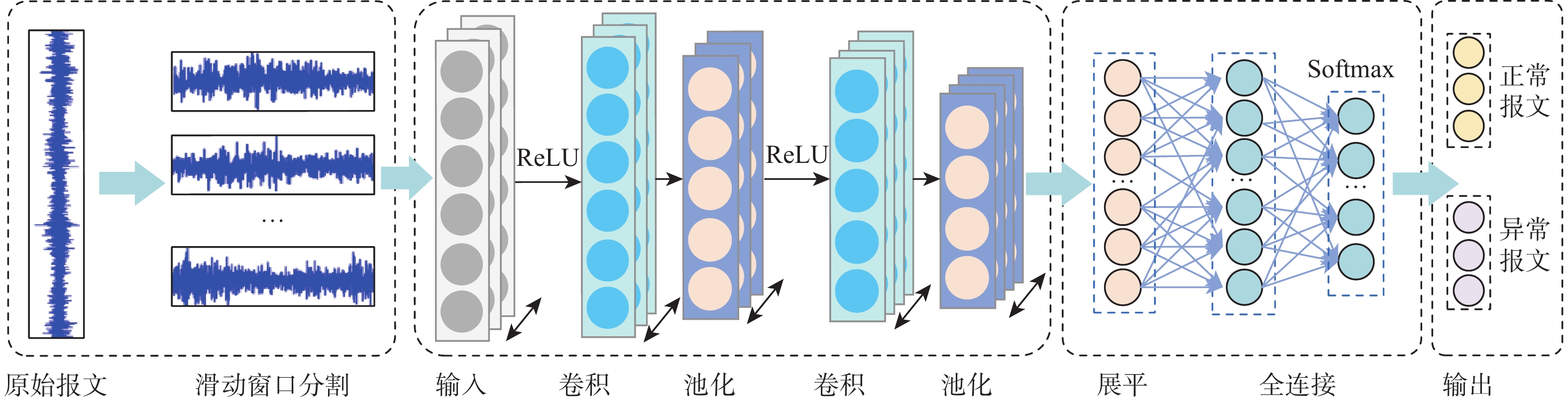
检测方法 数据集 针对攻击/异常类型 应用场景 优点 缺点 FlightSense[25] 自采集数据集 ADS-B身份欺骗 未加密广播环境 无需手动特征提取,自动学习信号特征 识别仅限已知飞机,依赖高质量I/Q数据 AMCN[58] 中国民航数据
主中心采集GNSS干扰 地面无GNSS信号监测站的区域 支持大规模干扰源定位,定位精度优于传统方法 依赖多个飞机数据协同分析,对细粒度干扰事件灵敏度有限 EML[31] Mendeley平台 “幽灵飞机”注入、
速度欺骗攻击对模型透明性有高要求的航空安全环境 高效的特征选择方法,提升对特定攻击的敏感性,内置决策解释机制 部署成本较大,模型复杂度较高 Sentinel-CNN[59] OpenSky ADS-B设备故障 ADS-B缺失空域 实现无源目标检测,有效提升空域态势感知能力 在姿态变化剧烈或强干扰条件下仍面临误差累积问题 TFFD[60] 自采集数据集 ADS-B身份欺骗 空管监视与航空通信安保的实时身份鉴别 成本可控,便于维护 工程复杂度高 FSOSIL[61] 自采集数据集 伪造信息、身份
欺骗低样本、开集、增量场景下的设备身份鉴别与拒识 可持续拓展,数据效率高 依赖元任务设计划分策略,任务构造与调参成本较高
下载: 导出CSV
表 9 基于数据重构思想的异常检测方法总结
Table 9. Summary of anomaly detection methods based on thought of data reconstruction
检测方法 数据集 针对攻击/异常类型 应用场景 优点 缺点 LSTM-编码器[62] FlightRadar24 ADS-B身份欺骗、ADS-B报文篡改 单机或航空器内部 系统部署要求少,无需额
外数据支持高度依赖已知航线数据,实时性表现较差 VAE-SVDD[63] OpenSky 拒绝服务攻击、数据篡改攻击 实时检测或历史数据回溯分析的高风险空域 较低的误报率和漏报率 对训练数据依赖较大,时序依赖捕捉能力有限 CAE[13] OpenSky 错误警报注入 突发飞行事件识别 在不同飞行阶段的异常
检测中表现优异针对阶段过渡时的异常检测表现差 DTTA[28] OpenSky 数据篡改攻击 不依赖历史数据检测航迹异常空域 对历史数据不足的航路或新航线泛化性较好 无法处理飞行中的动态变化 TVAE[64] FlightRadar24 “幽灵飞机”注入、拒绝
服务攻击泛航线、无先验场景 有效捕捉时序数据的全局信息,处理大规模数据 训练过程资源消耗大,数据量
小或包含噪声数据时,性能可能受到影响TTSAD[65] OpenSky 数据篡改攻击、重放攻击 轨迹安全监控 训练时间短,可拓展性好 结构相对复杂
下载: 导出CSV
表 10 基于深度学习的ADS-B异常检测方法总结
Table 10. Summary of ADS-B anomaly detection methods based on deep learning
检测方法 主要针对的攻击类型 方法描述 优点 缺点 基于时序预测思想 轨迹伪造、速度欺骗、
重放攻击、“幽灵飞机”
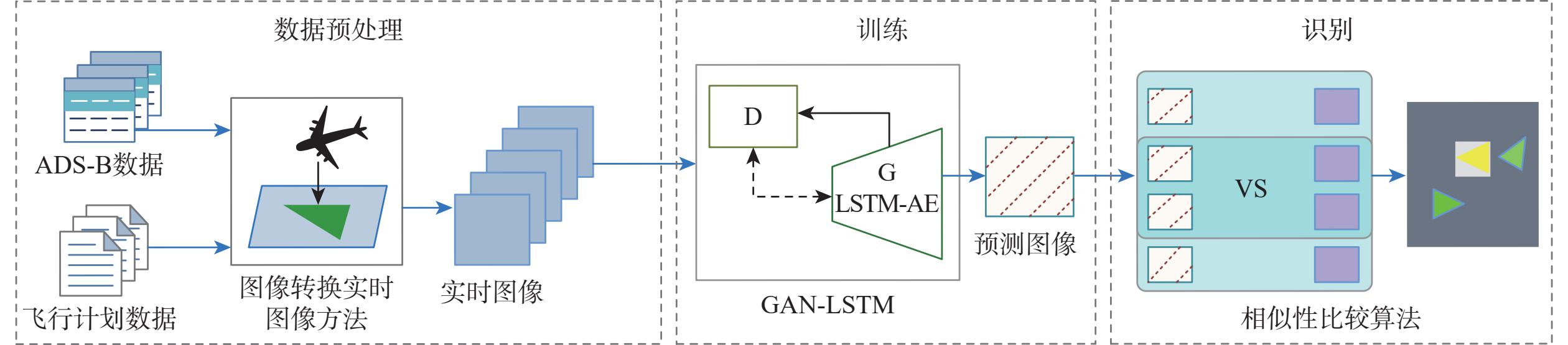
注入通过建模时序数据,能够捕捉序列中的长期依赖与动态行为变化 能有效建模序列数据中的长期依赖关系,适用于飞行状态等具有时序性的行为模式识别 网络结构较为复杂,训练过程计算资源消耗大,且在长序列建模中存在梯度传播效率问题 基于分类思想 GNSS干扰、ADS-B身份欺骗 采用多层神经结构,适合处理时序特征,进行高维特征分类与学习 结构形式灵活,适用于提取高维时序特征,能够高效完成复杂模式的时序分类任务 对时间相关性建模能力有限,难以捕捉数据随时间演化的动态特征 基于数据重构思想 数据篡改攻击、拒绝服务攻击 通过编码解码结构重构输入数据,以重构误差判断样本是否异常 可在缺乏异常标签的情况下实现异常检测 模型对正常数据分布高度依赖,若训练集覆盖不全,容易对异常识别能力产生干扰
下载: 导出CSV
表 11 基于ADS-B异常检测技术的空域监测产品
Table 11. Airspace monitoring products based on ADS-B anomaly detection technology
产品名称 企业 检测对象与粒度 应用场景 优势 局限性 Aireon Safety Dashboard Aireon 空域级指标化监测与趋势分析 面向航空导航服务机构与监管的空域风险监测 星基覆盖广、指标体系完善、支持区域与全球视角、运营成熟 商业化闭源、对接与采购成本较高、细节透明度有限 uAvionix truSky uAvionix 航迹级报文真实性验证与可信度评分 面向无人机超视距任务 低时延服务、提供验证得分、生态集成成熟、易于接入现有管控链路 覆盖度受地面接收网络布局影响、空域级态势需与其他平台联动 Spire Global Aviation GNSS Interference Spire Global 空域级干扰监测与区域告警 面向航空运营者和监管部门,通过API提供ADS-B异常趋势与区域可靠性评估 全球覆盖,支持实时API和自定义区域监测 算法细节和检测标准公开有限,服务费用和对接成本较高 SkAI Data Services GPSwise SkAI Data Services 空域级近实时干扰与疑似欺骗态势图与事件分析 航空公司运控评估、机队层级研判、研究与汇报 近实时可视化、开放生态灵活、易于快速验证与分析 数据完备性与一致性受众包网络密度影响、可靠性低于星基体系
下载: 导出CSV
-
[1] CCOM, DCOM. Nextgen-SESAR state of harmonisation[R/OL]. Luxembourg: Publications Office of the European Union, 2018. https://www.faa.gov/nextgen/nextgen-sesar-state-harmonisation. [2] Çevik N, Akleylek S. SoK of machine learning and deep learning based anomaly detection methods for automatic dependent surveillance-broadcast[J]. IEEE Access, 2024, 12: 35643-35662. [3] Strohmeier M, Lenders V, Martinovic I. On the security of the automatic dependent surveillance-broadcast protocol[J]. IEEE Communications Surveys & Tutorials, 2015, 17(2): 1066-1087. [4] Wu Z J, Shang T, Guo A X. Security issues in automatic dependent surveillance-broadcast (ADS-B): a survey[J]. IEEE Access, 2020, 8: 122147-122167. [5] Hicok D S, Lee D. Application of ADS-B for airport surface surveillance[C]//Proceedings of the 17th Digital Avionics Systems Conference. Piscataway: IEEE Press, 1998, 2: 3401-3408. [6] Corrado S J, Puranik T G, Fischer O P, et al. A clustering-based quantitative analysis of the interdependent relationship between spatial and energy anomalies in ADS-B trajectory data[J]. Transportation Research Part C: Emerging Technologies, 2021, 131: 103331. [7] Zhang J, Liu W, Zhu Y B. Study of ADS-B data evaluation[J]. Chinese Journal of Aeronautics, 2011, 24(4): 461-466. [8] McCallie D, Butts J, Mills R. Security analysis of the ADS-B implementation in the next generation air transportation system[J]. International Journal of Critical Infrastructure Protection, 2011, 4(2): 78-87. [9] Da Silva M, Puys M, Thevenon P H, et al. Automated ICS template for STRIDE microsoft threat modeling tool[C]//Proceedings of the 18th International Conference on Availability, Reliability and Security. New York: ACM, 2023: 1-7. [10] Khan H A, Khan H, Ghafoor S, et al. A survey on security of automatic dependent surveillance-broadcast (ADS-B) protocol: challenges, potential solutions, and future directions[J]. IEEE Communications Surveys & Tutorials, 2025, 27(5): 3199-3226. [11] Chiocchio S, Persia A, Santucci F, et al. Modeling and evaluation of enhanced reception techniques for ADS-B signals in high interference environments[J]. Physical Communication, 2020, 42: 101171. [12] Zhang X L, Li J S. SR-GNN: spectral residuals with graph neural networks for anomaly detection in ADS-B data[C]//Proceedings of the International Conference on Frontiers in Cyber Security. Berlin: Springer, 2024: 503-516. [13] Chevrot A, Vernotte A, Legeard B. CAE: contextual auto-encoder for multivariate time-series anomaly detection in air transportation[J]. Computers & Security, 2022, 116: 102652. [14] Leonardi M, Sirbu G. ADS-B crowd-sensor network and two-step Kalman filter for GNSS and ADS-B cyber-attack detection[J]. Sensors, 2021, 21(15): 4992. [15] Dong C, Zhang Y F, Jia Z Y, et al. Three-dimension collision-free trajectory planning of UAVs based on ADS-B information in low-altitude urban airspace[J]. Chinese Journal of Aeronautics, 2025, 38(2): 103170. [16] Cretin A, Vernotte A, Chevrot A, et al. Test data generation for false data injection attack testing in air traffic surveillance[C]//Proceedings of the IEEE International Conference on Software Testing, Verification and Validation Workshops. Piscataway: IEEE Press, 2020: 143-152. [17] Jheng S L, Jan S S, Chen Y H, et al. 1090 MHz ADS-B-based wide area multilateration system for alternative positioning navigation and timing[J]. IEEE Sensors Journal, 2020, 20(16): 9490-9501.[18] Wang J, Zou Y K, Ding J L. ADS-B spoofing attack detection method based on LSTM[J]. EURASIP Journal on Wireless Communications and Networking, 2020, 2020: 160. [19] Leonardi M. ADS-B anomalies and intrusions detection by sensor clocks tracking[J]. IEEE Transactions on Aerospace and Electronic Systems, 2019, 55(5): 2370-2381. [20] Jansen K, Niu L, Xue N, et al. Trust the crowd: wireless witnessing to detect attacks on ADS-B-based air-traffic surveillance[C]//Proceedings of the Network and Distributed System Security Symposium. [S.l.]: NDSS, 2021. [21] 刘海涛, 刘家祥, 李冬霞, 等. 基于到达时间间隔差的ADS-B位置消息验证方法[J]. 北京航空航天大学学报, 2024(9): 2696-2703.Liu H T, Liu J X, Li D X, et al. Verification scheme of position message for automatic dependent surveillance-broadcast system based on interval difference of arrival[J]. Journal of Beijing University of Aeronautics and Astronautics, 2024(9): 2696-2703(in Chinese). [22] Panda D K, Guo W S. Action robust reinforcement learning for air mobility deconfliction against conflict induced spoofing[J]. IEEE Transactions on Intelligent Transportation Systems, 2024, 25(12): 21343-21355. [23] Wang E S, Song Y S, Xu S, et al. ADS-B anomaly data detection model based on deep learning and difference of Gaussian approach[J]. Transactions of Nanjing University of Aeronautics and Astronautics, 2020, 37(4): 550-561. [24] Çevik N, Akleylek S. Anomaly detection system for ADS-B data: attack vectors and machine learning models[J]. Internet of Things, 2025, 29: 101416. [25] Joseph N S, Banerjee C, Pasiliao E, et al. FlightSense: a spoofer detection and aircraft identification system using raw ADS-B data[C]// Proceedings of the IEEE International Conference on Big Data. Piscataway: IEEE Press, 2020: 3885-3894. [26] Ying X H, Mazer J, Bernieri G, et al. Detecting ADS-B spoofing attacks using deep neural networks[C]//Proceedings of the IEEE Conference on Communications and Network Security. Piscataway: IEEE Press, 2019: 187-195. [27] Strohmeier M, Schäfer M, Lenders V, et al. Realities and challenges of nextgen air traffic management: the case of ADS-B[J]. IEEE Communications Magazine, 2014, 52(5): 111-118. [28] Fried A, Last M. Facing airborne attacks on ADS-B data with autoencoders[J]. Computers & Security, 2021, 109: 102405. [29] Li T Y, Wang B H. Sequential collaborative detection strategy on ADS-B data attack[J]. International Journal of Critical Infrastructure Protection, 2019, 24: 78-99. [30] Melvyn P, Couturier R, Ambert F, et al. Detecting ghost aircraft flooding in the surveillance of low-flying civil and military aircraft[C]//Proceedings of the 4th International Conference on Computer, Control and Robotics. Piscataway: IEEE Press, 2024: 328-332. [31] Vajrobol V, Saxena G J, Singh S, et al. Enhancing aviation control security through ADS-B injection detection using ensemble meta-learning models with Explainable AI[J]. Alexandria Engineering Journal, 2025, 112: 63-73. [32] Li T Y, Wang B H, Shang F T, et al. Dynamic temporal ADS-B data attack detection based on sHDP-HMM[J]. Computers & Security, 2020, 93: 101789. [33] Jasra S K, Valentino G, Muscat A, et al. Hybrid machine learning-statistical method for anomaly detection in flight data[J]. Applied Sciences, 2022, 12(20): 10261. [34] Li T Y, Wang B H, Shang F T, et al. Online sequential attack detection for ADS-B data based on hierarchical temporal memory[J]. Computers & Security, 2019, 87: 101599. [35] Li T Y, Wang B H, Shang F T, et al. ADS-B data attack detection based on generative adversarial networks[C]//Proceedings of the 11th International Symposium on Cyberspace Safety and Security. Berlin: Springer, 2019: 323-336. [36] Karam R, Salomon M, Couturier R. A comparative study of deep learning architectures for detection of anomalous ADS-B messages[C]//Proceedings of the 7th International Conference on Control, Decision and Information Technologies. Piscataway: IEEE Press, 2020: 241-246. [37] Cao Y P, Cao J W, Zhou Z G, et al. Aircraft track anomaly detection based on MOD-Bi-LSTM[J]. Electronics, 2021, 10(9): 1007. [38] Zha H R, Tian Q, Lin Y. Real-world ADS-B signal recognition based on radio frequency fingerprinting[C]//Proceedings of the IEEE 28th International Conference on Network Protocols. Piscataway: IEEE Press, 2020: 1-6. [39] Zhang Z C, Li G Y, Shi J T, et al. Real-world aircraft recognition based on RF fingerprinting with few labeled ADS-B signals[J]. IEEE Transactions on Vehicular Technology, 2024, 73(2): 2866-2871. [40] Zhong L F, Yang H, Zhang L, et al. Spoofing attack detection in ADS-B data through frequency enhanced patch attention mechanism[C]//Proceedings of the 6th International Conference on Electronic Engineering and Informatics. Piscataway: IEEE Press, 2024: 999-1003. [41] Nicolussi A, Tanner S, Wattenhofer R. Aircraft fingerprinting using deep learning[C]//Proceedings of the 28th European Signal Processing Conference. Piscataway: IEEE Press, 2021: 740-744. [42] Kacem T, Wijesekera D, Costa P. ADS-Bsec: a holistic framework to secure ADS-B[J]. IEEE Transactions on Intelligent Vehicles, 2018, 3(4): 511-521. [43] Naganawa J, Tajima H, Miyazaki H, et al. ADS-B anti-spoofing performance of monopulse technique with sector antennas[C]//Proceedings of the IEEE Conference on Antenna Measurements & Applications. Piscataway: IEEE Press, 2017: 87-90. [44] Shang F T, Wang B H, Yan F H, et al. Multidevice false data injection attack models of ADS-B multilateration systems[J/OL]. Security and Communication Networks, 2019. https://doi.org/10.1155/2019/8936784. [45] Darabseh A, AlKhzaimi H, Pöpper C. MAVPro: ADS-B message verification for aviation security with minimal numbers of on-ground sensors[C]//Proceedings of the 13th ACM Conference on Security and Privacy in Wireless and Mobile Networks. New York: ACM, 2020: 53-64. [46] Zhao D X, Sun J L, Gui G. En-route multilateration system based on ADS-B and TDOA/AOA for flight surveillance systems[C]// Proceedings of the IEEE 91st Vehicular Technology Conference. Piscataway: IEEE Press, 2020: 1-6. [47] Chai Y E, Liu M Q, Zheng W X, et al. False signal identification of ADS-B assisted by UAV cooperative localization[J]. Chinese Journal of Aeronautics, 2025, 38(10): 103439. [48] 王布宏, 罗鹏, 李腾耀, 等. 基于粒子群优化多核支持向量数据描述的广播式自动相关监视异常数据检测模型[J]. 电子与信息学报, 2020, 42(11): 2727-2734.Wang B H, Luo P, Li T Y, et al. ADS-B anomalous data detection model based on PSO-MKSVDD[J]. Journal of Electronics & Information Technology, 2020, 42(11): 2727-2734(in Chinese). [49] Lukeš P, Matejovie M. Detecting outlier positions in publicly available ADS-B data sets[C]//Proceedings of the New Trends in Civil Aviation. Piscataway: IEEE Press, 2024: 19-25. [50] Li J H, Zhou Y Z. Automatic dependent surveillance-broadcast deceptive jamming detection method based on track data[J]. Journal of Circuits, Systems and Computers, 2024, 33(12): 2450203. [51] Khan H, Khan H, Ghafoor S. Securing ADS-B communications through a novel authentication framework[PP/OL]. TechRxiv (2023-08-29)[2025-08-01]. https://doi.org/10.36227/techrxiv.24043494.v1. [52] Dabit A, Al-Fayoumi M, Mahmoud K. A secure regional authentication layer for global ADS-B communications[C]//Proceedings of the International Jordanian Cybersecurity Conference. Piscataway: IEEE Press, 2024: 99-104. [53] Chen X, He D B, Peng C, et al. A secure and effective hierarchical identity-based signature scheme for ADS-B systems[J]. IEEE Transactions on Aerospace and Electronic Systems, 2024, 60(4): 5157-5168. [54] Yao C, Zhang X J, Liu Y Z, et al. Blockchain-based secure and efficient ADS-B authentication via certificateless signature with packet loss tolerance[J]. IEEE Internet of Things Journal, 2025, 12(8): 10574-10588. [55] Habler E, Shabtai A. Analyzing sequences of airspace states to detect anomalous traffic conditions[J]. IEEE Transactions on Aerospace and Electronic Systems, 2022, 58(3): 1843-1857. [56] Ji Y F, Wang L W, Wu W L, et al. A method for LSTM-based trajectory modeling and abnormal trajectory detection[J]. IEEE Access, 2020, 8: 104063-104073. [57] Yue M, Zheng H, Cui H R, et al. GAN-LSTM-based ADS-B attack detection in the context of air traffic control[J]. IEEE Internet of Things Journal, 2023, 10(14): 12651-12665. [58] Cai K Q, Di Z, Zhu Y B, et al. An attention-based convolutional network framework for detection and localization of GNSS interference sources[J]. IEEE Transactions on Aerospace and Electronic Systems, 2024, 60(3): 2995-3011. [59] Heiselberg P, Sørensen K A, Heiselberg H. Aircraft detection and state estimation[C]//Proceedings of the IEEE International Geoscience and Remote Sensing Symposium. Piscataway: IEEE Press, 2024: 7693-7696. [60] Zheng Y F, Zhang X J, Tan Y H, et al. Transformer-based identification for ADS-B transmitters in open-time sets[J]. Chinese Journal of Aeronautics, 2025, 38(8): 103418. [61] Li T T, Wen Z Y, Jin C D, et al. Meta-RFF: meta-task adaptive-based few-shot open-set incremental learning for RF fingerprint recognition[J]. IEEE Transactions on Cognitive Communications and Networking, 2026, 12: 2115-2130. [62] Habler E, Shabtai A. Using LSTM encoder-decoder algorithm for detecting anomalous ADS-B messages[J]. Computers & Security, 2018, 78: 155-173. [63] Luo P, Wang B H, Li T Y, et al. ADS-B anomaly data detection model based on VAE-SVDD[J]. Computers & Security, 2021, 104: 102213. [64] 丁建立, 张琪琪, 王静, 等. 基于Transformer-VAE的ADS-B异常检测方法[J]. 系统工程与电子技术, 2023, 45(11): 3680-3689.Ding J L, Zhang Q Q, Wang J, et al. ADS-B anomaly detection method based on Transformer-VAE[J]. Systems Engineering and Electronics, 2023, 45(11): 3680-3689(in Chinese). [65] Luo P, Wang B H, Tian J W. TTSAD: TCN-Transformer-SVDD model for anomaly detection in air traffic ADS-B data[J]. Computers & Security, 2024, 141: 103840. [66] Nasser H. Use of ADS-B for GNSS RFI monitoring[R]. [S.l.]: IDM, 2022. [67] Liu J, Liu Y, Lin J Y, et al. Networking systems for video anomaly detection: a tutorial and survey[J]. ACM Computing Surveys, 2025, 57(10): 1-37. [68] Luo P, Wang B H, Tian J W, et al. ADS-Bpois: poisoning attacks against deep-learning-based air traffic ADS-B unsupervised anomaly detection models[J]. IEEE Internet of Things Journal, 2024, 11(23): 38301-38311. [69] Shang F T, Wang B H, Li T Y, et al. Adversarial examples on deep-learning-based ADS-B spoofing detection[J]. IEEE Wireless Communications Letters, 2020, 9(10): 1734-1737. [70] Wang C, Wang Z D, Dong H L, et al. Fusionformer: a novel adversarial Transformer utilizing fusion attention for multivariate anomaly detection[J]. IEEE Transactions on Neural Networks and Learning Systems, 2025, 36(8): 14479-14492. [71] Entezami A, Sarmadi H, Behkamal B, et al. Early warning of structural damage via manifold learning-aided data clustering and non-parametric probabilistic anomaly detection[J]. Mechanical Systems and Signal Processing, 2025, 224: 111984. [72] Zhang H, Wang Z, Zeng D, et al. DiffusionAD: norm-guided one-step denoising diffusion for anomaly detection[J]. IEEE Transactions on Pattern Analysis and Machine Intelligence, 2025, 47(8): 7140-7152. [73] Lin Y X, Chang Y, Tong X, et al. A survey on RGB, 3D, and multimodal approaches for unsupervised industrial image anomaly detection[J]. Information Fusion, 2025, 121: 103139. [74] 王布宏, 罗鹏, 阳勇, 等. 空中交通管理系统网络安全研究综述与展望[J]. 电子与信息学报, 2025, 47(5): 1230-1265.Wang B H, Luo P, Yang Y, et al. A review and prospect of cybersecurity research on air traffic management systems[J]. Journal of Electronics & Information Technology, 2025, 47(5): 1230-1265(in Chinese). [75] He H Y, Zhang J N, Chen H X, et al. A diffusion-based framework for multi-class anomaly detection[J]. Proceedings of the AAAI Conference on Artificial Intelligence, 2024, 38(8): 8472-8480. [76] Liu Q H, Paparrizos J. The elephant in the room: towards a reliable time-series anomaly detection benchmark[C]//Proceedings of the 38th International Conference on Neural Information Processing Systems. New York: ACM, 2024: 108231-108261. -

 下载:


计量
- 文章访问数: 404
- HTML全文浏览量: 152
- PDF下载量: 197
- 被引次数: 0
