





Nonaffine control of helicopter engine failure based on adaptive deep belief network
-
摘要:
针对直升机在动力失效条件下表现出的强非线性、非仿射特性及参数不确定性问题,提出基于自适应深度置信网络(ADBN)的非仿射智能控制方法。建立直升机六自由度刚体标称模型,并推导动力失效情况下的非仿射动力学模型;设计状态观测器以实现状态估计与调节,并利用ADBN逼近未知非线性项,从而增强模型的表达能力和泛化性能;在此基础上,结合自适应律构造非仿射控制器,以提升系统在不确定性和外部扰动下的鲁棒性。通过仿真验证了所提方法的有效性和优越性,结果表明:所提方法能够在参数未知和环境扰动存在的情况下保持较高的姿态稳定性、速度稳定性和轨迹跟踪精度。研究结果为直升机在极端工况下的安全控制提供了一种新的思路和技术途径。
Abstract:This research presents a nonaffine intelligent control approach based on an adaptive deep belief network (ADBN) to solve the significant nonlinearity, nonaffine features, and parameter uncertainties displayed by helicopters during power-failure scenarios. First, a nominal six-degree-of-freedom rigid-body model of the helicopter is established, and the corresponding nonaffine dynamic model under power failure is derived. The model representation capacity and generalization performance are then improved by using the ADBN to approximate unknown nonlinear factors and a state observer to do state estimation and control. On this basis, a nonaffine controller is constructed in conjunction with adaptive laws to improve the robustness of the system against uncertainties and external disturbances. Finally, simulation results are provided to verify the effectiveness and superiority of the proposed method. The results demonstrate that the proposed control scheme is capable of maintaining satisfactory attitude stability, velocity regulation, and trajectory tracking accuracy in the presence of unknown parameters and environmental disturbances. The proposed approach offers a new technical solution for the safe control of helicopters operating under extreme conditions.
-
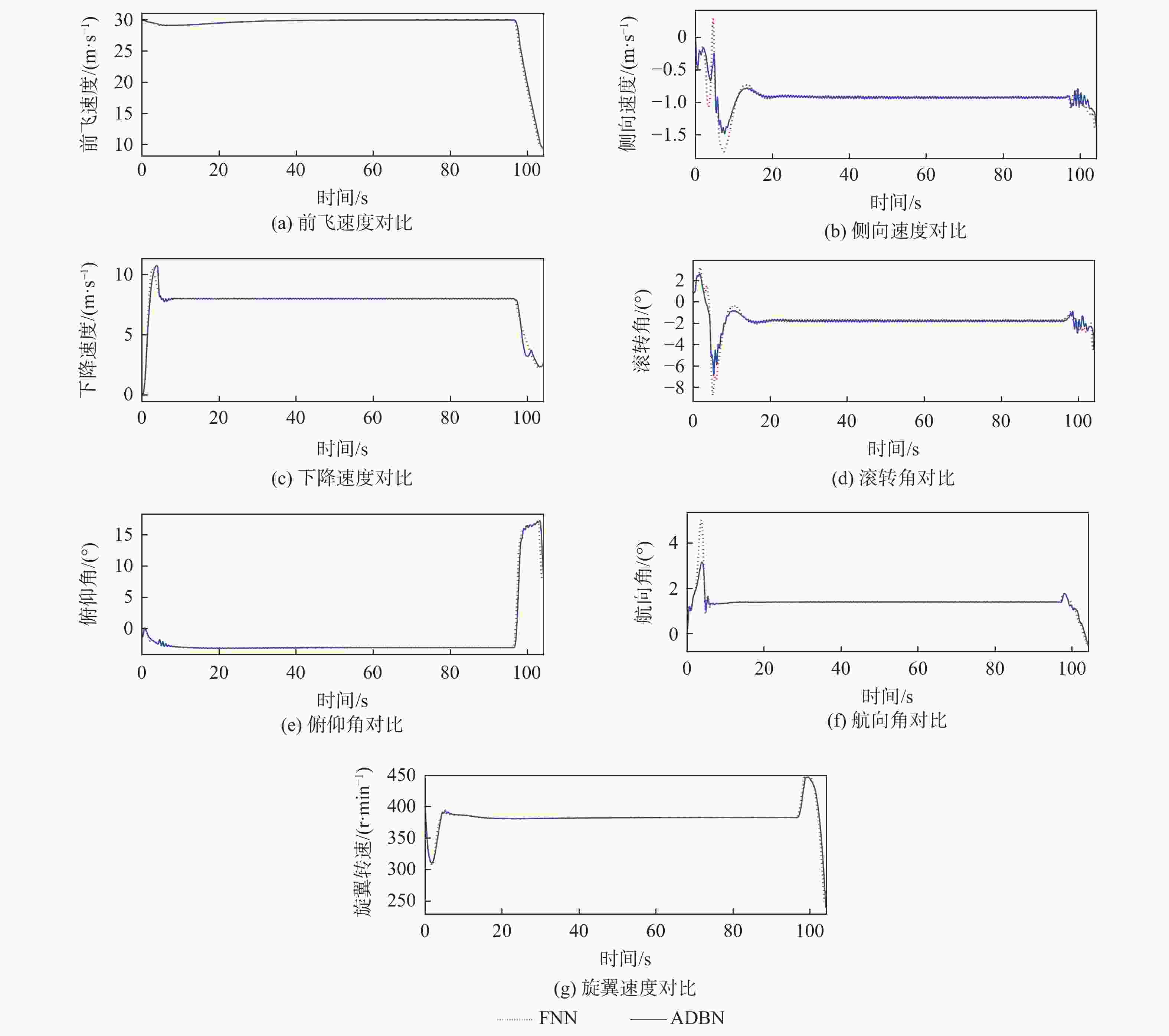
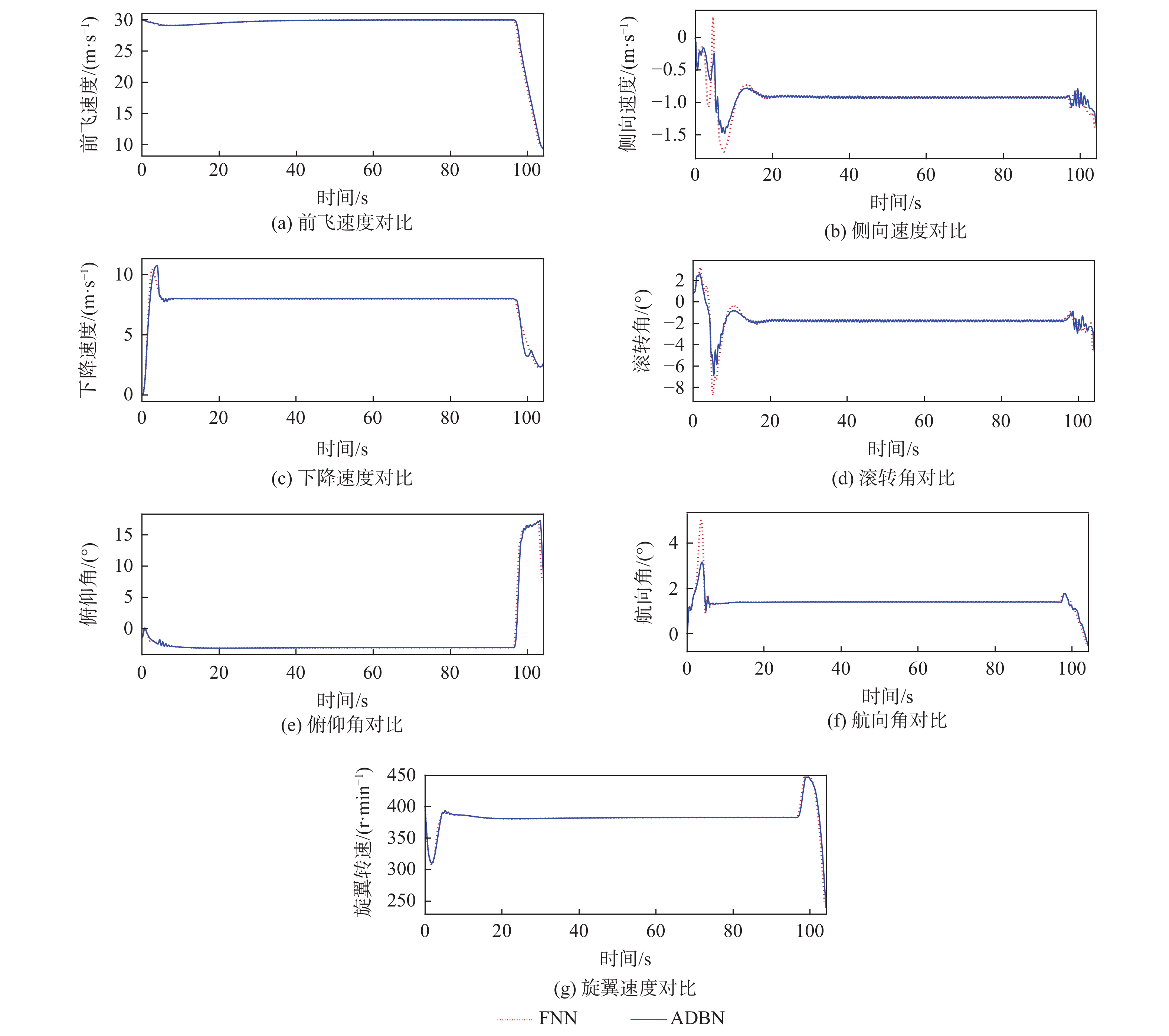
图 5 无扰动直线下降飞行仿真结果
Figure 5. Simulation results of undisturbed straight-line descent flight
-
[1] Chen H Z, Tian J, Nie S C, et al. Research on autorotation flight control technology of unmanned helicopters[C]//Proceedings of the 2023 International Conference on Computer Science and Automation Technology. Piscataway: IEEE Press, 2024: 488-492. [2] 屈天祥, 滕飞, 傅春啸, 等. 小型无人直升机自转建模与控制策略研究[J]. 机械与电子, 2022, 40(2): 45-49.Qu T X, Teng F, Fu C X, et al. Autorotation modeling of small unmanned helicopter and control strategy research[J]. Machinery & Electronics, 2022, 40(2): 45-49(in Chinese). [3] 张辽, 张允昌, 李威, 等. 直升机旋翼自转状态飞行仿真建模研究[J]. 系统仿真学报, 2013, 25(增刊1): 17-20.Zhang L, Zhang Y C, Li W, et al. Study on simulation modeling for flight process of helicopter with rotor autorotation[J]. Journal of System Simulation, 2013, 25(Sup 1): 17-20(in Chinese). [4] 韦康瑞, 周旭, 招启军, 等. 直升机自转下滑飞行力学建模与控制器设计[J]. 飞行力学, 2024, 42(4): 35-40.Wei K R, Zhou X, Zhao Q J, et al. Helicopter flight dynamic modeling and controller design during autorotation glide[J]. Flight Dynamics, 2024, 42(4): 35-40(in Chinese). [5] Zhao Y Y, Jhemi A A, Chen R T N. Optimal vertical takeoff and landing helicopter operation in one engine failure[J]. Journal of Aircraft, 1996, 33(2): 337-346. [6] Zhao Y Y, Chen R T N. Critical considerations for helicopters during runway takeoffs[J]. Journal of Aircraft, 1995, 32(4): 773-781. [7] Matlala P, Pedro J O. Design of DDP controller for autonomous autorotative landing of RWUAV following an engine failure[C]//Proceedings of the 2016 IEEE Conference on Control Applications. Piscataway: IEEE Press, 2016: 9-14. [8] Sanci M E, Uçak K, Günel G Ö. A novel adaptive LSSVR-based inverse optimal controller with integrator for nonlinear non-affine systems[J]. IEEE Access, 2023, 11: 137548-137576. [9] Liu W, Zhao J R. Fuzzy adaptive control for a class of uncertain nonlinear pure-feedback systems with full state constraints[C]//Proceedings of the 2018 Chinese Automation Congress. Piscataway: IEEE Press, 2019: 1-6. [10] Wang X, Guedes Soares C. Direct adaptive neural network control for ship manoeuvring modelling group model-based uncertain nonlinear systems in non-affine pure-feedback form[J]. IEEE Access, 2020, 8: 3272-3284. [11] Mishra P K, Dhar N K, Verma N K. Adaptive neural-network control of MIMO nonaffine nonlinear systems with asymmetric time-varying state constraints[J]. IEEE Transactions on Cybernetics, 2021, 51(4): 2042-2054. [12] Wang D, Hu L Z, Li X L, et al. Online fault-tolerant tracking control with adaptive critic for nonaffine nonlinear systems[J]. IEEE/CAA Journal of Automatica Sinica, 2025, 12(1): 215-227. [13] Zhang E Z, Huang Q N, Wei Z Q, et al. H∞ robust fault-tolerant control of a six-rotor UAV containing sensor faults and actuator non-affine faults[J]. IEEE Access, 2023, 11: 138773-138787. [14] Yang X, Li B, Wen G X. Adaptive neural network optimized control using reinforcement learning of critic-actor architecture for a class of non-affine nonlinear systems[J]. IEEE Access, 2021, 9: 141758-141765. [15] Wen G X, Ge S S, Tu F W. Optimized backstepping for tracking control of strict-feedback systems[J]. IEEE Transactions on Neural Networks and Learning Systems, 2018, 29(8): 3850-3862. [16] Wen G X, Chen C L P, Ge S S. Simplified optimized backstepping control for a class of nonlinear strict-feedback systems with unknown dynamic functions[J]. IEEE Transactions on Cybernetics, 2021, 51(9): 4567-4580. [17] Hu Y F, Zhang C, Wang B, et al. Noise-tolerant ZNN-based data-driven iterative learning control for discrete nonaffine nonlinear MIMO repetitive systems[J]. IEEE/CAA Journal of Automatica Sinica, 2024, 11(2): 344-361. [18] Yu Q X, Hou Z S, Bu X H, et al. RBFNN-based data-driven predictive iterative learning control for nonaffine nonlinear systems[J]. IEEE Transactions on Neural Networks and Learning Systems, 2020, 31(4): 1170-1182. [19] 招启军, 徐国华, 王博. 直升机空气动力学[M]. 北京: 科学出版社, 2024.Zhao Q J, Xu G H, Wang B. Helicopter aerodynamics[M]. Beijing: Science Press, 2024(in Chinese). [20] Hinton G E, Osindero S, Teh Y W. A fast learning algorithm for deep belief nets[J]. Neural Computation, 2006, 18(7): 1527-1554. [21] Bengio Y, Delalleau O. Justifying and generalizing contrastive divergence[J]. Neural Computation, 2009, 21(6): 1601-1621. [22] Wang G M, Qiao J F, Bi J, et al. An adaptive deep belief network with sparse restricted Boltzmann machines[J]. IEEE Transactions on Neural Networks and Learning Systems, 2020, 31(10): 4217-4228. [23] Song G, Tao G. Partial-state feedback multivariable MRAC and reduced-order designs[J]. Automatica, 2021, 129: 109622. [24] 孙笑云, 吴树范, 沈强. 包含有界切换增益的空间惯性传感器输出调节积分模型参考自适应控制[J]. 中国科学: 技术科学, 2024, 54(3): 490-500.Sun X Y, Wu S F, Shen Q. Output regulation based integral model reference adaptive control with bounded switching gain for space inertial sensor[J]. SCIENTIA SINICA Technologica, 2024, 54(3): 490-500(in Chinese). [25] Cui D, Ahn C K, Xiang Z R. Fault-tolerant fuzzy observer-based fixed-time tracking control for nonlinear switched systems[J]. IEEE Transactions on Fuzzy Systems, 2023, 31(12): 4410-4420. [26] Li Z J, Yue D, Ma Y J, et al. Neural-networks-based prescribed tracking for nonaffine switched nonlinear time-delay systems[J]. IEEE Transactions on Cybernetics, 2022, 52(7): 6579-6590. [27] Xue M Q, Tang Y, Ren W, et al. Practical consensus tracking of asynchronously switched multiagent systems[J]. IEEE Transactions on Automatic Control, 2024, 69(11): 7758-7772. [28] Hua C C, Tian W, Li Q D. Switching event-triggered fixed-time control for uncertain high-order nonlinear systems[J]. IEEE Transactions on Automatic Control, 2024, 69(7): 4742-4749. [29] Meng X Z, Mei J, Miao Z B, et al. Fully distributed consensus of multiple Euler-Lagrange systems under switching directed graphs using only position measurements[J]. IEEE Transactions on Automatic Control, 2024, 69(3): 1781-1788. [30] Tan C, Tao G, Qi R Y, et al. A direct MRAC based multivariable multiple-model switching control scheme[J]. Automatica, 2017, 84: 190-198. -

 下载:
下载:

 点击查看大图
计量
- 文章访问数: 235
- HTML全文浏览量: 138
- PDF下载量: 5
- 被引次数: 0
