





Spacecraft attitude reorientation with dynamic forbidden zones based on a teardrop-shaped artificial potential function
-
摘要:
针对航天器需实时规避多个动态禁止指向区域的技术难题,提出基于水滴形排斥人工势函数的姿态轨迹规划方法。区别于传统将天体视为静止禁区的假设,聚焦深空探测器规避微流星体撞击和低轨卫星避免高轨卫星光反射干扰等典型场景,通过分析微流星体超高速特性及卫星间相对角速度差异,构建了准确描述禁止指向约束动态演化的数学模型。突破传统圆形均匀排斥势场局限,提出水滴形自适应势函数,根据航天器与禁区的接近角度实时调整势场强度分布,在威胁方向增强排斥、远离方向适当减弱,避免过度保守;引入基于历史状态的运动趋势预测函数,通过分析相对运动特性实现风险预判和主动规避;设计排斥势函数系数正负可调的短路径绕行策略,使航天器能灵活选择远离式避障或贴边绕行模式。通过单/多敏感器和单/多动态禁区等复杂场景仿真验证,结果表明:所提方法在避障成功率、路径优化和能量消耗等关键指标上均优于传统方法,显著提升了航天器在动态环境中的预见性和避障性能。研究成果为解决动态约束下的航天器姿态控制问题提供了新的理论基础和实用化技术方案,对提高航天器自主避障能力具有重要工程应用价值。
Abstract:To address the challenge of spacecraft navigating multiple dynamic forbidden-pointing zones, this study proposes an attitude trajectory planning method based on a teardrop-shaped repulsive artificial potential function. This paper examines situations where a low-orbiting satellite must avoid light reflections from a high-orbiting satellite and where the surface of a deep space probe must avoid the direction of micrometeoroid impacts, in contrast to the conventional assumption that celestial bodies are static forbidden zones. Based on the high-speed characteristics of micrometeoroids and the angular velocity differences between satellites, a dynamic forbidden zone model is constructed. Building on the traditional uniform repulsive circle potential function, an innovative teardrop potential function is proposed, enabling the potential field to dynamically adapt to the approach angle between the spacecraft and the forbidden zone. A motion trend function is also introduced to characterize the relative motion characteristics. Furthermore, a short-path detour strategy with adjustable repulsive potential function coefficients is designed, enabling the spacecraft to flexibly switch obstacle avoidance directions based on actual needs. According to simulation results, this approach greatly enhances spacecraft predictability and obstacle avoidance performance in complex and dynamic settings, offering significant theoretical and engineering application value for attitude control under dynamic constraints.
-
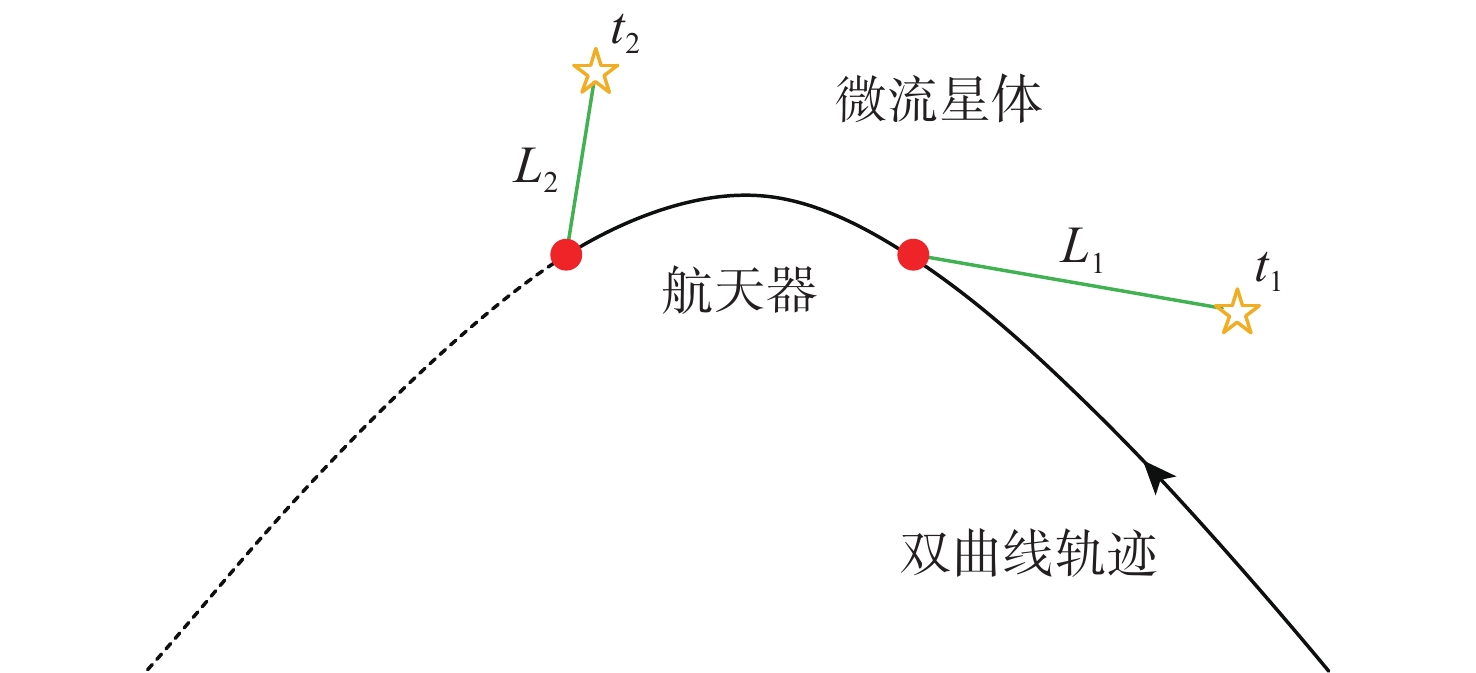
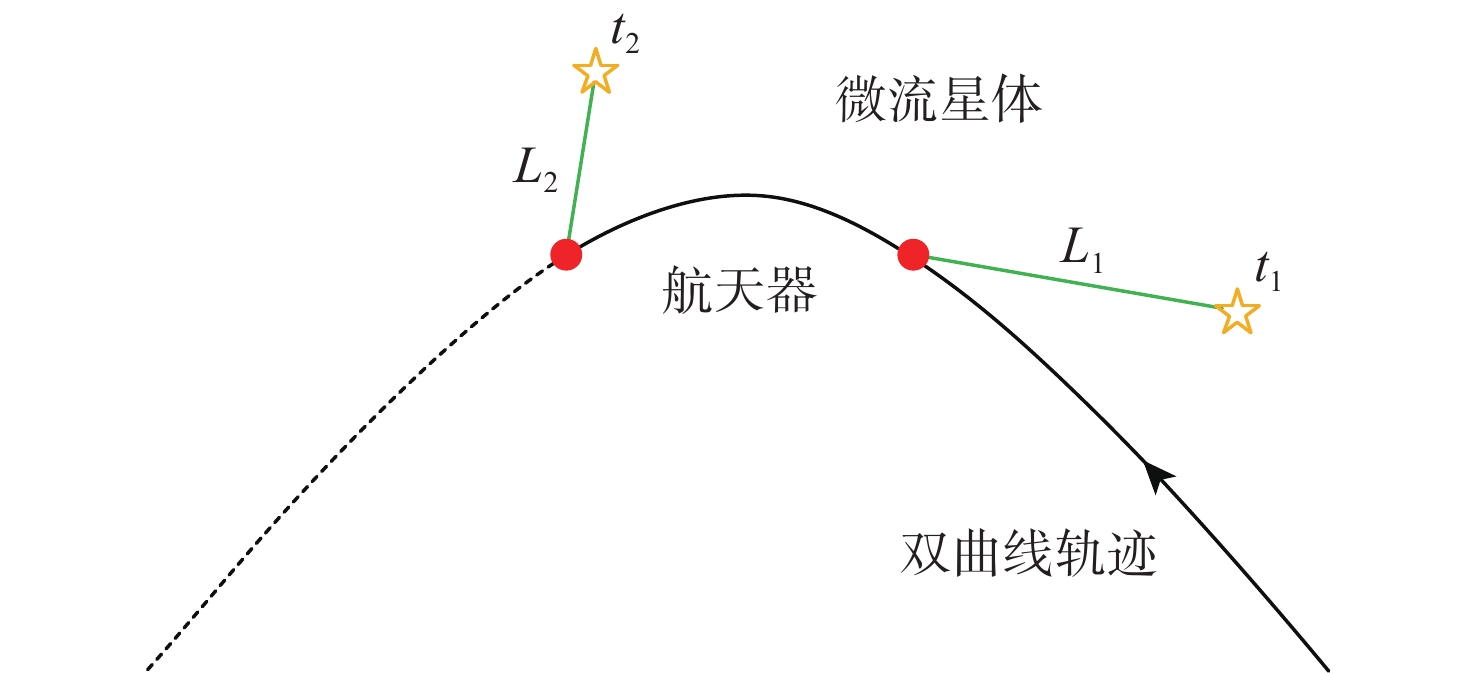
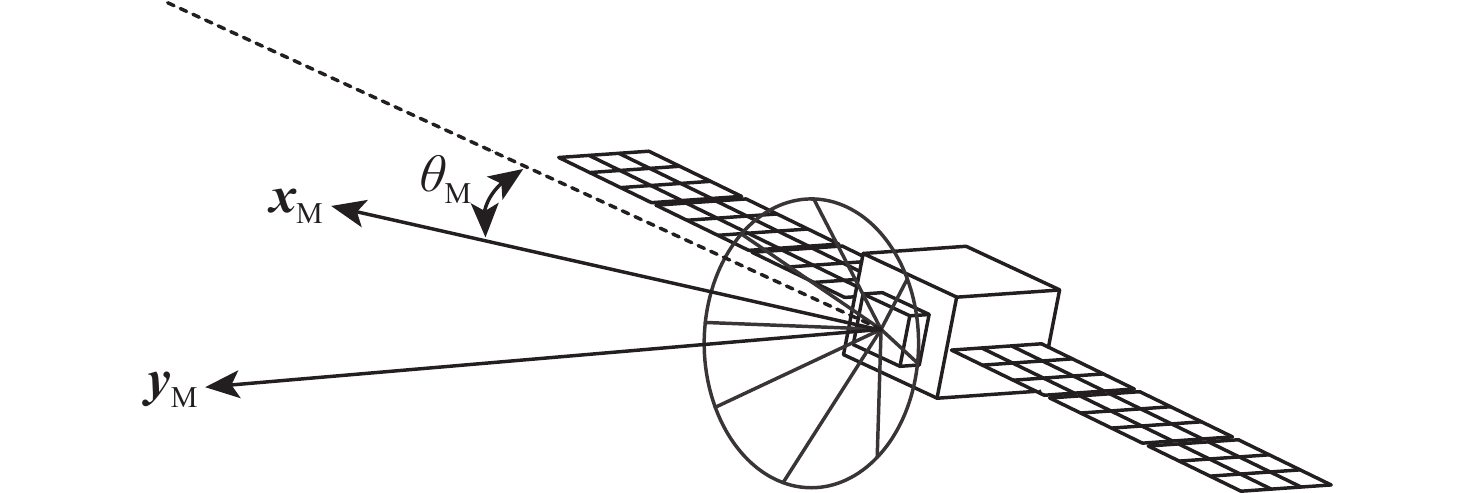
图 3 深空探测器和禁区在t1、t2时刻的动态演化示意图
Figure 3. Dynamics of deep space probe and forbidden zone at time t1 and t2
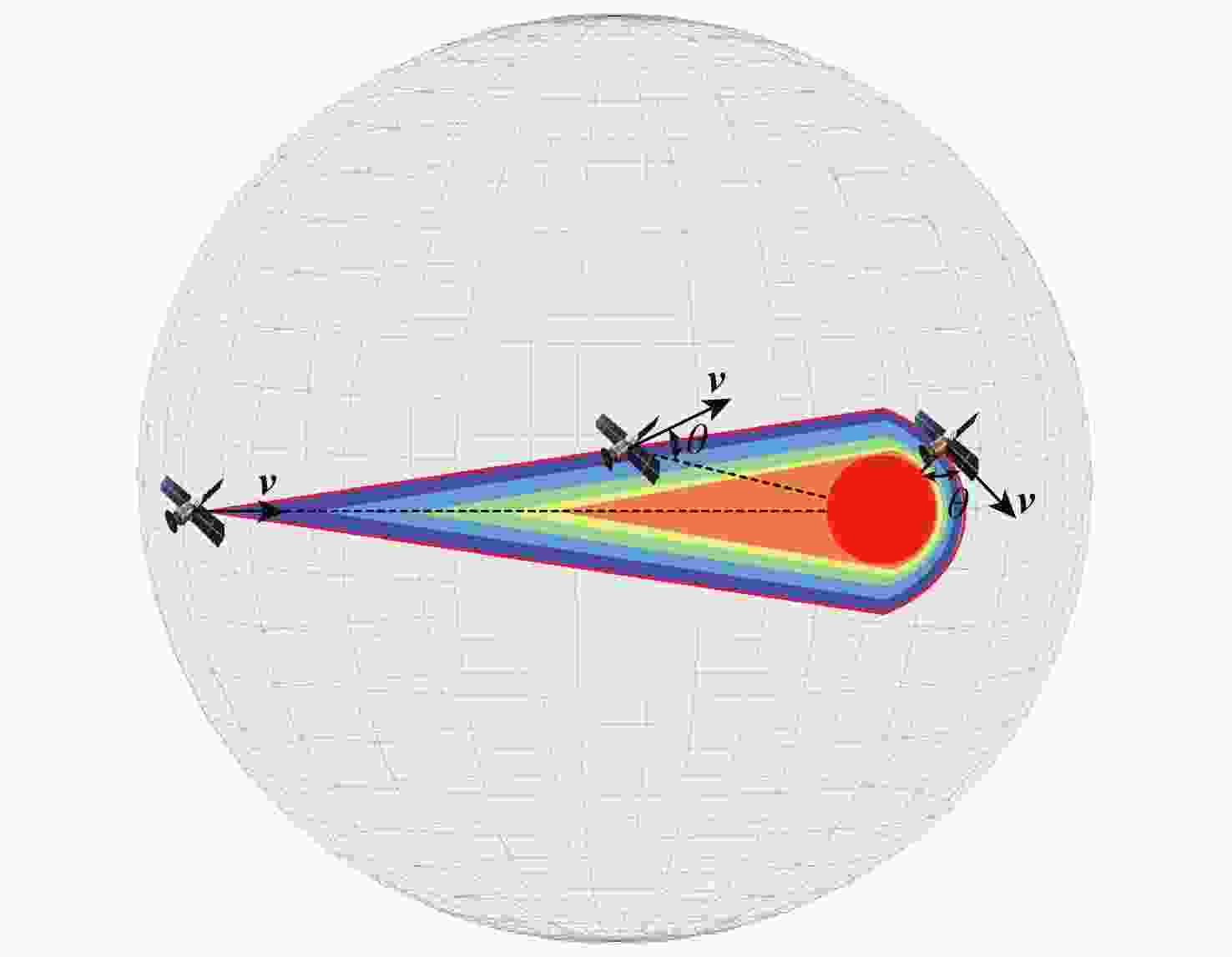
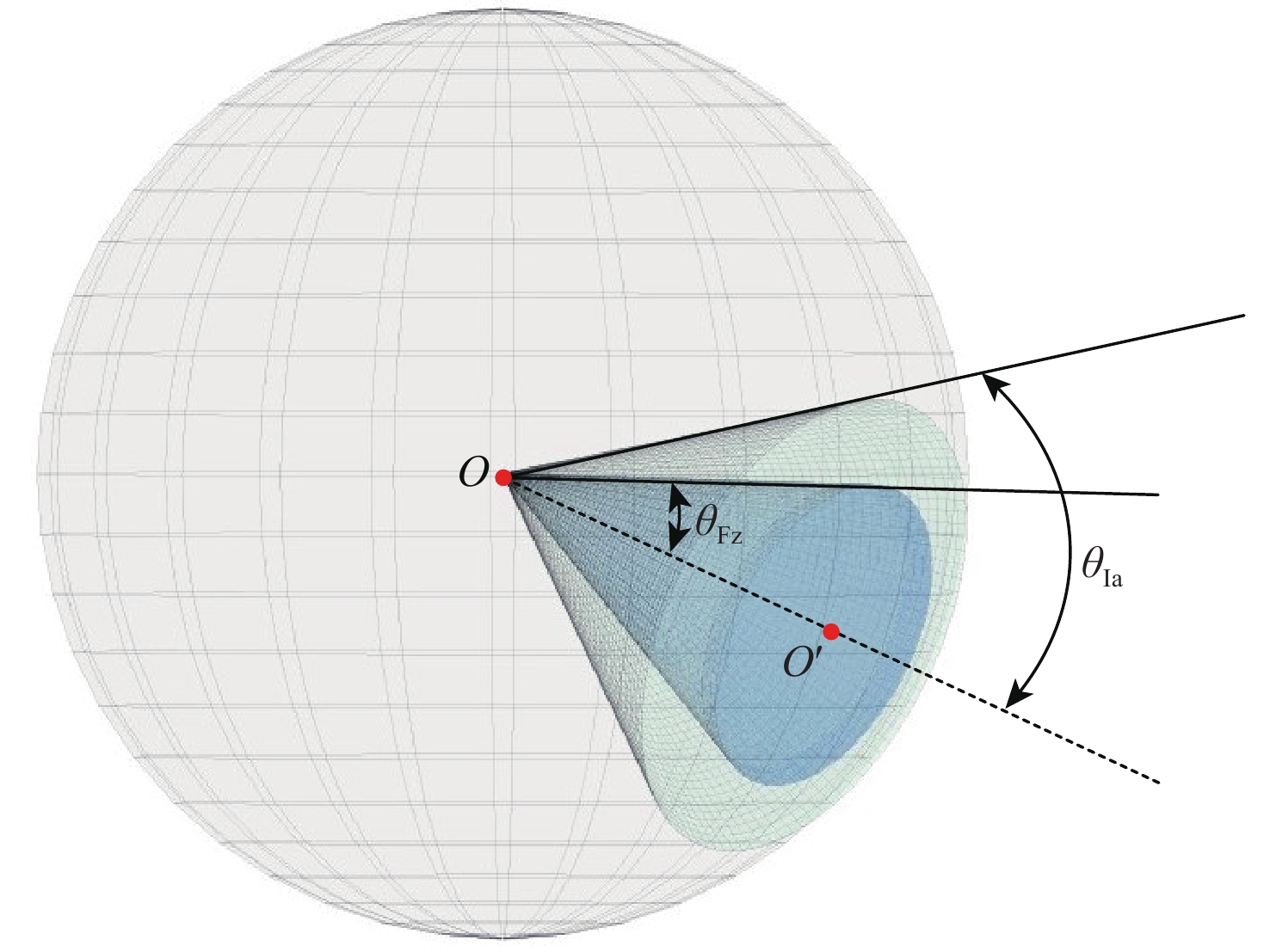
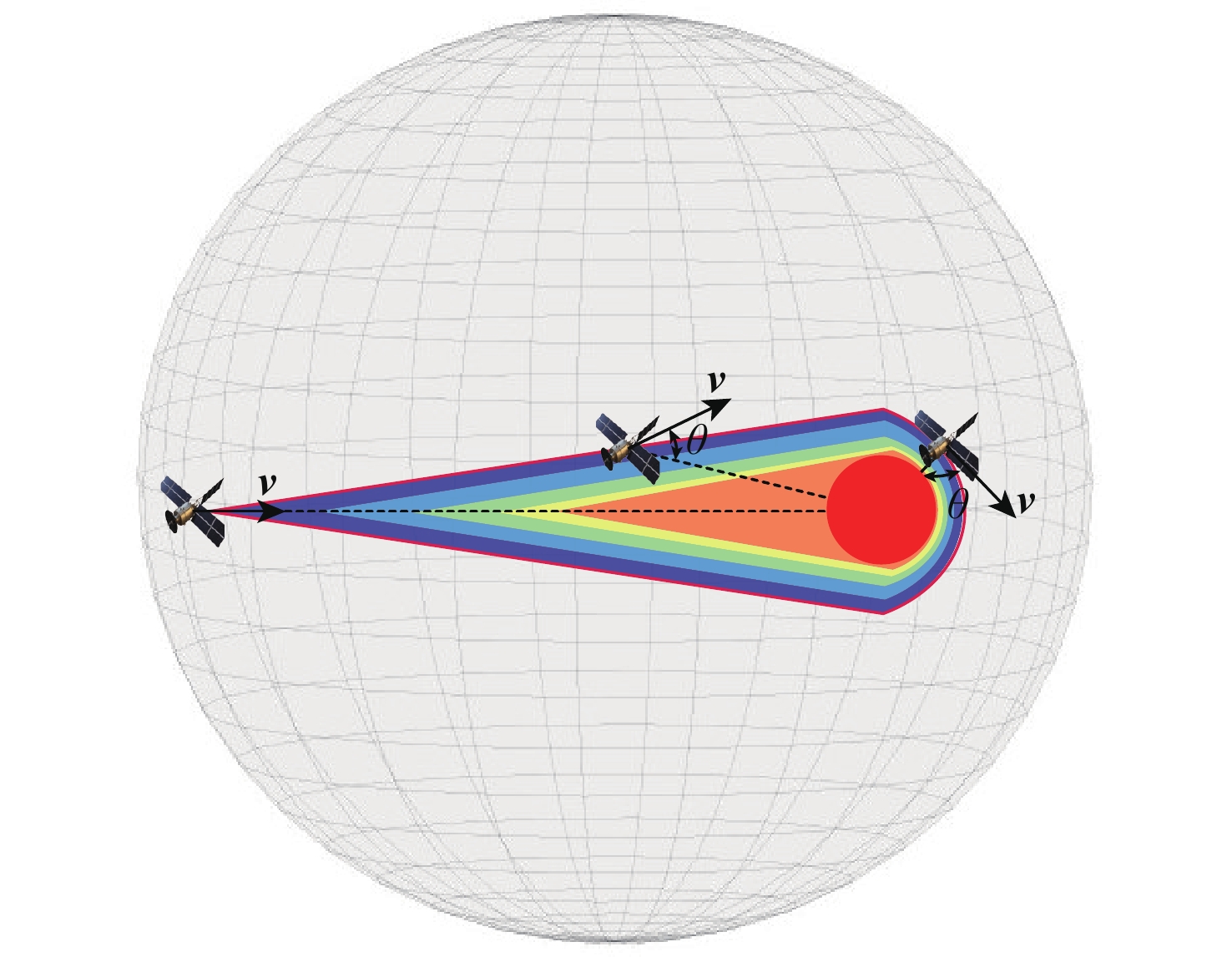
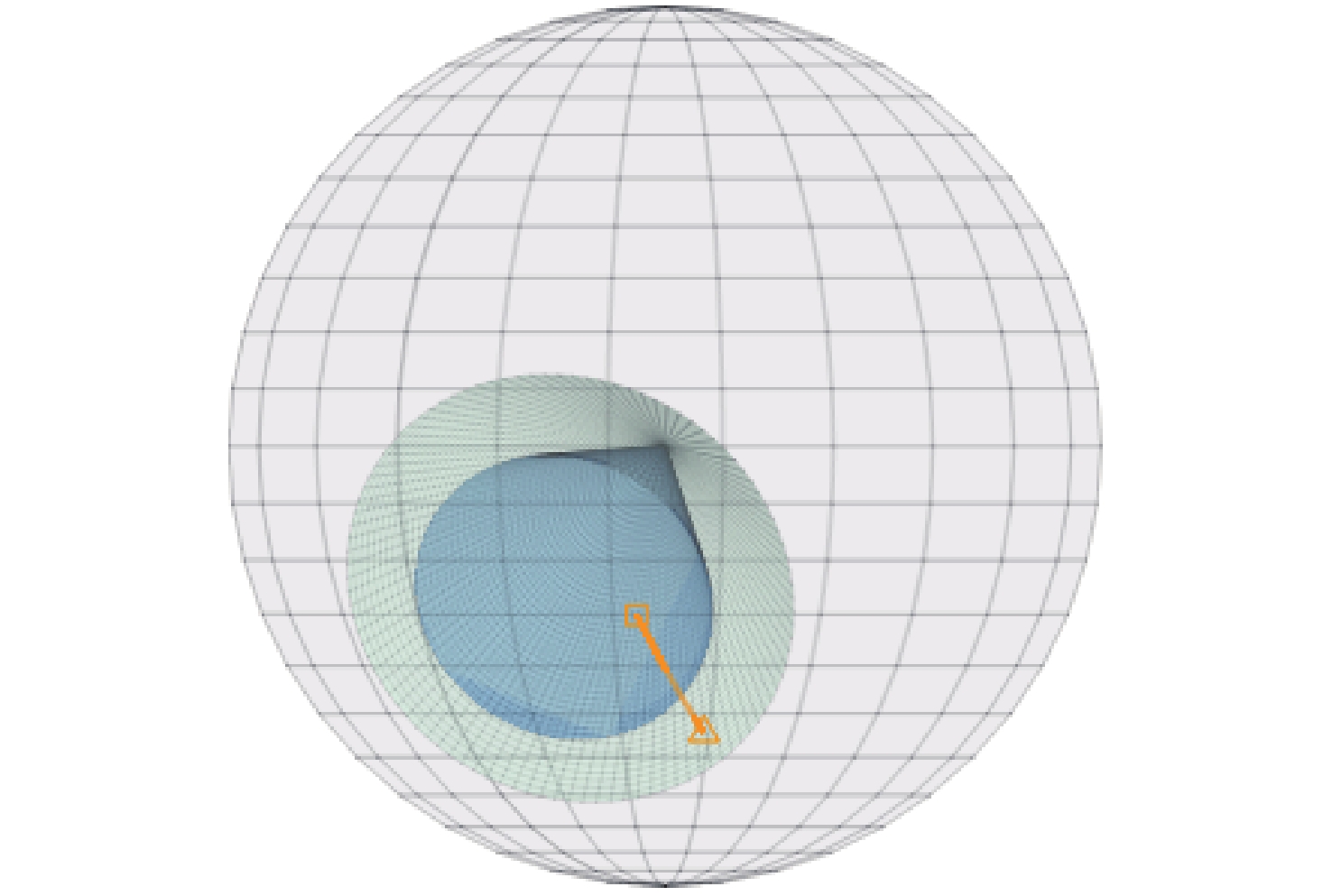
图 8 水滴形斥力势场示意图
Figure 8. Schematic diagram of water droplet type repulsive potential field
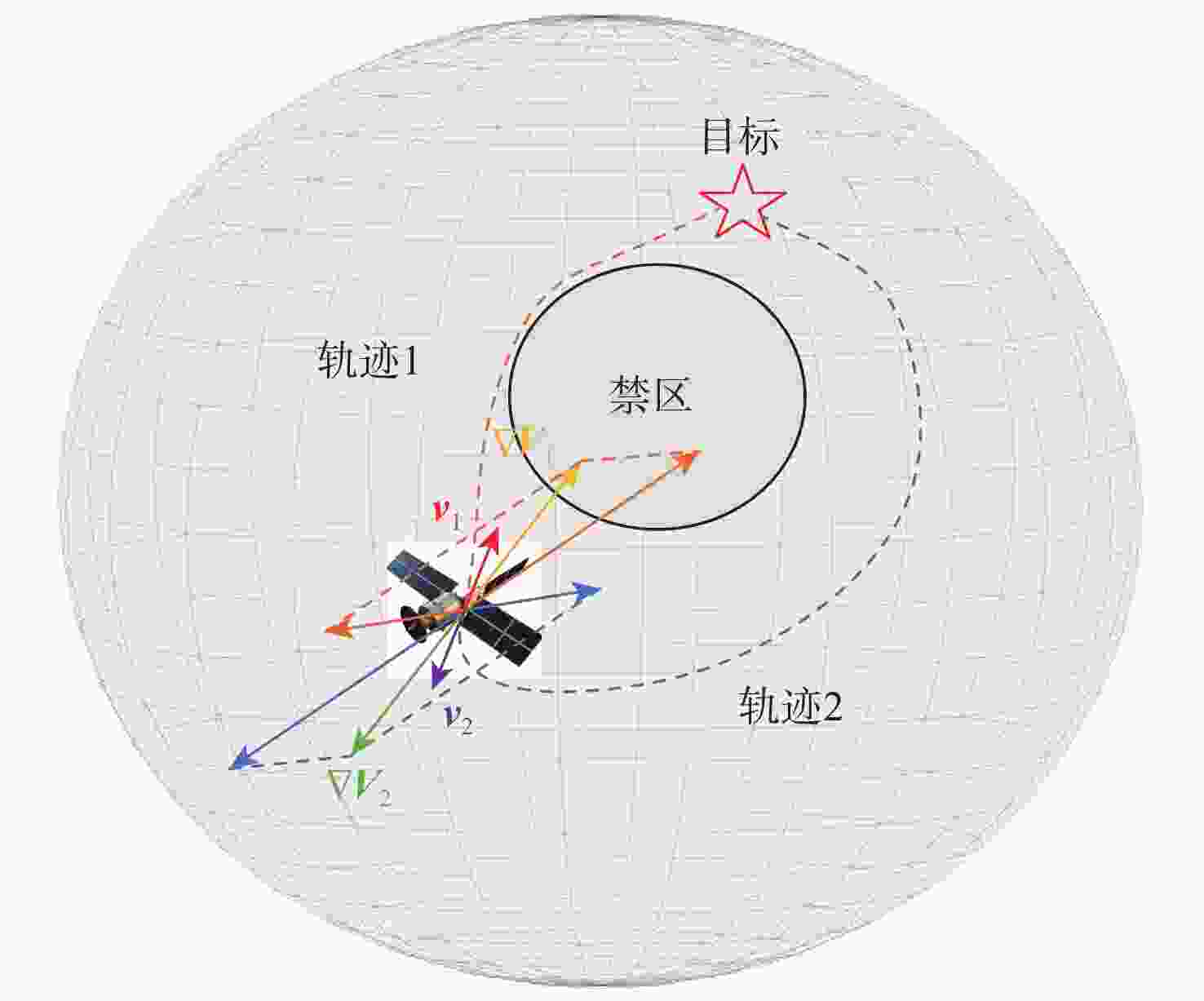
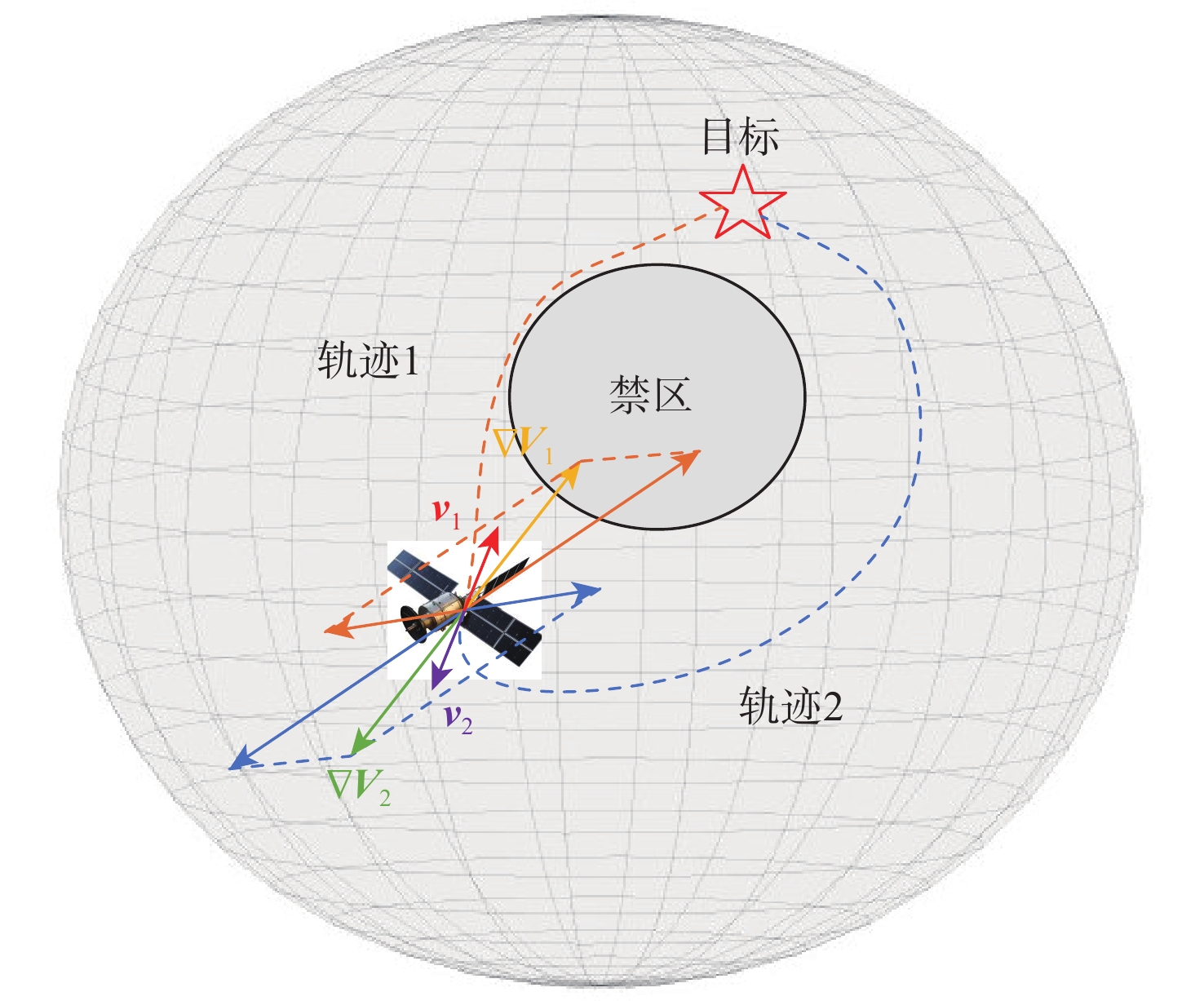
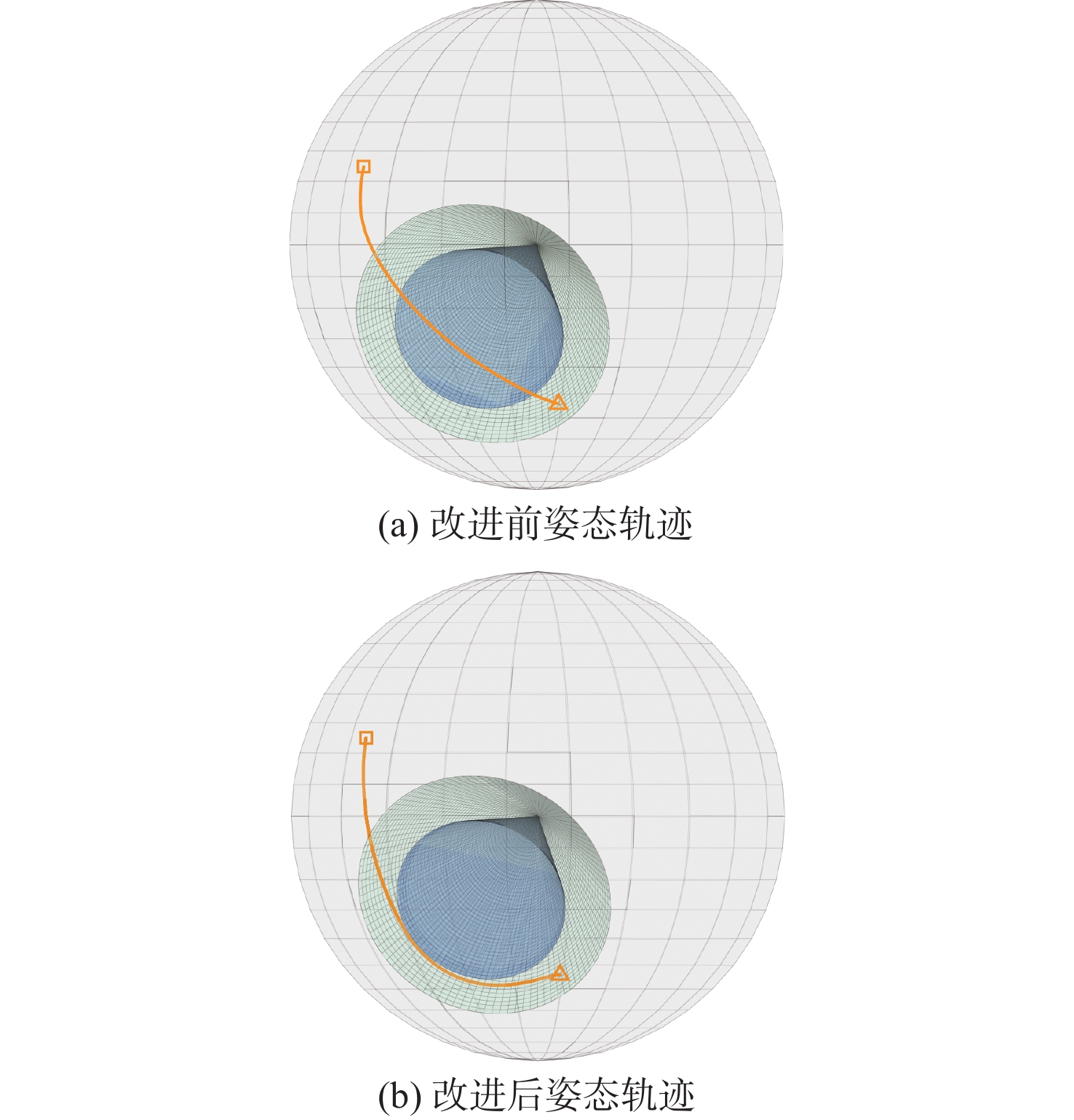
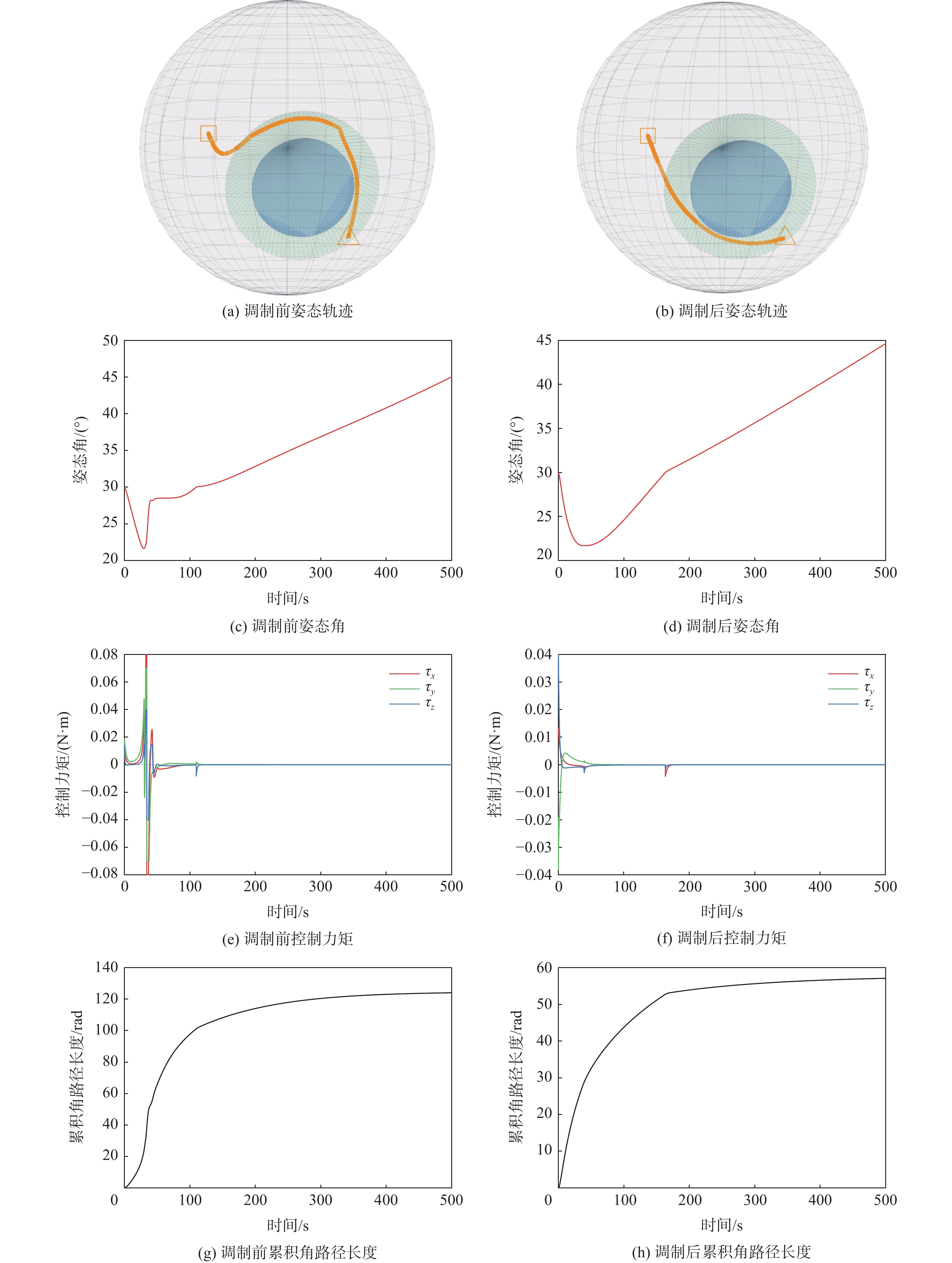
图 9 调制前后姿态轨迹示意图
Figure 9. Schematic diagram of before and after modulation attitude trajectories
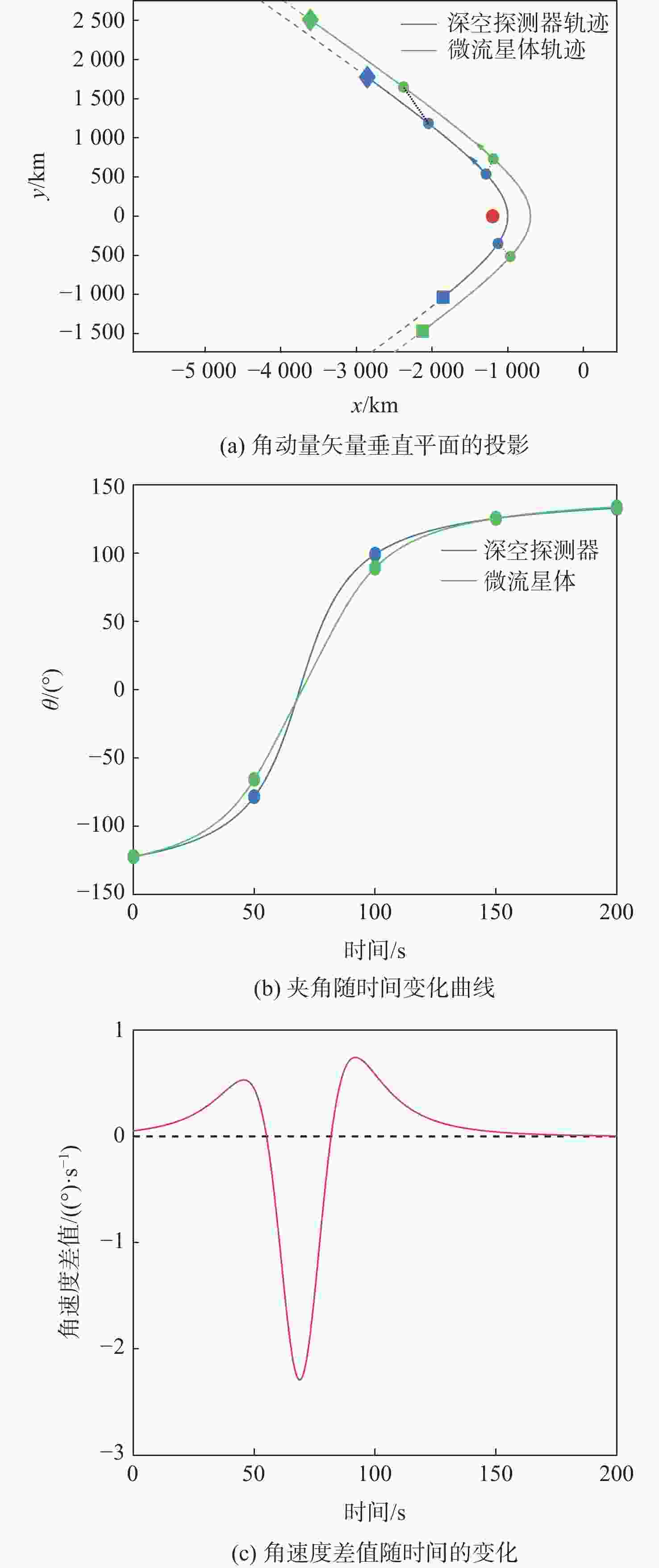
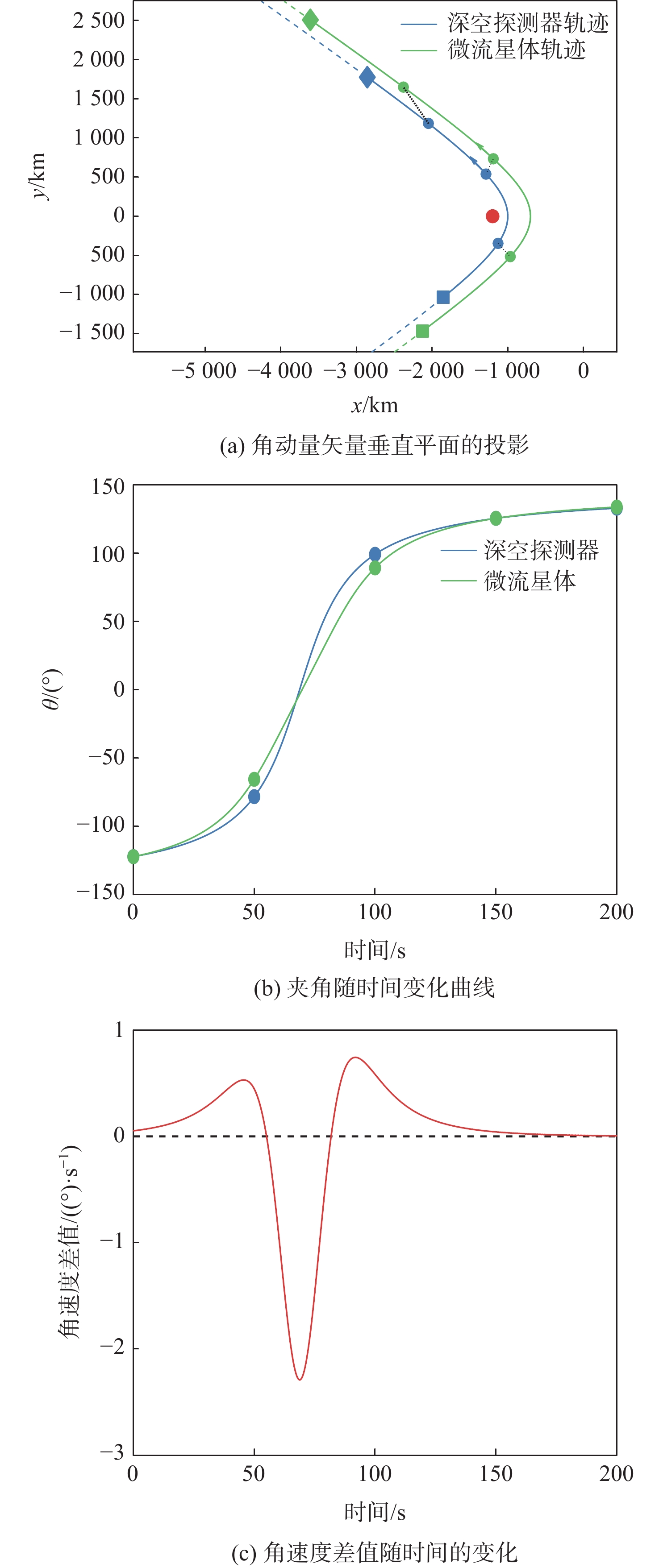
图 10 深空探测器与微流星体轨迹的比较
Figure 10. Comparative analysis of deep space probe and micrometeoroid trajectories
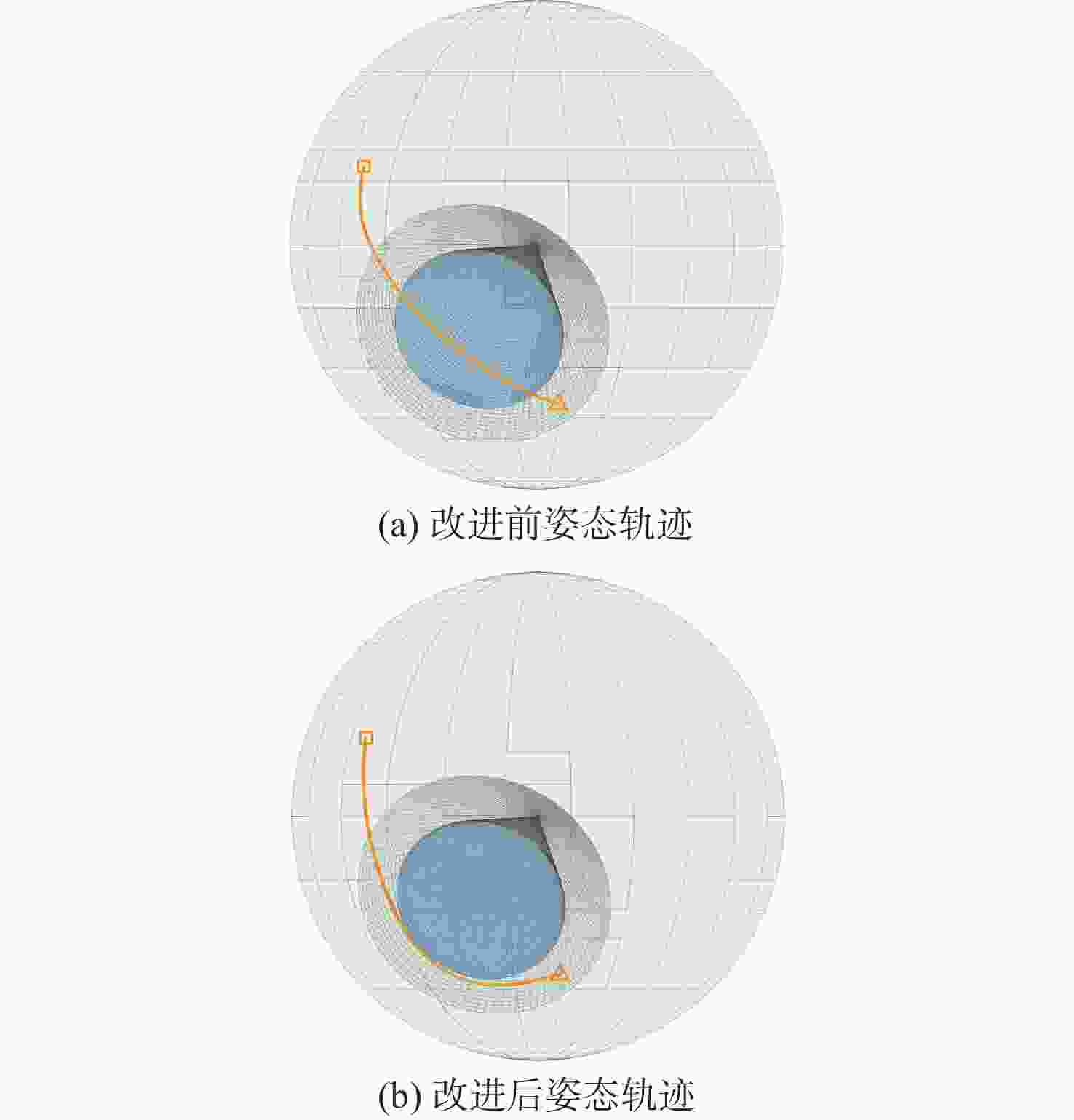
图 12 单动态禁区下改进前后轨迹对比
Figure 12. Comparative analysis of trajectory with original and enhanced methods under single dynamic forbidden zone
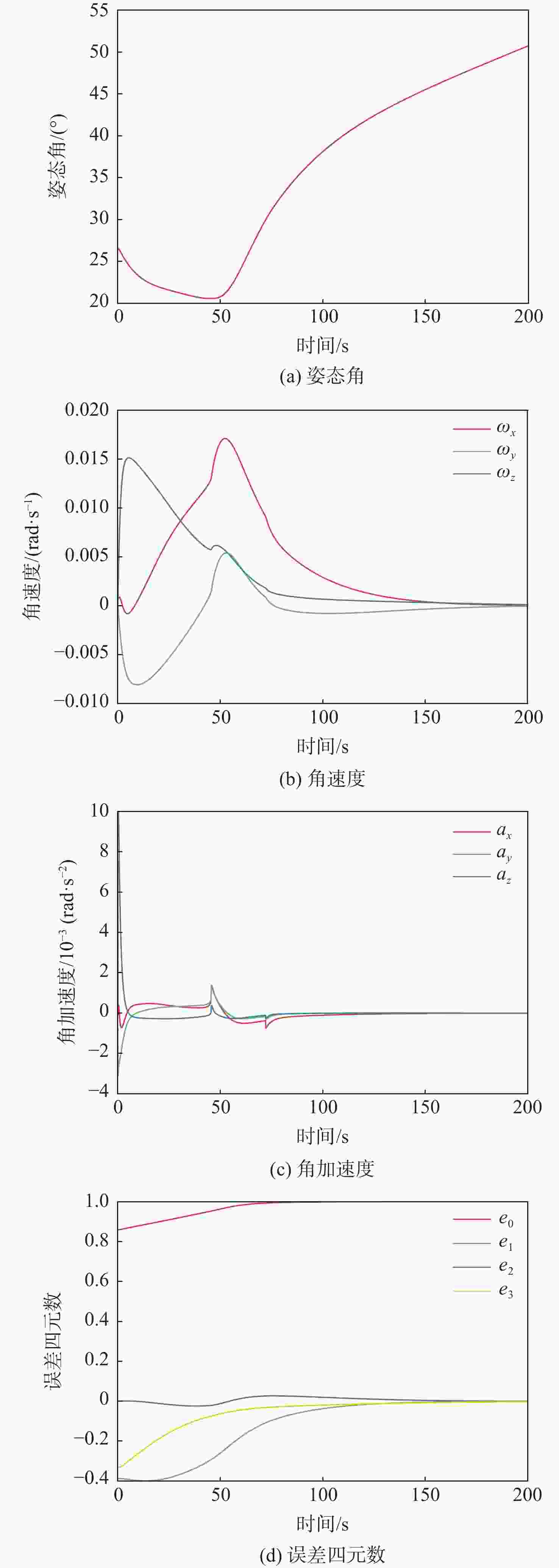
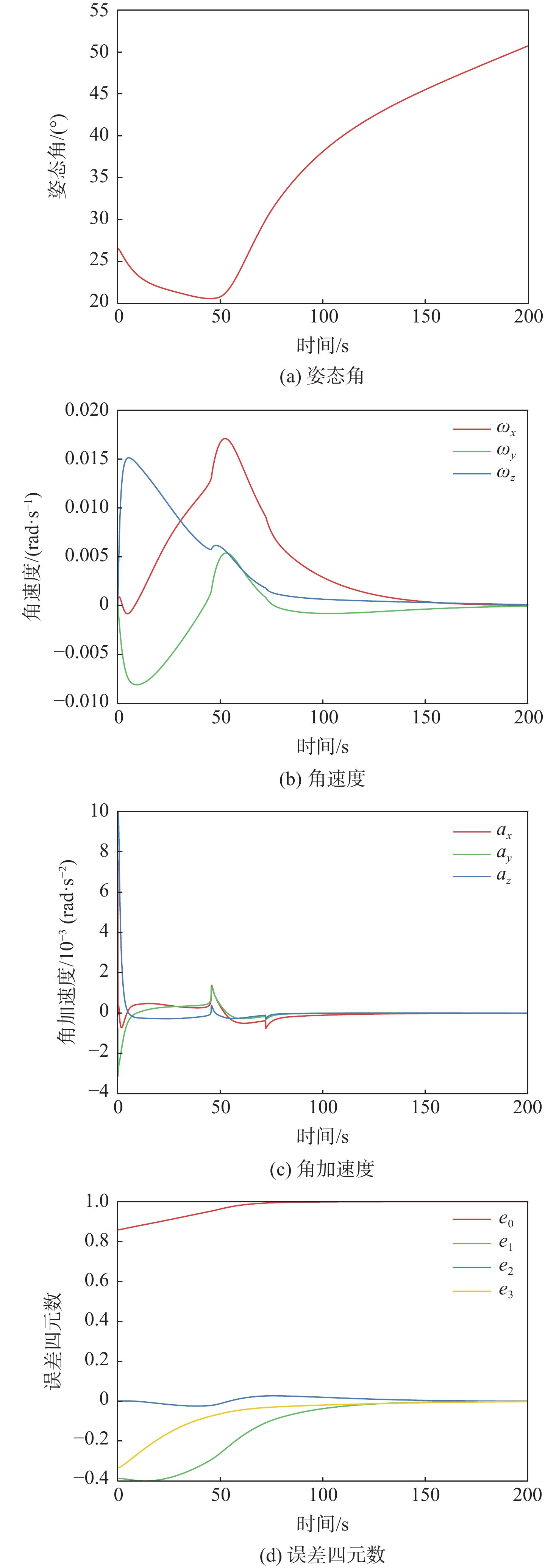
图 13 场景2在改进后控制律影响下的仿真结果
Figure 13. Simulation results of scenario 2 with enhanced control algorithm
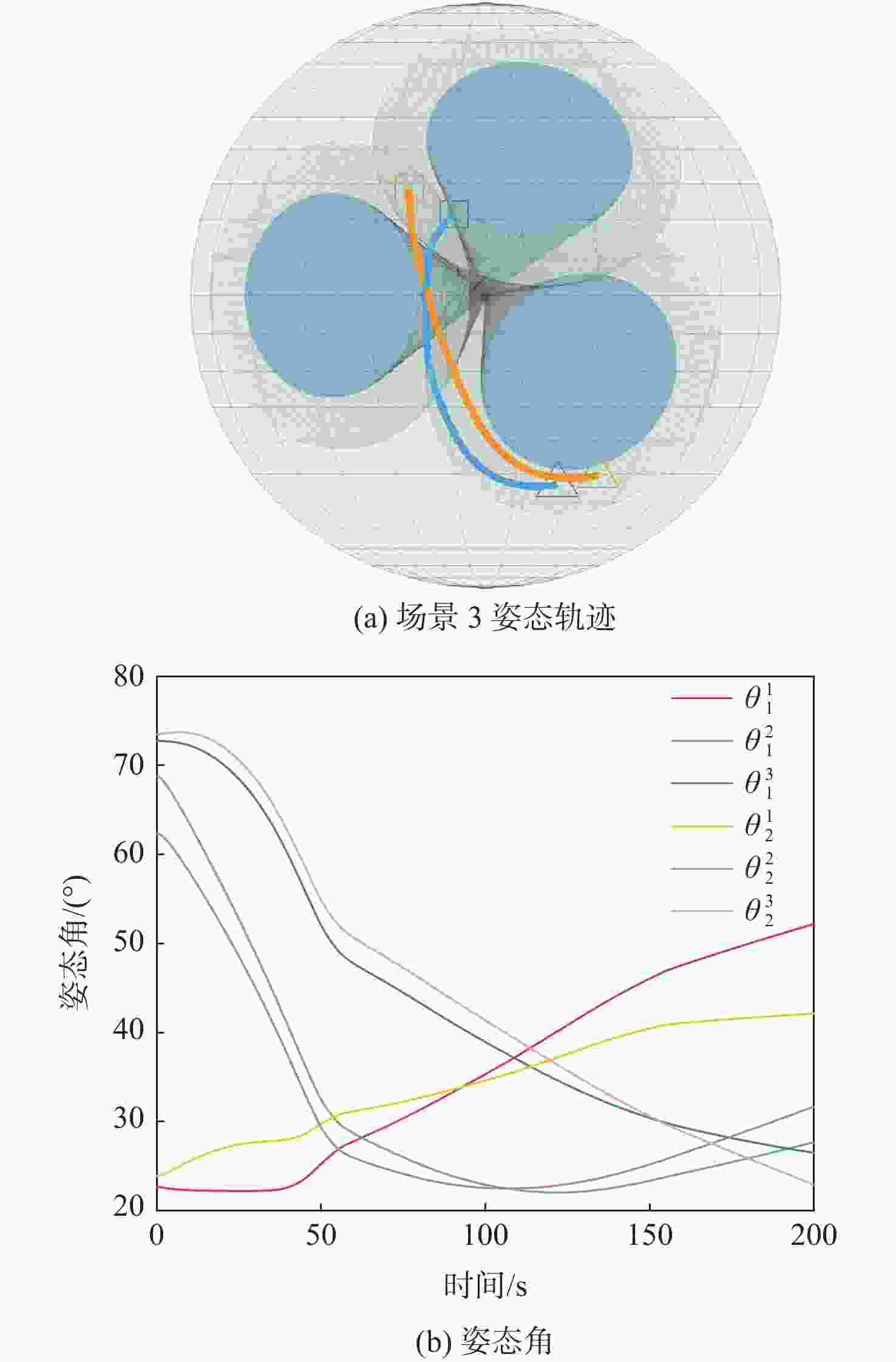
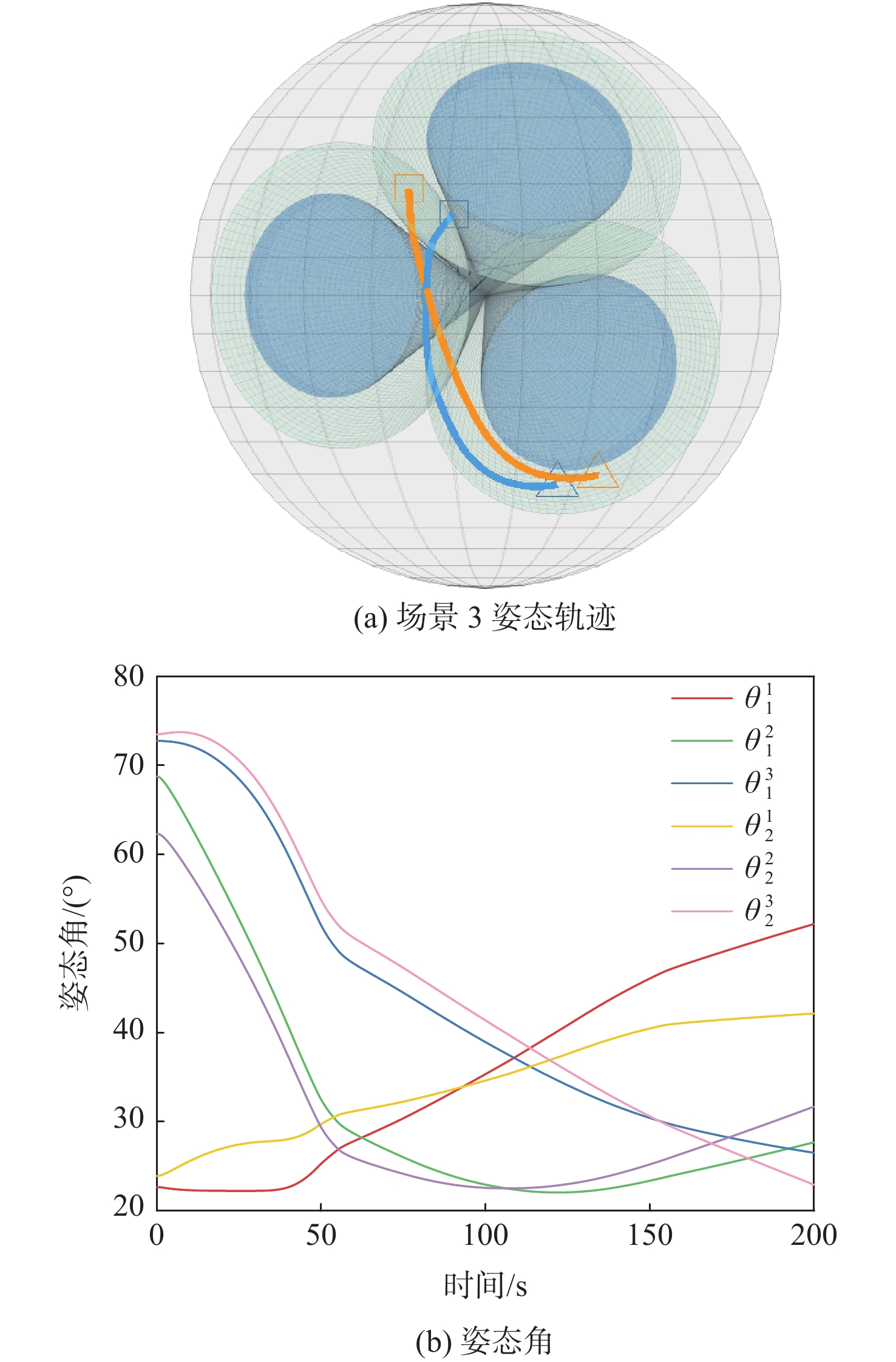
图 14 场景3在改进后控制律影响下的仿真结果
Figure 14. Simulation results of scenario 3 with enhanced control algorithm
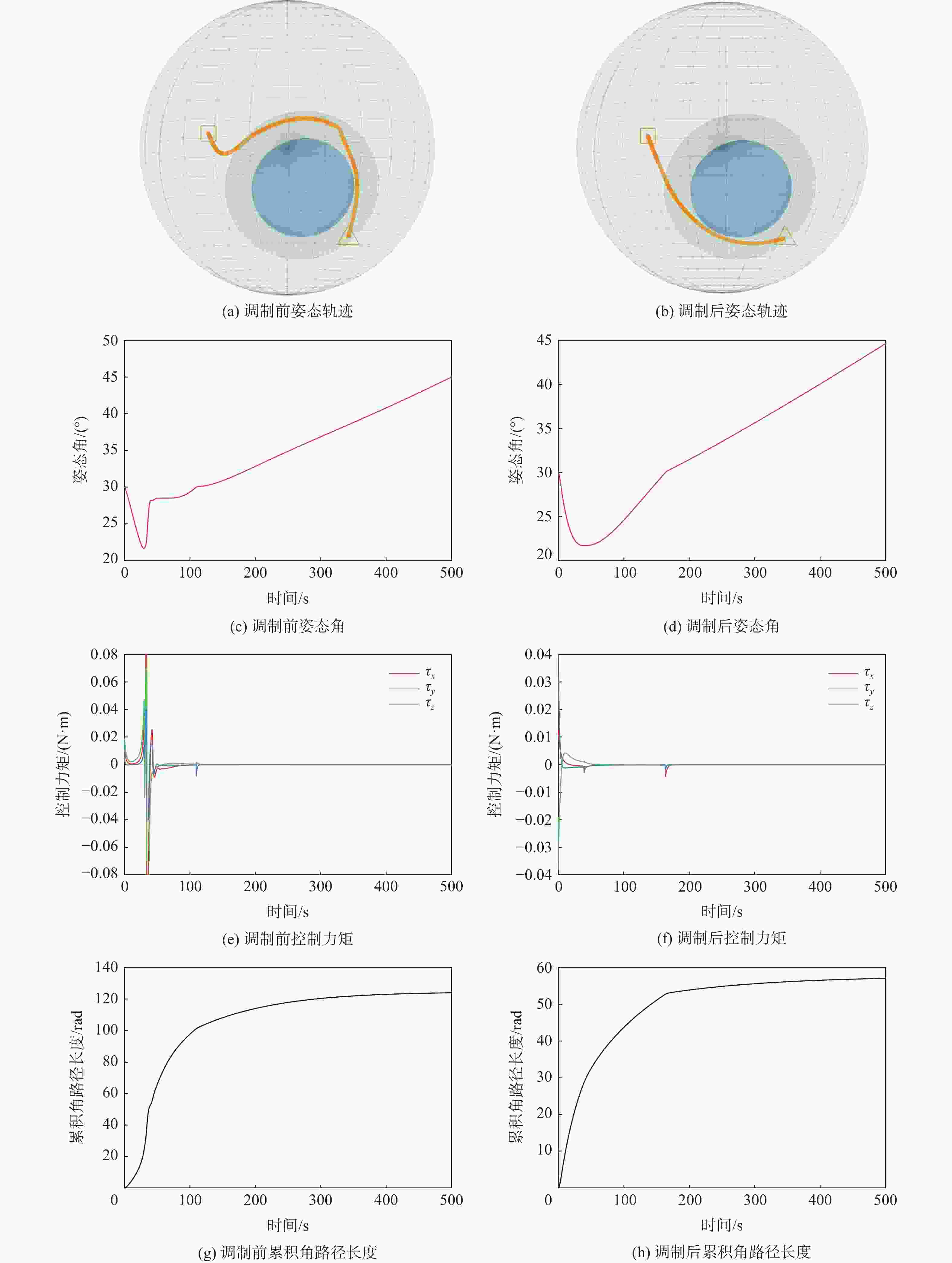
图 15 系统性能调制前后对比分析
Figure 15. Comparative analysis of system performance before and after modulation
表 1 4组场景仿真工况
Table 1. Four sets of scenario simulation conditions
参数 数值 $ {\boldsymbol{J}}/\left(\text{kg}\cdot {\text{m}}^{2}\right) $ Diag(8, 7, 4) $ {\omega }_{\max }/\left(\text{rad}\cdot {\text{s}}^{-1}\right) $ 0.05 $ {a}_{\max }/\left(\text{rad}\cdot {\text{s}}^{-2}\right) $ 0.01 $ {\theta }_{\text{Fz}}/\left(^{\circ}\right) $ 20 $ {\theta }_{\text{Ia}}/\left(^{\circ}\right) $ 30 $ {\theta }_{\text{M}}/\left(^{\circ}\right) $ 1 $ {k}_{\text{q}} $ 0.2 $ {k}_{{\text{ω}} } $ 3 $ {t}_{{i}}\text{/s} $ 0 $ {t}_{\text{f}}\text{/s} $ 200  下载: 导出CSV
表 2 轨道参数性能指标
Table 2. Track parameter performance indicators
参数 数值 $ {\boldsymbol{J}}/\left(\text{kg}\cdot{\text{m}}^{2}\right) $ Diag(8, 7, 4) $ {\omega }_{\max }/\left(\text{rad}\cdot\text{s}^{-1}\right) $ 0.05 $ {a}_{\max }/\left(\text{rad·}{\text{s}}^{-2}\right) $ 0.01 $ {\theta }_{\text{F}{\textit{z}} }/\left(^{\circ}\right) $ 20 $ {\theta }_{\text{Ia}}/\left(^{\circ}\right) $ 30 $ {\theta }_{\text{M}}/\left(^{\circ}\right) $ 1 $ {k}_{\text{q}} $ 0.2 $ {k}_{{\text{ω}} } $ 3 $ {t}_{\text{i}}\text{/s} $ 0 $ {t}_{\text{f}}\text{/s} $ 500
下载: 导出CSV
-
[1] Cervone A, Topputo F, Speretta S, et al. LUMIO: a CubeSat for observing and characterizing micro-meteoroid impacts on the Lunar far side[J]. Acta Astronautica, 2022, 195: 309-317. [2] 徐瑞, 李朝玉, 朱圣英, 等. 深空探测器自主规划技术研究进展[J]. 深空探测学报, 2021, 8(2): 111-123.Xu R, Li Z Y, Zhu S Y, et al. Research progress of autonomous planning technology for deep space probes[J]. Journal of Deep Space Exploration, 2021, 8(2): 111-123(in Chinese). [3] Chen R, Dong M N, Bai Y Z, et al. Trajectory planning and control of spacecraft avoiding dynamic debris swarm[J]. Aerospace Science and Technology, 2024, 151: 109273. [4] 马广富, 柳明旻, 王靓玥, 等. 考虑多禁止指向区域的航天器反步姿态机动控制[J]. 宇航学报, 2020, 41(8): 1042-1048.Ma G F, Liu M M, Wang L Y, et al. Spacecraft backstepping attitude control considering multiple forbidden pointing regions[J]. Journal of Astronautics, 2020, 41(8): 1042-1048(in Chinese). [5] Chu X Y, Zhang J R, Lu S, et al. Optimised collision avoidance for an ultra-close rendezvous with a failed satellite based on the Gauss pseudospectral method[J]. Acta Astronautica, 2016, 128: 363-376. [6] 许丹丹, 张进. 基于改进人工势函数的航天器近距离安全控制方法[J]. 力学学报, 2020, 52(6): 1581-1589.Xu D D, Zhang J. A collision-avoidance control algorithm for spacecraft proximity operations based on improved artificial potential function[J]. Chinese Journal of Theoretical and Applied Mechanics, 2020, 52(6): 1581-1589(in Chinese). [7] 胡庆雷, 邵小东, 杨昊旸, 等. 航天器多约束姿态规划与控制: 进展与展望[J]. 航空学报, 2022, 43(10): 395-423.Hu Q L, Shao X D, Yang H Y, et al. Spacecraft attitude planning and control under multiple constraints: Review and prospects[J]. Acta Aeronautica et Astronautica Sinica, 2022, 43(10): 395-423(in Chinese). [8] 徐瑞, 朱哲, 李朝玉, 等. 航天器姿态机动规划技术研究进展[J]. 宇航学报, 2023, 44(2): 155-167.Xu R, Zhu Z, Li Z Y, et al. Research progress of spacecraft attitude maneuver planning technology[J]. Journal of Astronautics, 2023, 44(2): 155-167(in Chinese). [9] Chi B R, Hu Q L. Saturated explicit reference governor for spacecraft constrained attitude reorientation control[J]. Aerospace Science and Technology, 2024, 145: 108874. [10] Kjellberg H C, Lightsey E G. Discretized constrained attitude pathfinding and control for satellites[J]. Journal of Guidance, Control, and Dynamics, 2013, 36(5): 1301-1309. [11] Lee D Y, Gupta R, Kalabić U V, et al. Geometric mechanics based nonlinear model predictive spacecraft attitude control with reaction wheels[J]. Journal of Guidance, Control, and Dynamics, 2016, 40(2): 309-319. [12] Sun C C, Dai R. Spacecraft attitude control under constrained zones via quadratically constrained quadratic programming[C]//Proceedings of the AIAA Guidance, Navigation, and Control Conference. Reston: AIAA, 2015. [13] Hua B, Sun S G, Wu Y H, et al. A spacecraft attitude manoeuvre planning algorithm based on improved policy gradient reinforcement learning[J]. Journal of Navigation, 2022, 75(3): 662-684. [14] 金磊, 杨绍龙. 基于强化学习的航天器姿态预设性能容错控制[J]. 北京航空航天大学学报, 2024, 50(8): 2404-2412.Jin L, Yang S L. Fault-tolerant control of spacecraft attitude with prescribed performance based on reinforcement learning[J]. Journal of Beijing University of Aeronautics and Astronautics, 2024, 50(8): 2404-2412(in Chinese). [15] Xue W H, Wang B C, Huang X X, et al. Spacecraft attitude maneuver planning with multi-sensor pointing constraints using improved RRT-star algorithm[J]. Advances in Space Research, 2023, 72(5): 1485-1495. [16] Xia K W, Wang J N, Zou Y, et al. Data-driven identifier-actor-critic learning for cooperative spacecraft attitude tracking with orientation constraints[J]. Automatica, 2025, 173: 112035. [17] 岳程斐, 霍涛, 陈雪芹, 等. 航天器姿态受限的协同势函数族设计方法[J]. 自动化学报, 2024, 50(1): 54-65.Yue C F, Huo T, Chen X Q, et al. Synergistic potential functions for constrained attitude control of rigid spacecraft[J]. Acta Automatica Sinica, 2024, 50(1): 54-65(in Chinese). [18] Li Q, Yuan J P, Zhang B, et al. Disturbance observer based control for spacecraft proximity operations with path constraint[J]. Aerospace Science and Technology, 2018, 79: 154-163. [19] Hua B, He J, Zhang H, et al. Spacecraft attitude reorientation control method based on potential function under complex constraints[J]. Aerospace Science and Technology, 2024, 144: 108738. [20] Munoz J, Boyarko G, Fitz-Coy N. Rapid path-planning options for autonomous proximity operations of spacecraft[C]//Proceedings of the AIAA/AAS Astrodynamics Specialist Conference. Reston: AIAA, 2010. [21] Zappulla R, Park H, Virgili-Llop J, et al. Real-time autonomous spacecraft proximity maneuvers and docking using an adaptive artificial potential field approach[J]. IEEE Transactions on Control Systems Technology, 2019, 27(6): 2598-2605. [22] 关涛, 李彬, 武云丽. 指向约束下有限时间航天器姿态重定向控制[J]. 空间控制技术与应用, 2024, 50(3): 52-59.Guan T, Li B, Wu Y L. Finite-time spacecraft attitude reorientation control under pointing constrains[J]. Aerospace Control and Application, 2024, 50(3): 52-59(in Chinese). [23] Mancini M, Ruggiero D. Artificial potential field and sliding mode control for spacecraft attitude maneuver with actuation and pointing constraints[J]. Control Engineering Practice, 2025, 162: 106373. [24] Menegatti D, Giuseppi A, Pietrabissa A. Model predictive control for collision-free spacecraft formation with artificial potential functions[C]//Proceedings of the 30th Mediterranean Conference on Control and Automation. Piscataway: IEEE Press, 2022: 564-570. [25] Hughes P C. Spacecraft attitude dynamics[M]. New York: Courier Corporation, 2012. [26] Wertz J R. Spacecraft attitude determination and control[M]. Dordrecht: Springer Science & Business Media, 2012. [27] Yang Y. Spacecraft attitude determination and control: quaternion based method[J]. Annual Reviews in Control, 2012, 36(2): 198-219. [28] Duan C, Hu Q L, Yang H Y, et al. Constrained control of underactuated spacecraft using artificial potentials[J]. IEEE Transactions on Industrial Electronics, 2024, 71(11): 14803-14812. [29] Shen Q, Yue C F, Goh C H. Velocity-free attitude reorientation of a flexible spacecraft with attitude constraints[J]. Journal of Guidance, Control, and Dynamics, 2017, 40(5): 1293-1299. [30] Qiu S, Cao X B, Wang F, et al. Deep space exploration orbit design departing from circumlunar orbit of lunar base[J]. Aerospace Science and Technology, 2019, 95: 105505. [31] Hu Q L, Chi B R, Akella M R. Anti-unwinding attitude control of spacecraft with forbidden pointing constraints[J]. Journal of Guidance, Control, and Dynamics, 2018, 42(4): 822-835. [32] Su Y H, Shen S P, Hu Z K, et al. Practical finite-time attitude reorientation control for rigid spacecraft with forbidden pointing constraints and physical limitations[J]. IEEE Transactions on Aerospace and Electronic Systems, 2025, 61(2): 3387-3397. [33] Li B, Wang Y, Zhang K, et al. Constrained feedback control for spacecraft reorientation with an optimal gain[J]. IEEE Transactions on Aerospace and Electronic Systems, 2021, 57(6): 3916-3926. [34] Lee U, Mesbahi M. Feedback control for spacecraft reorientation under attitude constraints via convex potentials[J]. IEEE Transactions on Aerospace and Electronic Systems, 2014, 50(4): 2578-2592. -

 下载:
下载:

 点击查看大图
计量
- 文章访问数: 201
- HTML全文浏览量: 73
- PDF下载量: 7
- 被引次数: 0
