





Coordinated deviation correction control for aircraft multi-actuators based on time-varying model predictive control
-
摘要:
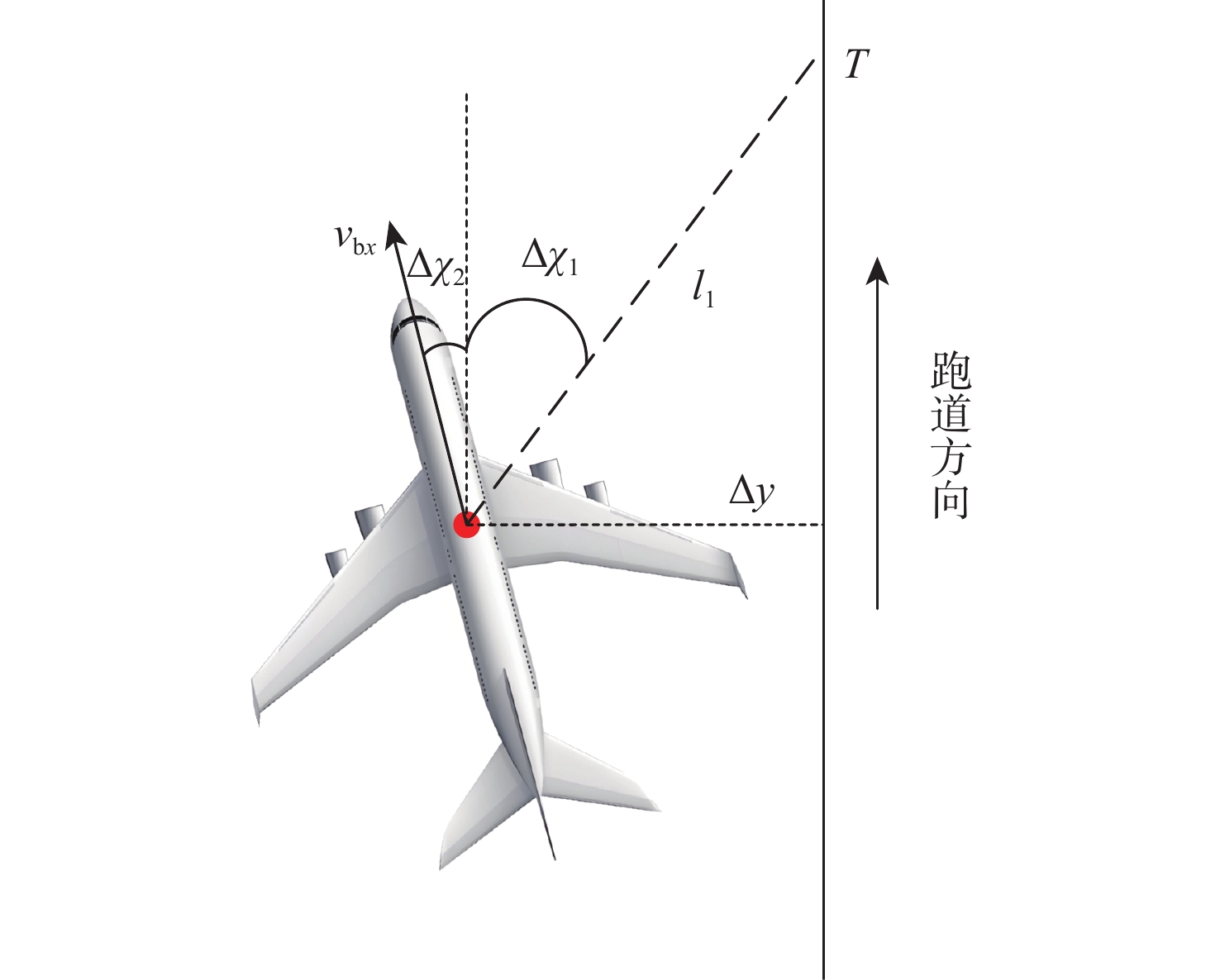
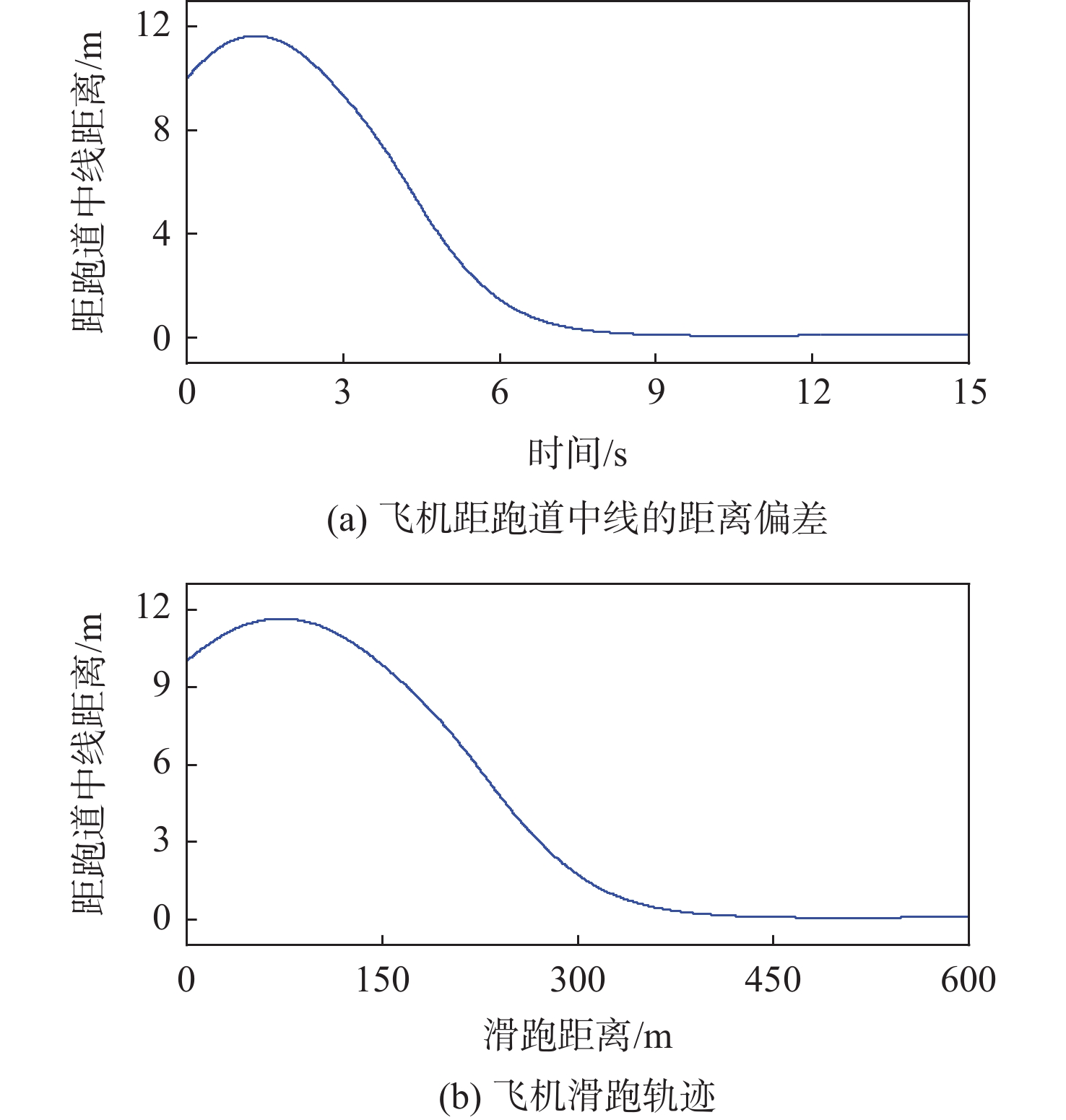
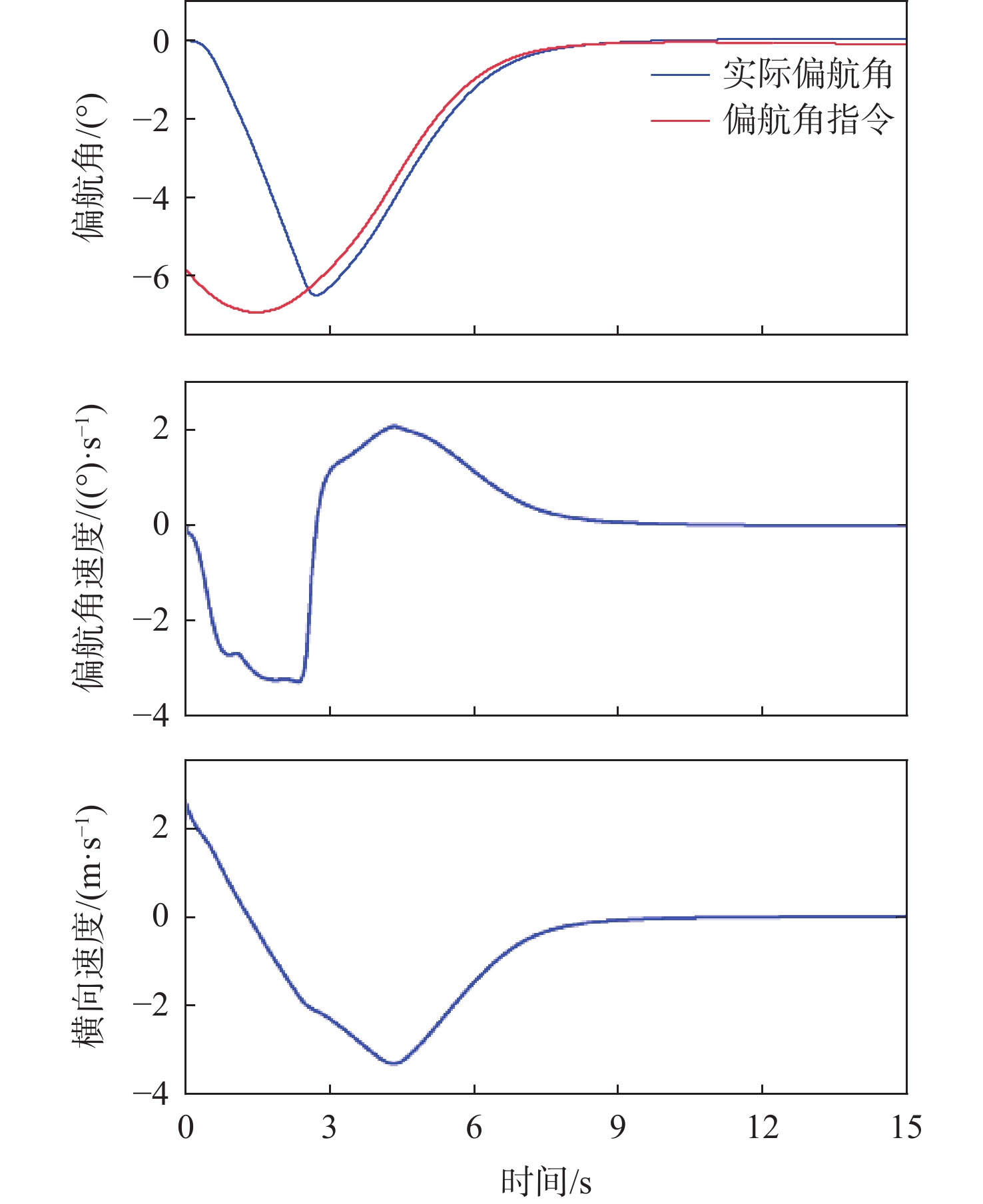
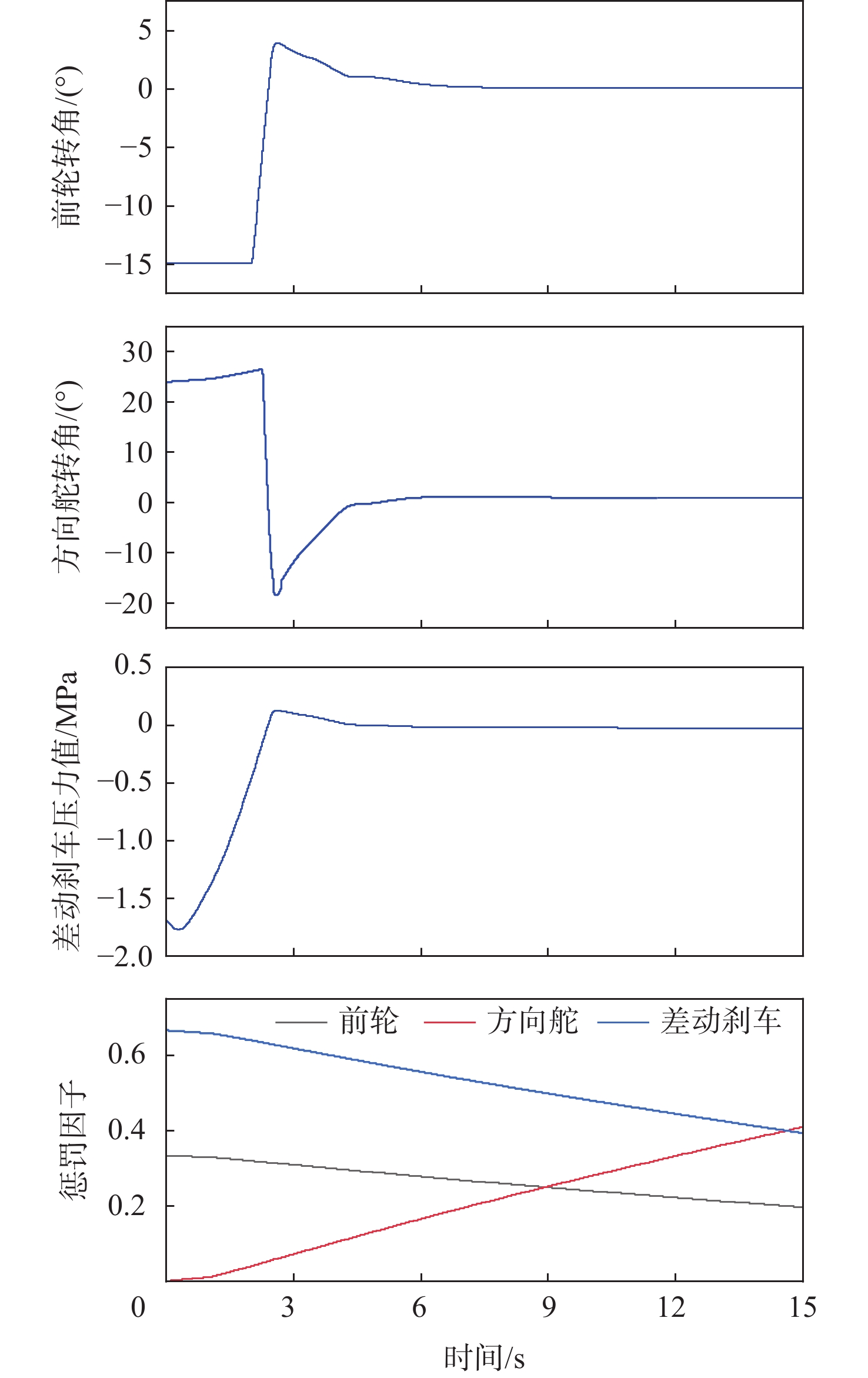
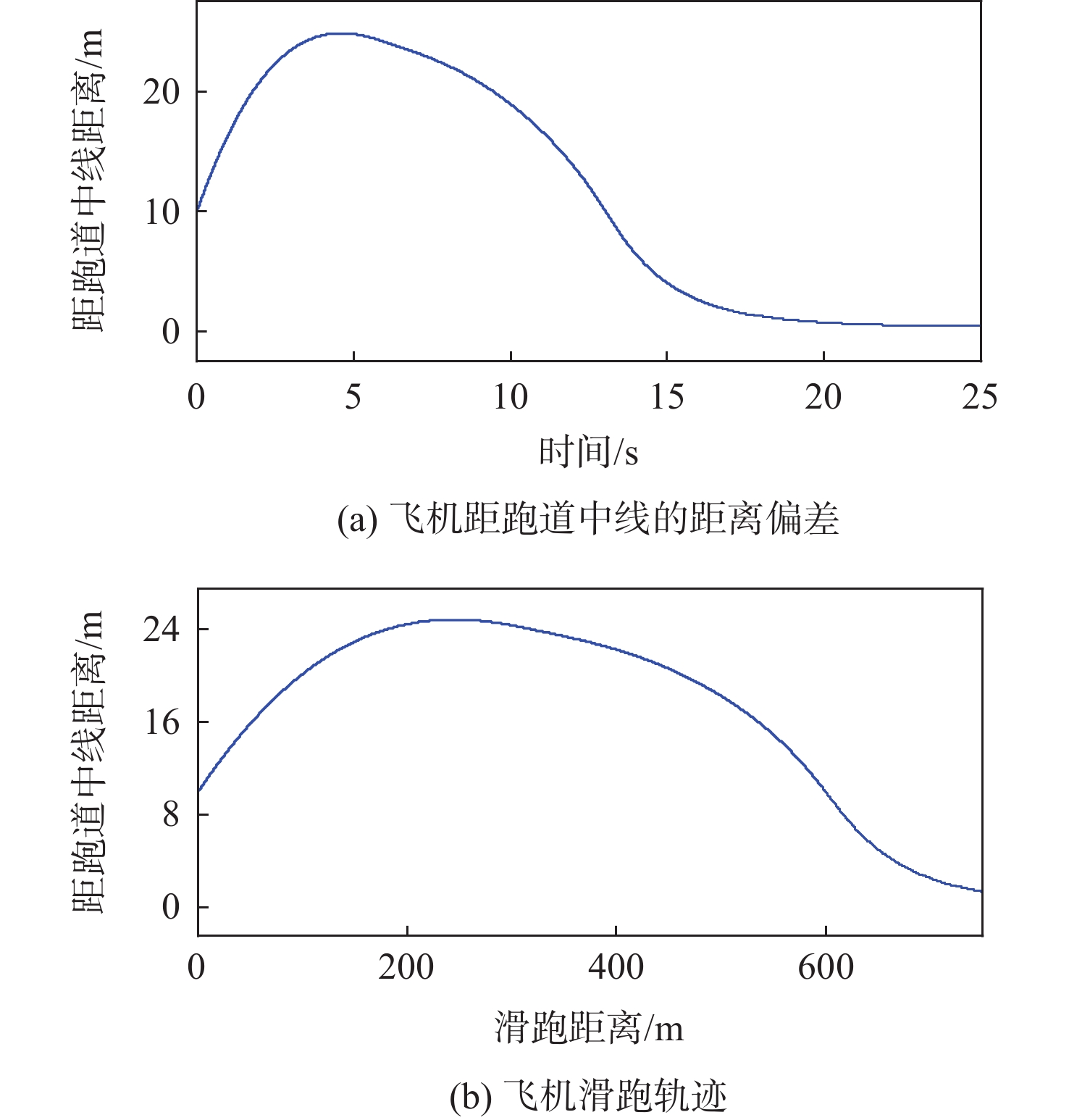
针对现有飞机无法高效地利用多个纠偏执行器进行协同纠偏,导致冲偏出跑道事故频发的问题,提出一种基于时变模型预测控制(MPC)的多执行器协同纠偏控制方法。建立精细的飞机地面滑跑动力学模型,并提出一种内外环分层控制方法架构;外环采用动态虚拟目标点导引律,将飞机与跑道中线的横向位置偏差转化为内环的偏航角指令;内环基于MPC方法,通过设计随滑跑速度动态调整的控制权重矩阵,在线优化求解方向舵、前轮转弯及主轮差动刹车的控制量,实现多执行器的协同控制。搭建了六自由度飞机动态仿真平台,并在多种工况下进行了验证,仿真结果表明:所提控制策略能够快速稳定地跟踪跑道中线,有效应对复杂工况,实现全速域内各纠偏执行器的平滑切换与高效协同。
Abstract:Runway excursions represent a significant percentage of aviation incidents, highlighting the critical limitations of current ground control methods, often restricted to a single actuator. This impedes the safe and synergistic use of multiple control surfaces for deviation correction of aircraft taxiing. To address the question, this paper proposes a novel coordinated multi-actuator control method based on a time-varying model predictive control (MPC) framework. The comprehensive methodology begins with a high-fidelity dynamic model of the aircraft’s ground taxiing phase, precisely considering complex nonlinear phenomena such as aerodynamic forces, ground friction dynamics, and tire side-slip characteristics. This model is then formulated as a linear time-varying state-space representation, which is suitable for the MPC framework. Building upon this model, a robust hierarchical inner-outer loop control architecture is designed for the systematic deviation correction task. Using a dynamic virtual target point guiding law, the outer loop converts the aircraft’s lateral position divergence from the runway centerline into an exact yaw angle instruction for the inner loop. The inner loop forms the core of the strategy, utilizing MPC for robust, coordinated control of the three primary actuators: rudder, nose wheel steering, and differential braking. A key innovation is a control weight matrix in the MPC cost function that adjusts dynamically with real-time taxiing speed. This adaptive weighting mechanism optimizes control inputs online, intelligently allocating authority across the full speed range. At high speeds, it gives priority to the rudder; at lower speeds, it smoothly switches to nose wheel steering and differential braking. For validation, a comprehensive 6-degree-of-freedom dynamic simulation platform was developed in MATLAB/Simulink. The strategy was rigorously tested under challenging conditions, including wet runways, crosswinds, and significant initial landing deviations. Simulation results consistently demonstrate that the controller enables fast, stable tracking of the runway centerline. The system effectively manages these complex scenarios, realizing smooth, efficient coordination among the actuators.
-
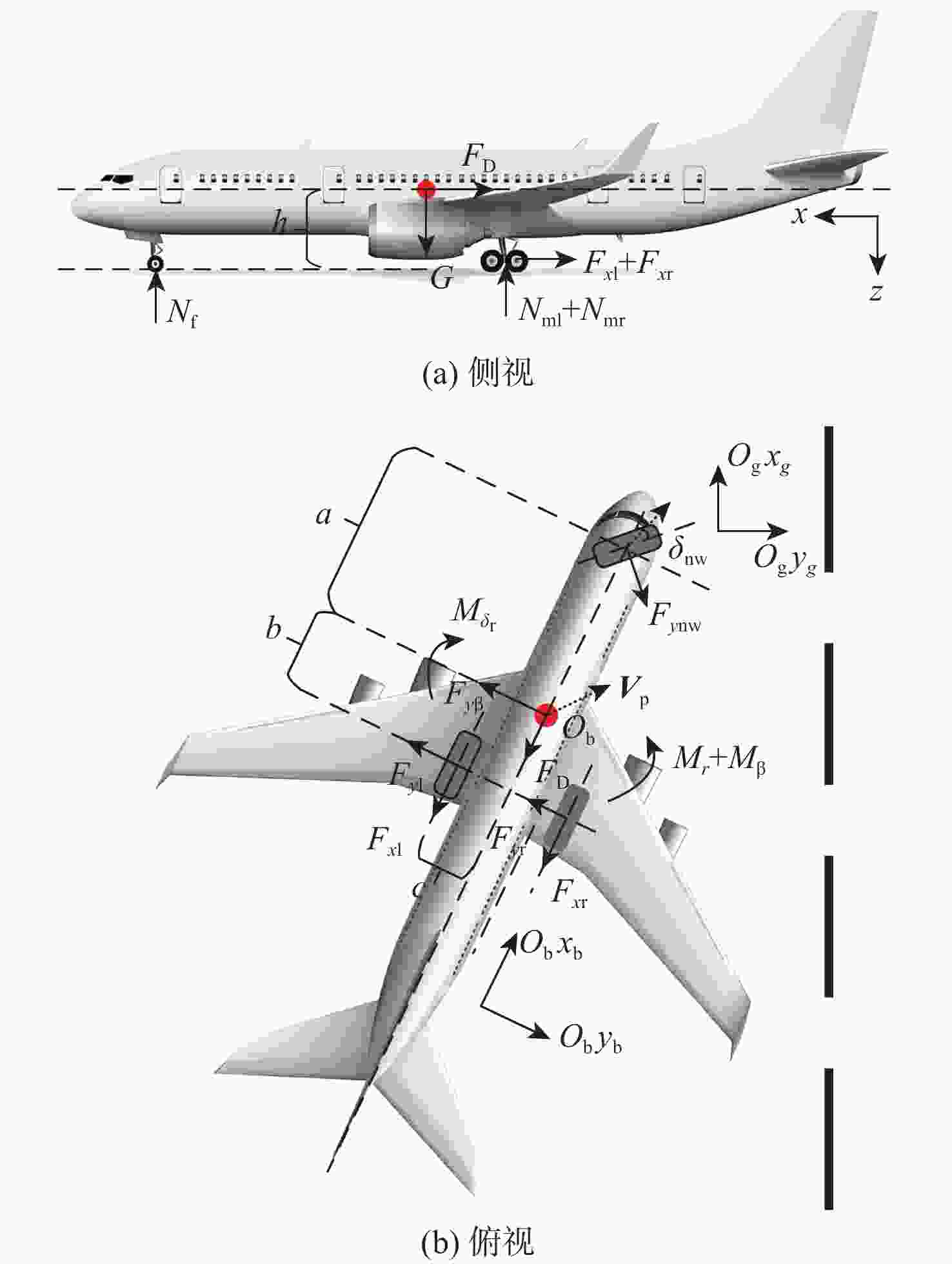
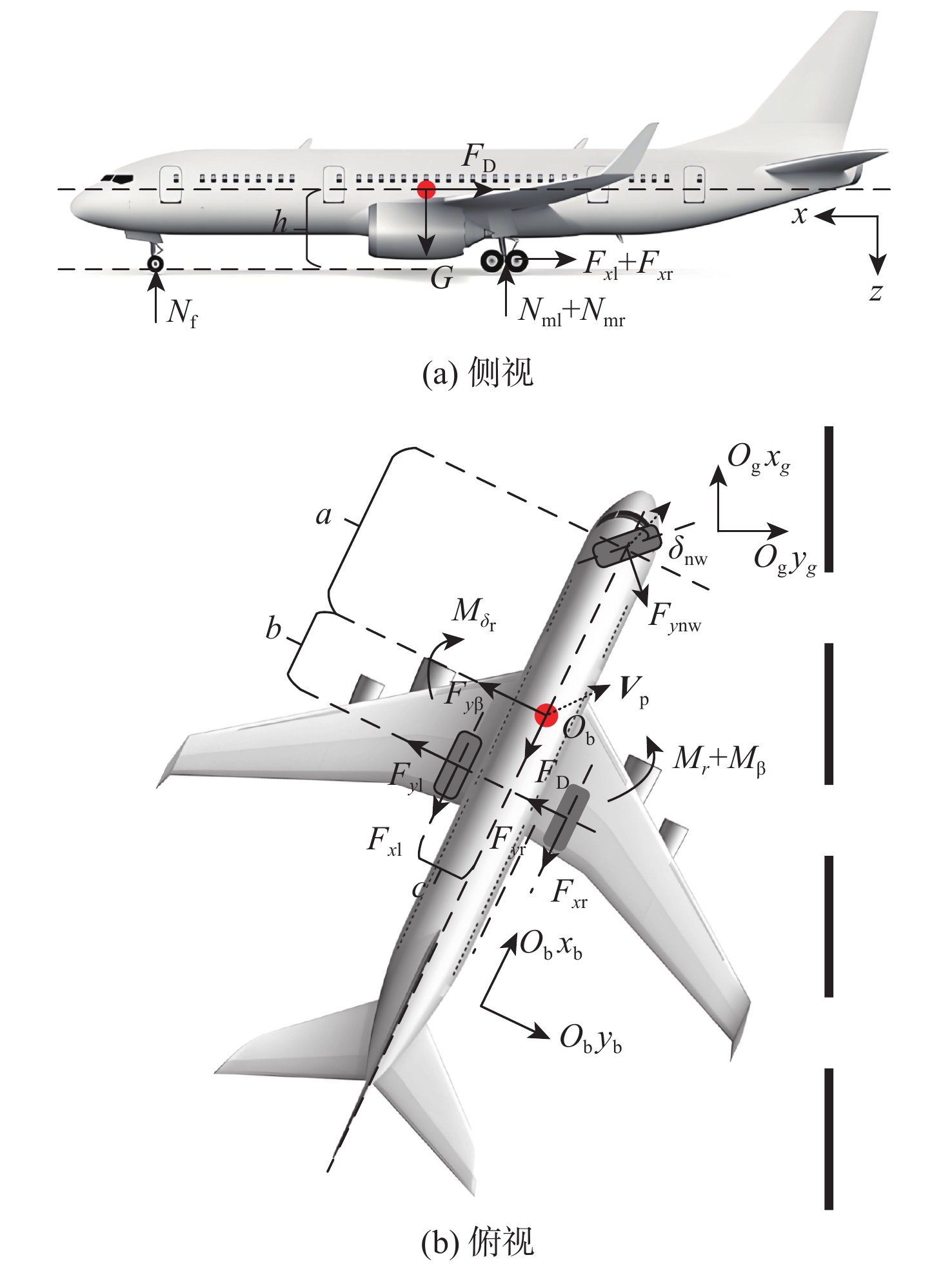
图 1 飞机地面滑跑受力分析示意
Figure 1. Schematic diagram of forces acting on an aircraft during ground taxiing
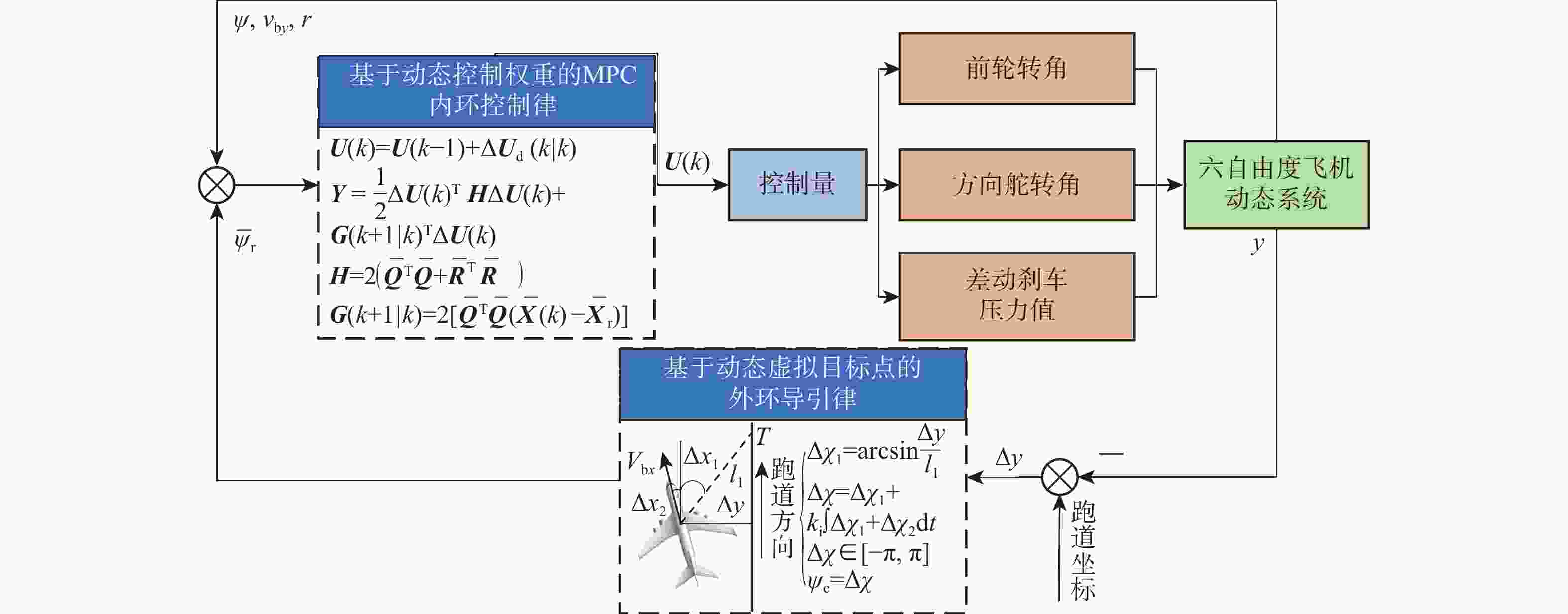
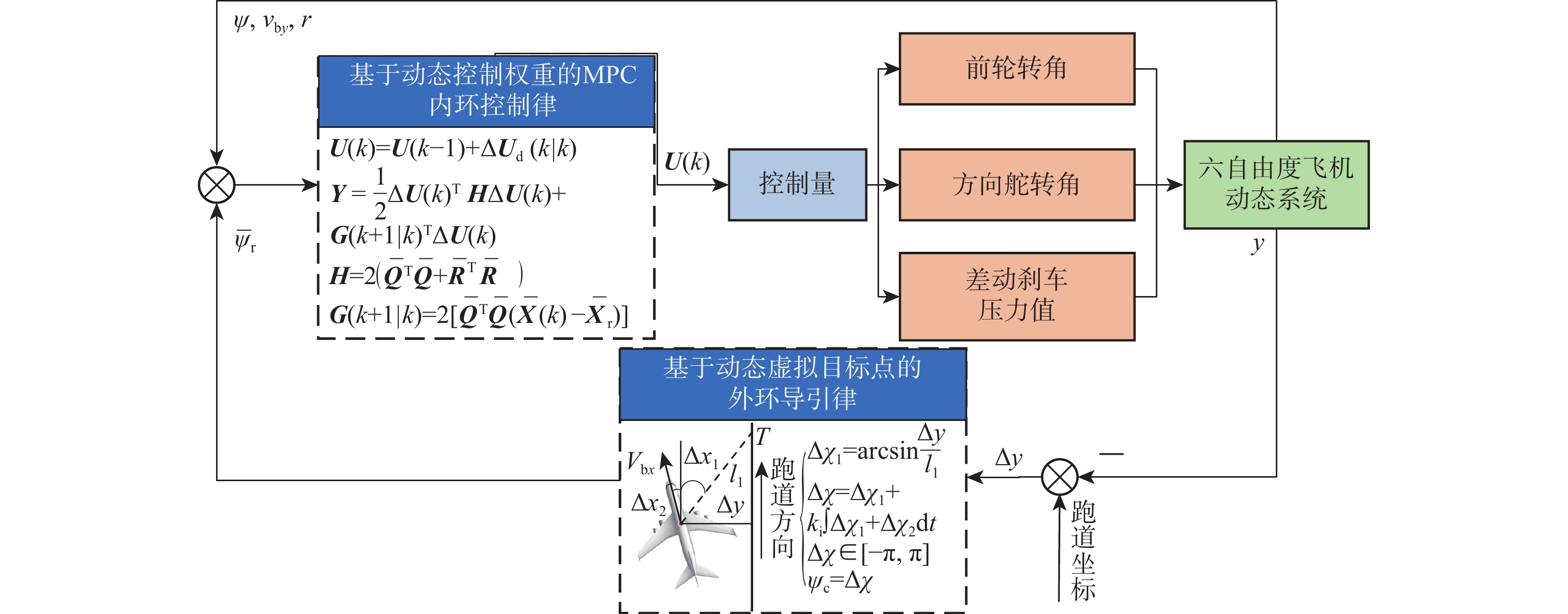
图 3 纠偏控制系统架构示意
Figure 3. Schematic diagram of taxiing correction control system architecture
表 1 六自由度飞机动态系统模型参数
Table 1. Parameters of the 6-degree-of-freedom aircraft dynamic system model
飞机
质量/kg飞机对$ x $轴
的惯性矩/
(kg·m−2)飞机对$ y $轴
的惯性矩/
(kg·m−2)飞机对$ z $轴
的惯性矩/
(kg·m−2)主轮到质心
纵向距离/m前轮到质心
纵向距离/m2个主轮
间距/m飞机质心
高度/m机翼
面积/m2翼展/m 方向舵
面积/m2方向舵
展长/m前轮
质量/kg前轮
半径/m主轮
质量/kg主轮
半径/m15 119 31 184 205 125 230 414 1.048 98 15.451 02 3 3 37.16 11.41 8 5 98 0.35 117 0.4  下载: 导出CSV
表 2 控制器参数
Table 2. Parameters of the controller
$ {k}_{\mathrm{i}} $ $ {l}_{0} $/m $ {T}_{\text{s}} $/s $ P $ $ N $ $ \boldsymbol{Q} $ $ {\mu }_{y\text{m}} $ $ {\mu }_{y\text{nw}} $ 最大前轮转角/(°) 最大方向舵转角/(°) 最大差动刹车压力值/MPa 1.5 15 0.001 200 20 [100,0.01,0.01]T 1 567 748 200 000 15 30 7
下载: 导出CSV
表 3 仿真初始参数
Table 3. Simulation initial parameters
滑跑初始速度/(km·h−1) 初始距跑道中线距离/m 初始前轮转角/(°) 初始方向舵转角/(°) 初始左右刹车压力/MPa 初始侧向速度/(km·h−1) 200 10 0 0 3 0
下载: 导出CSV
-
[1] 赵丁仪, 齐心歌, 汪磊. 冲偏出跑道事件风险评估研究进展[J]. 航空工程进展, 2025, 16(1): 1-8.Zhao D Y, Qi X G, Wang L. Research progress analysis on risk assessment of runway excursion[J]. Advances in Aeronautical Science and Engineering, 2025, 16(1): 1-8(in Chinese). [2] Duprez J, Mora-Camino F, Villaumé F. Aircraft-on-ground lateral control for low speed maneuvers[J]. IFAC Proceedings Volumes, 2004, 37(6): 475-480. [3] Son T N, Dat N T. Preview control of aircraft in ground operation[C]//Proceedings of the 2018 5th International Conference on Control, Decision and Information Technologies. Piscataway: IEEE Press, 2018: 550-554. [4] 段镇, 高九州, 贾宏光, 等. 无人机滑跑线性化建模与增益调节纠偏控制[J]. 光学精密工程, 2014, 22(6): 1507-1516.Duan Z, Gao J Z, Jia H G, et al. Linearized modeling and gain scheduling control for UAV taxiing[J]. Optics and Precision Engineering, 2014, 22(6): 1507-1516(in Chinese). [5] Re F. Modelica landing gear modelling and on-ground trajectory tracking with sliding mode control[C]//Proceedings of the Advances in Aerospace Guidance, Navigation and Control. Berlin: Springer, 2011: 103-115. [6] Latif Z, Shahzad A, Samar R, et al. Lateral parameter-varying modelling and control of a UAV on-ground[J]. IFAC-PapersOnLine, 2021, 54(8): 130-135. [7] Roos C, Biannic J M, Tarbouriech S, et al. On-ground aircraft control design using a parameter-varying anti-windup approach[J]. Aerospace Science and Technology, Elsevier, 2010, 14(7): 459-471. [8] 贾彩娟. 飞翼布局无人机地面滑跑纠偏控制系统设计与仿真[J]. 自动化应用, 2018, 59(7): 59-63.Jia C J. Design and simulation of deviation correction control system for UAV with flying wing layout on the ground[J]. Automation Application, 2018, 59(7): 59-63(in Chinese). [9] 郭杰, 李震, 陈天悦, 等. 小型无人机滑跑航向纠偏及增稳控制设计[J]. 北京理工大学学报, 2017, 37(12): 1287-1294.Guo J, Li Z, Chen T Y, et al. Heading deviation correction and stability augmentation control for small UAV taxiing[J]. Transactions of Beijing Institute of Technology, 2017, 37(12): 1287-1294(in Chinese). [10] 乔定定. 无人飞行器地面滑跑纠偏复合控制与仿真[D]. 成都: 电子科技大学, 2022.Qiao D D. Compound control and simulation of ground taxi deviation correction for unmanned aerial vehicle[D]. Chengdu: University of Electronic Science and Technology of China, 2022(in Chinese). [11] 贾伟, 孙哲芄, 吴玉生, 等. 基于L1方法的某型无人机滑跑纠偏控制[J]. 弹箭与制导学报, 2021, 41(1): 48-52.Jia W, Sun Z W, Wu Y S, et al. Deviation control of unmanned aerial vehicles based on L1 method[J]. Journal of Projectiles, Rockets, Missiles and Guidance, 2021, 41(1): 48-52(in Chinese). [12] Richalet J, Rault A, Testud J L, et al. Model predictive heuristic control: application to industrial process[J]. Automatica, 1978, 14(5): 413-428. [13] 卜瑞宇, 王彪, 李宏成, 等. 基于MPC的地形跟随航迹跟踪控制方案设计[J]. 控制工程, 2025, 32(3): 518-526.Bu R Y, Wang B, Li H C, et al. MPC based design of trajectory tracking control for terrain following[J]. Control Engineering of China, 2025, 32(3): 518-526(in Chinese). [14] 叶大鹏, 陈书达, 张之得. 基于在线高斯模型驱动MPC的四旋翼轨迹跟踪控制[J]. 飞行力学, 2025, 43(1): 56-62.Ye D P, Chen S D, Zhang Z D. Trajectory tracking control for a quadrotor based on online Gaussian model-driven MPC[J]. Flight Dynamics, 2025, 43(1): 56-62(in Chinese). [15] 张庆新, 郝晨乐, 朱金旭. 基于MPC和ESO的无人直升机姿态控制[J]. 飞行力学, 2022, 40(5): 53-58.Zhang Q X, Hao C L, Zhu J X. Attitude control for unmanned helicopter based on model predictive control and extended state observe[J]. Flight Dynamics, 2022, 40(5): 53-58(in Chinese). [16] 何德峰, 侍宇洁. 四驱电动汽车驱动力分配阶梯式模型预测控制[J]. 浙江工业大学学报, 2020, 48(1): 7-12.He D F, Shi Y J. Stair-like model predictive control for driving force allocation of four-wheel driven electric vehicles[J]. Journal of Zhejiang University of Technology, 2020, 48(1): 7-12(in Chinese). [17] 黄益绍, 王博, 李晨艳, 等. 自适应MPC 智能车轨迹跟踪控制[J]. 中国测试, 2025, 51(2): 169-175.Huang Y S, Wang B, Li C Y, et al. Intelligent vehicle trajectory tracking control based on adaptive MPC[J]. China Measurement & Testing Technology, 2025, 51(2): 169-175(in Chinese). [18] 张啸天, 廖飞, 何德峰. 基于快速MPC的固定翼无人机空中着陆抗扰控制[J]. 高技术通讯, 2025, 35(5): 535-547.Zhang X T, Liao F, He D F. Fast MPC based disturbance rejection control for aerial landing of a fixed-wing UAV[J]. Chinese High Technology Letters, 2025, 35(5): 535-547(in Chinese). [19] 陈希远, 王浩天, 严小双, 等. 考虑非线性因素的飞机防滑刹车系统控制[J]. 控制理论与应用, 2022, 39(5): 950-958.Chen X Y, Wang H T, Yan X S, et al. Control of aircraft anti-skid braking system considering nonlinear factors[J]. Control Theory & Applications, 2022, 39(5): 950-958(in Chinese). [20] Zhu J, Chu L, Tang X. Modeling and simulation of tire-water-road interaction using finite element analysis[J]. International Journal of Automotive Technology, 2017, 18(5): 761-770. -

 下载:
下载:

 点击查看大图
计量
- 文章访问数: 316
- HTML全文浏览量: 187
- PDF下载量: 20
- 被引次数: 0
