





Data-driven multivariate nonlinear mathematical model of landing gear shock absorbers
-
摘要:
针对起落架油气混合缓冲器的非线性动态特性,通过数据驱动方法结合理论分析与落震试验,采用伪线性最小二乘法,建立了以过载值为因变量,综合考虑缓冲器行程、速度和加速度等因素的多元非线性数学模型,并通过多次改进显著提高了模型的拟合精度和预测能力。为解决模型预测值与试验数据之间的时延现象,引入加速度项,模型的均方根误差(RMSE)从
0.0447 降低至0.0401 ,调整判定系数从0.968提升至0.974。为进一步改善初始阶段(行程为0~50 mm)的拟合偏差问题,在模型中加入了加速度的0.5次方项,模型的RMSE从0.0401 降低至0.0341 ,调整判定系数从0.974提升至0.981,模型对系统动态行为的描述能力和预测精度显著增强。研究结果表明:所建模型为起落架缓冲器的非线性动态特性提供了更准确的描述方法,并为整机自动控制系统的设计与优化提供了可靠的理论基础。-
关键词:
- 起落架油气混合缓冲器 /
- 数据驱动 /
- 多元非线性模型 /
- 伪线性最小二乘法 /
- 落震试验
Abstract:To address the nonlinear dynamic characteristics of the oleo-pneumatic landing gear strut, this study establishes a multivariate nonlinear mathematical model with overload as the dependent variable, through a data-driven approach combined with theoretical analysis and drop-test data. The model comprehensively incorporates factors such as strut stroke, velocity, and acceleration, and is developed using the pseudo-linear least squares method. Through multiple iterative improvements, the model's fitting accuracy and predictive capability have been significantly enhanced. To resolve the time delay phenomenon observed between model predictions and experimental data, an acceleration term was introduced into the model. This adjustment reduced the root mean square error (RMSE) from
0.0447 to0.0401 and increased the adjusted coefficient of determination from 0.968 to 0.974. A square-root acceleration term (acceleration increased to the power of 0.5) was added to the model in order to further address the fitting deviation problem during the first phase (stroke 0 mm to 50 mm). This refinement reduced the RMSE from0.0401 to0.0341 and increased the adjusted coefficient of determination from 0.974 to 0.981, significantly enhancing the model's ability to describe system dynamics and its predictive accuracy. The study demonstrates that the proposed model provides a more accurate method for describing the nonlinear dynamic characteristics of landing gear shock absorbers and offers a reliable theoretical foundation for the design and optimization of the overall automatic control system. -
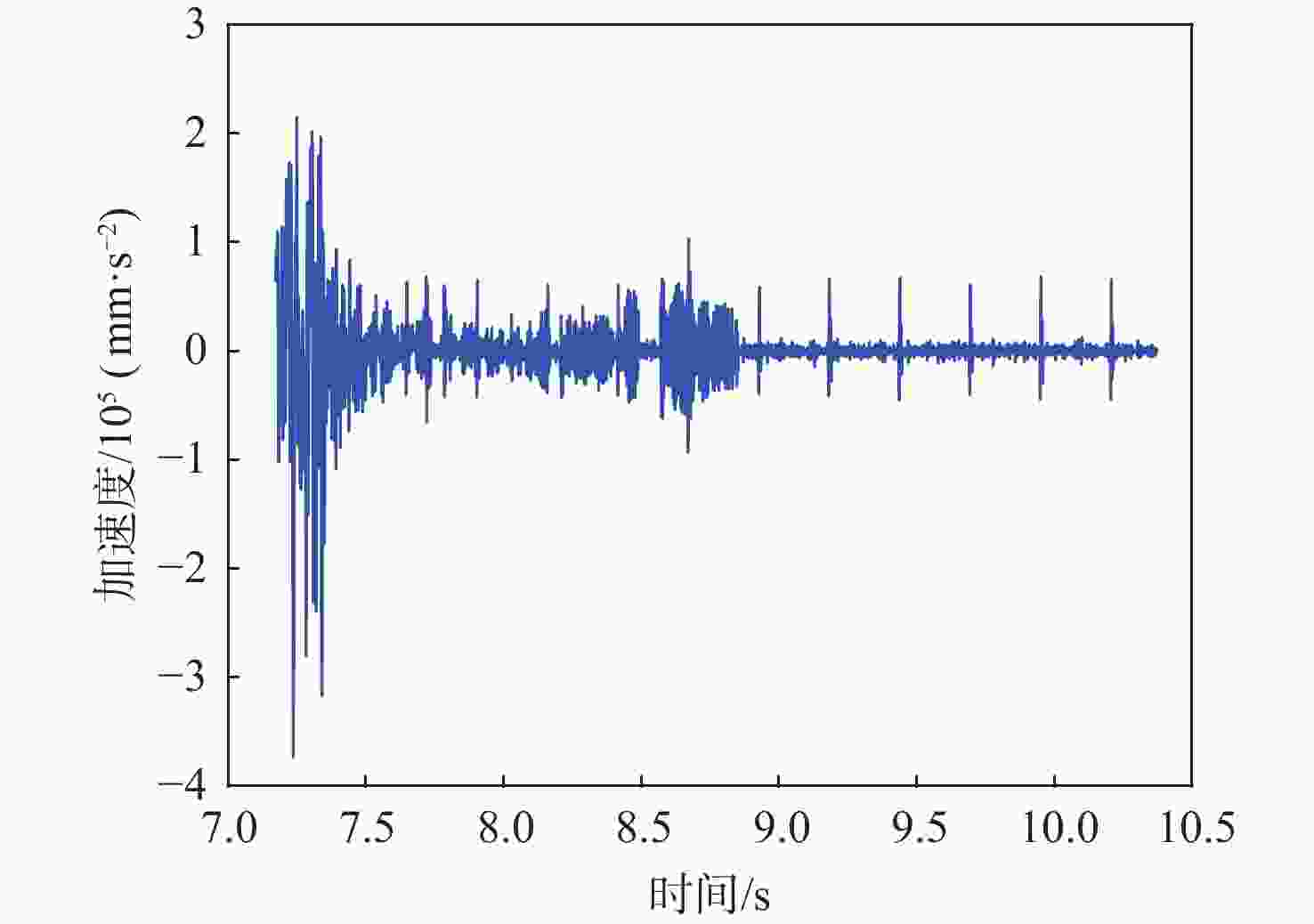
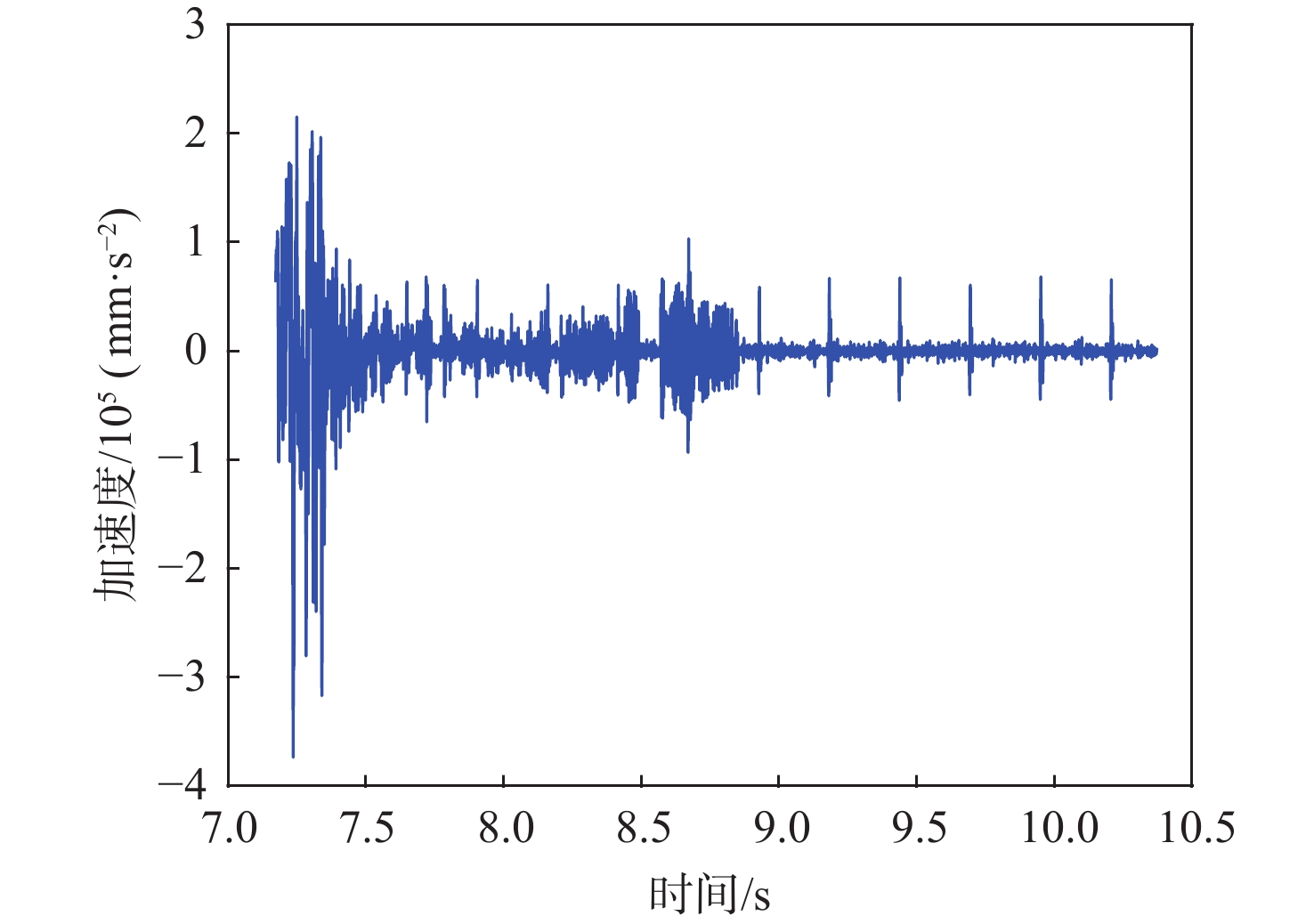
图 5 基于微分运算得到的缓冲器加速度曲线
Figure 5. Buffer acceleration curve based on differential operation
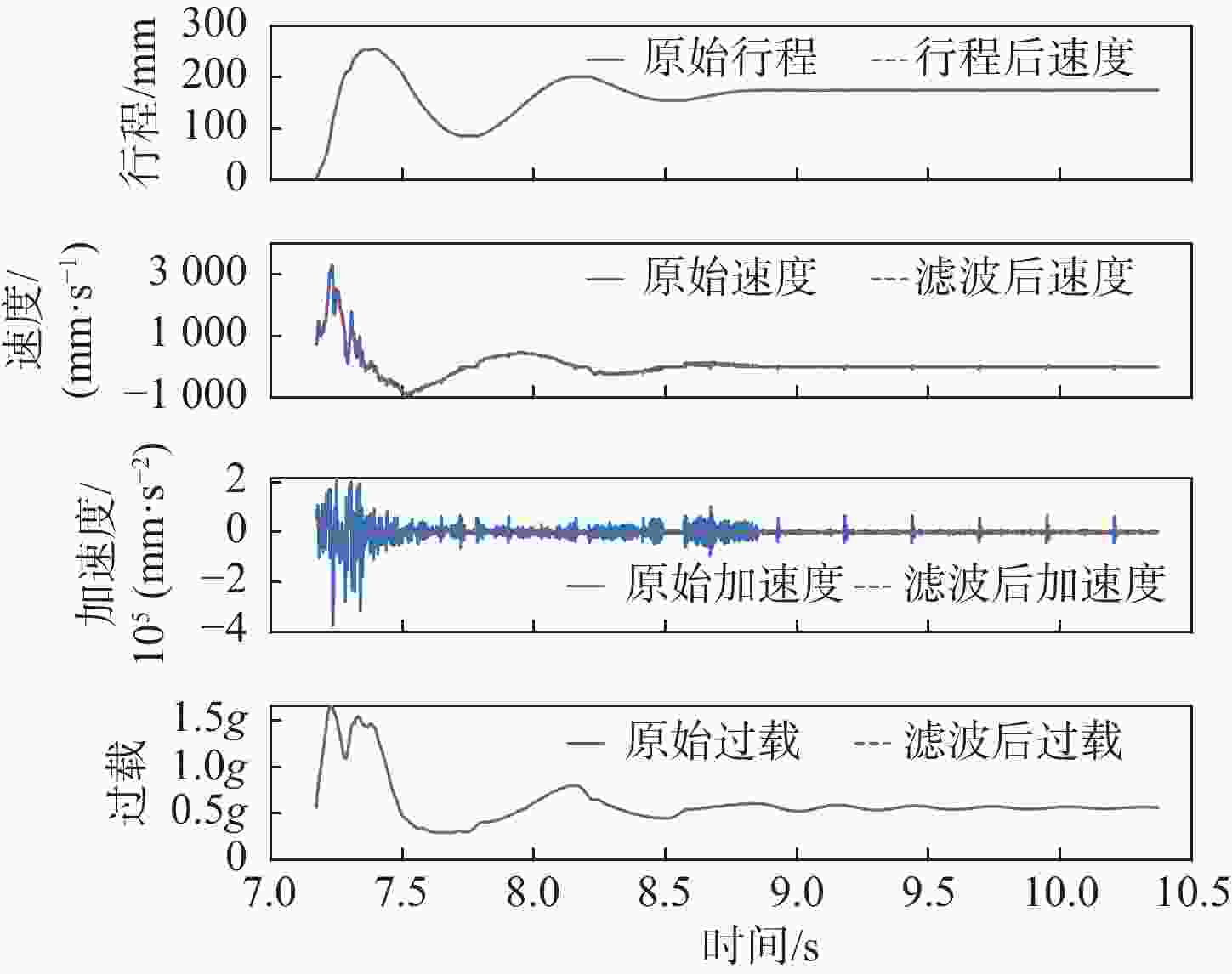
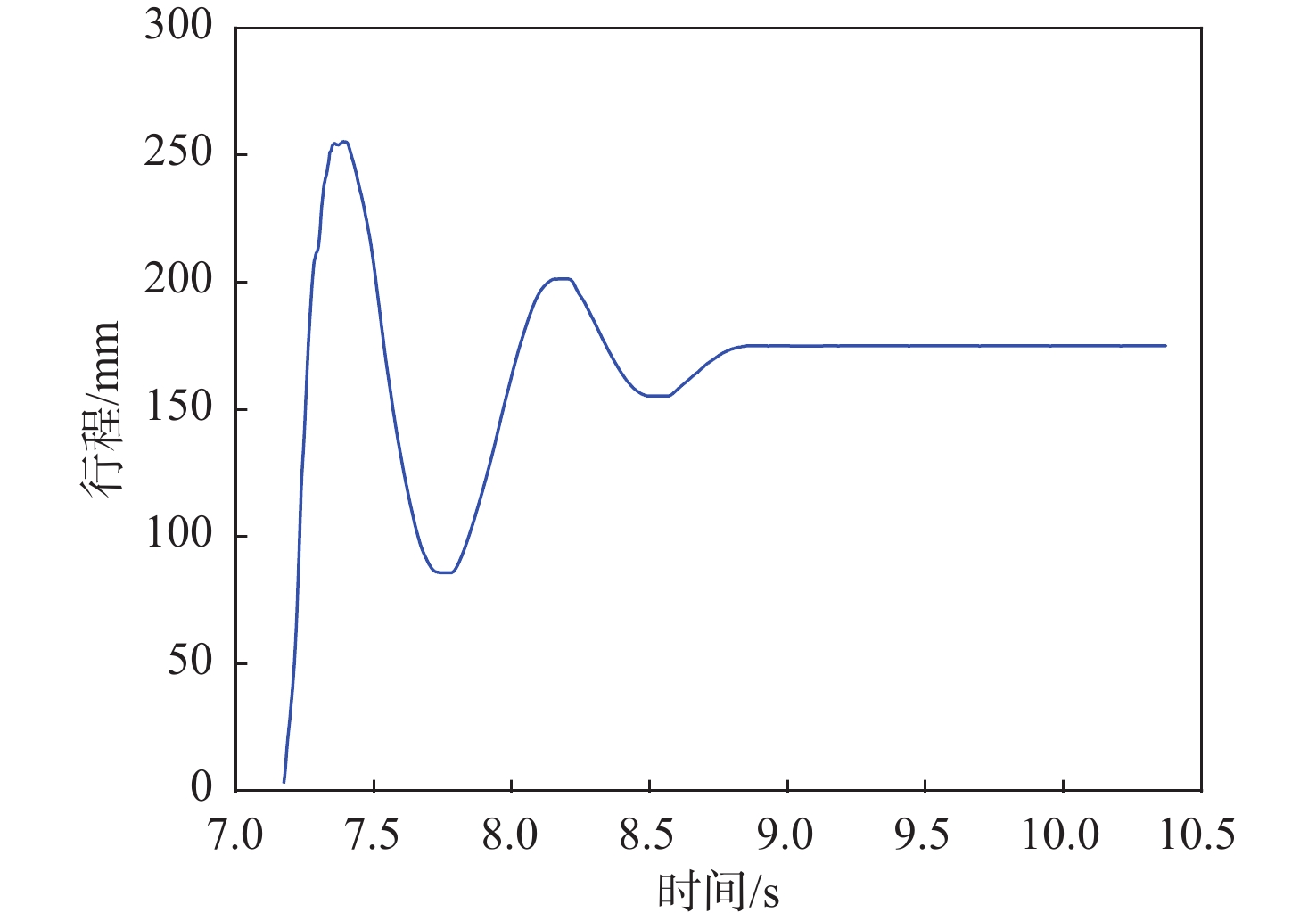
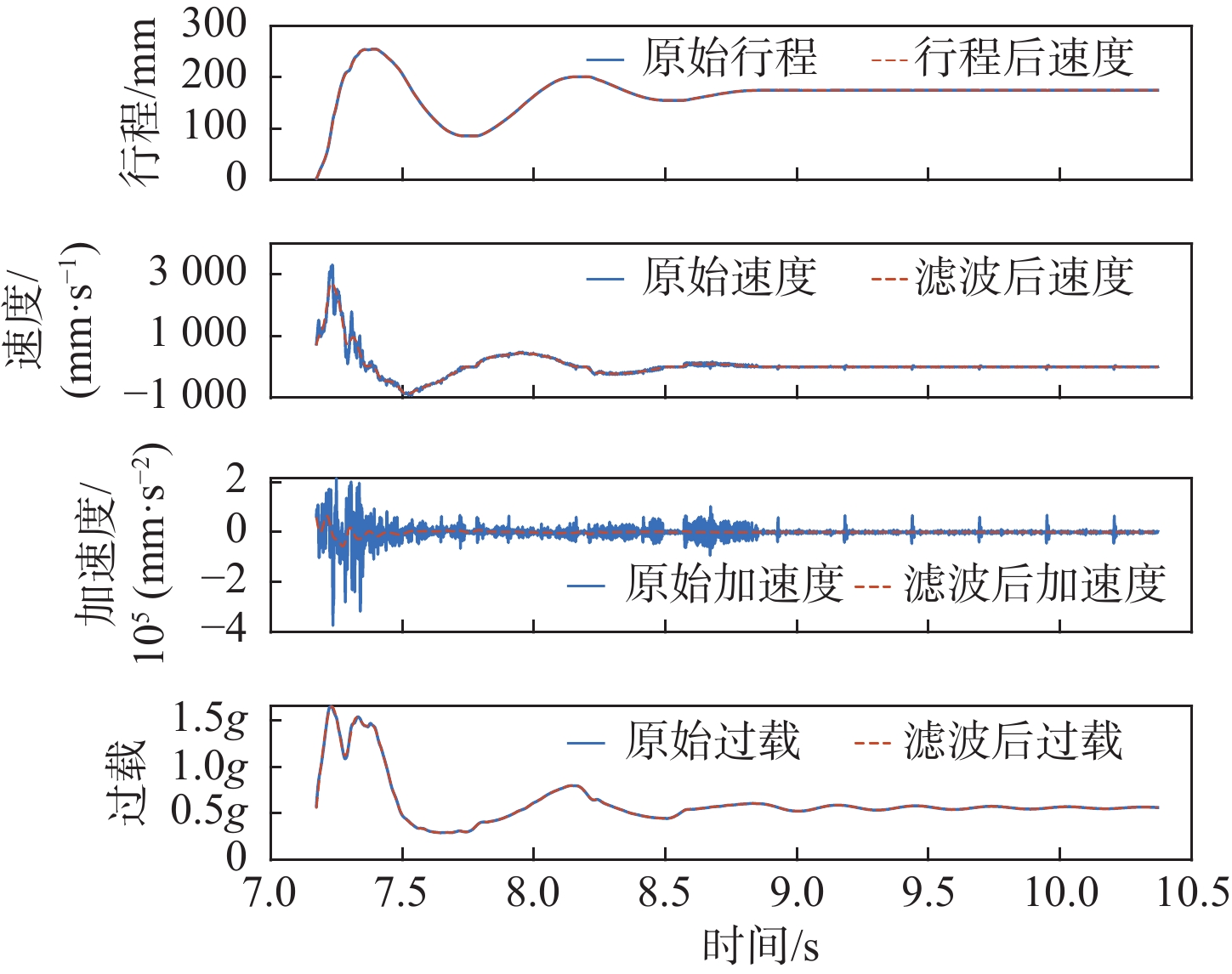
图 6 滤波处理后行程、过载、速度、加速度对比曲线
Figure 6. Comparison curves of stroke, overload, velocity, and acceleration after filtering
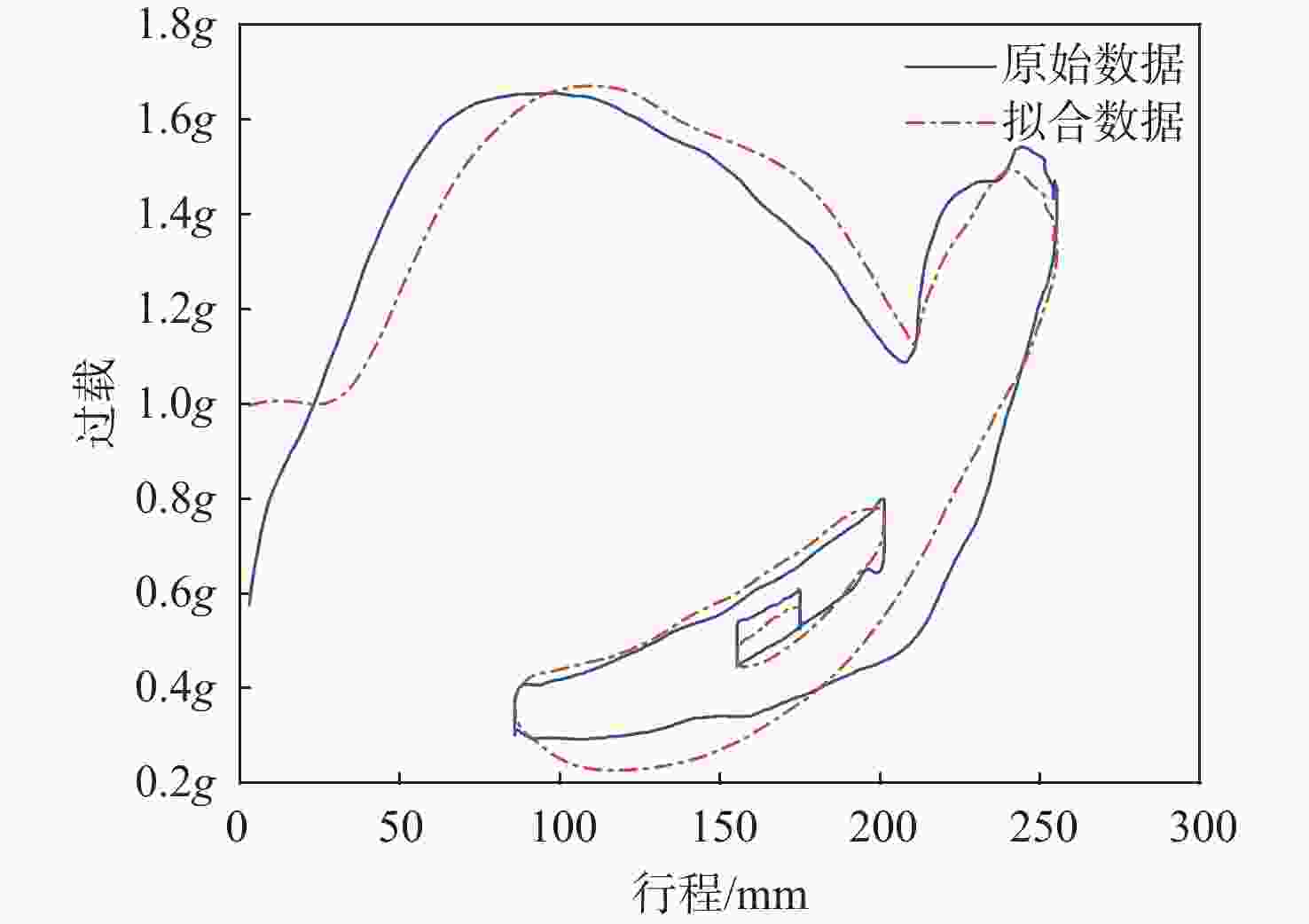
图 8 缓冲器功量图的实际值和拟合值对比
Figure 8. Comparison of actual and fitted power curves in the buffer power flow diagram
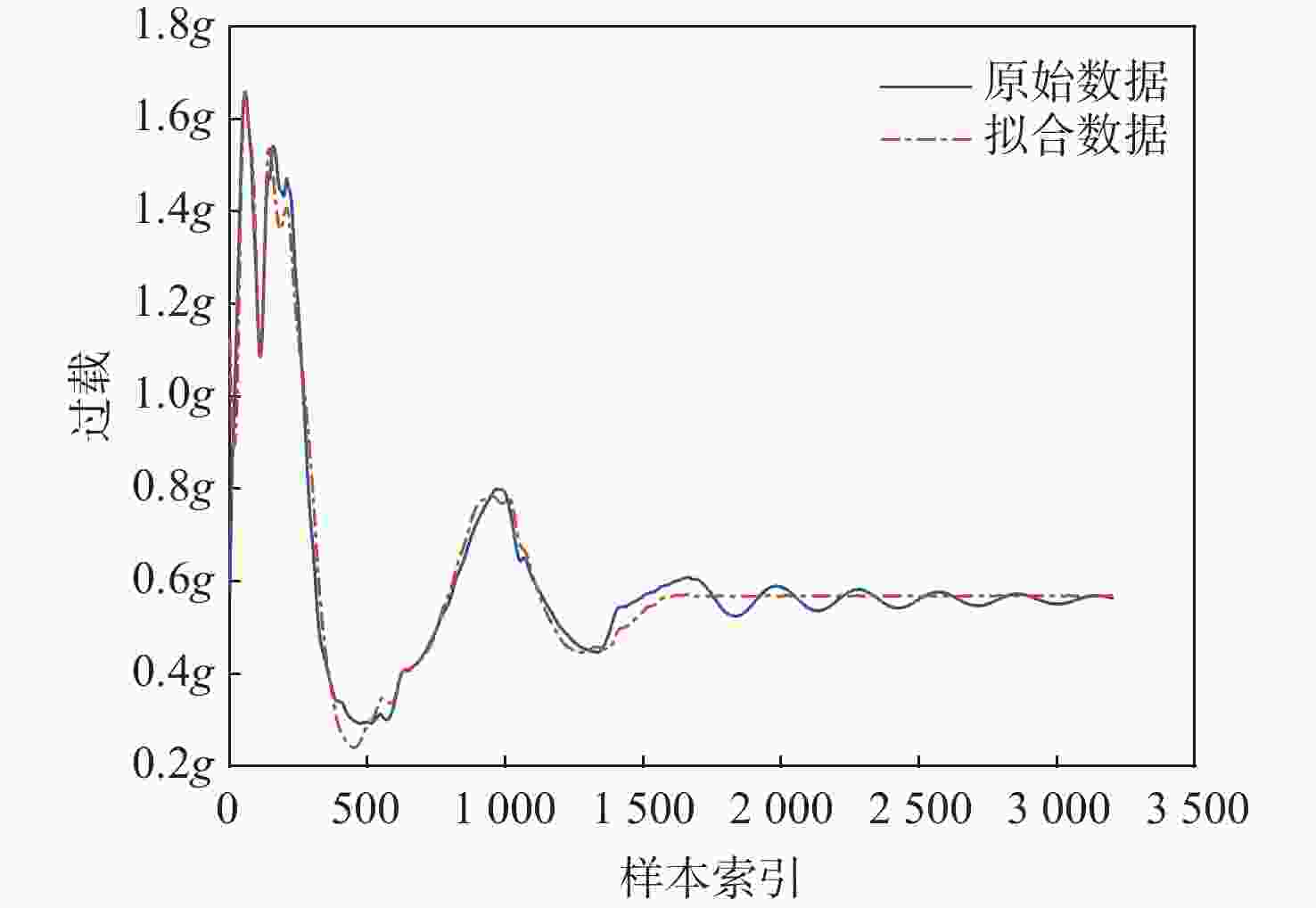
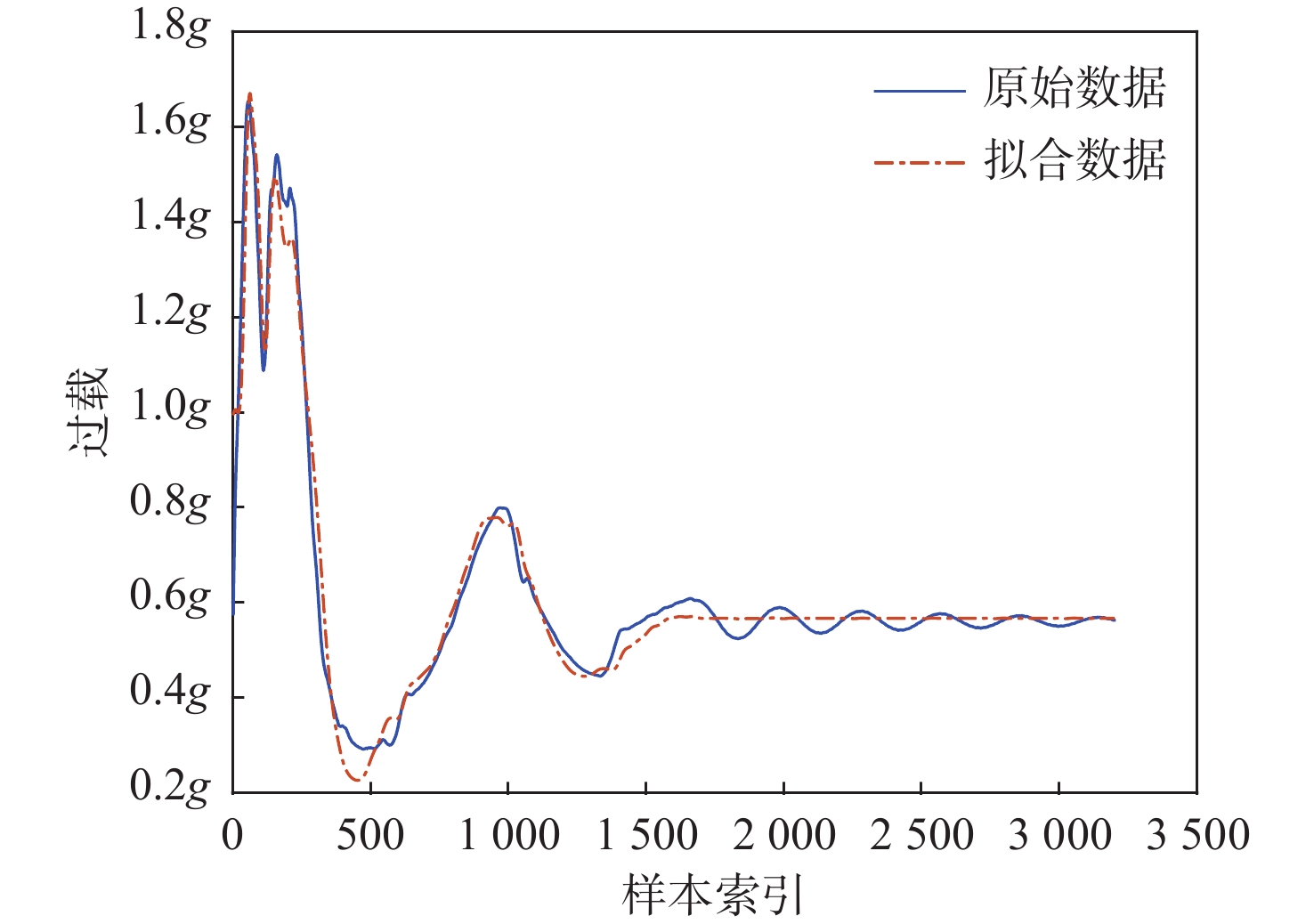
图 9 过载的实际值和改善时延的数学模型拟合值对比
Figure 9. Comparison of actual and fitted overload values of time-delay improvement mathematical model
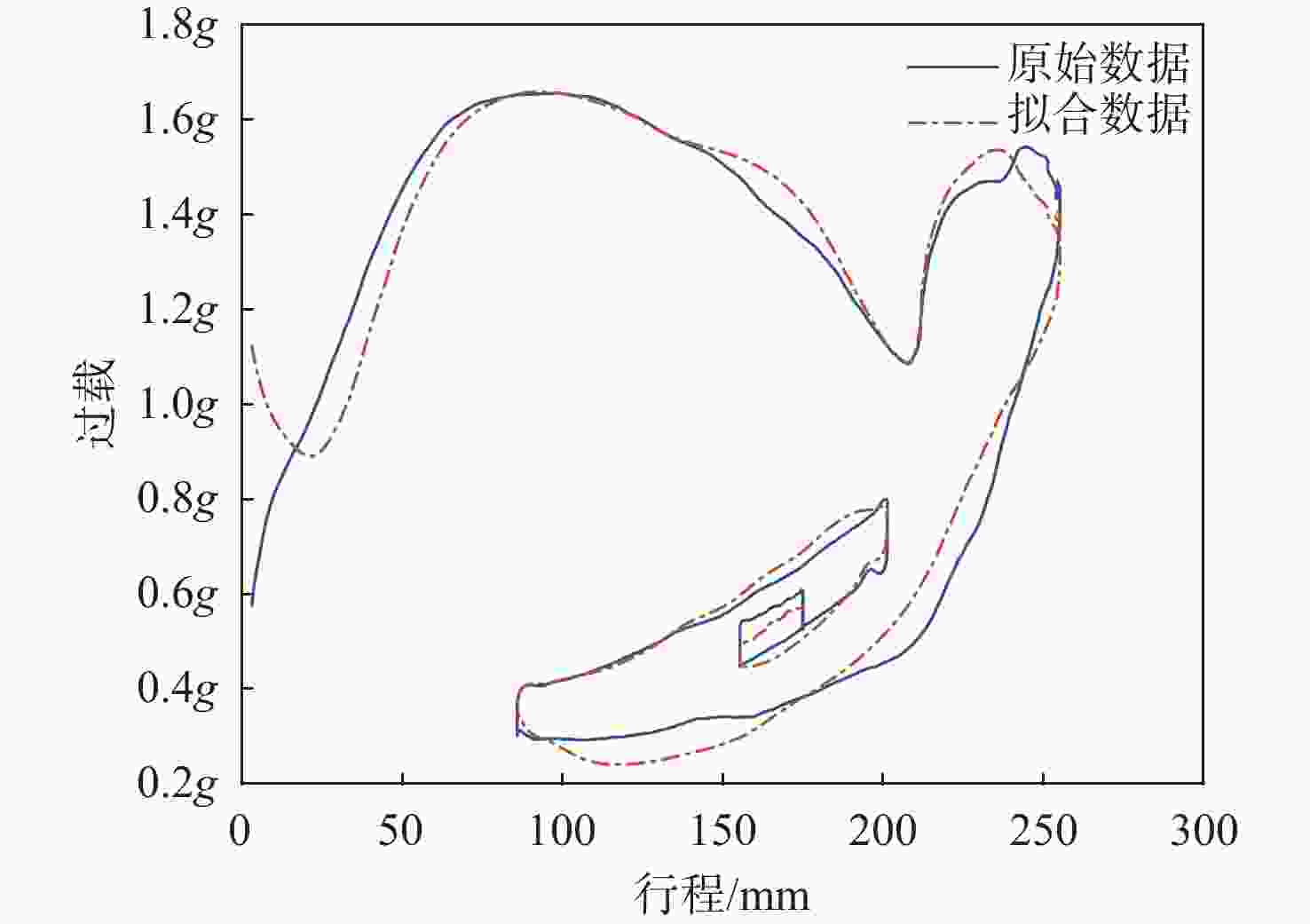
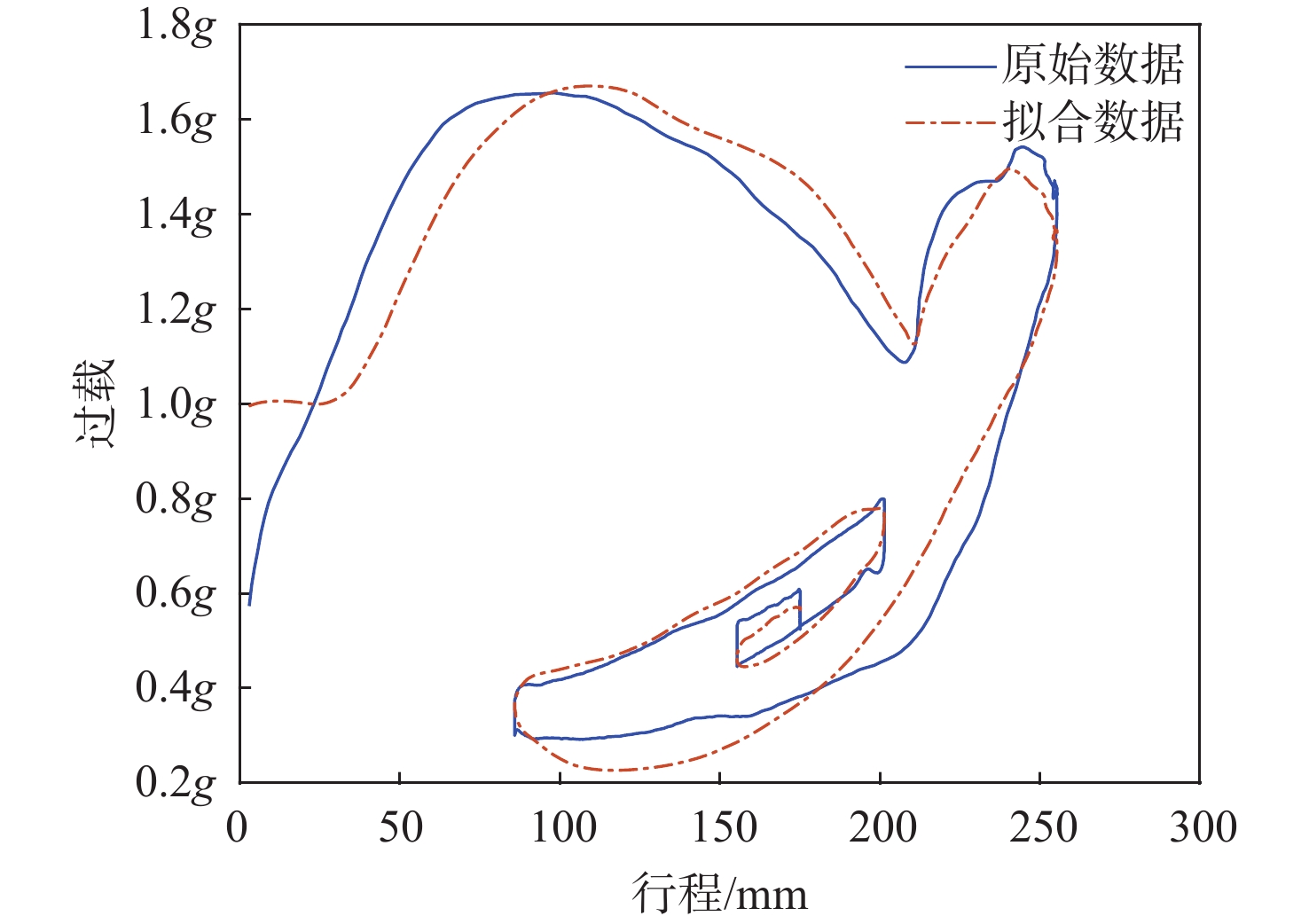
图 10 缓冲器功量图的实际值和改善时延的数学模型拟合值对比
Figure 10. Comparison of actual and fitted power curves in the buffer power diagram of time-delay improvement mathematical model
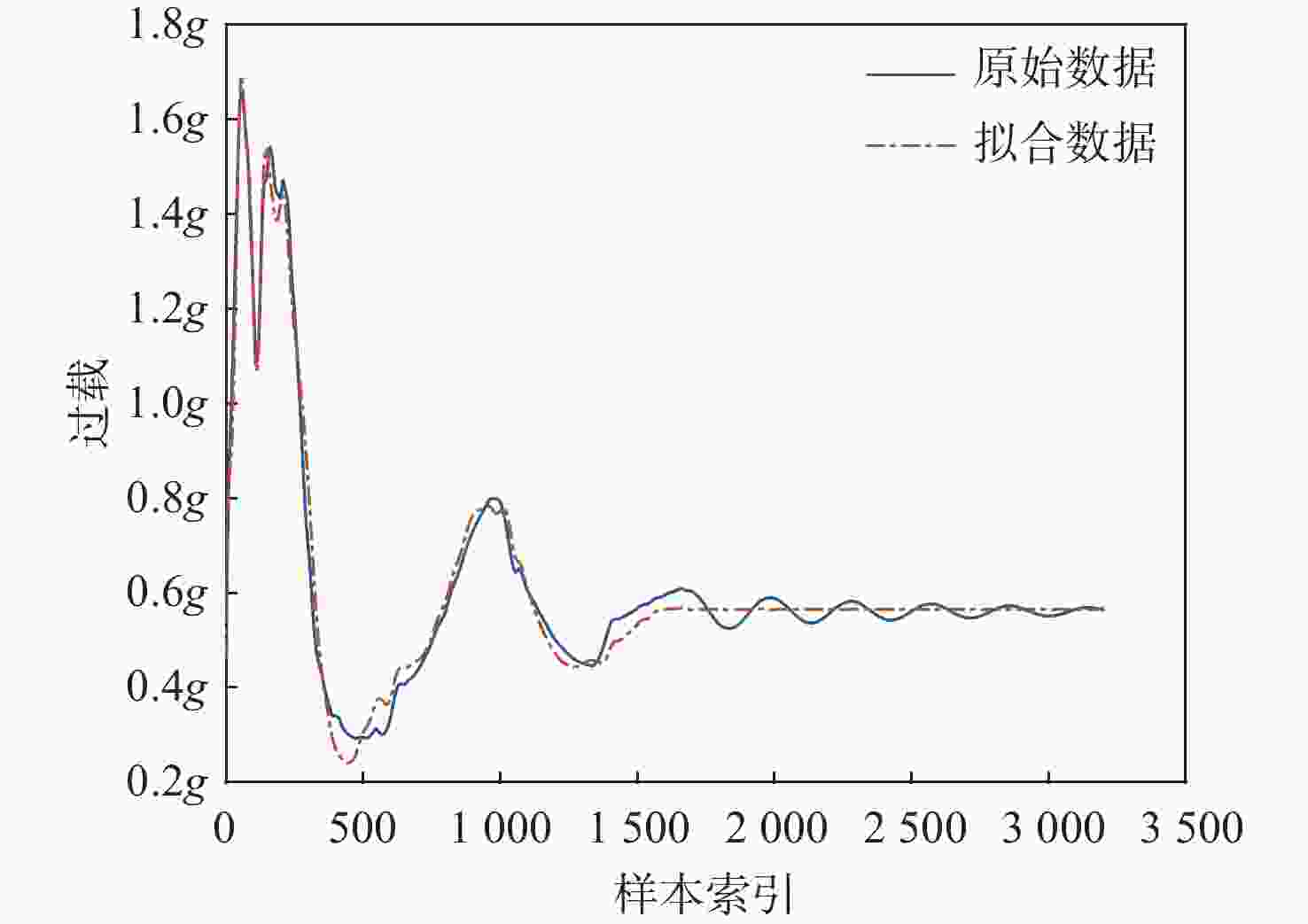
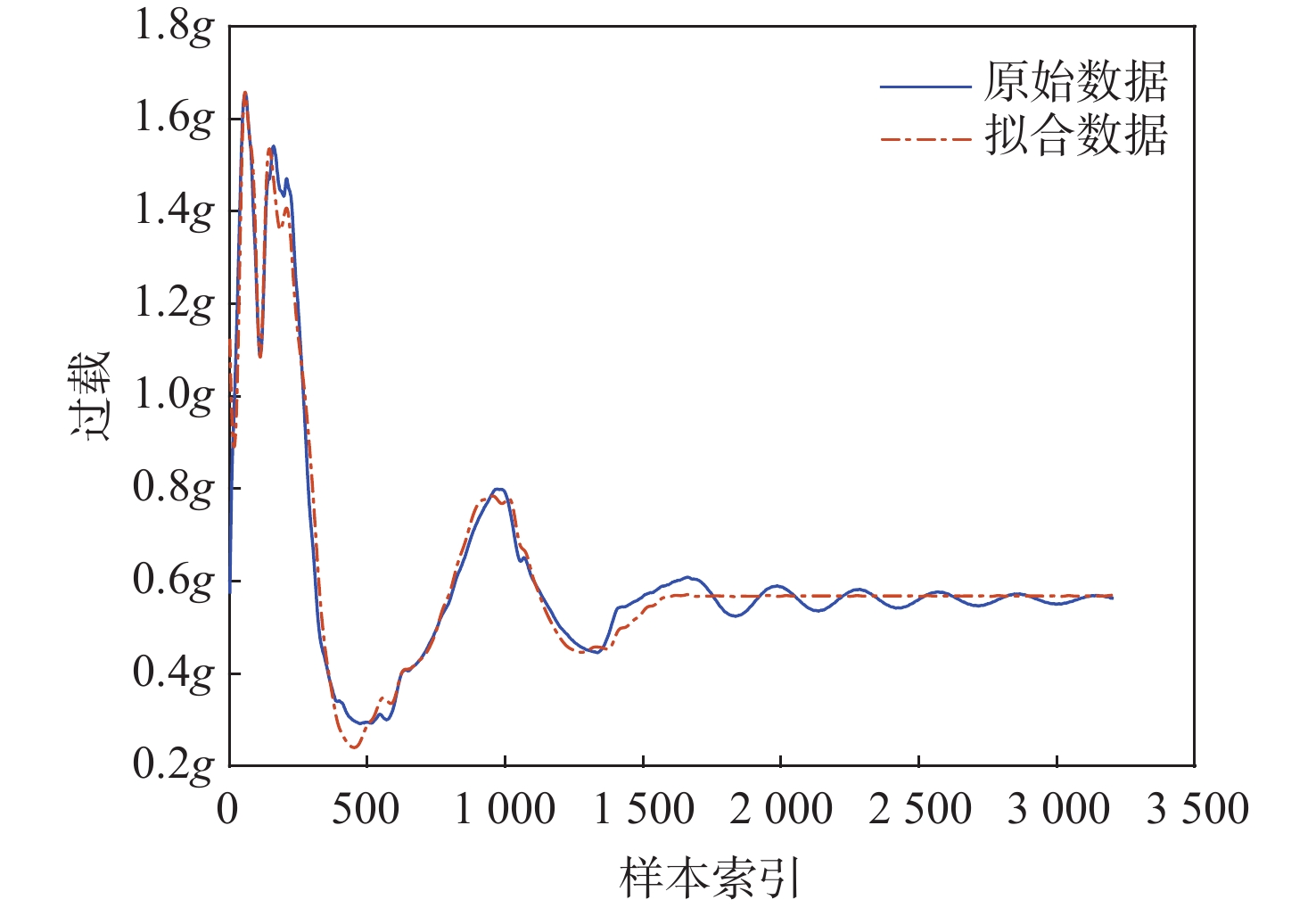
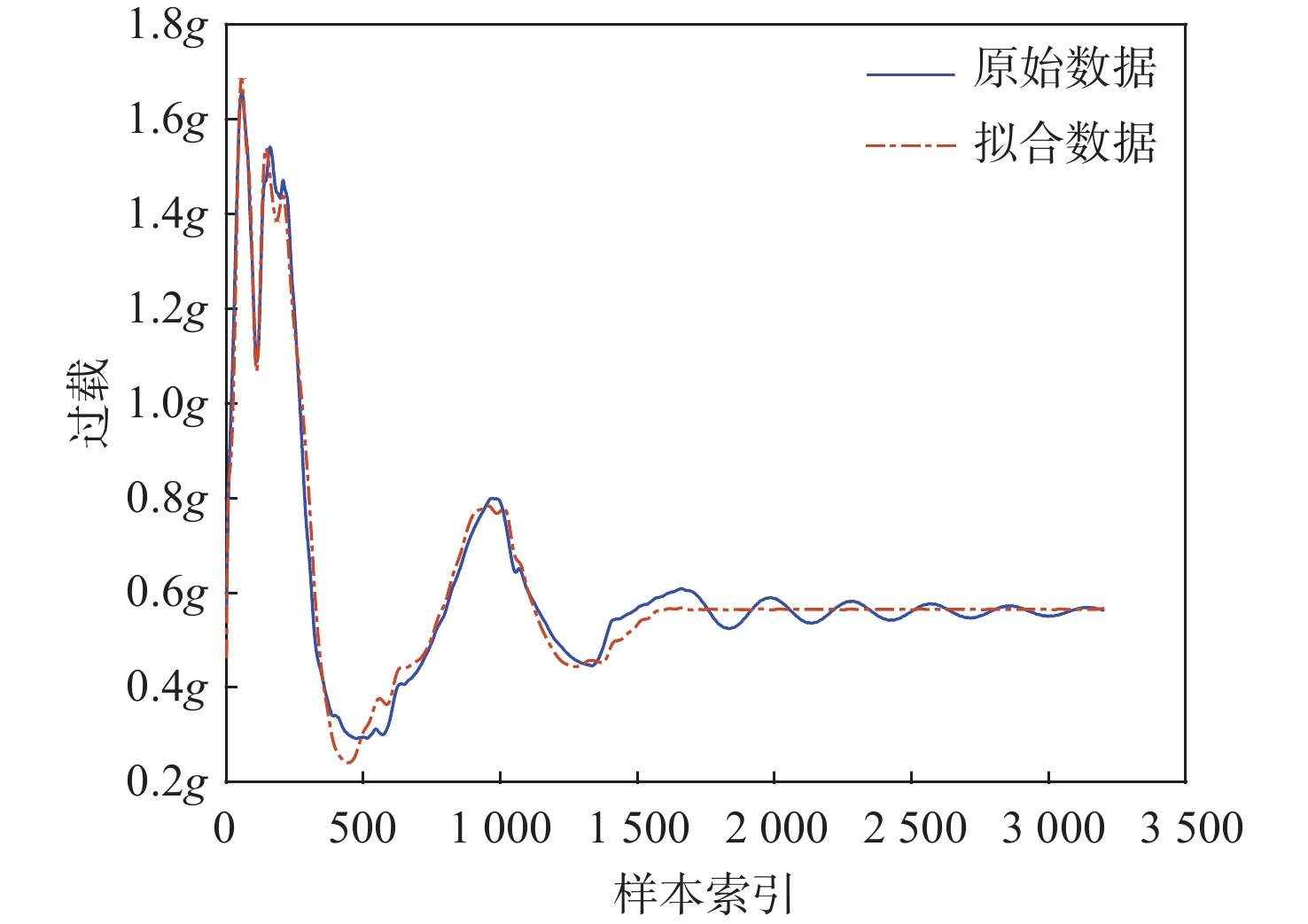
图 11 过载的实际值和改善初始阶段偏差的数学模型拟合值对比
Figure 11. Comparison of actual and fitted overload values of mathematical model for improving initial-stage deviation
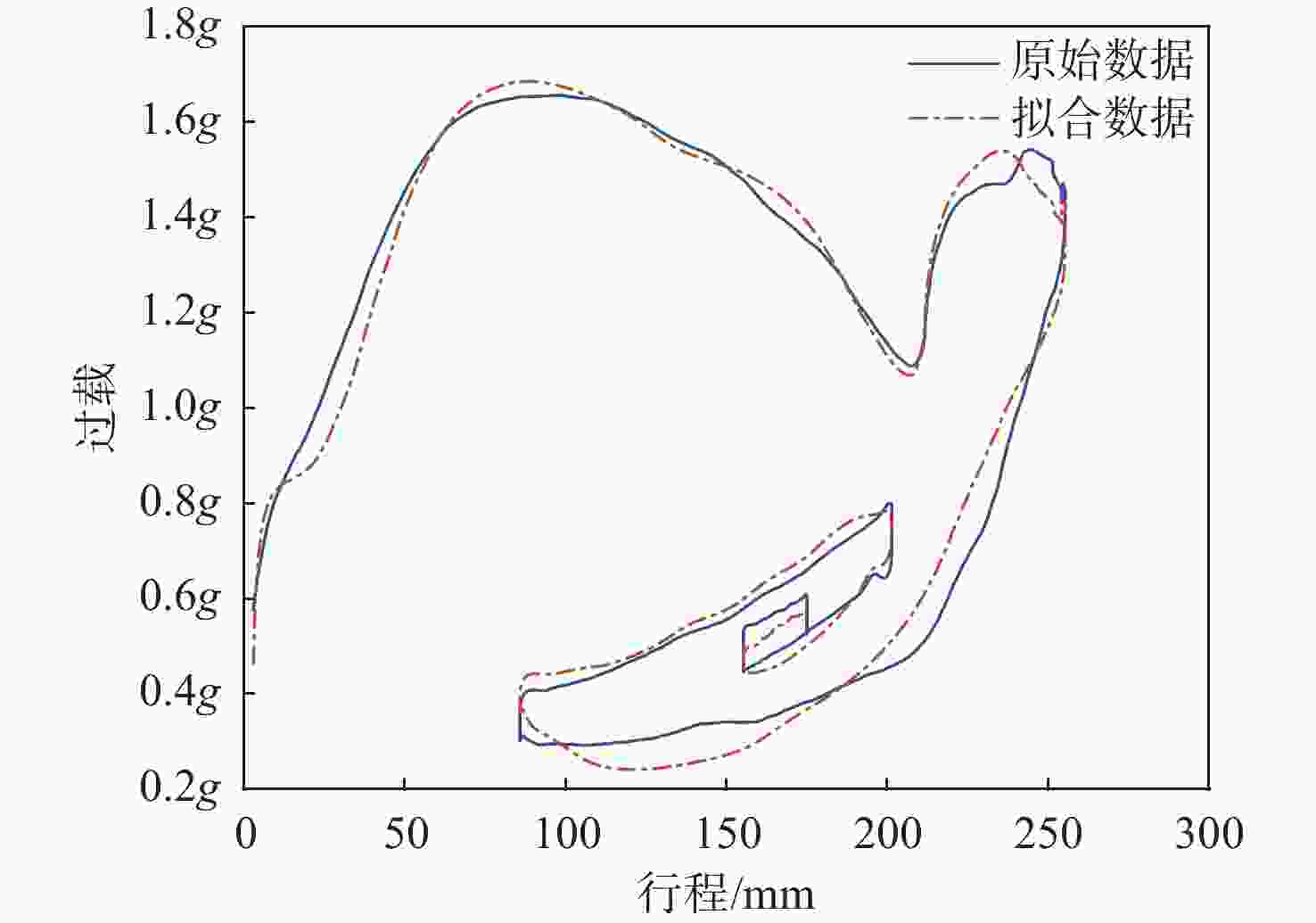
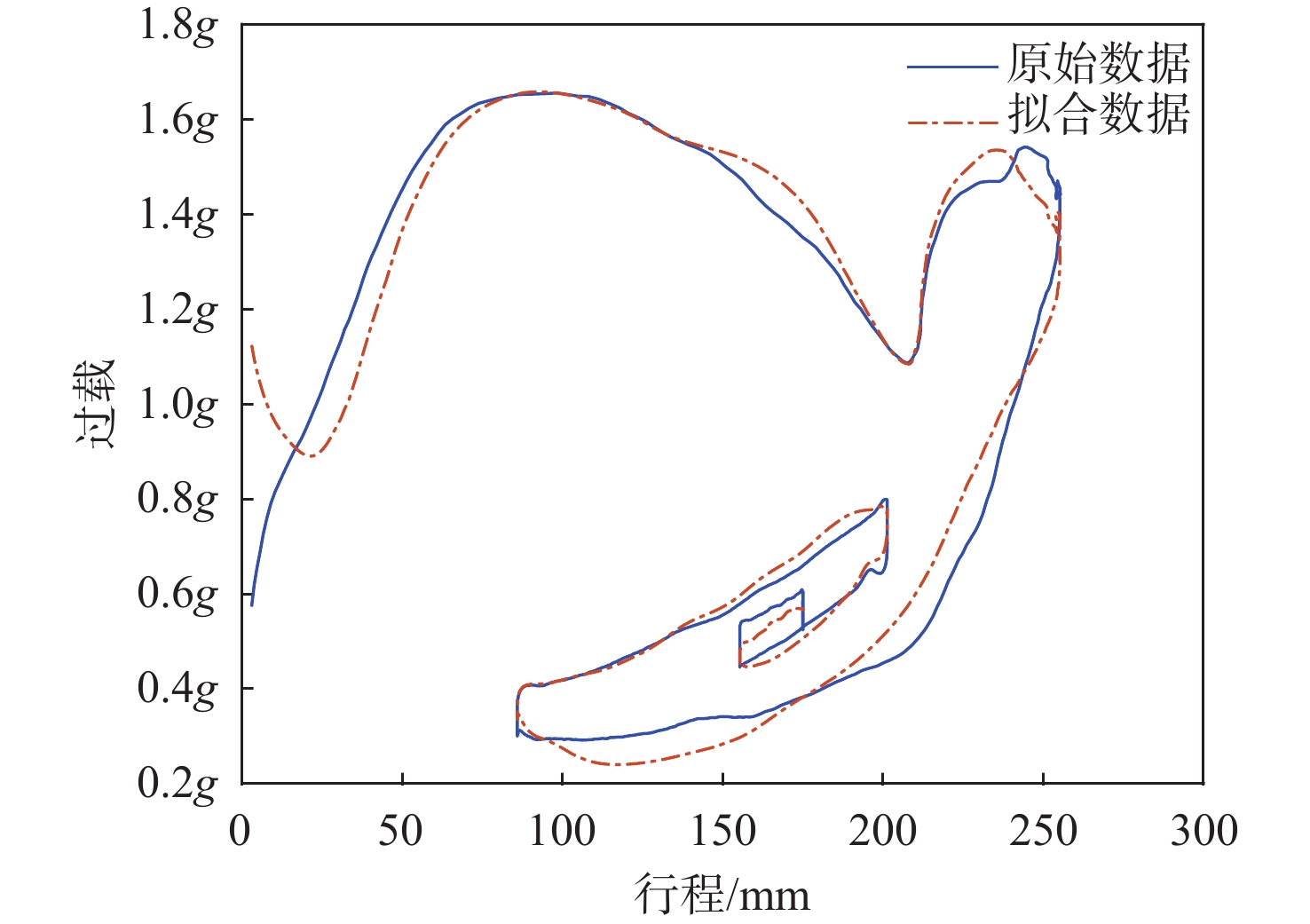
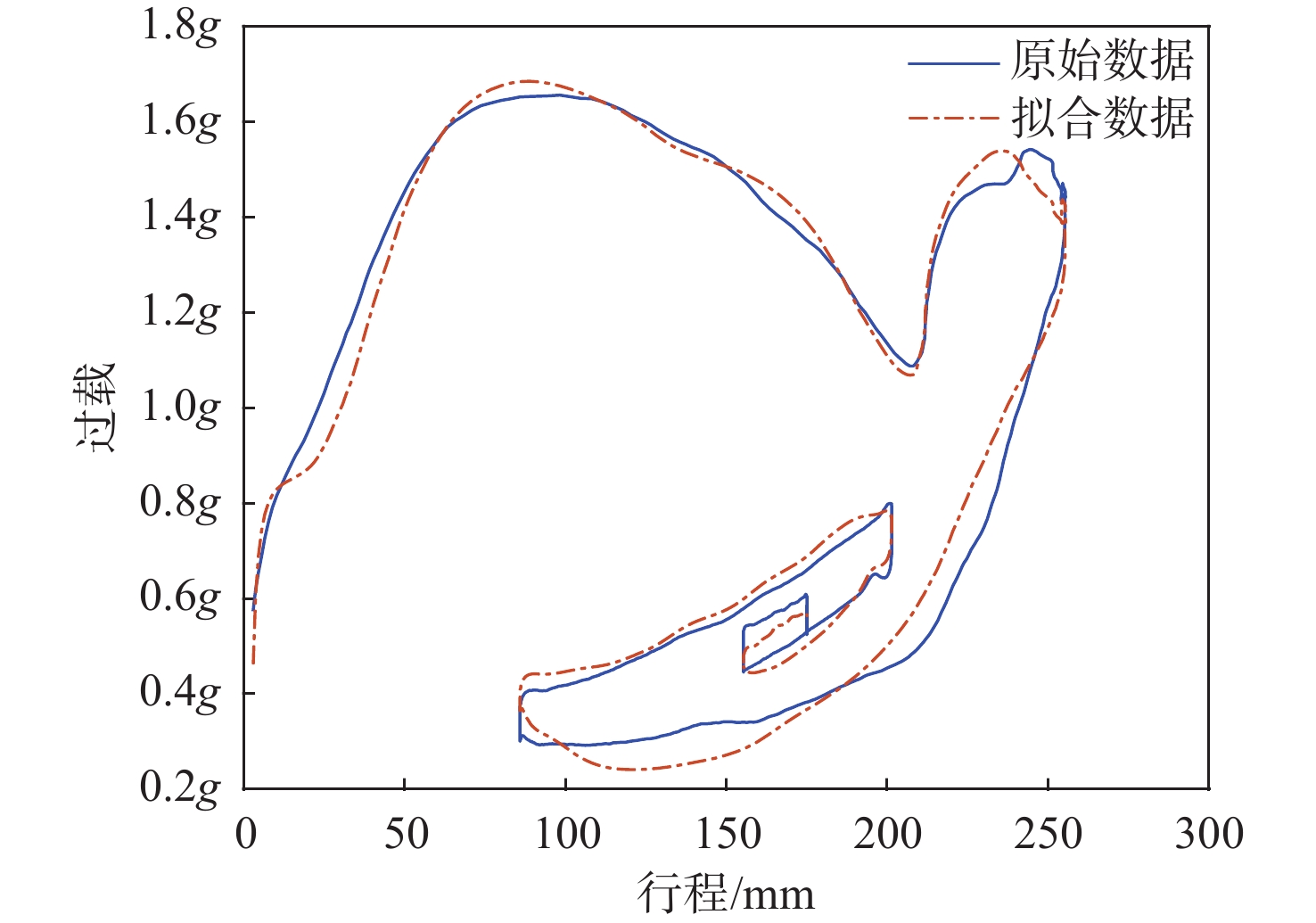
图 12 缓冲器功量图的实际值和改善初始阶段偏差的数学模型拟合值对比
Figure 12. Comparison of actual and fitted power curves in buffer power diagram of mathematical model for improving initial-stage deviation
表 1 Butterworth滤波器传递函数的分母多项式系数
Table 1. Denominator polynomial coefficients of the Butterworth filter transfer function
n b7 b6 b5 b4 b3 b2 b1 b0 1 1.0000 2 1.4142 1.0000 3 2.0000 2.0000 1.0000 4 2.6131 3.4142 2.6131 1.0000 5 3.2361 5.2361 5.2361 3.2361 1.0000 6 3.8637 7.4641 9.1416 7.4641 3.8637 1.0000 7 4.4940 10.0978 14.5918 14.5918 10.0978 4.4940 1.0000 8 5.1258 13.1371 21.8462 25.6884 21.8462 13.1371 5.1258 1.0000  下载: 导出CSV
表 2 对回归系数进行显著性检验的统计量
Table 2. Test statistic for the significance of regression coefficients
系数 估计值 SE $ t $统计量 $ {p}_{\text{value}} $ $ {a}_{0} $ 8.1464 × 10−18.9704 × 10−390.814 0 $ {a}_{1} $ − 9.0978 × 10−31.0834 × 10−4−83.977 0 $ {a}_{2} $ 2.2696 × 10−47.6238 × 10−629.770 4.4202 × 10−172$ {a}_{3} $ 4.3902 × 10−53.3417 × 10−7131.380 0 $ {a}_{4} $ 7.8479 × 10−81.7113 × 10−945.860 0 $ {a}_{5} $ 4.3789 × 10−74.1792 × 10−810.478 2.7918 × 10⁻²⁵
下载: 导出CSV
表 3 对模型整体拟合优度检验方面的诊断指标
Table 3. Diagnostic indicators for overall goodness-of-fit test of the model
RMSE $ {R}^{2} $ $ F $统计量 pvalue 0.044 7 0.968 1.92×10⁴ 0
下载: 导出CSV
表 4 对改善时延的数学模型的回归系数进行显著性检验的统计量
Table 4. Significance test statistics for regression coefficients of time-delay improvement model
系数 估计值 SE $ t $统计量 $ {p}_{\text{value}} $ $ {c}_{0} $ 7.9925 ×10−18.2152 ×10−397.289 0 $ {c}_{1} $ − 9.2222 ×10−39.9970 ×10−5−92.25 0 $ {c}_{2} $ 1.1248 ×10−47.9991 ×10−614.062 1.2714 ×10−43$ {c}_{3} $ 3.4830 ×10−61.2737 ×10−727.346 4.1638 ×10−148$ {c}_{4} $ 4.5151 ×10−53.1374 ×10−7143.91 0 $ {c}_{5} $ 9.1861 ×10−81.6562 ×10−955.465 0 $ {c}_{6} $ 4.9268 ×10−122.5144 ×10−121.9595 5.0147 ×10⁻²$ {c}_{7} $ 1.1873 ×10−64.6381 ×10−825.99 1.3008 ×10−131
下载: 导出CSV
表 5 对改善时延的数学模型整体拟合优度检验方面的诊断指标
Table 5. Diagnostic metrics for overall goodness-of-fit testing of time-delay improvement mathematical model
RMSE $ {R}^{2} $ $ F $统计量 pvalue 0.0401 0.974 1.71×10⁴ 0
下载: 导出CSV
表 6 对改善初始阶段偏差的数学模型的回归系数进行显著性检验的统计量
Table 6. Significance test statistics for regression coefficients of initial-stage deviation improvement model
系数 估计值 SE $ t $统计量 $ {p}_{\text{value}} $ $ {d}_{0} $ 1.194 1.3046 ×10−291.526 0 $ {d}_{1} $ − 1.1916 ×10−21.1175 ×10−4−106.630 0 $ {d}_{2} $ 1.4974 ×10−46.8534 ×10−621.849 9.713×10−99 $ {d}_{3} $ 3.5939 ×10−61.0767 ×10−733.379 8.5131 ×10−210$ {d}_{4} $ 5.1734 ×10−53.1619 ×10−7163.620 0 $ {d}_{5} $ 8.3556 ×10−81.3974 ×10−959.793 0 $ {d}_{6} $ 1.0192 ×10−63.9642 ×10−825.711 1.1927 ×10−132$ {d}_{7} $ − 1.6958 4.8066 ×10⁻²−35.281 1.6017 ×10−230
下载: 导出CSV
表 7 对改善初始阶段偏差的数学模型的整体拟合优度检验方面的诊断指标
Table 7. Diagnostic metrics for overall goodness-of-fit testing of mathematical model for improving initial-stage deviation
RMSE $ {R}^{2} $ $ F $统计量 pvalue 0.0341 0.981 2.39×10⁴ 0
下载: 导出CSV
-
[1] 隋福成, 陆华. 飞机起落架缓冲器数学模型研究[J]. 飞机设计, 2001, 21(2X): 44-51.Sui F C, Lu H. Mathemetical model research on aircraft landing gear damper[J]. Aircraft Design, 2001, 21(2X): 44-51(in Chinese). [2] Choi S B, Lee S K, Park Y P. A hysteresis model for the field-dependent damping force of a magnetorheological damper[J]. Journal of Sound and Vibration, 2001, 245(2): 375-383. [3] 孔祥东, 李斌, 权凌霄, 等. 磁流变液阻尼器Bingham-多项式力学模型研究[J]. 机械工程学报, 2017, 53(14): 179-186.Kong X D, Li B, Quan L X, et al. Study on dynamic Bingham-polynomial model of a MRF damper[J]. Journal of Mechanical Engineering, 2017, 53(14): 179-186(in Chinese). [4] Fan G, Li J, Hao H. Vibration signal denoising for structural health monitoring by residual convolutional neural networks[J]. Measurement, 2020, 157: 107651. [5] 余长青. 基于Butterworth函数的滤波器设计[J]. 遵义师范学院学报, 2008, 10(5): 74-76.Yu C Q. Filter design based on butterworth function[J]. Journal of Zunyi Normal College, 2008, 10(5): 74-76(in Chinese). [6] 王钢, 梁远升, 李海锋, 等. 基于PSO算法和Butterworth低通滤波器的参数自适应故障测距时域法[J]. 电力自动化设备, 2009, 29(3): 4-9.Wang G, Liang Y S, Li H F, et al. Time domain fault locating with parameter self-adaptation based on PSO algorithm and Butterworth low-pass filter[J]. Electric Power Automation Equipment, 2009, 29(3): 4-9(in Chinese). [7] 李钟慎, 郑胜家. 基于GUIDE进行Butterworth滤波器的分析[J]. 信息技术, 2006(10): 26-29.Li Z S, Zheng S J. Analyzing butterworth filter based on GUIDE[J]. Information Technology, 2006(10): 26-29(in Chinese). [8] Selesnick I W, Burrus C S. Generalized digital Butterworth filter design[J]. IEEE Transactions on Signal Processing, 1998, 46(6): 1688-1694. [9] 万永革. 数字信号处理的MATLAB实现[M]. 北京: 科学出版社, 2007: 135.Wan Y G. MATLAB implementation of digital signal processing[M]. Beijing: Science Press, 2007: 135(in Chinese). [10] 江晟, 许锋, 聂宏. 基于MATLAB /Simulink的大型水陆两栖飞机起落架缓冲性能优化[J]. 江苏航空, 2012, 3: 4-7.Jiang S, Xu F, Nie H. Optimization of buffer performance for large amphibious aircraft landing gear based on MATLAB/Simulink[J]. Jiang Su Aviation, 2012, 3: 4-7(in Chinese). [11] 朱永健, 陈云, 张万民. 基于LMS仿真实现变阻尼缓冲器优化设计[C]//中国航空学会结构强度专业学术交流会论文集. 北京: 中国航空学会, 2013: 240-248.Zhu Y J, Chen Y, Zhang W M. Optimization design of variable damping shock absorber based on LMS simulation[C]//Proceedings of the Academic Conference on Structural Strength of Chinese Society of Aeronautics and Astronautics. Beijing: Chinese Society of Aeronautics and Astronautics, 2013: 240-248(in Chinese). [12] 吴晓宇, 聂宏, 张明. 两种不同形式前起落架缓冲与前轮转弯性能对比研究[J]. 航空工程进展, 2015, 6(3): 333-340.Wu X Y, Nie H, Zhang M. Contrastive analysis of buffering and steering performance for two different types of nose landing gear[J]. Advances in Aeronautical Science and Engineering, 2015, 6(3): 333-340(in Chinese). [13] 周铁明. 磁流变阻尼器非线性建模及振动模糊控制研究[D]. 合肥: 合肥工业大学, 2013: 34.Zhou T M. Research on the nonlinear modeling of magnetorheological damper and fuzzy control of vibration[D]. Hefei: Hefei University of Technology, 2013: 34(in Chinese). [14] 张志涌. 精通MATLAB 6.5版[M]. 北京: 北京航空航天大学出版社, 2003: 152.Zhang Z Y. Proficient in MATLAB version 6.5[M]. Beijing: Beijing University of Aeronautics & Astronautics Press, 2003: 152(in Chinese). [15] 刘建涛, 杜平安. 考虑过载效应的金属材料疲劳裂纹扩展试验数据拟合及疲劳裂纹扩展速度计算方法研究[J]. 机械工程学报, 2012, 48(4): 85-91.Liu J T, Du P A. Research on the curve fitting of fatigue test data and computation of fatigue crack growth rates of metals in consideration of the retardation effect[J]. Journal of Mechanical Engineering, 2012, 48(4): 85-91(in Chinese). [16] 徐小华, 胡晓飞, 赵艳春. 基于多项式非线性拟合问题的探讨[J]. 赤峰学院学报(自然科学版), 2014, 30(2): 37-38.Xu X H, Hu X F, Zhao Y C. Discussion on nonlinear fitting based on polynomials[J]. Journal of Chifeng University (Natural Science Edition), 2014, 30(2): 37-38(in Chinese). [17] 雷晓波, 文敏, 雷蒂远, 等. 利用Pearson-Ⅲ分布预测某飞机法向过载极值[J]. 机械强度, 2018, 40(1): 106-110.Lei X B, Wen M, Lei D Y, et al. Prediction of aircraft normal overload extreme value based on Pearson-ⅲ distribution[J]. Journal of Mechanical Strength, 2018, 40(1): 106-110(in Chinese). [18] 余欣玺, 朱珠, 赵宇琪, 等. 一种变压器重过载的数学模型统计方法: CN115905357B[P]. 2025-07-18.Yu X X, Zhu Z, Zhao Y Q, et al. Mathematical model statistical method for heavy overload of transformer: CN115905357B[P]. 2025-07-18(in Chinese). -

 下载:
下载:

 点击查看大图
计量
- 文章访问数: 222
- HTML全文浏览量: 79
- PDF下载量: 10
- 被引次数: 0
