





Fault detection for reusable liquid rocket engines based on stacked wavelet autoencoder
-
摘要:
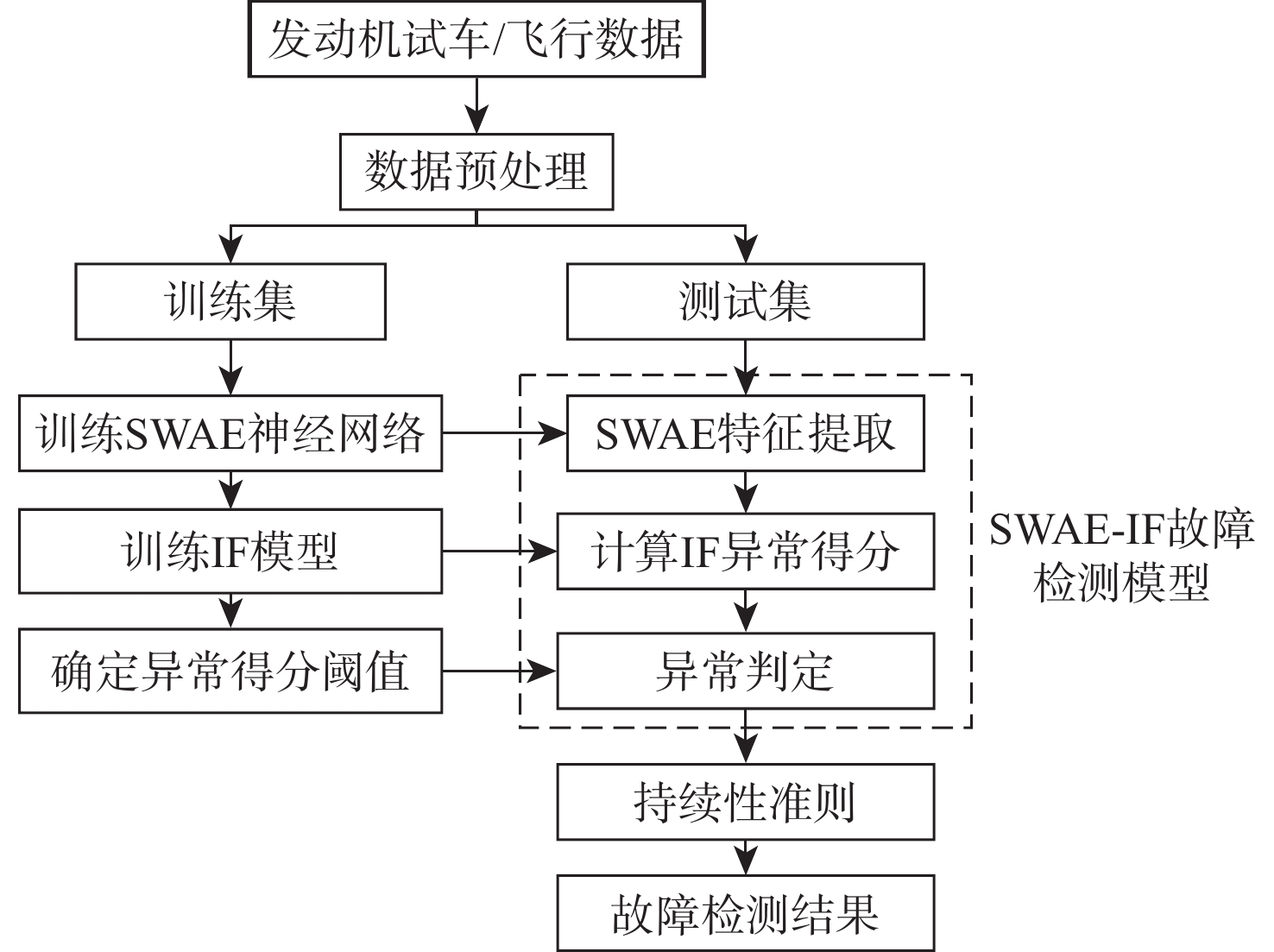
可重复使用液体火箭发动机的安全运行直接影响火箭飞行安全与复用效率,研究其故障检测技术具有重要意义。为此,提出一种结合堆叠小波自编码器(SWAE)与孤立森林(IF)的无监督故障检测方法。该方法仅使用正常工况数据训练,利用SWAE融合小波变换的时频分析能力与自编码器(AE)的特征学习优势,逐层提取抗噪时序特征;并引入IF算法,利用其对异常样本的快速孤立特性,实现无监督故障检测。在3类典型工程案例中,所提方法在多类型故障识别、跨工况泛化及渐变故障的早期检测中表现优异,与自适应阈值等传统方法相比,该方法的检测准确率、召回率及
F 1分数均为最优。-
关键词:
- 可重复使用液体火箭发动机 /
- 故障检测 /
- 堆叠小波自编码器 /
- 孤立森林 /
- 无监督学习
Abstract:Research on fault detection methods is crucial because the safe operation of reusable liquid rocket engines directly impacts rocket flight safety and reusability efficiency. This paper proposes an unsupervised fault detection method that combines a stacked wavelet autoencoder (SWAE) with an isolation forest (IF). The method is trained solely on normal operational data and leverages SWAE to integrate the time-frequency analysis capability of wavelet transform with the feature learning advantages of autoencoders (AE), enabling hierarchical extraction of noise-robust temporal features. Additionally, IF is introduced to exploit its ability to rapidly isolate anomalous samples, thereby achieving effective unsupervised fault detection. The suggested approach performs better in cross-operating-condition generalization, multi-type fault identification, and early gradual failure detection in three common engineering case studies. Compared with traditional approaches such as adaptive thresholding, the proposed method achieves the highest accuracy, recall rate, and
F 1 score. -
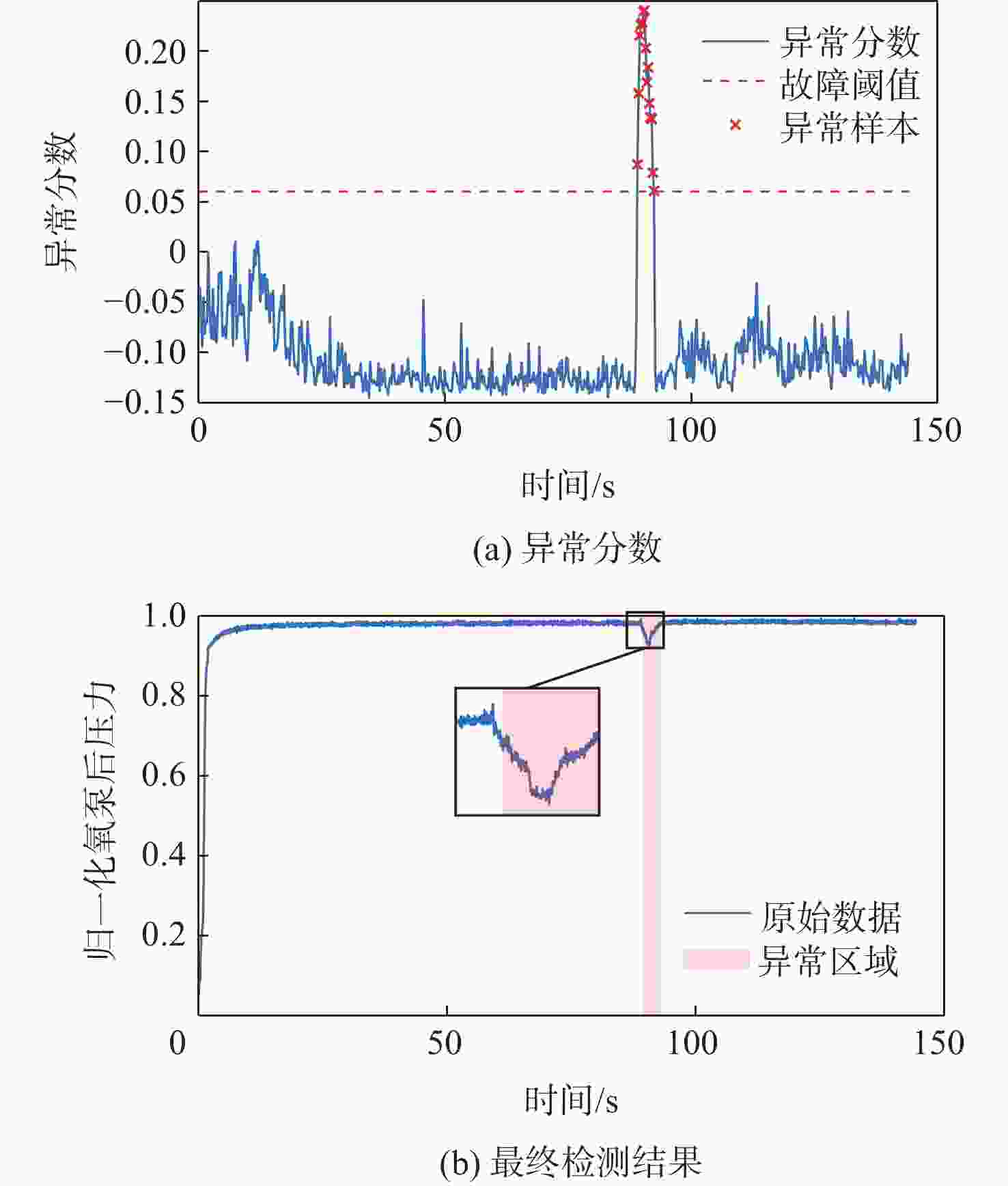
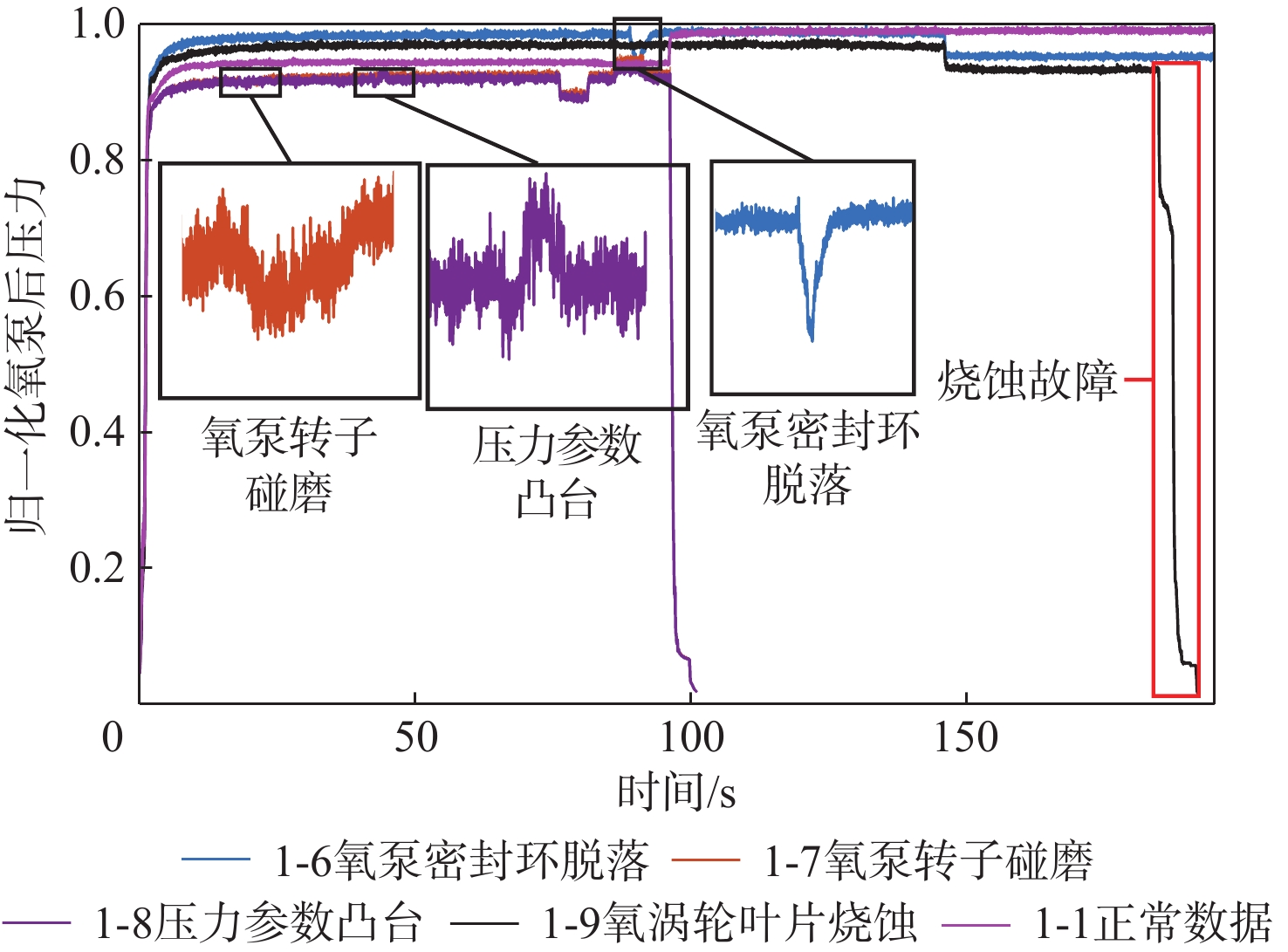
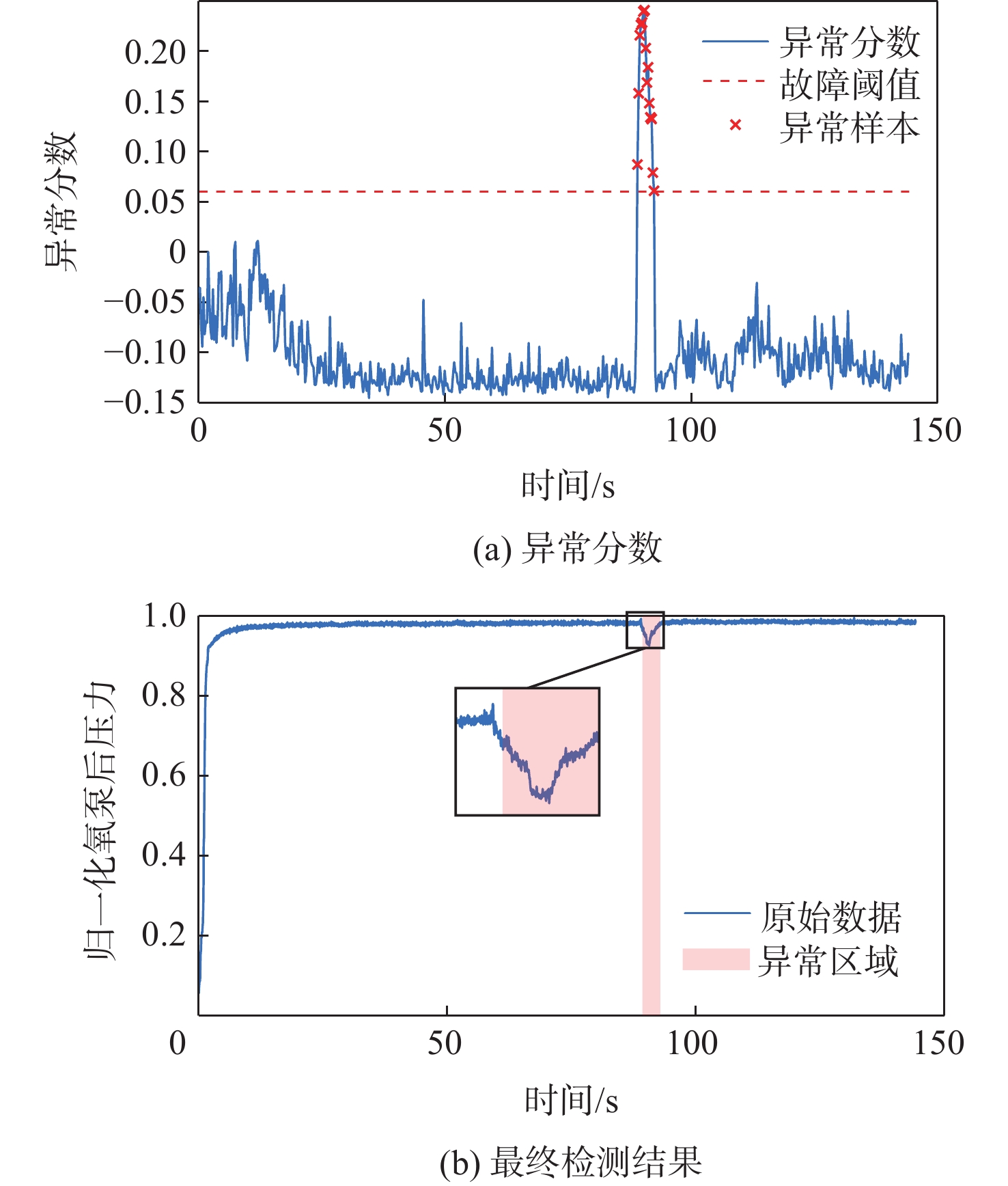
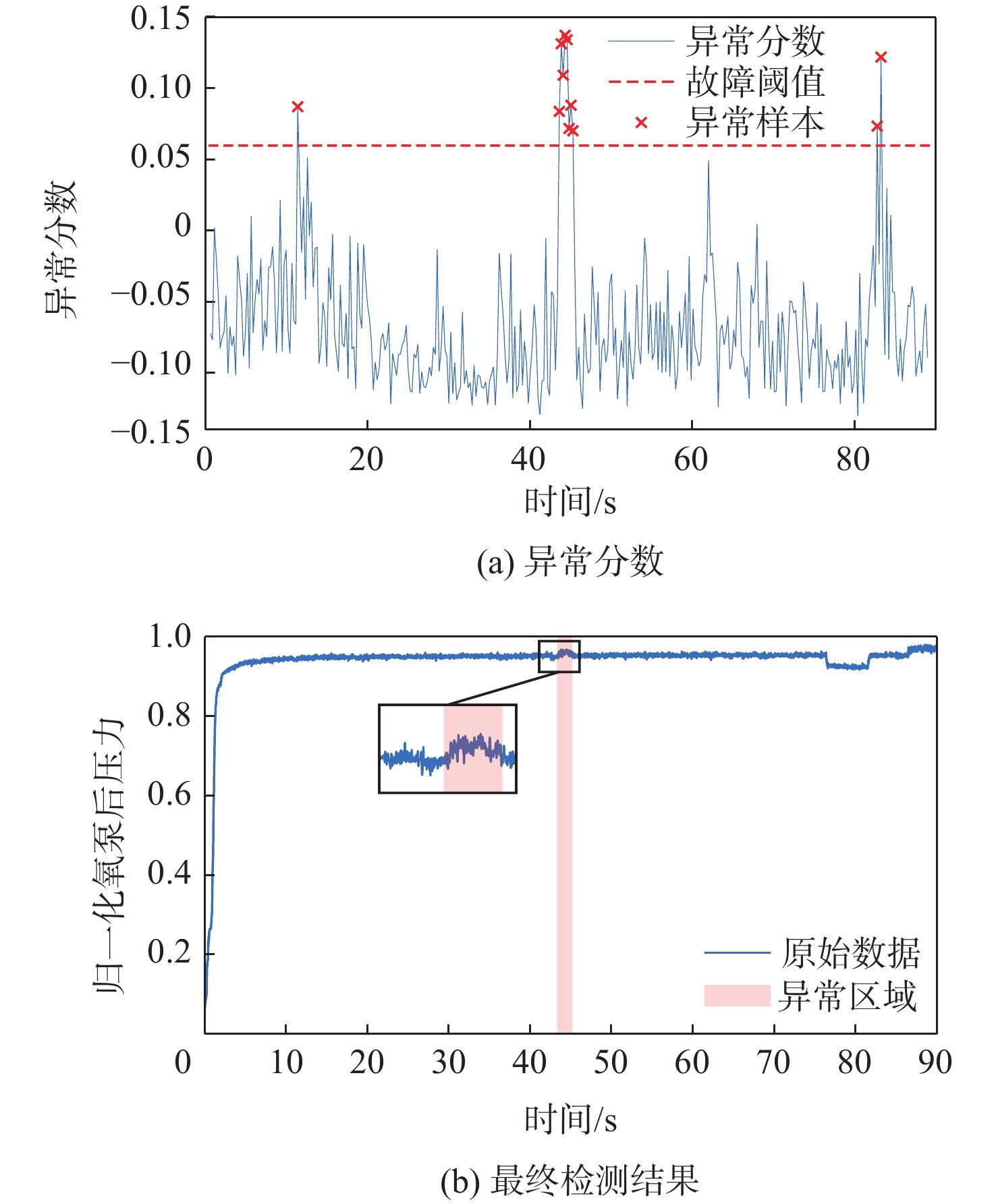
图 5 1-6号试车氧泵密封环脱落故障检测结果
Figure 5. Test results of the seal ring detachment fault of oxygen pumps during test runs from No. 1-6
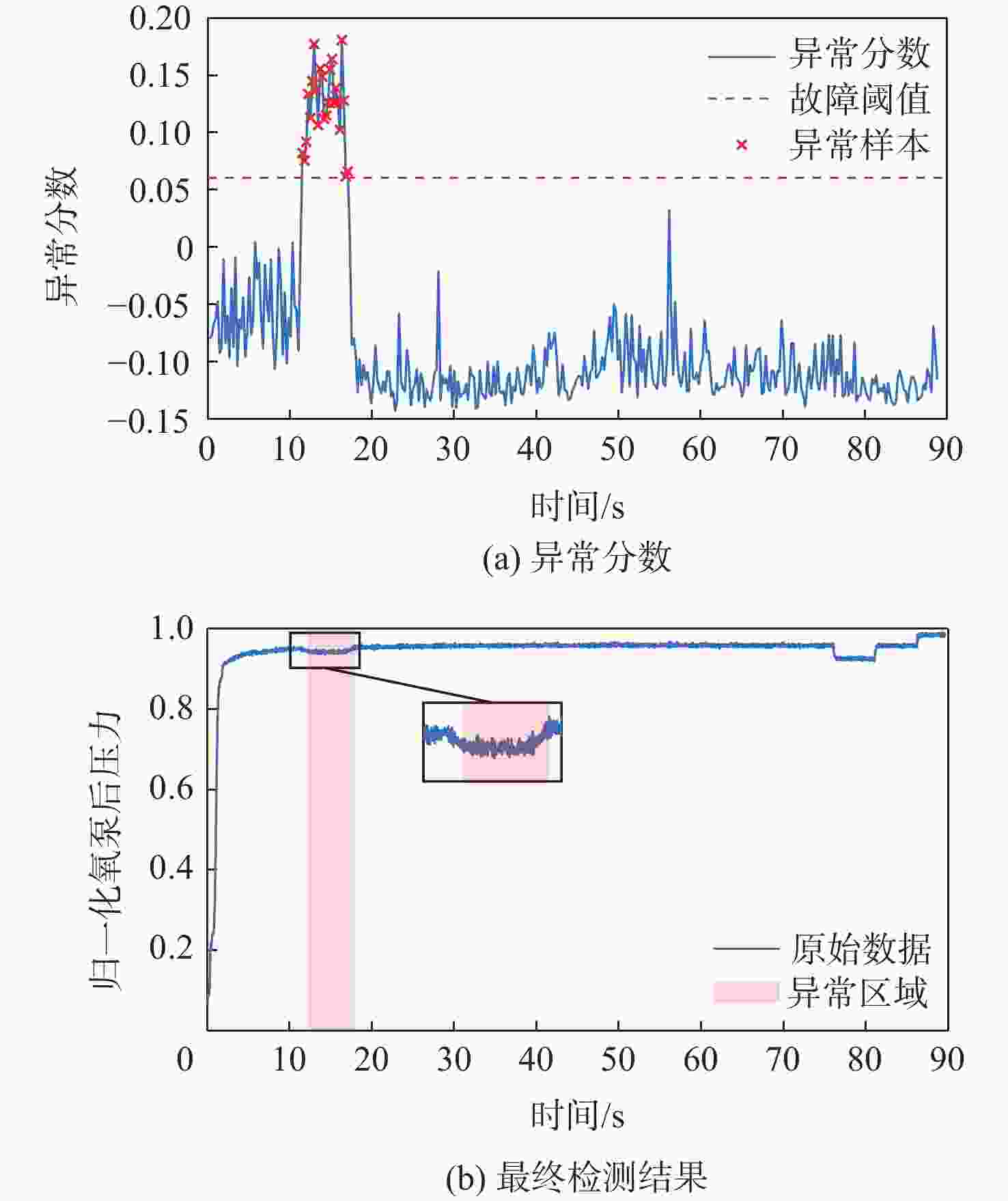
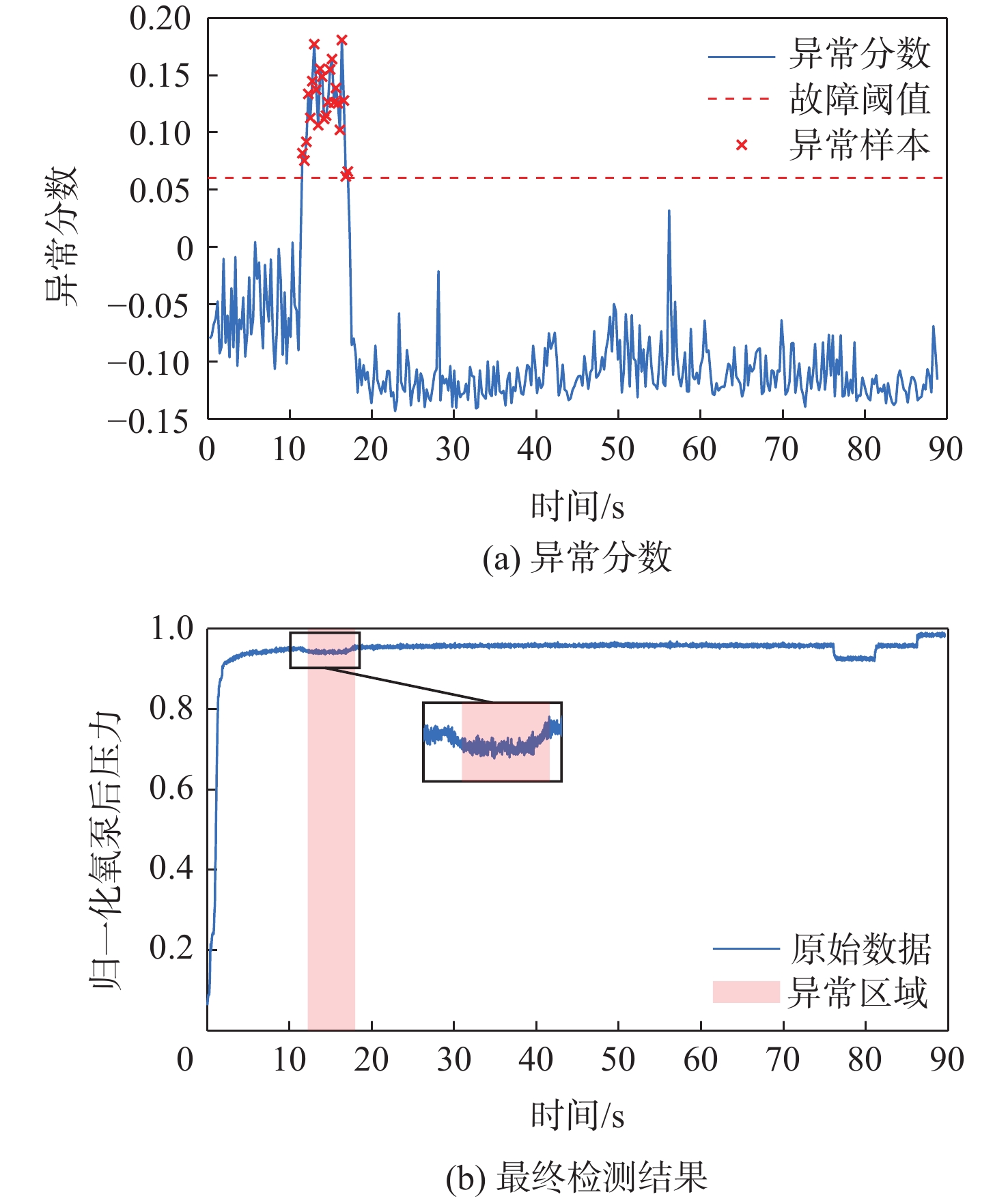
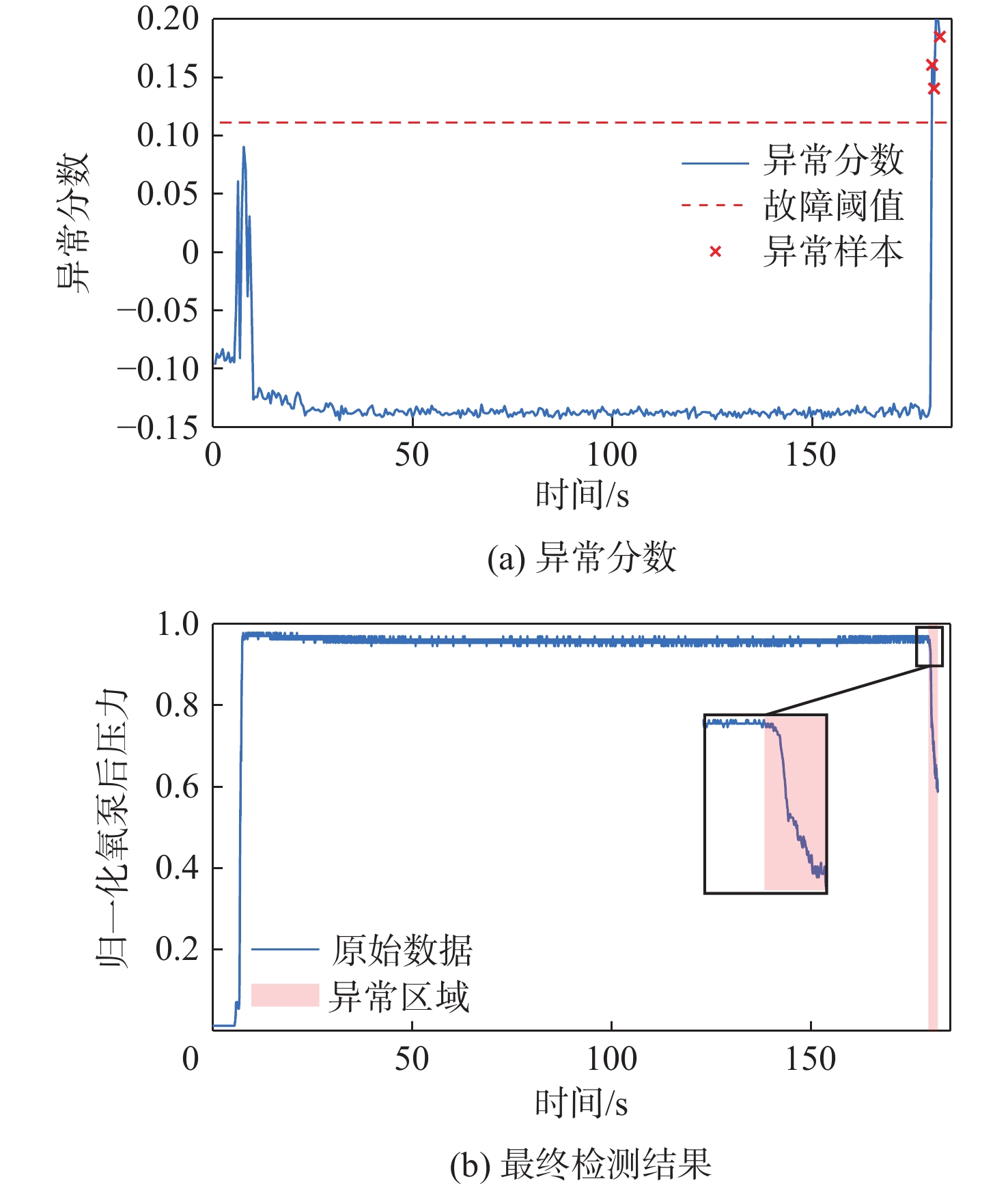
图 6 1-7号试车氧泵转子碰磨故障检测结果
Figure 6. Test results of rotor rubbing fault detection for oxygen pumps during test runs from No. 1-7
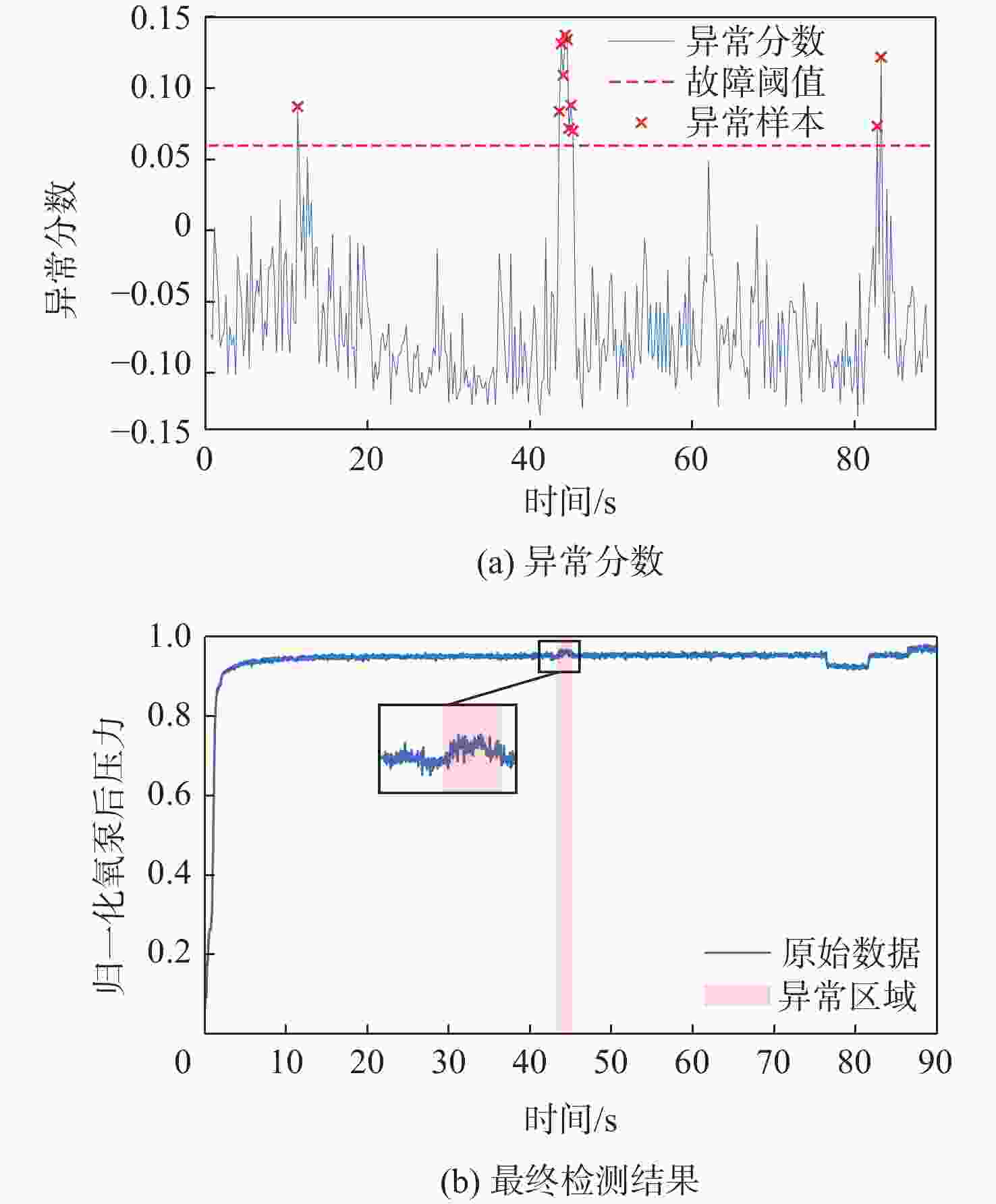
图 7 1-8号试车压力参数凸台故障检测结果
Figure 7. Test results of pressure parameter boss fault detection for test vehicles No. 1-8
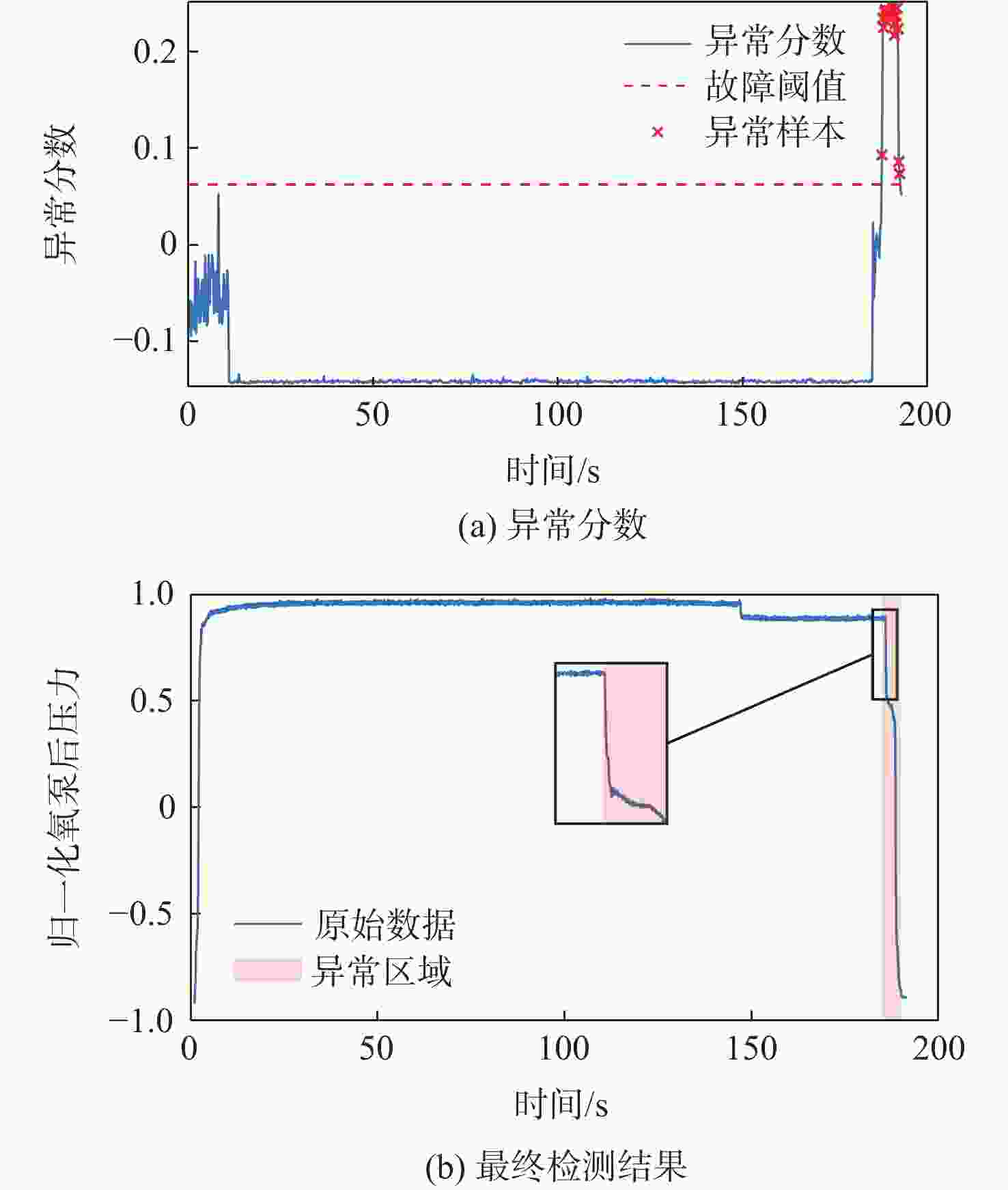
图 8 1-9号试车氧涡轮叶片烧蚀故障检测结果
Figure 8. Test results of ablation failure of oxygen turbine blades during test runs from No. 1-9
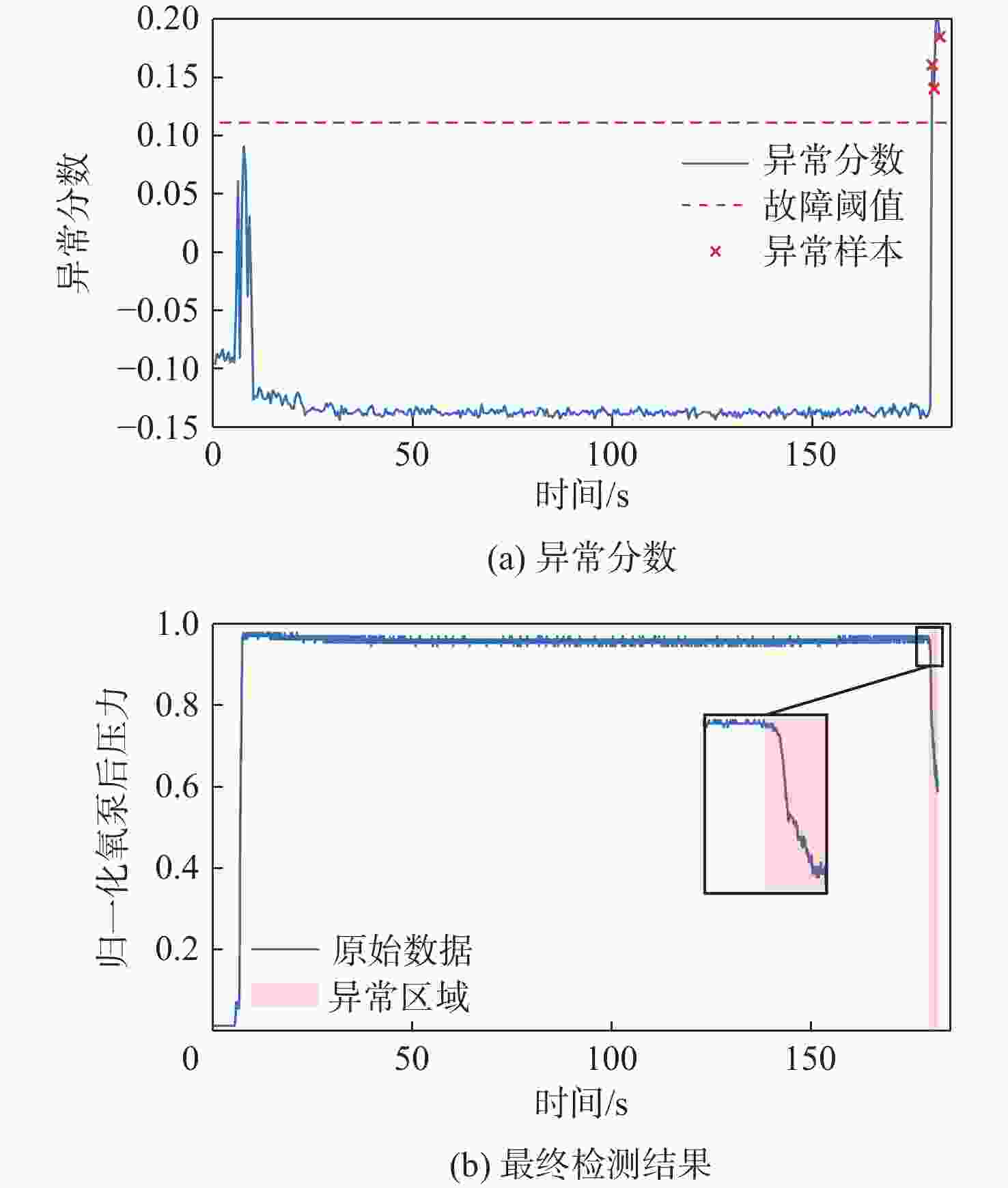
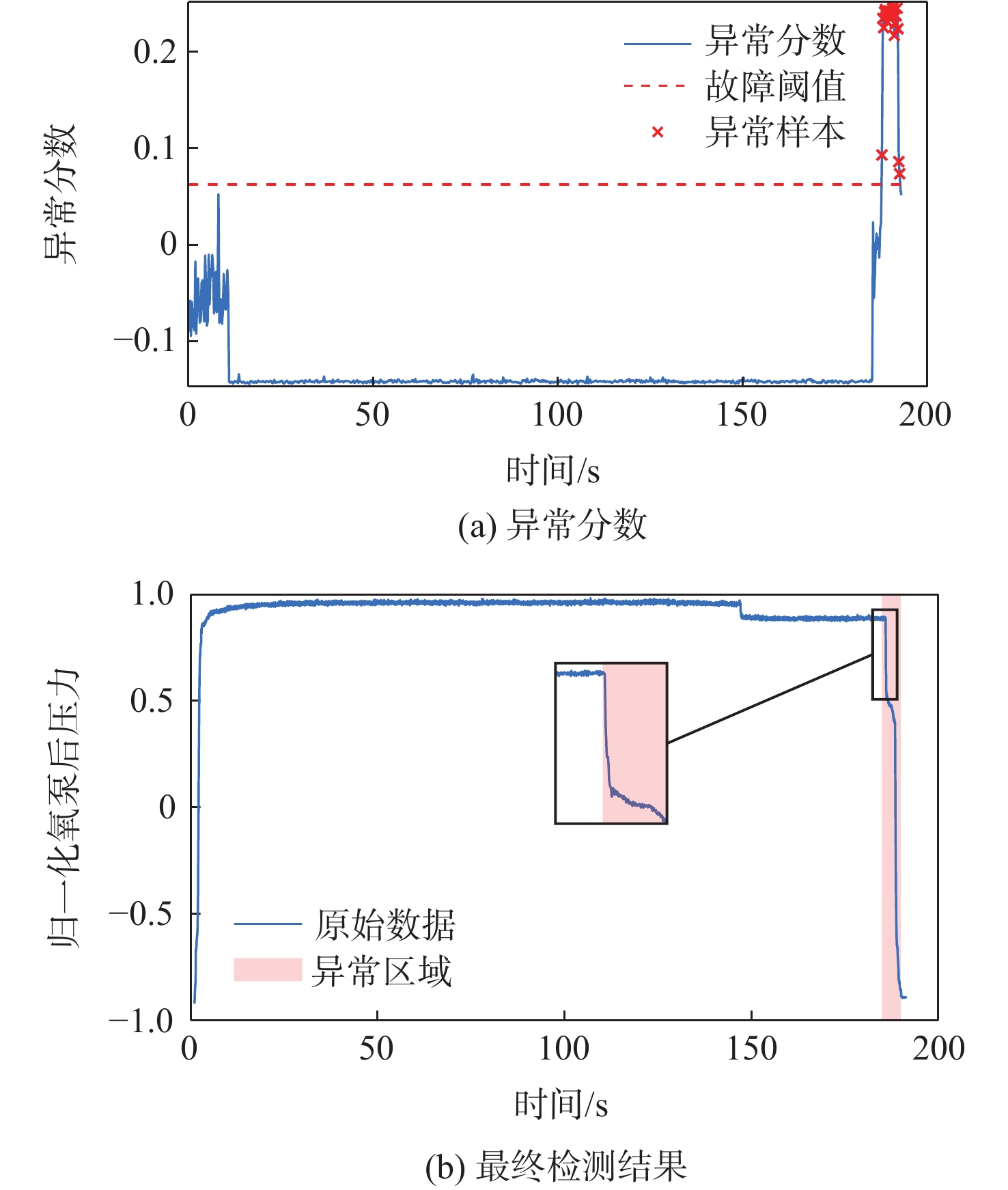
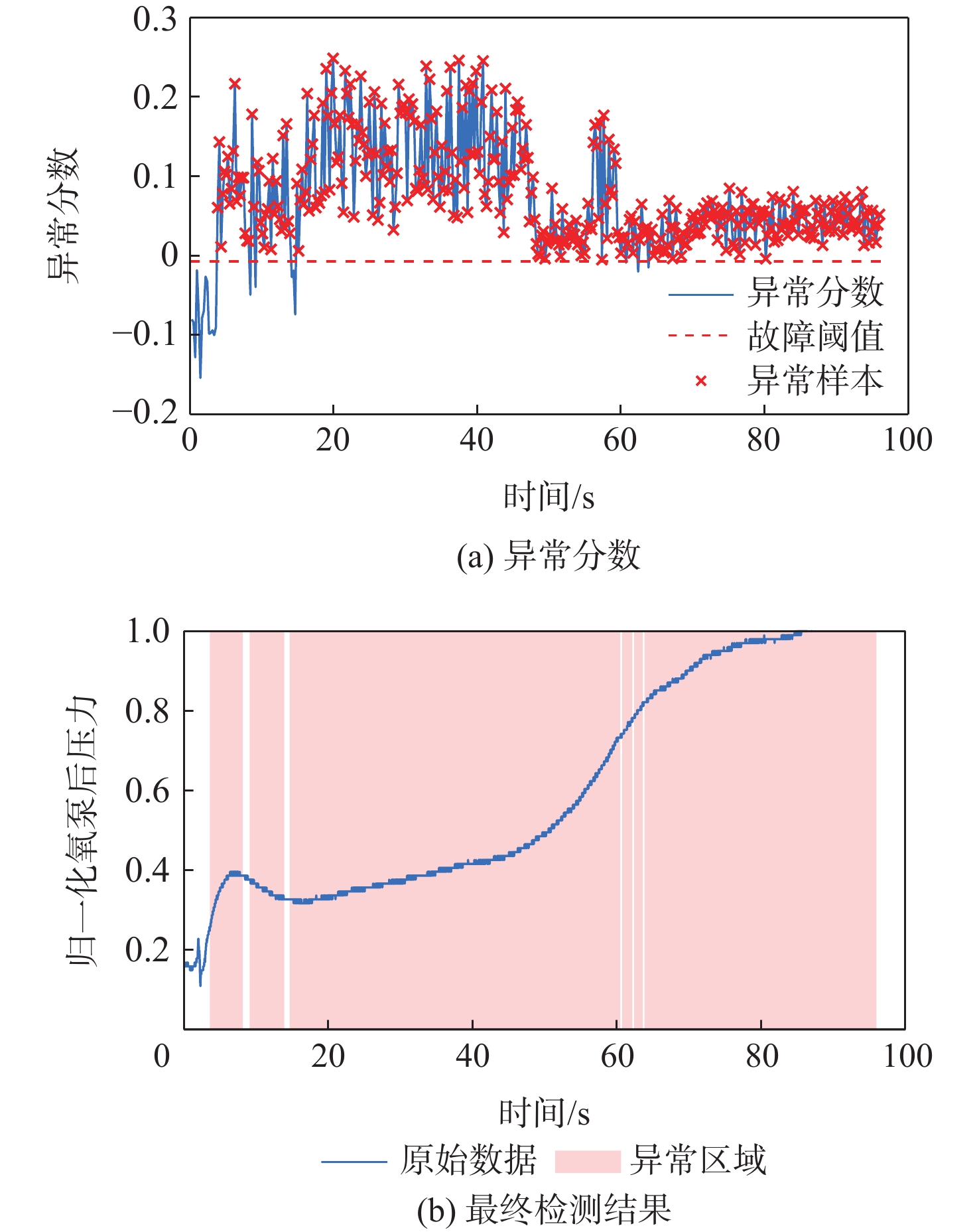
图 9 2-5飞行任务气蚀故障检测结果
Figure 9. Cavitation fault detection results of flight missions 2-5
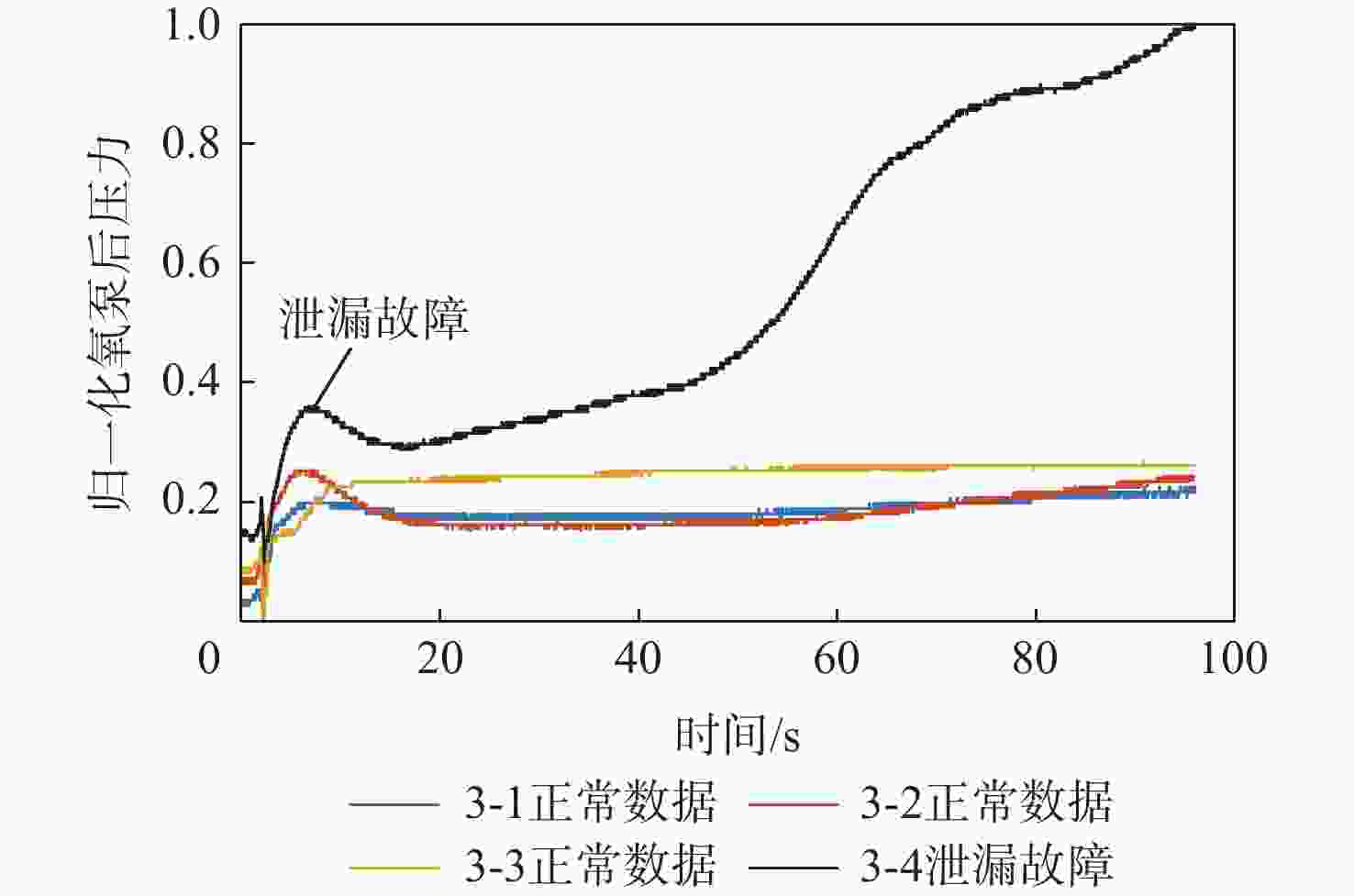
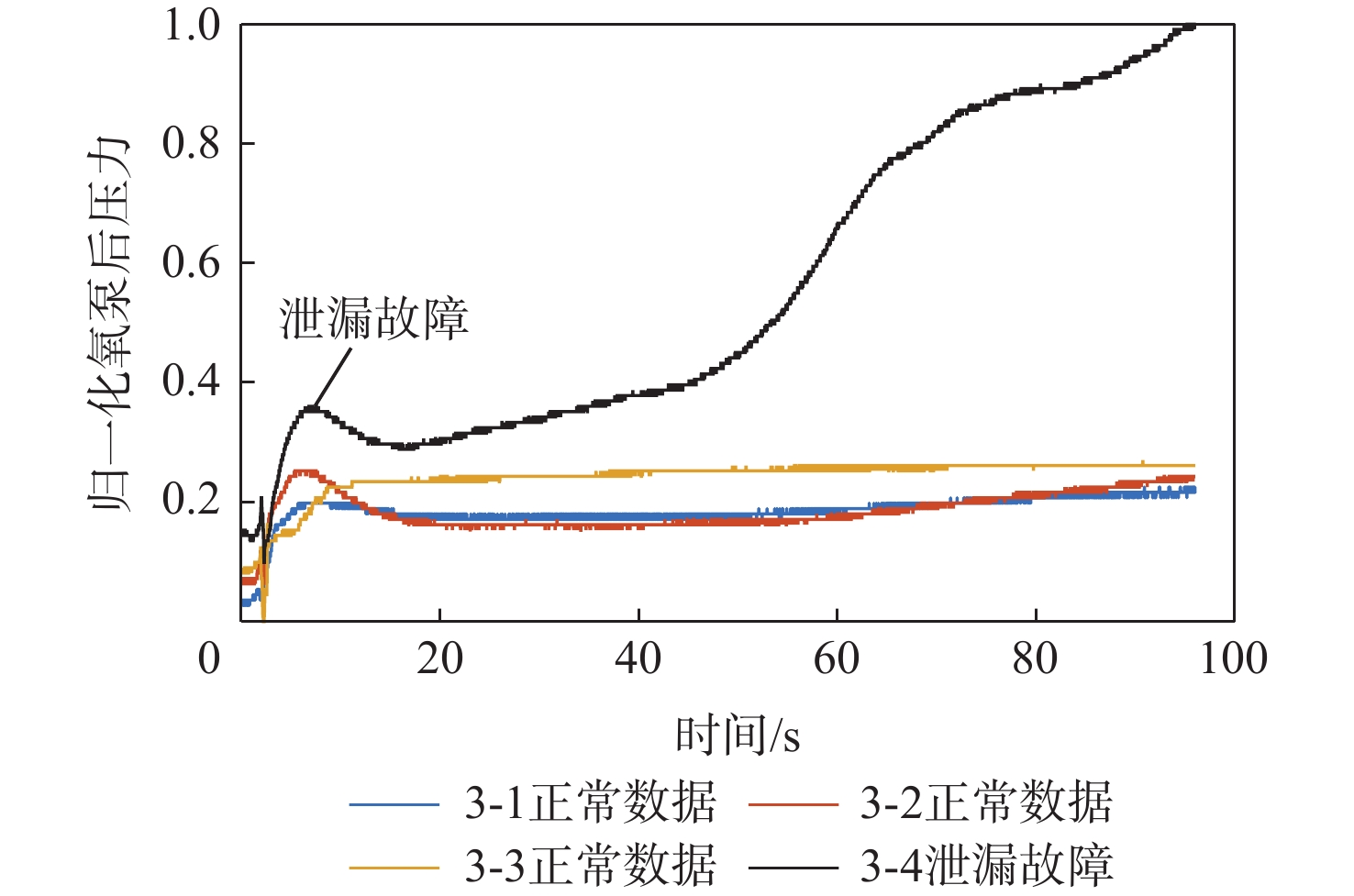
图 10 4次试车阀入口压力曲线
Figure 10. Pressure curve at the inlet of the valve during four test runs
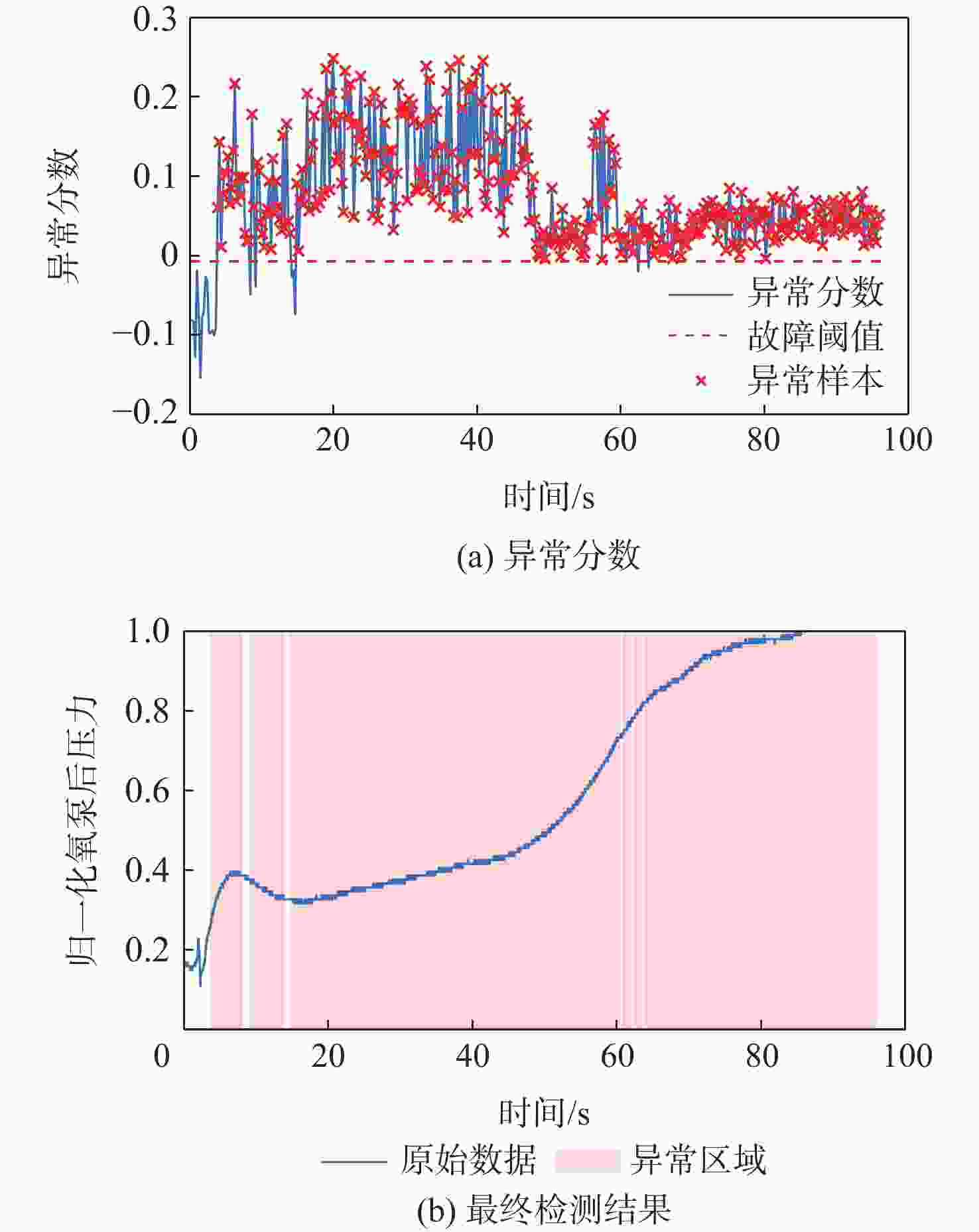
图 11 3-4号试车单向阀泄漏故障检测结果
Figure 11. Test results of leakage fault of check valve No. 3-4 during test run
表 1 SWAE超参数设定
Table 1. SWAE hyperparameter settings
隐藏层节点数 dropout配置 带宽
参数$ {f}_{\text{b}} $中心
频率$ {f}_{\text{c}} $稀疏惩罚
系数$ \beta $数值稳定性
参数$ \varepsilon $动量
参数$ {\beta }_{1} $动量
参数$ {\beta }_{2} $早停条件 批次
大小训练
轮数学习率 第1层128, 第2层64, 第3层32 各隐藏层均启用,
dropout率0.21.0 0.5 0.1 10−8 0.9 0.999 重构误差连续10轮
无下降停止64 200 0.001  下载: 导出CSV
表 2 某氢氧发动机数据集
Table 2. A hydrogen-oxygen engine dataset
运行情况 编号 故障情况 正常 1-1、1-2、1-3、1-4、1-5 非致命故障 1-6 氧泵密封环脱落 1-7 氧泵转子碰磨 1-8 异常燃烧,压力参数凸台 致命故障 1-9 氧涡轮叶片烧蚀
下载: 导出CSV
表 3 不同编号样本的模型性能评价结果
Table 3. Performance evaluation results for samples with different identification numbers
编号 准确率 精确率 召回率 F1分数 1-6 0.993 0.933 0.824 0.875 1-7 0.995 1.000 0.923 0.960 1-8 0.992 0.727 1.000 0.842 1-9 0.998 1.000 0.913 0.955 注:准确率、精确率、召回率、F1分数的平均值分别为0.995、0.915、0.915、0.908。
下载: 导出CSV
表 4 对比方法的超参数配置
Table 4. Hyperparameter settings of comparison methods
对比方法 参数配置 AE-IF AE:3个隐藏层,节点数分别为128、64、32;激活函数为Sigmoid;批次大小为64;学习率为0.001;训练轮数为200;IF参数与SWAE-IF一致 IF 树的数量为200;最大采样大小为256 OCSVM 采用RBF核,惩罚系数和核宽度取值范围为[10−3,103],参数经网络搜索优化以准确率最大取最优值 自适应阈值 带宽系数n=2;滑动窗口长度为24
下载: 导出CSV
表 5 不同故障检测方法性能对比(案例一)
Table 5. Property comparison of different fault detection methods (Case 1)
方法 准确率 精确率 召回率 F1分数 本文 0.995 0.915 0.915 0.908 AE-IF 0.974 0.797 0.637 0.704 IF 0.987 0.669 0.722 0.69 OCSVM 0.981 0.6 0.673 0.617 自适应阈值 0.972 0.427 0.493 0.435 注:加黑数字表示最优值。
下载: 导出CSV
表 6 某液氧煤油发动机数据集
Table 6. A liquid oxygen-kerosene engine dataset
运行情况 编号 数据类型 故障情况 正常 2-1、2-2、2-3、2-4 地面热试车 故障 2-5 飞行遥测 气蚀
下载: 导出CSV
表 7 不同故障检测方法性能对比(案例二)
Table 7. Property comparison of different fault detection methods (Case 2)
方法 准确率 精确率 召回率 F1分数 本文 0.997 0.833 1.000 0.909 AE-IF 0.989 0.556 1.000 0.714 IF 0.990 0.571 0.800 0.667 OCSVM 0.987 0.444 0.800 0.571 自适应阈值 0.987 0.500 1.000 0.667 注:加黑数字表示最优值。
下载: 导出CSV
表 8 单向阀数据集
Table 8. Data of a check valve
运行情况 编号 数据类型 故障情况 正常 3-1、3-2、3-3 地面热试车 故障 3-4 地面热试车 泄漏
下载: 导出CSV
表 9 不同故障检测方法性能对比(案例三)
Table 9. Property comparison of different fault detection methods (Case 3)
方法 准确率 精确率 召回率 F1分数 本文 0.943 0.969 0.971 0.970 AE-IF 0.898 0.950 0.942 0.946 IF 0.865 0.963 0.892 0.926 OCSVM 0.803 0.969 0.818 0.887 自适应阈值 0.743 0.983 0.742 0.846 注:加黑数字表示最优值。
下载: 导出CSV
表 10 不同故障检测阈值下模型性能对比
Table 10. Comparison of model performance under different fault detection thresholds
阈值大小 准确率 精确率 召回率 F1分数 $ \mu +\sigma $ 0.945 0.452 0.947 0.583 $ \mu +2\sigma $ 0.989 0.806 0.937 0.843 $ \mu +3\sigma $ 0.995 0.915 0.915 0.908 $ \mu +4\sigma $ 0.988 0.950 0.670 0.785 注:加黑数字表示最优值。
下载: 导出CSV
-
[1] 包为民. 可重复使用运载火箭技术发展综述[J]. 航空学报, 2023, 44(23): 629555.Bao W M. A review of reusable launch vehicle technology development[J]. Acta Aeronautica et Astronautica Sinica, 2023, 44(23): 629555(in Chinese). [2] 杨永强, 何江, 吕发正, 等. 130吨级重复使用液氧煤油发动机维护维修技术分析[J]. 载人航天, 2025, 31(1): 104-110 .Yang Y Q, He J, Lyu F Z, et al. Analysis on maintenance technology of 130-ton reusable LOX/kerosene rocket engine[J]. Manned Spaceflight, 2025, 31(1): 104-110(in Chinese). [3] 容易, 牟宇, 陈士强. 液体运载火箭动力冗余技术工程设计与实践[M]. 北京: 中国宇航出版社, 2021: 25-48.Rong Y, Mou Y, Chen S Q. Engineering design and practice of power redundancy technology for liquid launch vehicles[M]. Beijing: China Astronautic Publishing House, 2021: 25-48(in Chinese). [4] 杨述明, 吴建军, 谢昌霖, 等. 数据驱动智能故障诊断技术在液体火箭发动机的应用与展望[J]. 航空学报, 2025, 46(15): 1-20.Yang S M, Wu J J, Xie C L, et al. Application issues of data-driven intelligent fault diagnosis technologies for liquid rocket engines[J]. Acta Aeronautica et Astronautica Sinica, 2025, 46(15): 1-20(in Chinese). [5] 吴建军, 程玉强, 杨述明. 液体火箭发动机健康监控[M]. 北京: 科学出版社, 2021: 102-126.Wu J J, Cheng Y Q, Yang S M. Health monitoring of liquid rocket engine[M]. Beijing: Science Press, 2021: 102-126(in Chinese). [6] Oreilly D. System for anomaly and failure detection(SAFD) system development, NASA 1.26: 193907[R]. Los Angeles: Marshall Space Flight Center, 1992. [7] Biggs R. A probabilistic risk assessment for the Space Shuttle Main Engine with a turbomachinery vibration monitor cutoff system[C]//Proceedings of the 26th Joint Propulsion Conference. Reston: AIAA, 1990: 2712. [8] 王冠, 王婧雨, 刘巧珍, 等. 数据驱动的运载火箭氧涡轮泵异常分析方法[J]. 宇航学报, 2022, 43(7): 964-973.Wang G, Wang J Y, Liu Q Z, et al. Data-driven anomaly analysis method of launch vehicle oxygen turbopump[J]. Journal of Astronautics, 2022, 43(7): 964-973(in Chinese). [9] 陈泽灏, 陈晖, 高玉闪, 等. 基于模型的液体火箭发动机故障诊断技术回顾与展望[J]. 航空学报, 2023, 44(23): 629016.Chen Z H, Chen H, Gao Y S, et al. Review and prospect of model-based fault diagnosis technology for liquid rocket engines[J]. Acta Aeronautica et Astronautica Sinica, 2023, 44(23): 629016(in Chinese). [10] 张万旋, 卢哲, 张箭, 等. 基于注意力机制循环神经网络的液体火箭发动机故障检测[J]. 导弹与航天运载技术(中英文), 2024(2): 25-31.Zhang W X, Lu Z, Zhang J, et al. Rocket engine fault detection with attention based recurrent neural networks[J]. Missiles and Space Vehicles, 2024(2): 25-31(in Chinese). [11] Nie Y, Cheng Y Q, Wu J J. Dynamic cloud back-propagation networks and its application in fault diagnostic for liquid-propellant rocket engines[J]. Proceedings of the Institution of Mechanical Engineers, Part G: Journal of Aerospace Engineering, 2018, 232(3): 583-594. [12] Xu L, Zhao S B, LI N N, et al. Application of QGA-BP for fault detection of liquid rocket engines[J]. IEEE Transactions on Aerospace and Electronic Systems, 2019, 55(5): 2464-2472. [13] Park S Y, Ahn J. Deep neural network approach for fault detection and diagnosis during startup transient of liquid-propellant rocket engine[J]. Acta Astronautica, 2020, 177: 714-730. [14] 滕天祥, 宋春, 朱俊杰, 等. 用于液体火箭发动机故障诊断的深度特征可解释方法[J/OL]. 机械科学与技术, (2024-06-20)[2025-11-25]. https://doi.org/10.13433/j.cnki.1003-8728.20240093.Teng T X, Song C, Zhu J J, et al. A deep feature interpretable method for fault diagnosis of liquid rocket engine[J/OL]. Mechanical Science and Technology for Aerospace Engineering, (2024-06-20)[2025-11-25]. https://doi.org/10.13433/j.cnki.1003-8728.20240093(in Chinese). [15] 程玉强, 邓凌志. Wasserstein距离在液体火箭发动机故障检测中的应用[J]. 国防科技大学学报, 2023, 45(4): 20-27.Cheng Y Q, Deng L Z. Application of Wasserstein distance in fault detection for liquid-propellant rocket engines[J]. Journal of National University of Defense Technology, 2023, 45(4): 20-27(in Chinese). [16] 张振臻, 陈晖, 高玉闪, 等. 液体火箭发动机故障诊断技术综述[J]. 推进技术, 2022, 43(6): 20-38.Zhang Z Z, Chen H, Gao Y S, et al. Review on fault diagnosis technology of liquid rocket engine[J]. Journal of Propulsion Technology, 2022, 43(6): 20-38(in Chinese). [17] 刘鹤, 魏承, 张泽旭, 等. 基于滤波自编码包络分析的航天器异常检测方法[J/OL]. 北京航空航天大学学报, (2025-03-19)[2025-11-25]. https://doi.org/10.13700/j.bh.1001-5965.2024.0832.Liu H, Wei C, Zhang Z X, et al. Spacecraft anomaly detection based on filtered autoencoder envelope analysis[J/OL]. Journal of Beijing University of Aeronautics and Astronautics, (2025-03-19)[2025-11-25]. https://doi.org/10.13700/j.bh.1001-5965.2024.0832(in Chinese). [18] Feng Y, Liu Z J, Chen J L, et al. Make the rocket intelligent at IoT edge: stepwise GAN for anomaly detection of LRE with multisource fusion[J]. IEEE Internet of Things Journal, 2021, 9(4): 3135-3149. [19] Zhu X B, Cheng Y Q, Wu J J, et al. Steady-state process fault detection for liquid rocket engines based on convolutional auto-encoder and one-class support vector machine[J]. IEEE Access, 2020, 8: 3144-3158. [20] 刘莘, 王珺, 陈景龙, 等. 基于多源数据密度估计自编码器的液体火箭发动机无监督异常检测[J]. 机械工程学报, 2025, 61(2): 36-45.Liu S, Wang J, Chen J L, et al. Unsupervised anomaly detection for liquid rocket engines with multi-source data density estimation autoencoder[J]. Journal of Mechanical Engineering, 2025, 61(2): 36-45(in Chinese). [21] Shao H D, Lin J, Zhang L W, et al. A novel approach of multisensory fusion to collaborative fault diagnosis in maintenance[J]. Information Fusion, 2021, 74: 65-76. [22] Längkvist M, Karlsson L, Loutfi A. A review of unsupervised feature learning and deep learning for time-series modeling[J]. Pattern Recognition Letters, 2014, 42: 11-24. [23] Fu S , Zhong S S, Lin L , et al. A re-optimized deep auto-encoder for gas turbine unsupervised anomaly detection[J]. Engineering Applications of Artificial Intelligence, 2021, 101(12): 104199. [24] 唐立, 郝鹏, 任沛阁, 等. 基于改进孤立森林算法的无人机异常行为检测[J]. 航空学报, 2022, 43(8): 578-587.Tang L, Hao P, Ren P G, et al. UAV abnormal behavior detection based on improved iForest algorithm[J]. Acta Aeronautica et Astronautica Sinica, 2022, 43(8): 578-587(in Chinese). [25] Meire M , Van Baelen Q, Ooijevaar T, et al. Constraint guided autoencoders for joint optimization of condition indicator estimation and anomaly detection in machine condition monitoring[J]. Machine Learning, 2025, 114(7): 153. [26] 洪涛, 黄志奇, 杨畅. 涡轮泵实时故障检测的快速支持向量机算法[J]. 仪器仪表学报, 2012, 33(8): 1786-1792.Hong T, Huang Z Q, Yang C. Fast support vector machine algorithm for turbopump real-time fault detection[J]. Chinese Journal of Scientific Instrument, 2012, 33(8): 1786-1792(in Chinese). -

 下载:
下载:

 点击查看大图
计量
- 文章访问数: 202
- HTML全文浏览量: 67
- PDF下载量: 9
- 被引次数: 0
