





Fault-tolerant control for near space vehicle with new type dissimilar redundant actuation/flight control system
-
摘要:
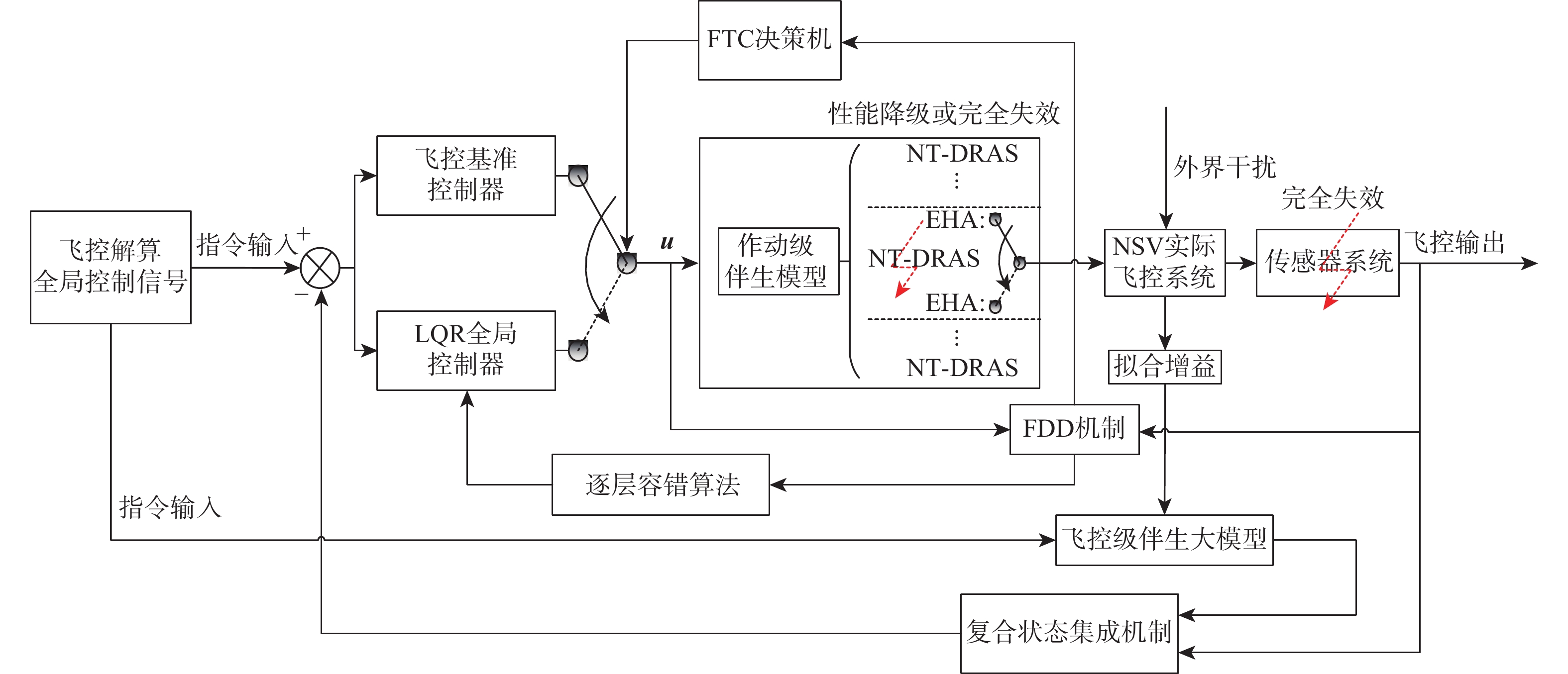
针对采用新型非相似余度作动系统(NT-DRAS)的临近空间飞行器(NSV)安全控制问题,提出一种基于伴生大模型的多层级容错控制(FTC)方法,该伴生大模型的物理含义为实际飞行器的虚拟系统,其与实际系统伴生存在,用于实时同步模拟和监控实际系统的功能/性能状态。该伴生大模型包含飞控级伴生主模型及作动级的伴生子模型,形成层级架构用于NSV实际系统的智能决策支持需求:当飞行器姿态相关传感器发生故障时,利用由飞控级伴生主模型的理论输出状态与真实系统可用状态共同构成混合输出状态,并基于混合输出状态通过线性二次型调节器(LQR)求解出状态反馈增益。同时,在作动级对配置的NT-DRAS进行基于伴生子模型的状态监控和余度管理,最终将基于伴生子模型推理识别的 NT-DRAS通道切换与飞控层基于伴生主模型的LQR 控制相结合,应对复杂及逐步恶化的作动器和飞控姿态传感器多故障变工况。基于MATLAB/Simulink平台的数值仿真结果验证了所提方法的有效性和先进性。
-
关键词:
- 临近空间飞行器 /
- 飞行控制系统 /
- 新型非相似余度作动系统 /
- 伴生大模型 /
- 逐层容错控制
Abstract:The paper presents a concomitant model based multi-level fault-tolerant control (FTC) for near space vehicle (NSV) with a new type of dissimilar redundant actuation system (NT-DRAS). The model, with its physical meaning as a virtual system of the actual vehicle, coexists with the real system to perform real-time synchronous simulation and monitoring of the real system's functions and performance status. In order to meet the intelligent decision-making support requirements of the NSV actual system, the concomitant big model consists of a flight control-level main model and actuation-level sub-models that form a hierarchical architecture. In the event that the vehicle's flight attitude-related sensors fail, a hybrid output state can be reconstructed by combining the theoretical output of the flight control-level concomitant main model with the real system usable state. This hybrid output state is then used to solve the state feedback gains using linear quadratic regulator (LQR) technology. Additionally, this study conducts state monitoring and redundancy management for the configured NT-DRAS system at the actuation level, ultimately combining concomitant sub-model based NT-DRAS channel switching measures by flight control-level concomitant main model based LQR control to address complex and progressively deteriorating fault conditions involving actuators and flight control attitude sensors. Finally, numerical simulations are performed on the MATLAB/Simulink platform to verify the effectiveness and progressiveness of the proposed method.
-
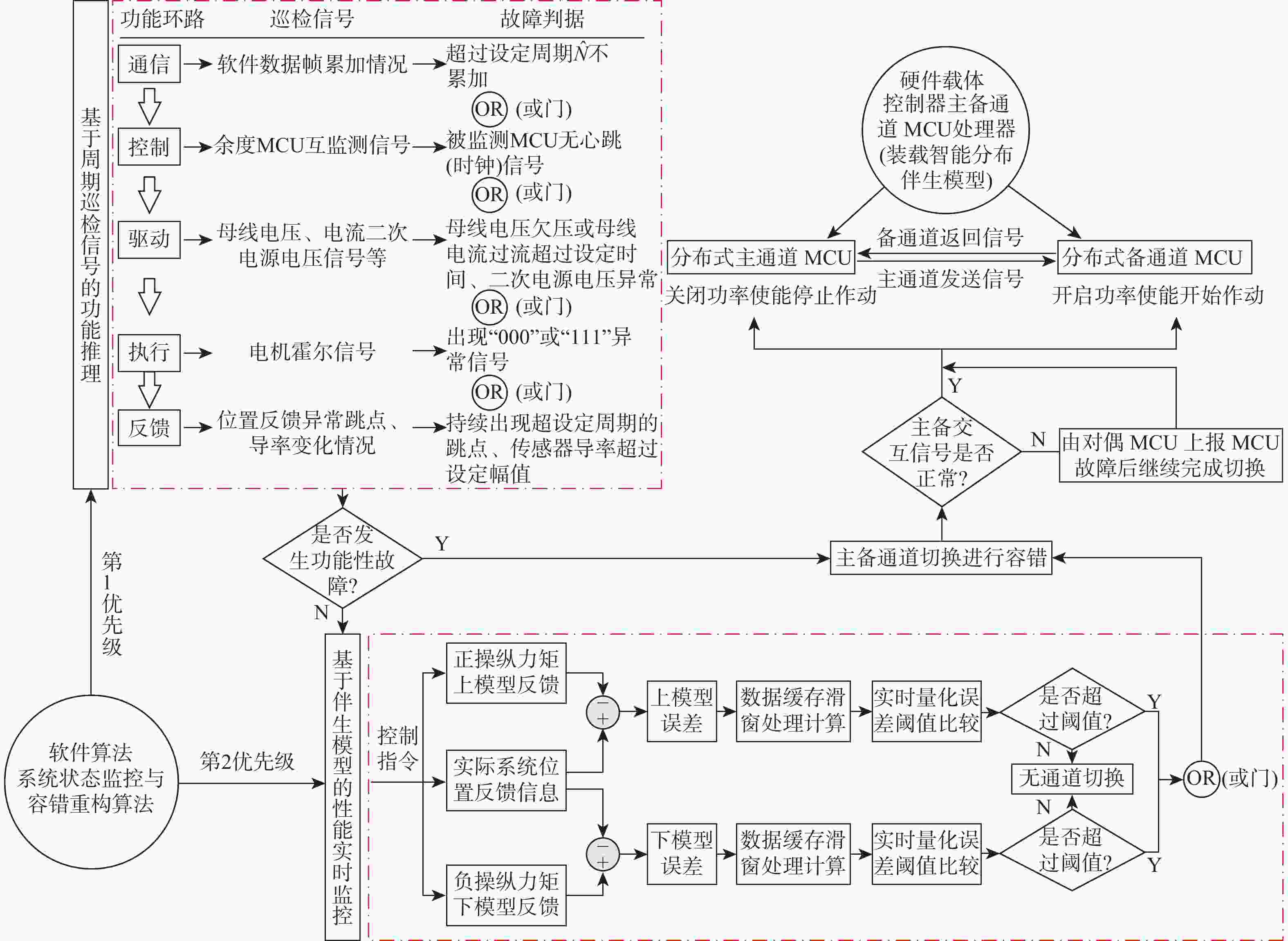
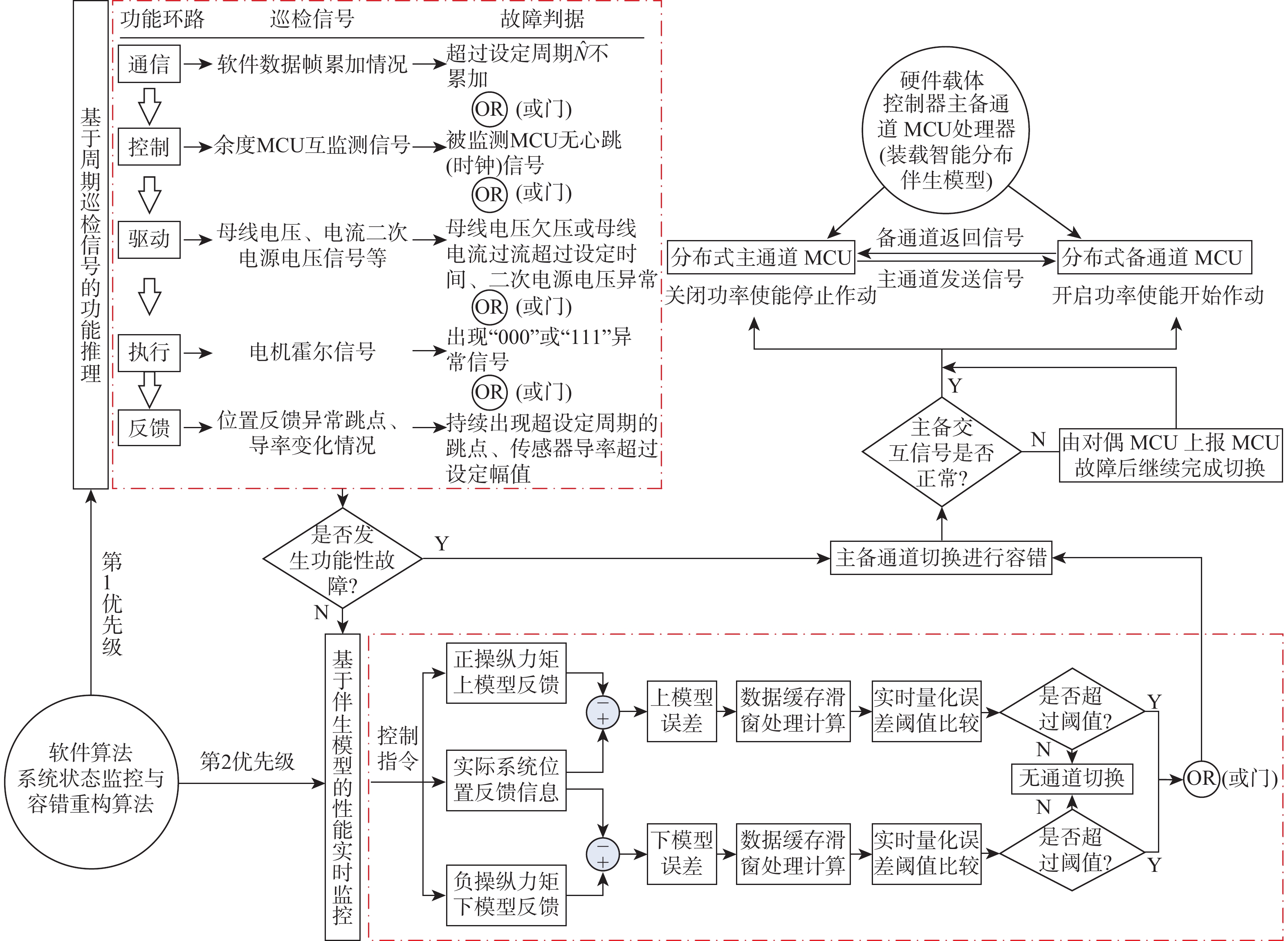
图 3 作动级基于伴生子模型的NT-DRAS故障智能推理机制
Figure 3. Concomitant sub-model based intelligent fault reasoning mechanism of NT-DRAS in actuation level
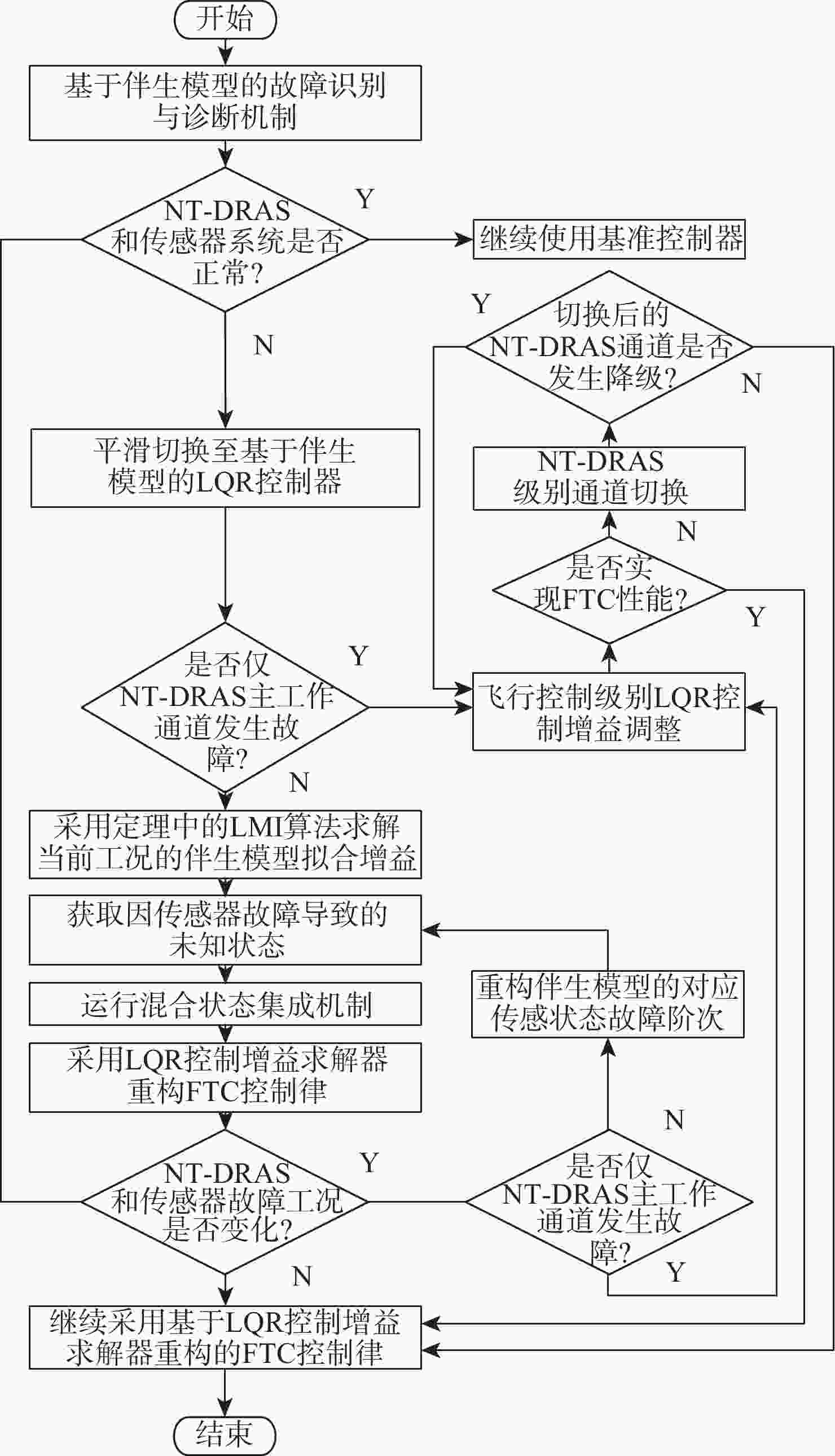
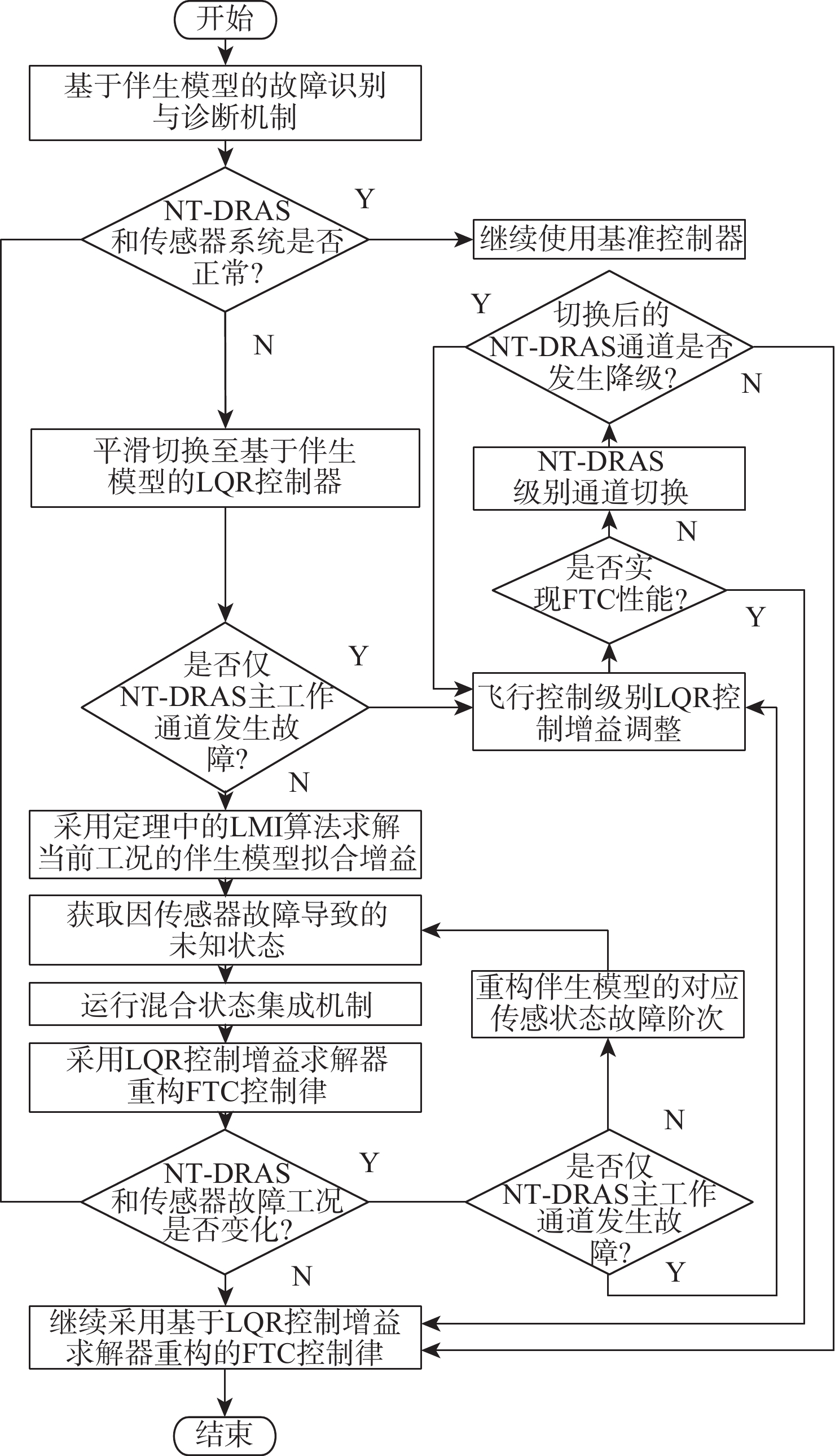
图 5 基于伴生大模型的NSV容错控制算法流程
Figure 5. Flowchart of concomitant model based NSV FTC algorithm
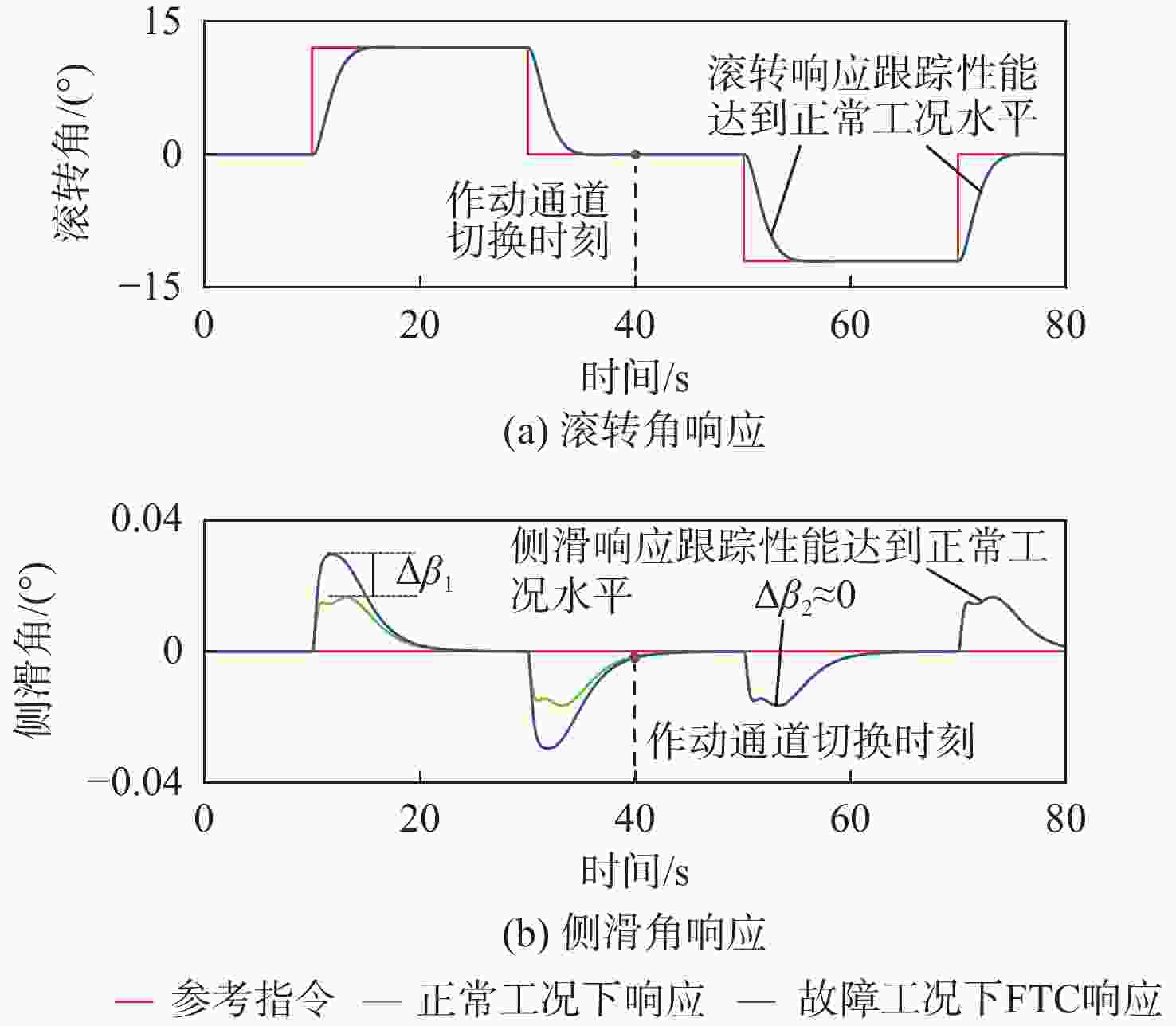
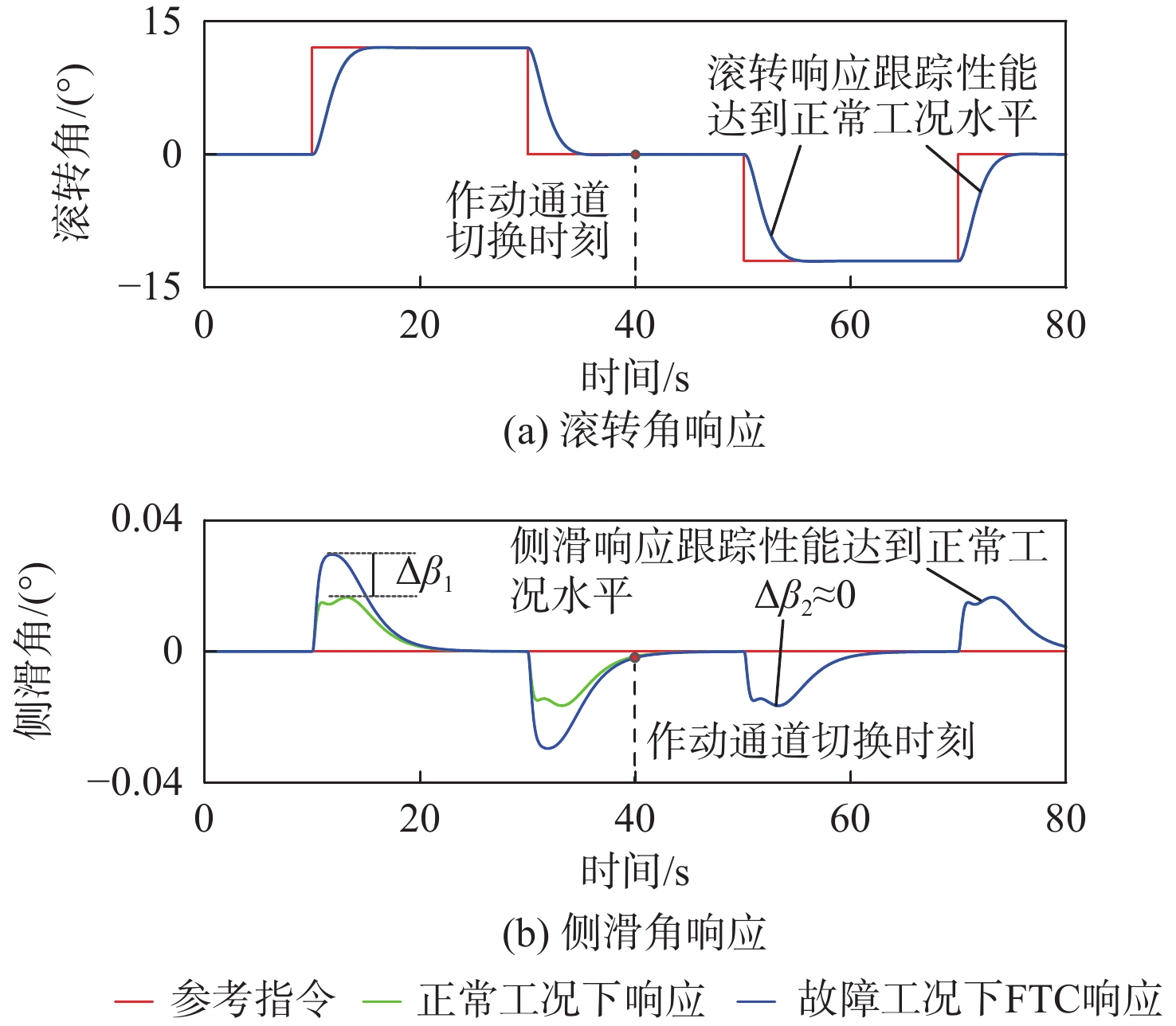
图 6 NT-DRAS级别的通道切换容错效果分析
Figure 6. Analysis of channel switching based fault tolerant effect at NT-DRAS level
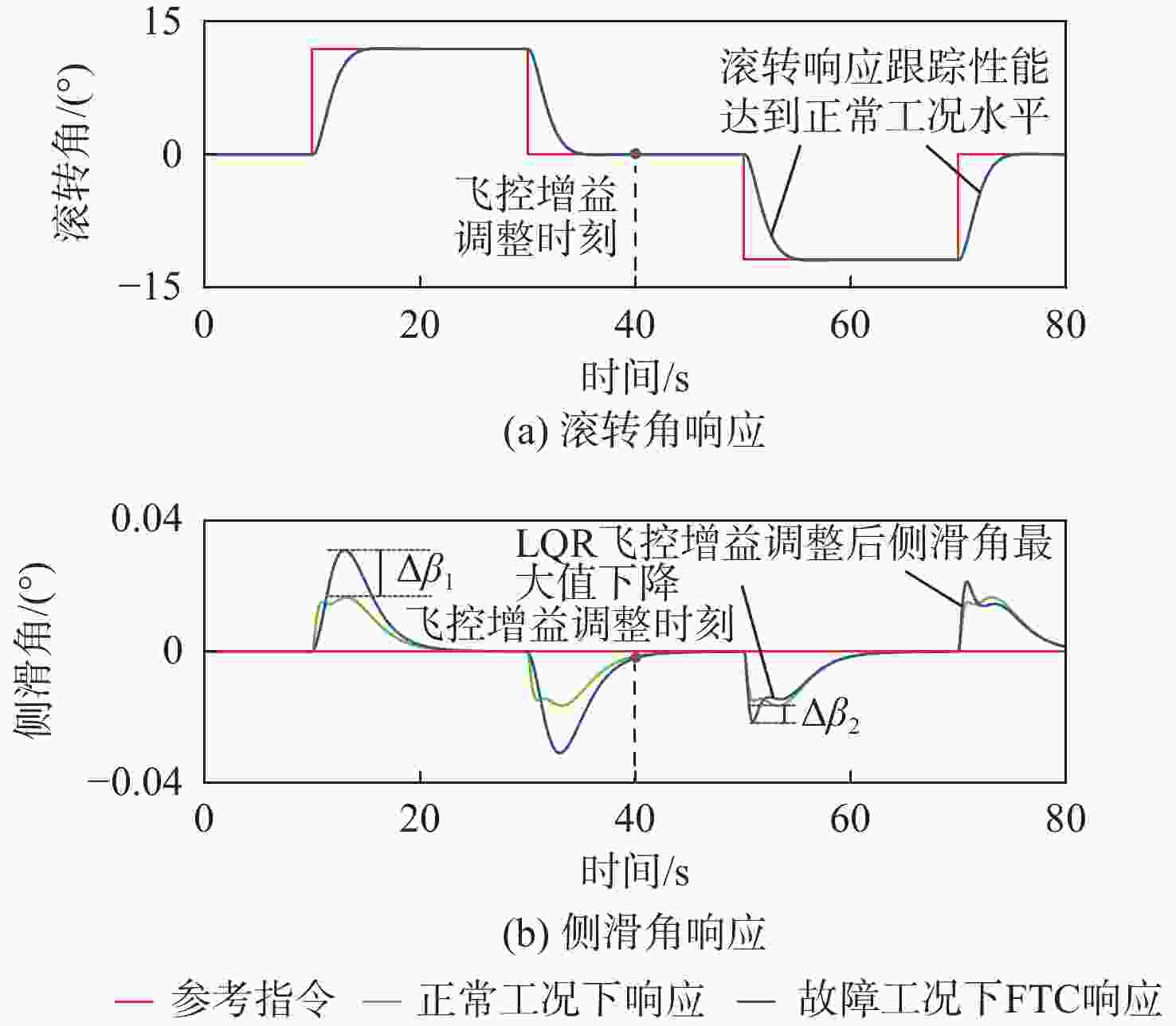
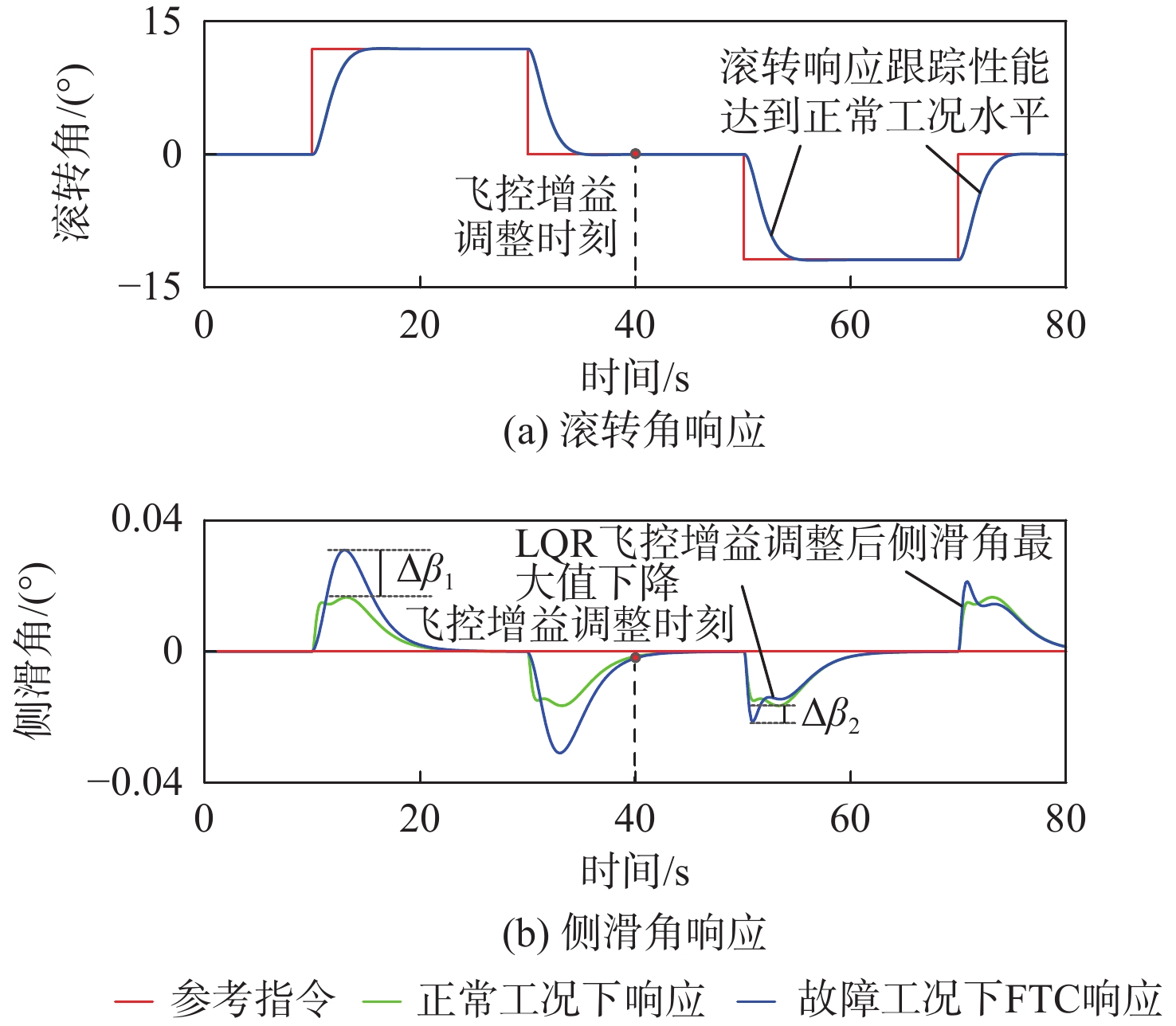
图 7 飞控级别综合控制增益调整容错效果分析
Figure 7. Analysis of comprehensive control gain adjustment based fault tolerant effect at flight control level
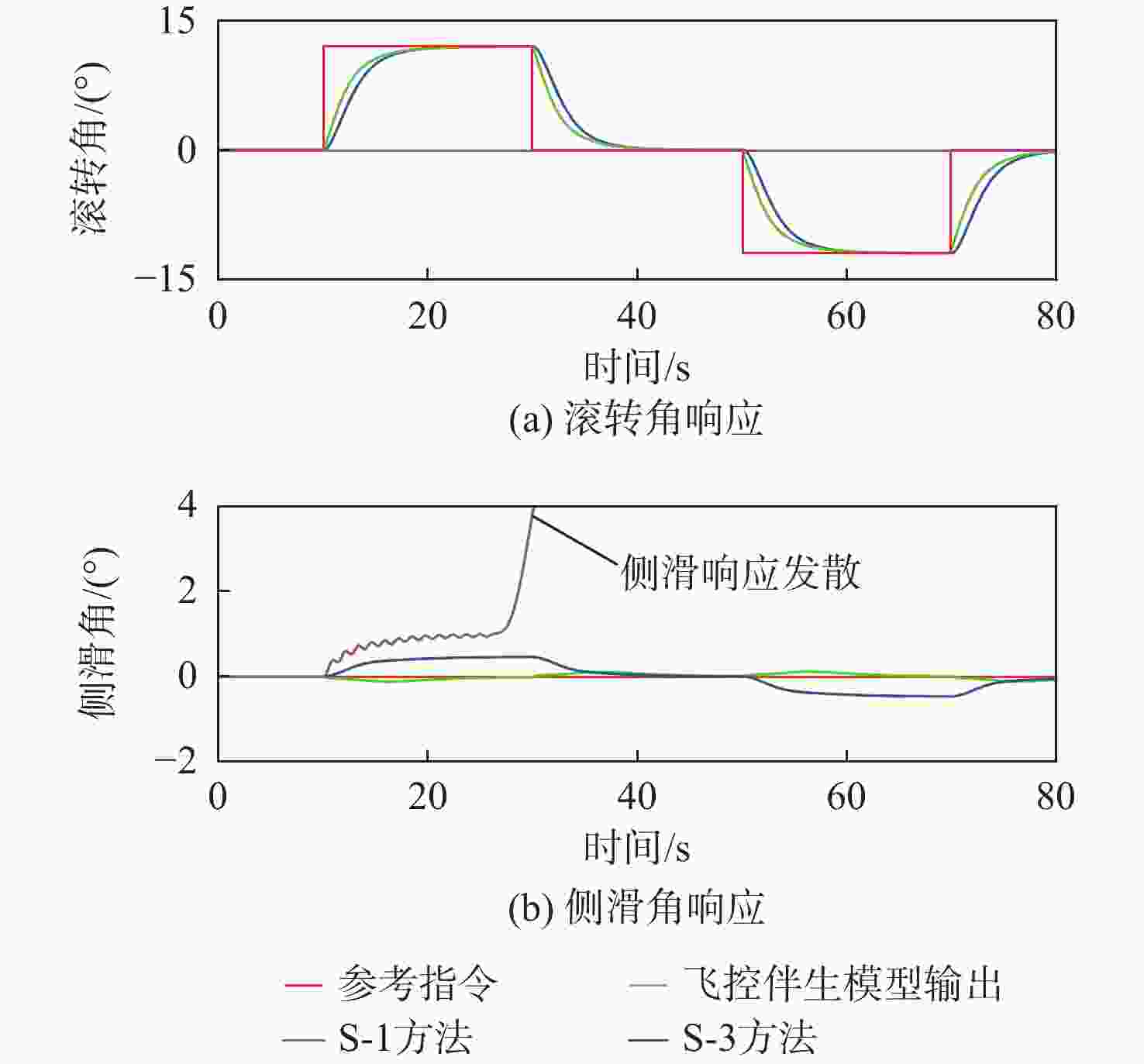
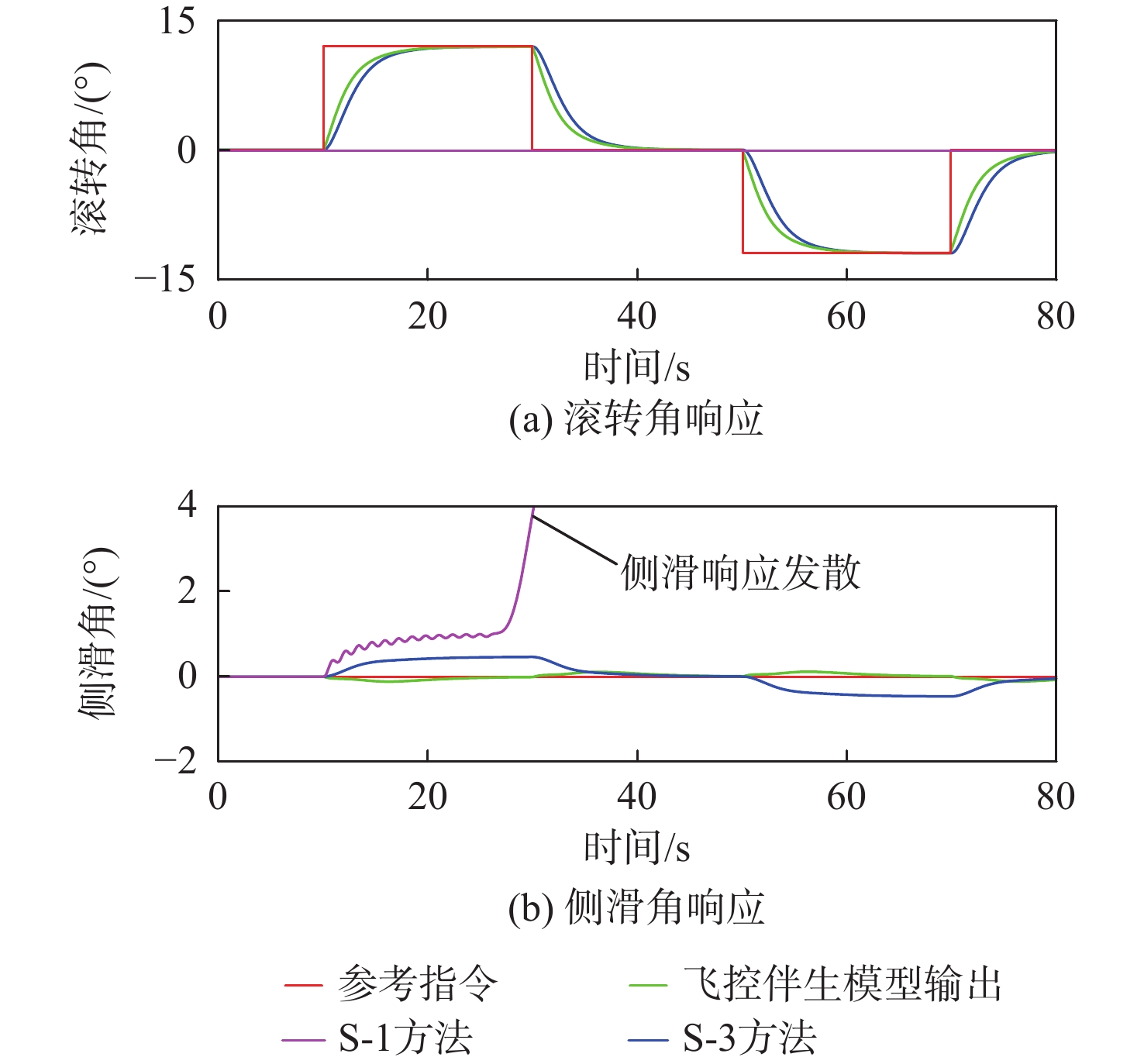
图 8 飞控伴生主模型收敛性及S-1方法与S-3方法容错效果分析
Figure 8. Analysis of flight control concomitant main model convergence and FTC effectiveness of S-1 and S-3 method
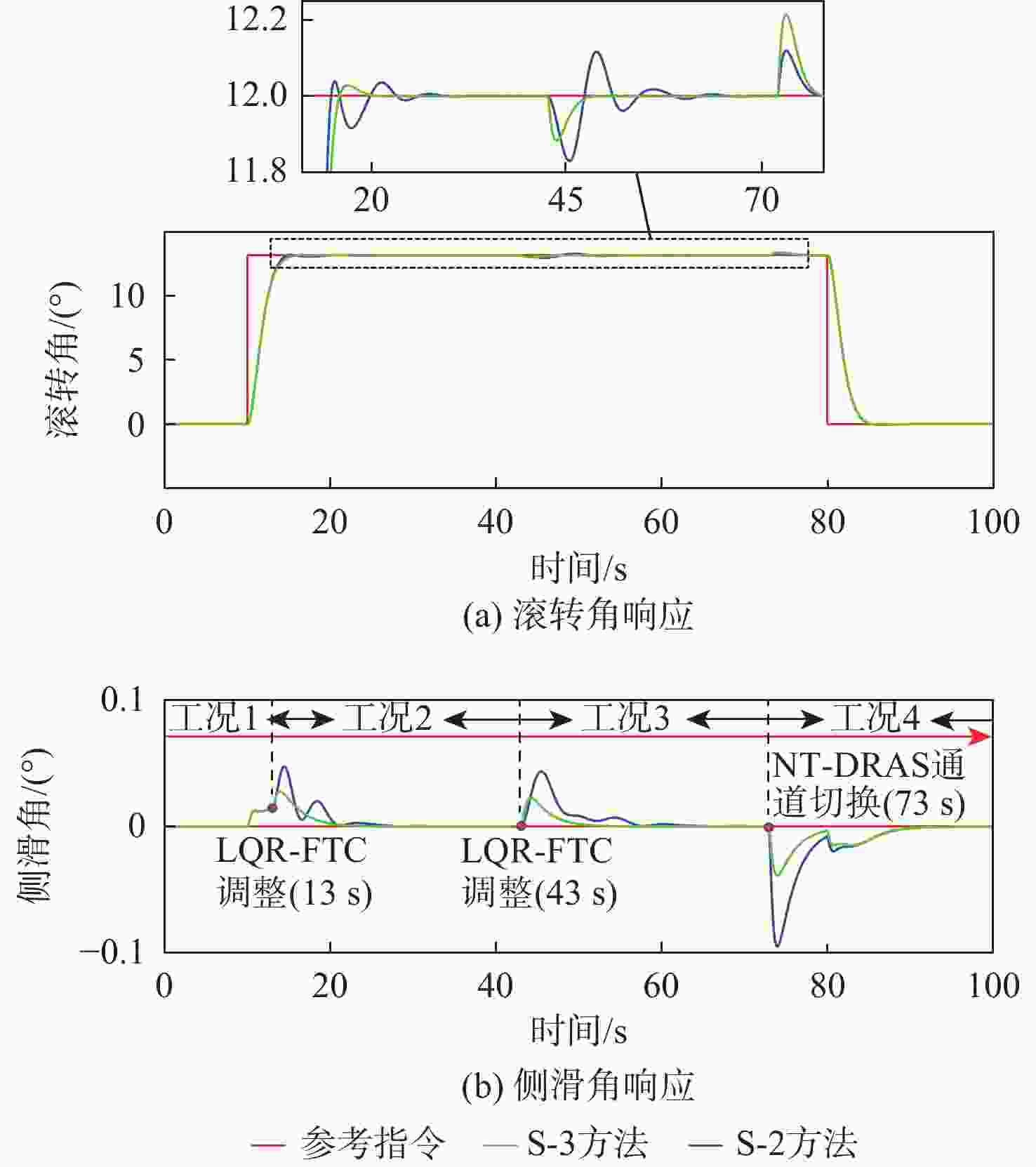
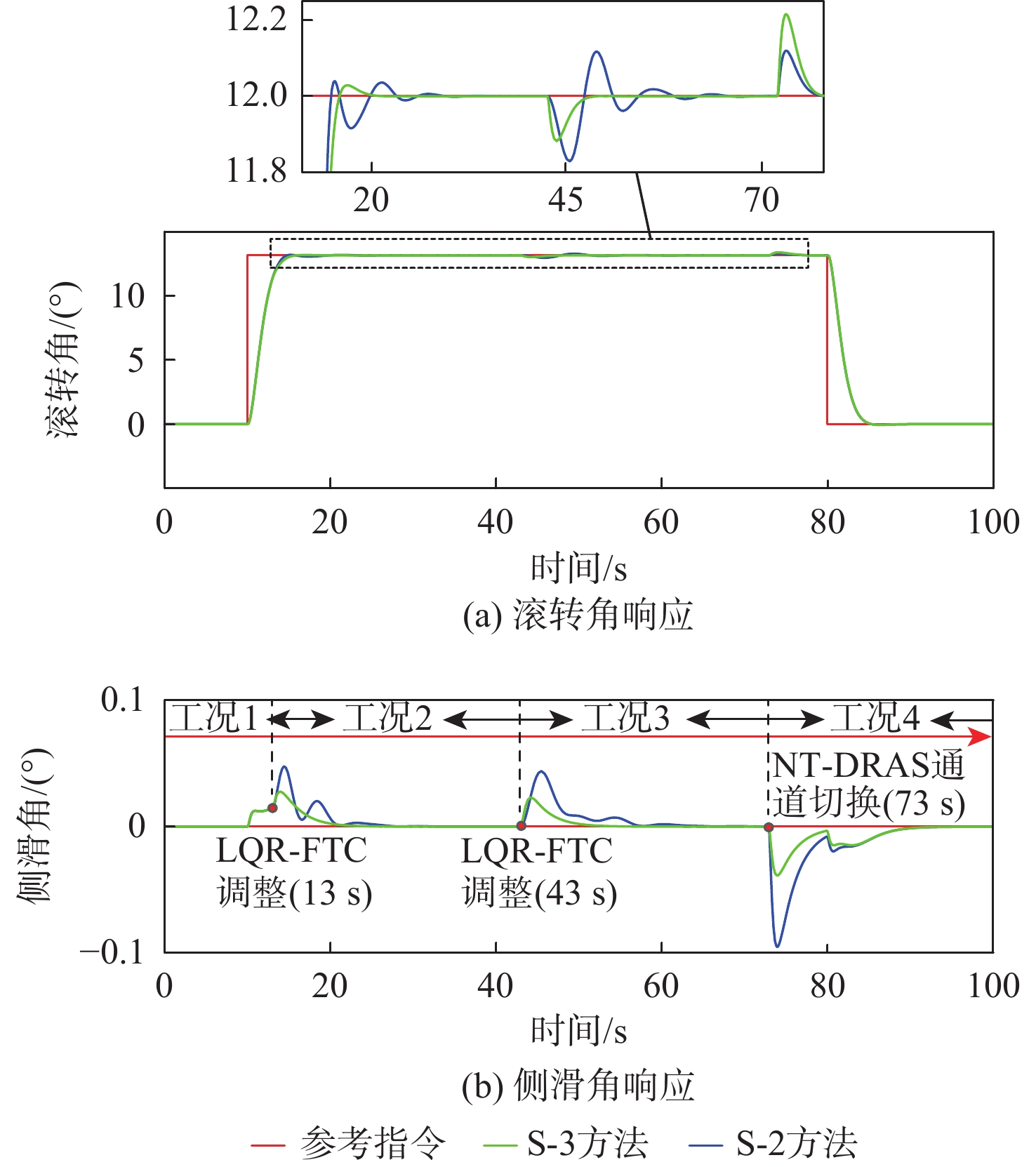
图 9 固定滚转角下故障变工况响应情况仿真曲线
Figure 9. Response curves under fault changing conditions when given constant roll angle
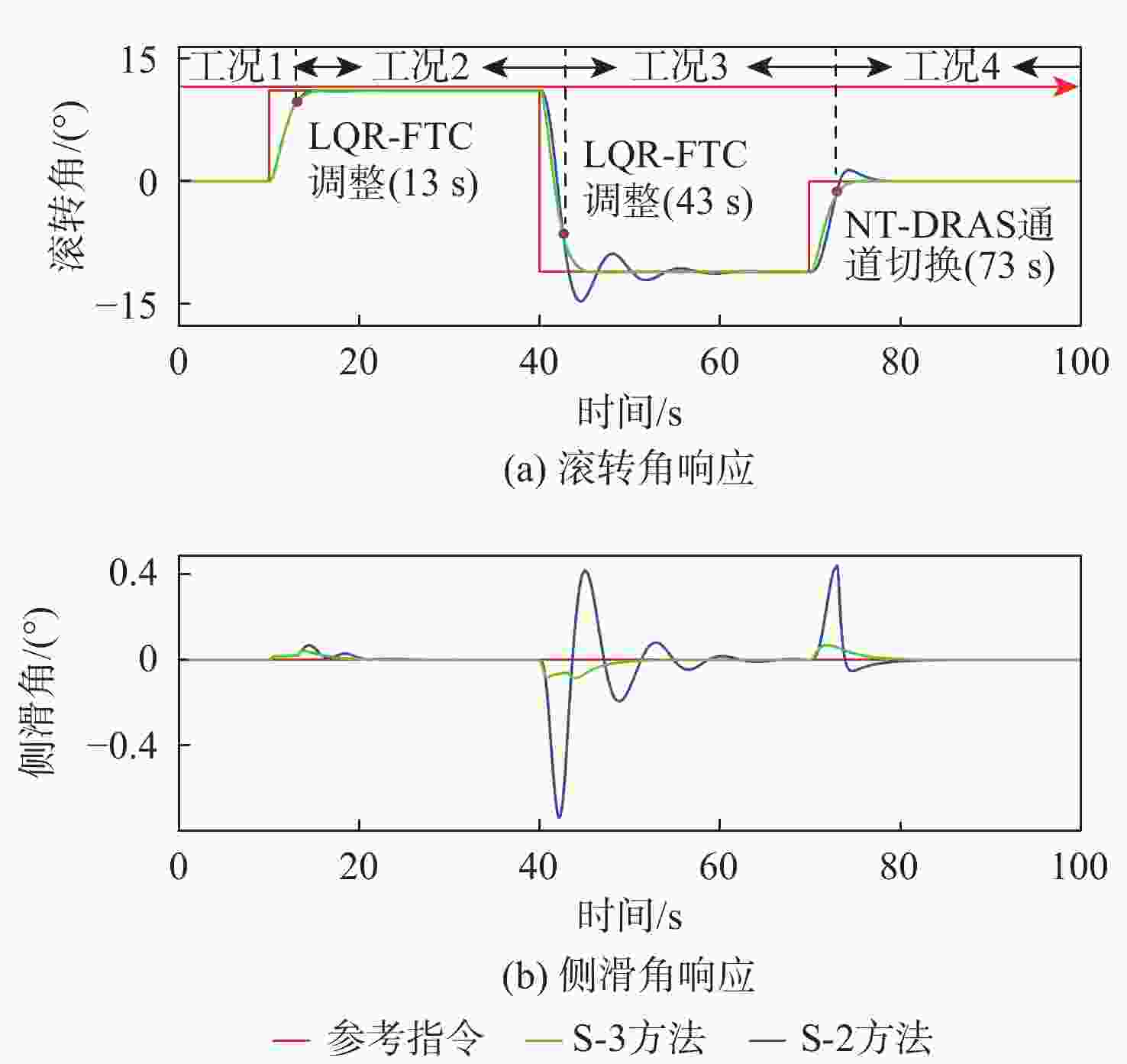
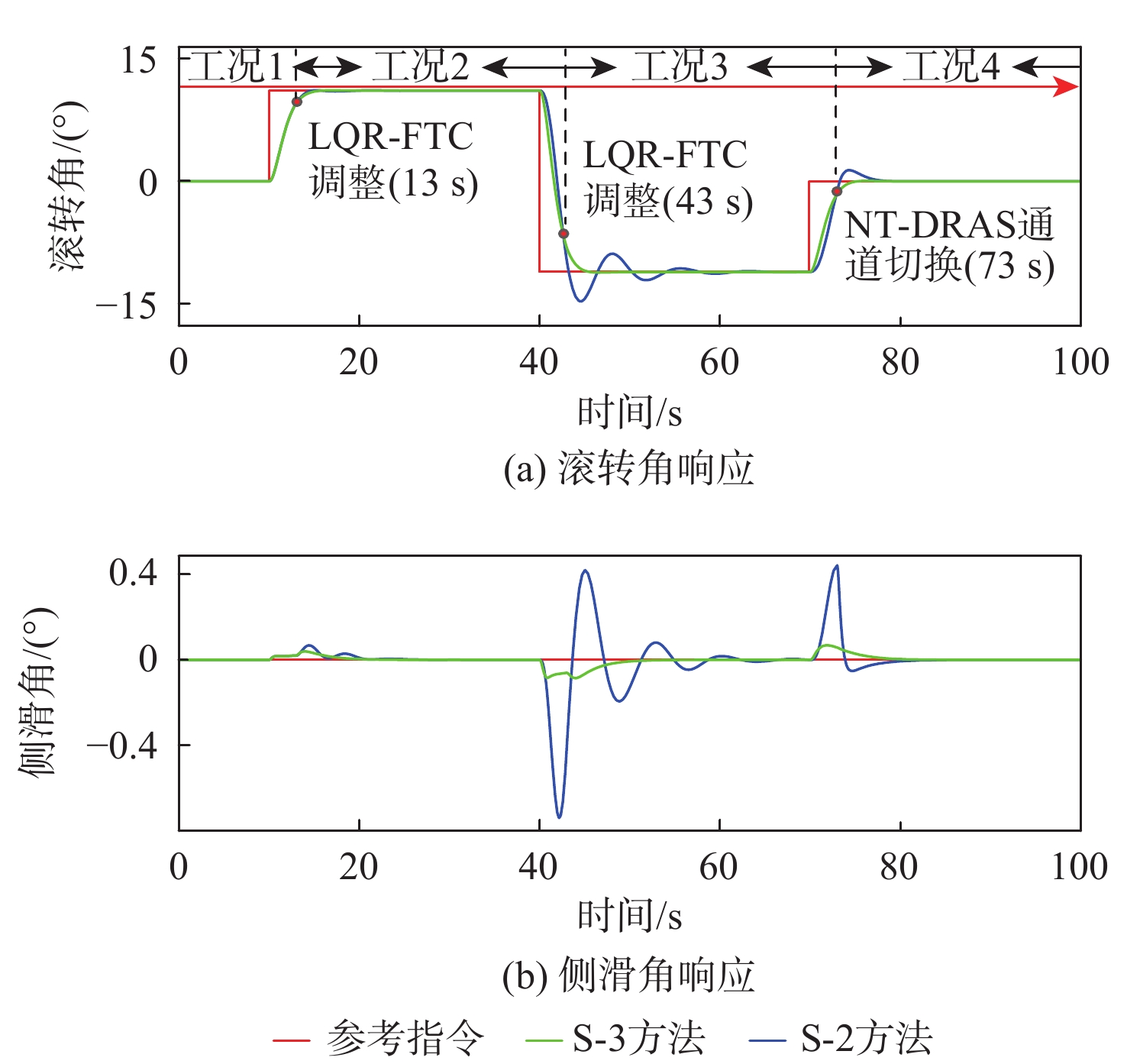
图 10 固定滚转角下故障变工况响应情况仿真曲线
Figure 10. Response curves under fault changing conditions when given constant roll angle
表 1 NSV变工况条件下的健康状态矩阵
Table 1. Health index matrices of NSV under changing cases
工况 作动系统$ \boldsymbol{H}_{\text{Case-}i}^{\text{NT-DRAS}} $ 姿态传感器$ \boldsymbol{H}_{\text{Case-}i}^{\text{semsor}} $ 1 $ {\mathrm{diag}}\left\{\begin{matrix}1 & 1 & 1 & 1 & 1\end{matrix}\right\} $ $ {\mathrm{diag}}\left\{\begin{matrix}1 & 1 & 1 & 1\end{matrix}\right\} $ 2 $ {\mathrm{diag}}\left\{\begin{matrix}0 & 1 & 0.6 & 1 & 0\end{matrix}\right\} $ $ {\mathrm{diag}}\left\{\begin{matrix}1 & 0 & 1 & 1\end{matrix}\right\} $ 3 $ {\mathrm{diag}}\left\{\begin{matrix}0 & 0.52 & 0.6 & 0.43 & 0\end{matrix}\right\} $ $ {\mathrm{diag}}\left\{\begin{matrix}1 & 0 & 0 & 1\end{matrix}\right\} $ 4 $ {\mathrm{diag}}\left\{\begin{matrix}0 & 0.11 & 0.23 & 0.17 & 0\end{matrix}\right\} $ $ {\mathrm{diag}}\left\{\begin{matrix}1 & 0 & 0 & 0\end{matrix}\right\} $  下载: 导出CSV
表 2 特定滚转角条件下容错控制性能量化评估结果
Table 2. FTC performance quantitative evaluation results under specific roll angle conditions
方法 $ {e}_{\text{perf-}\phi } $ $ {\overline{e}}_{\text{perf-}\phi } $ $ e_{\text{perf-}\phi }^{\text{max}} $ $ {e}_{\text{perf-}\beta } $ $ {\overline{e}}_{\text{perf-}\beta } $ $ e_{\text{perf-}\beta }^{\text{max}} $ S-2 60.462 0.009 12 0.478 0.00011 0.113 S-3 60.460 0.009 12 0.240 0.00006 0.045
下载: 导出CSV
表 3 滚转动作过程中容错控制性能量化评估结果
Table 3. FTC performance quantitative evaluation results under rolling dynamic process
方法 $ {e}_{\text{perf-}\phi } $ $ {\overline{e}}_{\text{perf-}\phi } $ $ e_{\text{perf-}\phi }^{\text{max}} $ $ {e}_{\text{perf-}\beta } $ $ {\overline{e}}_{\text{perf-}\beta } $ $ e_{\text{perf-}\beta }^{\text{max}} $ S-2 121.327 0.021 24 2.582 0.00047 0.62 S-3 113.010 0.018 24 0.466 0.00011 0.07
下载: 导出CSV
-
[1] 王远卓, 代洪华, 岳晓奎, 等 . 基于控制向量参数化的临近空间飞行器轨迹优化[J/OL]. 北京航空航天大学学报, (2025-07-29)[2025-11-24]. https://link.cnki.net/urlid/11.2625.V.20250729.0951.001.Wang Y Z, Dai H H, Yue X K, et al. Near-space vehicle trajectory optimization based on control vector parameterization[J/OL]. Journal of Beijing University of Aeronautics and Astronautics, (2025-07-05)[2025-07-29]. https://link.cnki.net/urlid/11.2625.V.20250729.0951.001(in Chinese). [2] Malyuta D, Yu Y, Elango P, et al. Advances in trajectory optimization for space vehicle control[J]. Annual Reviews in Control, 2021, 52: 282-315. [3] Shen Q K, Jiang B, Cocquempot V. Fuzzy logic system-based adaptive fault-tolerant control for near-space vehicle attitude dynamics with actuator faults[J]. IEEE Transactions on Fuzzy Systems, 2013, 21(2): 289-300. [4] Wang J, Wang S P, Wang X J, et al. Active fault tolerant control for vertical tail damaged aircraft with dissimilar redundant actuation system[J]. Chinese Journal of Aeronautics, 2016, 29(5): 1313-1325. [5] Zhang Y M, Jiang J. Bibliographical review on reconfigurable fault-tolerant control systems[J]. Annual Reviews in Control, 2008, 32(2): 229-252. [6] Yu X, Zhang Y M. Design of passive fault-tolerant flight controller against actuator failures[J]. Chinese Journal of Aeronautics, 2015, 28(1): 180-190. [7] Yu X, Jiang J. Hybrid fault-tolerant flight control system design against partial actuator failures[J]. IEEE Transactions on Control Systems Technology, 2012, 20(4): 871-886. [8] Alsaade F W, Yao Q J, Al-Zahrani M S, et al. Neural-based fixed-time attitude tracking control for space vehicle subject to constrained outputs[J]. Advances in Space Research, 2023, 71(9): 3588-3599. [9] Yu X, Fu Y, Zhang Y M. Aircraft fault accommodation with consideration of actuator control authority and gyro availability[J]. IEEE Transactions on Control Systems Technology, 2018, 26(4): 1285-1299. [10] Wang X J, Zhang Y W, Wang S P. Fault tolerant control of large civil aircraft[M]. Berlin: Springer, 2024. [11] 周印佳, 万千, 徐艺哲, 等. 基于神经网络的复杂前缘飞行器FADS系统冗余设计[J]. 北京航空航天大学学报, 2024, 50(3): 757-764.Zhou Y J, Wan Q, Xu Y Z, et al. Redundancy design of a FADS system on a complex leading-edge vehicle using neural network approach[J]. Journal of Beijing University of Aeronautics and Astronautics, 2024, 50(3): 757-764(in Chinese). [12] 彭余萧, 何真, 仇靖雯. 基于LSTM-DDPG算法的四翼变掠角飞行器主动变形决策[J]. 北京航空航天大学学报, 2025, 51(10): 3504-3514.Peng Y X, He Z, Qiu J W. Active deformation decision-making for four-wing variable sweep aircraft based on LSTM-DDPG algorithm[J]. Journal of Beijing University of Aeronautics and Astronautics, 2025, 51(10): 3504-3514(in Chinese). [13] 郭浩宇, 王少萍, 石健, 等 . 基于数字孪生的健康服役框架及其在永磁同步电机的应用[J]. 北京航空航天大学学报, (2024-08-01)[2025-11-25]. https://link.cnki.net/urlid/11.2625.V.20240731.1437.001.Guo H Y, Wang S P, Shi J, et al. Digital twin-based health service framework and its application in permanent magnet synchronous motors[J]. Journal of Beijing University of Aeronautics and Astronautics, (2024-08-01)[2025-11-25]. https://link.cnki.net/urlid/11.2625.V.20240731.1437.001(in Chinese). [14] Cao Y C, Ren W. Optimal linear-consensus algorithms: an LQR perspective[J]. IEEE Transactions on Systems, Man, and Cybernetics, Part B (Cybernetics), 2010, 40(3): 819-830. [15] Tsui C C. Robust control system design: advanced state space techniques[M]. Boca Raton: CRC Press, 2022. [16] Huang J, Wang J, Li W K, et al. Fault mode analysis and convex optimization-based fault-tolerant control for new type dissimilar redundant actuation system of near space vehicle[J]. Applied Sciences, 2023, 13(23): 12567. [17] Ferrante A, Ntogramatzidis L. The generalised discrete algebraic Riccati equation in linear-quadratic optimal control[J]. Automatica (Journal of IFAC), 2013, 49(2): 471-478. [18] Hanke C R, Nordwall D R. The simulation of a jumbo jet transport aircraft. Volume 2: Modeling data: NASA-CR-114494 [R]. Washington, D. C.: National Aeronautics and Space Administration, 1970. -

 下载:
下载:

 点击查看大图
计量
- 文章访问数: 651
- HTML全文浏览量: 448
- PDF下载量: 11
- 被引次数: 0
