





-
摘要:
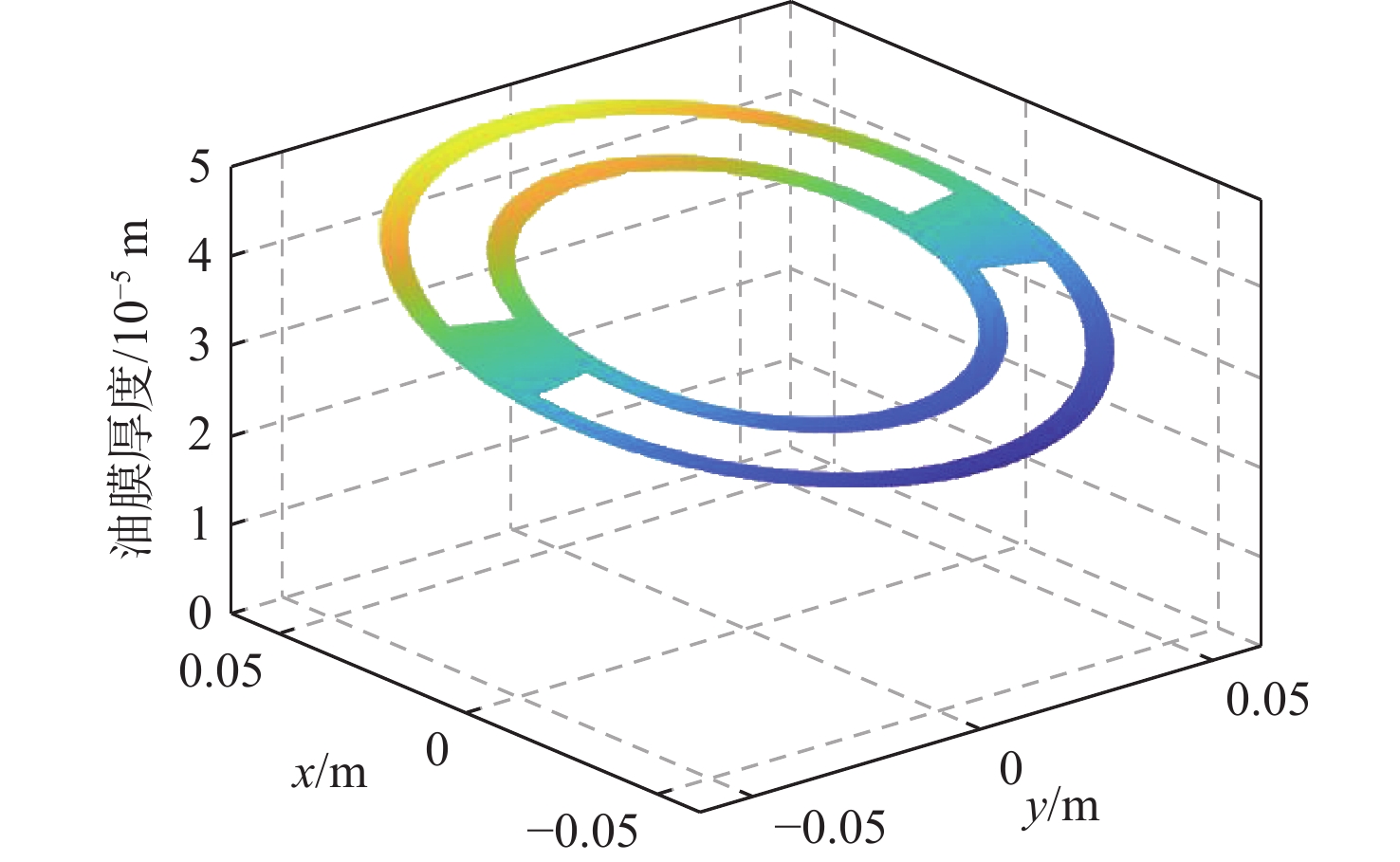
液压泵油膜厚度对润滑性能与工作可靠性具有重要影响,传统数值方法在处理复杂润滑模型时常面临计算效率低、对边界条件依赖性强等问题。为此,提出了一种基于物理信息神经网络(PINN)的液压泵流场建模求解方法,并将其应用于轴向柱塞泵转子-配流盘副的油膜厚度及润滑分析。该方法将雷诺方程、能量方程及混合润滑条件嵌入神经网络的损失函数中,实现物理规律与数据驱动的融合求解。研究结果表明:在典型工况下,PINN 方法能够在无需大量训练数据的情况下,有效求解油膜厚度分布,与数值方法结果吻合较好,相对误差平均值低于 10%,且计算效率显著提高。
Abstract:The oil film thickness in hydraulic pumps significantly impacts their lubrication performance and operational reliability. Traditional numerical methods often face challenges such as low computational efficiency and strong dependence on boundary conditions when handling complex lubrication models. In order to study the oil film thickness and lubrication of the cylinder block/valve plate pair in axial piston pumps, this research suggests a physics-informed neural network (PINN)-based approach for modeling and solving hydraulic pump flow fields. This approach embeds the Reynolds equation, energy equation, and mixed lubrication conditions into the neural network's loss function, achieving a fusion of physical principles and data-driven solutions. Results demonstrate that under typical operating conditions, the PINN method effectively solves oil film thickness distributions without requiring extensive training data. With an average relative error of less than 10%, it shows high agreement with numerical approach findings while greatly increasing computing efficiency.
-
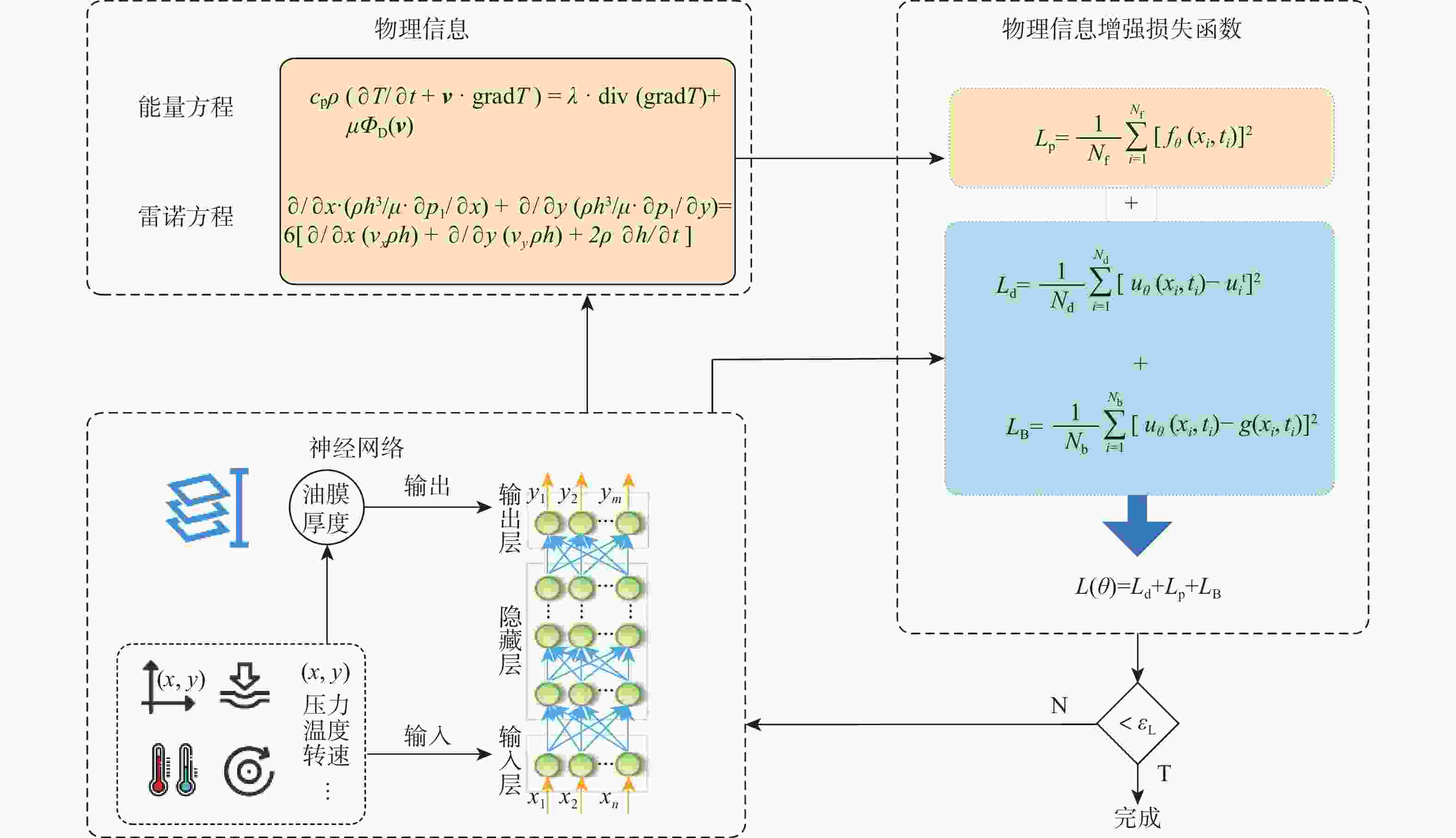
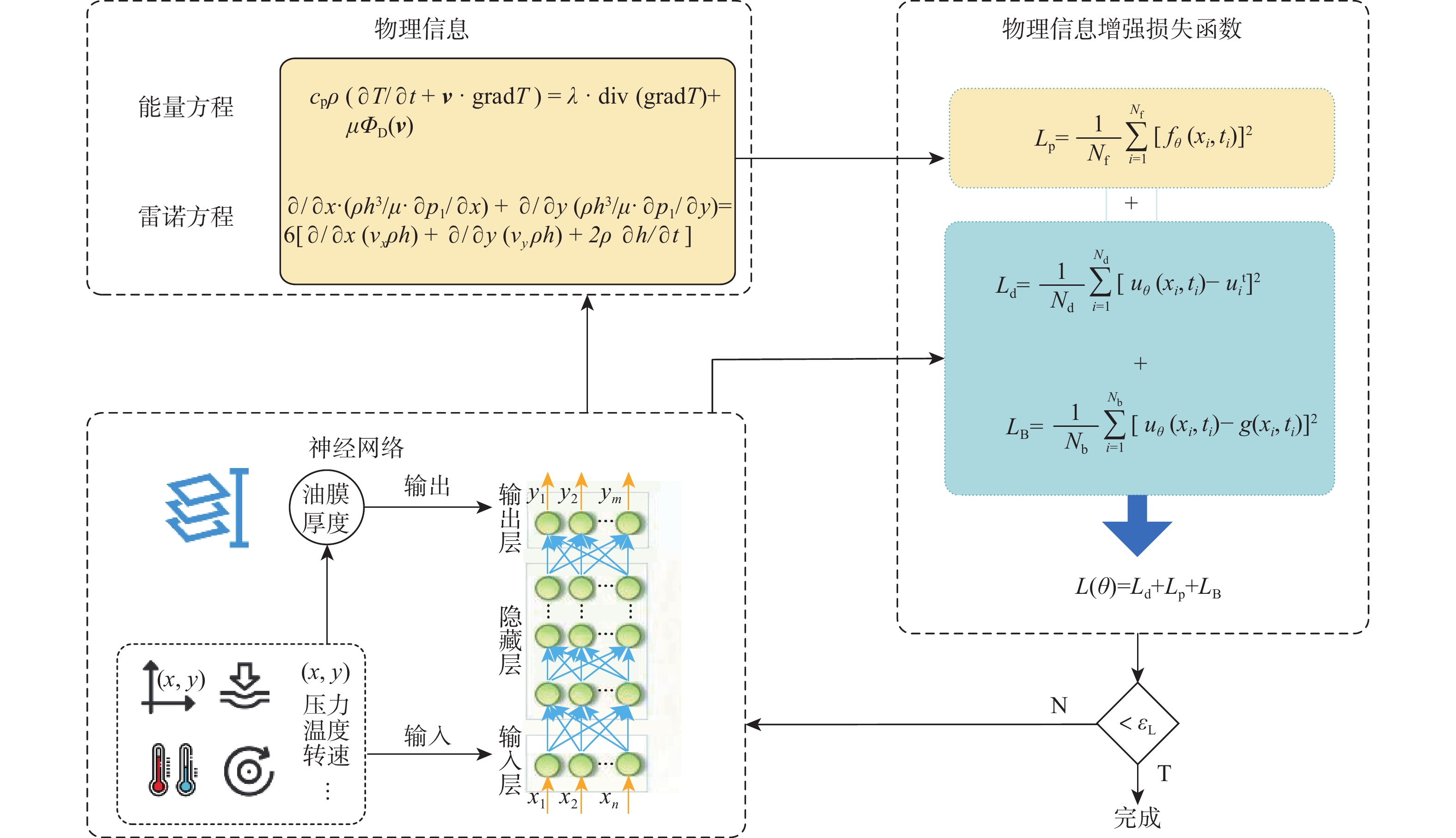
图 2 基于PINN的油膜厚度计算流程
Figure 2. Flowchart of PINN-based method for oil film thickness calculation
表 1 PINN与传统神经网络的比较
Table 1. Comparison between PINN and traditional neural networks
网络 目标函数 数据依赖 可解释性 泛化性能 适用场景 传统神经网络 最小化预测误差 需要大量高质量训练数据 黑箱模型,无物理含义 容易过拟合 图像、语音、文本等
数据驱动任务PINN 同时最小化预测误差与
物理方程残差可在稀疏数据条件下训练 内嵌物理约束,具有
物理可解释性泛化能力强 含 PDE 约束的科学计算
与工程建模[24] 下载: 导出CSV
表 2 PINN模型参数
Table 2. Parameters of PINN model
参数 取值 内部采样点数Nf 12000 每个边界采样点数Nb 3000 数据点数量Nd 5000 隐藏层数及神经元 5层,每层128个 激活函数 tanh 学习率 10−3 雷诺方程损失权重 10−4 能量方程损失权重 10−5 压力边界损失权重 10−1 温度边界损失权重 10−2
下载: 导出CSV
表 3 某型航空液压轴向柱塞泵主要参数
Table 3. Main specifications of a specific type of aviation hydraulic axial piston pump
参数 数值 柱塞腔直径/mm 26 斜盘倾角/(°) 15 柱塞长度/mm 150 转速/(r·min−1) 2000 动力黏度/(Pa·s) 0.02 摩擦系数 0.05 弹性模量 2.2×10¹¹ 刚度 1×10⁸ 油液密度/(kg·m−3) 860
下载: 导出CSV
-
[1] Zhang X, Wu H Y, Chen C C, et al. Oil film lubrication state analysis of piston pair in piston pump based on coupling characteristics of the fluid thermal structure[J]. Engineering Failure Analysis, 2022, 140: 106521. [2] Wang Z Q, Han B, Sun L T. Analysis of elastohydrodynamic lubrication (EHL) characteristics of port plate pair of a piston pump[J]. Machines, 2022, 10(12): 1109. [3] Chen J, Ma J M, Li J, et al. Performance optimization of grooved slippers for aero hydraulic pumps[J]. Chinese Journal of Aeronautics, 2016, 29(3): 814-823. [4] Zhao Y, Guo L, Wong P P L. Application of physics-informed neural network in the analysis of hydrodynamic lubrication[J]. Friction, 2023, 11(7): 1253-1264. [5] Zhang S X, Liu Z T, Xu Y, et al. A physics-informed hybrid data-driven approach with generative electrode-level features for lithium-ion battery health prognostics[J]. IEEE Transactions on Transportation Electrification, 2025, 11(1): 4857-4871. [6] Zhang S X, Liu Z T, Xu Y, et al. A physics-informed hybrid multitask learning for lithium-ion battery full-life aging estimation at early lifetime[J]. IEEE Transactions on Industrial Informatics, 2025, 21(1): 415-424. [7] Raissi M, Perdikaris P, Karniadakis G E. Physics-informed neural networks: a deep learning framework for solving forward and inverse problems involving nonlinear partial differential equations[J]. Journal of Computational physics, 2019, 378: 686-707. [8] Rom M. Physics-informed neural networks for the Reynolds equation with cavitation modeling[J]. Tribology International, 2023, 179: 108141. [9] Guan B C, He Q, Hu Y, et al. Physics-informed neural network for hydrodynamic lubrication with film thickness discontinuity[J]. Friction, 2025, 13(9): 9441035. [10] Saleh A, Jacobs G, Katre D, et al. Real-time prediction of pressure and film height distribution in plain bearings using physics-informed neural networks (PINNs)[J]. Lubricants, 2025, 13(8): 360. [11] Han B, Wang Z Q, Ji H, et al. Analysis of friction characteristics of valve plate pair in an axial piston pump considering cylinder block dynamics[J]. Journal of Tribology, 2024, 146(4): 041702. [12] Haghighat E, Raissi M, Moure A, et al. A physics-informed deep learning framework for inversion and surrogate modeling in solid mechanics[J]. Computer Methods in Applied Mechanics and Engineering, 2021, 379: 113741. [13] Wang S F, Yu X L, Perdikaris P. When and why PINNs fail to train: a neural tangent kernel perspective[J]. Journal of Computational Physics, 2022, 449: 110768. [14] Cuomo S, Di Cola V S, Giampaolo F, et al. Scientific machine learning through physics-informed neural networks: where we are and what’s next[J]. Journal of Scientific Computing, 2022, 92(3): 88. [15] Lu L, Jin P Z, Pang G F, et al. Learning nonlinear operators via DeepONet based on the universal approximation theorem of operators[J]. Nature Machine Intelligence, 2021, 3(3): 218-229. [16] Sun L N, Wang J X. Physics-constrained Bayesian neural network for fluid flow reconstruction with sparse and noisy data[J]. Theoretical and Applied Mechanics Letters, 2020, 10(3): 161-169. [17] Jagtap A D, Kawaguchi K, Karniadakis G E. Adaptive activation functions accelerate convergence in deep and physics-informed neural networks[J]. Journal of Computational Physics, 2020, 404: 109136. [18] Kharazmi E, Zhang Z Q, Karniadakis G E M. hp-VPINNs: variational physics-informed neural networks with domain decomposition[J]. Computer Methods in Applied Mechanics and Engineering, 2021, 374: 113547. [19] Mao Z P, Jagtap A D, Karniadakis G E. Physics-informed neural networks for high-speed flows[J]. Computer Methods in Applied Mechanics and Engineering, 2020, 360: 112789. [20] Geneva N, Zabaras N. Modeling the dynamics of PDE systems with physics-constrained deep auto-regressive networks[J]. Journal of Computational Physics, 2020, 403: 109056. [21] Cai S Z, Mao Z P, Wang Z C, et al. Physics-informed neural networks (PINNs) for fluid mechanics: a review[J]. Acta Mechanica Sinica, 2021, 37(12): 1727-1738. [22] Raissi M, Yazdani A, Karniadakis G E. Hidden fluid mechanics: learning velocity and pressure fields from flow visualizations[J]. Science, 2020, 367(6481): 1026-1030. [23] De Ryck T, Mishra S. Error analysis for physics-informed neural networks (PINNs) approximating Kolmogorov PDEs[J]. Advances in Computational Mathematics, 2022, 48(6): 79. [24] Ji W Q, Qiu W L, Shi Z Y, et al. Stiff-PINN: physics-informed neural network for stiff chemical kinetics[J]. The Journal of Physical Chemistry A, 2021, 125(36): 8098-8106. [25] Raissi M. Deep hidden physics models: deep learning of nonlinear partial differential equations[J]. Journal of Machine Learning Research, 2018, 19(25): 1-24. [26] Perdikaris P, Raissi M, Damianou A, et al. Nonlinear information fusion algorithms for data-efficient multi-fidelity modelling[J]. Proceedings of the Royal Society A: Mathematical, Physical and Engineering Sciences, 2017, 473(2198): 20160751. -

 下载:
下载:

 点击查看大图
计量
- 文章访问数: 303
- HTML全文浏览量: 150
- PDF下载量: 10
- 被引次数: 0
