





Research progress on mass transfer optimization of filter-press type electrochemical reactors for flow batteries
-
摘要:
压滤式电化学反应器因结构简单、模块化程度高、槽电压低等优势,成为液流电池主流反应器构型,并在储能电池、电化学水处理、合成化工等多个领域呈现出较广阔的应用前景。其中,全钒液流电池是商业化程度最高、研究体系最为成熟的代表,但其性能提升仍受限于传质效率不足所引发的浓差极化加剧、电压效率偏低及长期循环稳定性衰减等瓶颈问题,直接影响系统成本的控制。为此,主要以全钒液流电池为对象开展分析与讨论,从核心组件与运行系统2个角度,系统梳理电极、流场、隔膜等结构传质优化研究进展,分析流量、温度、电流密度、电解液浓度及罐堆比例等运行参数对传质过程的调控规律,明确各组件传质特性与电池整体性能的耦合关系,提出组件结构与系统运行协同的传质改进方向。从工程应用视角指出,全钒液流电池传质优化需在反应器组件改良的基础上,同步考量电堆尺寸放大效应、罐堆匹配、运行参数调控及系统能耗平衡,旨在为压滤式液流电池反应器的工程化设计与性能提升提供理论参考和技术参考。
Abstract:Filter-press electrochemical reactors have become the dominant reactor configuration for flow batteries owing to their simple structure, high modularity, and low cell voltage. They also show broad application potential in energy storage batteries, electrochemical water treatment, and electrosynthetic chemical processes. Among various flow battery systems, the all-vanadium redox flow battery represents the most commercially advanced and extensively studied technology. However, inadequate mass transfer continues to limit further performance development since it increases concentration polarization, reduces voltage efficiency, speeds up long-term performance degradation, and eventually raises system costs. This review focuses primarily on all-vanadium redox flow batteries and discusses mass-transfer enhancement from the perspectives of both key reactor components and system operation. Recent advances in the mass-transfer optimization of electrodes, flow fields, membranes, and other core components are systematically summarized. The effects of operating parameters, including flow rate, temperature, current density, electrolyte concentration, and tank-to-stack ratio, on mass-transfer behavior are analyzed. Based on this, coordinated optimization solutions including reactor structure and system operation are suggested, and the coupling relationship between component-level mass-transfer characteristics and total battery performance is elucidated. From an engineering perspective, mass-transfer optimization in all-vanadium redox flow batteries should not be limited to component modification alone. Instead, it should also account for stack scale-up effects, tank-stack matching, operating-parameter regulation, and the balance between electrochemical performance and system energy consumption. This review aims to provide theoretical guidance and technical references for the engineering design and performance improvement of filter-press flow battery reactors.
-
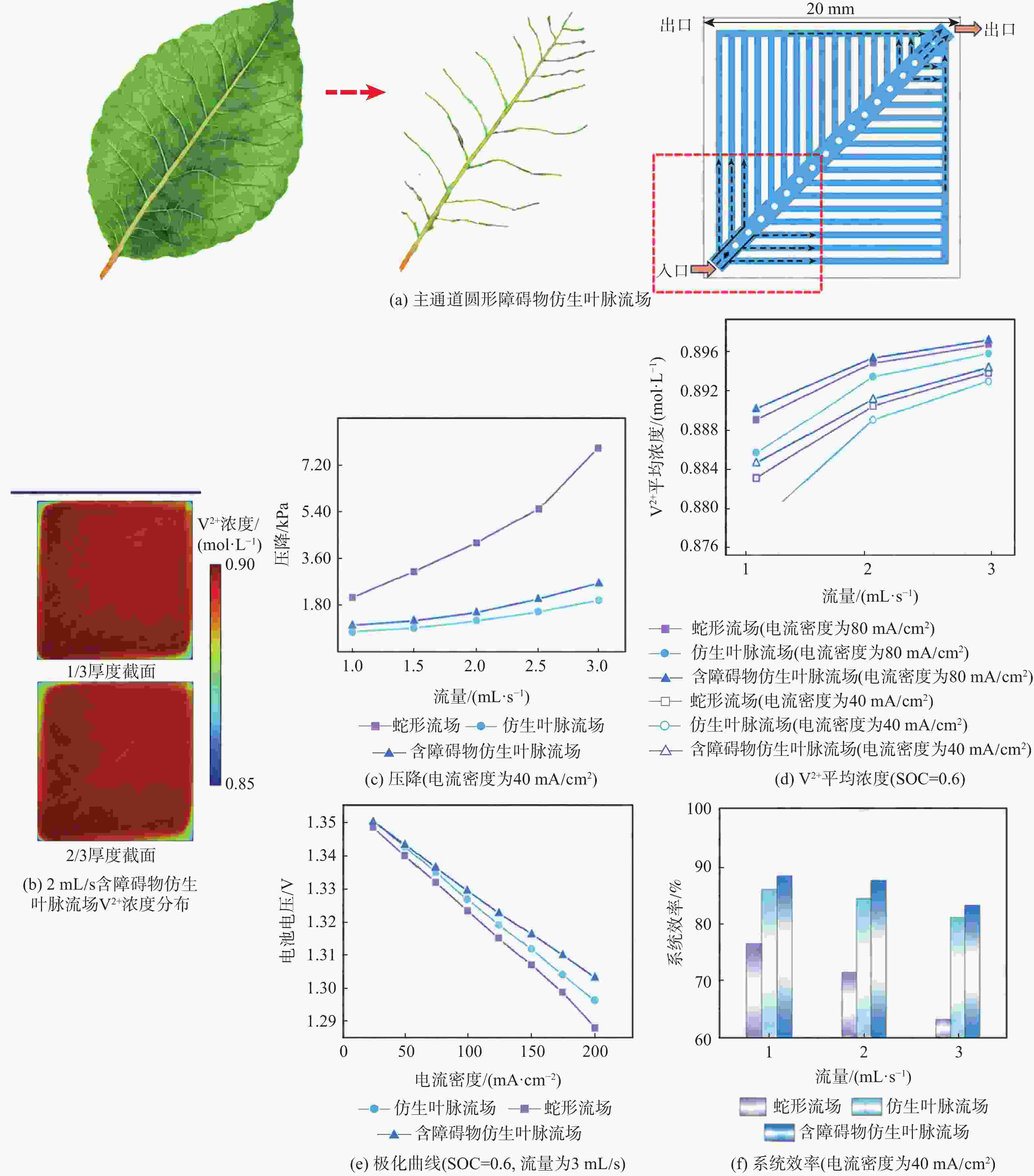
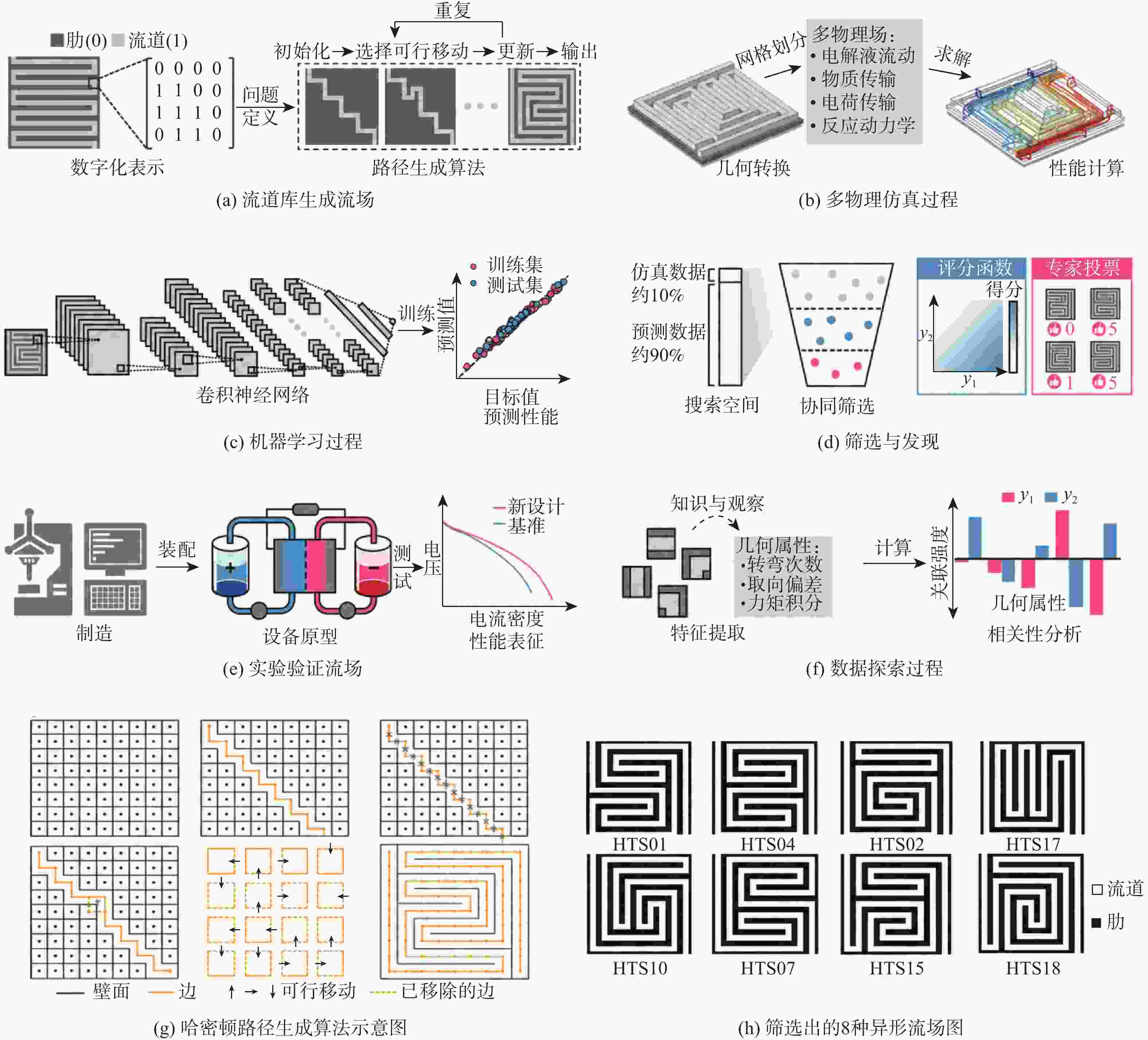
表 1 液流电池传质优化的多维度评价指标、物理意义及优化对象
Table 1. Multidimensional evaluation criteria, physical significance and optimisation targets for mass transfer optimisation in flow batteries
评价维度 核心评价指标 主要物理意义 对应优化对象 电极孔道与界面传质[28-31] 孔隙率、渗透率、有效扩散系数、曲折度、比表面积、润湿性 表征电解液进入多孔电极、活性物质扩散及电极/电解液界面反应物补给能力。极限电流密度、传质系数为该类本征参数的综合外在表现。 电极厚度、孔径尺寸、孔隙率、压缩率、纤维直径、微纳结构、活性位点 流体流动与空间均匀性[26,32-34] 速度分布、浓度/荷电状态(state of charge,SOC)分布、电流密度分布、肋下流速、流动均匀性因子、死区比例 表征流场对电极内反应物补给均匀性、局部贫液区形成和反应分布一致性的调控能力 流道结构选型与几何参数优化 隔膜选择性传质[35-38] 离子电导率、钒离子渗透率、离子选择性、膜阻、跨膜迁移通量 表征隔膜在离子传导、活性离子阻隔和交叉污染控制之间的平衡能力 离子交换膜、复合膜、多孔隔膜、选择性传输通道 运行参数与传质匹配[21,24,39-41] 流量、温度、电解液浓度、SOC、充放电电流密度 表征运行条件通过影响电解液物性(如黏度)及对流强度,对反应物补给速率、扩散能力和浓差过电位的调控作用 流量工作窗口、温度区间、活性物浓度配比、SOC运行范围、充放电制度等 系统级传质与工程约束[42-46] 多堆流量分配偏差、堆间温度偏差、旁路电流、泵基能耗占比、系统净效率 表征由单电池/单电堆放大至多堆串、并联系统后,因管路结构、热质耦合与电耦合等引发的流量不均衡、电和热管理困难及寄生能耗增加等工程约束问题。 多堆并联拓扑、歧管管路设计、管路阻力匹配、热管理策略、旁路电流控制、泵送系统  下载: 导出CSV
表 2 不同流场类型的传质特性、压降与适用场景对比
Table 2. A comparison of mass transfer characteristics, pressure drop and suitable applications for different flow field types
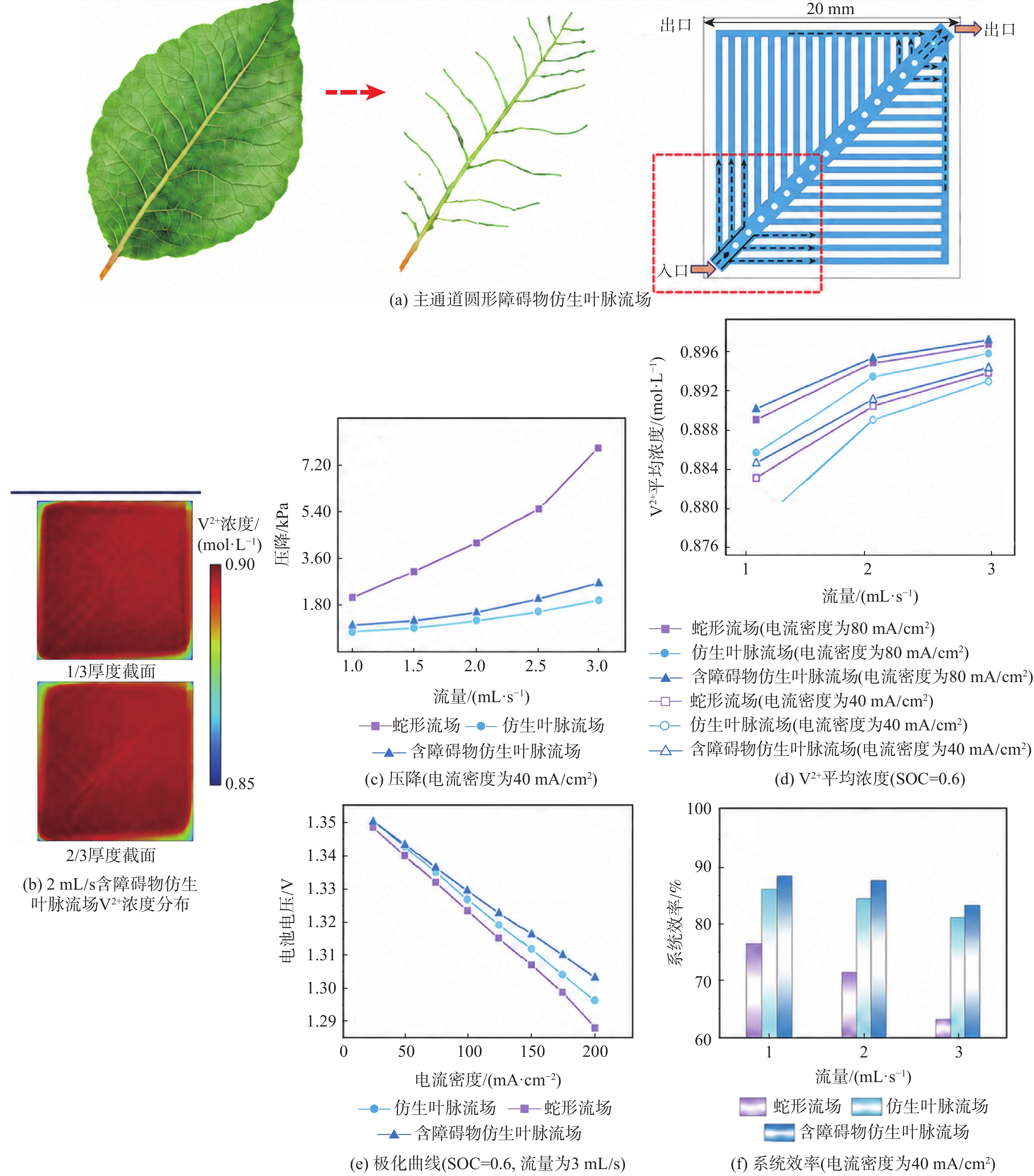
流场类型 传质增强机制 压降/泵耗特征 适用工况与电极匹配 局限性与优化方向 平行流场[57,74-75] 主要依赖通道内对流、扩散传输和有限肋下渗透对电极补给 压降最低、泵耗小 适合低-中等电流密度、高渗透率或较薄电极;大面积电堆需重点解决各通道间的均流问题 肋下和远端区域易传质不足,可通过波纹结构、导流板或多场协同结构改善 SFF[32-33,65-66] 长流道形成明显沿程压差,可增强局部横向渗透和肋下传质 压降较高,泵功代价明显 适合较高流速、高功率密度或与较厚电极匹配的流经型设计 易出现“热点”与“死区”交替,可通过变截面流道、堵块阵列、旋转或梯度深度设计优化 叉指流场[32,69,71,76] 进出口非直接连通,迫使电解液穿透电极厚度方向,缩短传质路径,并增强对流补给 压降取决于电极厚度、压缩率和渗透率;优化后可低于高阻SFF 适合高电流密度、低流速或薄/中等厚度高渗透电极;需与电极孔结构匹配 中部流量不足时易形成低浓度区,可采用并联交指、分叉交指等方式改善 多场协同流场[33-34,64,68] 通过速度场、浓度场和压力场的协同匹配调节速度-浓度梯度和速度-压力梯度的协同关系,实现低阻强化传质 可在提升浓度均匀性的同时,降低压降 适合对传质和泵耗均敏感的工程化应用场景,尤其在中高电流密度下优势明显 结构设计参数较多,需结合CFD数值模拟和实验验证,应兼顾加工可行性 仿生/双螺旋/异形流场[26,56,67,72] 通过分级分流、曲线流道增强电极覆盖面积和肋下对流传质的均匀性 压降一般控制在中等水平,但受结构复杂度和加工精度影响较大 适合高功率密度、复杂边界条件和大面积电堆的结构筛选 需关注加工成本、密封可靠性、模型泛化能力、大面积放大一致性和长期稳定性
下载: 导出CSV
表 3 结构与运行参数协同传质优化的控制变量分析
Table 3. Analysis of control variables for co-optimisation of mass transfer based on structural and operational parameters
协同对象 控制变量分析结论 工程优化方向 电极厚度-流量、电流密度[29-30,75] 电极厚度增加可提高有效反应面积,但会延长反应物扩散路径。低流量或高电流密度下,过厚电极内部容易出现反应物补给不足和浓差极化;较高流量或强制穿流流场可提高厚电极利用率 根据目标电流密度和供液能力确定电极厚度,在反应面积增加与传质路径延长之间寻求最优平衡 电极孔隙率/渗透率-流量[28-29,75] 高孔隙率和高渗透率有利于电解液进入电极并降低压降,但可能降低单位体积反应面积;低孔隙率可增加反应界面,但在高流量下可能引起较大流阻和局部传质受限 建立孔隙率、渗透率与循环流量的匹配关系,在反应面积、传质能力和泵功损耗之间进行综合优化 电极压缩率-流量、电流密度[30,54] 适度压缩可降低接触电阻并改善电极与双极板接触,但过度压缩会降低孔隙率和渗透率,导致流动阻力增加和局部传质不足,尤其在较低流量或较高电流密度下更易放大浓差极化 选择兼顾低接触电阻和高渗透率的压缩率,避免单纯追求低欧姆阻抗而牺牲传质性能 流场结构-流量、电流密度[26,32-34] 流场结构决定电解液分布和局部传质路径,流量决定反应物补给强度,电流密度决定反应物消耗速率。不同流场在流量-电流密度平面上的优势区间各异,低流量或高电流密度下,例如,叉指等强制对流型流场的肋下传质优势更突出,但泵耗代价增加 根据目标电流密度、允许泵功选择流场结构,在相同流量或相同泵功条件下比较不同流场的适用性,最终以系统净效率作为优选判据 隔膜厚度/选择性-SOC、浓度差、电流密度[35-36,38] 高质子电导率有利于降低欧姆损失,但若钒离子渗透率过高,会加剧交叉污染和容量衰减;高SOC差、浓度差和高电流密度会放大膜传质与迁移问题 优化膜电导率、离子选择性和机械稳定性,并控制SOC窗口和浓度差,兼顾电压效率、库仑效率和容量保持率
下载: 导出CSV
表 4 系统级传质问题、性能影响及优化策略
Table 4. System-level mass transfer issues, performance implications and optimisation strategies
系统级问题 对传质和性能的影响 优化思路 多堆并联流量分配不均[23-24,102] 局部低流量电堆易出现浓差极化和容量利用率下降;过量流量电堆则增加泵耗,造成堆间性能离散 优化主管/支管阻力匹配,采用对称或等阻管路布局,并增加分堆流量监测 热-流-电耦合不均[32,75,106] 温度分布不均会引起黏度、扩散系数和反应速率的空间差异,也可能加速副反应、跨膜迁移和材料老化,并放大局部传质差异 建立温度-流量-电流密度联动控制,保证电堆温度和SOC分布均匀 泵耗与电堆效率权衡[23,41,102] 高流量可降低浓差极化,但超过临界流量后系统净效率下降 以泵基效率或系统净效率为目标,避免单纯追求单电池电压提升 旁路电流[45-46] 共用歧管和电解液导电通道会形成旁路电流,造成电流分布不均和副反应加剧 通过歧管电阻设计、流道等阻化、分段集流和优化堆内流量分配缓解 长期沉积、污染与材料老化[27,100] 杂质沉积、膜降解、孔道堵塞或电极表面官能团衰减会降低有效传质面积,并增加压降 开展电解液净化、材料耐久设计、运行窗口控制和循环后传质复测
下载: 导出CSV
-
[1] Trinidad P, Walsh F C, Gilroy D. Conversion expressions for electrochemical reactors which operate under mass transport controlled reaction conditions. Part I: batch reactor, PFR and CSTR[J]. International Journal of Engineering Education, 1998, 14(6): 431-441. [2] 杨智菲. 全钒液流电池流场结构优化及催化剂原位电沉积研究[D]. 成都: 西南交通大学, 2021.Yang Z F. Research on flow field structure optimization and in-situ catalyst electrodeposition of all vanadium redox flow battery[D]. Chengdu: Southwest Jiaotong University, 2021(in Chinese). [3] 刘柏辰. 面向高可用能量容量的全钒液流电池结构设计及运行策略优化研究[D]. 杭州: 浙江大学, 2020.Liu B C. Architecture design and operation strategy of vanadium redox flow batteries for enhancing the effective energy capacities[D]. Hangzhou: Zhejiang University, 2020(in Chinese). [4] 诸旻. 有机废水电催化处理工艺方法研究[D]. 苏州: 苏州科技学院, 2022.Zhu M. Study on electrocatalytic treatment process of organic wastewater[D]. Suzhou: Suzhou University of Science and Technology, 2022(in Chinese). [5] Wiebe A, Gieshoff T, Möhle S, et al. Electrifying organic synthesis[J]. Angewandte Chemie International Edition, 2018, 57(20): 5594-5619. [6] Kumar S S, Himabindu V. Hydrogen production by PEM water electrolysis-A review[J]. Materials Science for Energy Technologies, 2019, 2(3): 442-454. [7] Perry S C, Ponce de León C, Walsh F C. Review: the design, performance and continuing development of electrochemical reactors for clean electrosynthesis[J]. Journal of the Electrochemical Society, 2020, 167(15): 155525. [8] Zhao P, Zhang H M, Zhou H T, et al. Characteristics and performance of 10kW class all-vanadium redox-flow battery stack[J]. Journal of Power Sources, 2006, 162(2): 1416-1420. [9] Zhang H. Flow battery technology[M]//Handbook of clean energy systems. Chichester: John Wiley & Sons, 2015: 1-12. [10] Ding C, Zhang H M, Li X F, et al. Vanadium flow battery for energy storage: prospects and challenges[J]. The Journal of Physical Chemistry Letters, 2013, 4(8): 1281-1294. [11] Niu Y C, Gao Q T, Zhao R F, et al. A high current density and long cycle life iron-chromium redox flow battery electrolyte[J]. Green Chemical Engineering, 2026, 7(1): 61-69. [12] Liu Y P, Guo C, Wu G F, et al. Uniformly dispersed bismuth metal nano catalyst modified carbon cloth electrode for iron-chromium flow battery[J]. Nano Research Energy, 2025, 4(1): e9120135. [13] Xie X, Xiang Y, Daoud W A. MoO3-deposited graphite felt for high-performance vanadium redox flow batteries[J]. ACS Applied Energy Materials, 2020, 3(11): 10463-10476. [14] Wu C X, Lu S F, Wang H N, et al. Endowing nonionic membrane with superior ionic selectivity by using g-C3N4 for redox flow battery[J]. Journal of Power Sources, 2023, 564: 232857. [15] Liu Z X, Wu X R, Xiao X, et al. Electrochemical dendrite management via voltage-controlled rearrangement[J]. National Science Review, 2025, 12(4): nwaf013. [16] Liu Y Y, Zhang J L, Lu S F, et al. Polyoxometalate-based electrolyte materials in redox flow batteries: current trends and emerging opportunities[J]. Materials Reports: Energy, 2022, 2(2): 100094. [17] Ashok A, Kumar A. A comprehensive review of metal-based redox flow batteries: progress and perspectives[J]. Green Chemistry Letters and Reviews, 2024, 17(1): 2302834. [18] Rahman M M, Islam M M, Shafiullah M, et al. Advancing grid integration with redox flow batteries: an engineering and economic review[J]. Green Chemistry Letters and Reviews, 2025, 18: 2507333. [19] Sánchez-Díez E, Ventosa E, Guarnieri M, et al. Redox flow batteries: status and perspective towards sustainable stationary energy storage[J]. Journal of Power Sources, 2021, 481: 228804. [20] Pletcher D, Green R A, Brown R C D. Flow electrolysis cells for the synthetic organic chemistry laboratory[J]. Chemical Reviews, 2018, 118(9): 4573-4591. [21] Kim D K, Yoon S J, Lee J, et al. Parametric study and flow rate optimization of all-vanadium redox flow batteries[J]. Applied Energy, 2018, 228: 891-901. [22] 赵天寿, 蒋浩然, 李文甲. 流体电池的化学工程科学问题[J]. 中国科学基金, 2023, 37(2): 170-177.Zhao T S, Jiang H R, Li W J. Chemical engineering scientific issue in flow cells[J]. Bulletin of National Natural Science Foundation of China, 2023, 37(2): 170-177(in Chinese). [23] Tang A, Bao J, Skyllas-Kazacos M. Studies on pressure losses and flow rate optimization in vanadium redox flow battery[J]. Journal of Power Sources, 2014, 248: 154-162. [24] Ma X K, Zhang H M, Sun C X, et al. An optimal strategy of electrolyte flow rate for vanadium redox flow battery[J]. Journal of Power Sources, 2012, 203: 153-158. [25] Toja F, Oriani S S, Casalegno A, et al. Elucidating the role of electrolyte velocity homogeneity for scaling up flow fields in vanadium redox flow batteries[J]. Chemical Engineering Journal, 2025, 526: 171201. [26] Wan S B, Jiang H R, Guo Z X, et al. Machine learning-assisted design of flow fields for redox flow batteries[J]. Energy & Environmental Science, 2022, 15(7): 2874-2888. [27] Yuan X Z, Song C J, Platt A, et al. A review of all-vanadium redox flow battery durability: degradation mechanisms and mitigation strategies[J]. International Journal of Energy Research, 2019, 43(13): 6599-6638. [28] Jiang H R, Zhang B W, Sun J, et al. A gradient porous electrode with balanced transport properties and active surface areas for vanadium redox flow batteries[J]. Journal of Power Sources, 2019, 440: 227159. [29] Ali E, Kwon H, Choi J, et al. A numerical study of electrode thickness and porosity effects in all vanadium redox flow batteries[J]. Journal of Energy Storage, 2020, 28: 101208. [30] Prasanna M M, Jayanti S. Effect of electrode thickness and compression on the performance of a flow-through mode vanadium redox flow battery cell[J]. Journal of Power Sources, 2025, 631: 236203. [31] Wang Q Z, Shan X Y, Liu H C, et al. Mass transfer in micro-nano porous electrodes: a crucial role in optimizing vanadium redox flow battery performance[J]. Journal of Colloid and Interface Science, 2026, 705: 139465. [32] Messaggi M, Canzi P, Mereu R, et al. Analysis of flow field design on vanadium redox flow battery performance: Development of 3D computational fluid dynamic model and experimental validation[J]. Applied Energy, 2018, 228: 1057-1070. [33] Wang Z M, Su R H, Jiang H R, et al. Understanding and enhancing the under-rib convection for flow-field structured vanadium redox flow batteries[J]. International Journal of Heat and Mass Transfer, 2024, 230: 125789. [34] Cheng Q, Li M J, Wang R L, et al. Design and optimization of guide flow channel for vanadium redox flow battery based on the multi-field synergy[J]. Journal of Power Sources, 2025, 650: 237526. [35] Huynh T T K, Yang T, P S N, et al. Construction of high-performance membranes for vanadium redox flow batteries: challenges, development, and perspectives[J]. Nano-Micro Letters, 2025, 17(1): 260. [36] Zhang D Z, Xin L, Xia Y S, et al. Advanced Nafion hybrid membranes with fast proton transport channels toward high-performance vanadium redox flow battery[J]. Journal of Membrane Science, 2021, 624: 119047. [37] Wang F R, Zhang Z H, Jiang F J. Dual-porous structured membrane for ion-selection in vanadium flow battery[J]. Journal of Power Sources, 2021, 506: 230234. [38] Lulay F, Weidlich C, Valtiner M, et al. Membrane degradation in redox flow batteries[J]. Green Chemistry Letters and Reviews, 2023, 16: 2274529. [39] Barton J L, Milshtein J D, Hinricher J J, et al. Quantifying the impact of viscosity on mass-transfer coefficients in redox flow batteries[J]. Journal of Power Sources, 2018, 399: 133-143. [40] Kim J, Park H. Mass transfer in flow batteries characterized by comparison of electrical potentials according to regions of porous electrodes[J]. Journal of Energy Storage, 2022, 55: 105556. [41] Mccloy R, Li Y F, Bao J, et al. Electrolyte flow rate control for vanadium redox flow batteries using the linear parameter varying framework[J]. Journal of Process Control, 2022, 115: 36-47. [42] Rashitov I, Voropay A, Tsepilov G, et al. Vanadium redox flow battery stack balancing to increase depth of discharge using forced flow attenuation[J]. Batteries, 2023, 9(9): 464. [43] Zhang B W, Lei Y, Bai B F, et al. A two-dimensional mathematical model for vanadium redox flow battery stacks incorporating nonuniform electrolyte distribution in the flow frame[J]. Applied Thermal Engineering, 2019, 151: 495-505. [44] Chen F Y, Gao H, Chen H, et al. Evaluation of thermal behaviors for the multi-stack vanadium flow battery module[J]. Journal of Energy Storage, 2020, 27: 101081. [45] Tang A, McCann J, Bao J, et al. Investigation of the effect of shunt current on battery efficiency and stack temperature in vanadium redox flow battery[J]. Journal of Power Sources, 2013, 242: 349-356. [46] Wandschneider F T, Röhm S, Fischer P, et al. A multi-stack simulation of shunt currents in vanadium redox flow batteries[J]. Journal of Power Sources, 2014, 261: 64-74. [47] Yang Y, Wang X Y, Wang Y J, et al. Functional nano-carbon layer decorated carbon felt electrode for vanadium redox flow batteries[J]. Journal of Energy Chemistry, 2025, 106: 735-741. [48] Liu Y, Meng H M, Wan K, et al. Nanoneedle array structure optimization-induced mass transfer in all-vanadium flow batteries[J]. Electrochimica Acta, 2025, 525: 146089. [49] 吴雄伟, 刘俊, 谢浩, 等. 全钒液流电池碳电极材料的研究进展[J]. 中国科学(化学), 2014, 44(8): 1280-1288.Wu X W, Liu J, Xie H, et al. Latest advance on carbon electrode materials for all vanadium redox flow battery[J]. Scientia Sinica Chimica, 2014, 44(8): 1280-1288(in Chinese). [50] Köble K, Ershov A, Duan K J, et al. Insights into the hydrogen evolution reaction in vanadium redox flow batteries: a synchrotron radiation based X-ray imaging study[J]. Journal of Energy Chemistry, 2024, 91: 132-144. [51] 张文泽, 吴贤文, 王玉娥, 等. 全钒液流电池电极材料的研究进展[J]. 吉首大学学报(自然科学版), 2016, 37(4): 61-66.Zhang W Z, Wu X W, Wang Y E, et al. Research progress on the electrode material of vanadium redox flow batteries[J]. Journal of Jishou University (Natural Sciences Edition), 2016, 37(4): 61-66(in Chinese). [52] Chen X R, Li L, Jiang Y Q, et al. Manipulating the local electronic structure microenvironment at the MXene interface to achieve efficient anode for vanadium redox flow battery[J]. Journal of Energy Chemistry, 2025, 104: 118-126. [53] Mu R, Zhang W, Shi Q W, et al. Engineering carbon electrodes for high-efficiency vanadium redox flow battery: multi-faceted approaches to electrocatalytic interfaces[J]. Journal of Energy Storage, 2025, 132: 117923. [54] Wang Q, Qu Z G, Jiang Z Y, et al. Experimental study on the performance of a vanadium redox flow battery with non-uniformly compressed carbon felt electrode[J]. Applied Energy, 2018, 213: 293-305. [55] Alphonse P J, Taş M, Elden G. Novel electrode design having gradually increasing porosity in a vanadium redox flow battery[J]. Fuel, 2023, 333: 126198. [56] Yaji K, Yamasaki S, Tsushima S, et al. Topology optimization for the design of flow fields in a redox flow battery[J]. Structural and Multidisciplinary Optimization, 2018, 57(2): 535-546. [57] He Q J, Yu J, Guo Z X, et al. Modeling of vanadium redox flow battery and electrode optimization with different flow fields[J]. E-Prime-Advances in Electrical Engineering, Electronics and Energy, 2021, 1: 100001. [58] Ali A, Ramadesigan V, Monder D S. Modelling and simulation based impact analysis of electrode parameters on the performance of vanadium redox flow batteries[J]. Journal of Power Sources, 2025, 653: 237659. [59] Martinez Lopez J, Aramendia I, Fernandez-Gamiz U, et al. Computational modeling of a 2D vanadium redox flow battery cell[J]. Jom, 2024, 76(1): 130-140. [60] Sun J, Jiang H R, Zhang B W, et al. Towards uniform distributions of reactants via the aligned electrode design for vanadium redox flow batteries[J]. Applied Energy, 2020, 259: 114198. [61] Wang Q Z, Shan X Y, Hou B Y, et al. Construction of kapok-like microstructure electrode for high power density vanadium redox flow batteries[J]. Journal of Energy Storage, 2025, 115: 115992. [62] Busacca C, Di Blasi O, Briguglio N, et al. Electrochemical performance investigation of electrospun urchin-like V2O3-CNF composite nanostructure for vanadium redox flow battery[J]. Electrochimica Acta, 2017, 230: 174-180. [63] Zheng Q, Shi X Y, Cai Y Z, et al. Artificial intelligence-empowered modeling and management of flow batteries: a mini-review[J]. Future Batteries, 2025, 7: 100107. [64] Wang F Z, Xiao G Z, Chu F M. Mass transfer enhancement in electrode and battery performance optimization of all-vanadium flow based on channel section reconstruction[J]. Chemical Engineering Journal, 2023, 451: 138619. [65] Lu M Y, Deng Y M, Yang W W, et al. A novel rotary serpentine flow field with improved electrolyte penetration and species distribution for vanadium redox flow battery[J]. Electrochimica Acta, 2020, 361: 137089. [66] Karami T, Zangeneh M R. Performance enhancement of vanadium redox flow battery by flow field modification: channel height reduction and channel blockage[J]. Future Batteries, 2025, 7: 100086. [67] Huang Z B, Liu Y L, Xie X, et al. Design and optimization of a novel flow field structure to improve the comprehensive performance of vanadium redox flow batteries[J]. Journal of Power Sources, 2025, 640: 236736. [68] Pan L M, Sun J, Qi H H, et al. Along-flow-path gradient flow field enabling uniform distributions of reactants for redox flow batteries[J]. Journal of Power Sources, 2023, 570: 233012. [69] Ishitobi H, Saito J, Sugawara S, et al. Visualized cell characteristics by a two-dimensional model of vanadium redox flow battery with interdigitated channel and thin active electrode[J]. Electrochimica Acta, 2019, 313: 513-522. [70] 杨帆. 面向流动传质的全钒液流电池流道与电极改进研究[D]. 长春: 吉林大学, 2023.Yang F. Study on improvement of flow channel and electrode of all-vanadium flow battery for flow and mass transfer[D]. Changchun: Jilin University, 2023(in Chinese). [71] Guo Z X, Ren J Y, Sun J, et al. A bifurcate interdigitated flow field with high performance but significantly reduced pumping work for scale-up of redox flow batteries[J]. Journal of Power Sources, 2023, 564: 232757. [72] Chai Y W, Qu D W, Fan L Y, et al. A double-spiral flow channel of vanadium redox flow batteries for enhancing mass transfer and reducing pressure drop[J]. Journal of Energy Storage, 2024, 78: 110278. [73] 刘子玉, 姜泽坤, 邱伟, 等. 人工智能在长时液流电池储能中的应用: 性能优化和大模型[J]. 储能科学与技术, 2024, 13(9): 2871-2883.Liu Z Y, Jiang Z K, Qiu W, et al. Application of artificial intelligence in long-duration redox flow batteries storage systems[J]. Energy Storage Science and Technology, 2024, 13(9): 2871-2883(in Chinese). [74] Xu Q, Zhao T S, Zhang C. Performance of a vanadium redox flow battery with and without flow fields[J]. Electrochimica Acta, 2014, 142: 61-67. [75] Muñoz-Perales V, García-Salaberri P Á, Mularczyk A, et al. Investigating the coupled influence of flow fields and porous electrodes on redox flow battery performance[J]. Journal of Power Sources, 2023, 586: 233420. [76] Yang T F, Zheng L Z, Teng L T, et al. Performance analysis of vanadium redox flow battery with interdigitated flow channel[J]. Thermal Science and Engineering Progress, 2024, 47: 102360. [77] Swain S, Brahma K, Nayak R, et al. Recent advances in optimized polybenzimidazole-based membranes for vanadium redox flow battery applications[J]. Journal of Energy Storage, 2025, 129: 117372. [78] Hemanth Kumar K, Gangasalam A, Chen Y S. Membrane technologies for vanadium redox flow and lithium-ion batteries: advances, challenges, and future perspectives: a review[J]. Journal of Energy Storage, 2025, 113: 115560. [79] Xi J Y, Li Z H, Yu L H, et al. Effect of degree of sulfonation and casting solvent on sulfonated poly(ether ether ketone) membrane for vanadium redox flow battery[J]. Journal of Power Sources, 2015, 285: 195-204. [80] Zhang Y X, Zheng L Y, Liu B, et al. Sulfonated polysulfone proton exchange membrane influenced by a varied sulfonation degree for vanadium redox flow battery[J]. Journal of Membrane Science, 2019, 584: 173-180. [81] Zhang Y P, Li J C, Zhang H, et al. Sulfonated polyimide membranes with different non-sulfonated diamines for vanadium redox battery applications[J]. Electrochimica Acta, 2014, 150: 114-122. [82] Kreuer K D. Proton conductivity: materials and applications[J]. Chemistry of Materials, 1996, 8(3): 610-641. [83] Kreuer K D, Rabenau A, Weppner W. Vehicle mechanism, a new model for the interpretation of the conductivity of fast proton conductors[J]. Angewandte Chemie International Edition in English, 1982, 21(3): 208-209. [84] Paul D K, Mccreery R, Karan K. Proton transport property in supported nafion nanothin films by electrochemical impedance spectroscopy[J]. Journal of the Electrochemical Society, 2014, 161(14): F1395-F1402. [85] Zhai S X, Lu Z R, Ai Y N, et al. Highly selective proton exchange membranes for vanadium redox flow batteries enabled by the incorporation of water-insoluble phosphotungstic acid-metal organic framework nanohybrids[J]. Journal of Membrane Science, 2022, 645: 120214. [86] Aziz M A, Han D B, Shanmugam S. Ultrahigh proton/vanadium selective and durable nafion/TiZrO4 composite membrane for high-performance all-vanadium redox flow batteries[J]. ACS Sustainable Chemistry & Engineering, 2021, 9(33): 11041-11051. [87] Yang Y, Wang Q G, Xiong S Z, et al. Research progress on optimized membranes for vanadium redox flow batteries[J]. Inorganic Chemistry Frontiers, 2024, 11(14): 4049-4079. [88] Zhai S X, Jia X Y, Lu Z R, et al. Highly ion selective composite proton exchange membranes for vanadium redox flow batteries by the incorporation of UiO-66-NH2 threaded with ion conducting polymers[J]. Journal of Membrane Science, 2022, 662: 121003. [89] Zhou Q, Zhang X H, Zhang Y B, et al. Tailored porous PBI membranes featuring efficient proton conduction pathways and multi-barrier systems for high-rate vanadium flow batteries[J]. Journal of Membrane Science, 2025, 719: 123769. [90] Sha’rani S S, Nasef M M, Jusoh N W C, et al. A highly-selective layer-by-layer membrane modified with polyethylenimine and graphene oxide for vanadium redox flow battery[J]. Science and Technology of Advanced Materials, 2024, 25: 2300697. [91] Yang F, Qu D W, Chai Y W, et al. Development of three-dimensional model for the analysis of the mass transport in vanadium redox flow batteries[J]. International Journal of Hydrogen Energy, 2022, 47(64): 27358-27373. [92] Khaki B, Das P. Voltage loss and capacity fade reduction in vanadium redox battery by electrolyte flow control[J]. Electrochimica Acta, 2022, 405: 139842. [93] Wang S J, Zhou Y N, Li Y, et al. Asymmetric variable flow-rate control enhances capacity and efficiency in vanadium redox flow batteries[J]. Journal of Energy Storage, 2025, 140: 118954. [94] Xi J Y, Xiao S B, Yu L H, et al. Broad temperature adaptability of vanadium redox flow battery: part 2: cell research[J]. Electrochimica Acta, 2016, 191: 695-704. [95] Zhang C, Zhao T S, Xu Q, et al. Effects of operating temperature on the performance of vanadium redox flow batteries[J]. Applied Energy, 2015, 155: 349-353. [96] Tian W X, Du H, Wang J Z, et al. A review of electrolyte additives in vanadium redox flow batteries[J]. Materials, 2023, 16(13): 4582. [97] Han L K, Chen H, Cheng X D, et al. Numerical analysis and optimization of flow rate for vanadium flow battery incorporating temperature effect[J]. Batteries, 2023, 9(6): 312. [98] Messaggi M, Rabissi C, Gambaro C, et al. Investigation of vanadium redox flow batteries performance through locally-resolved polarisation curves and impedance spectroscopy: insight into the effects of electrolyte, flow field geometry and electrode thickness[J]. Journal of Power Sources, 2020, 449: 227588. [99] Cecchetti M, Casalegno A, Zago M. Local potential measurement through reference electrodes in vanadium redox flow batteries: evaluation of overpotentials and electrolytes imbalance[J]. Journal of Power Sources, 2018, 400: 218-224. [100] Carvalho W M Jr, Cassayre L, Quaranta D, et al. Stability of highly supersaturated vanadium electrolyte solution and characterization of precipitated phases for vanadium redox flow battery[J]. Journal of Energy Chemistry, 2021, 61: 436-445. [101] Wang Z Y, Li Y J, Ren J Y, et al. A response time-based method to operando decouple the polarizations in redox flow batteries[J]. Cell Reports Physical Science, 2023, 4(5): 101395. [102] Guarnieri M, Trovò A, Picano F. Enhancing the efficiency of kW-class vanadium redox flow batteries by flow factor modulation: an experimental method[J]. Applied Energy, 2020, 262: 114532. [103] 王志文, 叶强. 液流电池系统储液罐中电解液的混合损失及导流策略[J]. 储能科学与技术, 2023, 12(4): 1148-1157.Wang Z W, Ye Q. Investigation of the mixing loss and guiding strategy of the electrolyte flow in the tanks of a redox flow battery system[J]. Energy Storage Science and Technology, 2023, 12(4): 1148-1157(in Chinese). [104] Lee H J, Choi N H, Kim H. Analysis of concentration polarization using UV-visible spectrophotometry in a vanadium redox flow battery[J]. Journal of the Electrochemical Society, 2014, 161(9): A1291-A1296. [105] Nemani V P, Smith K C. Uncovering the role of flow rate in redox-active polymer flow batteries: simulation of reaction distributions with simultaneous mixing in tanks[J]. Electrochimica Acta, 2017, 247: 475-485. [106] Gundlapalli R, Jayanti S. Comparative study of kilowatt-scale vanadium redox flow battery stacks designed with serpentine flow fields and split manifolds[J]. Batteries, 2021, 7(2): 30. [107] Trovò A, Marini G, Sutto A, et al. Standby thermal model of a vanadium redox flow battery stack with crossover and shunt-current effects[J]. Applied Energy, 2019, 240: 893-906. -

 下载:
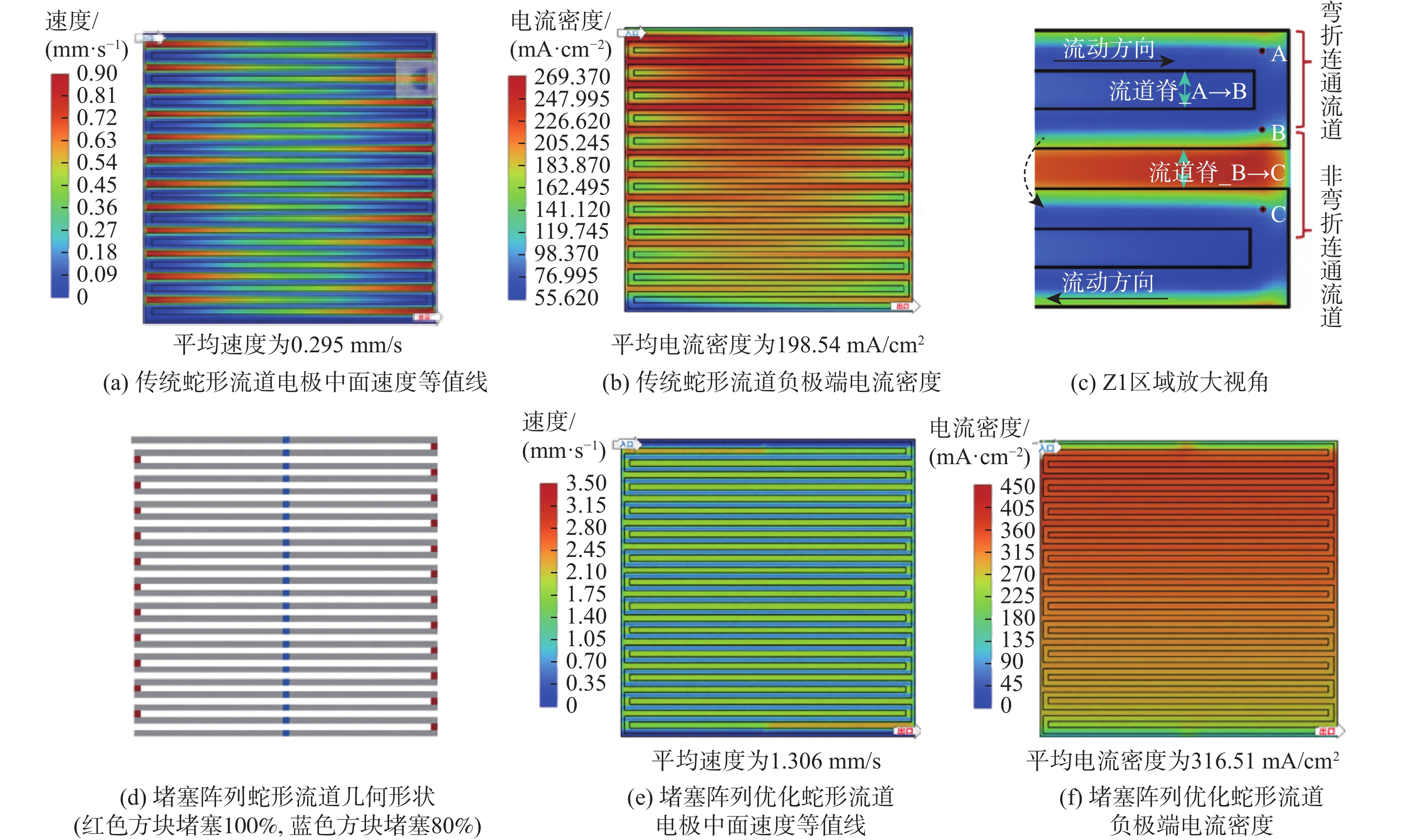

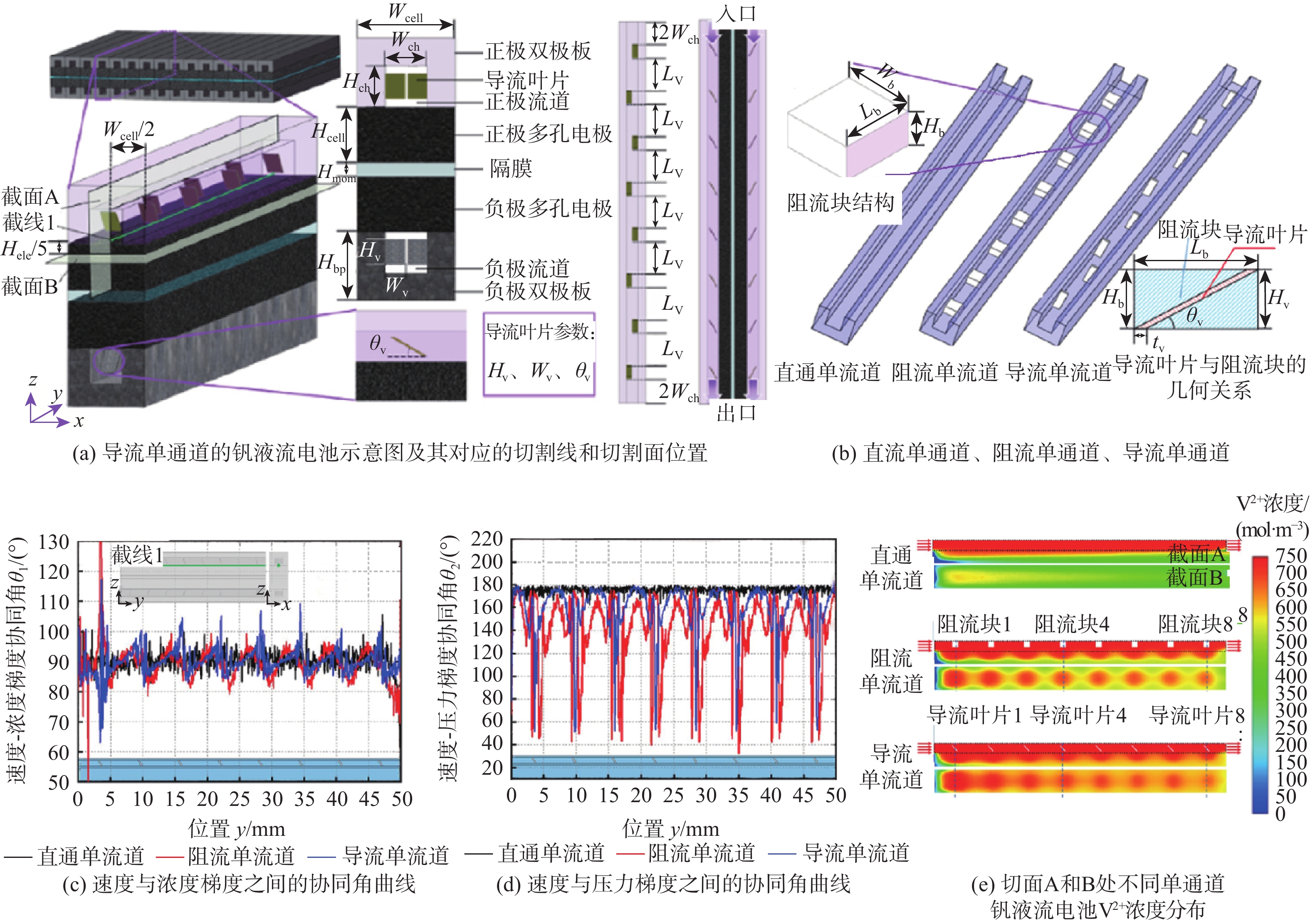


 点击查看大图
计量
- 文章访问数: 117
- HTML全文浏览量: 57
- PDF下载量: 2
- 被引次数: 0
