Position analysis of seven-link Barranov truss based on conformal geometric algebra
-
摘要:
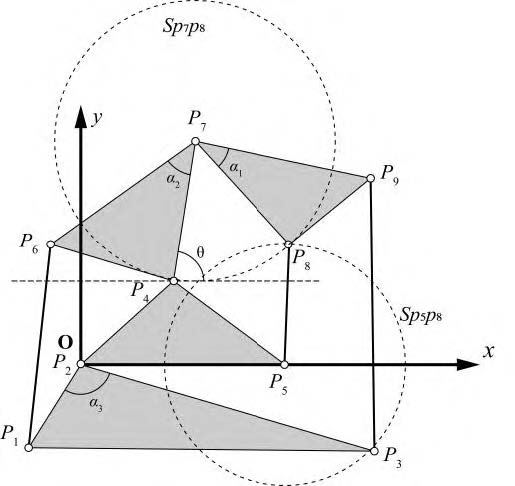
机构位置分析是机构运动学和动力学研究的基础。针对传统机构位置分析理论旋转坐标变换矩阵运算繁琐、多元高次非线性方程组求解困难等问题,提出了一种七杆巴氏桁架的位置分析共形几何代数(CGA)方法。利用CGA中的平移、旋转算子和几何积,建立各个运动点的位置坐标表达式;根据CGA中内积几何性质,直接获得该机构的一元16次位置输入-输出方程及其所有解析解;将该高次方程求解出的所有解进行回代,获得机构所有运动点的位置坐标,并通过数字实例验证所提方法的有效性。结果表明:所提方法的几何直观性显著优于传统的复向量法、D-H矩阵法,不仅可以避免矩阵运算和消元运算,且求解无增根也无漏根。
Abstract:The position analysis of mechanism is the basis of kinematics and dynamics research of mechanism.A conformal geometric algebraic (CGA) method for position analysis of seven-link Barranov truss is proposed to solve the problems of the traditional mechanism position analysis theory, such as the complicated operation of rotating coordinate transformation matrix and the difficulty of solving multivariate nonlinear equations of higher order. The expression of position coordinates of each moving point is established by means of translation, rotation operator and geometric formula expression in CGA. According to the properties of inner product geometry in CGA, the 16-degree position input-output equation of the mechanism and all its solutions are obtained directly. After all the solutions of the higher order equation are substituted back, the position coordinates of all moving points can be obtained. Finally, the effectiveness of the new method is verified by numerical examples.The results show that the geometric intuitionicity of the proposed algorithm is significantly superior to the traditional complex vector method and D-H matrix method. The proposed algorithm can not only avoid matrix operations and elimination operations, but also solve without adding or missing roots.
-
表 1 共形几何代数中几何元素的表达
Table 1. Expression of geometric elements in CGA
实体 内积空间表达式 外积空间表达式 点 ${\boldsymbol{P}} = {\boldsymbol{x}} + \dfrac{1}{2}{{\boldsymbol{x}}^2}{{\boldsymbol{e}}_\infty } + {{\boldsymbol{e}}_0}$ 球 ${\boldsymbol{S}} = {\boldsymbol{P}} - \dfrac{1}{2}{r^2}{{\boldsymbol{e}}_\infty }$ ${{\boldsymbol{S}}^ * } = {{\boldsymbol{P}}_1} \wedge {{\boldsymbol{P}}_2} \wedge {{\boldsymbol{P}}_3} \wedge {{\boldsymbol{P}}_4}$ 面 ${\boldsymbol{\pi }} = {\boldsymbol{n}} + d{{\boldsymbol{e}}_\infty }$ ${{\boldsymbol{\pi }}^ * } = {{\boldsymbol{P}}_1} \wedge {{\boldsymbol{P}}_2} \wedge {{\boldsymbol{P}}_3} \wedge {{\boldsymbol{e}}_\infty }$ 圆 ${\boldsymbol{Z}} = {{\boldsymbol{S}}_1} \wedge {{\boldsymbol{S}}_2}$ ${{\boldsymbol{Z}}^ * } = {{\boldsymbol{P}}_1} \wedge {{\boldsymbol{P}}_2} \wedge {{\boldsymbol{P}}_3}$ 线 ${\boldsymbol{l}} = {{\boldsymbol{\pi }}_1} \wedge {{\boldsymbol{\pi }}_2}$ ${{\boldsymbol{l}}^ * } = {{\boldsymbol{P}}_1} \wedge {{\boldsymbol{P}}_2} \wedge {{\boldsymbol{e}}_\infty }$ 点对 ${\boldsymbol{P}}_P = {{\boldsymbol{S}}_1} \wedge {{\boldsymbol{S}}_2} \wedge {{\boldsymbol{S}}_3}$ ${\boldsymbol{P}}_P^* = {{\boldsymbol{P}}_1} \wedge {{\boldsymbol{P}}_2}$ 表 2 位置正解10组实数解
Table 2. 10 sets of real number solutions for forward position kinematics
各点位置坐标 $ {{\boldsymbol{P}}}_{1} $ $ {{\boldsymbol{P}}}_{3} $ $ {{\boldsymbol{P}}}_{6} $ $ {{\boldsymbol{P}}}_{7} $ $ {{\boldsymbol{P}}}_{8} $ $ {{\boldsymbol{P}}}_{9} $ $ {t}_{1} $=0.618 034 (−4.000 00,−3.000 00) (6.000 00,−3.000 00) (0,6.000 00) (4.000 00,7.000 00) (6.000 00,4.000 00) (10.000 0,6.000 00) $ {t}_{2} $=0.011 682 (3.393 40,−3.672 17) (2.370 56,6.275 38) (3.715 24,6.171 43) (6.470 92,3.104 47) (9.704 36,1.509 21) (12.165 2,5.243 41) $ {t}_{3} $=0.482 881 (4.081 52,−2.888 11) (1.016 82,6.630 69 (0.660 712,6.347 58) (4.780 91,6.502 36) (7.189 27,3.819 11) (10.862 2,6.370 44) $ {t}_{4} $=−0.334 540 (1.651 67,−4.719 32) (4.672 19,4.813 59) (5.312 48,4.423 89) (5.571 88,0.308 959) (2.006 49,−0.227 689) (2.118 45,−4.698 42) $ {t}_{5} $=−0.341 171 (−4.335 79,2.490 16) (− 0.3867 15,−6.697 05)(5.329 19,4.384 37) (5.539 59,0.266 632) (4.605 84,3.749 18) (0.175 979,3.135 72) $ {t}_{6} $=−0.420 279 (1.062 47,−4.885 81) (5.225 49,4.206 46) (5.488 12,3.912 69) (5.129 44,−0.194 782) (4.663 44,−3.770 09) (8.992 13,−4.893 68) $ {t}_{7} $=−0.423 537 (−4.270 52,2.600 52) (−0.558 314,−6.684 93) (5.493 12,3.893 39) (5.111 72,−0.212 041) (4.748 82,−3.799 28) (9.108 06,−4.797 81) $ {t}_{8} $=−0.907 169 (−4.543 26,2.087 77) (0.220 628,−6.704 57) (5.289 43,1.523 63) (2.434 33,−1.451 00) (2.626 58,2.149 43) (−1.775 13,2.939 95) $ {t}_{9} $=−0.935 014 (−4.589 53,1.983 98) (0.372 944,−6.697 83) (5.243 46,1.425 21) (2.300 05,−1.462 06) (4.984 59,−3.868 97) (8.359 95,−0.935 213) $ {t}_{10} $=−1.025 82 (−3.653 12,−3.413 89) (6.288 55,−2.335 41) (5.083 89,1.131 94) (1.886 02,−1.470 68) (2.576 18,2.068 19) (−1.673 19,3.462 06) -
[1] GRASSMANN H. Die lineale ausdehnungslehre ein neuer zweig der mathematik paperback[M]. New York: Cambridge University Press, 2013. [2] CLIFFORD W K. On the space-theory of matter[M]//CAPEK M. The concepts of space and time. Berlin: Springer, 1976: 295-296. [3] HESTENES D. Grassmann’s legacy[M]//PETSCHE H J, LEWIS A, LIESEN J, et al. From past to future: GraBmann’s work in context. Berlin: Springer, 2011: 243-260. [4] HESTENES D. Old wine in new bottles: A new algebraic framework for computational geometry[M]//CORROCHAND E B, SOBCZYK G. Geometric Algebra with Applications in Science and Engineering. Berlin: Springer, 2001: 3-17. [5] LI H B. Invariant algebras and geometric reasoning[M]. Singarore: World Scientific, 2008. [6] CLIFFORD P. Applications of Grassmann’s extensive algebra[J]. American Journal of Mathematics, 1878, 1(4): 350. doi: 10.2307/2369379 [7] LI H B. Ordering in mechanical geometry theorem proving[J]. Science in China Series A: Mathematics, 1997, 40(3): 225-233. [8] HILDENBRAND D, ZAMORA J, BAYRO-CORROCHANO E. Inverse kinematics computation in computer graphics and robotics using conformal geometric algebra[J]. Advances in Applied Clifford Algebras, 2008, 18(3): 699-713. [9] WANG C Q, WU H T, MIAO Q H. Inverse kinematics computation in robotics using conformal geometric algebra[C]//Proceedings of the International Technology and Innovation Conference. London: IET, 2009: 1-5. [10] 张立先. 基于几何代数的机构运动学及特性分析[D]. 秦皇岛: 燕山大学, 2008.ZHANG L X. Kinematics and characteristic analysis of mechanism based on geometric algebra[D]. Qinhuangdao: Yanshan University, 2008(in Chinese). [11] KIM J S, JEONG J H, PARK J H. Inverse kinematics and geometric singularity analysis of a 3-SPS/S redundant motion mechanism using conformal geometric algebra[J]. Mechanism and Machine Theory, 2015, 90: 23-36. doi: 10.1016/j.mechmachtheory.2015.02.009 [12] 黄昔光, 黄旭. 基于共形几何代数的空间并联机构位置正解[J]. 北京航空航天大学学报, 2017, 43(12): 2377-2381.HUANG X G, HUANG X. Direct kinematics of a spatial parallel mechanism based on conformal geometric algebra[J]. Journal of Beijing University of Aeronautics and Astronautics, 2017, 43(12): 2377-2381(in Chinese). [13] 马朝阳. 基于共形几何代数的并联机器人运动学研究[D]. 北京: 北方工业大学, 2019.MA C Y. Research on kinematics of parallel robot based on conformal geometric algebra[D]. Beijing: North China University of Technology, 2019(in Chinese). [14] HUANG X G, MA C Y, SU H J. A geometric algebra algorithm for the closed-form forward displacement analysis of 3-PPS parallel mechanisms[J]. Mechanism and Machine Theory, 2019, 137: 280-296. doi: 10.1016/j.mechmachtheory.2019.01.035 [15] ROJAS N, THOMAS F. Distance-based position analysis of the three seven-link Assur kinematic chains[J]. Mechanism and Machine Theory, 2011, 46(2): 112-126. doi: 10.1016/j.mechmachtheory.2010.10.004 [16] INNOCENTI C. Position analysis in analytical form of the 7-link Assur kinematic chain featuring one ternary link connected to ternary links only[J]. Mechanism and Machine Theory, 1997, 32(4): 501-509. doi: 10.1016/S0094-114X(96)00063-8 [17] INNOCENTI C. Analytical-form position analysis of the 7-link Assur kinematic chain with four serially-connected ternary links[J]. Journal of Mechanical Design, 1994, 116(2): 622-628. doi: 10.1115/1.2919423 [18] INNOCENTI C. Polynomial solution to the position analysis of the 7-link Assur kinematic chain with one quaternary link[J]. Mechanism and Machine Theory, 1995, 30(8): 1295-1303. doi: 10.1016/0094-114X(95)00045-Z [19] 王品, 廖启征, 魏世民. 基于吴方法的一种7杆巴氏桁架位移分析研究[J]. 机械科学与技术, 2006, 25(6): 748-752. doi: 10.3321/j.issn:1003-8728.2006.06.030WANG P, LIAO Q Z, WEI S M. Forward didplacement analysis of a seven-link Barravo truss based on Wu method[J]. Mechanical Science and Technology, 2006, 25(6): 748-752(in Chinese). doi: 10.3321/j.issn:1003-8728.2006.06.030 [20] 王品, 廖启征, 庄育锋, 等. 9杆巴氏桁架的位移分析[J]. 机械工程学报, 2007, 43(7): 11-15. doi: 10.3321/j.issn:0577-6686.2007.07.003WANG P, LIAO Q Z, ZHUANG Y F, et al. Displacement analysis of nine-link Barranov truss[J]. Chinese Journal of Mechanical Engineering, 2007, 43(7): 11-15(in Chinese). doi: 10.3321/j.issn:0577-6686.2007.07.003 [21] WANG P, LIAO Q Z, ZHUANG Y F, et al. A method for position analysis of a kind of nine-link Barranov truss[J]. Mechanism and Machine Theory, 2007, 42(10): 1280-1288. doi: 10.1016/j.mechmachtheory.2006.11.005 -


下载: