-
摘要:
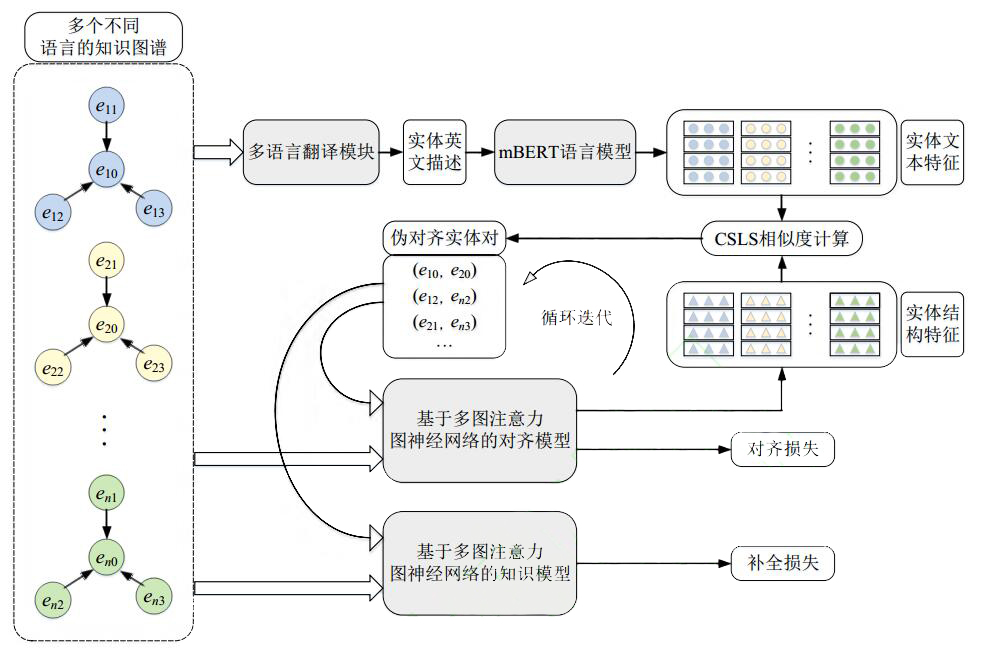
多语言知识图谱补全(MKGC)旨在利用其他语言知识图谱的信息增强目标语言知识图谱上的链接预测性能。现有方法通常利用不同语言知识图谱之间预先对齐的实体对作为知识迁移的媒介,然而在实际场景中,不同语言知识图谱之间通常没有预先对齐的实体,导致难以实现知识迁移。针对上述无对齐实体场景,提出一种融合预训练语言模型信息的伪对齐实体生成模块,不断迭代生成新的对齐实体进行知识迁移。为区分不同语言知识图谱中信息对目标语言知识图谱的贡献度,提出一种基于多图注意力的图神经网络(MGA-GNN)用于对三元组进行编码,通过该网络输出的嵌入表征计算得到三元组的合理性得分,完成链接预测任务。为验证所提方法的有效性,在2个公开数据集DBP-5L和E-PKG上进行了实验验证,结果表明:所提方法在多个语言知识图谱上链接预测的性能超过了有对齐实体的MKGC方法,证明了该方法在更加实际场景下的优越性能。
Abstract:The goal of multilingual knowledge graph completion (MKGC) is to improve link prediction performance on the target knowledge graph by leveraging data from other language-specific knowledge graphs. Existing methods usually use pre-aligned entities between different knowledge graphs to accomplish knowledge transfer. However, there are usually no pre-aligned entities between different knowledge graphs in practical scenarios, making knowledge transfer difficult to achieve. Considering the MKGC without aligned entity pairs, a pseudo-aligned entity generation module that integrates a pre-trained language model is proposed to iteratively generate new aligned entities for knowledge transfer. It is suggested to use a graph neural network based on multi-graph attention (MGA-GNN) to encode the triples in order to differentiate the information in various language-specific wisdom graphs. Finally, the plausibility of the triples is calculated via the embeddings output by the network to conduct the link prediction task. Experimental results on the DBP-5L and E-PKG datasets show the effectiveness of the proposed method and its superior performance in more practical scenarios.
-
表 1 数据集统计数据数量
Table 1. The statistic numbers of datasets
数据集 语言 实体数 关系数 训练数据量 验证数据量 测试数据量 DBP-5L[6] EL 5231 111 8670 4152 1017 EN 13996 831 48652 24051 7464 ES 12382 144 33036 16220 4810 FR 13176 178 30139 14705 4171 JA 11805 128 17979 8633 2162 E-PKG[8] DE 17223 21 45515 22753 7602 EN 16544 21 60310 39150 10071 ES 9595 21 18090 9039 3034 FR 17068 21 47999 23994 8022 IT 15670 21 42767 21377 7148 JA 2642 21 10013 5002 1688 表 2 DBP-5L数据集实验结果
Table 2. Experimental results on the DBP-5L dataset
方法分类 方法 语言 H@1 H@10 MRR 单语言
KGC方法TransE[9] EL 13.1 43.7 24.3 EN 7.3 29.3 16.9 ES 13.5 45.0 24.4 FR 17.5 48.8 27.6 JA 21.1 48.5 25.3 RotatE[11] EL 14.5 36.2 26.2 EN 12.3 30.4 20.7 ES 21.2 53.9 33.8 FR 23.2 55.5 35.1 JA 26.4 60.2 39.8 KG-BERT[23] EL 17.3 40.1 27.3 EN 12.9 31.9 21.0 ES 21.9 54.1 34.0 FR 23.5 55.9 35.4 JA 26.9 59.8 38.7 有对齐实体的
MKGC方法KEnS[6] EL 28.1 56.9 EN 15.1 39.8 ES 23.6 60.1 FR 25.5 62.9 JA 32.1 65.3 AlignKGC[7] EL 27.6 56.2 33.8 EN 15.5 39.2 22.3 ES 24.2 60.9 35.1 FR 24.1 62.3 37.4 JA 31.6 64.3 41.6 SS-AGA[8] EL 30.8 58.6 35.3 EN 16.3 41.3 23.1 ES 25.5 61.9 36.6 FR 27.1 65.5 38.3 JA 34.6 66.9 42.9 无对齐实体的
MKGC方法MGA-GNN EL 33.6 77.1 49.3 EN 19.5 59.8 33.7 ES 26.1 64.7 39.3 FR 31.2 70.5 44.6 JA 28.5 60.6 39.8 注:加粗数值表示性能最优。 表 3 E-PKG数据集实验结果
Table 3. Experimental results on the E-PKG dataset
方法分类 方法 语言 H@1 H@10 MRR 单语言
KGC方法TransE[9] DE 21.2 65.5 37.4 EN 23.2 67.5 39.4 ES 17.2 58.4 33.0 FR 20.8 66.9 37.5 IT 22.0 63.8 37.8 JA 25.1 72.7 43.6 RotatE[11] DE 22.3 64.3 38.2 EN 24.2 66.8 40.0 ES 18.3 58.9 33.7 FR 22.1 64.3 38.2 IT 22.5 64.0 38.1 JA 26.3 71.9 41.8 KG-BERT[23] DE 21.8 64.7 38.4 EN 24.3 66.4 39.6 ES 18.7 58.8 33.2 FR 22.3 67.2 38.3 IT 22.9 63.7 37.2 JA 26.9 72.4 44.1 有对齐实体的
MKGC方法KEnS[6] DE 24.3 65.8 EN 26.2 69.5 ES 21.3 59.5 FR 25.4 68.2 IT 25.1 64.6 JA 33.5 73.6 AlignKGC[7] DE 22.1 65.1 38.5 EN 25.6 68.3 40.5 ES 19.4 59.1 34.2 FR 22.8 67.2 38.8 IT 24.2 63.4 37.3 JA 31.2 72.3 46.2 SS-AGA[8] DE 24.6 66.3 39.4 EN 26.7 69.8 41.5 ES 21.0 60.1 36.3 FR 25.9 68.7 40.2 IT 24.9 63.8 38.4 JA 33.9 74.1 48.3 无对齐实体的
MKGC方法MGA-GNN DE 24.9 68.4 40.3 EN 29.3 70.4 44.4 ES 22.2 60.3 35.6 FR 24.1 68.9 39.6 IT 26.1 65.9 40.9 JA 43.0 73.2 54.5 注:加粗数值表示性能最优。 表 4 DBP-5L数据集中生成实体精确率和召回率
Table 4. The precision and recall of the generated aligned entities on the DBP-5L dataset
% 语言对 精确率 召回率 EL-JA 97.1 25.4 EL-ES 98.6 68.4 EL-EN 99.2 66.8 EL-FR 99.0 64.6 JA-ES 97.6 22.1 JA-EN 98.0 25.3 JA-FR 98.6 21.2 ES-EN 99.7 74.5 ES-FR 99.6 70.7 EN-FR 99.7 71.1 表 5 E-PKG数据集中生成实体精确率和召回率
Table 5. The precision and recall of the generated aligned entities on the E-PKG dataset
% 语言对 精确率 召回率 DE-EN 58.5 24.5 DE-ES 51.9 21.0 DE-FR 56.1 21.4 DE-IT 55.6 22.2 DE-JA 60.9 16.3 ES-EN 51.7 23.5 ES-FR 50.1 22.8 ES-IT 55.0 25.2 ES-JA 50.6 16.0 FR-EN 56.1 23.9 FR-IT 58.7 25.2 FR-JA 58.6 16.6 IT-EN 60.3 24.3 IT-JA 61.6 15.8 JA-EN 42.8 17.7 -
[1] REN H Y, DAI H J, DAI B, et al. LEGO: latent execution-guided reasoning for multi-hop question answering on knowledge graphs[C]//Proceedings of the 38th International Conference on Machine Learning. San Diego: PMLR, 2021, 139: 8959-8970. [2] SAXENA A, KOCHSIEK A, GEMULLA R. Sequence-to-sequence knowledge graph completion and question answering[C]//Proceedings of the 60th Annual Meeting of the Association for Computational Linguistics. Stroudsburg: ACL, 2022: 2814-2828. [3] WANG X, HUANG T L, WANG D X, et al. Learning intents behind interactions with knowledge graph for recommendation[C]//Proceedings of the Web Conference 2021. New York: ACM, 2021: 878-887. [4] WANG X T, LIU K P, WANG D J, et al. Multi-level recommendation reasoning over knowledge graphs with reinforcement learning[C]//Proceedings of the ACM Web Conference 2022. New York: ACM, 2022: 2098-2108. [5] LIN Q K, LIU J, XU F Z, et al. Incorporating context graph with logical reasoning for inductive relation prediction[C]//Proceedings of the 45th International ACM SIGIR Conference on Research and Development in Information Retrieval. New York: ACM, 2022: 893-903. [6] CHEN X L, CHEN M H, FAN C J, et al. Multilingual knowledge graph completion via ensemble knowledge transfer[C]//Findings of the Association for Computational Linguistics: EMNLP 2020. Stroudsburg: ACL, 2020: 3227-3238. [7] SINGH H, JAIN P, MAUSAM, et al. Multilingual knowledge graph completion with joint relation and entity alignment[EB/OL]. (2021-04-18)[2023-10-29]. https://arxiv.org/abs/2104.08804. [8] HUANG Z J, LI Z, JIANG H M, et al. Multilingual knowledge graph completion with self-supervised adaptive graph alignment[C]//Proceedings of the 60th Annual Meeting of the Association for Computational Linguistics. Stroudsburg: ACL, 2022: 474-485. [9] BORDES A, USUNIER N, GARCIA-DURÁN A, et al. Translating embeddings for modeling multi-relational data[C]//Proceedings of the 27th International Conference on Neural Information Processing Systems. New York: ACM, 2013: 2787-2795. [10] YANG B S, YIH W T, HE X D, et al. Embedding entities and relations for learning and inference in knowledge bases[C]//Proceedings of the International Conference on Learning Representations. Phoenix: ICLR, 2014: 2768038. [11] SUN Z Q, DENG Z H, NIE J Y, et al. RotatE: knowledge graph embedding by relational rotation in complex space[EB/OL]. (2019-02-26)[2023-10-29]. https://arxiv.org/abs/1902.10197. [12] SCHLICHTKRULL M, KIPF T N, BLOEM P, et al. Modeling relational data with graph convolutional networks[C]//Proceedings of the Semantic Web. Berlin: Springer, 2018: 593-607. [13] ZHANG Y Q, YAO Q M. Knowledge graph reasoning with relational digraph[C]//Proceedings of the ACM Web Conference. New York: ACM, 2022: 912-924. [14] CHEN M H, TIAN Y T, YANG M H, et al. Multilingual knowledge graph embeddings for cross-lingual knowledge alignment[C]//Proceedings of the 26th International Joint Conference on Artificial Intelligence. New York: ACM, 2017: 1511-1517. [15] GUO L B, ZHANG Q, SUN Z Q, et al. Understanding and improving knowledge graph embedding for entity alignment[C]//Proceedings of the 39th International Conference on Machine Learning. San Diego: PMLR, 2022, 162: 8145-8156. [16] ZHU Y, LIU H Z, WU Z H, et al. Relation-aware neighborhood matching model for entity alignment[J]. Proceedings of the AAAI Conference on Artificial Intelligence, 2021, 35(5): 4749-4756. [17] SUN Z Q, WANG C M, HU W, et al. Knowledge graph alignment network with gated multi-hop neighborhood aggregation[J]. Proceedings of the AAAI Conference on Artificial Intelligence, 2020, 34(1): 222-229. [18] YAN Y C, LIU L H, BAN Y K, et al. Dynamic knowledge graph alignment[J]. Proceedings of the AAAI Conference on Artificial Intelligence, 2021, 35(5): 4564-4572. [19] DEVLIN J, CHANG M W, LEE K, et al. BERT: pre-training of deep bidirectional transformers for language understanding[EB/OL]. (2019-05-24)[2023-10-29]. https://arxiv.org/abs/1810.04805. [20] CONNEAU A, LAMPLE G, RANZATO M, et al. Word translation without parallel data[EB/OL]. (2018-01-30)[2023-10-29]. https://arxiv.org/abs/1710.04087. [21] HENDRYCKS D, GIMPEL K. Gaussian error linear units (GELUs)[EB/OL]. (2023-06-06)[2023-10-29]. https://arxiv.org/abs/1606.08415. [22] LEHMANN J, ISELE R, JAKOB M, et al. DBpedia—a large-scale, multilingual knowledge base extracted from Wikipedia[J]. Semantic Web, 2015, 6(2): 167-195. [23] YAO L, MAO C S, LUO Y. KG-BERT: BERT for knowledge graph completion[EB/OL]. (2019-09-11)[2023-10-29]. https://arxiv.org/abs/1909.03193. -


下载: